EUROPE
113782 items
USA
109742 items
DIGITAL
187546 items (to print)
Download and print sheet music after purchase
Sheetmusic to print
187546 sheet music found


Guitar,Piano,Vocal,Voice - Level 2 - Digital Download SKU: A0.480405 By Kyle Threatt. By Cathy Harrison. Arranged by N/A. Children,Contemporary,Film/TV,Instructional,Traditional. Score. 5 pages. Cathy Harrison's Music #100114. Published by Cathy Harrison's Music (A0.480405). I'd Like to Count the Stars Tonight, a beautiful song written by Cathy Harrison, composer (ASCAP) and music teacher (www.cathyharrisonsmusic.com) based in the beautiful Gulf Coast city of Corpus Christi, Texas, is a song about counting the stars by ones, twos, threes, fours, and fives. Young children love singing I'd Like to Count the Stars Tonight, which could be used as a counting song. Purchase the I'd Like to Count the Stars Tonight for your song file today! Please share I'd Like to Count the Stars Tonight with your colleagues, friends, and relatives!
I'd Like to Count the Stars Tonight
Piano, Vocal and Guitar
Kyle Threatt
$7.00 5.91 € Piano, Vocal and Guitar PDF SheetMusicPlus

Viola Solo - Level 3 - Digital Download SKU: A0.552083 Composed by Johann Pachelbel. Arranged by James M. Guthrie. Baroque,Instructional,Standards,Wedding. Individual part. 2 pages. Jmsgu3 #6116381. Published by jmsgu3 (A0.552083). The famous wedding classic arranged for Solo Viola.Duration: 2:12Score: 2 pages. The famous Pachelbel Canon arranged for Solo Viola. A great choice for weddings & receptions! Pachelbel's Canon Pachelbel's Canon is, in fact, the traditional title for a composition by the German composer Johann Pachelbel. Other names for the work include namely: Canon and Gigue for 3 violins and basso continuo, Canon and Gigue in D, and of course Canon in D. We do not know when or why in particular it was written. The oldest copy is surprisingly from the 19th century. It is important to realize that it was a common routine for organists to practice improvisation on the chord progression underlying the canon. Pachelbel originally scored the Canon notably for three violins and continuo. He also in fact paired the Canon with a gigue. The movements are homotonal, to clarify, both are in the key of D major. History In due time, Pachelbel's Canon went out of style and remained in virtual oblivion for centuries. The Jean-François Paillard chamber orchestra, however, recorded an arrangement of it in 1968. As a result, it gained approval. Many ensembles began likewise to record the piece in the 1970s and by the 1980s became ubiquitous as background music. From the 1970s to the early 2000s, pop songs correspondingly used elements of the piece. The chord progression, in particular, was used this way. Also, since the 1980s, it has been not only wildly popular for weddings, but also for funeral ceremonies in the USA and Europe. Pachelbel Background Johann Pachelbel (1653 –1706) was a German composer, as well as an organist. He was furthermore instrumental in bringing the south German organ school to its apex. He wrote a large body of music, both sacred and, equally important, secular. In particular, he uniquely helped develop the chorale prelude and fugue. For this, he has, in fact, earned a rightful place in the company of the most significant composers of the mid-Baroque period. Works Pachelbel's music was certainly popular. With this in mind, he also consequently had many pupils. His music expressly developed into a model for south German composers. Nowadays, Pachelbel is most famous, particularly for the Canon in D, as well as the F minor Chaconne, the Toccata in E minor, and of course the Hexachordum Apollinis, a set of variations for the keyboard. Influences Johann Jakob Froberger and Johann Caspar Kerll were south German composers who significantly influenced Pachelbel. Furthermore, he was especially influenced by Italians such as Frescobaldi and Poglietti. He frequently preferred an articulate, simple contrapuntal style that highlighted clarity. His music is markedly less extravagant and harmonically adventurous than that of Dieterich Buxtehude. However, as a point often overlooked, like Buxtehude, Pachelbel experimented with different instrumental combinations in his chamber music. Legacy All in all, Pachelbel was most famous as a composer for the keyboard. He composed over two hundred pieces specifically for the instrument. Pachelbel was also surprisingly a prolific composer of vocal music. All in all, about a hundred vocal works survive, including 40 or so large-scale works.
Pachelbel: Canon in D for Solo Viola
Viola (band part)

$32.95 27.83 € Viola (band part) PDF SheetMusicPlus

Small Ensemble Cello,Double Bass,Oboe d'Amore,Viola - Level 4 - Digital Download SKU: A0.955113 Composed by Tomaso Albinoni (1671-1751). Arranged by Don Werdick (1946 - ). Baroque. Score and parts. 43 pages. Chamber Ensemble of Minnesota, Inc. #4763951. Published by Chamber Ensemble of Minnesota, Inc. (A0.955113). Complete score and parts of the Concerto for Two Oboes in C Major, Op. 7, No. 5 and String Orchestra , composed in 1715 by T. Albinoni, arranged by D Werdick for two Oboe d’amore in G Major. Includes Oboe d’amore I & II soloist score, solo parts. Movements: 1. Allegro 2. Adagio 3. Allegro Time: 8 minutes, 15 seconds 2019 Chamber Ensemble of Minnesota, Inc.
Concerto for Two Oboe d’amore in G Major, Op. 7 No. 5 and String Orchestra

$17.00 14.36 € PDF SheetMusicPlus

Piano,Vocal,Voice - Level 3 - Digital Download SKU: A0.1365249 Composed by Phil Beaman. Christian,Classical,Religious,Standards. Score. 3 pages. Phil Beaman #949568. Published by Phil Beaman (A0.1365249). The Heavens Are Telling is a vocal solo with piano or organ accompaniment.  I took two lines of music and lyrics from Haydn's 1797 oratorio The Creation and made that my chorus.  I then wrote short verses using lyrics from other parts of The Creation and then wrote new music for the verses to sound like a continuation of Haydn's work.  The structure is Ch/Vs/Ch/Vs/Ch/Ch with the final chorus having the lines reversed.  The piece makes a stately declaration of the wonders of God's creation of the heavens.  3 pages; 1:30 minutesvocal range - 7thpublished for the following ranges on this site:High in D - A to high GHigh in C - G to high FHigh in Bb - F to EMed in A - E to DMed in G - D to CMed in F - mid C to BLow in Eb - low Bb to ALow in D - low A to G.
The Heavens Are Telling - high voice in D
Piano, Voice

$4.99 4.21 € Piano, Voice PDF SheetMusicPlus

String Ensemble,String Trio Cello - Level 3 - Digital Download SKU: A0.552065 Composed by Johann Pachelbel. Arranged by James M. Guthrie. Baroque,Instructional,Standards,Wedding. Score and parts. 16 pages. Jmsgu3 #6105689. Published by jmsgu3 (A0.552065). Score: 9 pagesDuration: 2:40. The famous Pachelbel Canon arranged for Piano Trio. A great choice for weddings & receptions! Pachelbel's Canon Pachelbel's Canon is, in fact, the traditional title for a composition by the German composer Johann Pachelbel. Other names for the work include namely: Canon and Gigue for 3 violins and basso continuo, Canon and Gigue in D, and of course Canon in D. We do not know when or why in particular it was written. The oldest copy is surprisingly from the 19th century. It is important to realize that it was a common routine for organists to practice improvisation on the chord progression underlying the canon. Pachelbel originally scored the Canon notably for three violins and continuo. He also in fact paired the Canon with a gigue. The movements are homotonal, to clarify, both are in the key of D major. History In due time, Pachelbel's Canon went out of style and remained in virtual oblivion for centuries. The Jean-François Paillard chamber orchestra, however, recorded an arrangement of it in 1968. As a result, it gained approval. Many ensembles began likewise to record the piece in the 1970s and by the 1980s became ubiquitous as background music. From the 1970s to the early 2000s, pop songs correspondingly used elements of the piece. The chord progression, in particular, was used this way. Also, since the 1980s, it has been not only wildly popular for weddings, but also for funeral ceremonies in the USA and Europe. Pachelbel Background Johann Pachelbel (1653 –1706) was a German composer, as well as an organist. He was furthermore instrumental in bringing the south German organ school to its apex. He wrote a large body of music, both sacred and, equally important, secular. In particular, he uniquely helped develop the chorale prelude and fugue. For this, he has, in fact, earned a rightful place in the company of the most significant composers of the mid-Baroque period. Works Pachelbel's music was certainly popular. With this in mind, he also consequently had many pupils. His music expressly developed into a model for south German composers. Nowadays, Pachelbel is most famous, particularly for the Canon in D, as well as the F minor Chaconne, the Toccata in E minor, and of course the Hexachordum Apollinis, a set of variations for the keyboard. Influences Johann Jakob Froberger and Johann Caspar Kerll were south German composers who significantly influenced Pachelbel. Furthermore, he was especially influenced by Italians such as Frescobaldi and Poglietti. He frequently preferred an articulate, simple contrapuntal style that highlighted clarity. His music is markedly less extravagant and harmonically adventurous than that of Dieterich Buxtehude. However, as a point often overlooked, like Buxtehude, Pachelbel experimented with different instrumental combinations in his chamber music. Legacy All in all, Pachelbel was most famous as a composer for the keyboard. He composed over two hundred pieces specifically for the instrument. Pachelbel was also surprisingly a prolific composer of vocal music. All in all, about a hundred vocal works survive, including 40 or so large-scale works.
Pachelbel: Canon in D for Piano Trio
String Trio: 3 cellos

$36.95 31.21 € String Trio: 3 cellos PDF SheetMusicPlus

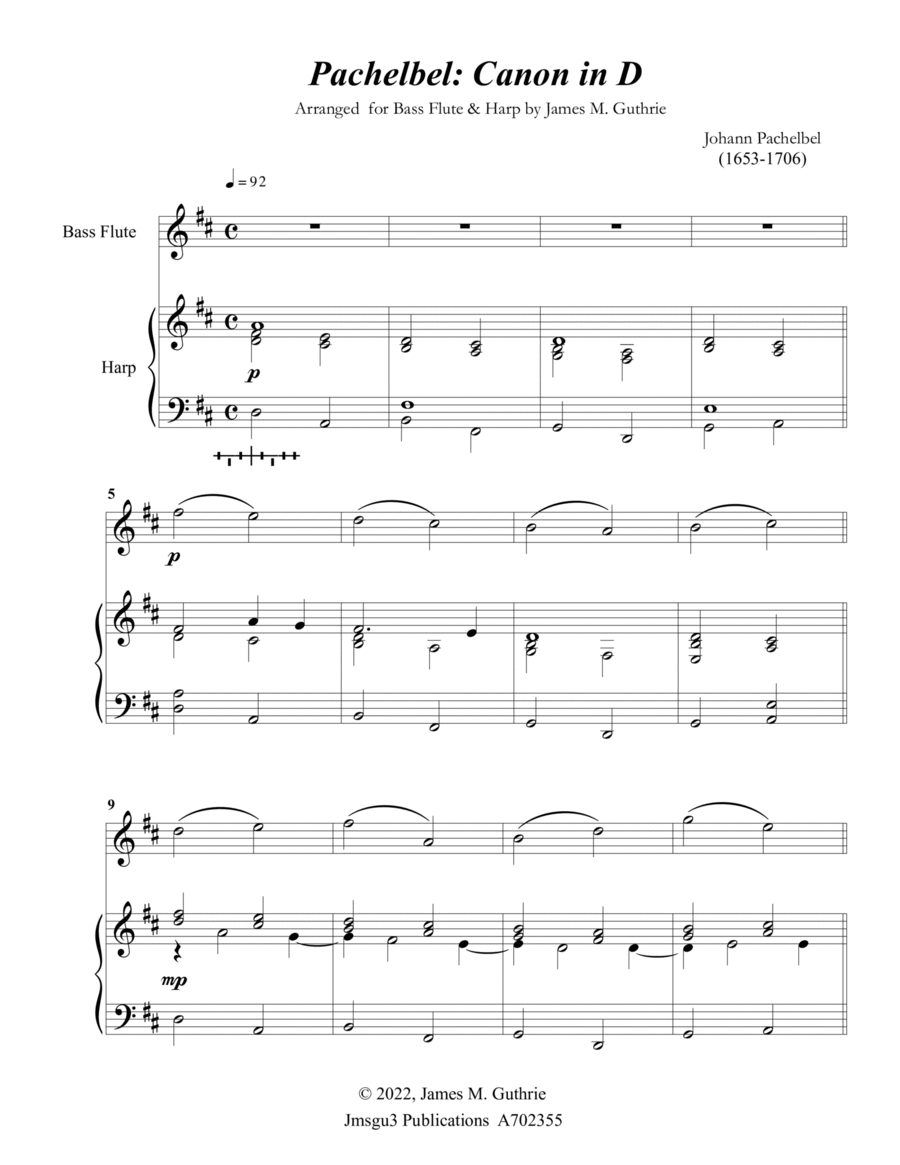
Instrumental Duet Bassoon,Harp,Instrumental Duet - Level 2 - Digital Download SKU: A0.1098863 Composed by Johann Pachelbel. Arranged by James M. Guthrie. Baroque,Classical,Standards,Traditional,Wedding. Score and parts. 11 pages. Jmsgu3 #702706. Published by jmsgu3 (A0.1098863). Score: 6 pages. Duration: ca. 2:30. The famous Pachelbel Canon arranged for Bassoon & Harp. A great choice for weddings & receptions! Pachelbel's Canon Pachelbel's Canon is, in fact, the traditional title for a composition by the German composer Johann Pachelbel. Other names for the work include namely: Canon and Gigue for 3 violins and basso continuo, Canon and Gigue in D, and of course Canon in D. We do not know when or why in particular it was written. The oldest copy is surprisingly from the 19th century. It is important to realize that it was a common routine for organists to practice improvisation on the chord progression underlying the canon. Pachelbel originally scored the Canon notably for three violins and continuo. He also in fact paired the Canon with a gigue. The movements are homotonal, to clarify, both are in the key of D major. History In due time, Pachelbel's Canon went out of style and remained in virtual oblivion for centuries. The Jean-François Paillard chamber orchestra, however, recorded an arrangement of it in 1968. As a result, it gained approval. Many ensembles began likewise to record the piece in the 1970s and by the 1980s became ubiquitous as background music. From the 1970s to the early 2000s, pop songs correspondingly used elements of the piece. The chord progression, in particular, was used this way. Also, since the 1980s, it has been not only wildly popular for weddings, but also for funeral ceremonies in the USA and Europe. Pachelbel Background Johann Pachelbel (1653 –1706) was a German composer, as well as an organist. He was furthermore instrumental in bringing the south German organ school to its apex. He wrote a large body of music, both sacred and, equally important, secular. In particular, he uniquely helped develop the chorale prelude and fugue. For this, he has, in fact, earned a rightful place in the company of the most significant composers of the mid-Baroque period. Works Pachelbel's music was certainly popular. With this in mind, he also consequently had many pupils. His music expressly developed into a model for the south German composers. Nowadays, Pachelbel is most famous particularly for the Canon in D, as well as the F minor Chaconne, the Toccata in E minor, and of course the Hexachordum Apollinis, a set of variations for the keyboard. Influences Johann Jakob Froberger and Johann Caspar Kerll were south German composers who significantly influenced Pachelbel. Furthermore, he was especially influenced by Italians such as Frescobaldi and Poglietti. He frequently preferred an articulate, simple contrapuntal style that highlighted clarity. His music is markedly less extravagant and harmonically adventurous than that of Dieterich Buxtehude. However, as a point often overlooked, like Buxtehude, Pachelbel experimented with different instrumental combinations in his chamber music. Legacy All in all, Pachelbel was most famous as a composer for the keyboard. He composed over two hundred pieces specifically for the instrument. Pachelbel was also surprisingly a prolific composer of vocal music. All in all, about a hundred vocal works survive, including 40 or so large-scale works.

Pachelbel: Canon in D for Bassoon & Harp
Bassoon and Harp

$32.95 27.83 € Bassoon and Harp PDF SheetMusicPlus

Organ,Trumpet - Level 3 - Digital Download SKU: A0.1000607 Composed by Johann Chr. Pezelius (1639-1694). Arranged by Matthias Eckart - Edition Ensemble Akzente. Baroque. 41 pages. Matthias Eckart #6352661. Published by Matthias Eckart (A0.1000607). Suite from Fünfstimmig blasende Musik from Johann Chr. Pezelius (1639-1694) is an interesting baroque piece. Here five pieces Intrade / Bal / Sarabande / Bal / Intrade from it in an arrangement in three different keys Bb, C and D for three trumpets and organ. Trumpet parts in D, A, Bb and C are included. A powerful highlight for every concert.Die Suite aus Fünfstimmig blasende Musik von Johann Chr. Pezelius (1639-1694) ist eine sehr interessante Barocksuite mit den fünf Sätzen Intrade / Bal / Sarabande / Bal / Intrade. Herausgegeben in drei Tonarten B-, C- und D-Dur für drei Trompeten und Orgel. Trompetenstimmen in D, A, Bb and C sind vorhanden. Ein interessantes Highlight für jedes Konzert. Johann Christoph Pezelius wurde 1639 in Glatz geboren und starb 1694 in Bauzen. Unklar ist bis heute, ob er Pezelius, Bezel, Pezolt, Pezel oder Petzel hieß. Pezelius war bis zu seiner Berufung zum Stadtmusikus in Bautzen Mitglied der Stadtpfeifer in Leipzig und ein anerkannter Clarinbläser seiner Zeit. Die hier vom Ensemble Akzente herausgegebene Suite stammt aus: Johannis Pezelii - Fünfstimmig blasende Musik bestehend aus Intraden, Allemanden, Balleten, Courenten, Sarabanden und Chiquen und wurde im Jahre 1685 verfasst. Die Originalbesetzung bestand aus zwei Zinken/Cornetten und drei Posaunen („zweyen Cornetten und dreyen Trombonen). Das Ensemble Akzente fand es reizvoll, einige Stücke zu bearbeiten und in einer eigenen kleinen Suite für zwei Trompeten und Orgel zusammenzufassen: Zwei Intraden rahmen zwei Ballette und eine Sarabande ein.
Suite from „Fünfstimmig blasende Musik" Vers. in Bb, C & D - arrangement for three trumpets & organ
Organ, Trumpet (duet)

$24.00 20.27 € Organ, Trumpet (duet) PDF SheetMusicPlus

Organ,Trumpet - Level 3 - Digital Download SKU: A0.1000577 Composed by Marc-Antoine Charpentier (1637-1707). Arranged by Matthias Eckart - Edition Ensemble Akzente. Baroque. 31 pages. Matthias Eckart #6347575. Published by Matthias Eckart (A0.1000577). Prelude from „Te Deum from Marc-Antoine Charpentier (1637-1707) is a beautiful baroque piece for three trumpets and organ (timpani ad lib.). Trumpet parts in Bb, C, D and A are included. A virtuoso piece for concerts in three different keys Bb, C and D.Das Prelude aus dem „Te Deum von Marc-Antoine Charpentier (1637-1707) ist ein zauberhaftes Barockstück für drei Trompeten und Orgel (Pauken ad lib.). Trompetenstimmen in B, C, D und A sind vorhanden. Ein virtuoser Klassiker für Konzerte in drei unterschiedlichen Tonarten B-, C- und D-Dur.
Prelude from „Te Deum" Version in Bb, C & D - arrangement for three trumpets and organ
Organ, Trumpet (duet)

$17.00 14.36 € Organ, Trumpet (duet) PDF SheetMusicPlus

Bassoon,Instrumental Duet,Violin - Level 2 - Digital Download SKU: A0.1271961 By Johann Sebastian Bach. By Johann Sebastian Bach. Arranged by Arezzo Music. Baroque,Chamber,Classical,Early Music,Religious. 3 pages. Arezzo Music #864314. Published by Arezzo Music (A0.1271961). Aria bwv 515 for violin and bassoon sheet music d minorImmerse yourself in the timeless beauty of J.S. Bach's Aria BWV 515 with our captivating sheet music for violin and bassoon duo in D minor! 🎻🎼 Experience the enchanting interplay between these two instruments as they bring to life the emotional depth of this exquisite piece. Our thoughtfully arranged sheet music allows the violin and bassoon to harmonize and expressively convey the emotions of the Aria in the haunting key of D minor. Perfect for violin and bassoon enthusiasts, our sheet music offers a delightful musical journey that will resonate with both performers and listeners alike. Hit like, subscribe, and share to celebrate the allure of Aria BWV 515 with fellow musicians worldwide! 🌟🎻🎼aria bwv 515 for violin and bassoon sheet music d minor
aria BWV 515 for violin and bassoon sheet music d minor
Violin, Bassoon (duet)
Johann Sebastian Bach
$3.99 3.37 € Violin, Bassoon (duet) PDF SheetMusicPlus

Easy Piano - Level 2 - Digital Download SKU: A0.1262850 Composed by Domenico Scarlatti. Arranged by Darek. Baroque,Classical,Early Music. Score. 2 pages. Darek #855858. Published by Darek (A0.1262850). Sonata in D Minor (EASY PIANO) (K 32) [Domenico Scarlatti]Simplified arrangement for pianists of Adagio (BWV 565) from Sonata in D Minor (K 32) by Domenico Scarlatti. Easy version for pianists | Easy piano arrangement  | Easy Baroque Tune | Simple Version for Piano. Included: Fingering, Dynamics, Articulations and video Youtube tutorial.  Embark on a captivating musical journey with my meticulously crafted easy-level piano sheet music for Domenico Scarlatti's timeless masterpiece, the Sonata in D Minor (K 32). Designed specifically for beginner pianists, this sheet music unlocks the wonders of the Baroque era, allowing you to explore the rich harmonies and expressive melodies. Immerse yourself in the beauty of this enchanting composition as you follow the expertly marked fingering, articulation, and dynamics. These essential notations guide your fingers and bring the music to life, ensuring a seamless and gratifying learning experience. To further enhance your musical exploration, my sheet music package includes an illuminating video YouTube tutorial. This comprehensive tutorial serves as your personal guide, providing valuable insights and techniques to master the piece with confidence. Indulge in the magic of classical music, where every note tells a story and every melody ignites the soul. With my sheet music, you'll embark on a musical adventure that nurtures your skills and deepens your understanding of piano artistry. Keywords: sheet music, piano, pianist, beginner, easy level, Domenico Scarlatti, Sonata in D Minor, K 32, Baroque era, fingering, articulation, dynamics, video tutorial, classical music, melody, composition, musical journey, harmonies, expressive, technique, learning experience.
Sonata in D Minor (EASY PIANO) (K 32) [Domenico Scarlatti]
Easy Piano

$3.00 2.53 € Easy Piano PDF SheetMusicPlus

Cello,Instrumental Duet,Violin - Level 2 - Digital Download SKU: A0.1271621 By Johann Sebastian Bach. By Johann Sebastian Bach. Arranged by Arezzo Music. Baroque,Chamber,Early Music,Traditional. 3 pages. Arezzo Music #864010. Published by Arezzo Music (A0.1271621). Aria D minor BWV 515 Violin and Cello Sheet MusicImmerse yourself in the beauty of J.S. Bach's Aria in D minor BWV 515 with our captivating sheet music for violin and cello duo! 🎻🎶 Experience the exquisite interplay between these two instruments as they breathe life into the soulful melodies of this timeless piece. Our thoughtfully arranged sheet music allows the violin and cello to harmonize and expressively convey the emotions of the Aria. Perfect for violin and cello enthusiasts, our sheet music offers a delightful musical journey that will resonate with both performers and listeners alike. Hit like, subscribe, and share to celebrate the enchanting allure of Aria in D minor with fellow musicians worldwide! 🌟🎻🎶Aria D minor BWV 515 Violin and Cello Sheet Music
Aria D minor BWV 515 Violin and Cello Sheet Music
Violin, Cello (duet)
Johann Sebastian Bach
$3.99 3.37 € Violin, Cello (duet) PDF SheetMusicPlus

Organ,Trumpet - Level 3 - Digital Download SKU: A0.1000538 Composed by Claudio Monteverdi (1576-1643). Arranged by Matthias Eckart - Edition Ensemble Akzente. Baroque. 11 pages. Matthias Eckart #6339699. Published by Matthias Eckart (A0.1000538). Toccata from L`Orfeo from Claudio Monteverdi (1576-1643) is a beautiful short baroque piece for two trumpets and organ/piano in three different keys (Bb, C and D). Trumpet parts in Bb, C, D and A are included. A nice short opener for concerts. Also playable on baroque trumpets.Toccata aus L´Orfeo von Claudio Monteverdi (1576-1643) ist ein zauberhaftes kurzes Barockstück für zwei Trompeten und Orgel/Klavier, herausgegeben in drei Tonarten (B-, C- und D-Dur). Trompetenstimmen in B, C, D und A sind vorhanden. Ein schönes kurzes Eröffnungsstück für Konzerte. Auch für Barocktrompete geeignet.
Toccata from "L´Orfeo" Version in Bb, C and D - arrangement for two trumpets and organ/piano
Organ, Trumpet (duet)

$17.00 14.36 € Organ, Trumpet (duet) PDF SheetMusicPlus


Free Sheet Music
Buy Sheet Music
But Sheet Music To Print
Buy Music Instruments

© 2000 - 2026

Home - Desktop version