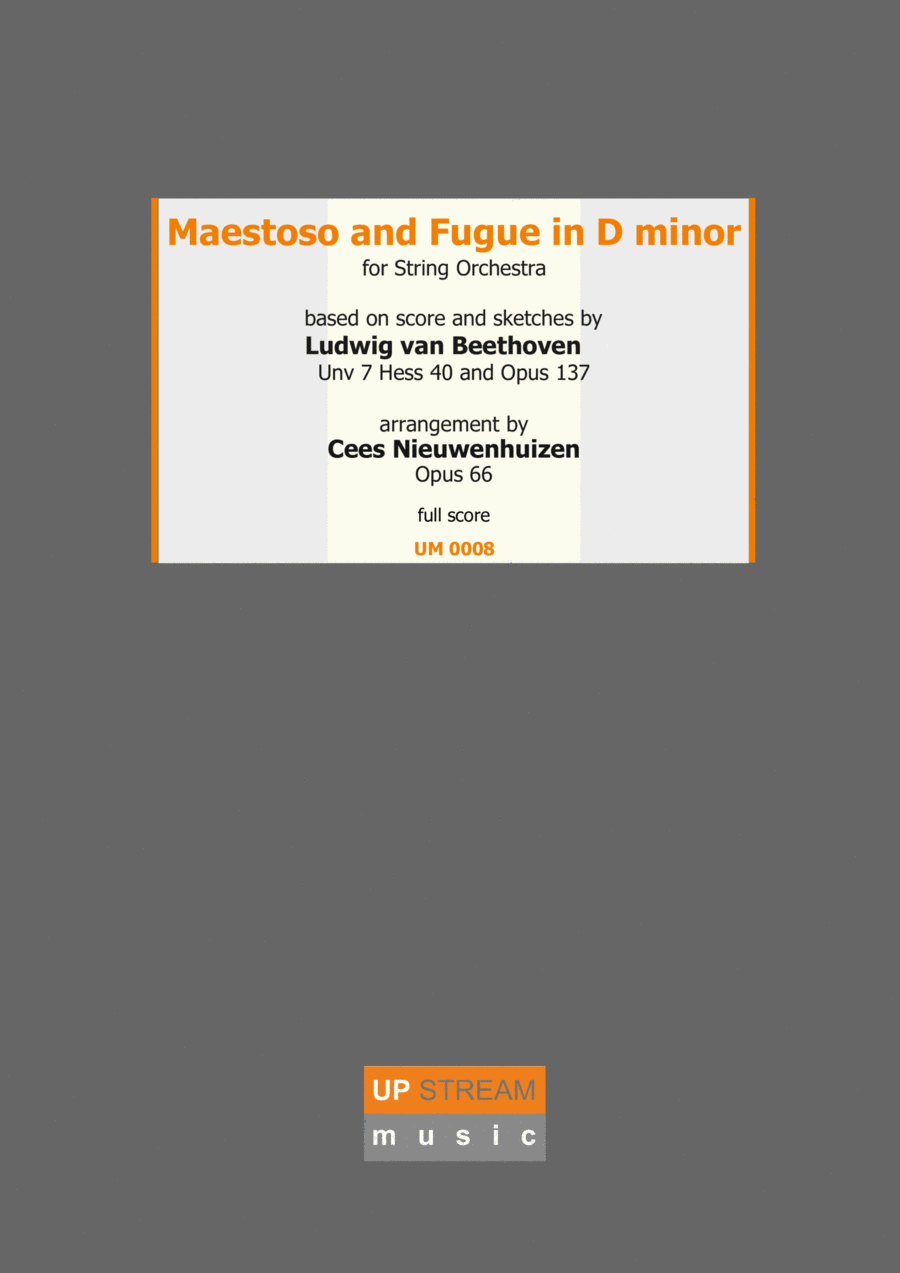
String Orchestra - Digital Download SKU: A0.933521 Composed by Ludwig van Beethoven, Cees Nieuwenhuizen. Arranged by Upstream Music. Classical. Score and parts. 18 pages. Upstream Music #6353295. Published by Upstream Music (A0.933521). Both the Adagio molto (Hess 40) and the unfinished, originally intended Fugue date from November, 1817. It was the publisher Tobias Haslinger who requested a prelude and fugue for a publication in line with works published earlier. Beethoven completed the prelude but with the fugue he stopped after merely four bars of music. The short original fugue theme was later inserted into the second part (Molto vivace) of the Ninth Symphony (Opus 125).The prelude (Beethoven did not give any time indication) starts with 37 bars of solemn music followed by 12 bars Allegro. In terms of form, rhythm, and key, this material shows great similarity to the Molto vivace from Opus 125 referred to above. The present version has been arranged for a string orchestra instead of for a string quintet, thus being the first publication which enables it to be performed in its entirety. In order to balance the foundation, I opted for introducing a contrabass part, which largely follows the cello part composed by Beethoven. As regards the phrasing, dynamics, and rests as well as the time indication, this publication follows those in Willy Hess’ publication. So the prescribed time ‘Adagio molto’ is not that of Beethoven himself.The arguments to link the Maestoso to the Fugue in D major (Opus 137) published later are multiple. In the first place, the Fugue also dates from 1817. Secondly, the key is the same as is the number of instruments for a string quintet with two separate alto parts. Not only does the original fugue theme start at the tone a, but the timing too is the same, that is 3/8. So it seems reasonable to assume that Beethoven intended both works as a couple.The abnormal rhythmics of the bars 38 up to and including 49 is remarkable. I have preserved it because the part has been authentically composed by Beethoven, while it did not seem logical to me to have it immediately followed by the Fugue completed by myself. I have composed a number of bars of music based on the beginning of the prelude by way of a smooth transition.In the Fugue, I closely adhere to Beethoven, at the same time introducing a contrabass part here as well, so as to support the cello. At a number of places in the score, Beethoven recorded neither music nor rests. This refers to the bars 5 (second viola and cello), 11, 12, 25 and 26 (first and second violins), 39 to 41 (all parts), 43 and 44 (all parts except the first violin), 45 (first viola) and finally 45 and 46 (second violin). As in Willy Hess’ publication, I have just inserted rests here.