EUROPE
4775 articles
USA
0 articles
DIGITAL
120670 articles (à imprimer)
Partitions Digitales
Partitions à imprimer
120670 partitions trouvées


Trombone Trio - Level 1 - Digital Download SKU: A0.1125139 Composed by Johann Sebastian Bach. Arranged by Ander. Baroque,Christmas,Easter,Sacred,Wedding. 7 pages. Woods Only, Arrangements #725918. Published by Woods Only, Arrangements (A0.1125139). This easy arrangement for trombone trio has been adapted to be simple to perform and understand the structure of the original work for various levels of musical knowledge. It can be played freely by beginning students because of the ease imposed on the piece. It is often performed at wedding ceremonies slowly and reverently, challenging the effect suggested by Bach in his original score for voices with trumpet, oboes, strings, and continuous bass. This is one of Bach's most beautiful cantatas, made famous by the Jesus the Joy of Men chorus. It was originally composed for Advent 1716 in Weimar. Years later, already in Leipzig, Advent was tempus clausum, there was no music in the churches. Bach then reworked it for the Feast of Mary's Visitation. It is the final chorale of the cantata Herz und Mund und Tat und Leben. Although it is the 32nd cantata composed by Bach, of those that have survived, it was given BWV 147 in the complete catalog of his works.
Jesu, joy of man's desiring by Bach for Trombone Trio
3 Trombones (trio)

$5.99 5.19 € 3 Trombones (trio) PDF SheetMusicPlus

Trombone Trio - Level 2 - Digital Download SKU: A0.1124866 Composed by Johann Sebastian Bach. Arranged by Ander. Baroque,Christmas,Easter,Sacred,Wedding. 6 pages. Woods Only, Arrangements #725637. Published by Woods Only, Arrangements (A0.1124866). This easy arrangement for trombone trio was adapted to be simple to perform and understand the structure of the original work for various levels of musical knowledge. It can be played freely by beginning students due to the ease imposed on the piece; however, this does not preclude it from being played by professionals and music teachers. It is also ideal for academic recitals, weddings, student method and ceremonies that are arranged in the same way as the piece contains. The Cantata 156 (BWV 156) was written for the third Sunday after Epiphany in 1729, and was first performed on January 23 of that year. The text is by Picander, one of Bach's favorite librettists. of the four cantatas written by Bach for the feast, it was the last and only one scored for solo voice. This is a choral cantata, employing a choral melody in several movements. Cantata 156, in fact, employs two different choral melodies and texts in the second and sixth movements. A cantata is a sung symphony consisting of several parts, one of which is the Arioso, which is the initial instrumental part.
Arioso by Bach for Trombone Trio
3 Trombones (trio)

$5.99 5.19 € 3 Trombones (trio) PDF SheetMusicPlus

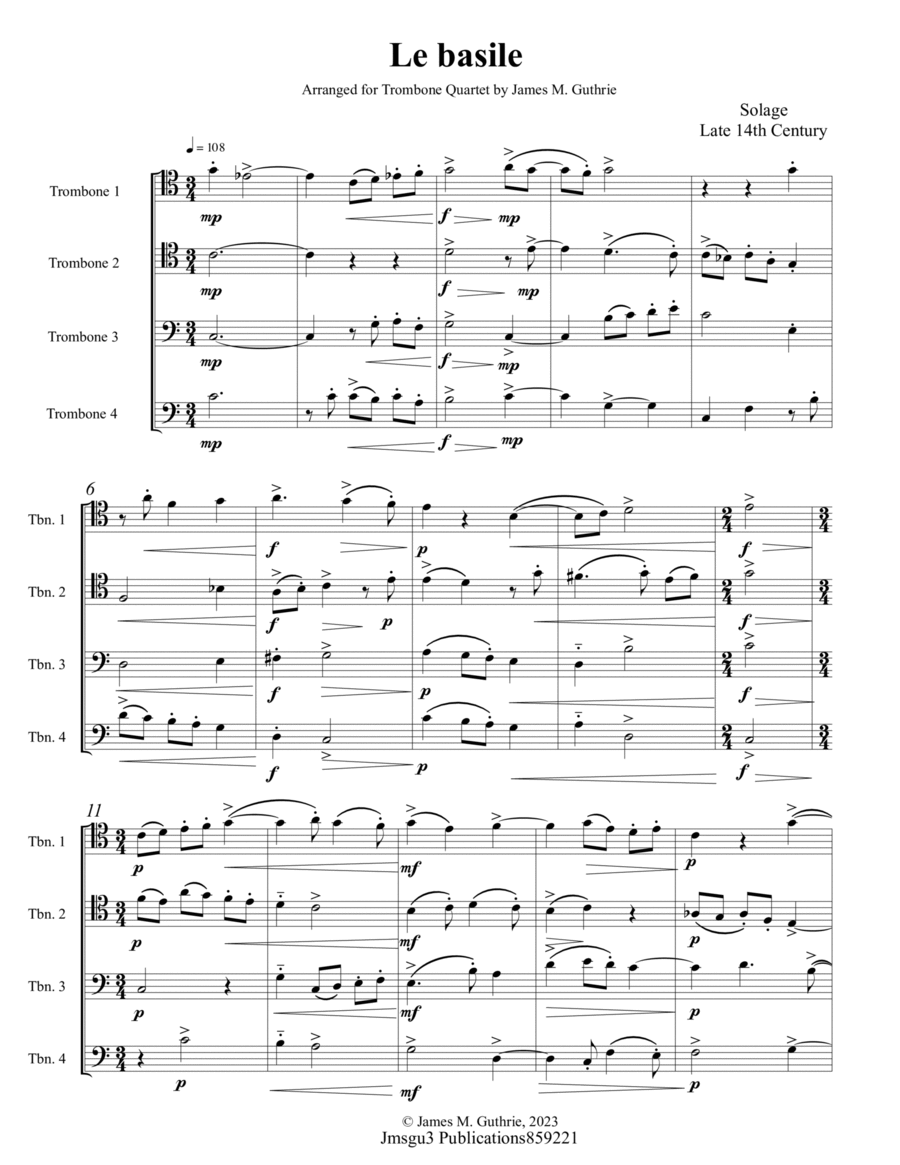
Trombone Quartet Trombone - Level 2 - Digital Download SKU: A0.1266548 Composed by Solage. Arranged by James M. Guthrie. Chamber,Contest,Early Music,Festival,Historic,Medieval. 8 pages. Jmsgu3 #859221. Published by jmsgu3 (A0.1266548). Solage's ballade Le basile de sa propre nature is a significant work in the history of medieval music. Here are some of its historical significances:1. It is one of the twelve surviving works attributed to Solage, a French composer who lived in the late 14th century. Solage's works are known for their complex rhythms, intricate harmonies, and expressive melodies.2. Le basile de sa propre nature is a four-voice ballade that features a text about the mythical creature known as the basilisk. The lyrics describe the basilisk as a monster that kills everything it sees with its deadly venom. The music is characterized by its intricate rhythms and harmonies, which reflect the text's vivid imagery.3. The ballade is preserved in the Chantilly Codex, a manuscript that contains a collection of French secular music from the late 14th century. The Chantilly Codex is one of the most important sources of medieval music, and it provides valuable insights into the musical practices of the time.4. Le basile de sa propre nature is an example of the Ars subtilior style, which was a highly experimental and complex musical style that emerged in the late 14th century. This style was characterized by its use of intricate rhythms, complex harmonies, and unusual notational practices. The Ars subtilior style was highly influential in the development of later musical styles, and it remains an important part of the medieval musical canon.Overall, Solage's ballade Le basile de sa propre nature is a significant work that reflects the complex and experimental musical practices of the late 14th century. Its vivid imagery, intricate rhythms, and complex harmonies make it a valuable contribution to the medieval musical canon.Lyrics:All those he sees he kills suddenly,For his venom is deadly.He is a basilisk by his own nature,And he has no other way of being. He is a monster of great power,And he is feared by all who know him.He is a creature of the earth,And he is a master of death. He is a basilisk by his own nature,And he has no other way of being.All those he sees he kills suddenly,For his venom is deadly. He is a creature of the night,And he is a master of the dark.He is a monster of great might,And he is feared by all who hear his name. He is a basilisk by his own nature,And he has no other way of being.All those he sees he kills suddenly,For his venom is deadly.Solage was a French composer and probably also a poet who lived in the late 14th century. He composed the most pieces in the Chantilly Codex, which is the principal source of music of the ars subtilior, a manneristic compositional school centered on Avignon at the end of the century. Solage is an obscure composer, and aside from what can be deduced from the pieces attributed to him in the Chantilly Codex, nothing else is known about him. There are several interpretations of his name, and it is not clear whether his first name was Jean or Charles. The ars subtilior was a manneristic compositional school centered on Avignon at the end of the 14th century. It was characterized by complex rhythms and pitch, and it was a transitional period between the late medieval and Renaissance periods. Solage was one of the composers who fit into this school, and he composed the most pieces in the Chantilly Codex, which is the principal source of music of the ars subtilior. Stylistically, Solage's works exhibit two distinctly different characters: a relatively simple one usually associated with his great predecessor and elder contemporary Guillaume de Machaut, and a more recherché one, complex in the areas of both pitch and rhythm, characteristic of the ars subtilior. 
Solage: Le basile for Trombone Quartet
Quatuor de cuivres: 4 trombones

$32.95 28.58 € Quatuor de cuivres: 4 trombones PDF SheetMusicPlus

Trombone Duet Trombone - Level 3 - Digital Download SKU: A0.1370396 By Johann Pachelbel. By Johann Pachelbel. Arranged by Glauco Fernandes. Baroque,Chamber,Classical,Wedding. Score. 6 pages. Glauco Fernandes #954772. Published by Glauco Fernandes (A0.1370396). Embark on a journey into the sublime grandeur of classical music with the exclusive sheet music for the arrangement of Johann Pachelbel's Canon in D. This exquisitely crafted arrangement is thoughtfully designed for intermediate-level musicians, offering a captivating musical experience that serves as both an enriching challenge for those honing their skills and a valuable addition to the repertoire of professional musicians.The sheet music for Canon in D stands out for its accessible approach, providing beginner musicians with a stimulating challenge to enhance their instrument-playing abilities. Simultaneously, more experienced musicians will find in this arrangement a rare gem to enrich their repertoires, imparting a unique and engaging interpretation to Pachelbel's majestic composition.Ideal for a variety of events, this arrangement of Canon in D adds a touch of elegance to performances, particularly suitable for weddings where the classical beauty of this piece can create a truly memorable atmosphere. Whether for celebratory moments or as part of a professional repertoire, this sheet music offers a lush and sophisticated interpretation, elevating any occasion.Acquire the Canon in D sheet music now and immerse yourself in the classical opulence of this iconic composition. With its intrinsic quality, this arrangement will not only pose a stimulating challenge for burgeoning musicians but also become an indispensable piece for professionals looking to enrich and diversify their repertoires.If you're seeking more high-quality sheet music, we suggest searching for Glauco Fernandes in the website's search bar. Contact: glaucofernandes.arrangements@gmail.com.
Canon by Pachelbel - Trombone Duet with Chord Notation
2 Trombones (duo)
Johann Pachelbel
$5.99 5.19 € 2 Trombones (duo) PDF SheetMusicPlus

Jazz Ensemble - Digital Download SKU: AX.00-PC-0017121_TN1 1st Trombone. Composed by Gordon Goodwin. Jazz. Part. 3 pages. Alfred Music - Digital Sheet Music #00-PC-0017121_TN1. Published by Alfred Music - Digital Sheet Music (AX.00-PC-0017121_TN1). UPC: 038081299976.Challenging, yes, impossible, no. Gordon Goodwin's Hunting Wabbits 2 will provide all the challenge any band needs as they explore this tongue-in-cheek musical adventure that is well worth the effort. The groove is straight eighths (semi-legit) and funky. The instrumentation is flexible: saxophone parts with woodwind doubles, sax parts without doubles, and even optional string parts . . . yes, strings! Percussion parts included. Solo space for all saxes, trumpet 4 and trombones 1/2. As recorded by Gordon Goodwin on The Phat Pack CD. This is an amazing arrangement! This title is available in SmartMusic.
Hunting Wabbits 2 (A Bad Hare Day): 1st Trombone
Trombone (partie séparée)

$3.00 2.6 € Trombone (partie séparée) PDF SheetMusicPlus

Brass Ensemble Trombone - Level 5 - Digital Download SKU: A0.792418 Composed by John Philip Sousa. Arranged by Andrew Converse. 20th Century,Contemporary,Folk,Patriotic. Score and parts. 12 pages. Gordon Cherry #4821599. Published by Gordon Cherry (A0.792418). Mr. Andrew Converse has written a great arrangement for Trombone Quartet of Sousa's first big hit as a march. The Gladiator is an early work by John Philip Sousa, written in 1886 while he was leader of the US Marine Band. The Gladiator was written as a tribute to Charles B. Towle, a journalist at the Boston Traveler. The journalist introduced him to the Knights Templar.  There is speculation about the origins of the march's name.  Sousa had not written many marches before that, and none of them received great popularity. The Gladiator, however, sold over a million copies - a record for the time and it was soon performed frequently. It follows the traditional march style of the period. Although marches such as Semper Fidelis, The Washington Post, Stars and Stripes Forever and Hands Across the Sea have achieved greater popularity, the Gladiator is still regarded as John Philip Sousa's first success.
Gladiator March for Trombone Quartet
Quatuor de cuivres: 4 trombones

$17.50 15.18 € Quatuor de cuivres: 4 trombones PDF SheetMusicPlus


Partitions Gratuites
Acheter des Partitions Musicales
Acheter des Partitions Digitales à Imprimer
Acheter des Instruments de Musique

© 2000 - 2026

Accueil - Version intégrale