EUROPE
51 articles
USA
0 articles
DIGITAL
13967 articles (à imprimer)
Partitions Digitales
Partitions à imprimer
13967 partitions trouvées


String Ensemble Violin - Level 4 - Digital Download SKU: A0.1111401 Composed by Wolfgang Amadeus Mozart. Arranged by Regis Bookshar. Chamber,Christian,Classical,Instructional,Religious. 28 pages. Regis Bookshar #713690. Published by Regis Bookshar (A0.1111401). Recordare (from Requiem (K. 626) - Wolfgang Amadeus Mozart/Franz Xaver Sussmayr - Violin Sextet - Advanced/Intermediate - Digital Download. Hauntingly beautiful is how the Recordare from Mozart's Requiem is often described. Originally written for an orchestra and four vocal soloists, it has now been transcribed by Regis Bookshar for a Violin Sextet and would be a wonderful addition to any music library. This arrangement will provide students with the opportunity to play this beautiful composition, something which they may not have had the opportunity to do, otherwise. This selection could be performed for concerts, recitals and church services and is suitable for high school and college students but professional musicians would also enjoy playing this arrangement. Included are a score and a complete set of parts (28 pages). The Regis Bookshar Trumpet Ensemble has performed the Trumpet Quintet version of the Recordare for funerals, providing beautiful, introspective music for the occasion. There is some controversy surrounding the circumstances of the Requiem's composition because Mozart died before he could complete it. Count Franz von Walsegg had commissioned a Requiem Mass but Mozart had received only half of the payment in advance. So, upon his death on December 5th, 1791, his widow, Constanze, wished to have the work completed secretly by someone else and submit it to the count as having been completed by Mozart to collect the final payment. Joseph von Eybler was one of the first composers to be asked to complete the score and had worked on a number of movements but felt unable to complete the remainder and gave the manuscript back to Constanze Mozart. The task was then given to another composer, Franz Xaver Sussmayr. Sussmayr borrowed some of Eybler's work in making his completion, added his own orchestration to other movements and added several new movements which a Requiem Mass would normally comprise. He then added a final section by adapting the opening two movements which Mozart had written to the different words which finish the Requiem Mass, which according to both Sussmayr and Mozart's wife, was done according to Mozart's directions. The completed score, initially by Mozart but largely finished by Sussmayr, was then dispatched to Count Walsegg complete with a counterfeited signature of Mozart dated 1792. Despite the controversy over how much of the music is actually Mozart's, the commonly performed Sussmayr version has become widely accepted by the public, and is considered one of Mozart's finest compositions. The Recordare is considered by many people to be one of the most beautiful compositions in Mozart's entire catalogue. Regis Bookshar, a trumpet player, has performed the Requiem in concert with a full orchestra, soloists and a chorus and felt that other musicians should have the opportunity to play the hauntingly beautiful Recordare as well. So, in addition to this arrangement for a Violin Sextet, he has made quite a few other arrangements of this beautiful composition. There are Quintets, Sextets, Septets and Octets readily available for a wide variety of instrumental ensembles. Please take the time to look for other versions of this composition. You may fine something else which may also suit your needs. I would also encourage you to search for other arrangements by Regis Bookshar as well, as there are numerous arrangements in a variety of styles, also available for purchase. You may find something else which might interest you. Please continue to check periodically because new arrangements are being added as often as possible. I'm certain that this beautiful arrangement of Mozart's Recordare, will continue to entertain both performers and audiences alike for years to come.
Recordare (from "Requiem") (F) (Violin Sextet)

$32.00 27.17 € PDF SheetMusicPlus

Brass Ensemble Trumpet - Level 4 - Digital Download SKU: A0.813450 Composed by Johann Pachelbel. Arranged by Regis Bookshar. Baroque,Multicultural,Standards,Wedding,World. Score and parts. 36 pages. Regis Bookshar #6260511. Published by Regis Bookshar (A0.813450). Canon (Pachelbel) (Bb) (Trumpet Octet) - Advanced/Intermediate - Digital Download. This selection, Johann Pachelbel's celebrated Canon, is perhaps the most famous canon ever written and has been one of my favorite compositions to arrange. A canon is a polyphonic device in which several voices play the same music, entering in sequence. Pachelbel's Canon, was originally written in the key of D Major and was scored for three violins arranged in canon, accompanied by a basso continuo which repeats the same harmonic progression throughout the entire piece. The common musical term for this is ostinato or ground bass. Regis Bookshar has now arranged this music for a Trumpet Octet. Three Trumpets play the melody in canon while the ostinato accompaniment is played by the other five instruments. This arrangement is suitable for high school and college students but could also be performed by professional performers. It is one of the many arrangements from The Regis Bookshar Trumpet Ensemble's extensive music library that are becoming available for the first time. It is perfect for concerts and church services, especially for Weddings, but could be performed for any occasion. Included are a score and a complete set of parts (36 pages). This version is written in the key of Bb Major, to make it a little easier for some younger performers, but another version is also available in the key of D Major if you would prefer. Other versions of Pachelbel's Canon have also been arranged by Regis Bookshar and are available for a wide variety of instrumental Quintets and Octets, in both the keys of D Major and Bb Major. I think that String players would probably prefer to play the versions in the key of D Major while the Brass and Woodwind musicians might prefer to play the Bb Major versions. I hope you take the time to compare the different versions to find the right version for you. To help you decide which version, or versions, you may want to choose, I have included several musical samples for you to listen to and to hear what these arrangements may sound like and so that you may compare the various arrangements. Also, just to let you know, the Octets written in the key of Bb Major have full-length recordings while the Octets in D Major and all Quintets have only the first 25 measures, or so, available to hear. Please feel free to search for other arrangements by Regis Bookshar which are also available. There are quite a few other arrangements in a variety of styles and I'm certain you will find something else which might interest you as well. Please keep checking because I plan to continue to add new arrangements as often as I can. I'm certain that this exciting arrangement of Pachelbel's Canon will be a challenge to some performers but will continue to entertain both performers and audiences alike for years to come.
Canon (Pachelbel) (Bb) (Trumpet Octet)

$28.00 23.78 € PDF SheetMusicPlus

Saxophone Ensemble,Woodwind Ensemble Alto Saxophone - Level 4 - Digital Download SKU: A0.1110860 Composed by Wolfgang Amadeus Mozart. Arranged by Regis Bookshar. Chamber,Christian,Classical,Instructional,Religious. 28 pages. Regis Bookshar #713155. Published by Regis Bookshar (A0.1110860). Recordare (from Requiem (K. 626) - Wolfgang Amadeus Mozart/Franz Xaver Sussmayr - Alto Saxophone Sextet - Advanced/Intermediate - Digital Download. Hauntingly beautiful is how the Recordare from Mozart's Requiem is often described. Originally written for an orchestra and four vocal soloists, it has now been transcribed by Regis Bookshar for an Alto Saxophone Sextet and would be a wonderful addition to any music library. This arrangement will provide students with the opportunity to practice breath control because of its long, sustained phrases, and also to give them the chance to play this beautiful composition, something which they may not have had the opportunity to do, otherwise. This selection could be performed for concerts, recitals and church services and is suitable for high school and college students but professional musicians would also enjoy playing this arrangement. Included are a score and a complete set of parts (28 pages). The Regis Bookshar Trumpet Ensemble has performed the Trumpet Quintet version of the Recordare for funerals, providing beautiful, introspective music for the occasion. There is some controversy surrounding the circumstances of the Requiem's composition because Mozart died before he could complete it. Count Franz von Walsegg had commissioned a Requiem Mass but Mozart had received only half of the payment in advance. So, upon his death on December 5th, 1791, his widow, Constanze, wished to have the work completed secretly by someone else and submit it to the count as having been completed by Mozart to collect the final payment. Joseph von Eybler was one of the first composers to be asked to complete the score and had worked on a number of movements but felt unable to complete the remainder and gave the manuscript back to Constanze Mozart. The task was then given to another composer, Franz Xaver Sussmayr. Sussmayr borrowed some of Eybler's work in making his completion, added his own orchestration to other movements and added several new movements which a Requiem Mass would normally comprise. He then added a final section by adapting the opening two movements which Mozart had written to the different words which finish the Requiem Mass, which according to both Sussmayr and Mozart's wife, was done according to Mozart's directions. The completed score, initially by Mozart but largely finished by Sussmayr, was then dispatched to Count Walsegg complete with a counterfeited signature of Mozart dated 1792. Despite the controversy over how much of the music is actually Mozart's, the commonly performed Sussmayr version has become widely accepted by the public, and is considered one of Mozart's finest compositions. The Recordare is considered by many people to be one of the most beautiful compositions in Mozart's entire catalogue. Regis Bookshar, a trumpet player, has performed the Requiem in concert with a full orchestra, soloists and a chorus and felt that other musicians should have the opportunity to play the hauntingly beautiful Recordare as well. So, in addition to this arrangement for an Alto Saxophone Sextet, he has made quite a few other arrangements of this beautiful composition. There are Quintets, Sextets, Septets and Octets readily available for a wide variety of instrumental ensembles. Please take the time to look for other versions of this composition. You may fine something else which may also suit your needs. I would also encourage you to search for other arrangements by Regis Bookshar as well, as there are numerous arrangements in a variety of styles, also available for purchase. You may find something else which might interest you. Please continue to check periodically because new arrangements are being added as often as possible. I'm certain that this beautiful arrangement of Mozart's Recordare, will continue to entertain both performers and audiences alike for years to come.
Recordare (from "Requiem") (F) (Alto Saxophone Sextet)
Ensemble de saxophones

$32.00 27.17 € Ensemble de saxophones PDF SheetMusicPlus

Flute Choir,Woodwind Ensemble Flute - Level 4 - Digital Download SKU: A0.1112877 Composed by Wolfgang Amadeus Mozart. Arranged by Regis Bookshar. Chamber,Christian,Classical,Instructional,Religious. 44 pages. Regis Bookshar #714833. Published by Regis Bookshar (A0.1112877). Recordare (from Requiem (K. 626) - Wolfgang Amadeus Mozart/Franz Xaver Sussmayr - Flute Octet - Advanced/Intermediate - Digital Download. Hauntingly beautiful is how the Recordare from Mozart's Requiem is often described. Originally written for an orchestra and four vocal soloists, it has now been transcribed by Regis Bookshar for a Flute Octet, and would be a wonderful addition to any music library. This arrangement will provide students with the opportunity to practice breath control because of its long, sustained phrases, and also to give them the chance to play this beautiful composition, something which they may not have had the opportunity to do, otherwise. This selection could be performed for concerts, recitals and church services and is suitable for high school and college students but professional musicians would also enjoy playing this arrangement. Included are a score and a complete set of parts (44 pages). The Regis Bookshar Trumpet Ensemble has performed the Trumpet Quintet version of the Recordare for funerals, providing beautiful, introspective music for the occasion. There is some controversy surrounding the circumstances of the Requiem's composition because Mozart died before he could complete it. Count Franz von Walsegg had commissioned a Requiem Mass but Mozart had received only half of the payment in advance. So, upon his death on December 5th, 1791, his widow, Constanze, wished to have the work completed secretly by someone else and submit it to the count as having been completed by Mozart to collect the final payment. Joseph von Eybler was one of the first composers to be asked to complete the score and had worked on a number of movements but felt unable to complete the remainder and gave the manuscript back to Constanze Mozart. The task was then given to another composer, Franz Xaver Sussmayr. Sussmayr borrowed some of Eybler's work in making his completion, added his own orchestration to other movements and added several new movements which a Requiem Mass would normally comprise. He then added a final section by adapting the opening two movements which Mozart had written to the different words which finish the Requiem Mass, which according to both Sussmayr and Mozart's wife, was done according to Mozart's directions. The completed score, initially by Mozart but largely finished by Sussmayr, was then dispatched to Count Walsegg complete with a counterfeited signature of Mozart dated 1792. Despite the controversy over how much of the music is actually Mozart's, the commonly performed Sussmayr version has become widely accepted by the public, and is considered one of Mozart's finest compositions. The Recordare is considered by many people to be one of the most beautiful compositions in Mozart's entire catalogue. Regis Bookshar, a trumpet player, has performed the Requiem in concert with a full orchestra, soloists and a chorus and felt that other musicians should have the opportunity to play the hauntingly beautiful Recordare as well. So, in addition to this arrangement for a Flute Octet, he has made quite a few other arrangements of this beautiful composition. There are Quintets, Sextets, Septets and Octets readily available for a wide variety of instrumental ensembles. Please take the time to look for other versions of this composition. You may fine something else which may also suit your needs. I would also encourage you to search for other arrangements by Regis Bookshar as well, as there are numerous arrangements in a variety of styles, also available for purchase. You may find something else which might interest you. Please continue to check periodically because new arrangements are being added as often as possible. I'm certain that this beautiful arrangement of Mozart's Recordare, will continue to entertain both performers and audiences alike for years to come.
Recordare (from "Requiem") (F) (Flute Octet)
Ensemble de Flûtes

$40.00 33.97 € Ensemble de Flûtes PDF SheetMusicPlus

Brass Ensemble Euphonium - Level 4 - Digital Download SKU: A0.1112874 Composed by Wolfgang Amadeus Mozart. Arranged by Regis Bookshar. Chamber,Christian,Classical,Instructional,Religious. Score and Parts. 43 pages. Regis Bookshar #714830. Published by Regis Bookshar (A0.1112874). Recordare (from Requiem (K. 626) - Wolfgang Amadeus Mozart/Franz Xaver Sussmayr - Euphonium Octet - Advanced/Intermediate - Digital Download. Hauntingly beautiful is how the Recordare from Mozart's Requiem is often described. Originally written for an orchestra and four vocal soloists, it has now been transcribed by Regis Bookshar for a Euphonium Octet, and would be a wonderful addition to any music library. This arrangement will provide students with the opportunity to practice breath control because of its long, sustained phrases, and also to give them the chance to play this beautiful composition, something which they may not have had the opportunity to do, otherwise. This selection could be performed for concerts, recitals and church services and is suitable for high school and college students but professional musicians would also enjoy playing this arrangement. Included are a score and a complete set of parts (43 pages) written in Treble Clef. There is also a version written in Bass Clef if you prefer. The Regis Bookshar Trumpet Ensemble has performed the Trumpet Quintet version of the Recordare for funerals, providing beautiful, introspective music for the occasion. There is some controversy surrounding the circumstances of the Requiem's composition because Mozart died before he could complete it. Count Franz von Walsegg had commissioned a Requiem Mass but Mozart had received only half of the payment in advance. So, upon his death on December 5th, 1791, his widow, Constanze, wished to have the work completed secretly by someone else and submit it to the count as having been completed by Mozart to collect the final payment. Joseph von Eybler was one of the first composers to be asked to complete the score and had worked on a number of movements but felt unable to complete the remainder and gave the manuscript back to Constanze Mozart. The task was then given to another composer, Franz Xaver Sussmayr. Sussmayr borrowed some of Eybler's work in making his completion, added his own orchestration to other movements and added several new movements which a Requiem Mass would normally comprise. He then added a final section by adapting the opening two movements which Mozart had written to the different words which finish the Requiem Mass, which according to both Sussmayr and Mozart's wife, was done according to Mozart's directions. The completed score, initially by Mozart but largely finished by Sussmayr, was then dispatched to Count Walsegg complete with a counterfeited signature of Mozart dated 1792. Despite the controversy over how much of the music is actually Mozart's, the commonly performed Sussmayr version has become widely accepted by the public, and is considered one of Mozart's finest compositions. The Recordare is considered by many people to be one of the most beautiful compositions in Mozart's entire catalogue. Regis Bookshar, a trumpet player, has performed the Requiem in concert with a full orchestra, soloists and a chorus and felt that other musicians should have the opportunity to play the hauntingly beautiful Recordare as well. So, in addition to this arrangement for a Euphonium Octet, he has made quite a few other arrangements of this beautiful composition. There are Quintets, Sextets, Septets and Octets readily available for a wide variety of instrumental ensembles. Please take the time to look for other versions of this composition. You may fine something else which may also suit your needs. I would also encourage you to search for other arrangements by Regis Bookshar as well, as there are numerous arrangements in a variety of styles, also available for purchase. You may find something else which might interest you. Please continue to check periodically because new arrangements are being added as often as possible. I'm certain that this beautiful arrangement of Mozart's Recordare, will continue to entertain both performers and audiences alike for years to come.
Recordare (from "Requiem") (F) (Euphonium Octet - Treble Clef)

$40.00 33.97 € PDF SheetMusicPlus

String Ensemble,String Quintet - Level 3 - Digital Download SKU: A0.813806 Composed by Gustav Holst. Arranged by Regis Bookshar. 20th Century,Contemporary,Sacred,Standards,Wedding. Score and parts. 9 pages. Regis Bookshar #6487187. Published by Regis Bookshar (A0.813806). O Spirit All-Embracing (Thaxted) (Bb) (String Quintet) - Intermediate - Digital Download. This marvelous arrangement of O Spirit All-Embracing, a hymn tune based on the Andante Maestoso section from Jupiter, the Bringer of Jollity from Gustav Holst's The Planets, would be a fabulous addition to any music library and could be performed for church services, especially Weddings and Funerals, but would be appropriate any time during the church year. However, if you are looking to perform this selection for concerts or recitals, I would suggest you look for the arrangement of Jupiter (Andante Maestoso from Jupiter, the Bringer of Jollity from The Planets), also by Regis Bookshar. These arrangements are suitable for high school and college students but professional musicians would also enjoy playing these selections as well. Included are a score and a complete set of parts (9 pages). This selection is one of the many arrangements from The Regis Bookshar Trumpet Ensemble's extensive music library which are being made available for the first time. We have performed the Trumpet Quintet version of this composition quite often for numerous weddings and other special occasions.The Planets, written between 1914 and 1917 by the English composer Gustav Holst, premiered at the Queen's Hall in London, on September 29, 1918 for an invited audience of about 250 people. In the fourth movement, Jupiter, the Bringer of Jollity, Holst portrays Jupiter's supposedly characteristic abundance of life and vitality. Nobility and generosity are allegedly characteristics of those born under Jupiter, and in the slower, middle section marked Andante Maestoso, perhaps the most well-known theme from The Planets (and the theme on which this arrangement is based), Holst provides a broad tune embodying these traits. In 1921, Holst adapted the theme to fit the patriotic poem I Vow to Thee, My Country by Cecil Spring Rice, and was written as a unison song with orchestra. It did not appear as the hymn tune until 1926, when Holst harmonized this melody, named Thaxted, named after the English village where he had lived for many years. Holst's friend Ralph Vaughan Williams included it in Songs of Praise. It has since been performed at numerous occasions, most notably for the wedding of Prince Charles and Diana, Princess of Wales in 1981, and also at the funerals of Princess Diana in 1997, Margaret Thatcher in 2013 and Senator John McCain where it was performed at the Washington National Cathedral on September 1, 2018. In addition to being used as the melody for the solemn, patriotic hymn I Vow to Thee, My Country, other settings of this hymn tune also include O God, Beyond All Praising, by Michael Perry in 1982, O Spirit All-Embracing by Delores Dufner in 1995 and We Praise You and Acknowledge You, O God, a paraphrase of the Te Deum Laudemus by Stephen P. Starke in 1999.Regis Bookshar thought that it would be wonderful if other instrumentalists could have the opportunity to play this beautiful melody, so, in addition to the Trumpet Quintet version and this version for a String Quintet, consisting of 2 Violins, 1 Viola, 1 Violoncello and 1 Double Bass (which has the lead), he has made quite a few other arrangements of this selection. There are Quintets readily available for a wide variety of instrumental ensembles. Please take the time to look for other versions of this composition. You may find something else that may also suit your needs. I would also encourage you to search for other arrangements by Regis Bookshar, as well, as there are numerous arrangements in a variety of styles, also available for purchase. You may find something else which might interest you. Please continue to check periodically because new arrangements are added as often as possible. I'm certain that this beautiful arrangement of O Spirit All-Embracing based on the Andante Maestoso section from Jupite.
O Spirit All-Embracing (Thaxted) (Bb) (String Quintet - 2 Violins, 1 Viola, 1 Cello, 1 Bass) (Double

$10.00 8.49 € PDF SheetMusicPlus

Brass Ensemble Trombone - Level 3 - Digital Download SKU: A0.813691 Composed by Gustav Holst. Arranged by Regis Bookshar. 20th Century,Contemporary,Standards,Wedding,World. Score and parts. 9 pages. Regis Bookshar #6473985. Published by Regis Bookshar (A0.813691). I Vow to Thee, My Country (Thaxted) (Bb) (Trombone Quintet) - Intermediate - Digital Download. This marvelous arrangement of I Vow to Thee, My Country, a hymn tune based on the Andante Maestoso section from Jupiter, the Bringer of Jollity from Gustav Holst's The Planets, would be a fabulous addition to any music library and could be performed for church services, especially Weddings and Funerals, but would be appropriate any time during the church year. However, if you are looking to perform this selection for concerts or recitals, I would suggest you look for the arrangement of Jupiter (Andante Maestoso from Jupiter, the Bringer of Jollity from The Planets), also by Regis Bookshar. These arrangements are suitable for high school and college students but professional musicians would also enjoy playing these selections as well. Included are a score and a complete set of parts (9 pages). This selection is one of the many arrangements from The Regis Bookshar Trumpet Ensemble's extensive music library which are being made available for the first time. We have performed the Trumpet Quintet version of this composition quite often for numerous weddings and other special occasions.The Planets, written between 1914 and 1917 by the English composer Gustav Holst, premiered at the Queen's Hall in London, on September 29, 1918 for an invited audience of about 250 people. In the fourth movement, Jupiter, the Bringer of Jollity, Holst portrays Jupiter's supposedly characteristic abundance of life and vitality. Nobility and generosity are allegedly characteristics of those born under Jupiter, and in the slower, middle section marked Andante Maestoso, perhaps the most well-known theme from The Planets (and the theme on which this arrangement is based), Holst provides a broad tune embodying these traits. In 1921, Holst adapted the theme to fit the patriotic poem I Vow to Thee, My Country by Cecil Spring Rice, and was written as a unison song with orchestra. It did not appear as the hymn tune until 1926, when Holst harmonized this melody, named Thaxted, named after the English village where he had lived for many years. Holst's friend Ralph Vaughan Williams included it in Songs of Praise. It has since been performed at numerous occasions, most notably for the wedding of Prince Charles and Diana, Princess of Wales in 1981, and also at the funerals of Princess Diana in 1997, Margaret Thatcher in 2013 and Senator John McCain where it was performed at the Washington National Cathedral on September 1, 2018. In addition to being used as the melody for the solemn, patriotic hymn I Vow to Thee, My Country, other settings of this hymn tune also include O God, Beyond All Praising, by Michael Perry in 1982, O Spirit All Embracing by Delores Dufner in 1995 and We Praise You and Acknowledge You, O God, a paraphrase of the Te Deum Laudemus by Stephen P. Starke in 1999.Regis Bookshar thought that it would be wonderful if other instrumentalists could have the opportunity to play this beautiful melody, so, in addition to the Trumpet Quintet version and this version for a Trombone Quintet, he has made quite a few other arrangements of this selection. There are Quintets readily available for a wide variety of instrumental ensembles. Please take the time to look for other versions of this composition. You may find something else that may also suit your needs. I would also encourage you to search for other arrangements by Regis Bookshar, as well, as there are numerous arrangements in a variety of styles, also available for purchase. You may find something else which might interest you. Please continue to check periodically because new arrangements are added as often as possible. I'm certain that this beautiful arrangement of I Vow to Thee, My Country based on the Andante Maestoso section from Jupiter, the Bringer of Jollity from Gustav Holst's The Planets, will continue to entert.
I Vow to Thee, My Country (Thaxted) (Bb) (Trombone Quintet)
Ensemble de Trombones

$10.00 8.49 € Ensemble de Trombones PDF SheetMusicPlus

String Quintet Cello,Viola,Violin - Level 4 - Digital Download SKU: A0.1108384 Composed by Wolfgang Amadeus Mozart. Arranged by Regis Bookshar. Chamber,Christian,Classical,Instructional,Religious. 25 pages. Regis Bookshar #711025. Published by Regis Bookshar (A0.1108384). Recordare (from Requiem (K. 626) - Wolfgang Amadeus Mozart/Franz Xaver Sussmayr - String Quintet - Advanced/Intermediate - Digital Download. Hauntingly beautiful is how the Recordare from Mozart's Requiem is often described. Originally written for an orchestra and four vocal soloists, it has now been transcribed by Regis Bookshar for a String Quintet, consisting of 2 Violins, 1 Viola and 2 Violoncellos, and would be a wonderful addition to any music library. This arrangement will provide students with the opportunity to play this beautiful composition, something which they may not have had the opportunity to do, otherwise. This selection could be performed for concerts, recitals and church services and is suitable for high school and college students but professional musicians would also enjoy playing this arrangement. Included are a score and a complete set of parts (25 pages). The Regis Bookshar Trumpet Ensemble has performed the Trumpet Quintet version of the Recordare for funerals, providing beautiful, introspective music for the occasion. There is some controversy surrounding the circumstances of the Requiem's composition because Mozart died before he could complete it. Count Franz von Walsegg had commissioned a Requiem Mass but Mozart had received only half of the payment in advance. So, upon his death on December 5th, 1791, his widow, Constanze, wished to have the work completed secretly by someone else and submit it to the count as having been completed by Mozart to collect the final payment. Joseph von Eybler was one of the first composers to be asked to complete the score and had worked on a number of movements but felt unable to complete the remainder and gave the manuscript back to Constanze Mozart. The task was then given to another composer, Franz Xaver Sussmayr. Sussmayr borrowed some of Eybler's work in making his completion, added his own orchestration to other movements and added several new movements which a Requiem Mass would normally comprise. He then added a final section by adapting the opening two movements which Mozart had written to the different words which finish the Requiem Mass, which according to both Sussmayr and Mozart's wife, was done according to Mozart's directions. The completed score, initially by Mozart but largely finished by Sussmayr, was then dispatched to Count Walsegg complete with a counterfeited signature of Mozart dated 1792. Despite the controversy over how much of the music is actually Mozart's, the commonly performed Sussmayr version has become widely accepted by the public, and is considered one of Mozart's finest compositions. The Recordare is considered by many people to be one of the most beautiful compositions in Mozart's entire catalogue. Regis Bookshar, a trumpet player, has performed the Requiem in concert with a full orchestra, soloists and a chorus and felt that other musicians should have the opportunity to play the hauntingly beautiful Recordare as well. So, in addition to this arrangement for a String Quintet, he has made quite a few other arrangements of this beautiful composition. There are Quintets, Sextets, Septets and Octets readily available for a wide variety of instrumental ensembles. Please take the time to look for other versions of this composition. You may fine something else which may also suit your needs. I would also encourage you to search for other arrangements by Regis Bookshar as well, as there are numerous arrangements in a variety of styles, also available for purchase. You may find something else which might interest you. Please continue to check periodically because new arrangements are being added as often as possible. I'm certain that this beautiful arrangement of Mozart's Recordare, will continue to entertain both performers and audiences alike for years to come.
Recordare (from "Requiem") (F) (String Quintet - 2 Violins, 1 Viola, 2 Cellos)
Quintette à cordes: 2 violons, 2 altos, violoncelle

$28.00 23.78 € Quintette à cordes: 2 violons, 2 altos, violoncelle PDF SheetMusicPlus

Brass Ensemble Horn,Trombone,Trumpet,Tuba - Level 3 - Digital Download SKU: A0.813674 Composed by Gustav Holst. Arranged by Regis Bookshar. 20th Century,Contemporary,Multicultural,Standards,Wedding,World. Score and parts. 9 pages. Regis Bookshar #6473843. Published by Regis Bookshar (A0.813674). I Vow to Thee, My Country (Thaxted) (Bb) (Brass Quintet) - Intermediate - Digital Download. This marvelous arrangement of I Vow to Thee, My Country, a hymn tune based on the Andante Maestoso section from Jupiter, the Bringer of Jollity from Gustav Holst's The Planets, would be a fabulous addition to any music library and could be performed for church services, especially Weddings and Funerals, but would be appropriate any time during the church year. However, if you are looking to perform this selection for concerts or recitals, I would suggest you look for the arrangement of Jupiter (Andante Maestoso from Jupiter, the Bringer of Jollity from The Planets), also by Regis Bookshar. These arrangements are suitable for high school and college students but professional musicians would also enjoy playing these selections as well. Included are a score and a complete set of parts (9 pages). This selection is one of the many arrangements from The Regis Bookshar Trumpet Ensemble's extensive music library which are being made available for the first time. We have performed the Trumpet Quintet version of this composition quite often for numerous weddings and other special occasions.The Planets, written between 1914 and 1917 by the English composer Gustav Holst, premiered at the Queen's Hall in London, on September 29, 1918 for an invited audience of about 250 people. In the fourth movement, Jupiter, the Bringer of Jollity, Holst portrays Jupiter's supposedly characteristic abundance of life and vitality. Nobility and generosity are allegedly characteristics of those born under Jupiter, and in the slower, middle section marked Andante Maestoso, perhaps the most well-known theme from The Planets (and the theme on which this arrangement is based), Holst provides a broad tune embodying these traits. In 1921, Holst adapted the theme to fit the patriotic poem I Vow to Thee, My Country by Cecil Spring Rice, and was written as a unison song with orchestra. It did not appear as the hymn tune until 1926, when Holst harmonized this melody, named Thaxted, named after the English village where he had lived for many years. Holst's friend Ralph Vaughan Williams included it in Songs of Praise. It has since been performed at numerous occasions, most notably for the wedding of Prince Charles and Diana, Princess of Wales in 1981, and also at the funerals of Princess Diana in 1997, Margaret Thatcher in 2013 and Senator John McCain where it was performed at the Washington National Cathedral on September 1, 2018. In addition to being used as the melody for the solemn, patriotic hymn I Vow to Thee, My Country, other settings of this hymn tune also include O God, Beyond All Praising, by Michael Perry in 1982, O Spirit All Embracing by Delores Dufner in 1995 and We Praise You and Acknowledge You, O God, a paraphrase of the Te Deum Laudemus by Stephen P. Starke in 1999.Regis Bookshar thought that it would be wonderful if other instrumentalists could have the opportunity to play this beautiful melody, so, in addition to the Trumpet Quintet version and this version for a Brass Quintet, consisting of 2 Trumpets, 1 French Horn, 1 Trombone (which has the lead) and 1 Tuba, he has made quite a few other arrangements of this selection. There are Quintets readily available for a wide variety of instrumental ensembles. Please take the time to look for other versions of this composition. You may find something else that may also suit your needs. I would also encourage you to search for other arrangements by Regis Bookshar, as well, as there are numerous arrangements in a variety of styles, also available for purchase. You may find something else which might interest you. Please continue to check periodically because new arrangements are added as often as possible. I'm certain that this beautiful arrangement of I Vow to Thee, My Country based on the Andante Maestoso section from Jupiter, the Brin.
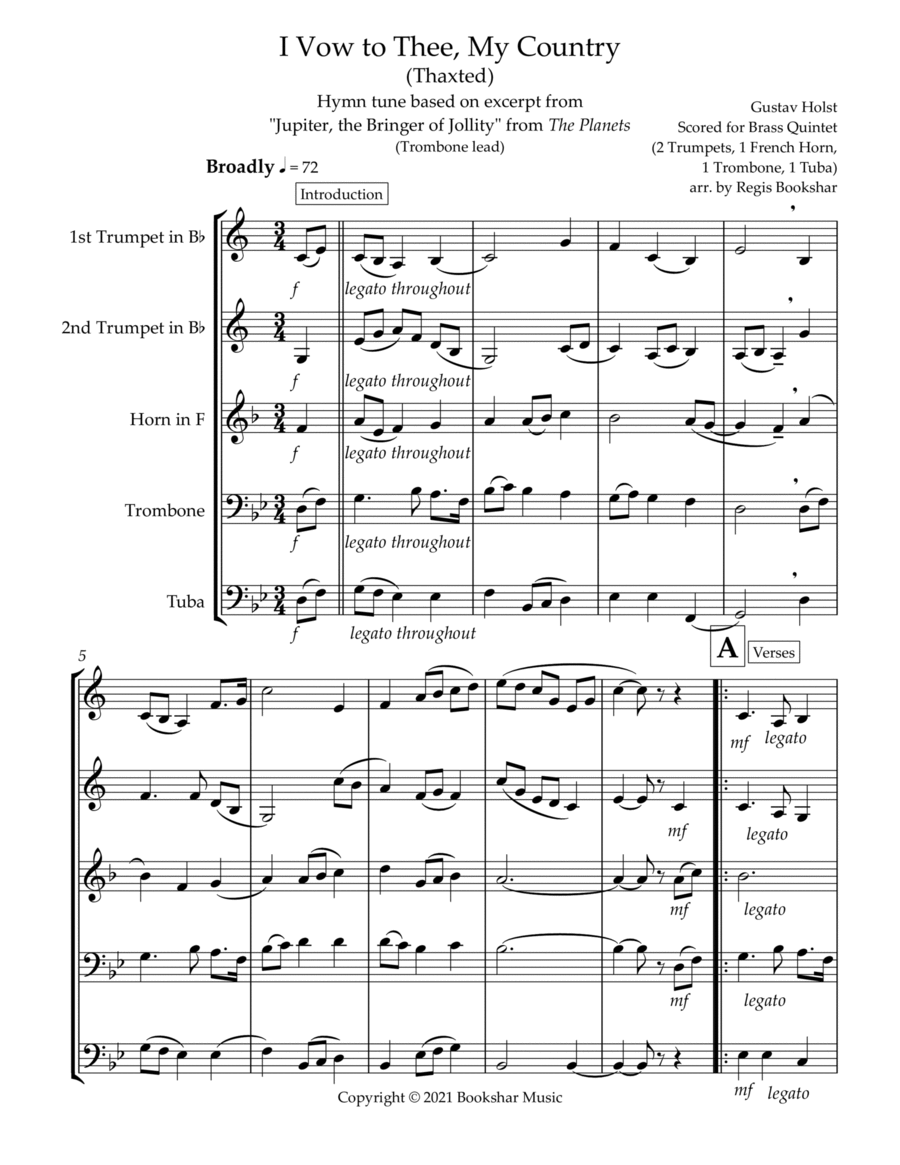
I Vow to Thee, My Country (Thaxted) (Bb) (Brass Quintet - 2 Trp, 1 Hrn, 1 Trb, 1 Tuba) (Trombone lea
Quatuor de Cuivres : 2 trompettes, trombone, tuba

$10.00 8.49 € Quatuor de Cuivres : 2 trompettes, trombone, tuba PDF SheetMusicPlus

Euphonium,Tuba - Level 4 - Digital Download SKU: A0.1110879 Composed by Wolfgang Amadeus Mozart. Arranged by Regis Bookshar. Chamber,Christian,Classical,Instructional,Religious. 28 pages. Regis Bookshar #713173. Published by Regis Bookshar (A0.1110879). Recordare (from Requiem (K. 626) - Wolfgang Amadeus Mozart/Franz Xaver Sussmayr - Brass Sextet - Advanced/Intermediate - Digital Download. Hauntingly beautiful is how the Recordare from Mozart's Requiem is often described. Originally written for an orchestra and four vocal soloists, it has now been transcribed by Regis Bookshar for a Brass Sextet, consisting of 5 Euphoniums and 1 Tuba, and would be a wonderful addition to any music library. This arrangement will provide students with the opportunity to practice breath control because of its long, sustained phrases. This selection could be performed for concerts, recitals and church services and is suitable for high school and college students but professional musicians would also enjoy playing this arrangement. Included are a score and a complete set of parts (28 pages) written for the Euphoniums in Treble Clef. There is also a version written in Bass Clef, if you would prefer. The Regis Bookshar Trumpet Ensemble has performed the Trumpet Quintet version of the Recordare for funerals, providing beautiful, introspective music for the occasion. There is some controversy surrounding the circumstances of the Requiem's composition because Mozart died before he could complete it. Count Franz von Walsegg had commissioned a Requiem Mass but Mozart had received only half of the payment in advance. So, upon his death on December 5th, 1791, his widow, Constanze, wished to have the work completed secretly by someone else and submit it to the count as having been completed by Mozart to collect the final payment. Joseph von Eybler was one of the first composers to be asked to complete the score and had worked on a number of movements but felt unable to complete the remainder and gave the manuscript back to Constanze Mozart. The task was then given to another composer, Franz Xaver Sussmayr. Sussmayr borrowed some of Eybler's work in making his completion, added his own orchestration to other movements and added several new movements which a Requiem Mass would normally comprise. He then added a final section by adapting the opening two movements which Mozart had written to the different words which finish the Requiem Mass, which according to both Sussmayr and Mozart's wife, was done according to Mozart's directions. The completed score, initially by Mozart but largely finished by Sussmayr, was then dispatched to Count Walsegg complete with a counterfeited signature of Mozart dated 1792. Despite the controversy over how much of the music is actually Mozart's, the commonly performed Sussmayr version has become widely accepted by the public, and is considered one of Mozart's finest compositions. The Recordare is considered by many people to be one of the most beautiful compositions in Mozart's entire catalogue. Regis Bookshar, a trumpet player, has performed the Requiem in concert with a full orchestra, soloists and a chorus and felt that other musicians should have the opportunity to play the hauntingly beautiful Recordare as well. So, in addition to this arrangement for a Brass Sextet, he has made quite a few other arrangements of this beautiful composition. There are Quintets, Sextets, Septets and Octets readily available for a wide variety of instrumental ensembles. Please take the time to look for other versions of this composition. You may fine something else which may also suit your needs. I would also encourage you to search for other arrangements by Regis Bookshar as well, as there are numerous arrangements in a variety of styles, also available for purchase. You may find something else which might interest you. Please continue to check periodically because new arrangements are being added as often as possible. I'm certain that this beautiful arrangement of Mozart's Recordare, will continue to entertain both performers and audiences alike for years to come.
Recordare (from "Requiem") (F) (Brass Sextet - 5 Euph (Treble Clef), 1 Tuba)

$32.00 27.17 € PDF SheetMusicPlus

Saxophone Quintet,Woodwind Ensemble Alto Saxophone,Baritone Saxophone,Tenor Saxophone - Level 4 - Digital Download SKU: A0.1108376 Composed by Wolfgang Amadeus Mozart. Arranged by Regis Bookshar. Chamber,Christian,Classical,Instructional,Religious. 25 pages. Regis Bookshar #711017. Published by Regis Bookshar (A0.1108376). Recordare (from Requiem (K. 626) - Wolfgang Amadeus Mozart/Franz Xaver Sussmayr - Saxophone Quintet - Advanced/Intermediate - Digital Download. Hauntingly beautiful is how the Recordare from Mozart's Requiem is often described. Originally written for an orchestra and four vocal soloists, it has now been transcribed by Regis Bookshar for a Saxophone Quintet, consisting of 3 Alto Saxophones, 1 Tenor Saxophone and 1 Baritone Saxophone, and would be a wonderful addition to any music library. This arrangement will provide students with the opportunity to practice breath control because of its long, sustained phrases. This selection could be performed for concerts, recitals and church services and is suitable for high school and college students but professional musicians would also enjoy playing this arrangement. Included are a score and a complete set of parts (25 pages). The Regis Bookshar Trumpet Ensemble has performed the Trumpet Quintet version of the Recordare for funerals, providing beautiful, introspective music for the occasion. There is some controversy surrounding the circumstances of the Requiem's composition because Mozart died before he could complete it. Count Franz von Walsegg had commissioned a Requiem Mass but Mozart had received only half of the payment in advance. So, upon his death on December 5th, 1791, his widow, Constanze, wished to have the work completed secretly by someone else and submit it to the count as having been completed by Mozart to collect the final payment. Joseph von Eybler was one of the first composers to be asked to complete the score and had worked on a number of movements but felt unable to complete the remainder and gave the manuscript back to Constanze Mozart. The task was then given to another composer, Franz Xaver Sussmayr. Sussmayr borrowed some of Eybler's work in making his completion, added his own orchestration to other movements and added several new movements which a Requiem Mass would normally comprise. He then added a final section by adapting the opening two movements which Mozart had written to the different words which finish the Requiem Mass, which according to both Sussmayr and Mozart's wife, was done according to Mozart's directions. The completed score, initially by Mozart but largely finished by Sussmayr, was then dispatched to Count Walsegg complete with a counterfeited signature of Mozart dated 1792. Despite the controversy over how much of the music is actually Mozart's, the commonly performed Sussmayr version has become widely accepted by the public, and is considered one of Mozart's finest compositions. The Recordare is considered by many people to be one of the most beautiful compositions in Mozart's entire catalogue. Regis Bookshar, a trumpet player, has performed the Requiem in concert with a full orchestra, soloists and a chorus and felt that other musicians should have the opportunity to play the hauntingly beautiful Recordare as well. So, in addition to this arrangement for a Saxophone Quintet, he has made quite a few other arrangements of this beautiful composition. There are Quintets, Sextets, Septets and Octets readily available for a wide variety of instrumental ensembles. Please take the time to look for other versions of this composition. You may fine something else which may also suit your needs. I would also encourage you to search for other arrangements by Regis Bookshar as well, as there are numerous arrangements in a variety of styles, also available for purchase. You may find something else which might interest you. Please continue to check periodically because new arrangements are being added as often as possible. I'm certain that this beautiful arrangement of Mozart's Recordare, will continue to entertain both performers and audiences alike for years to come.
Recordare (from "Requiem") (F) (Saxophone Quintet - 3 Alto, 1 Ten, 1 Bari)
Quintette de Saxophone: 5 saxophones

$28.00 23.78 € Quintette de Saxophone: 5 saxophones PDF SheetMusicPlus

Woodwind Ensemble,Woodwind Quintet Bassoon,Clarinet,Flute,Horn,Oboe - Level 3 - Digital Download SKU: A0.813788 Composed by Gustav Holst. Arranged by Regis Bookshar. 20th Century,Contemporary,Sacred,Standards,Wedding. 9 pages. Regis Bookshar #6476791. Published by Regis Bookshar (A0.813788). Thaxted (Bb) (Woodwind Quintet) - Intermediate - Digital Download. This marvelous arrangement of Thaxted, a hymn tune based on the Andante Maestoso section from Jupiter, the Bringer of Jollity from Gustav Holst's The Planets, would be a fabulous addition to any music library and could be performed for church services, especially Weddings and Funerals, but would be appropriate any time during the church year. However, if you are looking to perform this selection for concerts or recitals, I would suggest you look for the arrangement of Jupiter (Andante Maestoso from Jupiter, the Bringer of Jollity from The Planets), also by Regis Bookshar. These arrangements are suitable for high school and college students but professional musicians would also enjoy playing these selections as well. Included are a score and a complete set of parts (9 pages). This selection is one of the many arrangements from The Regis Bookshar Trumpet Ensemble's extensive music library which are being made available for the first time. We have performed the Trumpet Quintet version of this composition quite often for numerous weddings and other special occasions.The Planets, written between 1914 and 1917 by the English composer Gustav Holst, premiered at the Queen's Hall in London, on September 29, 1918 for an invited audience of about 250 people. In the fourth movement, Jupiter, the Bringer of Jollity, Holst portrays Jupiter's supposedly characteristic abundance of life and vitality. Nobility and generosity are allegedly characteristics of those born under Jupiter, and in the slower, middle section marked Andante Maestoso, perhaps the most well-known theme from The Planets (and the theme on which this arrangement is based), Holst provides a broad tune embodying these traits. In 1921, Holst adapted the theme to fit the patriotic poem I Vow to Thee, My Country by Cecil Spring Rice, and was written as a unison song with orchestra. It did not appear as the hymn tune until 1926, when Holst harmonized this melody, named Thaxted, named after the English village where he had lived for many years. Holst's friend Ralph Vaughan Williams included it in Songs of Praise. It has since been performed at numerous occasions, most notably for the wedding of Prince Charles and Diana, Princess of Wales in 1981, and also at the funerals of Princess Diana in 1997, Margaret Thatcher in 2013 and Senator John McCain where it was performed at the Washington National Cathedral on September 1, 2018. In addition to being used as the melody for the solemn, patriotic hymn I Vow to Thee, My Country, other settings of this hymn tune also include O God, Beyond All Praising, by Michael Perry in 1982, O Spirit All Embracing by Delores Dufner in 1995 and We Praise You and Acknowledge You, O God, a paraphrase of the Te Deum Laudemus by Stephen P. Starke in 1999.Regis Bookshar thought that it would be wonderful if other instrumentalists could have the opportunity to play this beautiful melody, so, in addition to the Trumpet Quintet version and this version for a Woodwind Quintet, consisting of 1 Flute (which has the lead), 1 Oboe, 1 Clarinet, 1 French Horn and 1 Bassoon, he has made quite a few other arrangements of this selection. There are Quintets readily available for a wide variety of instrumental ensembles. Please take the time to look for other versions of this composition. You may find something else that may also suit your needs. I would also encourage you to search for other arrangements by Regis Bookshar, as well, as there are numerous arrangements in a variety of styles, also available for purchase. You may find something else which might interest you. Please continue to check periodically because new arrangements are added as often as possible. I'm certain that this beautiful arrangement of Thaxted based on the Andante Maestoso section from Jupiter, the Bringer of Jollity from Gustav Holst's The Planets,.
Thaxted (hymn tune based on excerpt from "Jupiter" from The Planets) (Bb) (Woodwind Quintet - 1 Flut
Quintette à Vent: flûte, Hautbois, basson, clarinette, Cor

$10.00 8.49 € Quintette à Vent: flûte, Hautbois, basson, clarinette, Cor PDF SheetMusicPlus

Brass Ensemble Horn,Trombone,Trumpet,Tuba - Level 3 - Digital Download SKU: A0.813794 Composed by Gustav Holst. Arranged by Regis Bookshar. 20th Century,Contemporary,Sacred,Standards,Wedding. Score and parts. 9 pages. Regis Bookshar #6480695. Published by Regis Bookshar (A0.813794). O Spirit All-Embracing (Thaxted) (Bb) (Brass Quintet) - Intermediate - Digital Download. This marvelous arrangement of O Spirit All-Embracing, a hymn tune based on the Andante Maestoso section from Jupiter, the Bringer of Jollity from Gustav Holst's The Planets, would be a fabulous addition to any music library and could be performed for church services, especially Weddings and Funerals, but would be appropriate any time during the church year. However, if you are looking to perform this selection for concerts or recitals, I would suggest you look for the arrangement of Jupiter (Andante Maestoso from Jupiter, the Bringer of Jollity from The Planets), also by Regis Bookshar. These arrangements are suitable for high school and college students but professional musicians would also enjoy playing these selections as well. Included are a score and a complete set of parts (9 pages). This selection is one of the many arrangements from The Regis Bookshar Trumpet Ensemble's extensive music library which are being made available for the first time. We have performed the Trumpet Quintet version of this composition quite often for numerous weddings and other special occasions.The Planets, written between 1914 and 1917 by the English composer Gustav Holst, premiered at the Queen's Hall in London, on September 29, 1918 for an invited audience of about 250 people. In the fourth movement, Jupiter, the Bringer of Jollity, Holst portrays Jupiter's supposedly characteristic abundance of life and vitality. Nobility and generosity are allegedly characteristics of those born under Jupiter, and in the slower, middle section marked Andante Maestoso, perhaps the most well-known theme from The Planets (and the theme on which this arrangement is based), Holst provides a broad tune embodying these traits. In 1921, Holst adapted the theme to fit the patriotic poem I Vow to Thee, My Country by Cecil Spring Rice, and was written as a unison song with orchestra. It did not appear as the hymn tune until 1926, when Holst harmonized this melody, named Thaxted, named after the English village where he had lived for many years. Holst's friend Ralph Vaughan Williams included it in Songs of Praise. It has since been performed at numerous occasions, most notably for the wedding of Prince Charles and Diana, Princess of Wales in 1981, and also at the funerals of Princess Diana in 1997, Margaret Thatcher in 2013 and Senator John McCain where it was performed at the Washington National Cathedral on September 1, 2018. In addition to being used as the melody for the solemn, patriotic hymn I Vow to Thee, My Country, other settings of this hymn tune also include O God, Beyond All Praising, by Michael Perry in 1982, O Spirit All-Embracing by Delores Dufner in 1995 and We Praise You and Acknowledge You, O God, a paraphrase of the Te Deum Laudemus by Stephen P. Starke in 1999.Regis Bookshar thought that it would be wonderful if other instrumentalists could have the opportunity to play this beautiful melody, so, in addition to the Trumpet Quintet version and this version for a Brass Quintet, consisting of 2 Trumpets (one of which has the lead), 1 French Horn, 1 Trombone and 1 Tuba, he has made quite a few other arrangements of this selection. There are Quintets readily available for a wide variety of instrumental ensembles. Please take the time to look for other versions of this composition. You may find something else that may also suit your needs. I would also encourage you to search for other arrangements by Regis Bookshar, as well, as there are numerous arrangements in a variety of styles, also available for purchase. You may find something else which might interest you. Please continue to check periodically because new arrangements are added as often as possible. I'm certain that this beautiful arrangement of O Spirit All-Embracing based on the Andante Maestoso section from Jupi.
O Spirit All-Embracing (Thaxted) (Bb) (Brass Quintet - 2 Trp, 1 Hrn, 1 Trb, 1 Tuba) (Trumpet lead)
Quatuor de Cuivres : 2 trompettes, trombone, tuba

$10.00 8.49 € Quatuor de Cuivres : 2 trompettes, trombone, tuba PDF SheetMusicPlus

String Quartet String Quartet,Violin - Level 3 - Digital Download SKU: A0.1092495 Composed by Francesco Durante. Arranged by Regis Bookshar. Baroque,Instructional,Sacred. Score and parts. 7 pages. Regis Bookshar #696587. Published by Regis Bookshar (A0.1092495). Kyrie - by Francesco Durante; Violin Quartet – Intermediate – Digital Download. “Kyrieâ€, originally written for a four-part vocal ensemble by Francesco Durante, has now been transcribed, edited and arranged by Regis Bookshar, for a Violin Quartet. It would be a welcomed addition to any music library. This short composition, which lasts less than two minutes, will provide students with the opportunity to continue to develop good intonation because many of the phrases cadence on a unison note. This selection could be performed for concerts, recitals and church services. It is suitable for high school and college students but professional musicians would also enjoy playing this selection. Included are a score and a complete set of parts (7 pages). This selection is one of the many arrangements from the Regis Bookshar Trumpet Ensemble’s extensive music library which are being made available for the first time. We have performed the Trumpet Quartet version of this composition for many church services, especially funerals, when we were asked to supply something more somber and introspective rather than the louder, more festive music which many people come to expect from a Trumpet Ensemble. Francesco Durante was an Italian composer who was born on March 31, 1684 at Frattamaggiore, in the Kingdom of Naples. At an early age he entered the Conservatorio dei poveri di Gesu Cristo, in Naples, where he received lessons from Gaetano Greco. Later he became a pupil of Alessandro Scarlatti at the Conservatorio di Sant’Onofrio. He is said to have succeeded Scarlatti in 1725 at Sant’Onofrio and to have remained there until 1742, when he succeeded Nicola Porpora as head of the Conservatorio di Santa Maria de Loreto, also in Naples. He held this post for thirteen years, until his death on September 30, 1755. His fame as a teacher was considerable, and, unlike his Neapolitan contemporaries, who attracted international notice with their operas, Francesco Durante achieved recognition through his church music, along with some vocal chamber and instrumental works. His concern was not quantity. A complete collection of Durante’s works, consisting almost exclusively of sacred music, was presented by Gaspare Selveggi, a Neapolitan art collector and music theorist, to the Bibliotheque Nationale in Paris. The imperial library of Vienna also preserves a valuable collection of Durante’s manuscripts. The fact that Durante never composed for the stage brought him an exaggerated reputation as a composer of sacred music. He was considered one of the best church composers of his style and period. In his masses, requiems, litanies and Lamentations, he could provide strong expressive moments, as he does in this “Kyrieâ€. In addition to this arrangement for a Violin Quartet, Regis Bookshar has also made other arrangements of this selection. There are Quartets readily available for a wide variety of instrumental ensembles. Please take the time to look for other versions of this composition. You may find something else that may also suit your needs. I would also encourage you to search for other arrangements by Regis Bookshar, as well, as there are numerous arrangements in a variety of styles, also available for purchase. You may find something else which might interest you. Please continue to check periodically because new arrangements are being added as often as possible. I’m certain that this beautiful arrangement of Francesco Durante’s “Kyrie†will continue to entertain both performers and audiences alike for years to come.
Kyrie (Durante) (Violin Quartet)
Quatuor à cordes: 4 violons

$10.00 8.49 € Quatuor à cordes: 4 violons PDF SheetMusicPlus

Euphonium - Level 4 - Digital Download SKU: A0.1111650 Composed by Wolfgang Amadeus Mozart. Arranged by Regis Bookshar. Chamber,Christian,Classical,Instructional,Religious. 41 pages. Regis Bookshar #713945. Published by Regis Bookshar (A0.1111650). Recordare (from Requiem (K. 626) - Wolfgang Amadeus Mozart/Franz Xaver Sussmayr - Euphonium Septet - Advanced/Intermediate - Digital Download. Hauntingly beautiful is how the Recordare from Mozart's Requiem is often described. Originally written for an orchestra and four vocal soloists, it has now been transcribed by Regis Bookshar for a Euphonium Septet, and would be a wonderful addition to any music library. This arrangement will provide students with the opportunity to practice breath control because of its long, sustained phrases, and also to give them the chance to play this beautiful composition, something which they may not have had the opportunity to do, otherwise. This selection could be performed for concerts, recitals and church services and is suitable for high school and college students but professional musicians would also enjoy playing this arrangement. Included are a score and a complete set of parts (41 pages) written in Bass Clef. There is also a version written in Treble Clef if you prefer. The Regis Bookshar Trumpet Ensemble has performed the Trumpet Quintet version of the Recordare for funerals, providing beautiful, introspective music for the occasion. There is some controversy surrounding the circumstances of the Requiem's composition because Mozart died before he could complete it. Count Franz von Walsegg had commissioned a Requiem Mass but Mozart had received only half of the payment in advance. So, upon his death on December 5th, 1791, his widow, Constanze, wished to have the work completed secretly by someone else and submit it to the count as having been completed by Mozart to collect the final payment. Joseph von Eybler was one of the first composers to be asked to complete the score and had worked on a number of movements but felt unable to complete the remainder and gave the manuscript back to Constanze Mozart. The task was then given to another composer, Franz Xaver Sussmayr. Sussmayr borrowed some of Eybler's work in making his completion, added his own orchestration to other movements and added several new movements which a Requiem Mass would normally comprise. He then added a final section by adapting the opening two movements which Mozart had written to the different words which finish the Requiem Mass, which according to both Sussmayr and Mozart's wife, was done according to Mozart's directions. The completed score, initially by Mozart but largely finished by Sussmayr, was then dispatched to Count Walsegg complete with a counterfeited signature of Mozart dated 1792. Despite the controversy over how much of the music is actually Mozart's, the commonly performed Sussmayr version has become widely accepted by the public, and is considered one of Mozart's finest compositions. The Recordare is considered by many people to be one of the most beautiful compositions in Mozart's entire catalogue. Regis Bookshar, a trumpet player, has performed the Requiem in concert with a full orchestra, soloists and a chorus and felt that other musicians should have the opportunity to play the hauntingly beautiful Recordare as well. So, in addition to this arrangement for a Euphonium Septet, he has made quite a few other arrangements of this beautiful composition. There are Quintets, Sextets, Septets and Octets readily available for a wide variety of instrumental ensembles. Please take the time to look for other versions of this composition. You may fine something else which may also suit your needs. I would also encourage you to search for other arrangements by Regis Bookshar as well, as there are numerous arrangements in a variety of styles, also available for purchase. You may find something else which might interest you. Please continue to check periodically because new arrangements are being added as often as possible. I'm certain that this beautiful arrangement of Mozart's Recordare, will continue to entertain both performers and audiences alike for years to come.
Recordare (from "Requiem") (F) (Euphonium Septet - Bass Clef)

$36.00 30.57 € PDF SheetMusicPlus


Partitions Gratuites
Acheter des Partitions Musicales
Acheter des Partitions Digitales à Imprimer
Acheter des Instruments de Musique

© 2000 - 2025

Accueil - Version intégrale





