EUROPE
200 articles
USA
1117 articles
DIGITAL
9420 articles (à imprimer)
Partitions Digitales
Partitions à imprimer
9420 partitions trouvées


Choral Choir (TTBB) - Level 2 - Digital Download SKU: A0.1270160 By Arlo Guthrie. By Arlo Guthrie. Arranged by Craig Hanson. A Cappella,Comedy,Folk. Octavo. 6 pages. Edition Craig Hanson #862589. Published by Edition Craig Hanson (A0.1270160). For TTBB chorus a cappella and solo voice. As performed by Arlo Guthrie.Wanna hear something? You know that Indians never ate clams. They didn't have linguini! And so what happened was that clams was allowed to grow unmolested in the coastal waters of America for millions of years. And they got big, and I ain't talking about clams in general, I'm talking about each clam! Individually. I mean each one was a couple of million years old or older. So imagine they could have got bigger than this whole room. And when they get that big, God gives them little feet so that they could walk around easier. And when they get feet, they get dangerous. I'm talking about real dangerous. I ain't talking about sitting under the water waiting for you. I'm talking about coming after you.Imagine being on one of them boats coming over to discover America, like Columbus or something, standing there at night on watch, everyone else is either drunk or asleep. And you're watching for America and the boat's going up and down. And you don't like it anyhow but you gotta stand there and watch, for what? Only he knows, and he ain't watching. You hear the waves lapping against the side of the ship. The moon is going behind the clouds. You hear the pitter patter of little footprints on deck. ‘Is that you kids?’ It ain't! My god! It's this humongous, giant clam!Imagine those little feet coming on deck. A clam twice the size of the ship. Feet first. You're standing there shivering with fear, you grab one of these. This is a belaying pin. They used to have these stuck in the holes all around the ship… You probably didn't know what this is for; you probably had an idea, but you were wrong. They used to have these stuck in the holes all along the sides of the ship, everywhere. You wouldn't know what this is for unless you was that guy that night.I mean, you'd grab this out of the hole, run on over there, bam bam on them little feet! Back into the ocean would go a hurt, but not defeated, humongous, giant clam. Ready to strike again when opportunity was better.You know not even the coastal villages was safe from them big clams. You know them big clams had an inland range of about 15 miles. Think of that. I mean our early pioneers and the settlers built little houses all up and down the coast you know. A little inland and stuff like that and they didn't have houses like we got now, with bathrooms and stuff. They built little privies out back. And late at night, maybe a kid would have to go, and he'd go stomping out there in the moonlight. And all they'd hear for miles around...(loud clap/belch).... One less kid for America. One more smiling, smurking, humongous, giant clam.So Americans built forts. Them forts --you know—them pictures of them forts with the wooden points all around. You probably thought them points was for Indians but that's stupid! 'Cause Indians know about doors. But clams didn't. Even if a clam knew about a door, so what? A clam couldn't fit in a door. I mean, he'd come stomping up to a fort at night, put them feet on them points, jump back crying, tears coming out of them everywhere. But Americans couldn't live in forts forever. You couldn't just build one big fort around America. How would you go to the beach?So what they did was they formed groups of people. I mean they had groups of people all up and down the coast form these little alliances. Like up North it was call the Clamshell Alliance. And farther down South it was called the Catfish Alliance. They had these Alliances all up and down the coast defending themselves against these threatening monsters. These humongous giant clams. Andt hey'd go out there, if there was maybe fifteen of them they'd be singing songs in fifteen part harmony. And when one part disappeared, that's how they knew where the clam would be.Which is why Americans only sing in four part harmony to this very day. That proved to be too dangerous. See, what they did was they'd be singing these songs called Clam Chanties, and they'd have these big spears called clampoons. And they'd be walking up and down the beach and the method they eventually devised where they'd have this guy, the most strongest heavy duty true blue American, courageous type dude they could find and they'd have him out there walking up and down the beach by himself with other chicken dudes hiding behind the sand dunes somewhere.He'd be singing the verses. They'd be singing the chorus, and clams would hear 'em. And clams hate music. So clams would come out of the water and they'd come after this one guy. And all you'd see pretty soon was flying all over the sand flying up and down the beach manmanclamclammanmanclam manclamclamman up and down the beach going this way and that way up the hills in the water out of the water behind the trees everywhere. Finally the man would jump over a big sand dune, roll over the side, the clam would come over the dune, fall in the hole and fourteen guys would come out there and stab the shit out of him with their clampoons.That's the way it was. That was one way to deal with them. The other way was to weld two clams together. [I don't believe it. I'm losing it. Hey. What can you do. Another night shot to hell.] Hey, this was serious back then. This was very serious. I mean these songs now are just piddly folk songs. But back then these songs were controversial. These was radical, almost revolutionary songs. Because times was different and clams was a threat to America. That's right. So we want to sing this song tonight about the one last... You see what they did was there was one man, he was one of these men, his name will always be remembered, his name was Reuben Clamzo, and he was one of the last great clam men there ever was. He stuck the last clam stab. The last clampoon into the last clam that was ever seen on this continent. Knowing he would be out of work in an hour. He did it anyway so that you and me could go to the beach in relative safety. That's right. Made America safe for the likes of you and me. And so we sing this song in his memory. He went into whaling like most of them guys did and he got out of that, when he died. You know, clams was much more dangerous than whales. Clams can run in the water, on the water or on the ground, and they are so big sometimes that they can jump and they can spread their kinda shells and kinda almost fly like one of them flying squirrels.You could be standing there thinking that your perfectly safe and all of a sudden whop.... That's true... And so this is the song of this guy by the name of Reuben Clamzo and the song takes place right after he stabbed this clam and the clam was, going through this kinda death dance over on the side somewhere. The song starts there and he goes into whaling and takes you through the next...I sing the part of the guy on the beach by himself. I go like this: Poor old Reuben Clamzo and you go Clamzo Boys Clamzo. That's the part of the fourteen chicken dudes over on the other side. That's what they used to sing. They'd be calling these clams out of the water. Like taunting them making fun of them. Clams would get real mad and come out. Here we go. I want you to sing it in case you ever have an occasion to join such an alliance. You know some of these alliances are still around. Still defending America against things like them clams. If you ever wants to join one, now you have some historic background. So you know where these guys are coming from. It's not just some 60's movement or something, these things go back a long time.Notice the distinction you're going to have to make now between the first and easy Clamzo Boys Clamzo and the more complicated Clamzo Me Boys Clamzo. Stay serious! Folk songs are serious. That's what Pete Seeger told me. Arlo I only want to tell you one thing... Folk songs are serious. I said right. Let's do it in C for Clam...Iet's do it in B... For boy that's a big clam... Iet' s do it in G for Gee, I hope that big clam don't see me. Let's do it in F... For …he sees me. Let's do it back in A...for a clam is coming. Better get this song done quick. The Story of Reuben Clamzo and His Strange Daughter in the Key of A.
The Story Of Reuben Clamzo & His Strange Daughter
Chorale TTBB
Arlo Guthrie
$3.99 3.35 € Chorale TTBB PDF SheetMusicPlus

Brass Quintet - Level 4 - Digital Download SKU: A0.1489490 Composed by Dr. Daniel N. Thrower. Chamber,Classical,Historic,Patriotic. 38 pages. Https://gildedmusicpress.com/ #1066354. Published by https://gildedmusicpress.com/ (A0.1489490). Three of these seven short pieces are worthy to open any brass quintet concert or recital.  Two fanfares are too short for a concert feature but work extremely well in a ceremony or celebratory setting.  The last two short pieces aptly serve contrasting special purposes, as explained below.“Fort Pierre Fanfare” is about 40 seconds in duration, and was composed to open the feature concert at the South Dakota Bandmasters Association convention in 2022.  Offutt Brass, from the US Air Force Heartland of America Band, was invited to perform that concert.  Before the final piece of the concert, when gifts were exchanged between the sponsor and performers, beautiful presentation copies of the sheet music were presented to the sponsor.  In performance, staging directions on the music can be extremely effective or cringy, depending on how they are conveyed.  If there is any inkling that there may be a cringe factor, ignore them, and play the fanfare already on stage.“Enduring Freedom Fanfare” is nearly a minute of music.  It was composed as a gift for the outgoing Commander of the US Air Force Heritage of America Band, Major Rafael Toro-Quiñones.  His leadership was strong and inspiring, and he held a place of high esteem among many of the fine military musicians that he led.  The Change of Command ceremony was toward the end of the Covid-19 shut-downs, so the work was not performed at the ceremony.  Chief Remley, from the command’s satellite location in Nebraska, hand-delivered some finely printed presentation copies to Major Toro-Quiñones.“Noble Eagle Fanfare” is slightly over a minute in length, and, like “Enduring Freedom Fanfare,” was composed as a gift for another outgoing Commander of the US Air Force Heritage of America Band, Captain David Neil Regner.“Pilgrims’ Fanfare” was composed on what many Americans acknowledge as “Pioneer Day,” 24 July 2023.  Not only honoring the thousands of pioneers that settled the western United States, but also the pilgrims that voyaged across the ocean to settle in the new continent.  It is about 15 seconds in duration and is effective for any occasion in need of a magnificent fanfare.“Flightline Fanfare,” as its title implies, was composed for the ribbon cutting ceremony of the dedication of the newly renovated flightline at Offutt Air Force Base in Nebraska.  Unfortunately, the ceremony itself was altered last-minute, and the 15-second fanfare was not used.  However, like “Pilgrims’ Fanfare,” it is very handy for any event demanding a splash of pomp.“American Interlude” is a soft 75-second underscore for an MC’s moving speech or dedication.  It was originally composed as a smooth segue between two moving patriotic pieces of different keys in a concert setting, but can be used in any similar appropriate situation.“Troop 184” is dedicated to my childhood BSA Scoutmaster, Gerry Nielson, who molded me in significant ways into the man I am decades later.  It is functional music, akin to a fight song, and can be easily marched to.  Words may be crafted as a customized hiking ditty, or it can be featured before or after ceremonies as prelude or processional music.  The duration can also be customized, as there is a written optional repeat, lengthening the tune from 45 seconds to a minute and a half.
Americana Fanfares, Vol. 2, Op. 137
Quintette de Cuivres: 2 trompettes, Cor, trombone, tuba

$24.95 20.97 € Quintette de Cuivres: 2 trompettes, Cor, trombone, tuba PDF SheetMusicPlus

Concert Band - Level 2 - Digital Download SKU: A0.917409 Composed by Gregory Fritze. 20th Century,Contemporary,Instructional,Standards. Score and parts. 52 pages. Musica Nova USA #6075605. Published by Musica Nova USA (A0.917409). Set Free to go Home was composed in the fall of 2019. It was commissioned by Dr. Kristen Tjornehoj, Conductor of the University of Wisconsin at River Falls Symphony Band in remembrance of Kaye Bird, who passed away in 2016 as a resident of River Falls and a member of the community for several years. Kaye Bird was also a resident of Indiana, PA for 37 years and was a well respected teacher in the public schools there. Set Free to go Home was premiered by the Indiana University of Pennsylvania Symphony Band at Fisher Auditorium on February 6, 2020, conducted by Dr. Jason Worzbyt. It is agrade 3 band piece with a duration of five minutes. It is published by Musica Nova USA and availableon sheetmusicplus.com and jwpepper.com.Performance Notes: Set Free to go Home was composed with flexible instrumentation in mind.There are several instruments listed in the score that would enhance the piece (such as harp, oboes,double bass, ect.) but are not necessary to convey a successful performance. For example, if there are not five percussionists available, the piece may be played by less performers with the use of a drumkit, with one person playing two or more parts. This composition can sound very good whether thereare fifteen players or a band with one hundred players.Gregory Fritze is a prize-winning composer and Fulbright Scholar, as well as an active performer and conductor. His compositions have been performed more than one thousand times in over twenty-six countries. He has written over ninety compositions for orchestra, band, chamber ensembles and soloists. He has won over sixty composition awards both nationally and internationally, includingFirst Prize in the 1st WASBE (World Association of Symphonic Bands and Ensembles) International Composition Contest 2017, First Prize Winner of Reneé Fisher Composition Prize, First Prize Winnerin Concurso Bienal de Composición de Musica para Banda, Ciudad de Santa Cruz de Tenerife (Spain), Menzione d’Onore (highest award given) of the Mario Bernardo Angelo-Comneno International MusicCompetition by the Accademia Angelica Costantiniana Arti E Scienze (Italy), First Prize in the TUBA International Etude Composition Competition, the IBLA Grand Prize (Italy), 2nd Prize in the 2nd WASBE International Composition Contest 2019, several awards from The American Prize, annual composition awards from Standard Awards Panel of American Society of Composers, Authors, and Publishers andmany others. He has been commissioned by The Rhode Island Philharmonic Orchestra, The Army Band Pershing’s Own of Washington, DC, The Banda Municipal of Bilbao, The Primativa de Lliria,and others. His compositions include works published by several publishers in the United States, SouthAmerica and Europe and have been performed extensively throughout the world.He has thirty-three compositions commercially recorded on Albany Records, MSR Classics, Crystal Records, Mark Records and others. He has been a guest lecturer, conductor and performer atmany colleges, universities and music festivals in the United States, Canada, Japan, South America and Europe. He was born in Allentown, Pennsylvania in 1954 and has Composition degrees from the Boston Conservatory and Indiana University. He now resides in Daytona Beach Shores, Florida.
Set Free to go Home - grade 3 concert band
Orchestre d'harmonie

$40.00 33.61 € Orchestre d'harmonie PDF SheetMusicPlus

Small Ensemble Medium Voice,Piano Accompaniment,Tenor Saxophone - Level 5 - Digital Download SKU: A0.534375 Composed by Paul Wehage. Concert,Contemporary,Holiday,Love,Standards. Score and parts. 41 pages. Musik Fabrik Music Publishing #3396161. Published by Musik Fabrik Music Publishing (A0.534375). To You for Baritone, Tenor Saxophone and piano is dedicated to the American Baritone Kurt Ollmann, who has done much for the promotion and performance of American music both in the United States and abroad.Whitman’s poem speaks of seeing a stranger and feeling love for this person. In contrast to Poe’s To Helen, which treats a similar subject of a chance meeting of a stranger that the poet loves, Whitman does not idealize his subject but rather pointedly and brutally describes how he sees this person and what feelings (both negative and positive) this contemplation provokes in the poet’s mind In order to reflect this musically, there is an alternation between more introspective and brooding sections which are then followed by more ecstatic outbursts. The piece ends with the poet watching the stranger leave, expressing what the composer felt to be acceptance and release.As in any chamber music with voice, it is important that the two instruments allow the voice to predominate, regardless of the dynamics marked in their parts. The saxophonist should try as much as possible to match colour with the voice,in order to allow the contrapuntal exchanges between the voice and the saxophone to blend evenly. The pianist should play the passages at rehearsal marks E, G and K in a more soloist manner, always taking care not to cover the voice..To YouWhoever you are, I fear you are walking the walks of dreams,I fear these supposed realities are to melt from under your feet and hands,Even now your features, joys, speech, house, trade, manners,troubles, follies, costume, crimes, dissipate away from you,Your true soul and body appear before me.They stand forth out of affairs, out of commerce, shops, work,farms, clothes, the house, buying, selling, eating, drinking,suffering, dying.Whoever you are, now I place my hand upon you, that you be my poem,I whisper with my lips close to your ear.I have loved many women and men, but I love none better than you.O I have been dilatory and dumb,I should have made my way straight to you long ago,I should have blabb'd nothing but you, I should have chanted nothingbut you.I will leave all and come and make the hymns of you,None has understood you, but I understand you,None has done justice to you, you have not done justice to yourself,None but has found you imperfect, I only find no imperfection in you,None but would subordinate you, I only am he who will never consentto subordinate you,I only am he who places over you no master, owner, better, God,beyond what waits intrinsically in yourself.Painters have painted their swarming groups and the centre-figure of all,From the head of the centre-figure spreading a nimbus of gold-color'd light,But I paint myriads of heads, but paint no head without its nimbusof gold-color'd light,From my hand from the brain of every man and woman it streams,effulgently flowing forever.O I could sing such grandeurs and glories about you!You have not known what you are, you have slumber'd upon yourselfall your life,Your eyelids have been the same as closed most of the time,What you have done returns already in mockeries,(Your thrift, knowledge, prayers, if they do not return inmockeries, what is their return?)The mockeries are not you,Underneath them and within them I see you lurk,I pursue you where none else has pursued you,Silence, the desk, the flippant expression, the night, theaccustom'd routine, if these conceal you from others or fromyourself, they do not conceal you from me,The shaved face, the unsteady eye, the impure complexion, if thesebalk others they do not balk me,The pert apparel, the deform'd attitude, drunkenness, greed,premature death, all these I part aside.There is no endowment in man or woman that is not tallied in you,There is no virtue,.
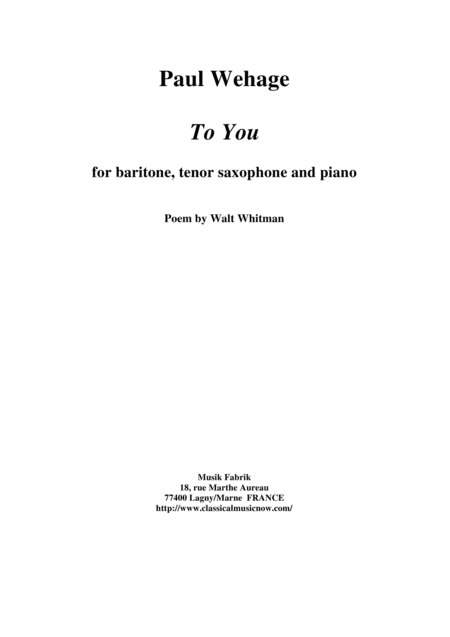
Paul Wehage: To You for baritone, tenor saxophone and piano

$29.95 25.17 € PDF SheetMusicPlus

High voice and piano - Moderately Difficult - Digital Download SKU: MQ.8454-2E Composed by David Conte. Secular, 21st century. Instrument part. 6 pages. E. C. Schirmer Music Company - Digital #8454-2E. Published by E. C. Schirmer Music Company - Digital (MQ.8454-2E). English.American Death Ballads was composed especially for tenor Brian Thorsett. We have been frequent collaborators since 2011, when he premiered the complete set of my Three Settings of W. B. Yeats for string quartet and tenor. At his urging, I transcribed and published my Three Poems of Christina Rossetti (originally for medium voice) for high voice, which he premiered at the San Francisco Conservatory in 2014. American Death Ballads was premiered by him at the San Francisco Conservatory, November 1, 2015, with pianist John Churchwell, and at the National Association of Teachers of Singing (NATS) Conference in Chicago, July 10, 2016, with pianist Warren Jones.The choice of texts for my American Death Ballads was inspired partly by Copland’s Old American Songs, which I deeply admire, but more by my dear friend and colleague the late Conrad Susa’s Two Murder Ballads. The ingenuity of Susa’s accompaniments for his ballads in imagining anew the original source material owes a great deal to Copland’s accompaniment for his songs. Though the content of my songs is completely original and not based on preexisting melodies, I have tried to expand on this further, as the texts are much longer, and go through many different moods and characters. The four texts I chose include stories about murder, death, and dying. Though two of the texts were written in England, they traveled to the colonies almost immediately. The subjects of the texts had spent time in America, and their stories were well known to Americans.Wicked Polly is a cautionary tale. Polly has lived a dissolute and immoral life, saying, 'I'll turn to God when I grow old.' Suddenly taken ill, she realizes that it is too late to repent. She dies in agony and is presumably sent to hell; young people are advised to heed. My musical setting is stately and preacherly in character for the narrator; for Polly it becomes pleading and remorseful. The Unquiet Grave was brought to the attention of Alan Lomax, the great American field collector of folk music, by English folk singer Shirley Collins. The text is taken from an English folk song dating from 1400. In The Unquiet Grave, a young man mourns his dead lover too fervently and prevents her from obtaining peace. The dead woman complains that his weeping is keeping her from peaceful rest. He begs a kiss; she tells him it would kill him. When he persists, wanting to join her in death, she explains that once they were both dead their hearts would simply decay, and that he should enjoy life while he has it. My setting is in a flowing Andante with a rocking accompaniment. Three voices are delineated here: the narrator, the mournful lover, and the dead lover speaking from the grave. The Dying Californian first appeared in the New England Diadem in 1854. Its lyrics are based on a letter from a New Englander’s sailor to his brother who is dying at sea while on the way to California to seek his fortune in the California gold fields. He implores his brother to impart his message to his father, mother, wife, and children. My setting opens with the singer alone in a moderate dirge tempo, then, joined by the piano, moves through many tonalities and moods before ending with supreme confidence as the speaker 'gained a port called Heaven/Where the gold will never rust.'Captain Kidd was a Scottish sailor who was tried and executed for piracy and murder in 1701. The American connection to this ballad is that Kidd escaped to America and for a time lived in New York and Boston, though he was a wanted criminal by the British authorities and was extradited to Britain, where he was hung at 'Executioner’s Dock.' The lyric was printed in Britain in 1701, traveling to the colonies almost immediately. Though the didactic tone of the text is similar to Wicked Polly, it expresses no regret until the final lines: 'Take warning now by me, and shun bad company, / Lest you come to hell with me, for I must die.' My setting is fast and spirited, expressing the confidence of a man who lived life as he wanted. -David Conte.
The Unquiet Grave from American Death Ballads (Downloadable)
Voix haute

$3.50 2.94 € Voix haute PDF SheetMusicPlus

Guitar,Voice - Level 2 - Digital Download SKU: A0.1042566 By The Candlelight Guitarist. By Words by Samuel Francis Smith, Music: traditional. Arranged by Bradley Powell. Patriotic,Sacred,Traditional. Guitar Tab with Voice. 2 pages. Geofonica Artistworks #647335. Published by Geofonica Artistworks (A0.1042566). Beloved American patriotic hymn arranged for Guitar solo, in both standard notation an TAB (instrumental finger-style, also suitable for accompanying singers, with lyrics included), arranged by Bradley Powell, who has recorded many albums as The Candlelight Guitarist. Level: beginning to Intermediate classical guitar, written in standard notation. (NOTE: This same arrangement in standard notation only, without TAB, is also available.) Arrangement features a short serene introduction, which serves as a transition motif within arrangement. Harmony is a subtle blend of traditional, folk-jazz and classical. Suitable for patriotic occasions, memorials, celebrations and religious services. ABOUT: Bradley Powell (aka The Candlelight Guitarist) began guitar at age ten, inspired by The Beatles. At 15, he became a protégé of jazz guitarist Joe Pass, and later studied classical guitar under Vincent Macaluso and at California State University, Northridge under Ronald Purcell, with a master class under Andrés Segovia. Brad was featured performing Gerald Wilson's Sonata for Guitar and Orchestra at the Hollywood Bowl, with the composer conducting. Brad was mentored in composition by David Rose (composer for Little House on the Prairie). Brad has composed music for TV, including Hill Street Blues and The 'A' Team, working with Mike Post. Brad has ten albums as The Candlelight Guitarist. Brad is also the classical guitarist for Disney's Princess Breakfast Adventuire at Disneyland's Grand Californian Resort. When not making music, Brad is often out hiking with his dogs.COMMENTS FROM ESTABLISHED REVIEWERS...Dr. Beth - Amazon.com #1 Hall of Fame reviewerBrad has a knack for putting together gentle, soothing guitar medleys which provide the perfect background or relaxation soundtrack.Bill Binkelman - Music Reviewer for Zone Music Reporter and New Age RetailerThe Candlelight Guitarist is your tour guide to a land of easy-going, warm, and inviting instrumentals.Rebecca of Amazon - Amazon.com HALL OF FAME TOP 500 REVIEWERBradley Powell's flawless playing allows you to completely relax into sleep or relax into an evening of candlelight and romance. I've fallen into a peaceful sleep while listening to this music and have also spent relaxing afternoons reading while The Candlelight Guitarist wove an intricate tapestry of sounds to nurture my heart. ... Bradley Powell's music is infused with natural ambience. As rich sounds renew your spirit, you can relax into a deep sigh of the heart. His style is artistic, heart healing and filled with romantic and cultural influences.Vicki Blizzard (Editor, PaperWorks and Crazy for Cross-Stitch! magazines) in CREATIVITY e-Letter: Music to filter into my dreams. My new favorite to listen to is classical guitar music by Bradley Powell.Jana L. Perskie Ceruleana (New York, NY USA) ~ Amazon.com TOP 50 Reviewer.The talented and creative Bradley Powell is the Candlelight Guitarist. His music is original and some of the most soul soothing I have ever heard.Bob McKillop, founder and publisher, MaineFolkMusic.comBrad Powell is a talented and highly trained California guitarist and composer who calls himself The Candlelight Guitarist, and for good reason. His music is perfect for situations in which candlelight figures prominently. Quiet meditation, romance, intellectual stimulation – the soft, pure tones of his Spanish and classic instrumental style open up your heart and render it more receptive to the spiritual messages that these pursuits engender.Grady Harp - HALL OF FAME TOP 100 REVIEWERmusic to soothe and calm and enrich the psyche. Would that there were more Brad Powells out there to help us all through these times. The world would be a saner place!
America (My Country ‘Tis of Thee)
Guitare notes et tablatures
The Candlelight Guitarist
$2.99 2.51 € Guitare notes et tablatures PDF SheetMusicPlus

Piano,Soprano Saxophone - Level 2 - Digital Download SKU: A0.549121 Composed by Camille Saint-Saëns (1835 – 1921). Arranged by James M. Guthrie, ASCAP. Instructional,Romantic Period,Standards. Score and part. 9 pages. Jmsgu3 #3452273. Published by jmsgu3 (A0.549121). Saint-Saens: The Swan (Le Cygne) movement 13 from the Carnival of the Animals Suite. Duration: 2:50 Score: 5 pg, 28 ms. Solo part: 1 pg. Piano part: 3 pg. Performance: Level: Early intermediate and up. One of his most popular and widely recognized works, it is the only movement from the Carnival Suite that Saint-Saens permitted to be performed in public during his lifetime. This is an excellent recital encore choice to demonstrate melodic playing and strategic phrasing. The Carnival of the Animals The Carnival of the Animals is an entertaining musical suite of fourteen movements by Camille Saint-Saëns. The work was composed for private performance by an ensemble of two pianos and solo instruments. The Swan (No. 13) is one of the most popular of the fourteen movements. In its entirety, it lasts about 25 minutes. Saint-Saëns Background Charles-Camille Saint-Saëns (1835 – 1921) was, by all means, in particular, a famous French composer, brilliant organist, and significant musical mastermind of the Romantic era. Indeed, his most famous compositions, in the long run, including his Piano Concerto No. 2 (1868), Cello Concerto No. 1 (1872), and the Danse macabre (1874). Notwithstanding, we must also add Violin Concerto No. 3 (1880), Symphony No. 3 (the Organ Symphony, 1886), it must be remembered, Carnival of the Animals (1886) to the list. Childhood It is important to realize that Saint-Saëns was certainly, in fact, a child musical prodigy. Consequently, with this in mind, he made his concert debut albeit at ten years old. Another key point to remember is that he expressly studied at the Paris Conservatoire, then in spite of reality conversely followed a traditional career path as a church organist. Nevertheless, twenty years later, on the other hand, he left to become a successful freelance pianist and composer despite, as has been noted, his former employment situation. Furthermore, his performances were after all markedly in demand - not only in Europe but above all in the Americas all in all as well. Youth A point often overlooked is that in his youth, Saint-Saëns was certainly excited about the modern music of the day. He was in essence fond of the music of his contemporaries, in particular, Schumann, Liszt, and for the most part Wagner. In contrast, however, his own compositions seemed in fact largely confined within the conservative classical tradition. Be that as it may, he was at the same time nevertheless, in fact, a scholar of musical history. Criticism On the whole, his conservatism in fact ultimately brought him into frequent conflict in his later years with composers of the impressionist and in particular the dodecaphonic schools of musical thought.  A point often overlooked is that he included neoclassical elements in his music contrary to some critics. Furthermore, in so doing he provided the most compelling evidence that he predicted the techniques and works by Stravinsky and Les Six. To put it another way, given these points, he was regarded, perhaps for the most part unfairly so, as a non-progressive reactionary henceforth around the time of his passing. Legacy To sum up, Saint-Saëns taught for a short time in Paris, where his students included namely Gabriel Fauré. To clarify, Maurice Ravel later studied with Fauré. In conclusion, both Ravel and Fauré were powerfully influenced by Saint-Saëns, whom they respected as a musical mastermind.
Saint-Saens: The Swan for Soprano Sax & Piano
Saxophone Soprano et Piano

$32.95 27.69 € Saxophone Soprano et Piano PDF SheetMusicPlus

Piano,Violin - Level 3 - Digital Download SKU: A0.1254029 Composed by Camille Saint-Saens. Arranged by James M. Guthrie, ASCAP. 19th Century,Chamber,Contest,Festival,Historic,Romantic Period. 9 pages. Jmsgu3 #847642. Published by jmsgu3 (A0.1254029). Saint-Saëns: The Swan (Le Cygne) movement 13 from the Carnival of the Animals Suite. One of his most popular and widely recognized works, it is the only movement from the Carnival Suite that Saint-Saëns permitted to be performed publicly during his lifetime. This is an excellent recital encore to demonstrate melodic playing and strategic phrasing.The Carnival of the AnimalsThe Carnival of the Animals is an entertaining musical suite of fourteen movements by Camille Saint-Saëns. The work was composed for private performance by an ensemble of two pianos and solo instruments. The Swan (No. 13) is among the fourteen most famous movements. In its entirety, it lasts about 25 minutes.Saint-Saëns BackgroundCharles-Camille Saint-Saëns 1835 – 1921) was, by all means, in particular, a famous French composer, brilliant organist, and significant musical mastermind of the Romantic era. Indeed, his most famous compositions, in the long run, include his Piano Concerto No. 2 (1868), Cello Concerto No. 1 (1872), and the Danse macabre (1874). Notwithstanding, we must also add Violin Concerto No. 3 (1880), Symphony No. 3 (the Organ Symphony, 1886), and, it must be remembered, Carnival of the Animals (1886) to the list.ChildhoodIt is essential to realize that Saint-Saëns was undoubtedly, in fact, a child musical prodigy. Consequently, with this in mind, he made his concert debut, albeit at ten years old. Another critical point to remember is that he expressly studied at the Paris Conservatoire, then, despite reality, conversely followed a traditional career path as a church organist. Nevertheless, twenty years later, on the other hand, he left to become a successful freelance pianist and composer despite, as has been noted, his former employment situation. Furthermore, his performances were, after all, markedly in demand - not only in Europe but, above all, in the Americas all in all as well.YouthA point often overlooked is that in his youth, Saint-Saëns was undoubtedly excited about the modern music of the day. He was, in essence, fond of the music of his contemporaries, particularly Schumann, Liszt, and, for the most part, Wagner. In contrast, however, his compositions seemed, in fact, primarily confined within the conservative classical tradition. Be that as it may, he was, at the same time, nevertheless, a scholar of musical history.CriticismOn the whole, his conservatism, in fact, ultimately brought him into frequent conflict in his later years with composers of the impressionist and, in particular, the dodecaphonic schools of musical thought. A point often overlooked is that he included neoclassical elements in his music, contrary to some critics. Furthermore, in so doing, he provided the most compelling evidence that he predicted the techniques and works by Stravinsky and Les Six. To put it another way, given these points, he was regarded, perhaps for the most part unfairly, as a non-progressive reactionary henceforth around the time of his passing.LegacySaint-Saëns taught briefly in Paris, where his students included Gabriel Fauré. Maurice Ravel later studied with Fauré. In conclusion, both Ravel and Fauré were powerfully influenced by Saint-Saëns, whom they respected as a musical mastermind.
Saint-Saens: The Swan for Violin and Piano
Violon et Piano

$34.95 29.37 € Violon et Piano PDF SheetMusicPlus

B-Flat Clarinet,Piano - Level 3 - Digital Download SKU: A0.1314273 Composed by Camille Saint-Saens. Arranged by James M. Guthrie. 19th Century,Chamber,Contest,Festival,Historic,Romantic Period. Score and part. 11 pages. Jmsgu3 #903015. Published by jmsgu3 (A0.1314273). Saint-Saëns: The Swan (Le Cygne) movement 13 from the Carnival of the Animals Suite. One of his most popular and widely recognized works, it is the only movement from the Carnival Suite that Saint-Saëns permitted to be performed publicly during his lifetime. This is an excellent recital encore to demonstrate melodic playing and strategic phrasing.The Carnival of the AnimalsThe Carnival of the Animals is an entertaining musical suite of fourteen movements by Camille Saint-Saëns. The work was composed for private performance by an ensemble of two pianos and solo instruments. The Swan (No. 13) is among the fourteen most famous movements. In its entirety, it lasts about 25 minutes.Saint-Saëns BackgroundCharles-Camille Saint-Saëns 1835 – 1921) was, by all means, in particular, a famous French composer, brilliant organist, and significant musical mastermind of the Romantic era. Indeed, his most famous compositions, in the long run, include his Piano Concerto No. 2 (1868), Cello Concerto No. 1 (1872), and the Danse macabre (1874). Notwithstanding, we must also add Violin Concerto No. 3 (1880), Symphony No. 3 (the Organ Symphony, 1886), and, it must be remembered, Carnival of the Animals (1886) to the list.ChildhoodIt is essential to realize that Saint-Saëns was undoubtedly, in fact, a child musical prodigy. Consequently, with this in mind, he made his concert debut, albeit at ten years old. Another critical point to remember is that he expressly studied at the Paris Conservatoire, then, despite reality, conversely followed a traditional career path as a church organist. Nevertheless, twenty years later, on the other hand, he left to become a successful freelance pianist and composer despite, as has been noted, his former employment situation. Furthermore, his performances were, after all, markedly in demand - not only in Europe but, above all, in the Americas all in all as well.YouthA point often overlooked is that in his youth, Saint-Saëns was undoubtedly excited about the modern music of the day. He was, in essence, fond of the music of his contemporaries, particularly Schumann, Liszt, and, for the most part, Wagner. In contrast, however, his compositions seemed, in fact, primarily confined within the conservative classical tradition. Be that as it may, he was, at the same time, nevertheless, a scholar of musical history.CriticismOn the whole, his conservatism, in fact, ultimately brought him into frequent conflict in his later years with composers of the impressionist and, in particular, the dodecaphonic schools of musical thought. A point often overlooked is that he included neoclassical elements in his music, contrary to some critics. Furthermore, in so doing, he provided the most compelling evidence that he predicted the techniques and works by Stravinsky and Les Six. To put it another way, given these points, he was regarded, perhaps for the most part unfairly, as a non-progressive reactionary henceforth around the time of his passing.LegacySaint-Saëns taught briefly in Paris, where his students included Gabriel Fauré. Maurice Ravel later studied with Fauré. In conclusion, both Ravel and Fauré were powerfully influenced by Saint-Saëns, whom they respected as a musical mastermind.
Saint-Saëns: The Swan for Clarinet & Piano
Clarinette et Piano

$32.95 27.69 € Clarinette et Piano PDF SheetMusicPlus

Piano,Soprano Flute - Level 3 - Digital Download SKU: A0.1314255 Composed by Camille Saint-Saens. Arranged by James M. Guthrie. 19th Century,Chamber,Contest,Festival,Historic,Romantic Period. Score and part. 11 pages. Jmsgu3 #902996. Published by jmsgu3 (A0.1314255). Saint-Saëns: The Swan (Le Cygne) movement 13 from the Carnival of the Animals Suite. One of his most popular and widely recognized works, it is the only movement from the Carnival Suite that Saint-Saëns permitted to be performed publicly during his lifetime. This is an excellent recital encore to demonstrate melodic playing and strategic phrasing. The Carnival of the AnimalsThe Carnival of the Animals is an entertaining musical suite of fourteen movements by Camille Saint-Saëns. The work was composed for private performance by an ensemble of two pianos and solo instruments. The Swan (No. 13) is among the fourteen most famous movements. In its entirety, it lasts about 25 minutes. Saint-Saëns BackgroundCharles-Camille Saint-Saëns 1835 – 1921) was, by all means, in particular, a famous French composer, brilliant organist, and significant musical mastermind of the Romantic era. Indeed, his most famous compositions, in the long run, include his Piano Concerto No. 2 (1868), Cello Concerto No. 1 (1872), and the Danse macabre (1874). Notwithstanding, we must also add Violin Concerto No. 3 (1880), Symphony No. 3 (the Organ Symphony, 1886), and, it must be remembered, Carnival of the Animals (1886) to the list. Childhood It is essential to realize that Saint-Saëns was undoubtedly, in fact, a child musical prodigy. Consequently, with this in mind, he made his concert debut, albeit at ten years old. Another critical point to remember is that he expressly studied at the Paris Conservatoire, then, despite reality, conversely followed a traditional career path as a church organist. Nevertheless, twenty years later, on the other hand, he left to become a successful freelance pianist and composer despite, as has been noted, his former employment situation. Furthermore, his performances were, after all, markedly in demand - not only in Europe but, above all, in the Americas all in all as well. YouthA point often overlooked is that in his youth, Saint-Saëns was undoubtedly excited about the modern music of the day. He was, in essence, fond of the music of his contemporaries, particularly Schumann, Liszt, and, for the most part, Wagner. In contrast, however, his compositions seemed, in fact, primarily confined within the conservative classical tradition. Be that as it may, he was, at the same time, nevertheless, a scholar of musical history. Criticism On the whole, his conservatism, in fact, ultimately brought him into frequent conflict in his later years with composers of the impressionist and, in particular, the dodecaphonic schools of musical thought. A point often overlooked is that he included neoclassical elements in his music, contrary to some critics. Furthermore, in so doing, he provided the most compelling evidence that he predicted the techniques and works by Stravinsky and Les Six. To put it another way, given these points, he was regarded, perhaps for the most part unfairly, as a non-progressive reactionary henceforth around the time of his passing.LegacySaint-Saëns taught briefly in Paris, where his students included Gabriel Fauré. Maurice Ravel later studied with Fauré. In conclusion, both Ravel and Fauré were powerfully influenced by Saint-Saëns, whom they respected as a musical mastermind.
Saint-Saëns: The Swan for Flute & Piano
Flûte traversière et Piano

$32.95 27.69 € Flûte traversière et Piano PDF SheetMusicPlus

Piano,Soprano Saxophone - Level 3 - Digital Download SKU: A0.1314331 Composed by Camille Saint-Saens. Arranged by James M. Guthrie. 19th Century,Chamber,Contest,Festival,Historic,Romantic Period. Score and part. 11 pages. Jmsgu3 #903074. Published by jmsgu3 (A0.1314331). Saint-Saëns: The Swan (Le Cygne) movement 13 from the Carnival of the Animals Suite. One of his most popular and widely recognized works, it is the only movement from the Carnival Suite that Saint-Saëns permitted to be performed publicly during his lifetime. This is an excellent recital encore to demonstrate melodic playing and strategic phrasing.The Carnival of the AnimalsThe Carnival of the Animals is an entertaining musical suite of fourteen movements by Camille Saint-Saëns. The work was composed for private performance by an ensemble of two pianos and solo instruments. The Swan (No. 13) is among the fourteen most famous movements. In its entirety, it lasts about 25 minutes.Saint-Saëns BackgroundCharles-Camille Saint-Saëns 1835 – 1921) was, by all means, in particular, a famous French composer, brilliant organist, and significant musical mastermind of the Romantic era. Indeed, his most famous compositions, in the long run, include his Piano Concerto No. 2 (1868), Cello Concerto No. 1 (1872), and the Danse macabre (1874). Notwithstanding, we must also add Violin Concerto No. 3 (1880), Symphony No. 3 (the Organ Symphony, 1886), and, it must be remembered, Carnival of the Animals (1886) to the list.ChildhoodIt is essential to realize that Saint-Saëns was undoubtedly, in fact, a child musical prodigy. Consequently, with this in mind, he made his concert debut, albeit at ten years old. Another critical point to remember is that he expressly studied at the Paris Conservatoire, then, despite reality, conversely followed a traditional career path as a church organist. Nevertheless, twenty years later, on the other hand, he left to become a successful freelance pianist and composer despite, as has been noted, his former employment situation. Furthermore, his performances were, after all, markedly in demand - not only in Europe but, above all, in the Americas all in all as well.YouthA point often overlooked is that in his youth, Saint-Saëns was undoubtedly excited about the modern music of the day. He was, in essence, fond of the music of his contemporaries, particularly Schumann, Liszt, and, for the most part, Wagner. In contrast, however, his compositions seemed, in fact, primarily confined within the conservative classical tradition. Be that as it may, he was, at the same time, nevertheless, a scholar of musical history.CriticismOn the whole, his conservatism, in fact, ultimately brought him into frequent conflict in his later years with composers of the impressionist and, in particular, the dodecaphonic schools of musical thought. A point often overlooked is that he included neoclassical elements in his music, contrary to some critics. Furthermore, in so doing, he provided the most compelling evidence that he predicted the techniques and works by Stravinsky and Les Six. To put it another way, given these points, he was regarded, perhaps for the most part unfairly, as a non-progressive reactionary henceforth around the time of his passing.LegacySaint-Saëns taught briefly in Paris, where his students included Gabriel Fauré. Maurice Ravel later studied with Fauré. In conclusion, both Ravel and Fauré were powerfully influenced by Saint-Saëns, whom they respected as a musical mastermind.
Saint-Saëns: The Swan for Soprano Sax & Piano
Saxophone Soprano et Piano

$32.95 27.69 € Saxophone Soprano et Piano PDF SheetMusicPlus

Alto Saxophone,Piano - Level 3 - Digital Download SKU: A0.1314328 Composed by Camille Saint-Saens. Arranged by James M. Guthrie. 19th Century,Chamber,Contest,Festival,Historic,Romantic Period. Score and part. 11 pages. Jmsgu3 #903072. Published by jmsgu3 (A0.1314328). Saint-Saëns: The Swan (Le Cygne) movement 13 from the Carnival of the Animals Suite. One of his most popular and widely recognized works, it is the only movement from the Carnival Suite that Saint-Saëns permitted to be performed publicly during his lifetime. This is an excellent recital encore to demonstrate melodic playing and strategic phrasing.The Carnival of the AnimalsThe Carnival of the Animals is an entertaining musical suite of fourteen movements by Camille Saint-Saëns. The work was composed for private performance by an ensemble of two pianos and solo instruments. The Swan (No. 13) is among the fourteen most famous movements. In its entirety, it lasts about 25 minutes.Saint-Saëns BackgroundCharles-Camille Saint-Saëns 1835 – 1921) was, by all means, in particular, a famous French composer, brilliant organist, and significant musical mastermind of the Romantic era. Indeed, his most famous compositions, in the long run, include his Piano Concerto No. 2 (1868), Cello Concerto No. 1 (1872), and the Danse macabre (1874). Notwithstanding, we must also add Violin Concerto No. 3 (1880), Symphony No. 3 (the Organ Symphony, 1886), and, it must be remembered, Carnival of the Animals (1886) to the list.ChildhoodIt is essential to realize that Saint-Saëns was undoubtedly, in fact, a child musical prodigy. Consequently, with this in mind, he made his concert debut, albeit at ten years old. Another critical point to remember is that he expressly studied at the Paris Conservatoire, then, despite reality, conversely followed a traditional career path as a church organist. Nevertheless, twenty years later, on the other hand, he left to become a successful freelance pianist and composer despite, as has been noted, his former employment situation. Furthermore, his performances were, after all, markedly in demand - not only in Europe but, above all, in the Americas all in all as well.YouthA point often overlooked is that in his youth, Saint-Saëns was undoubtedly excited about the modern music of the day. He was, in essence, fond of the music of his contemporaries, particularly Schumann, Liszt, and, for the most part, Wagner. In contrast, however, his compositions seemed, in fact, primarily confined within the conservative classical tradition. Be that as it may, he was, at the same time, nevertheless, a scholar of musical history.CriticismOn the whole, his conservatism, in fact, ultimately brought him into frequent conflict in his later years with composers of the impressionist and, in particular, the dodecaphonic schools of musical thought. A point often overlooked is that he included neoclassical elements in his music, contrary to some critics. Furthermore, in so doing, he provided the most compelling evidence that he predicted the techniques and works by Stravinsky and Les Six. To put it another way, given these points, he was regarded, perhaps for the most part unfairly, as a non-progressive reactionary henceforth around the time of his passing.LegacySaint-Saëns taught briefly in Paris, where his students included Gabriel Fauré. Maurice Ravel later studied with Fauré. In conclusion, both Ravel and Fauré were powerfully influenced by Saint-Saëns, whom they respected as a musical mastermind.
Saint-Saëns: The Swan for Alto Sax & Piano
Saxophone Alto et Piano

$32.95 27.69 € Saxophone Alto et Piano PDF SheetMusicPlus

French Horn,Piano - Level 3 - Digital Download SKU: A0.1313124 Composed by Camille Saint-Saens. Arranged by James M. Guthrie. 19th Century,Chamber,Contest,Festival,Romantic Period,Wedding. Score and part. 9 pages. Jmsgu3 #901955. Published by jmsgu3 (A0.1313124). Saint-Saëns: The Swan (Le Cygne) movement 13 from the Carnival of the Animals Suite. One of his most popular and widely recognized works, it is the only movement from the Carnival Suite that Saint-Saëns permitted to be performed publicly during his lifetime. This is an excellent recital encore to demonstrate melodic playing and strategic phrasing.The Carnival of the AnimalsThe Carnival of the Animals is an entertaining musical suite of fourteen movements by Camille Saint-Saëns. The work was composed for private performance by an ensemble of two pianos and solo instruments. The Swan (No. 13) is among the fourteen most famous movements. In its entirety, it lasts about 25 minutes.Saint-Saëns BackgroundCharles-Camille Saint-Saëns 1835 – 1921) was, by all means, in particular, a famous French composer, brilliant organist, and significant musical mastermind of the Romantic era. Indeed, his most famous compositions, in the long run, include his Piano Concerto No. 2 (1868), Cello Concerto No. 1 (1872), and the Danse macabre (1874). Notwithstanding, we must also add Violin Concerto No. 3 (1880), Symphony No. 3 (the Organ Symphony, 1886), and, it must be remembered, Carnival of the Animals (1886) to the list.ChildhoodIt is essential to realize that Saint-Saëns was undoubtedly, in fact, a child musical prodigy. Consequently, with this in mind, he made his concert debut, albeit at ten years old. Another critical point to remember is that he expressly studied at the Paris Conservatoire, then, despite reality, conversely followed a traditional career path as a church organist. Nevertheless, twenty years later, on the other hand, he left to become a successful freelance pianist and composer despite, as has been noted, his former employment situation. Furthermore, his performances were, after all, markedly in demand - not only in Europe but, above all, in the Americas all in all as well.YouthA point often overlooked is that in his youth, Saint-Saëns was undoubtedly excited about the modern music of the day. He was, in essence, fond of the music of his contemporaries, particularly Schumann, Liszt, and, for the most part, Wagner. In contrast, however, his compositions seemed, in fact, primarily confined within the conservative classical tradition. Be that as it may, he was, at the same time, nevertheless, a scholar of musical history.CriticismOn the whole, his conservatism, in fact, ultimately brought him into frequent conflict in his later years with composers of the impressionist and, in particular, the dodecaphonic schools of musical thought. A point often overlooked is that he included neoclassical elements in his music, contrary to some critics. Furthermore, in so doing, he provided the most compelling evidence that he predicted the techniques and works by Stravinsky and Les Six. To put it another way, given these points, he was regarded, perhaps for the most part unfairly, as a non-progressive reactionary henceforth around the time of his passing.LegacySaint-Saëns taught briefly in Paris, where his students included Gabriel Fauré. Maurice Ravel later studied with Fauré. In conclusion, both Ravel and Fauré were powerfully influenced by Saint-Saëns, whom they respected as a musical mastermind.
Saint-Saëns: The Swan for French Horn & Piano
Cor et Piano

$32.95 27.69 € Cor et Piano PDF SheetMusicPlus

Choral Choir,Choral,SAB Chorus - Level 2 - Digital Download SKU: A0.1435064 Composed by Clyde Moreland. Arranged by Jon Arterton. Historic,Holiday,Multicultural,Patriotic,World. 9 pages. Moreland Publishing Company #1015165. Published by Moreland Publishing Company (A0.1435064). This wonderfully patriotic song about the Statue of Liberty will have your audiences on their feet. It embraces the contributions immigrants have made to this country. It’s perfect for Americana/Fourth of July-themed concerts. It features a major solo. The lyrics tell the story.SOLO: Set sail across these waters over a wide and open seaWith my wife and my son and daughters to this land of OpportunityDisembarking at Ellis Island feelings of pride came over meAs the veil of the mist that shrouded her lifted up I could clearly seeStanding tall she lifted my heart, revealing all I’d come to beShe holds the light for my rights, for my life, for my child, for my landCHORUS: She stands for me. Lady Liberty lifted me up. She stands for me SOLO: Two hundred years we now flash forward at the dawn of this brave new worldAs I stand with my eyes gazing upward she still stands with the light in her handIt still shines as bright as it can be for those still longing to breathe freeThough by the waves we are tossed as we weather the storms she still shows us who we can beStanding tall she lifted my heart, showing all we’d come to beStands for the lonely and lost and those tempest tossed she still standsCHORUS: She stands for me. Lady Liberty lifted me up. She stands for me VARIOUS SOLOS: I am the farmer standing by my plowThe small business owner makes a go of it nowI am the dreamer through no fault of mineBut still wanting a life and a future that’s bright/ We are the couple blessed by eyes aboveBut stripped of our rights because of who we love We are the tired, the oppressed and the poorThe huddled masses at the golden doorCHORUS: We are a people of all colors and creedsTogether we’re strong in our diversityLady Liberty lifted me up. She stands for me.
She Stands For Me
Chorale 3 parties

$2.35 1.97 € Chorale 3 parties PDF SheetMusicPlus


Partitions Gratuites
Acheter des Partitions Musicales
Acheter des Partitions Digitales à Imprimer
Acheter des Instruments de Musique

© 2000 - 2026

Accueil - Version intégrale





