EUROPE
2603 articles
USA
0 articles
DIGITAL
15700 articles (à imprimer)
Partitions Digitales
Partitions à imprimer
15700 partitions trouvées


B-Flat Clarinet,Piano,Violin - Level 5 - Digital Download SKU: A0.1208741 Composed by Adam Lenhart. Chamber,Classical,Contemporary,Contest,Festival. 33 pages. Adam Lenhart #806841. Published by Adam Lenhart (A0.1208741). Introduction to The Rubáiyát of Omar KhayyámThe Rubaiyat of Omar Khayyam is a Persian poetry collection first put together in 1460 in Shiraz.  It consists of quatrains, four-line poems, with a set of unconventional themes.  The poetry is irreligious and questions the afterlife and God's providence.  It shows keen awareness of the shortness of life and the finality of death. It advises therefore that every fleeting moment of every day should be savored, with wine, lovers and song. The combination of a serious philosophy of life and a carefree attitude has made the poetry popular for centuries.  In 1859, Edward FitzGerald brought out a loose English translation that took the world by storm.  It became the most beloved and widely known poem in the English language for decades until its popularity finally faded in the late twentieth century. Although they were attributed to the great mathematician and astronomer, Omar Khayyam (d. 1131), the poems were by many anonymous hands, and he was just a frame author, akin to Scheherezade in the Arabian Nights.- Dr. Juan Cole, Richard P. Mitchell Collegiate Professor of History at the University of MichiganAbout the CompositionTwo Scenes from The Rubáiyát of Omar Khayyám explores and embodies two of the main themes that carry throughout the quatrains of the poem collection. In FitzGerald's translation, the quatrains follow a day to night cycle. The two movements reflect this by starting off with an abrupt wake up section and ending the piece with a nocturne.  The first movement, Wine, celebrates the camaraderie, joy and chaos that comes through the physical joy of being with friends. The clarinet, violin and piano interact in a conversational way, talking, laughing, and insulting one another in their own independent lines.The second movement is entitled Intimacy and explores the emotional joy of connecting with one another. The movement is set in a waltz style dance and draws influence from Chopin, Liszt and other romantic era composers. This is juxtaposed by youthful and energetic phrases so that the piece embodies all forms of love: young love, years of marriage and even friendship. Each movement has a sense of urgency and density which is present in the rubá'iyát as well, expressing to the reader that our time on Earth is so short and to make the most of each day.---------------------------Adam Lenhart (b. 2002) is a University of Michigan student of music theory, composition, voice and organ from Ottawa Lake, Michigan. As a theorist, his areas of study vary widely, including 18th century counterpoint, the early American Sacred Harp tradition, and impressionism. As a composer, his music draws inspiration from nature, mathematics and poetry. In 2020 he was awarded the Michigan Music Education Association’s Young Composers of Michigan award, as well as first prize in the University of Toledo Young Composers competition. Lenhart has also participated in numerous ensembles across Michigan, including the MYAF All-State Choir, Tecumseh Pops Orchestra, University of Michigan Men’s Glee Club and the SMTD University Choir. He thoroughly enjoys collaboration with other composers, performers, poets and visual artists. Some of his recent projects include collaborations with individuals from the University of Michigan Chamber Music, History, and Poetry departments.
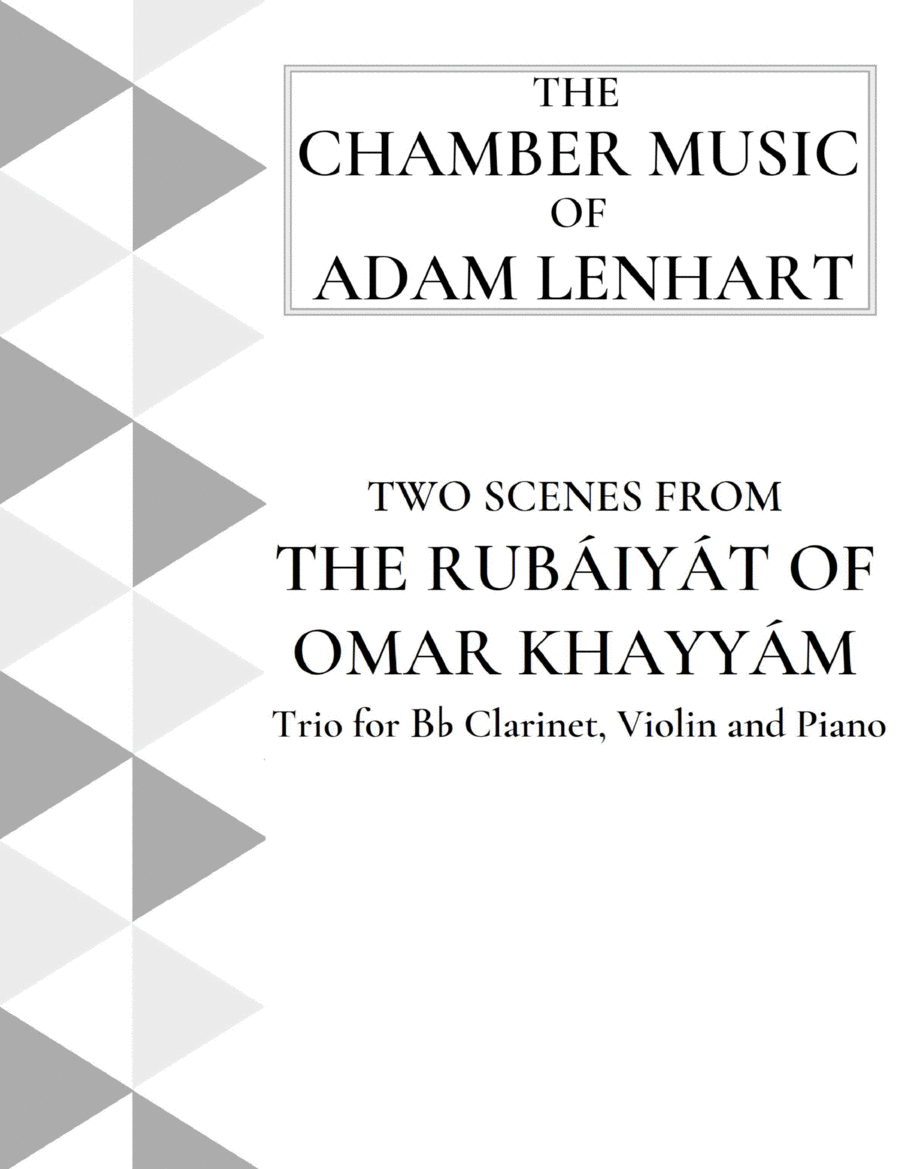
Two Scenes from The Rubáiyát of Omar Khayyám (Trio for Bb Clarinet, Violin and Piano)
Violon, Clarinette, Piano (trio)

$14.99 12.98 € Violon, Clarinette, Piano (trio) PDF SheetMusicPlus

Full Orchestra - Level 5 - Digital Download SKU: A0.1315331 Composed by Geraldine (Denny) Green. 21st Century,Classical,Contemporary,Romantic Period. 468 pages. Geraldine (Denny) Green at Oakmountmusic #904077. Published by Geraldine (Denny) Green at Oakmountmusic (A0.1315331). Duration : Approx. 30 minutesInstrumentationFlutes 1&2Piccolo/Flute 3Oboes 1&2Cor AnglaisClarinets 1&2 in BflatBass Clarinet in Bflat (To Low C)Bassoons 1&2Horns 1 – 4 in FTrumpets 1&2 in BflatTenor Trombones 1&2Bass TromboneTubaTimpani – 4Bass Drum, Sleigh Bells, Temple Blocks, Maracas, Cymbals – Crash and Suspended Snare Drum,Tambourine Triangle Tubular Bell (only 1 B bell required) Glockenspeil XylophoneCelestaHarpViolins 1&2ViolasCellosDouble BassesAbout The WorkOn Tuesday March 24th 2020, one day into the first UK national Lockdown at the start of the worldwide Covid-19 Pandemic, my Mum died! She was 91 and had been poorly with many different illnesses for the previous 6 months, so we knew it was coming. But the timing and unfathomable sadness of her death, together with the start of a worldwide pandemic, little did I know it at the time, was to bring forth from me a tsunami of music the likes of which I hadn’t written for many years. A set of six solo studies for various members of the clarinet family came first, written between March 20th and April 20th. As I wrote them they were orchestrating themselves in my head and forming something else as well. That “something else†grew and grew, as the Six Studies intertwined themselves around each other and expanded together, joining forces with two brand new themes to form what soon was to become an immense orchestral work. The title was easy. Glastry is a tiny district in the middle of the Co.Down countryside of Northern Ireland, where my Mum was born and brought up. And Pearl was her name. Her full name was actually Margaret Mary Ward (eventually to become Denny when she married my Dad, Colum Denny, from Belfast), but everyone always called her Pearl. The nickname was bestowed upon her just after she was born on February 28th 1929 and stuck ever since.The Glastry Pearl is a tribute to my Mum and the great and mighty person she was to me and all who knew her. It employs at least one theme or motif from each of the Six Studies For Various Solo Clarinets and uses them throughout the work in the from of Leitmotifs. It was only when the work was nearing completion that I began to wonder how to describe it. Freddy Naftel, a good composer friend of mine, suggested that Tone Poem was a fitting description and I immediately agreed. The music itself is completely tonal and highly Romantic, yet also peppered with exciting contemporary disonance. I believe it to be a good, and hopefully fun, challenge to symphony orchestras, both professional and high standard amateur alike. It offers everything from the the somber opening to the hilarious and wildly energetic central Waltz, to the glorious soaring final section, so plenty of variety to please many palates.
The Glastry Pearl. Tone Poem Elegy For My Mum.
Orchestre

$200.00 173.21 € Orchestre PDF SheetMusicPlus

Choral Piano,Vocal,Voice - Level 4 - Digital Download SKU: A0.730418 Composed by James Nathaniel Holland. Children,Christmas,Contemporary,Holiday. Score. 150 pages. James Nathaniel Holland #3376293. Published by James Nathaniel Holland (A0.730418). The Piano Vocal Score (with SA Chorus) New Contemporary Classical Music from American Costa Rican composer James Nathaniel Holland in his masterful ballet adaptation of Hans Christian Andersen's classic tale, The Snow Queen. Ballet yet to be premiered. Be the first to produce it! Highlights are The Dance of the Evil Snow Sprite and the Distorted Mirror, Innocence and Kai and Gerde's Special Friendship, The Waltz of the Roses ('Think of my love as a Rose'), The Waltz of the Snowflakes (Snowbees), Gerde Morns Kai's Death, The Suite of the Lady of Spring (Tale of the Tiger Lillies, The Dream of the Morning Glories, The Tale of the Snowdrops, the Hyacinth's Tale), The Waltz of the Summer Palace, Dance of the Thieves and Kai's Joyous Dance Finale. Ballet Synopsis: Evil Snow Sprites make a mirror that reflects all that is mean and evil. When it shatters, its splinters drift to the far corners of the world. Gerde and Kai are two poor children who live in Copenhagen in the early 19th Century. They live innocently with their parents and Grandmother and tend a rooftop rose garden. One winter night Kai meets the Snow Queen and a splinter from the mirror enters his eye. The Snow Queen returns and abducts Kai. Although accepted as dead, Gerde deeply feels otherwise and begins her quest to find her friend, traveling through the four seasons, sometimes beautiful and sometimes frightening.  The Lady of Spring takes her as an addition to her fantastical garden filled with tales and dreams of the flowers who dwell there. But when Gerde sees the rose on Spring's bonnet she wakes from her enchantment. Her tears spring back the roses who tell her Kai is not dead. She flees from the garden. Gerde grows up in the wilderness and a crow says that he has seen Kai at the Palace of the Queen of Summer. They hurry there to find a magnificent ball in progress. Gerde is introduced to the Kai lookalike but knows something is not right. The Queen of Summer helps Gerde on her way and lends her a coach and gives her a magic red rose that will never fade.As coach searches for Kai, it enters the season of Autumn and is accosted by robber girl and a band of theives. They dance in an rousing, energetic dance taunting her. When the morning comes Gerde tells her fellow captive animals of her quest to find Kai and that all hope is lost. The pigeons finally tell Gerde that Kai was abducted by the Snow Queen many years ago. The robber girl overhears them and has a change of heart letting her go with her reindeer to the far North of the Snow Queen.Gerde finds Kai in the palace of the Snow Queen piecing together the evil mirror. She gives Kai up for dead but leaves the rose of summer beside him. Kai spots the rose and he sheds a tear. The splinter falls out and he completes the mirror.They head back for home to their families were there is a big finale of a beautiful wedding on a late summer day and live happily ever after.YouTube Complete Ballet presentation: https://youtu.be/-zDAJ-Ttw70Composer website:  http://lacoronadelossantos.net/jamesnathanielholland.htmlTwo part performance CDs sold separately. Full score and parts sold separately. Many arrangements of the Waltz of the Roses ('Think of my love as a Rose'), The Lady of Spring and her Garden, and the Waltz of the Summer Palace sold separately. Orchestral Scores and Parts sold separately.
The Snow Queen, A Ballet in 3 Acts, PIANO VOCAL SCORE

$19.95 17.28 € PDF SheetMusicPlus

Piano Solo - Level 4 - Digital Download SKU: A0.1200229 By Skeeter Davis. By Arthur Kent and Sylvia Dee. Arranged by Timothy Stapay. Broadway,Film/TV,Musical/Show,Pop,Rock,Standards. Score. 6 pages. Timothy Stapay #799031. Published by Timothy Stapay (A0.1200229). An arrangement of The End Of The World,  a song covered by many famous artists. includingThe Carpenters; thanks to the phenomenal singing of Karen Carpenter.  The End of the World was written by composer Arthur Kent and lyricist Sylvia Dee, who often worked as a team.The Carpenters (officially known as Carpenters were an American vocal and instrumental duo consisting of siblings Karen (1950–1983) and Richard Carpenter (born 1946). They produced a distinctive soft musical style, combining Karen's contralto vocals with Richard's harmonizing, arranging, and composition skills. During their 14-year career, the Carpenters recorded 10 albums along with many singles and several television specials. Karen possessed a powerful singing voice, and close miking brought out many nuances in her performances.  Richard arranged their music to take advantage of this, though Karen had a three-octave vocal range.  Richard's work with Karen was influenced by the music of Les Paul, whose overdubbing of the voice of wife and musical partner Mary Ford allowed her to be used as both the lead and harmony vocals.[6] By multi-tracking, Richard was able to use Karen and himself for the harmonies to back Karen's lead. The overdubbed background harmonies were distinctive to the Carpenters, but it was the soulful, engaging sound of Karen's lead voice that made them so recognizable.  Record executive Mike Curb said it was Karen's voice that took the Carpenters above straight pop music into pop rock.   She was known as a one take wonder and could deliver a strong performance on the first attempt.Richard Carpenter was the creative force behind the Carpenters' sound. An accomplished keyboard player, composer and arranger, music critic Daniel Levitin called him one of the most gifted arrangers to emerge in popular music.  The duo's smooth harmonies were not in step with contemporary music, which was dominated by heavy rock.  Instead, the Carpenters strove for a rich and melodic sound, along the same vein as the Beach Boys and the Mamas & the Papas, but with greater fullness and orchestration including frequent use of small string and horn sections and introspective lyrics centred around relationships.  Richard also admired the musicianship and arranging skills of Frank Zappa, and the two briefly met backstage at the Billboard Forum in 1975.End Of The World: Lyrics:Why does the sun go on shining?Why does the sea rush to shore?Don't they know it's the end of the world?'Cause you don't love me any moreWhy do the birds go on singing?Why do the stars glow above?Don't they know it's the end of the world?It ended when I lost your love[Bridge]I wake up in the morning and I wonderWhy everything's the same as it wasI can't understand, no, I can't understandHow life goes on the way it doesWhy does my heart go on beating?Why do these eyes of mine cry?Don't they know it's the end of the world?It ended when you said goodbyeWhy does my heart go on beating?Why do these eyes of mine cry?Don't they know it's the end of the world?It ended when you
The End Of The World
Piano seul
Skeeter Davis
$6.99 6.05 € Piano seul PDF SheetMusicPlus

Cello,Instrumental Duet,Violin - Level 3 - Digital Download SKU: A0.1305309 By Zac Efron & Zendaya. By Benj Pasek and Justin Paul. Arranged by Sarah Cellobat Chaffee. Contemporary,Film/TV,Pop,Wedding. 13 pages. Sarah Cellobat Chaffee #894748. Published by Sarah Cellobat Chaffee (A0.1305309). Written by Benj Pasek and Justin Paul for the feature film The Greatest Showman, Rewrite The Stars is an exciting anthem in which Phillip, played by Zac Efron, works to convince his lover that they are meant to be together despite the odds against them. This catchy song was a huge hit even independently of the movie, reaching the Billboard Hot 100 and receiving a Teen Choice Award for Best Collaboration. It has also become a popular song for weddings, chosen by couples to symbolize their bright future together...so you can't go wrong having this one in your gig books! Originally written for a wedding ceremony, this Cellobat arrangement for violin and cello duet maintains the soaring melodies and exciting driving beat of the original, and it even features beautiful cello solos at the beginning and the end! Intermediate-level arrangement; this will be playable for students and sightreadable for professionals.Sarah “Cellobat†Chaffee is an in-demand acoustic & electric cellist and string arranger. Currently, she performs with legendary rock band Aerosmith in their “Deuces Are Wild†residency show, and she is the principal cellist for the Raiders House Band, playing for a crowd of 60,000 at all of the team's home games. She also plays with many other groups including Premiere Wedding Music, Bella Electric Strings, the Femmes Of Rock, and David Perrico’s Pop Strings Orchestra. Sarah has performed and recorded with numerous other artists including Disturbed, Mötley Crüe, Celine Dion, Halsey, Michael Bublé, Sarah Brightman, and Lady A. She is the exclusive arranger for a number of award-winning wedding and event companies all across the United States, including Premiere Wedding Music, Las Vegas Music Oasis, and Impulse Strings, and she has created custom arrangements for many other ensembles all over the world. You can find her at:http://www.cellobat.comhttp://www.instagram.com/cellobathttps://www.youtube.com/@Cellobat.
Rewrite The Stars
Violon, Violoncelle (duo)
Zac Efron & Zendaya
$9.99 8.65 € Violon, Violoncelle (duo) PDF SheetMusicPlus

Full Orchestra - Level 3 - Digital Download SKU: A0.746971 Composed by Montenegrin folk song. Arranged by Keith Terrett. 20th Century,Multicultural,Patriotic,Praise & Worship,Traditional,World. 27 pages. Keith Terrett #5205655. Published by Keith Terrett (A0.746971). The National Anthem of Montenegro arranged for Symphony Orchestra. There are versions for Brass Quintet & String Orchestra in my on-line stores.Oj, svijetla majska zoro (Montenegrin Cyrillic: „Ој, Ñвијетла мајÑка зоро, trans. Oh, Bright Dawn of May) is the official National anthem of Montenegro adopted in 2004. Before becoming the anthem, it was a popular folk song of the Montenegrins, with many variations of its text. The oldest one is dated to the 2nd half of the 19th century, known as Oh, Bright Dawn of Heroism, oh!, a popular Montenegrin folk song.It was played in public for the first time in 1863 in the national theater in Belgrade. It was a component song of the Battle of Grahovo or blood feud in Montenegro (Бој на Грахову или крвна оÑвета у Црној Гори) heroic play in three parts. It is unknown if the text’s authors are also the play’s, namely the following Montenegrin composer/writers: the father of Marko Car Jovan Car and an unknown Obrad Vitković. The play and the Montenegrin folk song was also played/sung in the National Theater again in 1870 and 1876. Its first record in Montenegro itself dates to 1887, when it was included into the regular school program of Montenegrin national songs for pupils in the 3rd grade. It was reconfirmed in the teacher’s plan for Montenegrin schools of 1888, which speculates that it must have been an established folk song for decades by then.Sekule Drljević, party strongman of a minor political party which was active in the Yugoslavian Kingdom in Montenegro known as the Montenegrin Federalist Party, rewrote the text and published it in 1937 in the book of then’s Croatian writer of Montenegrin origins Savić Marković Å tedimlija known as Crvena Hrvatska (Red Croatia), which confounded the thesis not of a Serb ethnic origin of the Montenegrins, which was the dominant one back then, but rather from the Croats. Its name was Eternal Ours… (VjeÄna naÅ¡a). When Nikola Hercigonja wrote down Oh, Bright Dawn of May shortly after WWII ended after 1945, he erroneously concluded that Drljević was the original wholesale author of this song, which also led to its considerable decline in popularity as a Montenegrin folk song altogether.The song survived until today under various names as a popular Montenegrin folk song under the name Oh, Bright Dawn of May (Oj svijetla majska zoro). This version of the song has been one of the several versions proposed in 1993 during the first discussion on the official anthem, however, on which there was no consensus because of the disputed melodic value.Need an anthem fast? They are ALL in my store! All my anthem arrangements are also available for Orchestra, Recorders, Saxophones, Wind, Brass and Flexible band. If you need an anthem urgently for an instrumentation not in my store, let me know via e-mail, and I will arrange it for you FOC if possible! keithterrett@gmail.com Love national anthems, then join me on twitter, facebook, instagram & soundcloud for frequent updates on my Olympic anthems!
Montenegrin National Anthem for Symphony Orchestra (Kt Olympic Anthem Series)
Orchestre

$36.00 31.18 € Orchestre PDF SheetMusicPlus

Instrumental Solo,Oboe d'Amore,Piano - Level 1 - Digital Download SKU: A0.548718 Composed by Martin Luther. Arranged by James M. Guthrie, ASCAP. Easter,Instructional,Standards. Score and individual part. 4 pages. Jmsgu3 #3411751. Published by jmsgu3 (A0.548718). Out of the Depths I Cry to You by Martin Luther. The first verses feature modified counterpoint and harmony proceeding at quarter = 82. The final verse is reharmonized for maximum dramatic effect at a more contemplative tempo such as quarter = 64. Features the entire range of the instrument. Very powerful selection for Lent or Easter. Duration (3 verses) 3:05, 36 ms. Score: 3 pg. Solo part: 1 pg. The piano reads from the score. Out of the Depths Aus tiefer Not schrei ich zu dir (From deep affliction I cry out to you), is, of course, a hymn composed by Martin Luther. Moreover, Luther also wrote the lyrics, essentially a paraphrase of Psalm 130. First published in 1524, it is also one of eight songs in the original Lutheran hymnal. It appears likewise in many hymnals and in different translations. The lyrics furthermore stimulated compositions from the Renaissance to the contemporary. Consequently, composers such as Johann Sebastian Bach built an entire chorale cantata on it. Other composers similarly contributed pieces, such as Felix Mendelssohn and Max Reger. Luther Background Martin Luther, (1483 –1546) was a German professor of theology, composer, priest, and moreover, an influential character in the Protestant Reformation. Luther had a momentous impact on church and society due to his contributions to the musical arts. He wanted to disseminate the gospel among mankind and with this intention thought that the best way to do that was through music. Influence It is important to realize that other musicians, and their descendants, were encouraged by Luther’s songs and wrote their own hymns. Luther, to be sure, had a thorough musical education. For example, he knew secular and sacred songs from an early age. He, in particular, played the lute well and sang in the monastery when he was a monk. That is to say, music was an essential part of his life. He in fact first began writing songs in 1523, sometimes writing the melody as well as the lyrics. Luther was certainly able to evaluate the composers of his time. He thought especially highly of Josquin des and Ludwig Senfl. He was also acquainted, with this in mind, with other composers and their works. Legacy The Lutheran musical ethos soon covered all of Germany and later significantly fashioned Protestant musical culture. Heinrich Schütz and Johann Sebastian Bach are the most compelling evidence of this Protestant musical culture. Additionally, as a point often overlooked, the pedal organ, first refined in northern Germany, became universally prevalent. As a matter of fact, Dieterich Buxtehude established a regular evening organ concert series in Lübeck. Another key point is that this concert series, in turn, spread North German Musical ideas worldwide. Luther was especially convinced that music is a beautiful and exclusive offering of the divine.
Luther: Out of the Depths for Oboe d'Amore & Piano

$24.95 21.61 € PDF SheetMusicPlus

Bass Flute,Instrumental Solo,Piano - Level 1 - Digital Download SKU: A0.548712 Composed by Martin Luther. Arranged by James M. Guthrie, ASCAP. Easter,Instructional,Standards. Score and individual part. 4 pages. Jmsgu3 #3411731. Published by jmsgu3 (A0.548712). Out of the Depths I Cry to You by Martin Luther arranged for bass flute & piano. The first verses feature modified counterpoint and harmony proceeding at quarter = 82. The final verse is reharmonized for maximum dramatic effect at a more contemplative tempo such as quarter = 64. Features the entire range of the instrument. Very powerful selection for Lent or Easter. Duration (3 verses) 3:05, 36 ms. Score: 3 pg. Solo part: 1 pg. The piano reads from the score. Out of the Depths Aus tiefer Not schrei ich zu dir (From deep affliction I cry out to you), is, of course, a hymn composed by Martin Luther. Moreover, Luther also wrote the lyrics, essentially a paraphrase of Psalm 130. First published in 1524, it is also one of eight songs in the original Lutheran hymnal. It appears likewise in many hymnals and in different translations. The lyrics furthermore stimulated compositions from the Renaissance to the contemporary. Consequently, composers such as Johann Sebastian Bach built an entire chorale cantata on it. Other composers similarly contributed pieces, such as Felix Mendelssohn and Max Reger. Luther Background Martin Luther, (1483 –1546) was a German professor of theology, composer, priest, and moreover, an influential character in the Protestant Reformation. Luther had a momentous impact on church and society due to his contributions to the musical arts. He wanted to disseminate the gospel among mankind and with this intention thought that the best way to do that was through music. Influence It is important to realize that other musicians, and their descendants, were encouraged by Luther’s songs and wrote their own hymns. Luther, to be sure, had a thorough musical education. For example, he knew secular and sacred songs from an early age. He, in particular, played the lute well and sang in the monastery when he was a monk. That is to say, music was an essential part of his life. He in fact first began writing songs in 1523, sometimes writing the melody as well as the lyrics. Luther was certainly able to evaluate the composers of his time. He thought especially highly of Josquin des and Ludwig Senfl. He was also acquainted, with this in mind, with other composers and their works. Legacy The Lutheran musical ethos soon covered all of Germany and later significantly fashioned Protestant musical culture. Heinrich Schütz and Johann Sebastian Bach are the most compelling evidence of this Protestant musical culture. Additionally, as a point often overlooked, the pedal organ, first refined in northern Germany, became universally prevalent. As a matter of fact, Dieterich Buxtehude established a regular evening organ concert series in Lübeck. Another key point is that this concert series, in turn, spread North German Musical ideas worldwide. Luther was especially convinced that music is a beautiful and exclusive offering of the divine.
Luther: Out of the Depths for Bass Flute & Piano

$24.95 21.61 € PDF SheetMusicPlus

Baritone Saxophone,Piano - Level 1 - Digital Download SKU: A0.548713 Composed by Martin Luther. Arranged by James M. Guthrie, ASCAP. Easter,Instructional,Standards. Score and part. 4 pages. Jmsgu3 #3411737. Published by jmsgu3 (A0.548713). Out of the Depths I Cry to You by Martin Luther. The first verses feature modified counterpoint and harmony proceeding at quarter = 82. The final verse is reharmonized for maximum dramatic effect at a more contemplative tempo such as quarter = 64. Features the entire range of the instrument. Very powerful selection for Lent or Easter. Duration (3 verses) 3:05, 36 ms. Score: 3 pg. Solo part: 1 pg. The piano reads from the score. Out of the Depths Aus tiefer Not schrei ich zu dir (From deep affliction I cry out to you), is, of course, a hymn composed by Martin Luther. Moreover, Luther also wrote the lyrics, essentially a paraphrase of Psalm 130. First published in 1524, it is also one of eight songs in the original Lutheran hymnal. It appears likewise in many hymnals and in different translations. The lyrics furthermore stimulated compositions from the Renaissance to the contemporary. Consequently, composers such as Johann Sebastian Bach built an entire chorale cantata on it. Other composers similarly contributed pieces, such as Felix Mendelssohn and Max Reger. Luther Background Martin Luther, (1483 –1546) was a German professor of theology, composer, priest, and moreover, an influential character in the Protestant Reformation. Luther had a momentous impact on church and society due to his contributions to the musical arts. He wanted to disseminate the gospel among mankind and with this intention thought that the best way to do that was through music. Influence It is important to realize that other musicians, and their descendants, were encouraged by Luther’s songs and wrote their own hymns. Luther, to be sure, had a thorough musical education. For example, he knew secular and sacred songs from an early age. He, in particular, played the lute well and sang in the monastery when he was a monk. That is to say, music was an essential part of his life. He in fact first began writing songs in 1523, sometimes writing the melody as well as the lyrics. Luther was certainly able to evaluate the composers of his time. He thought especially highly of Josquin des and Ludwig Senfl. He was also acquainted, with this in mind, with other composers and their works. Legacy The Lutheran musical ethos soon covered all of Germany and later significantly fashioned Protestant musical culture. Heinrich Schütz and Johann Sebastian Bach are the most compelling evidence of this Protestant musical culture. Additionally, as a point often overlooked, the pedal organ, first refined in northern Germany, became universally prevalent. As a matter of fact, Dieterich Buxtehude established a regular evening organ concert series in Lübeck. Another key point is that this concert series, in turn, spread North German Musical ideas worldwide. Luther was especially convinced that music is a beautiful and exclusive offering of the divine.
Luther: Out of the Depths for Baritone Sax & Piano
Saxophone Baryton, Piano

$24.95 21.61 € Saxophone Baryton, Piano PDF SheetMusicPlus

Piano,Trombone - Level 1 - Digital Download SKU: A0.548722 Composed by Martin Luther. Arranged by James M. Guthrie, ASCAP. Easter,Instructional,Standards. Score and part. 4 pages. Jmsgu3 #3411759. Published by jmsgu3 (A0.548722). Out of the Depths I Cry to You by Martin Luther. The first verses feature modified counterpoint and harmony proceeding at quarter = 82. The final verse is reharmonized for maximum dramatic effect at a more contemplative tempo such as quarter = 64. Features the entire range of the instrument. Very powerful selection for Lent or Easter. Duration (3 verses) 3:05, 36 ms. Score: 3 pg. Solo part: 1 pg. The piano reads from the score. Out of the Depths Aus tiefer Not schrei ich zu dir (From deep affliction I cry out to you), is, of course, a hymn composed by Martin Luther. Moreover, Luther also wrote the lyrics, essentially a paraphrase of Psalm 130. First published in 1524, it is also one of eight songs in the original Lutheran hymnal. It appears likewise in many hymnals and in different translations. The lyrics furthermore stimulated compositions from the Renaissance to the contemporary. Consequently, composers such as Johann Sebastian Bach built an entire chorale cantata on it. Other composers similarly contributed pieces, such as Felix Mendelssohn and Max Reger. Luther Background Martin Luther, (1483 –1546) was a German professor of theology, composer, priest, and moreover, an influential character in the Protestant Reformation. Luther had a momentous impact on church and society due to his contributions to the musical arts. He wanted to disseminate the gospel among mankind and with this intention thought that the best way to do that was through music. Influence It is important to realize that other musicians, and their descendants, were encouraged by Luther’s songs and wrote their own hymns. Luther, to be sure, had a thorough musical education. For example, he knew secular and sacred songs from an early age. He, in particular, played the lute well and sang in the monastery when he was a monk. That is to say, music was an essential part of his life. He in fact first began writing songs in 1523, sometimes writing the melody as well as the lyrics. Luther was certainly able to evaluate the composers of his time. He thought especially highly of Josquin des and Ludwig Senfl. He was also acquainted, with this in mind, with other composers and their works. Legacy The Lutheran musical ethos soon covered all of Germany and later significantly fashioned Protestant musical culture. Heinrich Schütz and Johann Sebastian Bach are the most compelling evidence of this Protestant musical culture. Additionally, as a point often overlooked, the pedal organ, first refined in northern Germany, became universally prevalent. As a matter of fact, Dieterich Buxtehude established a regular evening organ concert series in Lübeck. Another key point is that this concert series, in turn, spread North German Musical ideas worldwide. Luther was especially convinced that music is a beautiful and exclusive offering of the divine.
Luther: Out of the Depths for Trombone & Piano
Trombone et Piano

$24.95 21.61 € Trombone et Piano PDF SheetMusicPlus

Piano,Tenor Saxophone - Level 1 - Digital Download SKU: A0.548723 Composed by Martin Luther. Arranged by James M. Guthrie, ASCAP. Easter,Instructional,Standards. Score and part. 4 pages. Jmsgu3 #3411761. Published by jmsgu3 (A0.548723). Out of the Depths I Cry to You by Martin Luther. The first verses feature modified counterpoint and harmony proceeding at quarter = 82. The final verse is reharmonized for maximum dramatic effect at a more contemplative tempo such as quarter = 64. Features the entire range of the instrument. Very powerful selection for Lent or Easter. Duration (3 verses) 3:05, 36 ms. Score: 3 pg. Solo part: 1 pg. The piano reads from the score. Out of the Depths Aus tiefer Not schrei ich zu dir (From deep affliction I cry out to you), is, of course, a hymn composed by Martin Luther. Moreover, Luther also wrote the lyrics, essentially a paraphrase of Psalm 130. First published in 1524, it is also one of eight songs in the original Lutheran hymnal. It appears likewise in many hymnals and in different translations. The lyrics furthermore stimulated compositions from the Renaissance to the contemporary. Consequently, composers such as Johann Sebastian Bach built an entire chorale cantata on it. Other composers similarly contributed pieces, such as Felix Mendelssohn and Max Reger. Luther Background Martin Luther, (1483 –1546) was a German professor of theology, composer, priest, and moreover, an influential character in the Protestant Reformation. Luther had a momentous impact on church and society due to his contributions to the musical arts. He wanted to disseminate the gospel among mankind and with this intention thought that the best way to do that was through music. Influence It is important to realize that other musicians, and their descendants, were encouraged by Luther’s songs and wrote their own hymns. Luther, to be sure, had a thorough musical education. For example, he knew secular and sacred songs from an early age. He, in particular, played the lute well and sang in the monastery when he was a monk. That is to say, music was an essential part of his life. He in fact first began writing songs in 1523, sometimes writing the melody as well as the lyrics. Luther was certainly able to evaluate the composers of his time. He thought especially highly of Josquin des and Ludwig Senfl. He was also acquainted, with this in mind, with other composers and their works. Legacy The Lutheran musical ethos soon covered all of Germany and later significantly fashioned Protestant musical culture. Heinrich Schütz and Johann Sebastian Bach are the most compelling evidence of this Protestant musical culture. Additionally, as a point often overlooked, the pedal organ, first refined in northern Germany, became universally prevalent. As a matter of fact, Dieterich Buxtehude established a regular evening organ concert series in Lübeck. Another key point is that this concert series, in turn, spread North German Musical ideas worldwide. Luther was especially convinced that music is a beautiful and exclusive offering of the divine.
Luther: Out of the Depths for Tenor Sax & Piano
Saxophone Tenor et Piano

$24.95 21.61 € Saxophone Tenor et Piano PDF SheetMusicPlus

Piano,Soprano Saxophone - Level 1 - Digital Download SKU: A0.548720 Composed by Martin Luther. Arranged by James M. Guthrie, ASCAP. Easter,Instructional,Standards. Score and part. 4 pages. Jmsgu3 #3411755. Published by jmsgu3 (A0.548720). Out of the Depths I Cry to You by Martin Luther. The first verses feature modified counterpoint and harmony proceeding at quarter = 82. The final verse is reharmonized for maximum dramatic effect at a more contemplative tempo such as quarter = 64. Features the entire range of the instrument. Very powerful selection for Lent or Easter. Duration (3 verses) 3:05, 36 ms. Score: 3 pg. Solo part: 1 pg. The piano reads from the score. Out of the Depths Aus tiefer Not schrei ich zu dir (From deep affliction I cry out to you), is, of course, a hymn composed by Martin Luther. Moreover, Luther also wrote the lyrics, essentially a paraphrase of Psalm 130. First published in 1524, it is also one of eight songs in the original Lutheran hymnal. It appears likewise in many hymnals and in different translations. The lyrics furthermore stimulated compositions from the Renaissance to the contemporary. Consequently, composers such as Johann Sebastian Bach built an entire chorale cantata on it. Other composers similarly contributed pieces, such as Felix Mendelssohn and Max Reger. Luther Background Martin Luther, (1483 –1546) was a German professor of theology, composer, priest, and moreover, an influential character in the Protestant Reformation. Luther had a momentous impact on church and society due to his contributions to the musical arts. He wanted to disseminate the gospel among mankind and with this intention thought that the best way to do that was through music. Influence It is important to realize that other musicians, and their descendants, were encouraged by Luther’s songs and wrote their own hymns. Luther, to be sure, had a thorough musical education. For example, he knew secular and sacred songs from an early age. He, in particular, played the lute well and sang in the monastery when he was a monk. That is to say, music was an essential part of his life. He in fact first began writing songs in 1523, sometimes writing the melody as well as the lyrics. Luther was certainly able to evaluate the composers of his time. He thought especially highly of Josquin des and Ludwig Senfl. He was also acquainted, with this in mind, with other composers and their works. Legacy The Lutheran musical ethos soon covered all of Germany and later significantly fashioned Protestant musical culture. Heinrich Schütz and Johann Sebastian Bach are the most compelling evidence of this Protestant musical culture. Additionally, as a point often overlooked, the pedal organ, first refined in northern Germany, became universally prevalent. As a matter of fact, Dieterich Buxtehude established a regular evening organ concert series in Lübeck. Another key point is that this concert series, in turn, spread North German Musical ideas worldwide. Luther was especially convinced that music is a beautiful and exclusive offering of the divine.
Luther: Out of the Depths for Soprano Sax & Piano
Saxophone Soprano et Piano

$24.95 21.61 € Saxophone Soprano et Piano PDF SheetMusicPlus

Piano,Tuba - Level 1 - Digital Download SKU: A0.548724 Composed by Martin Luther. Arranged by James M. Guthrie, ASCAP. Easter,Instructional,Standards. Score and part. 4 pages. Jmsgu3 #3411763. Published by jmsgu3 (A0.548724). Out of the Depths I Cry to You by Martin Luther. The first verses feature modified counterpoint and harmony proceeding at quarter = 82. The final verse is reharmonized for maximum dramatic effect at a more contemplative tempo such as quarter = 64. Features the entire range of the instrument. Very powerful selection for Lent or Easter. Duration (3 verses) 3:05, 36 ms. Score: 3 pg. Solo part: 1 pg. The piano reads from the score. Out of the Depths Aus tiefer Not schrei ich zu dir (From deep affliction I cry out to you), is, of course, a hymn composed by Martin Luther. Moreover, Luther also wrote the lyrics, essentially a paraphrase of Psalm 130. First published in 1524, it is also one of eight songs in the original Lutheran hymnal. It appears likewise in many hymnals and in different translations. The lyrics furthermore stimulated compositions from the Renaissance to the contemporary. Consequently, composers such as Johann Sebastian Bach built an entire chorale cantata on it. Other composers similarly contributed pieces, such as Felix Mendelssohn and Max Reger. Luther Background Martin Luther, (1483 –1546) was a German professor of theology, composer, priest, and moreover, an influential character in the Protestant Reformation. Luther had a momentous impact on church and society due to his contributions to the musical arts. He wanted to disseminate the gospel among mankind and with this intention thought that the best way to do that was through music. Influence It is important to realize that other musicians, and their descendants, were encouraged by Luther’s songs and wrote their own hymns. Luther, to be sure, had a thorough musical education. For example, he knew secular and sacred songs from an early age. He, in particular, played the lute well and sang in the monastery when he was a monk. That is to say, music was an essential part of his life. He in fact first began writing songs in 1523, sometimes writing the melody as well as the lyrics. Luther was certainly able to evaluate the composers of his time. He thought especially highly of Josquin des and Ludwig Senfl. He was also acquainted, with this in mind, with other composers and their works. Legacy The Lutheran musical ethos soon covered all of Germany and later significantly fashioned Protestant musical culture. Heinrich Schütz and Johann Sebastian Bach are the most compelling evidence of this Protestant musical culture. Additionally, as a point often overlooked, the pedal organ, first refined in northern Germany, became universally prevalent. As a matter of fact, Dieterich Buxtehude established a regular evening organ concert series in Lübeck. Another key point is that this concert series, in turn, spread North German Musical ideas worldwide. Luther was especially convinced that music is a beautiful and exclusive offering of the divine.
Luther: Out of the Depths for Tuba & Piano
Tuba et Piano

$24.95 21.61 € Tuba et Piano PDF SheetMusicPlus

English Horn,Piano - Level 1 - Digital Download SKU: A0.548716 Composed by Martin Luther. Arranged by James M. Guthrie, ASCAP. Easter,Instructional,Standards. Score and part. 4 pages. Jmsgu3 #3411745. Published by jmsgu3 (A0.548716). Out of the Depths I Cry to You by Martin Luther. The first verses feature modified counterpoint and harmony proceeding at quarter = 82. The final verse is reharmonized for maximum dramatic effect at a more contemplative tempo such as quarter = 64. Features the entire range of the instrument. Very powerful selection for Lent or Easter. Duration (3 verses) 3:05, 36 ms. Score: 3 pg. Solo part: 1 pg. The piano reads from the score. Out of the Depths Aus tiefer Not schrei ich zu dir (From deep affliction I cry out to you), is, of course, a hymn composed by Martin Luther. Moreover, Luther also wrote the lyrics, essentially a paraphrase of Psalm 130. First published in 1524, it is also one of eight songs in the original Lutheran hymnal. It appears likewise in many hymnals and in different translations. The lyrics furthermore stimulated compositions from the Renaissance to the contemporary. Consequently, composers such as Johann Sebastian Bach built an entire chorale cantata on it. Other composers similarly contributed pieces, such as Felix Mendelssohn and Max Reger. Luther Background Martin Luther, (1483 –1546) was a German professor of theology, composer, priest, and moreover, an influential character in the Protestant Reformation. Luther had a momentous impact on church and society due to his contributions to the musical arts. He wanted to disseminate the gospel among mankind and with this intention thought that the best way to do that was through music. Influence It is important to realize that other musicians, and their descendants, were encouraged by Luther’s songs and wrote their own hymns. Luther, to be sure, had a thorough musical education. For example, he knew secular and sacred songs from an early age. He, in particular, played the lute well and sang in the monastery when he was a monk. That is to say, music was an essential part of his life. He in fact first began writing songs in 1523, sometimes writing the melody as well as the lyrics. Luther was certainly able to evaluate the composers of his time. He thought especially highly of Josquin des and Ludwig Senfl. He was also acquainted, with this in mind, with other composers and their works. Legacy The Lutheran musical ethos soon covered all of Germany and later significantly fashioned Protestant musical culture. Heinrich Schütz and Johann Sebastian Bach are the most compelling evidence of this Protestant musical culture. Additionally, as a point often overlooked, the pedal organ, first refined in northern Germany, became universally prevalent. As a matter of fact, Dieterich Buxtehude established a regular evening organ concert series in Lübeck. Another key point is that this concert series, in turn, spread North German Musical ideas worldwide. Luther was especially convinced that music is a beautiful and exclusive offering of the divine.
Luther: Out of the Depths for English Horn & Piano
Cor anglais, Piano

$24.95 21.61 € Cor anglais, Piano PDF SheetMusicPlus

B-Flat Trumpet,Piano - Level 1 - Digital Download SKU: A0.548721 Composed by Martin Luther. Arranged by James M. Guthrie, ASCAP. Easter,Instructional,Standards. Score and part. 4 pages. Jmsgu3 #3411757. Published by jmsgu3 (A0.548721). Out of the Depths I Cry to You by Martin Luther. The first verses feature modified counterpoint and harmony proceeding at quarter = 82. The final verse is reharmonized for maximum dramatic effect at a more contemplative tempo such as quarter = 64. Features the entire range of the instrument. Very powerful selection for Lent or Easter. Duration (3 verses) 3:05, 36 ms. Score: 3 pg. Solo part: 1 pg. The piano reads from the score. Out of the Depths Aus tiefer Not schrei ich zu dir (From deep affliction I cry out to you), is, of course, a hymn composed by Martin Luther. Moreover, Luther also wrote the lyrics, essentially a paraphrase of Psalm 130. First published in 1524, it is also one of eight songs in the original Lutheran hymnal. It appears likewise in many hymnals and in different translations. The lyrics furthermore stimulated compositions from the Renaissance to the contemporary. Consequently, composers such as Johann Sebastian Bach built an entire chorale cantata on it. Other composers similarly contributed pieces, such as Felix Mendelssohn and Max Reger. Luther Background Martin Luther, (1483 –1546) was a German professor of theology, composer, priest, and moreover, an influential character in the Protestant Reformation. Luther had a momentous impact on church and society due to his contributions to the musical arts. He wanted to disseminate the gospel among mankind and with this intention thought that the best way to do that was through music. Influence It is important to realize that other musicians, and their descendants, were encouraged by Luther’s songs and wrote their own hymns. Luther, to be sure, had a thorough musical education. For example, he knew secular and sacred songs from an early age. He, in particular, played the lute well and sang in the monastery when he was a monk. That is to say, music was an essential part of his life. He in fact first began writing songs in 1523, sometimes writing the melody as well as the lyrics. Luther was certainly able to evaluate the composers of his time. He thought especially highly of Josquin des and Ludwig Senfl. He was also acquainted, with this in mind, with other composers and their works. Legacy The Lutheran musical ethos soon covered all of Germany and later significantly fashioned Protestant musical culture. Heinrich Schütz and Johann Sebastian Bach are the most compelling evidence of this Protestant musical culture. Additionally, as a point often overlooked, the pedal organ, first refined in northern Germany, became universally prevalent. As a matter of fact, Dieterich Buxtehude established a regular evening organ concert series in Lübeck. Another key point is that this concert series, in turn, spread North German Musical ideas worldwide. Luther was especially convinced that music is a beautiful and exclusive offering of the divine.
Luther: Out of the Depths for Trumpet & Piano
Trompette

$24.95 21.61 € Trompette PDF SheetMusicPlus


Partitions Gratuites
Acheter des Partitions Musicales
Acheter des Partitions Digitales à Imprimer
Acheter des Instruments de Musique

© 2000 - 2026

Accueil - Version intégrale





