EUROPE
166318 articles
USA
100084 articles
DIGITAL
427344 articles (à imprimer)
Partitions Digitales
Partitions à imprimer
427344 partitions trouvées


Full Orchestra - Level 2 - Digital Download SKU: A0.1224099 Composed by Juan María Solare. 19th Century,20th Century,21st Century,Classical,Instructional. Score and Parts. 20 pages. Juan Maria Solare #820190. Published by Juan Maria Solare (A0.1224099). Orchestraining is a cycle of orchestral studies, each of which focuses on different aspects of performance. These studies are specifically designed for non-professional orchestras, although any orchestra will improve by playing some of these pieces during rehearsals. It is always necessary to pay attention to intonation and many other aspects of orchestral performance.In addition, these studies are also useful for orchestral conducting students. For example, it is essential to know how to conduct a simultaneous attack of a chord that does not begin on the first beat, but a eighth note after the third beat.I began writing these studies around 2013, when I took over the direction of the Bremer Orchestergemeinschaft and noticed the complete absence of repertoire of this kind. As a pianist, I am accustomed to studies by Carl Czerny or playing scales. Each individual instrumentalist knows studies of technique for their instrument. However, there are no, or at least I am not aware of, similar studies for orchestral performance technique and the specific difficulties of ensemble playing that it requires. The cycle Orchestraining aims to fill this gap.The particular study Orchestraining Nr. 01 focuses on the subject of simultaneous attacks, presenting a series of staccato chords in different parts of the bar. The piece will be played twice, with different dynamics and (partly) different performing techniques (particularly in the strings: pizzicato vs. arco).Orchestraining No. 01 - simultaneous attacks*Orchestraining es un ciclo de estudios orquestales, cada uno de los cuales tematiza diferentes aspectos de la ejecución. Estos estudios están concebidos específicamente para orquestas no profesionales; sin embargo, cualquier orquesta mejorará si toca alguna de estas piezas durante los ensayos. Siempre es necesario cuidar la afinación y muchos otros aspectos de la ejecución orquestal.Adicionalmente, estos estudios son también útiles para estudiantes de dirección orquestal. Por ejemplo, es imprescindible saber cómo dirigir un ataque simultáneo de un acorde que no comienza en el uno, sino una corchea después del tercer tiempo.Comencé a escribir estos estudios hacia 2013, cuando asumí la dirección de la Bremer Orchestergemeinschaft y noté la ausencia total de repertorio de este tipo. Como pianista estoy acostumbrado a los estudios de Carl Czerny o a tocar escalas. Cada instrumentista, individualmente, conoce sobradamente estudios de técnica para su instrumento. Sin embargo no existen, o no conozco, estudios similares para la técnica de ejecución orquestal y las dificultades específicas de ensamblaje que ésta requiere. El ciclo Orchestraining intenta cubrir esta laguna.El estudio Orchestraining Nr. 01 en particular trata el tema de los ataques simultáneos, presentando una serie de acordes staccato en distintas partes del compás. La obra se tocará dos veces, con distintas dinámicas y (en parte) con distintas técnicas de ejecución (particularmente en las cuerdas: pizzicato vs. arco).
Orchestraining No. 01 [Orchestra]
Orchestre

$5.00 4.22 € Orchestre PDF SheetMusicPlus

Full Orchestra - Level 4 - Digital Download SKU: A0.1370381 Composed by Claude Debussy. Arranged by Ben Trigg. 19th Century,Romantic Period. 221 pages. OlivePress Music #954757. Published by OlivePress Music (A0.1370381). From Debussyâ??s Préludes, Book I:I: The Wind Over The PlainsII: The Girl With The Flaxen HairIII: Puckâ??s DanceIV: The Sunken CathedralDebussyâ??s piano music is filled with colour, texture, vibrancy, sonority. To play it is to be taken inside a sound world greater than the instrument itself. In other words, it seems to demand orchestration. Whether the fanfare call of Puckâ??s Dance, the sotto voce flurries evoking The Wind Over The Plains, or the deepest and highest reaches of the musical spectrum explored in the under-water world of The Sunken Cathedral, Debussyâ??s music seems to drop hints at obvious orchestral manoeuvres. His great skill, of course, was condensing these musical ideas to the piano. But the fruit is there fo the taking, and indeed other orchestrations exist of the complete suite of piano preludes â?? Books I and II. So, why another?This particular suite cherry-picks some of my own favourite movements from the suite, and arranges them in a â??symphonicâ?? structure to present an opening, expository movement (The Wind Over The Plains), a romantic Adagio (The Girl With The Flaxen Hair), a sprightly â??scherzoâ?? (Puckâ??s Dance), concluding with an epic finale (The Sunken Cathedral). This condensed suite may make the music more approachable for some orchestras, and offers something shorter to concert programmes wishing to feature other major works alongside, instead of performing all 24 preludes.I hope you enjoy performing this suite as much as I enjoyed arranging it.Instrumentation: Piccolo 2 Flutes 2 Oboes Cor Anglais 2 Clarinets in Bâ?­ Bass Clarinet in Bâ?­ 2 Bassoons Contrabassoon 4 Horns in F 3 Trumpets in Bâ?­ 2 Trombones Bass Trombone Tuba Timpani Percussion (3/4 players): Triangle, Crash Cymbals, Suspended Cymbal, Bass Drum, Tam-Tam, Glockenspiel, Tubular Bells Celesta Harp Violin 1 (divisi à 4) Violin 2 (divisi à 4) Viola (divisi à 4) Violoncello (divisi à 4) Contrabass (B extension where possible) (divisi à 4)
Four Impressions on Debussy (4 Piano Preludes arranged for Full Orchestra) ? Score and Parts
Orchestre

$99.99 84.42 € Orchestre PDF SheetMusicPlus

Full Orchestra - Level 5 - Digital Download SKU: A0.534555 Composed by Thierry Pélicant. 20th Century,Contemporary,Standards. Score and parts. 46 pages. Musik Fabrik Music Publishing #4283543. Published by Musik Fabrik Music Publishing (A0.534555). In 2004, the Orchestre Philharmonique de l’Oise commissioned its musical director, t Thierry Pélicant, this concerto for the late Claude Caens, the principal contrabass of this orchestra. This great artist, who was friends with everyone in this ensemble, wanted everyone to have a part in the festivities, not only the strings, but also the winds, the horns, the trumpets and the percussion, and also that they all should be heard ! Thierry Pélicant wrote therefore a concerto which is at once very symphonic – and for this reason, it is strongly advised that the contrabass be amplified – but also a piece which would express the friendship between the orchestra and the soloist. This concerto strives to be both warm and lyrical : it is not a virtuoso showpiece, inspite of the real technical that it offers to the soloist and which he would do well to try to hid them from the audience. It is also not a battle between the orchestra and this gentle giant : they stroll together, sometimes joyously, sometimes with nostalgia and go through the strong storms which do not fail to present themselves, smiling together and finding them to be envigorating.The work is scored for (2(Pic)2(EH)22/2200/Timp/2perc/strings) and lasts aproximately 23 minutes. The orchestral parts are on rental from the pubilsher.  The full score is available for sale on this site.Thierry Pélicant was born in 1957 at Sainte-Adresse, France. After studying the organ and the horn, his meeting with Jean-Claude Hartemann, the Musical Director of the Opéra Comique in Paris lead him to decide to explore conducting. He was the student of Haremann for fifteen years. He is the Musical Director of the André Messager Orchestre and has also directed the Orchestre Philharmonique de l’Oise since 1980, one of the oldest French orchestras, since it was founded in 1750. A passionate ssupporter of French music, Pélicant reconstructed the Messe solennelle of L.V.A Boïeldieu and Te Deum of 1792 by Philidor and premièred and recorded the Suite Parnassienne, Massenet’s last work. At the same time, he has also served the music of our time in premièring or recording the works of Dazzi, Marchand, Braconnier, Bénard, Drouin, Preschez, etc. As a composer, musical grammar and stylistic debates only interest him from afar. As a true gourmet (since cooking is another of his passions), he strives to write the music that pleases him, that would be enjoyable to play and which would be enjoyable to hear, hopefully with real pleasure and in which he tries to express the emotions and the pleasant or surprising states of being which, to hime, these works are tied. Through this process, he has created concertos (for oboe, for bassoon, for organ, for contrabass), Escales & paysages, ma monumental literary concerto for narrator, piano and orchestra, written for his friend Dominique Preschez, Operas (Histoires comme ça, Ribouldingue, Élise et le fantôme) ; With the poet Luis Porquet, he wrote the song cycle Ombre légère (for soprano, harp and orchestre), Rhapsodie du Havre (for tenor and chamber orchestra, a commission from the Forum de Normandie to commemorate the 500 years of the founding of the city Le Havre), Et de toi, Bethleem, Christmas oratorio for baritone, chorus and orchestra and, finally, commissioned by the Orchestre de l’Oise in honor of the centennial of the First World War 14, fresque de la Grande Guerre, for the tenor Daniel Gàlvez-Vallejo, children’s chorus and orchestra. In the area of chamber music, he has written a sonata for horn and piano, for the Festival de Giverny, Borée (quintet for oboe and strings), Sextuor d’été, and Milonga (septet inspired by the World of Tango Music). Published in 2005, his novel Carnets de Walter Crane, explores the sufferings of a composer who has the obligation to write a string quartet ...
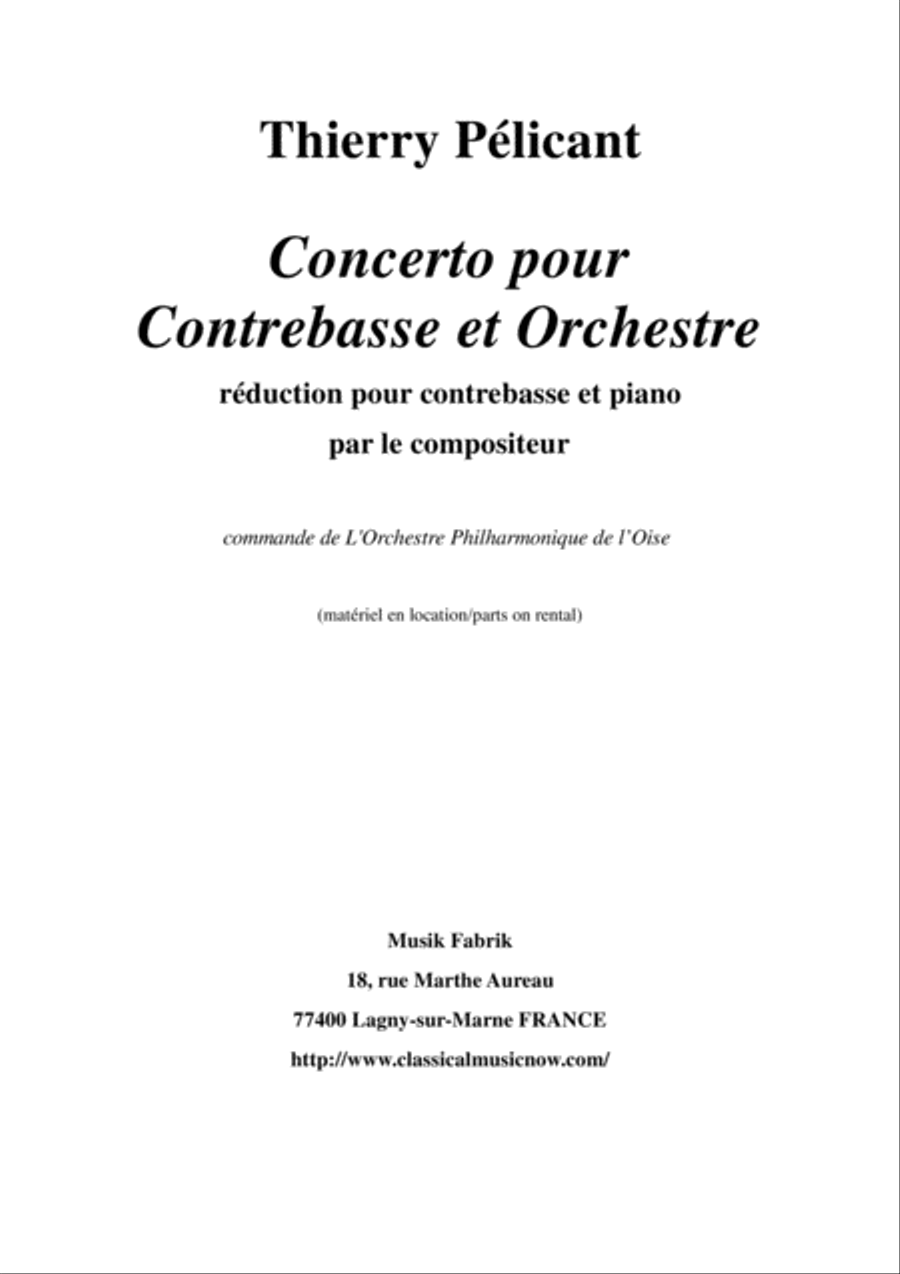
Thierry Pélicant: Concerto for contrabass and orchestra, piano reduction and solo part
Orchestre

$29.95 25.28 € Orchestre PDF SheetMusicPlus

Full Orchestra - Level 5 - Digital Download SKU: A0.534554 Composed by Thierry Pélicant. 20th Century,Contemporary,Standards. Score and parts. 136 pages. Musik Fabrik Music Publishing #4283537. Published by Musik Fabrik Music Publishing (A0.534554). In 2004, the Orchestre Philharmonique de l’Oise commissioned its musical director, t Thierry Pélicant, this concerto for the late Claude Caens, the principal contrabass of this orchestra. This great artist, who was friends with everyone in this ensemble, wanted everyone to have a part in the festivities, not only the strings, but also the winds, the horns, the trumpets and the percussion, and also that they all should be heard ! Thierry Pélicant wrote therefore a concerto which is at once very symphonic – and for this reason, it is strongly advised that the contrabass be amplified – but also a piece which would express the friendship between the orchestra and the soloist. This concerto strives to be both warm and lyrical : it is not a virtuoso showpiece, inspite of the real technical that it offers to the soloist and which he would do well to try to hid them from the audience. It is also not a battle between the orchestra and this gentle giant : they stroll together, sometimes joyously, sometimes with nostalgia and go through the strong storms which do not fail to present themselves, smiling together and finding them to be envigorating.The work is scored for (2(Pic)2(EH)22/2200/Timp/2perc/strings) and lasts aproximately 23 minutes. The orchestral parts are on rental from the pubilsher.  The piano reduction with the solo part is available for sale on this site.Thierry Pélicant was born in 1957 at Sainte-Adresse, France. After studying the organ and the horn, his meeting with Jean-Claude Hartemann, the Musical Director of the Opéra Comique in Paris lead him to decide to explore conducting. He was the student of Haremann for fifteen years. He is the Musical Director of the André Messager Orchestre and has also directed the Orchestre Philharmonique de l’Oise since 1980, one of the oldest French orchestras, since it was founded in 1750. A passionate ssupporter of French music, Pélicant reconstructed the Messe solennelle of L.V.A Boïeldieu and Te Deum of 1792 by Philidor and premièred and recorded the Suite Parnassienne, Massenet’s last work. At the same time, he has also served the music of our time in premièring or recording the works of Dazzi, Marchand, Braconnier, Bénard, Drouin, Preschez, etc. As a composer, musical grammar and stylistic debates only interest him from afar. As a true gourmet (since cooking is another of his passions), he strives to write the music that pleases him, that would be enjoyable to play and which would be enjoyable to hear, hopefully with real pleasure and in which he tries to express the emotions and the pleasant or surprising states of being which, to hime, these works are tied. Through this process, he has created concertos (for oboe, for bassoon, for organ, for contrabass), Escales & paysages, ma monumental literary concerto for narrator, piano and orchestra, written for his friend Dominique Preschez, Operas (Histoires comme ça, Ribouldingue, Élise et le fantôme) ; With the poet Luis Porquet, he wrote the song cycle Ombre légère (for soprano, harp and orchestre), Rhapsodie du Havre (for tenor and chamber orchestra, a commission from the Forum de Normandie to commemorate the 500 years of the founding of the city Le Havre), Et de toi, Bethleem, Christmas oratorio for baritone, chorus and orchestra and, finally, commissioned by the Orchestre de l’Oise in honor of the centennial of the First World War 14, fresque de la Grande Guerre, for the tenor Daniel Gàlvez-Vallejo, children’s chorus and orchestra. In the area of chamber music, he has written a sonata for horn and piano, for the Festival de Giverny, Borée (quintet for oboe and strings), Sextuor d’été, and Milonga (septet inspired by the World of Tango Music). Published in 2005, his novel Carnets de Walter Crane, explores the sufferings of a composer who has the obligation to write a string quartet ...
Thierry Pélicant: Concerto for contrabass and orchestra, score only
Orchestre

$38.95 32.88 € Orchestre PDF SheetMusicPlus

String Orchestra - Level 3 - Digital Download SKU: A0.725221 By Paul Barker Music. By Paul Barker. 20th Century,21st Century,Classical,Contemporary,Contest,Festival. Score and Parts. 26 pages. Paul Barker Music #6216749. Published by Paul Barker Music (A0.725221). Festiva is a refreshing orchestral fiesta laced with syncopated rhythms, memorable melodic motifs and playful use of suspensions and accents. Suitable as a fabulous finale or a competition showpiece with its powerful energy and spectacular fiery toccata sections.  Accompaniment & Part-Dominant rehearsal tracks available as single or multi-user MP3 downloads for your entire ensemble from www.paulbarkermusic.com Level: Intermediate (UK Grade 5+ and USA 2+) Duration: 2:55 Occasion: Concerts - Competitions - Festivals Instrumentation: String Orchestra - Timpani
Festiva
Orchestre à Cordes
Paul Barker Music
$29.95 25.28 € Orchestre à Cordes PDF SheetMusicPlus

Full Orchestra - Digital Download SKU: A0.746748 Composed by Keith Terrett. Contemporary,World. 33 pages. Keith Terrett #3129265. Published by Keith Terrett (A0.746748). ere at last is my ’’Elegy sentimentale’’ for orchestra, and my first original composition (opus 1), for full symphony orchestra.I hope it makes an excellent piece for amateur and professional orchestras alike; with some challenging and interesting string, woodwind and brass writing for all.I envisage the ’’Elegy’’ eventually making a good piece of film music, and in consequence any directors or producers looking for a movie theme; please feel free to contact me!Elegy Sentimenatle is a mournful & melancholic work, suited for performances on the concert platform.A Supreme Work of Art!The Elegy Sentimentale opens impressively. Keith Terrett plants a C deep in virgin soil; orchestrated brilliantly for bassoon, harp and delineated by pizzicato double basses this bass line is a tree of a forest; and we are at once held by the strength of the roots. The tonality is immediately clear, and there is a grand feeling of space and power in the wide layout of the score. A lone solo clarinet high in the tessitura accompanied by a solo cello with a counter subject state the opening eight bar theme which embodies the seeds of two ideas, which supplies the generating force for the slightly agitated Piu Mosso which follows. The counter subject given by the solo cello at the beginning is now reiterated by the plaintive voice of a solo oboe and a third motif makes an appearance in the solo clarinet; oboe and clarinet duet beautifully over arpeggiated rhythmic impulses in the harp. A new subject of an accompanying nature, derived from all the material thus far presented now comes off at a tangent on the strings cascading downwards and accompanying woodwind who, play the chief melodic subject while horns cry in anguish. This first section is then repeated; I found the whole experience spiritual, detached and wondering, intensified by the breath-taking stillness. Mr Terrett in the middle section that follows now uses his full orchestral forces; after a key change the emotional charge that follows is cataclysmic in its cry of anguish; the main theme is stated in a full dress orchestral tutti, which is then repeated. The music ebbs and flows with slight variations in the woodwind recalling the main ideas; at the very end high strings bring consolation and finally peace. Keith Terrett shows an admirable command of orchestration and melodic construction and combines these qualities with rare imagination and insight.Gerald Manning
Elegy Sentimentale for Orchestra
Orchestre

$30.00 25.33 € Orchestre PDF SheetMusicPlus

Full Orchestra - Level 5 - Digital Download SKU: A0.861959 Composed by Mark O'Connor. 20th Century,Contemporary,Folk. Score and parts. 93 pages. Mark O'Connor Musik International #6209393. Published by Mark O'Connor Musik International (A0.861959). Americana Symphony Variations on Appalachia Waltz (score – symphony orchestra) MO164AScore (parts available)Music by Mark O’Connor86 pages – 33:00 minutes in length Americana Symphony Variations on Appalachia WaltzFor Large Symphony Orchestra3333/4331/timp/perc/pno/harp+stringsComposed and orchestrated by Mark O’Connor 1st Movement: Brass Fanfare: Wide Open Spaces2nd Movement: New World Fanciful Dance3rd Movement: Different Paths Towards Home4th Movement: Open Plains Hoedown5th Movement: Soaring Eagle, Setting Sun6th Movement: Theme: Splendid HorizonsNote: Any movement or combination of the movements can be singled out or re-organized for performance. Most any order of movements is acceptable. Suggestions for consideration included I., II., III., and IV., all recommended as stand alone pieces. Most an order of movements is acceptable. The composition was designed for maximum flexibility. Three or four movements combine to make a shorter variation Symphony. What is American Classical music? This CD contains Mark O'Connor's latest orchestral works: Americana Symphony Variations on Appalachia Waltz(2006) and Concerto No. 6 Old Brass (2003). Sony Classical//BMG label director Gilbert Hetherwick explains; Dvorak and Copland painted symphonic landscapes using melodies inspired by the Americana tradition, and Mark O'Connor actually comes from that tradition itself. He's lived it every day of his life. And you hear it in every note of his Americana Symphony. For the majority of his solo career, O'Connor has dedicated himself to composing for orchestra: he has written six full-length concertos, several orchestral suites and string orchestra compositions, and most recently his first Symphony.David Wallace, Juilliard School faculty member and Senior Teaching Artist with the New York Philharmonic, comments on the overall characteristics of O'Connor's music: The Americana Symphony combines historical narrative with classical and folk variation principles. The Symphony contains instrumental virtuosity, rhythmic drive, poignant lyricism, and probing counterpoint. With the Americana Symphony, Mark O'Connor provides his answer to a question that has intrigued U. S. composers since the debut of Dvorak's New World Symphony in 1892: How do you write the great American Symphony?William Intrilligator, artistic director of the Dubuque Symphony, conducted one of the first performances of the Americana Symphony: Very few pieces of new music have the same emotional and visceral effect as this Symphony, he writes. It has such power and beauty, and these traits are expressed in original ways that are pure O'Connor and truly American.Marin Alsop, artistic director of the Baltimore Symphony Orchestra and this recording's conductor of the Americana Symphony, calls the Symphony simply A hit! Original music printed from the composer’s manuscripts.Music editing, copying and engraving by Mark O’Connorusing Finale on Apple Macintosh 2006 - 2007 Composed by Mark O’ConnorCommissioned by: Cabrillo Music Festival and Marin Alsop, Colorado Symphony, Dubuque Symphony, Fargo Moorhead Symphony, Fox Valley Symphony, Garrett Lakes Arts Festival, Greater Anderson Musical Arts Consortium, Imperial Symphony, Reading Symphony, Richmond Symphony, Rockford Symphony, Santa Fe Symphony, Springfield Symphony, Springfield Symphony, Symphony Silicon Valley, Youngstown Youth Symphony. Can be heard on Americana Symphony! OMAC RecordsBaltimore Symphony Orchestra, Marin Alsop
Americana Symphony "Variations on Appalachia Waltz" (score – symphony orchestra)
Orchestre

$40.00 33.77 € Orchestre PDF SheetMusicPlus

Full Orchestra - Level 5 - Digital Download SKU: A0.861961 Composed by Mark O'Connor. 20th Century,Contemporary,Folk. Score and parts. 162 pages. Mark O'Connor Musik International #6209399. Published by Mark O'Connor Musik International (A0.861961). Americana Symphony Variations on Appalachia Waltz (brass parts – symphony orchestra) MO164J-PBrass Parts (score and parts available)Music by Mark O’Connor162 pages – 33:00 minutes in length Americana Symphony Variations on Appalachia WaltzFor Large Symphony Orchestra3333/4331/timp/perc/pno/harp+stringsComposed and orchestrated by Mark O’Connor 1st Movement: Brass Fanfare: Wide Open Spaces2nd Movement: New World Fanciful Dance3rd Movement: Different Paths Towards Home4th Movement: Open Plains Hoedown5th Movement: Soaring Eagle, Setting Sun6th Movement: Theme: Splendid HorizonsNote: Any movement or combination of the movements can be singled out or re-organized for performance. Most any order of movements is acceptable. Suggestions for consideration included I., II., III., and IV., all recommended as stand alone pieces. Most an order of movements is acceptable. The composition was designed for maximum flexibility. Three or four movements combine to make a shorter variation Symphony. What is American Classical music? This CD contains Mark O'Connor's latest orchestral works: Americana Symphony Variations on Appalachia Waltz(2006) and Concerto No. 6 Old Brass (2003). Sony Classical//BMG label director Gilbert Hetherwick explains; Dvorak and Copland painted symphonic landscapes using melodies inspired by the Americana tradition, and Mark O'Connor actually comes from that tradition itself. He's lived it every day of his life. And you hear it in every note of his Americana Symphony. For the majority of his solo career, O'Connor has dedicated himself to composing for orchestra: he has written six full-length concertos, several orchestral suites and string orchestra compositions, and most recently his first Symphony.David Wallace, Juilliard School faculty member and Senior Teaching Artist with the New York Philharmonic, comments on the overall characteristics of O'Connor's music: The Americana Symphony combines historical narrative with classical and folk variation principles. The Symphony contains instrumental virtuosity, rhythmic drive, poignant lyricism, and probing counterpoint. With the Americana Symphony, Mark O'Connor provides his answer to a question that has intrigued U. S. composers since the debut of Dvorak's New World Symphony in 1892: How do you write the great American Symphony?William Intrilligator, artistic director of the Dubuque Symphony, conducted one of the first performances of the Americana Symphony: Very few pieces of new music have the same emotional and visceral effect as this Symphony, he writes. It has such power and beauty, and these traits are expressed in original ways that are pure O'Connor and truly American.Marin Alsop, artistic director of the Baltimore Symphony Orchestra and this recording's conductor of the Americana Symphony, calls the Symphony simply A hit! Original music printed from the composer’s manuscripts.Music editing, copying and engraving by Mark O’Connorusing Finale on Apple Macintosh 2006 - 2007 Composed by Mark O’ConnorCommissioned by: Cabrillo Music Festival and Marin Alsop, Colorado Symphony, Dubuque Symphony, Fargo Moorhead Symphony, Fox Valley Symphony, Garrett Lakes Arts Festival, Greater Anderson Musical Arts Consortium, Imperial Symphony, Reading Symphony, Richmond Symphony, Rockford Symphony, Santa Fe Symphony, Springfield Symphony, Springfield Symphony, Symphony Silicon Valley, Youngstown Youth Symphony. Can be heard on Americana Symphony! OMAC RecordsBaltimore Symphony Orchestra, Marin Alsop
Americana Symphony "Variations on Appalachia Waltz" (brass parts – symphony orchestra)
Orchestre

$80.00 67.54 € Orchestre PDF SheetMusicPlus

Full Orchestra - Level 5 - Digital Download SKU: A0.861963 Composed by Mark O'Connor. 20th Century,Contemporary,Folk. Score and parts. 163 pages. Mark O'Connor Musik International #6209407. Published by Mark O'Connor Musik International (A0.861963). Americana Symphony Variations on Appalachia Waltz (string parts – symphony orchestra) MO164U-ZString Parts (score and parts available)Music by Mark O’Connor163 pages – 33:00 minutes in length Americana Symphony Variations on Appalachia WaltzFor Large Symphony Orchestra3333/4331/timp/perc/pno/harp+stringsComposed and orchestrated by Mark O’Connor 1st Movement: Brass Fanfare: Wide Open Spaces2nd Movement: New World Fanciful Dance3rd Movement: Different Paths Towards Home4th Movement: Open Plains Hoedown5th Movement: Soaring Eagle, Setting Sun6th Movement: Theme: Splendid HorizonsNote: Any movement or combination of the movements can be singled out or re-organized for performance. Most any order of movements is acceptable. Suggestions for consideration included I., II., III., and IV., all recommended as stand alone pieces. Most an order of movements is acceptable. The composition was designed for maximum flexibility. Three or four movements combine to make a shorter variation Symphony. What is American Classical music? This CD contains Mark O'Connor's latest orchestral works: Americana Symphony Variations on Appalachia Waltz(2006) and Concerto No. 6 Old Brass (2003). Sony Classical//BMG label director Gilbert Hetherwick explains; Dvorak and Copland painted symphonic landscapes using melodies inspired by the Americana tradition, and Mark O'Connor actually comes from that tradition itself. He's lived it every day of his life. And you hear it in every note of his Americana Symphony. For the majority of his solo career, O'Connor has dedicated himself to composing for orchestra: he has written six full-length concertos, several orchestral suites and string orchestra compositions, and most recently his first Symphony.David Wallace, Juilliard School faculty member and Senior Teaching Artist with the New York Philharmonic, comments on the overall characteristics of O'Connor's music: The Americana Symphony combines historical narrative with classical and folk variation principles. The Symphony contains instrumental virtuosity, rhythmic drive, poignant lyricism, and probing counterpoint. With the Americana Symphony, Mark O'Connor provides his answer to a question that has intrigued U. S. composers since the debut of Dvorak's New World Symphony in 1892: How do you write the great American Symphony?William Intrilligator, artistic director of the Dubuque Symphony, conducted one of the first performances of the Americana Symphony: Very few pieces of new music have the same emotional and visceral effect as this Symphony, he writes. It has such power and beauty, and these traits are expressed in original ways that are pure O'Connor and truly American. Marin Alsop, artistic director of the Baltimore Symphony Orchestra and this recording's conductor of the Americana Symphony, calls the Symphony simply A hit! Original music printed from the composer’s manuscripts.Music editing, copying and engraving by Mark O’Connorusing Finale on Apple Macintosh 2006 - 2007 Composed by Mark O’ConnorCommissioned by: Cabrillo Music Festival and Marin Alsop, Colorado Symphony, Dubuque Symphony, Fargo Moorhead Symphony, Fox Valley Symphony, Garrett Lakes Arts Festival, Greater Anderson Musical Arts Consortium, Imperial Symphony, Reading Symphony, Richmond Symphony, Rockford Symphony, Santa Fe Symphony, Springfield Symphony, Springfield Symphony, Symphony Silicon Valley, Youngstown Youth Symphony. Can be heard on Americana Symphony! OMAC RecordsBaltimore Symphony Orchestra, Marin Alsop
Americana Symphony "Variations on Appalachia Waltz" (string parts – symphony orchestra)
Orchestre

$80.00 67.54 € Orchestre PDF SheetMusicPlus

Full Orchestra - Level 5 - Digital Download SKU: A0.861960 Composed by Mark O'Connor. 20th Century,Contemporary,Folk. Score and parts. 176 pages. Mark O'Connor Musik International #6209395. Published by Mark O'Connor Musik International (A0.861960). Americana Symphony Variations on Appalachia Waltz (wind parts – symphony orchestra) MO164B-IWind Parts (score and parts available)Music by Mark O’Connor164 pages – 33:00 minutes in length Americana Symphony Variations on Appalachia WaltzFor Large Symphony Orchestra3333/4331/timp/perc/pno/harp+stringsComposed and orchestrated by Mark O’Connor 1st Movement: Brass Fanfare: Wide Open Spaces2nd Movement: New World Fanciful Dance3rd Movement: Different Paths Towards Home4th Movement: Open Plains Hoedown5th Movement: Soaring Eagle, Setting Sun6th Movement: Theme: Splendid HorizonsNote: Any movement or combination of the movements can be singled out or re-organized for performance. Most any order of movements is acceptable. Suggestions for consideration included I., II., III., and IV., all recommended as stand alone pieces. Most an order of movements is acceptable. The composition was designed for maximum flexibility. Three or four movements combine to make a shorter variation Symphony. What is American Classical music? This CD contains Mark O'Connor's latest orchestral works: Americana Symphony Variations on Appalachia Waltz(2006) and Concerto No. 6 Old Brass (2003). Sony Classical//BMG label director Gilbert Hetherwick explains; Dvorak and Copland painted symphonic landscapes using melodies inspired by the Americana tradition, and Mark O'Connor actually comes from that tradition itself. He's lived it every day of his life. And you hear it in every note of his Americana Symphony. For the majority of his solo career, O'Connor has dedicated himself to composing for orchestra: he has written six full-length concertos, several orchestral suites and string orchestra compositions, and most recently his first Symphony.David Wallace, Juilliard School faculty member and Senior Teaching Artist with the New York Philharmonic, comments on the overall characteristics of O'Connor's music: The Americana Symphony combines historical narrative with classical and folk variation principles. The Symphony contains instrumental virtuosity, rhythmic drive, poignant lyricism, and probing counterpoint. With the Americana Symphony, Mark O'Connor provides his answer to a question that has intrigued U. S. composers since the debut of Dvorak's New World Symphony in 1892: How do you write the great American Symphony?William Intrilligator, artistic director of the Dubuque Symphony, conducted one of the first performances of the Americana Symphony: Very few pieces of new music have the same emotional and visceral effect as this Symphony, he writes. It has such power and beauty, and these traits are expressed in original ways that are pure O'Connor and truly American.Marin Alsop, artistic director of the Baltimore Symphony Orchestra and this recording's conductor of the Americana Symphony, calls the Symphony simply A hit!  Original music printed from the composer’s manuscripts.Music editing, copying and engraving by Mark O’Connorusing Finale on Apple Macintosh 2006 - 2007 Composed by Mark O’ConnorCommissioned by: Cabrillo Music Festival and Marin Alsop, Colorado Symphony, Dubuque Symphony, Fargo Moorhead Symphony, Fox Valley Symphony, Garrett Lakes Arts Festival, Greater Anderson Musical Arts Consortium, Imperial Symphony, Reading Symphony, Richmond Symphony, Rockford Symphony, Santa Fe Symphony, Springfield Symphony, Springfield Symphony, Symphony Silicon Valley, Youngstown Youth Symphony. Can be heard on Americana Symphony! OMAC RecordsBaltimore Symphony Orchestra, Marin Alsop
Americana Symphony "Variations on Appalachia Waltz" (wind parts – symphony orchestra)
Orchestre

$80.00 67.54 € Orchestre PDF SheetMusicPlus

Full Orchestra - Level 5 - Digital Download SKU: A0.861962 Composed by Mark O'Connor. 20th Century,Contemporary,Folk. Score and parts. 99 pages. Mark O'Connor Musik International #6209401. Published by Mark O'Connor Musik International (A0.861962). Americana Symphony Variations on Appalachia Waltz (percussion parts – symphony orchestra) MO164Q-TPercussion Parts (score and parts available)Music by Mark O’Connor99 pages – 33:00 minutes in length Americana Symphony Variations on Appalachia WaltzFor Large Symphony Orchestra3333/4331/timp/perc/pno/harp+stringsComposed and orchestrated by Mark O’Connor 1st Movement: Brass Fanfare: Wide Open Spaces2nd Movement: New World Fanciful Dance3rd Movement: Different Paths Towards Home4th Movement: Open Plains Hoedown5th Movement: Soaring Eagle, Setting Sun6th Movement: Theme: Splendid HorizonsNote: Any movement or combination of the movements can be singled out or re-organized for performance. Most any order of movements is acceptable. Suggestions for consideration included I., II., III., and IV., all recommended as stand alone pieces. Most an order of movements is acceptable. The composition was designed for maximum flexibility. Three or four movements combine to make a shorter variation Symphony. What is American Classical music? This CD contains Mark O'Connor's latest orchestral works: Americana Symphony Variations on Appalachia Waltz(2006) and Concerto No. 6 Old Brass (2003). Sony Classical//BMG label director Gilbert Hetherwick explains; Dvorak and Copland painted symphonic landscapes using melodies inspired by the Americana tradition, and Mark O'Connor actually comes from that tradition itself. He's lived it every day of his life. And you hear it in every note of his Americana Symphony. For the majority of his solo career, O'Connor has dedicated himself to composing for orchestra: he has written six full-length concertos, several orchestral suites and string orchestra compositions, and most recently his first Symphony.David Wallace, Juilliard School faculty member and Senior Teaching Artist with the New York Philharmonic, comments on the overall characteristics of O'Connor's music: The Americana Symphony combines historical narrative with classical and folk variation principles. The Symphony contains instrumental virtuosity, rhythmic drive, poignant lyricism, and probing counterpoint. With the Americana Symphony, Mark O'Connor provides his answer to a question that has intrigued U. S. composers since the debut of Dvorak's New World Symphony in 1892: How do you write the great American Symphony?William Intrilligator, artistic director of the Dubuque Symphony, conducted one of the first performances of the Americana Symphony: Very few pieces of new music have the same emotional and visceral effect as this Symphony, he writes. It has such power and beauty, and these traits are expressed in original ways that are pure O'Connor and truly American.Marin Alsop, artistic director of the Baltimore Symphony Orchestra and this recording's conductor of the Americana Symphony, calls the Symphony simply A hit!  Original music printed from the composer’s manuscripts.Music editing, copying and engraving by Mark O’Connorusing Finale on Apple Macintosh 2006 - 2007 Composed by Mark O’ConnorCommissioned by: Cabrillo Music Festival and Marin Alsop, Colorado Symphony, Dubuque Symphony, Fargo Moorhead Symphony, Fox Valley Symphony, Garrett Lakes Arts Festival, Greater Anderson Musical Arts Consortium, Imperial Symphony, Reading Symphony, Richmond Symphony, Rockford Symphony, Santa Fe Symphony, Springfield Symphony, Springfield Symphony, Symphony Silicon Valley, Youngstown Youth Symphony. Can be heard on Americana Symphony! OMAC RecordsBaltimore Symphony Orchestra, Marin Alsop
Americana Symphony "Variations on Appalachia Waltz" (percussion parts – symphony orchestra)
Orchestre

$50.00 42.21 € Orchestre PDF SheetMusicPlus

Chamber Orchestra - Level 5 - Digital Download SKU: A0.1453498 Composed by Sy Brandon. 21st Century,Contest,Festival. 235 pages. Sy Brandon #1032727. Published by Sy Brandon (A0.1453498). Legacy is a three-movement composition for chamber orchestra that makes social commentary on the issue of global warming. It was commission in 2007 by the Washington Sinfonietta, Rufus Jones, conductor and rewritten for chamber orchestra in 2023. I. Conflicts - This movement begins with a cry from native cultures admonishing our neglect of the environment. The cry is interspersed with debate regarding the seriousness of global warming (woodwinds). The debate grows stronger as the cries grow weaker. The debate isquieted by a measure of repeated chords that could be the words, stop it! stop it now!” A weak cry in the English Horn brings the introduction to a close. An Allegro section follows with a rhythmic and primitive sounding section representing the underdeveloped nations that are destroying the rain forests for economic gain. This material evolves into a more harmonic and contrapuntal section representing industrialized nations reluctant to change, also for economic reasons. Things quiet down as the music takes the listener to another part of the globe, East Asia. Conflict is again present in this section. The music returns to a varied restatement of the industrialized nations music before traveling to India for a section influenced by Raga. This section builds in dissonance until we hear the repeated stop it now chords from the introduction. A brief reprise of the cries brings the movement to a close. II. Consequences - This movement evokes a somber mood that is reflective of living in a climate of extremes. The movement is in arch form as it begins and ends with open harmony reflective of barren lands that once were fertile. The middle section serves as a climax expressing the harshness of the climate. Colleen McCullough's book, A Creed for the Third Millennium was a source of inspiration for this movement. III. Sacrifice and Compromise - The movement begins with a strong section that suggests progress. It is followed by a quieter and intense section that alternates lyrical lines over a staccato ostinato creating a sense of urgency. The opening section returns and is followed by a development of the ostinato section. This section is symbolic of how ideas need to be adapted in order for progress to be made. The opening section returns once more before leading into the concluding section where there is coming together of the instruments on a long lyrical line representing more and more people working together for change. The movement ends with a sense of triumph over adversity. Score prints on legal size paper and parts on letter.
Legacy for Chamber Orchestra
Orchestre de chambre

$40.00 33.77 € Orchestre de chambre PDF SheetMusicPlus

Full Orchestra - Level 2 - Digital Download SKU: A0.896909 Composed by Marcelo Torca. Arranged by Marcelo Torca. Contemporary,Instructional,Jazz,Pop,Rock. Score and parts. 508 pages. Marcelo Torca #2548811. Published by Marcelo Torca (A0.896909).                                     Este livro dá as noções iniciais para formar uma orquestra de câmara de um grupo instrumental, de instrumentos musicais diferentes dos normalmente utilizados nas orquestras tradicionais.                                   Os instrumentos musicais trabalhados serão: Flauta-doce Sopranino; Flauta-doce Soprano; Flauta-doce Contralto; Escaleta; Bandolim; Cavaco; Violão; Guitarra; Viola Caipira; Baixo elétrico; Acordeão; Teclado; Piano; Metalofone; Bateria; Percussão, Pandeiro, Surdo, Tamborim, Agogô, Reco-reco, Tantã ou Timba, Berimbau, Cajón, Rebolo.                                   Os arranjos para estes instrumentos, a forma como organizar as ideias musicais e como interpretar, seguem nas páginas seguintes.                                   As Grades fornecidas, são ideias de formação de conjuntos e como organizar.                                   Há arranjos para ritmos para percussão e para os demais instrumentos musicais abordados neste livro, exemplos de como pode se organizar as ideias rítmicas.                                   Nos exercícios de Harmonizando, com início na página trinta, coloca-se na prática as ideias, lembrando que nem sempre a ideia funciona bem, a confirmação é através do som.                                   Depois de ter feito os arranjos, basta transferir para a grade, este livro tem a preocupação de ensinar uma forma de arranjo, organizando as ideias, pois num conjunto grande, é fácil se perder, principalmente quando não tem algo fixo a ser seguido. O solo pode ser distribuído em vários instrumentos, assim como tocar todos os instrumentos de uma vez fica bom em trechos da música, mas não sempre a totalidade da música, assim vai dar as características mais de orquestra e não somente de um conjunto.                                   Este livro também fala sobre a grade dos instrumentos de percussão utilizados na OGI – Orquestra Grupo Instrumental, e o arranjo para várias levadas, assim como, várias levadas para a bateria. Percussão e Bateria, onde se podem tocar juntos, ou separados. As levadas são apenas uma noção do que se pode fazer, é apenas um guia, o arranjo de cada música é único e sempre tem que ser criativo.                                   Na última página encontra-se a legenda da notação musical para cada instrumento de percussão, respeitando sua característica sonora.                                   Há várias opções de organização e possibilidades.
Coleção OGI: Orquestra Grupo Instrumental
Orchestre

$20.00 16.88 € Orchestre PDF SheetMusicPlus


Partitions Gratuites
Acheter des Partitions Musicales
Acheter des Partitions Digitales à Imprimer
Acheter des Instruments de Musique

© 2000 - 2026

Accueil - Version intégrale





