EUROPE
9182 articles
USA
0 articles
DIGITAL
7098 articles (à imprimer)
Partitions Digitales
Partitions à imprimer
7098 partitions trouvées


Saxophone Quartet,Woodwind Ensemble Alto Saxophone,Baritone Saxophone,Soprano Saxophone,Tenor Saxophone - Level 3 - Digital Download SKU: A0.1509886 By Francesco Leone. By Zequinha de Abreu. Arranged by Francesco Leone. Latin. 27 pages. Glissato Edizioni Musicali #1085096. Published by Glissato Edizioni Musicali (A0.1509886). Rediscover the timeless charm of Brazilian music with Os Pintinhos no Terreiro, a classic Chorinho piece composed by the legendary Zequinha de Abreu, now masterfully arranged for Saxophone Quartet SATB (Soprano, Alto, Tenor, and Baritone) at an intermediate level by Francesco Leone. This arrangement breathes new life into Abreu's enchanting composition, offering a fresh perspective that blends traditional Brazilian sounds with the dynamic range of saxophones.Included in this package are the score and parts for Bb Soprano, Eb Alto, Bb Tenor, and Eb Baritone saxophones, meticulously crafted to ensure a rewarding and enjoyable performance experience. Whether you are looking to explore the rich heritage of Brazilian music or seeking to add a piece of lyrical beauty and rhythmic complexity to your ensemble's repertoire, this arrangement provides an excellent opportunity.Additionally, this arrangement is accompanied by informative resources available in multiple languages: English, French, German, Spanish, Italian, and Portuguese.For a taste of how this arrangement comes to life, an audio demo is available at www.glissato.it under the product code: EG1034. Dive into the world of Chorinho with Os Pintinhos no Terreiro and let the spirited melodies and intricate harmonies of Zequinha de Abreu's Brazil enchant your audience.- Saxophon-Noten, partitions pour saxophone, partituras para saxofón, partituras para saxofone, spartiti per sassofono, saksofon notalar?, nuty na saksofon -.
Saxophone Quartet sheet music: "Os Pintinhos no Terreiro" (score & parts)
Quatuor de Saxophones: 4 saxophones
Francesco Leone
$12.99 11.08 € Quatuor de Saxophones: 4 saxophones PDF SheetMusicPlus

Saxophone Quartet,Woodwind Ensemble Baritone Saxophone - Level 2 - Digital Download SKU: A0.1289796 Composed by Ludwig van Beethoven. Arranged by Ander. Christmas,Classical,March,Romantic Period. 14 pages. Woods Only, Arrangements #880494. Published by Woods Only, Arrangements (A0.1289796). This arrangement adapted for baritone saxophone quartet was designed to make its listeners weep with emotion, because the adaptation preserves the original essence of the work, keeping its integrity faithful to what Beethoven wanted to transmit, with only a slight change in tone and addition of harmonic resources in the structure of the arrangement. Even though it is a funeral march, it is well suited for any musical performance occasion, being intended for beginner students who want to immerse themselves in the universe of romantic music, and nothing better than starting with the transitional composer of this period, which also does not prevent professional teachers from using it for recitals, academic presentations or didactic material in their classes as an ensemble practice. Ludwig van Beethoven's Piano Sonata No. 14 in C minor sharp, Op. 27, No. 2, is one of his most popular compositions and was an audience favorite even in his day. Written when Beethoven was 31, the Moonlight Sonata (Mondscheinsonate in German) was composed after he finished some commissioned works, but there is no evidence that he was hired to write this work. It did not receive its nickname until 1832, five years after Beethoven's death. It was the critic Ludwig Rellstab who compared the music to a moonlighting on Lake Lucerne. This comparison was adopted as a nickname for the work. Called Quasi una fantasia by the author - like its companion Op. 27, No. 1 - the piece was completed in 1801 and dedicated the following year to one of the composer's pupils. Beethoven chose to open the sonata with a slow, hypnotic arpeggio movement, the best known of the entire work. The dotted rhythm of its minimal melody evokes the tradition of 'Trauermusik' (funeral music).
Moonlight Sonata by Beethoven for Baritone Sax Quartet
Quatuor de Saxophones: 4 saxophones

$7.99 6.82 € Quatuor de Saxophones: 4 saxophones PDF SheetMusicPlus

Baritone Saxophone Duet Baritone Saxophone - Level 2 - Digital Download SKU: A0.1151948 Composed by Ludwig van Beethoven. Arranged by Ander. Christmas,Classical,Instructional,March,Romantic Period. 2 scores. 8 pages. Woods Only, Arrangements #752155. Published by Woods Only, Arrangements (A0.1151948). This arrangement adapted for baritone saxophone duo was designed to make its listeners weep with emotion, because the adaptation preserves the original essence of the work, keeping its integrity faithful to what Beethoven wanted to transmit, with only a slight change in tone and addition of harmonic resources in the structure of the arrangement. Even though it is a funeral march, it is well suited for any musical performance occasion, being intended for beginner students who want to immerse themselves in the universe of romantic music, and nothing better than starting with the transitional composer of this period, which also does not prevent professional teachers from using it for recitals, academic presentations or didactic material in their classes as an ensemble practice. Ludwig van Beethoven's Piano Sonata No. 14 in C minor sharp, Op. 27, No. 2, is one of his most popular compositions and was an audience favorite even in his day. Written when Beethoven was 31, the Moonlight Sonata (Mondscheinsonate in German) was composed after he finished some commissioned works, but there is no evidence that he was hired to write this work. It did not receive its nickname until 1832, five years after Beethoven's death. It was the critic Ludwig Rellstab who compared the music to a moonlighting on Lake Lucerne. This comparison was adopted as a nickname for the work. Called Quasi una fantasia by the author - like its companion Op. 27, No. 1 - the piece was completed in 1801 and dedicated the following year to one of the composer's pupils. Beethoven chose to open the sonata with a slow, hypnotic arpeggio movement, the best known of the entire work. The dotted rhythm of its minimal melody evokes the tradition of 'Trauermusik' (funeral music).
Moonlight Sonata by Beethoven for Baritone Sax Duet
2 Saxophones (duo)

$3.99 3.4 € 2 Saxophones (duo) PDF SheetMusicPlus

Saxophone Trio,Woodwind Ensemble Baritone Saxophone - Level 2 - Digital Download SKU: A0.1147503 Composed by Ludwig van Beethoven. Arranged by Ander. Christmas,Classical,Instructional,March,Romantic Period. 9 pages. Woods Only, Arrangements #747741. Published by Woods Only, Arrangements (A0.1147503). This arrangement adapted for baritone saxophone trio was designed to make its listeners weep with emotion, because the adaptation preserves the original essence of the work, keeping its integrity faithful to what Beethoven wanted to transmit, with only a slight change in tone and addition of harmonic resources in the structure of the arrangement. Even though it is a funeral march, it is well suited for any musical performance occasion, being intended for beginner students who want to immerse themselves in the universe of romantic music, and nothing better than starting with the transitional composer of this period, which also does not prevent professional teachers from using it for recitals, academic presentations or didactic material in their classes as an ensemble practice. Ludwig van Beethoven's Piano Sonata No. 14 in C minor sharp, Op. 27, No. 2, is one of his most popular compositions and was an audience favorite even in his day. Written when Beethoven was 31, the Moonlight Sonata (Mondscheinsonate in German) was composed after he finished some commissioned works, but there is no evidence that he was hired to write this work. It did not receive its nickname until 1832, five years after Beethoven's death. It was the critic Ludwig Rellstab who compared the music to a moonlighting on Lake Lucerne. This comparison was adopted as a nickname for the work. Called Quasi una fantasia by the author - like its companion Op. 27, No. 1 - the piece was completed in 1801 and dedicated the following year to one of the composer's pupils. Beethoven chose to open the sonata with a slow, hypnotic arpeggio movement, the best known of the entire work. The dotted rhythm of its minimal melody evokes the tradition of 'Trauermusik' (funeral music).
Moonlight Sonata by Beethoven for Baritone Sax Trio
3 Saxophones (trio)

$5.99 5.11 € 3 Saxophones (trio) PDF SheetMusicPlus

Woodwind Ensemble,Woodwind Quintet Baritone Saxophone - Level 2 - Digital Download SKU: A0.1129505 Composed by Ludwig van Beethoven. Arranged by Ander. Christmas,Classical,Instructional,March,Romantic Period. 16 pages. Woods Only, Arrangements #729953. Published by Woods Only, Arrangements (A0.1129505). This arrangement adapted for baritone sax quintet was designed to make its listeners weep with emotion, because the adaptation preserves the original essence of the work, keeping its integrity faithful to what Beethoven wanted to transmit, with only a slight change in tone and addition of harmonic resources in the structure of the arrangement. Even though it is a funeral march, it is well suited for any musical performance occasion, being intended for beginner students who want to immerse themselves in the universe of romantic music, and nothing better than starting with the transitional composer of this period, which also does not prevent professional teachers from using it for recitals, academic presentations or didactic material in their classes as an ensemble practice. Ludwig van Beethoven's Piano Sonata No. 14 in C minor sharp, Op. 27, No. 2, is one of his most popular compositions and was an audience favorite even in his day. Written when Beethoven was 31, the Moonlight Sonata (Mondscheinsonate in German) was composed after he finished some commissioned works, but there is no evidence that he was hired to write this work. It did not receive its nickname until 1832, five years after Beethoven's death. It was the critic Ludwig Rellstab who compared the music to a moonlighting on Lake Lucerne. This comparison was adopted as a nickname for the work. Called Quasi una fantasia by the author - like its companion Op. 27, No. 1 - the piece was completed in 1801 and dedicated the following year to one of the composer's pupils. Beethoven chose to open the sonata with a slow, hypnotic arpeggio movement, the best known of the entire work. The dotted rhythm of its minimal melody evokes the tradition of 'Trauermusik' (funeral music).
Moonlight Sonata by Beethoven for Baritone Sax Quintet
Quintette de Saxophone: 5 saxophones

$9.99 8.52 € Quintette de Saxophone: 5 saxophones PDF SheetMusicPlus

Baritone Saxophone,Instrumental Duet,Tenor Saxophone - Level 2 - Digital Download SKU: A0.1151950 Composed by Ludwig van Beethoven. Arranged by Ander. Christmas,Classical,Instructional,March,Romantic Period. 8 pages. Woods Only, Arrangements #752157. Published by Woods Only, Arrangements (A0.1151950). This arrangement adapted for low sax duo was designed to make its listeners weep with emotion, because the adaptation preserves the original essence of the work, keeping its integrity faithful to what Beethoven wanted to transmit, with only a slight change in tone and addition of harmonic resources in the structure of the arrangement. Even though it is a funeral march, it is well suited for any musical performance occasion, being intended for beginner students who want to immerse themselves in the universe of romantic music, and nothing better than starting with the transitional composer of this period, which also does not prevent professional teachers from using it for recitals, academic presentations or didactic material in their classes as an ensemble practice. Ludwig van Beethoven's Piano Sonata No. 14 in C minor sharp, Op. 27, No. 2, is one of his most popular compositions and was an audience favorite even in his day. Written when Beethoven was 31, the Moonlight Sonata (Mondscheinsonate in German) was composed after he finished some commissioned works, but there is no evidence that he was hired to write this work. It did not receive its nickname until 1832, five years after Beethoven's death. It was the critic Ludwig Rellstab who compared the music to a moonlighting on Lake Lucerne. This comparison was adopted as a nickname for the work. Called Quasi una fantasia by the author - like its companion Op. 27, No. 1 - the piece was completed in 1801 and dedicated the following year to one of the composer's pupils. Beethoven chose to open the sonata with a slow, hypnotic arpeggio movement, the best known of the entire work. The dotted rhythm of its minimal melody evokes the tradition of 'Trauermusik' (funeral music).
Moonlight Sonata by Beethoven for Low Saxophone Duet
2 Saxophones (duo)

$3.99 3.4 € 2 Saxophones (duo) PDF SheetMusicPlus

Woodwind Ensemble,Woodwind Quintet Alto Saxophone,Baritone Saxophone,Tenor Saxophone - Level 4 - Digital Download SKU: A0.805843 Composed by Edvard Grieg. Arranged by G L Harvey. Concert,Graduation,Romantic Period,Standards. 15 pages. G L Harvey #4615521. Published by G L Harvey (A0.805843). This work is from Grieg's Lyric Pieces originally written for piano in 1891. I must confess that this is one of my favorite piano works to play and I've always thought that it would make a great piece for small ensemble. This arrangement for two altos, two tenors and baritone saxophone keeps largely to the original voicing and style, with the melodic elements flowing mostly between the alto saxophones and tenor saxophone. Performance notes suggest placing the alto saxes at opposite ends of the ensemble to make the most of the stereo or antiphonal effect from the melody sweeping back and forth. Players of advanced intermediate standard (about grade 5+ ABRSM) will be able to produce a convincing concert or recital performance.
Notturno, Opus 54 No. 4 (Saxophone Quintet)
Quintette de Saxophone: 5 saxophones

$15.99 13.64 € Quintette de Saxophone: 5 saxophones PDF SheetMusicPlus

Woodwind Ensemble,Woodwind Quartet Alto Saxophone,Baritone Saxophone,Soprano Saxophone,Tenor Saxophone - Level 5 - Digital Download SKU: A0.976041 Composed by Lior Navok. 20th Century,Contemporary. 108 pages. Lior Navok Music #4725323. Published by Lior Navok Music (A0.976041). SAXOPHONE QUARTET (1999) INSTRUMENTATION: SATB Saxophones DURATION: 15 minutes MOVEMENTS: Introduction Recitative No. 1 - AltoCirclesrecitative No. 2 - TenorEvening ThoughtsRecitative No.3 - BaritoneScherzo; Recitative No. 4 - SopranoFinalePROGRAM NOTES: The composer writes about his work:The saxophone quartet as a musical medium is one of the richest in its contrasting colors, versatility and expressions. For me, Saxophone Quartet music is also the closest to the human choir. While writing my saxophone quartet I was intrigued to explore the ensemble's technical, timbrel, rhythmical and lyrical aspects. The four saxophones can create a homogeneous texture, but can also express their own individuality and uniqueness. Therefore, the quartet consists of five movements, and four recitatives, one for each saxophone. The recitatives' purpose is double: to feature one saxophone a time on one hand, and lead to the next movement on the other. Saxophone Quartet was commissioned by the Fromm Music Foundation and received its first performance by the Raschèr Saxophone Quartet. INFO:Item: Full Score & Set of Parts Edition: 2nd Edition Copyright: Lior Navok Publisher: Lior Navok Music Pages: Score: 37 Parts: 68 Ink: Black & White Paper Size: DIN A4 / Letter.
"Saxophone Quartet" [Score & Parts]
Quatuor de Saxophones: 4 saxophones

$35.00 29.87 € Quatuor de Saxophones: 4 saxophones PDF SheetMusicPlus

Trombone Quartet - Level 3 - Digital Download SKU: A0.1262047 Composed by Ludwig van Beethoven. Arranged by Ander. 19th Century,Christmas,Classical,March,Romantic Period. 13 pages. Woods Only, Arrangements #855103. Published by Woods Only, Arrangements (A0.1262047). This arrangement adapted for trombone quartet was designed to make its listeners weep with emotion, because the adaptation preserves the original essence of the work, keeping its integrity faithful to what Beethoven wanted to transmit, with only a slight change in tone and addition of harmonic resources in the structure of the arrangement. Even though it is a funeral march, it is well suited for any musical performance occasion, being intended for beginner students who want to immerse themselves in the universe of romantic music, and nothing better than starting with the transitional composer of this period, which also does not prevent professional teachers from using it for recitals, academic presentations or didactic material in their classes as an ensemble practice. Ludwig van Beethoven's Piano Sonata No. 14 in C minor sharp, Op. 27, No. 2, is one of his most popular compositions and was an audience favorite even in his day. Written when Beethoven was 31, the Moonlight Sonata (Mondscheinsonate in German) was composed after he finished some commissioned works, but there is no evidence that he was hired to write this work. It did not receive its nickname until 1832, five years after Beethoven's death. It was the critic Ludwig Rellstab who compared the music to a moonlighting on Lake Lucerne. This comparison was adopted as a nickname for the work. Called Quasi una fantasia by the author - like its companion Op. 27, No. 1 - the piece was completed in 1801 and dedicated the following year to one of the composer's pupils. Beethoven chose to open the sonata with a slow, hypnotic arpeggio movement, the best known of the entire work. The dotted rhythm of its minimal melody evokes the tradition of 'Trauermusik' (funeral music).
Moonlight Sonata by Beethoven for Trombone Quartet
Quatuor de cuivres: 4 trombones

$7.99 6.82 € Quatuor de cuivres: 4 trombones PDF SheetMusicPlus

Saxophone Quartet,Woodwind Ensemble - Level 2 - Digital Download SKU: A0.1138459 Composed by Ludwig van Beethoven. Arranged by Ander. Christmas,Classical,Instructional,March,Romantic Period. 15 pages. Woods Only, Arrangements #738796. Published by Woods Only, Arrangements (A0.1138459). This arrangement adapted for sax quartet was designed to make its listeners weep with emotion, because the adaptation preserves the original essence of the work, keeping its integrity faithful to what Beethoven wanted to transmit, with only a slight change in tone and addition of harmonic resources in the structure of the arrangement. Even though it is a funeral march, it is well suited for any musical performance occasion, being intended for beginner students who want to immerse themselves in the universe of romantic music, and nothing better than starting with the transitional composer of this period, which also does not prevent professional teachers from using it for recitals, academic presentations or didactic material in their classes as an ensemble practice. Ludwig van Beethoven's Piano Sonata No. 14 in C minor sharp, Op. 27, No. 2, is one of his most popular compositions and was an audience favorite even in his day. Written when Beethoven was 31, the Moonlight Sonata (Mondscheinsonate in German) was composed after he finished some commissioned works, but there is no evidence that he was hired to write this work. It did not receive its nickname until 1832, five years after Beethoven's death. It was the critic Ludwig Rellstab who compared the music to a moonlighting on Lake Lucerne. This comparison was adopted as a nickname for the work. Called Quasi una fantasia by the author - like its companion Op. 27, No. 1 - the piece was completed in 1801 and dedicated the following year to one of the composer's pupils. Beethoven chose to open the sonata with a slow, hypnotic arpeggio movement, the best known of the entire work. The dotted rhythm of its minimal melody evokes the tradition of 'Trauermusik' (funeral music).
Moonlight Sonata by Beethoven for Saxophone Quartet
Quatuor de Saxophones: 4 saxophones

$7.99 6.82 € Quatuor de Saxophones: 4 saxophones PDF SheetMusicPlus

Baritone Saxophone,Piano - Level 1 - Digital Download SKU: A0.1156946 Composed by Ludwig van Beethoven. Arranged by Ander. Christmas,Classical,Instructional,March,Romantic Period. Score and part. 5 pages. Woods Only, Arrangements #757290. Published by Woods Only, Arrangements (A0.1156946). This arrangement adapted for baritone saxophone and piano was designed to make its listeners weep with emotion, because the adaptation preserves the original essence of the work, keeping its integrity faithful to what Beethoven wanted to transmit, with only a slight change in tone and addition of harmonic resources in the structure of the arrangement. Even though it is a funeral march, it is well suited for any musical performance occasion, being intended for beginner students who want to immerse themselves in the universe of romantic music, and nothing better than starting with the transitional composer of this period, which also does not prevent professional teachers from using it for recitals, academic presentations or didactic material in their classes as an ensemble practice. Ludwig van Beethoven's Piano Sonata No. 14 in C minor sharp, Op. 27, No. 2, is one of his most popular compositions and was an audience favorite even in his day. Written when Beethoven was 31, the Moonlight Sonata (Mondscheinsonate in German) was composed after he finished some commissioned works, but there is no evidence that he was hired to write this work. It did not receive its nickname until 1832, five years after Beethoven's death. It was the critic Ludwig Rellstab who compared the music to a moonlighting on Lake Lucerne. This comparison was adopted as a nickname for the work. Called Quasi una fantasia by the author - like its companion Op. 27, No. 1 - the piece was completed in 1801 and dedicated the following year to one of the composer's pupils. Beethoven chose to open the sonata with a slow, hypnotic arpeggio movement, the best known of the entire work. The dotted rhythm of its minimal melody evokes the tradition of 'Trauermusik' (funeral music).
Moonlight Sonata by Beethoven for Baritone Sax
Saxophone Baryton, Piano

$1.99 1.7 € Saxophone Baryton, Piano PDF SheetMusicPlus

Guitar - Level 3 - Digital Download SKU: A0.1177383 By Frederic Chopin. By FreÌdeÌric Chopin. Arranged by Brian Streckfus. 19th Century,Classical,Contemporary,Instructional,Romantic Period. Guitar Tab. 6 pages. Brian Streckfus #776814. Published by Brian Streckfus (A0.1177383). Key: Changed from B minor to A minorCapo: 2 (If you want original key, but I wasn't a fan of capo 2; it felt like there was no bass notes.)1. Arranged for guitar. 2. Piano pedal markings removed 3. Phrase markings removed and opted for commas. 4. Re-harmonized 5. Key changed from B minor to A minor. 6. Slurs 7. Left hand fingers 8. Tablature9. Harmonics added when advantageous, but playing the regular note would work as well.10. Piano pedal markings removed and replaced with commas. It's a flaw of sheet music that slurs, ties, and phrase markings are all the same symbol, and having all three happening can clutter a score.Compromises This may sound obvious, but of course I had to make some alterations to make this flow properly on guitar. Many of the original chord inversions on the piano were not kept. However, many harmonies were kept intact as far as following the chord nomenclature name. Measure 50 was originally an A minor chord, the irony is that the F major suprise is an homage to Chopin anyways, suprised he didn't opt for it. To be honest, I don't like how there is a perfect authentic cadence in measure 50. I think modern audiences would want to clap too badly, so I believe that ending needs to be slightly messed up to propel the music forward, and give a sense that there is still a problem. The other chord that was changed was an E7b9 to a Ddim7 in measure 78. If you know your theory well, you'll realize these chords have the same exact function and nearly the same notes, it's just that Ddim7 flowed a bit better on guitar. I'd rather have guitarists play the rhythms correctly and with musicality, than have guitarist clunkily go though overly large chords in order to mantain historical accuracy.  Measure 15 was hard to keep the original chord intact. A Bb/D with a G in the melody as a suspension sounds more like a g minor chord. That is cliche Chopinesque neopolitan moment so the Bb is crucial to mantain. Having some rough sort of Bbmaj7 or G minor chord while mantaining the melody seemed to sound the best even though the name of the chord might have gotten a little off. I tried chord charts, but they seemed messier than what it was worth. I also could have the denser tablature in the sheet music, but that does make it look 10x more intimidating. So this version is unique in that the tablature is my denser arrangement, whereas the sheet music would allow someone to quickly make a new arrangement. I like this ethos because most guitarists are likely to be much better at playing chord quickly when they don't have to have an exact voicing. This makes this arrangement easier to further perfect since I am naming the harmonies, which often isn't done in classical music.BackstoryThis is one of my favorite pieces, and also my favorite composer. I feel classical guitar repertoire is lacking easily playable music in the romantic style. Often, if it is romantic guitar music, it is extemely difficult and therefore only a select few can enjoy performing it. Also, I sometimes get my hopes up to find a romantic guitar composer, but then after listening, there's nothing quite like Chopin. Obviously, you will have to have some chops to play this since it's one of the most ambitious undertakings a guitarist could take, but it's also not so hard that you have to be train for a decade because I changed the key.
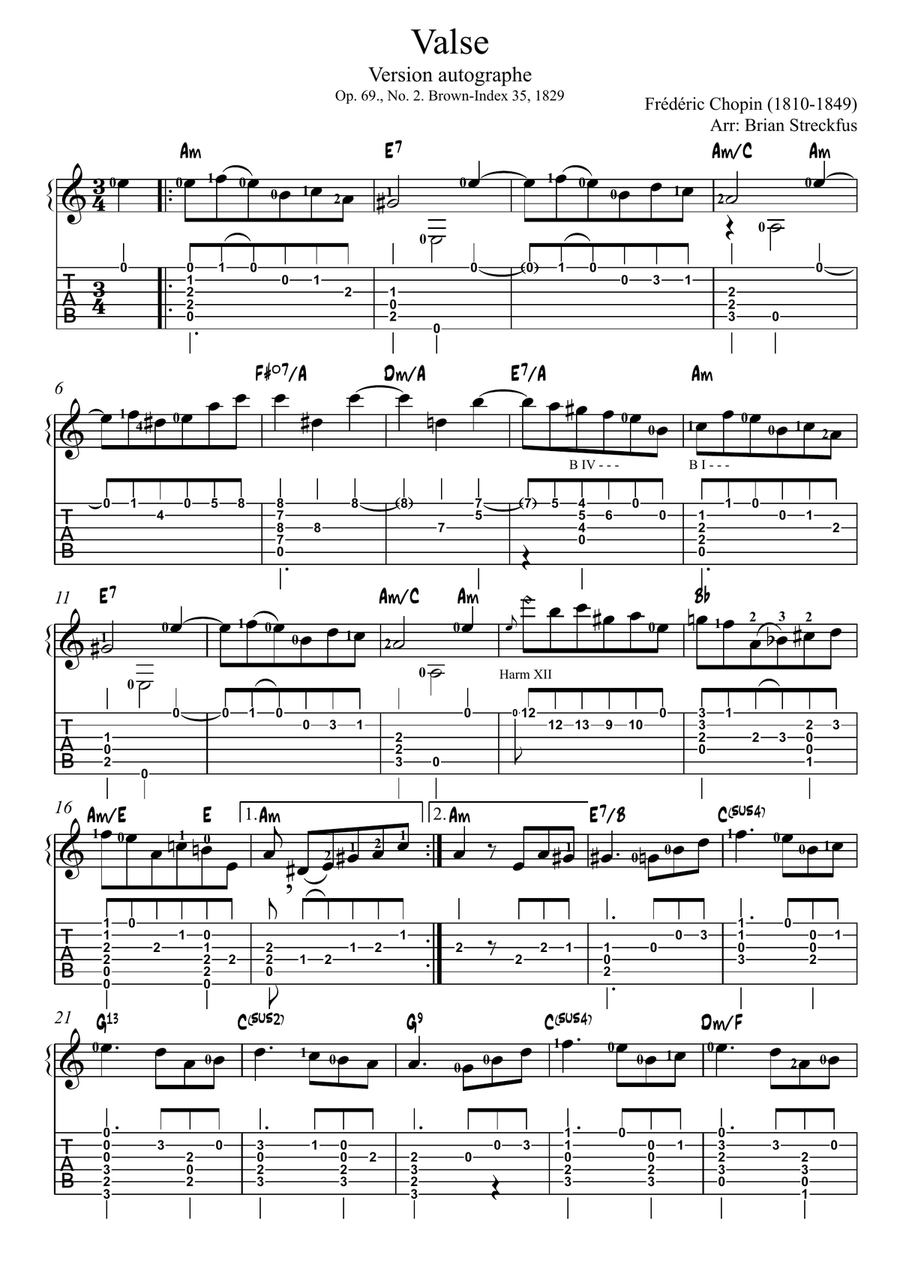
Waltz Op 69 No 2 (Arranged for Guitar)
Guitare notes et tablatures
Frederic Chopin
$1.99 1.7 € Guitare notes et tablatures PDF SheetMusicPlus

Alto Saxophone,Instrumental Duet,Tenor Saxophone - Level 2 - Digital Download SKU: A0.1151949 Composed by Ludwig van Beethoven. Arranged by Ander. Christmas,Classical,Instructional,March,Romantic Period. 9 pages. Woods Only, Arrangements #752156. Published by Woods Only, Arrangements (A0.1151949). This arrangement adapted for sax duo was designed to make its listeners weep with emotion, because the adaptation preserves the original essence of the work, keeping its integrity faithful to what Beethoven wanted to transmit, with only a slight change in tone and addition of harmonic resources in the structure of the arrangement. Even though it is a funeral march, it is well suited for any musical performance occasion, being intended for beginner students who want to immerse themselves in the universe of romantic music, and nothing better than starting with the transitional composer of this period, which also does not prevent professional teachers from using it for recitals, academic presentations or didactic material in their classes as an ensemble practice. Ludwig van Beethoven's Piano Sonata No. 14 in C minor sharp, Op. 27, No. 2, is one of his most popular compositions and was an audience favorite even in his day. Written when Beethoven was 31, the Moonlight Sonata (Mondscheinsonate in German) was composed after he finished some commissioned works, but there is no evidence that he was hired to write this work. It did not receive its nickname until 1832, five years after Beethoven's death. It was the critic Ludwig Rellstab who compared the music to a moonlighting on Lake Lucerne. This comparison was adopted as a nickname for the work. Called Quasi una fantasia by the author - like its companion Op. 27, No. 1 - the piece was completed in 1801 and dedicated the following year to one of the composer's pupils. Beethoven chose to open the sonata with a slow, hypnotic arpeggio movement, the best known of the entire work. The dotted rhythm of its minimal melody evokes the tradition of 'Trauermusik' (funeral music).
Moonlight Sonata by Beethoven for Saxophone Duet
2 Saxophones (duo)

$3.99 3.4 € 2 Saxophones (duo) PDF SheetMusicPlus

Saxophone Trio,Woodwind Ensemble - Level 2 - Digital Download SKU: A0.1147505 Composed by Ludwig van Beethoven. Arranged by Ander. Christmas,Classical,Instructional,March,Romantic Period. 9 pages. Woods Only, Arrangements #747743. Published by Woods Only, Arrangements (A0.1147505). This arrangement adapted for sax trio was designed to make its listeners weep with emotion, because the adaptation preserves the original essence of the work, keeping its integrity faithful to what Beethoven wanted to transmit, with only a slight change in tone and addition of harmonic resources in the structure of the arrangement. Even though it is a funeral march, it is well suited for any musical performance occasion, being intended for beginner students who want to immerse themselves in the universe of romantic music, and nothing better than starting with the transitional composer of this period, which also does not prevent professional teachers from using it for recitals, academic presentations or didactic material in their classes as an ensemble practice. Ludwig van Beethoven's Piano Sonata No. 14 in C minor sharp, Op. 27, No. 2, is one of his most popular compositions and was an audience favorite even in his day. Written when Beethoven was 31, the Moonlight Sonata (Mondscheinsonate in German) was composed after he finished some commissioned works, but there is no evidence that he was hired to write this work. It did not receive its nickname until 1832, five years after Beethoven's death. It was the critic Ludwig Rellstab who compared the music to a moonlighting on Lake Lucerne. This comparison was adopted as a nickname for the work. Called Quasi una fantasia by the author - like its companion Op. 27, No. 1 - the piece was completed in 1801 and dedicated the following year to one of the composer's pupils. Beethoven chose to open the sonata with a slow, hypnotic arpeggio movement, the best known of the entire work. The dotted rhythm of its minimal melody evokes the tradition of 'Trauermusik' (funeral music).
Moonlight Sonata by Beethoven for Saxophone Trio
3 Saxophones (trio)

$5.99 5.11 € 3 Saxophones (trio) PDF SheetMusicPlus


Partitions Gratuites
Acheter des Partitions Musicales
Acheter des Partitions Digitales à Imprimer
Acheter des Instruments de Musique

© 2000 - 2025

Accueil - Version intégrale





