EUROPE
34 articles
USA
79 articles
DIGITAL
32 articles (à imprimer)
Partitions Digitales
Partitions à imprimer
32 partitions trouvées


Instrumental Duet Bassoon,Flute,Instrumental Duet,Oboe - Level 3 - Digital Download SKU: A0.956623 Composed by J Offenbach. Arranged by Catriona Melville-Mason. Concert,Romantic Period,Standards. Score and parts. 5 pages. C Melville-Mason #6487623. Published by C Melville-Mason (A0.956623). This arrangement of the well-known 'Can Can' tune is designed for double reed duet of oboe and bassoon.  The oboe part can, however, also be played on flute - though extra care may need to be taken with dynamics to ensure that the melody is never swamped by the lower part.Officially entitled ‘Galop Infernale’, this piece hails from Offenbach’s Orpheus in the Underworld, first performed in October 1858.  Offenbach’s comic opera is a humorous take on Gluck’s highly successful Orpheus and Euridice. During a scene in which the gods are socialising, Jupiter suggests dancing a minuet.  The other gods decide this is far too staid, calling for something with a livelier, party-feel – and the Galop Infernale follows.  The tune’s association with the high-kicking Can Can dance came later, some 50 years after Offenbach’s death, when the French cabaret venues Moulin Rouge and Folies Bergère appropriated the piece for use in this context.
Can Can - Oboe (Flute) and Bassoon Duet

$4.50 3.87 € PDF SheetMusicPlus

Piano Solo - Level 3 - Digital Download SKU: A0.818538 Composed by Christoph Willibald Von Gluck. Arranged by Thomas Ling of Sibu. Classical,Contemporary,Standards. Score. 4 pages. Thomas Swee Chin #6714531. Published by Thomas Swee Chin (A0.818538).  Orpheus and Eurydice is one of the most famous mythical love stories in world literature.Dance of the Blessed Spirits is a ballet excerpt from Christoph Willibald Gluck's opera Orfeo ed Euridice, which is based on the story of Orpheus from the Greek mythology. This was the famous flute solo found in Act 2.The texture is mainly three layered: melody, chords and a bass line. Slow music is about resonance. The melody will be coloured and enhanced with plenty of well judged damper pedal effect. 
Dance of the Blessed Spirits - from "Orpheus and Eurydice" by C W Gluck
Piano seul

$6.99 6 € Piano seul PDF SheetMusicPlus

Small Ensemble Bassoon,Clarinet,Flute,Horn,Oboe - Digital Download SKU: A0.839017 Composed by Christoph Willibald Von Gluck. Arranged by Kenneth Martin. Classical,Concert. Score and parts. 15 pages. Martin Music Editions #5214107. Published by Martin Music Editions (A0.839017). Orfeo ed Euridice (French: Orphée et Eurydice; English: Orpheus and Eurydice) is an opera composed by Christoph Willibald Gluck, based on the myth of Orpheus and set to a libretto by Ranieri de' Calzabigi. It belongs to the genre of the azione teatrale, meaning an opera on a mythological subject with choruses and dancing. The piece was first performed at the Burgtheater in Vienna on 5 October 1762, in the presence of Empress Maria Theresa. Orfeo ed Euridice is the first of Gluck's reform operas, in which he attempted to replace the abstruse plots and overly complex music of opera seria with a noble simplicity in both the music and the drama. The opera is the most popular of Gluck's works, and was one of the most influential on subsequent German operas. Variations on its plot-the underground rescue-mission in which the hero must control, or conceal, his emotions-can be found in Mozart's The Magic Flute, Beethoven's Fidelio, and Wagner's Das Rheingold. Though originally set to an Italian libretto, Orfeo ed Euridice owes much to the genre of French opera, particularly in its use of accompanied recitative and a general absence of vocal virtuosity. Indeed, twelve years after the 1762 premiere, Gluck re-adapted the opera to suit the tastes of a Parisian audience at the Académie Royale de Musique with a libretto by Pierre-Louis Moline. This reworking was given the title Orphée et Eurydice, and several alterations were made in vocal casting and orchestration to suit French tastes.
ARIA from L'Orfeo ed Euridice (Gluck) for Wind Quintet (Horn in F solo)
Quintette à Vent: flûte, Hautbois, basson, clarinette, Cor

$5.99 5.15 € Quintette à Vent: flûte, Hautbois, basson, clarinette, Cor PDF SheetMusicPlus

Brass Ensemble Horn,Trombone,Trumpet,Tuba - Level 3 - Digital Download SKU: A0.839015 Composed by Christoph Willibald Von Gluck. Arranged by Kenneth Martin. Classical,Concert. Score and parts. 11 pages. Martin Music Editions #5214105. Published by Martin Music Editions (A0.839015). Orfeo ed Euridice (French: Orphée et Eurydice; English: Orpheus and Eurydice) is an opera composed by Christoph Willibald Gluck, based on the myth of Orpheus and set to a libretto by Ranieri de' Calzabigi. It belongs to the genre of the azione teatrale, meaning an opera on a mythological subject with choruses and dancing. The piece was first performed at the Burgtheater in Vienna on 5 October 1762, in the presence of Empress Maria Theresa. Orfeo ed Euridice is the first of Gluck's reform operas, in which he attempted to replace the abstruse plots and overly complex music of opera seria with a noble simplicity in both the music and the drama. The opera is the most popular of Gluck's works, and was one of the most influential on subsequent German operas. Variations on its plot-the underground rescue-mission in which the hero must control, or conceal, his emotions-can be found in Mozart's The Magic Flute, Beethoven's Fidelio, and Wagner's Das Rheingold. Though originally set to an Italian libretto, Orfeo ed Euridice owes much to the genre of French opera, particularly in its use of accompanied recitative and a general absence of vocal virtuosity. Indeed, twelve years after the 1762 premiere, Gluck re-adapted the opera to suit the tastes of a Parisian audience at the Académie Royale de Musique with a libretto by Pierre-Louis Moline. This reworking was given the title Orphée et Eurydice, and several alterations were made in vocal casting and orchestration to suit French tastes.
ARIA from L'Orfeo ed Euridice (Gluck) for Brass Quintet (Horn in F solo)
Quatuor de Cuivres : 2 trompettes, trombone, tuba

$5.99 5.15 € Quatuor de Cuivres : 2 trompettes, trombone, tuba PDF SheetMusicPlus

Brass Quintet Horn,Trombone,Trumpet,Tuba - Level 4 - Digital Download SKU: A0.1446054 Composed by Christoph Willibald Gluck,. Arranged by Keith Terrett. Classical,Contest,Festival,Historic,Instructional,Opera. 16 pages. Keith Terrett #1025876. Published by Keith Terrett (A0.1446054). Orfeo ed Euridice is an opera composed by Christoph Willibald Gluck, based on the myth of Orpheus and set to a libretto by Ranieri de' Calzabigi. It belongs to the genre of the azione teatrale, meaning an opera on a mythological subject with choruses and dancing.The piece was first performed at the Burgtheater in Vienna on 5 October 1762, in the presence of Empress Maria Theresa. Orfeo ed Euridice is the first of Gluck's reform operas, in which he attempted to replace the abstruse plots and overly complex music of opera seria with a noble simplicity in both the music and the drama.The opera is the most popular of Gluck's works, and was one of the most influential on subsequent German operas. Variations on its plot—the underground rescue mission in which the hero must control, or conceal, his emotions—can be found in Mozart's The Magic Flute, Beethoven's Fidelio, and Wagner's Das Rheingold.Though originally set to an Italian libretto, Orfeo ed Euridice owes much to the genre of French opera, particularly in its use of accompanied recitative and a general absence of vocal virtuosity. Indeed, twelve years after the 1762 premiere, Gluck re-adapted the opera to suit the tastes of a Parisian audience at the Académie Royale de Musique with a libretto by Pierre-Louis Moline. This reworking was given the title Orphée et Eurydice, and several alterations were made in vocal casting and orchestration to suit French tastes.Ther picture is Count Francesco Algarotti, an Italian polymath, philosopher, poet, essayist, anglophile, art critic and art collector. He was a man of broad knowledge, an expert in Newtonianism, architecture and opera. He was a friend of Frederick the Great and leading authors of his times: Voltaire, Jean-Baptiste de Boyer, Marquis d'Argens, Pierre-Louis de Maupertuis and the atheist Julien Offray de La Mettrie. Lord Chesterfield, Thomas Gray, George Lyttelton, Thomas Hollis, Metastasio, Benedict XIV and Heinrich von Brühl were among his correspondents.''The Sicilienne and Rigaudon is one of the many pieces that violin virtuoso Fritz Kreisler composed in the style of other composers. When he first presented and published these pieces, he offered them as recently discovered works by those other composers, newly adapted and arranged by himself. In the case of Sicilienne and Rigaudon, it is eighteenth-century French violinist/composer François Francoeur whose name is on the title sheet, though the piece really has nothing to do with Francoeur's style.The piece is a simple and a charming one, however. The Sicilienne is a binary-form miniature that sweeps along on a characteristic dotted rhythm, with a rather melancholy melody. Think old French ballet. The constant 16th notes of the Rigaudon, give it a character quite unlike that of a traditional rigaudon-a cheerful Baroque dance movement in duple meter.
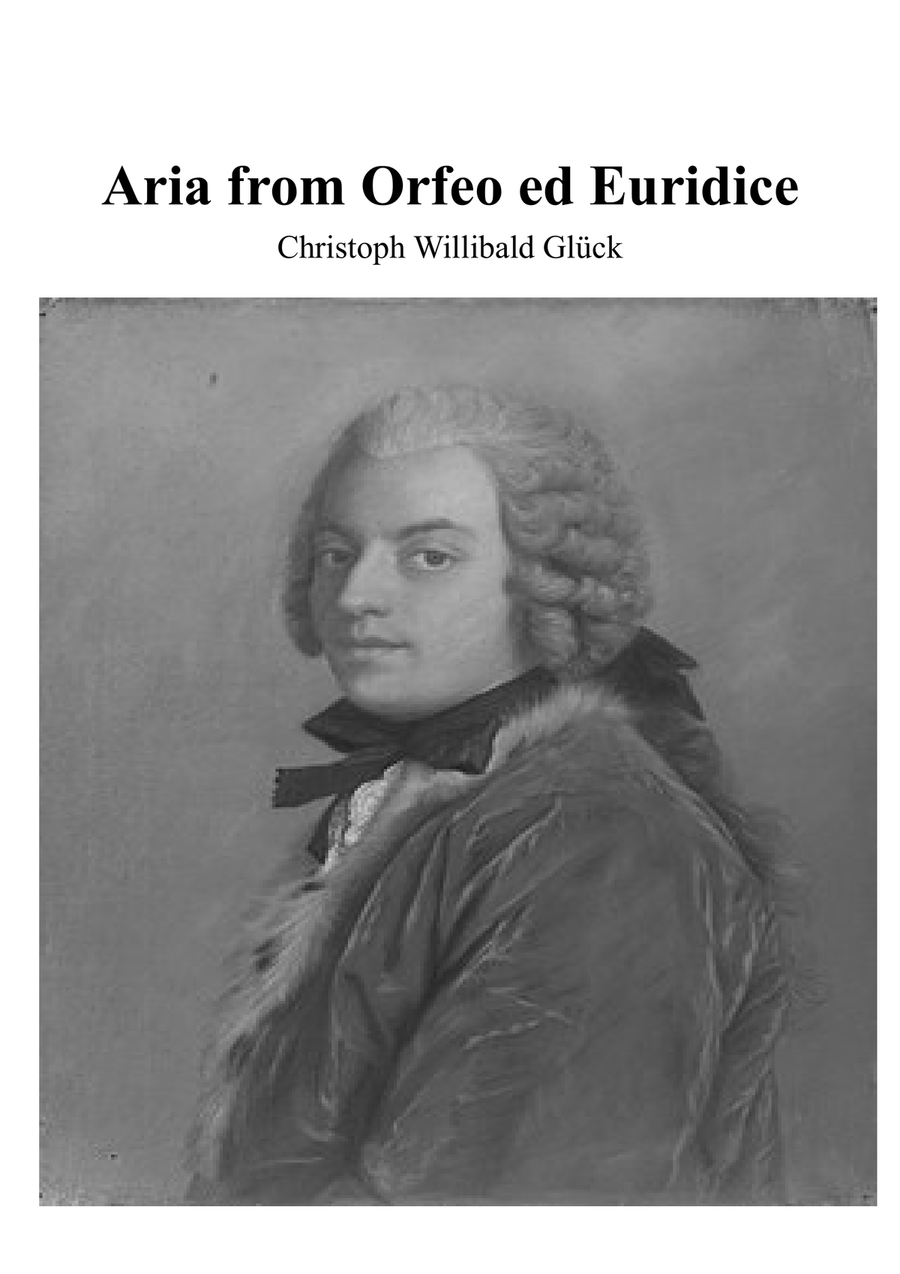
Aria from the Opera Orfeo ed Euridice for Brass Quintet (French Horn solo)
Quintette de Cuivres: 2 trompettes, Cor, trombone, tuba

$8.99 7.72 € Quintette de Cuivres: 2 trompettes, Cor, trombone, tuba PDF SheetMusicPlus

Brass Ensemble Horn,Trombone,Trumpet,Tuba - Level 2 - Digital Download SKU: A0.802569 Composed by Christoph Willibald Von Gluck. Arranged by Norman Richardson & Peet du Toit. Contemporary. Score and parts. 7 pages. Peet du Toit #5795223. Published by Peet du Toit (A0.802569). Orfeo ed Euridice is an opera composed by Christoph Willibald Gluck, based on the myth of Orpheus and set to a libretto by Ranieri de' Calzabigi. It belongs to the genre of the azione teatrale, meaning an opera on a mythological subject with choruses and dancing. Orfeo ed Euridice is the first of Gluck's reform operas, in which he attempted to replace the abstruse plots and overly complex music of opera seria (serious) with a noble simplicity in both the music and the drama.I have also arranged the Aria from this work for a brass quintet with the French Horn as agile soloist. You might like to combine the two movements, like is often heard when performed or broadcasted.
Dance of the Blessed Spirits from Orfeo ed Euridice - GW Gluck (Brass Quintet)
Quatuor de Cuivres : 2 trompettes, trombone, tuba

$13.00 11.17 € Quatuor de Cuivres : 2 trompettes, trombone, tuba PDF SheetMusicPlus

Guitar Ensemble Guitar - Level 2 - Digital Download SKU: A0.1514794 Composed by Luiz Bonfa. Arranged by by José Maria Silva. Classical,Latin,Multicultural,World. Score and Parts. 20 pages. José Silva #1089286. Published by José Silva (A0.1514794). A different and beautiful arrangement made by José Maria Silva for Guitar Quintet .*Two-voice melody and accompaniment with chords and a bass guitar-style line. *A small rhythm section with instruments characteristic of Brazil used in Bossa can be added.“Manhã de Carnaval (Carnival Morning), often referred to as Black Orpheus, is a song by Brazilian composer Luiz Bonfá and lyricist António Maria.Manhã de Carnaval appeared as a principal theme in the 1959 Portuguese-language film Orfeu Negro by French director Marcel Camus. The film's soundtrack also included songs by Antônio Carlos Jobim and Vinícius de Moraes, as well as the composition by Bonfá Samba de Orfeu. Manhã de Carnaval appears in the film, including versions sung or hummed by both the principal characters (Orfeu and Euridice), as well as an instrumental version, so that the song has been described as the main musical theme of the film. In the portion of the film in which the song is sung by the character Orfeu, portrayed by Breno Mello, the song was dubbed by Agostinho dos Santos. The song was initially rejected for inclusion in the film by Camus, but Bonfá was able to convince the director that the music for Manhã de Carnaval was superior to the song.
BLACK ORPHEUS (Manhã de Carnaval) - for Guitar Quintet

$12.00 10.31 € PDF SheetMusicPlus

Christoph Willibald Gluck : Orphée et Eurydice - Che farò senza Euridice
Saxhorn et Piano
Téléchargez la partition Saxhorn alto Orphée et Eurydice - Che far&og…
2.99 € Saxhorn et Piano PDF Tomplay

Christoph Willibald Gluck : Orphée et Eurydice - Che farò senza Euridice
Trompette
Téléchargez la partition Trompette Orphée et Eurydice - Che far&ograv…
3.99 € Trompette PDF Tomplay

Christoph Willibald Gluck : Orphée et Eurydice - Che farò senza Euridice
Violoncelle
Téléchargez la partition Violoncelle Orphée et Eurydice - Che far&ogr…
3.99 € Violoncelle PDF Tomplay

Christoph Willibald Gluck : Orphée et Eurydice - Che farò senza Euridice
Violon
Téléchargez la partition Violon Orphée et Eurydice - Che farò …
3.99 € Violon PDF Tomplay

Christoph Willibald Gluck : Orphée et Eurydice - Che farò senza Euridice (Saxophone ténor)
Saxophone Tenor
Téléchargez la partition Saxophone Orphée et Eurydice - Che far&ograv…
3.99 € Saxophone Tenor PDF Tomplay

Christoph Willibald Gluck : Orphée et Eurydice - Che farò senza Euridice
Flûte traversière
Téléchargez la partition Flûte Orphée et Eurydice - Che far&ogr…
3.99 € Flûte traversière PDF Tomplay


Partitions Gratuites
Acheter des Partitions Musicales
Acheter des Partitions Digitales à Imprimer
Acheter des Instruments de Musique

© 2000 - 2026

Accueil - Version intégrale





