EUROPE
0 articles
USA
0 articles
DIGITAL
1023 articles (ŕ imprimer)
Partitions Digitales
Partitions à imprimer
1023 partitions trouvées


High voice and piano - Moderately Difficult - Digital Download SKU: MQ.8454-2E Composed by David Conte. Secular, 21st century. Instrument part. 6 pages. E. C. Schirmer Music Company - Digital #8454-2E. Published by E. C. Schirmer Music Company - Digital (MQ.8454-2E). English.American Death Ballads was composed especially for tenor Brian Thorsett. We have been frequent collaborators since 2011, when he premiered the complete set of my Three Settings of W. B. Yeats for string quartet and tenor. At his urging, I transcribed and published my Three Poems of Christina Rossetti (originally for medium voice) for high voice, which he premiered at the San Francisco Conservatory in 2014. American Death Ballads was premiered by him at the San Francisco Conservatory, November 1, 2015, with pianist John Churchwell, and at the National Association of Teachers of Singing (NATS) Conference in Chicago, July 10, 2016, with pianist Warren Jones.The choice of texts for my American Death Ballads was inspired partly by Copland’s Old American Songs, which I deeply admire, but more by my dear friend and colleague the late Conrad Susa’s Two Murder Ballads. The ingenuity of Susa’s accompaniments for his ballads in imagining anew the original source material owes a great deal to Copland’s accompaniment for his songs. Though the content of my songs is completely original and not based on preexisting melodies, I have tried to expand on this further, as the texts are much longer, and go through many different moods and characters. The four texts I chose include stories about murder, death, and dying. Though two of the texts were written in England, they traveled to the colonies almost immediately. The subjects of the texts had spent time in America, and their stories were well known to Americans.Wicked Polly is a cautionary tale. Polly has lived a dissolute and immoral life, saying, 'I'll turn to God when I grow old.' Suddenly taken ill, she realizes that it is too late to repent. She dies in agony and is presumably sent to hell; young people are advised to heed. My musical setting is stately and preacherly in character for the narrator; for Polly it becomes pleading and remorseful. The Unquiet Grave was brought to the attention of Alan Lomax, the great American field collector of folk music, by English folk singer Shirley Collins. The text is taken from an English folk song dating from 1400. In The Unquiet Grave, a young man mourns his dead lover too fervently and prevents her from obtaining peace. The dead woman complains that his weeping is keeping her from peaceful rest. He begs a kiss; she tells him it would kill him. When he persists, wanting to join her in death, she explains that once they were both dead their hearts would simply decay, and that he should enjoy life while he has it. My setting is in a flowing Andante with a rocking accompaniment. Three voices are delineated here: the narrator, the mournful lover, and the dead lover speaking from the grave. The Dying Californian first appeared in the New England Diadem in 1854. Its lyrics are based on a letter from a New Englander’s sailor to his brother who is dying at sea while on the way to California to seek his fortune in the California gold fields. He implores his brother to impart his message to his father, mother, wife, and children. My setting opens with the singer alone in a moderate dirge tempo, then, joined by the piano, moves through many tonalities and moods before ending with supreme confidence as the speaker 'gained a port called Heaven/Where the gold will never rust.'Captain Kidd was a Scottish sailor who was tried and executed for piracy and murder in 1701. The American connection to this ballad is that Kidd escaped to America and for a time lived in New York and Boston, though he was a wanted criminal by the British authorities and was extradited to Britain, where he was hung at 'Executioner’s Dock.' The lyric was printed in Britain in 1701, traveling to the colonies almost immediately. Though the didactic tone of the text is similar to Wicked Polly, it expresses no regret until the final lines: 'Take warning now by me, and shun bad company, / Lest you come to hell with me, for I must die.' My setting is fast and spirited, expressing the confidence of a man who lived life as he wanted. -David Conte.
The Unquiet Grave from American Death Ballads (Downloadable)
Voix haute

$3.50 3.05 € Voix haute PDF SheetMusicPlus

Woodwind Ensemble,Woodwind Trio - Level 3 - Digital Download SKU: A0.958470 Composed by Joseph Dillon Ford. 20th Century. 7 pages. David Warin Solomons2 #3691569. Published by David Warin Solomons2 (A0.958470). The Fuga a tre voci was composed on 28 March 1976 not long before I moved from Miami to Cambridge to begin graduate study in music at Harvard. It remained an imperfect sketch in need of extensive revisions, and languished for a quarter-century in a manila file folder until I rediscovered it late in 2001 and was pleased to find that it was worth the trouble of resurrecting. This was no easy task, as it was my original intention to comply closely with eighteenth-century contrapuntal practices. Although I had written numerous polyphonic pieces in a similar style since 1976, none of these was a fugue. There was also the challenge of reconnecting with musical ideas I had originated at the age of twenty-four at a time in my life when I was rapidly approaching the age of fifty. Still, I persevered in my efforts to revive and improve this early polyphonic essay, and hope the performer and listener will be as pleased with the results as I am. This three-voice fugue can be performed by any instrument or combination of instruments, including the harpsichord.
Fuga a tre (3 part fugue) for wind trio

$7.00 6.09 € PDF SheetMusicPlus

Instrumental Duet Harpsichord,Instrumental Duet,Piano - Level 3 - Digital Download SKU: A0.958468 Composed by Joseph Dillon Ford. 20th Century. Score and parts. 3 pages. David Warin Solomons2 #3691563. Published by David Warin Solomons2 (A0.958468). The Fuga a tre voci was composed on 28 March 1976 not long before I moved from Miami to Cambridge to begin graduate study in music at Harvard. It remained an imperfect sketch in need of extensive revisions, and languished for a quarter-century in a manila file folder until I rediscovered it late in 2001 and was pleased to find that it was worth the trouble of resurrecting. This was no easy task, as it was my original intention to comply closely with eighteenth-century contrapuntal practices. Although I had written numerous polyphonic pieces in a similar style since 1976, none of these was a fugue. There was also the challenge of reconnecting with musical ideas I had originated at the age of twenty-four at a time in my life when I was rapidly approaching the age of fifty. Still, I persevered in my efforts to revive and improve this early polyphonic essay, and hope the performer and listener will be as pleased with the results as I am. This three-voice fugue can be performed by any instrument or combination of instruments, including the harpsichord.
Fuga a tre (3 part fugue) for keyboard
Piano seul

$7.00 6.09 € Piano seul PDF SheetMusicPlus

String Ensemble,String Trio - Level 3 - Digital Download SKU: A0.958467 Composed by Joseph Dillon Ford. 20th Century. Score and parts. 7 pages. David Warin Solomons2 #3691565. Published by David Warin Solomons2 (A0.958467). The Fuga a tre voci was composed on 28 March 1976 not long before I moved from Miami to Cambridge to begin graduate study in music at Harvard. It remained an imperfect sketch in need of extensive revisions, and languished for a quarter-century in a manila file folder until I rediscovered it late in 2001 and was pleased to find that it was worth the trouble of resurrecting. This was no easy task, as it was my original intention to comply closely with eighteenth-century contrapuntal practices. Although I had written numerous polyphonic pieces in a similar style since 1976, none of these was a fugue. There was also the challenge of reconnecting with musical ideas I had originated at the age of twenty-four at a time in my life when I was rapidly approaching the age of fifty. Still, I persevered in my efforts to revive and improve this early polyphonic essay, and hope the performer and listener will be as pleased with the results as I am. This three-voice fugue can be performed by any instrument or combination of instruments, including the harpsichord.
Fuga a tre (3 part fugue) for string trio
Trio ŕ Cordes: violon, alto, violoncelle

$7.00 6.09 € Trio ŕ Cordes: violon, alto, violoncelle PDF SheetMusicPlus

Large Ensemble Alto Saxophone,Baritone Saxophone,Bass Guitar,Clarinet,Drums,Flute,Piano,Tenor Saxophone - Level 4 - Digital Download SKU: A0.876448 Composed by Joe Procopio. Dance,Jazz,Pop. Score and parts. 23 pages. JoeCopio Music LLC #53327. Published by JoeCopio Music LLC (A0.876448). MARY ~ ELAINE Back to School 2015 From PAPA’S FAMOUS DANCES by Joe Procopio MARY ~ ELAINE is a dance written and arranged by Joe Procopio for a small ensemble, band, stage band or combo. It was originally composed for a small band with flexible instrumentation. It may be performed with only two Saxophones (Alto Sax I and Alto Sax II) and a standard backup with Piano/Keyboard, Guitar, Bass and Drums. In addition, any combo may be augmented by adding any or all of the parts included for Flute, Clarinet, Tenor Sax, and Baritone Sax. This flexible or variable instrumentation of MARY ~ ELAINE makes it unique and perfect for schools and colleges that do not have a permanent roster of music students entering their music programs annually. It also eases the burden for Directors searching for good music to perform for groups with ever changing numbers of music students. What’s more, MARY ~ ELAINE has a section open for solos to enable the ensemble to feature players who can improvise well enhancing not only the group’s enjoyment but also everyone’s listening pleasure. This piece has been performed by College and High School students in many major concert events all along the East Coast with great success. It is published separately and in a set entitled PAPA’S FAMOUS DANCES PART 1 from the sets PAPA’S FAMOUS DANCES Part I and Part II. Each Part contains 3 Dances. I have adapted the audio here for synthesizer so that it may be previewed. It is one of 6 works named and dedicated to each of my 6 Grandchildren: Lilly, Mary, Lydia, Emma, Joey and Wilson. Instrumentation for MARY ~ ELAINE includes SCORE and parts for: ALTO SAX I ALTO SAX II TENOR SAX BARITONE SAX FLUTE CLARINET PIANO/KEYBOARD - GUITAR - BASS - DRUMS VITA Joe Procopio is a master musician and teacher with proven success for over 50 years. His purpose in teaching, writing music and books is to make his successful method of making musicians available to as many people as possible around the world. While I cannot guarantee that my methods will make you a great musician as they have for many others, says Procopio, I can say that they are designed to magnify your love of music - and that I guarantee each will enrich and enhance your life. People from all over the world have written to me to tell me so. As a Master Musician , Joe Procopio is an ASCAP Artist, composer, conductor and professional musician. He was the Lead Reed for many of the nation's top recording artists including: The Temptations, Steve and Eydie Gorme, Aretha Franklin, Tony Bennett, Lawrence Welk, Frankie Avalon, Frankie Laine, Jack Jones, Kathryn Grayson, Carmel Quinn, Don Cornell, Bobby Rydell, Vic Damone, Rodney Dangerfield, Foster Brooks, The Vagabonds, The Ritz Brothers, Sammy Cohn, Jimmy Van Heusen, Tiny Tim, Al Martino, Petula Clark, Wayne Newton, Pat Cooper, The Four Tops, The Spinners, etc. Lead Alto Sax Jimmy Dorsey Orchestra and the Palace Theater Myrtle Beach, SC He is listed in The Encyclopedia of Saxophone Music Londeix, Roncorp Pub. He is the teacher of Guitarist T. Maxwell heard in TV’s Magnum P.I., The Rockford Files and Kojak ; the vocalist/bassist I. Cattell of Brit Floyd (Pink Floyd) and New York Tenor Saxophonist Paul Carlon to mention a few. His accomplishments as a teacher include: The Miles Clark Endowed Chair, Music, College of the Albemarle, Elizabeth City, NC, Chair Music Department Cazenovia Central School NY Director Of Instrumental Music Chapel Hill/Carrboro City Schools NC Adjunct Professor Applied Music Cazenovia College, NY.
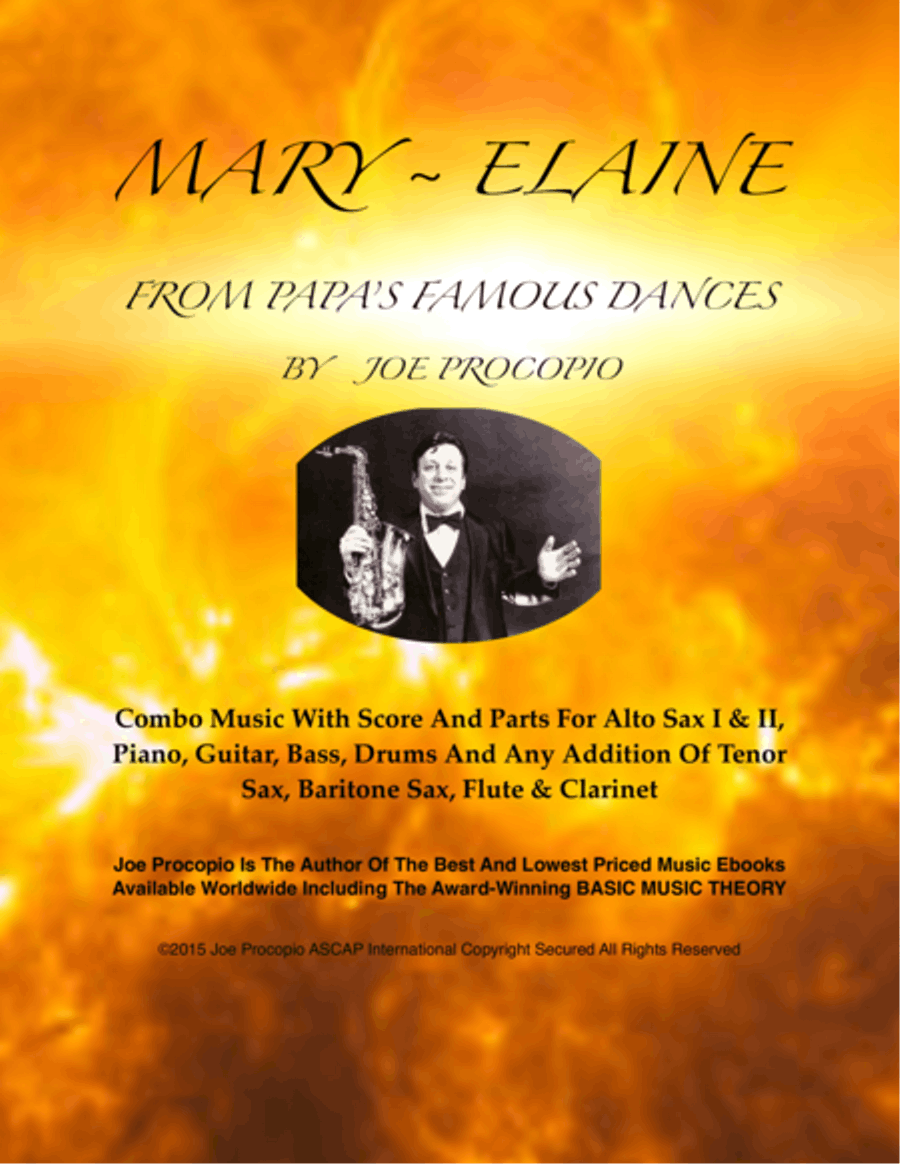
MARY ~ ELAINE
Saxophone Tenor et Piano

$4.99 4.34 € Saxophone Tenor et Piano PDF SheetMusicPlus

Soprano, tenor, Knabensoprano, flugelhorn, mixed choir and chamber orchestra - Digital Download SKU: S9.Q7038 Teil I: Schwarz vor Augen... · Teil II: ...und es ward Licht!. Composed by Harald Weiss. This edition: study score. Music Of Our Time. Downloadable, Study score. Duration 100' 0. Schott Music - Digital #Q7038. Published by Schott Music - Digital (S9.Q7038). Latin • German.On letting go(Concerning the selection of the texts) In the selection of the texts, I have allowed myself to be motivated and inspired by the concept of “letting go”. This appears to me to be one of the essential aspects of dying, but also of life itself. We humans cling far too strongly to successful achievements, whether they have to do with material or ideal values, or relationships of all kinds. We cannot and do not want to let go, almost as if our life depended on it. As we will have to practise the art of letting go at the latest during our hour of death, perhaps we could already make a start on this while we are still alive. Tagore describes this farewell with very simple but strikingly vivid imagery: “I will return the key of my door”. I have set this text for tenor solo. Here I imagine, and have correspondingly noted in a certain passage of the score, that the protagonist finds himself as though “in an ocean” of voices in which he is however not drowning, but immersing himself in complete relaxation. The phenomenon of letting go is described even more simply and tersely in Psalm 90, verse 12: “So teach us to number our days, that we may apply our hearts unto wisdom”. This cannot be expressed more plainly.I have begun the requiem with a solo boy’s voice singing the beginning of this psalm on a single note, the note A. This in effect says it all. The work comes full circle at the culmination with a repeat of the psalm which subsequently leads into a resplendent “lux aeterna”. The intermediate texts of the Requiem which highlight the phenomenon of letting go in the widest spectrum of colours originate on the one hand from the Latin liturgy of the Messa da Requiem (In Paradisum, Libera me, Requiem aeternam, Mors stupebit) and on the other hand from poems by Joseph von Eichendorff, Hermann Hesse, Rabindranath Tagore and Rainer Maria Rilke.All texts have a distinctive positive element in common and view death as being an organic process within the great system of the universe, for example when Hermann Hesse writes: “Entreiß dich, Seele, nun der Zeit, entreiß dich deinen Sorgen und mache dich zum Flug bereit in den ersehnten Morgen” [“Tear yourself way , o soul, from time, tear yourself away from your sorrows and prepare yourself to fly away into the long-awaited morning”] and later: “Und die Seele unbewacht will in freien Flügen schweben, um im Zauberkreis der Nacht tief und tausendfach zu leben” [“And the unfettered soul strives to soar in free flight to live in the magic sphere of the night, deep and thousandfold”]. Or Joseph von Eichendorff whose text evokes a distant song in his lines: “Und meine Seele spannte weit ihre Flügel aus. Flog durch die stillen Lande, als flöge sie nach Haus” [“And my soul spread its wings wide. Flew through the still country as if homeward bound.”]Here a strong romantically tinged occidental resonance can be detected which is however also accompanied by a universal spirit going far beyond all cultures and religions. In the beginning was the sound Long before any sort of word or meaningful phrase was uttered by vocal chords, sounds, vibrations and tones already existed. This brings us back to the music. Both during my years of study and at subsequent periods, I had been an active participant in the world of contemporary music, both as percussionist and also as conductor and composer. My early scores had a somewhat adventurous appearance, filled with an abundance of small black dots: no rhythm could be too complicated, no register too extreme and no harmony too dissonant. I devoted myself intensely to the handling of different parameters which in serial music coexist in total equality: I also studied aleatory principles and so-called minimal music.I subsequently emigrated and took up residence in Spain from where I embarked on numerous travels over the years to India, Africa and South America. I spent repeated periods during this time as a resident in non-European countries. This meant that the currents of contemporary music swept past me vaguely and at a great distance. What I instead absorbed during this period were other completely new cultures in which I attempted to immerse myself as intensively as possible.I learned foreign languages and came into contact with musicians of all classes and styles who had a different cultural heritage than my own: I was intoxicated with the diversity of artistic potential.Nevertheless, the further I distanced myself from my own Western musical heritage, the more this returned insistently in my consciousness.The scene can be imagined of sitting somewhere in the middle of the Brazilian jungle surrounded by the wailing of Indians and out of the blue being provided with the opportunity to hear Beethoven’s late string quartets: this can be a heart-wrenching experience, akin to an identity crisis. This type of experience can also be described as cathartic. Whatever the circumstances, my “renewed” occupation with the “old” country would not permit me to return to the point at which I as an audacious young student had maltreated the musical parameters of so-called contemporary music. A completely different approach would be necessary: an extremely careful approach, inching my way gradually back into the Western world: an approach which would welcome tradition back into the fold, attempt to unfurl the petals and gently infuse this tradition with a breath of contemporary life.Although I am aware that I will not unleash a revolution or scandal with this approach, I am nevertheless confident as, with the musical vocabulary of this Requiem, I am travelling in an orbit in which no ballast or complex structures will be transported or intimated: on the contrary, I have attempted to form the message of the texts in music with the naivety of a “homecomer”. Harald WeissColonia de San PedroMarch 20091 (auch Altfl.) · 2 (2. auch Engl. Hr.) · 1 (auch Bassklar.) · 0 - 2 · Flhr. · 0 · 0 - P. S. (Glsp. · Röhrengl. · Gongs · Trgl. · Beck. · Tamt. · 2 Holzschlitztr. (oder Woodbl.) · Woodbl. · gr. Tr.) (3 Spieler) - Org. (Positiv) - Str. (4 · 4 · 4 · 4 · 2).
Requiem
Orchestre de chambre

$55.99 48.73 € Orchestre de chambre PDF SheetMusicPlus

Organ - advanced - Digital Download SKU: S9.Q45183 Martin Luther. Composed by Enjott Schneider. This edition: Sheet music. Downloadable. Duration 24 minutes. Schott Music - Digital #Q45183. Published by Schott Music - Digital (S9.Q45183). On the occasion of the quincentenary of Reformation Day in 2017, the composer Enjott Schneider thoroughly studied Martin Luther the individual and all his contradictions. The result is a brilliant, demanding organ symphony which is perfect for concerts on the subject of Reformation and Martin Luther. The composer describes the five movements of the symphony as follows: '1st movement: Wir glauben all an einen Gott with its quintuplet-like beginning is very Gregorian in style, outlining the range of Lutheran emotionalism between the Middle Ages and the modern era. The irrationality of faith ultimately has priority over any thought and evidence. At the beginning of the movement, sounds of knocking on wood remind of the nailing of the Ninety-Five Theses to the doors of churches in Wittenberg. The chorale melody sometimes hides with an almost rough medieval saltarello, referring to Luther's robustness and vitality with which he knew to carry away even common people. 2nd movement: In 1530, the electoral prince of Saxony presented to Luther at Coburg Castle the golden signet ring with the Luther rose which became the symbol of his theology of grace. A white heart with black cross is fixed on a five-petalled rose. To him, white is the colour of angels and ghosts, black stands for the pain of crucification: The just shall live by faith, but by faith in the Crucified. But the fact that the rose and the heart are the dominating symbols shows how Catholic Marian piety remained an ingredient of Luther's spirituality throughout his life. In line with the dominant five-petal structure of the rose, this movement was composed, to a large extent, in accordance with the floating, lyrical rhythm in 5/8 time. 3rd movement: The omnipresence of death and dying – from the plague and war to the never-ending dangers of daily life – was an essential part of the world view of that time. Fears ensued that might heighten into the grotesque, e.g. in the pictures of Hieronymus Bosch. The Danse macabre was a popular motif in those years. Luther's chorale Mitten wir im Leben sind / mit dem Tod umfangen from 1524 (Enchiridion from Erfurt) is based on the Gregorian chant Media vita in morte sumus created in France around 750 and, with its idea of transience, inspired a simplistic air. 4th movement: The famous confession delivered at the Diet of Worms in 1521, I stand here and can say no more. God help me. Amen, are not Luther's words but the version later used as text for a pamphlet. However, it represents quite plainly the straightforwardness and inevitability of his mission. Musically, it was made into a perpetuum mobile, i.e. a dogged, ostinato and never-ending musical air. 5th movement: The Mighty Fortress, on the other hand, is one of the great symbols of Martin Luther which, with its shining C major key, embodies the Protestant ideology and willful nature of the Reformation unlike any other song. Heinrich Heine called it the Marseille anthem of the Reformation, Friedrich Engels the Marseillaise of the Peasants' Wars. This disputability is not thought through to the end but rather interrupted: With a jubilant birdcall version of the melody, the finale shows a rather chamber-music-like side of the ideals of freedom of Christians.'.
Orgelsinfonie No. 16
Orgue

$21.99 19.14 € Orgue PDF SheetMusicPlus

Alto Saxophone,Piano - Level 2 - Digital Download SKU: A0.933817 Composed by Traditional. Arranged by William Pagan-Perez. Children,Concert,Standards. Score and part. 22 pages. William Pagan-Perez #3024439. Published by William Pagan-Perez (A0.933817). Four Hispanic Children’s Songs Doña Ana (Madame Ana) El patio de mi casa (The Garden Of My House) ¡Que Llueva! (Let It Rain!) San SerenĂ­ About the piece: Many times, great musicians transcribed and perform art song cycles by Brahms, Schubert, Schumann, or Rachmaninoff in order to express lyricism with their musical instruments like a singer does. Practicing and performing Four Hispanic Children’s Songs, give young music students a good opportunity to start expressing lyricism or to start playing beautiful melodic lines imitating the expressiveness of the human voice. Four Hispanic Children’s Songs can be programmed on student concerts, or solo music recitals in schools. Also, professional musician can perform Four Hispanic Children’s Songs on recitals, educative concerts or entertainment concerts programmed for children.     Four Hispanic Children’s Songs is a four movements piece based on 18th Century children songs from Spain that became parts of the Hispano American heritage. It was arranged as a song cycle, with march textures that accompany the melody to allow a better learning and rehearsing process in class.  ------------------------------------------- Sobre la pieza: En muchas ocasiones, los grandes mĂşsicos transcriben y ejecutan ciclos de canciones de artes compuestos por Brahms, Schubert, Schumann, or Rachmaninoff con la intenciĂłn de expresar lirismo o tocar bellas lĂ­neas melĂłdicas imitando la expresividad de la voz humana con sus instrumentos musicales. El practicar y tocar la mĂşsica de Four Hispanic Children’s Songs (Cuatro Canciones Infantiles Hispanas) brinda a los jĂłvenes estudiantes de mĂşsica, una buena oportunidad para comenzar a expresar lirismo o de tocar melodĂ­as expresivas como si fuera un cantante. Four Hispanic Children’s Songs puede ser programada y presentada en conciertos de estudiantes, o recitales de mĂşsica solista en escuelas. TambiĂ©n la pieza puede se ejecutada por mĂşsicos profesionales en recitales, conciertos educativos o concierto de entretenimiento programados para la niñez.  Four Hispanic Children’s Songs es una pieza con cuatro movimientos; basadas en canciones infantiles del siglo XVIII y oriundas de España, pero que fueron adoptadas dentro de las tradiciones hispanoamericanas. El arreglista utilizĂł texturas de marcha para acompañar las canciones, facilitar el proceso de aprendizaje y de ensayo del estudiante en el salĂłn de clases. Note: The MP3 sound is the midi version for flute and piano.
Four Hispanic Children’s Songs for Alto Sax. in Eb and Piano
Saxophone Alto et Piano

$8.95 7.79 € Saxophone Alto et Piano PDF SheetMusicPlus


Partitions Gratuites
Acheter des Partitions Musicales
Acheter des Partitions Digitales à Imprimer
Acheter des Instruments de Musique

© 2000 - 2026

Accueil - Version intégrale





