EUROPE
27130 articles
USA
86158 articles
DIGITAL
178080 articles (à imprimer)
Partitions Digitales
Partitions à imprimer
178080 partitions trouvées


Voice - advanced to difficult - Digital Download SKU: S9.Q19478 A fresh approach. This edition: method. Schott Sight-Reading Series. Dieser Band baut auf Vom-Blatt-Singen 1 auf und führt die ersten Aspekte des Vom-Blatt-Singens mittels genauen Erkennens von Rhythmus und Tonhöhe fort. Downloadable, Textbook. Op. 2. Schott Music - Digital #Q19478. Published by Schott Music - Digital (S9.Q19478). English • French • German.This book sets out to build on the initial aspects of singing at sight in reading both the rhythm and pitch accurately, as begun in Sight-Singing 1. Sight-Singing 2 is divided into two parts. Part 1 comprises 95 exercises in either single or 2-part form. These cover methods to secure the line of the pitch, sequences, singing a lower part, ties, awareness of chord structure, canons, chromatic movement, modulations and tone rows. A section of 2-part exercises is also included using treble and bass clefs. Part 2 consists of 16 solo pieces which are presented in the treble clef, and aim to develop the singer’s ability to pitch independently from their accompaniment. These short pieces are based on chords, intervals, the Dorian mode, pentatonic scales, melodic minor scales, chromatic movement and changing time signatures. The aim of this volume is to develop a secure sense of pitch, providing a comprehensive range of styles and challenges which will be of value not just to singers but to all dedicated musicians. The skill of being able to ‘vocalise’ a melody independently and accurately is a valuable asset for all musicians regardless of vocal ability or instrument played. The ability to ‘hear’ a phrase before it is sung or played is especially useful. - 95 solo/2-part exercises - 16 accompanied solos - 1 wide range of challenging styles - valuable both to singers and instrumentalists.
Sight-Singing 2

$12.99 10.97 € PDF SheetMusicPlus

Hand Drum,Handpan,Instrumental Solo,Steel Pan - Level 1 - Digital Download SKU: A0.569907 By Sharon Wilson. By William Moore. Arranged by Sharon Wilson. 20th Century,Easter,Folk,Sacred,Traditional. Individual part. 10 pages. Sharon Wilson #6685591. Published by Sharon Wilson (A0.569907). This sheet music is notated for C major diatonic scale Tongue Drums (suitable for any 8, 11, or 13-note drum in the key of C). This hymn arrangement can be performed as a solo, as rhythmic chord accompaniment for singing, or as a duet. Four separate scores are provided for maximum flexibility. Whether beginner or experienced musician, these scores can be used in numerous ways from solo playing to playing with a partner or as a group. A note and chord reference chart is included as well as a rhythm pattern chart. Descriptions, suggestions, and uses for each score and chart are detailed on the introduction page and summarized below:Melody ScoreThis score can be played as a solo with or without singing along. Those new to reading standard music notation as well as those already familiar with music notation will find the numbers above the staff helpful. These numbers correspond to the numbers on the Tongue Drum. Lyrics appear below the staff for sing along enjoyment. Harmony ScoreThis score can be used in conjunction with the Melody Score to form a duet by providing the accompaniment (harmony) while someone plays or sings the melody. Note numbers below the staff corresponding to the numbers on the drum. Chord names are shown above the staff for playing a rhythmic accompaniment in place of the harmony accompaniment shown. The chord names can also be used for ensemble playing with other instruments (such as a Ukulele or Guitar).Grand StaffThe Grand Staff score combines the Melody Score with the Harmony Score. This score provides a visual overview of how the two scores line up and is helpful for a director or teacher using this set of scores in a group setting. If playing with a partner (a duet), this score may be easier to use since you both can see what the other person is playing. This score includes note numbers above the melody staff and below the harmony staff corresponding to the numbers on the drum; chord names shown above the harmony staff for ensemble playing with other instruments or for using a rhythmic chord accompaniment; and lyrics between the staves for sing along enjoyment. Advanced Solo ScoreThe Advanced Solo score includes harmony notes along with the melody notes to create a fuller sounding solo which can be played with or without singing along. Numbers corresponding to the numbers on the Tongue Drum are included above the staff.Note and Chord ChartThis chart consists of two separate staff rows. The first staff shows the notes used for the melody. The second staff shows the notes in each chord used in this song. Any combination of the notes within a given chord can be played using one of the rhythm patterns. Rhythm ChartThis chart shows four rhythm patterns that can be used as an accompaniment for the melody. Using the Harmony Score or the Grand Staff, follow the chord names to play notes from the given chord using one of the rhythm patterns.This arrangement is one of the 10 songs in the collection Hymns of Praise for 8-note C major diatonic scale Tongue Drums (A collection of 10 Solos and Duets).Visit Sharon Wilson's website: www.SharonWilsonMusic.comSubscribe to her YouTube Channel: www.youtube.com/user/SharonWilsonMusic
"Jesus, What a Friend for Sinners" for 8-note C major diatonic scale Tongue Drum
Sharon Wilson
$3.99 3.37 € PDF SheetMusicPlus

Large Ensemble Bass Drum,Drums,Marimba,Multi-Percussion,Snare Drum,Vibraphone,Xylophone - Level 5 - Digital Download SKU: A0.935386 Composed by Dan Heslink. Contemporary. Score and parts. 46 pages. Pharaoh Publications #6058011. Published by Pharaoh Publications (A0.935386). Sinfonietta                                                                                                                  composed by Dan Heslink Sinfonietta is a trio for vibraphone, marimba and percussion (xylophone, snare drum, and bass drum). Its expression is intended to be non-representational, presenting only an interesting technical construction in a suave formal organization. With the title the composer designates a single movement, with length and seriousness of expression approaching a symphonic movement. Its form approximates an expanded version of the classical sonata-allegro, dividing materials into three large sections. Beginning are the two main phrases of the principal theme, which establish patterns that are idiomatic throughout the movement. The first measure’s quartal harmonies divide into rhythms alternating the two hands, the right-hand posing a melody and the left-hand complementing it with harmony and rhythmic repetition. The phrase at measure 7 is a long-breathed melody for vibes accompanied by undulating chords in the marimba. A transition comprising highly qualitative rhythms (stated first by the marimba in m. 20.) has much identity. By measure 41, the transition has grown into a full secondary theme, one that is developed and repeated often throughout the movement. The exposition closes with a theme beginning in measure 51. It is announced by the vibes as another long-breathed melody unfolding over the active rhythm of the second theme. After a gradual dissipation, the development section starts at measure 92 with a new but related theme, heard first in the vibes. It offers a different key and an expressive melody slowly unfolding over rhythmically active harmonies. The remainder of this middle section explores nuances of the secondary and closing themes, and ultimately leads to the movement’s first climax. It eventually dissipates through a gradual reduction of density and tempo.  The Reprise begins vigorously at m. 118 with statements of both the principal theme’s phrases. Then the second theme is transformed by the addition of bass drum strokes, which sets up a codetta. This section comprises a long crescendo on the new theme over a rhythmic tattoo derived from the second theme, and builds to a bold conclusion.  Pedaling on the vibes is indicated with a solid bracket below the connected notes, and half pedaling with a dashed bracket. It is imperative that the percussion part be heard but not dominate. The performer is encouraged to experiment with a piccolo snare drum and 28 bass drum. Sinfonietta would serve equally well in a professional, college or advanced high school percussion recital. The composer assigns a difficulty level of medium difficult. Duration is 8:10. The composer, Dan Heslink, can be contacted at dan@dheslink.com.  
Sinfonietta for Percussion Trio
measure 41, the transition has grown into a full secondary theme, one that is developed and repeated often throughout the movement The exposition closes with a theme beginning in measure 51
$9.99 8.44 € PDF SheetMusicPlus

Hand Drum,Handpan,Instrumental Solo,Steel Pan - Level 2 - Digital Download SKU: A0.569904 By Sharon Wilson. By Edwin O. Excell. Arranged by Sharon Wilson Music. Christian,Folk,Holiday,Praise & Worship,Sacred. Individual part. 12 pages. Sharon Wilson #6685583. Published by Sharon Wilson (A0.569904). This sheet music is notated for C major diatonic scale Tongue Drums (suitable for any 8, 11, or 13-note drum in the key of C). This hymn arrangement can be performed as a solo, as rhythmic chord accompaniment for singing, or as a duet. Four separate scores are provided for maximum flexibility. Whether beginner or experienced musician, these scores can be used in numerous ways from solo playing to playing with a partner or as a group. A note and chord reference chart is included as well as a rhythm pattern chart. Descriptions, suggestions, and uses for each score and chart are detailed on the introduction page and summarized below:Melody ScoreThis score can be played as a solo with or without singing along. Those new to reading standard music notation as well as those already familiar with music notation will find the numbers above the staff helpful. These numbers correspond to the numbers on the Tongue Drum. Lyrics appear below the staff for sing along enjoyment. Harmony ScoreThis score can be used in conjunction with the Melody Score to form a duet by providing the accompaniment (harmony) while someone plays or sings the melody. Note numbers below the staff corresponding to the numbers on the drum. Chord names are shown above the staff for playing a rhythmic accompaniment in place of the harmony accompaniment shown. The chord names can also be used for ensemble playing with other instruments (such as a Ukulele or Guitar).Grand StaffThe Grand Staff score combines the Melody Score with the Harmony Score. This score provides a visual overview of how the two scores line up and is helpful for a director or teacher using this set of scores in a group setting. If playing with a partner (a duet), this score may be easier to use since you both can see what the other person is playing. This score includes note numbers above the melody staff and below the harmony staff corresponding to the numbers on the drum; chord names shown above the harmony staff for ensemble playing with other instruments or for using a rhythmic chord accompaniment; and lyrics between the staves for sing along enjoyment. Advanced Solo ScoreThe Advanced Solo score includes harmony notes along with the melody notes to create a fuller sounding solo which can be played with or without singing along. Numbers corresponding to the numbers on the Tongue Drum are included above the staff.Note and Chord ChartThis chart consists of two separate staff rows. The first staff shows the notes used for the melody. The second staff shows the notes in each chord used in this song. Any combination of the notes within a given chord can be played using one of the rhythm patterns. Rhythm ChartThis chart shows four rhythm patterns that can be used as an accompaniment for the melody. Using the Harmony Score or the Grand Staff, follow the chord names to play notes from the given chord using one of the rhythm patterns.This arrangement is one of the 10 songs in the collection Hymns of Praise for 8-note C major diatonic scale Tongue Drums (A collection of 10 Solos and Duets).Visit Sharon Wilson's website: www.SharonWilsonMusic.comSubscribe to her YouTube Channel: www.youtube.com/user/SharonWilsonMusic
"Count Your Blessings" for 8-note C major diatonic scale Tongue Drum
Sharon Wilson
$3.99 3.37 € PDF SheetMusicPlus

Hand Drum,Handpan,Instrumental Solo,Steel Pan - Level 1 - Digital Download SKU: A0.569903 By Sharon Wilson. By Robert Robinson. Arranged by Sharon Wilson. Children,Folk,Holiday,Sacred,Traditional. Individual part. 10 pages. Sharon Wilson #6685581. Published by Sharon Wilson (A0.569903). This sheet music is notated for C major diatonic scale Tongue Drums (suitable for any 8, 11, or 13-note drum in the key of C). This hymn arrangement can be performed as a solo, as rhythmic chord accompaniment for singing, or as a duet. Four separate scores are provided for maximum flexibility. Whether beginner or experienced musician, these scores can be used in numerous ways from solo playing to playing with a partner or as a group. A note and chord reference chart is included as well as a rhythm pattern chart. Descriptions, suggestions, and uses for each score and chart are detailed on the introduction page and summarized below:Melody ScoreThis score can be played as a solo with or without singing along. Those new to reading standard music notation as well as those already familiar with music notation will find the numbers above the staff helpful. These numbers correspond to the numbers on the Tongue Drum. Lyrics appear below the staff for sing along enjoyment. Harmony ScoreThis score can be used in conjunction with the Melody Score to form a duet by providing the accompaniment (harmony) while someone plays or sings the melody. Note numbers below the staff corresponding to the numbers on the drum. Chord names are shown above the staff for playing a rhythmic accompaniment in place of the harmony accompaniment shown. The chord names can also be used for ensemble playing with other instruments (such as a Ukulele or Guitar).Grand StaffThe Grand Staff score combines the Melody Score with the Harmony Score. This score provides a visual overview of how the two scores line up and is helpful for a director or teacher using this set of scores in a group setting. If playing with a partner (a duet), this score may be easier to use since you both can see what the other person is playing. This score includes note numbers above the melody staff and below the harmony staff corresponding to the numbers on the drum; chord names shown above the harmony staff for ensemble playing with other instruments or for using a rhythmic chord accompaniment; and lyrics between the staves for sing along enjoyment. Advanced Solo ScoreThe Advanced Solo score includes harmony notes along with the melody notes to create a fuller sounding solo which can be played with or without singing along. Numbers corresponding to the numbers on the Tongue Drum are included above the staff.Note and Chord ChartThis chart consists of two separate staff rows. The first staff shows the notes used for the melody. The second staff shows the notes in each chord used in this song. Any combination of the notes within a given chord can be played using one of the rhythm patterns. Rhythm ChartThis chart shows four rhythm patterns that can be used as an accompaniment for the melody. Using the Harmony Score or the Grand Staff, follow the chord names to play notes from the given chord using one of the rhythm patterns.This arrangement is one of the 10 songs in the collection Hymns of Praise for 8-note C major diatonic scale Tongue Drums (A collection of 10 Solos and Duets).Visit Sharon Wilson's website: www.SharonWilsonMusic.comSubscribe to her YouTube Channel: www.youtube.com/user/SharonWilsonMusic
"Come, Thou Fount of Every Blessing" for 8-note C major diatonic scale Tongue Drum
Sharon Wilson
$3.99 3.37 € PDF SheetMusicPlus

Marimba Solo - Level 4 - Digital Download SKU: A0.1310693 Composed by Michael M. Chang. 21st Century,Contemporary. Individual part. 10 pages. Michael M. Chang #899669. Published by Michael M. Chang (A0.1310693). Crossing the River is written for an intermediate to advanced player using four mallets on a 4.3 marimba with optional 5-octave notes indicated in parentheses ( ). The song's meaning can be found in our everyday lives - how things can become mundane and sometimes events beyond our control can overwhelm us. During those times, our thoughts may drift back to our youth and to the simple things that brought us joy. Remembering these may bring a moment of contentment, but making those moments a part of our lives again can lead to a lifetime of happiness.The music begins in the key of E Major, with playful, lyrical phrases before modulating to a section in F# Major, which consists of a light, airy right-hand melody accompanied by a syncopated left-hand ostinato. The flow pauses for a moment of introspection, before a similar syncopated section returns, but this time in the key of A# minor. This builds to a beautiful chorale section as the river is crossed, before closing with a variation on the opening theme in C# Major. Singable and pleasing to the ear, the piece's melodies may help improve dexterity, particularly in the player's right hand.
Crossing the River
Marimba

$9.99 8.44 € Marimba PDF SheetMusicPlus

Soprano voice,Vocal Solo - Level 5 - Digital Download SKU: A0.799615 Composed by Richard Strauss. Arranged by Nicole Elyse DiPaolo. 20th Century,Romantic Period. 9 pages. Nicole Elyse DiPaolo #5022033. Published by Nicole Elyse DiPaolo (A0.799615). The first of its kind, and the sixth entry in Nicole Elyse DiPaolo's Accessible Accompaniments series of aria reductions, this is a genuinely playable and piano/vocal reduction of Grossmächtige Prinzessin, Zerbinetta's famous aria from Strauss's Ariadne auf Naxos (second version, 1916). Please note that the version on this page is a cut beginning from So war es mit Pagliazzo and the complete aria, from rehearsal nos. 100-130, is available separately. Coloratura sopranos who love this aria no longer need to fear bringing it in for auditions, last-minute performing engagements, or other situations in which the pianist may have to sight-read from the chaotic and sometimes unplayable vocal score. Pianists may now enjoy playing this aria comfortably, without risking strain/injury.In addition to the current cut, one beginning at Noch glaub' ich is also available. To see previews of that section within the aria and a preview of the complete aria, please visit their respective SheetMusicPlus pages.All Accessible Accompaniments, including this one, boast several unique features:1. No reduction ever requires stretches of over an octave, not including bass notes meant to be held or fudged with the pedal (though octaves may also contain chord tones within them). This reduces the amount of rearranging that smaller-handed pianists must already do. Obviously, further reworkings are to be expected and pianists should feel free to add to or modify what I’ve provided.2. I’ve included less essential, but potentially desirable additional voices/passages in cue-size noteheads so that pianists can easily see them, but know that they are not necessary in a sink or swim accompanying situation. Presenting less essential material in cue-size noteheads also reduces visual clutter on the page.3. In addition to the composer’s markings, when needed, I have included hints on particular notes to bring out when the singer is likely to need them as a pitch anchor or when it is not obvious which line should be brought out within the texture.4. All page turns have been carefully selected so as to result in the least possible disruption to the pianist when possible. When an inevitable page turn precedes a potentially surprising note or chord, I’ve included the next downbeat’s notes in cue-size stemless noteheads at the end of the preceding measure.5. When known, I’ve noted alternate cuts that singers might like to take within certain arias.6. In some cases I’ve modernized spelling conventions for easier readability (for example, by replacing ß with ss in German arias) and occasionally I've enharmonically respelled brief passages for greater clarity.About the Arranger: Praised as a sensitive pianist and outstanding accompanist who delivers powerful interpretations, Nicole Elyse DiPaolo enjoys a multifaceted career as a sought-after collaborative pianist, educational composer, arranger, coach, private teacher, and adjunct music professor. Currently based in the Cleveland area, Ms. DiPaolo has appeared as a concerto soloist with the Ambassador Chamber Players on multiple occasions and as a recitalist, collaborator, and presenter worldwide. Currently, Ms. DiPaolo is an online Adjunct Lecturer in Music at Indiana University; the Principal Theory Teacher at Liberty Park Music, an online-only video subscription-based music school; an invited blog contributor and guest instructor at Tonebase; and a sought-after online instructor of piano, music theory, and composition who includes partimento and historical improvisation in her curricula. For more information, please visit http://ndipaolo.musicaneo.com .
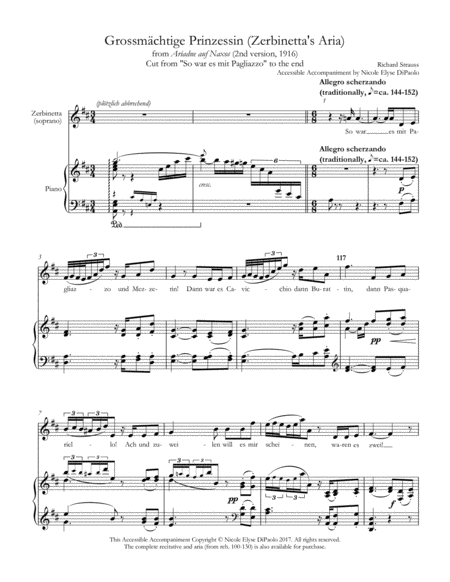
Grossmächtige Prinzessin (Zerbinetta, from So war es) from Ariadne auf Naxos - Accessible Accompani
Voix Soprano, Piano

$8.95 7.56 € Voix Soprano, Piano PDF SheetMusicPlus

Soprano voice,Vocal Solo - Digital Download SKU: A0.799614 Composed by Richard Strauss. Arranged by Nicole Elyse DiPaolo. 20th Century,Romantic Period. 12 pages. Nicole Elyse DiPaolo #5022031. Published by Nicole Elyse DiPaolo (A0.799614). The first of its kind, and the sixth entry in Nicole Elyse DiPaolo's Accessible Accompaniments series of aria reductions, this is a genuinely playable and piano/vocal reduction of Grossmächtige Prinzessin, Zerbinetta's famous aria from Strauss's Ariadne auf Naxos (second version, 1916). Please note that the version on this page is a cut beginning from Noch glaub' ich and the complete aria, from rehearsal nos. 100-130, is available separately. Coloratura sopranos who love this aria no longer need to fear bringing it in for auditions, last-minute performing engagements, or other situations in which the pianist may have to sight-read from the chaotic and sometimes unplayable vocal score. Pianists may now enjoy playing this aria comfortably, without risking strain/injury.In addition to the current cut, one beginning at So war es mit Pagliazzo is also available. To see previews of those sections within the aria, please visit their respective SheetMusicPlus pages.All Accessible Accompaniments, including this one, boast several unique features:1. No reduction ever requires stretches of over an octave, not including bass notes meant to be held or fudged with the pedal (though octaves may also contain chord tones within them). This reduces the amount of rearranging that smaller-handed pianists must already do. Obviously, further reworkings are to be expected and pianists should feel free to add to or modify what I’ve provided.2. I’ve included less essential, but potentially desirable additional voices/passages in cue-size noteheads so that pianists can easily see them, but know that they are not necessary in a sink or swim accompanying situation. Presenting less essential material in cue-size noteheads also reduces visual clutter on the page.3. In addition to the composer’s markings, when needed, I have included hints on particular notes to bring out when the singer is likely to need them as a pitch anchor or when it is not obvious which line should be brought out within the texture.4. All page turns have been carefully selected so as to result in the least possible disruption to the pianist when possible. When an inevitable page turn precedes a potentially surprising note or chord, I’ve included the next downbeat’s notes in cue-size stemless noteheads at the end of the preceding measure.5. When known, I’ve noted alternate cuts that singers might like to take within certain arias.6. In some cases I’ve modernized spelling conventions for easier readability (for example, by replacing ß with ss in German arias) and occasionally I've enharmonically respelled brief passages for greater clarity.About the Arranger: Praised as a sensitive pianist and outstanding accompanist who delivers powerful interpretations, Nicole Elyse DiPaolo enjoys a multifaceted career as a sought-after collaborative pianist, educational composer, arranger, coach, private teacher, and adjunct music professor. Currently based in the Cleveland area, Ms. DiPaolo has appeared as a concerto soloist with the Ambassador Chamber Players on multiple occasions and as a recitalist, collaborator, and presenter worldwide. Currently, Ms. DiPaolo is an online Adjunct Lecturer in Music at Indiana University; the Principal Theory Teacher at Liberty Park Music, an online-only video subscription-based music school; an invited blog contributor and guest instructor at Tonebase; and a sought-after online instructor of piano, music theory, and composition who includes partimento and historical improvisation in her curricula. For more information, please visit http://ndipaolo.musicaneo.com .
Grossmächtige Prinzessin (Zerbinetta, from Noch glaub' ich) from Ariadne auf Naxos - Accessible Acc
Voix Soprano, Piano

$10.95 9.25 € Voix Soprano, Piano PDF SheetMusicPlus

Soprano voice,Vocal Solo - Level 5 - Digital Download SKU: A0.1303524 By Richard Wagner. By Richard Wagner. Arranged by Nicole Elyse DiPaolo. 19th Century,Classical,Opera,Romantic Period. 5 pages. Nicole Elyse DiPaolo #893099. Published by Nicole Elyse DiPaolo (A0.1303524). The first of its kind, this is a genuinely playable piano/vocal reduction of O Sachs! Mein Freund!, Eva's aria from Richard Wagner's Die Meistersinger von Nurnberg. Dramatic sopranos who love this aria no longer need to fear bringing it in for auditions, last-minute performing engagements, or other situations in which the pianist is unlikely to know this aria and may become rattled by the chaotic piano reductions in the currently available vocal scores. Pianists with limited practice time may now enjoy playing this aria comfortably as well. Because vocal line/orchestral doublings are characteristic of Wagner, those have been preserved in this edition. All Accessible Accompaniments, including this one, boast several unique features:1. No reduction ever requires stretches of over an octave, not including bass notes meant to be held or “fudged†with the pedal (though octaves may also contain chord tones within them). This reduces the amount of rearranging that smaller-handed pianists must already do. Obviously, further reworkings are to be expected and pianists should feel free to add to or modify what I’ve provided.2. I’ve included less essential, but potentially desirable additional voices/passages in cue-size noteheads so that pianists can easily see them, but know that they are not necessary in a “sink or swim†accompanying situation. Presenting less essential material in cue-size noteheads also reduces visual clutter on the page.3. In addition to the composer’s markings, when needed, I have included hints on particular notes to bring out when the singer is likely to need them as a pitch anchor or when it is not obvious which line should be brought out within the texture.4. All page turns have been carefully selected so as to result in the least possible disruption to the pianist when possible. When an inevitable page turn precedes a potentially surprising note or chord, I’ve included the next downbeat’s notes in cue-size stemless noteheads at the end of the preceding measure.5. When known, I’ve noted alternate cuts that singers might like to take within certain arias.6. In some cases I’ve modernized spelling conventions for easier readability (for example, by replacing “߆with “ss†in German arias) and occasionally I've enharmonically respelled brief passages for greater clarity.
O Sachs! Mein Freund! (Eva's Aria) from Die Meistersinger - Accessible Accompaniments Edition
Voix Soprano, Piano
Richard Wagner
$8.95 7.56 € Voix Soprano, Piano PDF SheetMusicPlus

Soprano voice,Vocal Solo - Level 5 - Digital Download SKU: A0.799613 Composed by Richard Strauss. Arranged by Nicole Elyse DiPaolo. 20th Century,Romantic Period. 17 pages. Nicole Elyse DiPaolo #5022029. Published by Nicole Elyse DiPaolo (A0.799613). The first of its kind, and the sixth entry in Nicole Elyse DiPaolo's Accessible Accompaniments series of aria reductions, this is a genuinely playable and piano/vocal reduction of Grossmächtige Prinzessin, Zerbinetta's famous aria from Strauss's Ariadne auf Naxos (second version, 1916). Coloratura sopranos who love this aria no longer need to fear bringing it in for auditions, last-minute performing engagements, or other situations in which the pianist may have to sight-read from the chaotic and sometimes unplayable vocal score. Pianists may now enjoy playing this aria comfortably, without risking strain/injury.This aria is also available to purchase in smaller sections, as commonly offered in auditions, at reduced prices. They include a score beginning at Noch glaub' ich and one beginning at So war es mit Pagliazzo. To see previews of those sections within the aria, please visit their respective SheetMusicPlus pages. The edition you are viewing here is the complete aria, covering rehearsal nos. 100-130.All Accessible Accompaniments, including this one, boast several unique features:1. No reduction ever requires stretches of over an octave, not including bass notes meant to be held or fudged with the pedal (though octaves may also contain chord tones within them). This reduces the amount of rearranging that smaller-handed pianists must already do. Obviously, further reworkings are to be expected and pianists should feel free to add to or modify what I’ve provided.2. I’ve included less essential, but potentially desirable additional voices/passages in cue-size noteheads so that pianists can easily see them, but know that they are not necessary in a sink or swim accompanying situation. Presenting less essential material in cue-size noteheads also reduces visual clutter on the page.3. In addition to the composer’s markings, when needed, I have included hints on particular notes to bring out when the singer is likely to need them as a pitch anchor or when it is not obvious which line should be brought out within the texture.4. All page turns have been carefully selected so as to result in the least possible disruption to the pianist when possible. When an inevitable page turn precedes a potentially surprising note or chord, I’ve included the next downbeat’s notes in cue-size stemless noteheads at the end of the preceding measure.5. When known, I’ve noted alternate cuts that singers might like to take within certain arias.6. In some cases I’ve modernized spelling conventions for easier readability (for example, by replacing ß with ss in German arias) and occasionally I've enharmonically respelled brief passages for greater clarity.About the Arranger: Praised as a sensitive pianist and outstanding accompanist who delivers powerful interpretations, Nicole Elyse DiPaolo enjoys a multifaceted career as a sought-after collaborative pianist, educational composer, arranger, coach, private teacher, and adjunct music professor. Currently based in the Cleveland area, Ms. DiPaolo has appeared as a concerto soloist with the Ambassador Chamber Players on multiple occasions and as a recitalist, collaborator, and presenter worldwide. Currently, Ms. DiPaolo is an online Adjunct Lecturer in Music at Indiana University; the Principal Theory Teacher at Liberty Park Music, an online-only video subscription-based music school; an invited blog contributor and guest instructor at Tonebase; and a sought-after online instructor of piano, music theory, and composition who includes partimento and historical improvisation in her curricula. For more information, please visit http://ndipaolo.musicaneo.com .

Grossmächtige Prinzessin (Zerbinetta's Aria, Complete) from Ariadne auf Naxos - Accessible Accompan
Voix Soprano, Piano

$13.95 11.79 € Voix Soprano, Piano PDF SheetMusicPlus

Easy Piano - Level 2 - Digital Download SKU: A0.896073 By Laura Story. By Laura Story. Arranged by Jim Lansing. Instructional,New Age,Pop,Religious,Singer/Songwriter. Score. 3 pages. Jim Lansing #5347733. Published by Jim Lansing (A0.896073). Early Intermediate level arrangement transposed to F major to keep RH on the treble clef staff.  Syncopation has been simplified; once notes are learned, encourage player to use their ear to fix rhythms to match the artis's recording.  RH melody off-beat entrances are preceeded by LH playing on the preceding beat to help player feel the rhythmic pulseRH moves quite a bit, requiring comfort with (1) reaching the thumb down a 3rd from 2 finger, (2) crossing thumb under 2 finger on black note, and (3) crossing 2 finger over thumb.  LH spends much of the piece in Gm but does have movement, requiring (1) ability to cross the 2 finger over thumb, (2) turning thumb under 2 finger, and (3) making an octave leap.
Blessings
Piano Facile
Laura Story
$4.99 4.22 € Piano Facile PDF SheetMusicPlus

Piano Solo - Level 4 - Digital Download SKU: A0.1415779 By ROBERT VAN HORNE. By ROBERT VAN HORNE. Film/TV,Instructional,Multicultural,New Age,Romantic Period,World. Score. 8 pages. White Piano International Publishing #993491. Published by White Piano International Publishing (A0.1415779). SINGFOO (OUR HAPPINESS) (Original Piano Music) from “CHINA LOVEâ€Composed and Arranged by Robert Van Horne in 1993Advanced Intermediate Piano Solo8 pagesDuration approximately 4:15In 1987 while living in Singapore, I aimed to create an album comprising ten piano compositions inspired by Chinese music, which I titled CHINA LOVE.Within this collection, there is a piece titled SINGFOO, a term phonetically pronounced in Mandarin, carrying the meaning of Our Happiness when pronounced with proper accents. In crafting this composition, I drew from the tradition of Chinese music, often reflecting life's trials and triumphs. The essence of SINGFOO (OUR HAPPINESS) encapsulates the sentiment of finally discovering our happiness amidst life's journey.The sheet music for SINGFOO (OUR HAPPINESS) is clearly notated, featuring dynamic markings, articulation indicators, phrasing, pedal suggestions, chord symbols, fingerings, and relevant musical terminology to aid performers.This arrangement caters to advanced intermediate students, professional pianists, and piano instructors alike, providing a rewarding musical experience.For those interested, a complete audio sample with background instruments is included with SINGFOO (OUR HAPPINESS) from Robert’s CHINA LOVE album.Additionally, an EARLY INTERMEDIATE PIANO arrangement of the entire collection, titled TEN MUSICAL THEMES FROM 'CHINA LOVE, can be obtained from: Sheet Music Plus Sheet Music Direct Published by White Piano International PublishingRobert is a member of ASCAPWebsite: www.robertvanhorne.comEmail: rvh@robertvanhorne.com.
SINGFOO (OUR HAPPINESS)
Piano seul
ROBERT VAN HORNE
$2.99 2.53 € Piano seul PDF SheetMusicPlus

Hand Drum,Handpan,Instrumental Solo,Steel Pan - Level 1 - Digital Download SKU: A0.569896 By Sharon Wilson. By Robert Lowry. Arranged by Sharon Wilson. Folk,Praise & Worship,Romantic Period,Sacred,Traditional. Individual part. 10 pages. Sharon Wilson #6642173. Published by Sharon Wilson (A0.569896). This sheet music is notated for C major diatonic scale Tongue Drums (suitable for any 8, 11, or 13-note drum in the key of C). This hymn arrangement can be performed as a solo, as rhythmic chord accompaniment for singing, or as a duet. Four separate scores are provided for maximum flexibility. Whether beginner or experienced musician, these scores can be used in numerous ways from solo playing to playing with a partner or as a group. A note and chord reference chart is included as well as a rhythm pattern chart. Descriptions, suggestions, and uses for each score and chart are detailed on the introduction page and summarized below:Melody ScoreThis score can be played as a solo with or without singing along. Those new to reading standard music notation as well as those already familiar with music notation will find the numbers above the staff helpful. These numbers correspond to the numbers on the Tongue Drum. Lyrics appear below the staff for sing along enjoyment. Harmony ScoreThis score can be used in conjunction with the Melody Score to form a duet by providing the accompaniment (harmony) while someone plays or sings the melody. Note numbers below the staff corresponding to the numbers on the drum. Chord names are shown above the staff for playing a rhythmic accompaniment in place of the harmony accompaniment shown. The chord names can also be used for ensemble playing with other instruments (such as a Ukulele or Guitar).Grand StaffThe Grand Staff score combines the Melody Score with the Harmony Score. This score provides a visual overview of how the two scores line up and is helpful for a director or teacher using this set of scores in a group setting. If playing with a partner (a duet), this score may be easier to use since you both can see what the other person is playing. This score includes note numbers above the melody staff and below the harmony staff corresponding to the numbers on the drum; chord names shown above the harmony staff for ensemble playing with other instruments or for using a rhythmic chord accompaniment; and lyrics between the staves for sing along enjoyment. Advanced Solo ScoreThe Advanced Solo score includes harmony notes along with the melody notes to create a fuller sounding solo which can be played with or without singing along. Numbers corresponding to the numbers on the Tongue Drum are included above the staff.Note and Chord ChartThis chart consists of two separate staff rows. The first staff shows the notes used for the melody. The second staff shows the notes in each chord used in this song. Any combination of the notes within a given chord can be played using one of the rhythm patterns. Rhythm ChartThis chart shows four rhythm patterns that can be used as an accompaniment for the melody. Using the Harmony Score or the Grand Staff, follow the chord names to play notes from the given chord using one of the rhythm patterns.This arrangement is one of the 10 songs in the collection Hymn Meditations for 8-note C major diatonic scale Tongue Drums (A collection of 10 Solos and Duets).Visit Sharon Wilson's website: www.SharonWilsonMusic.comSubscribe to her YouTube Channel: www.youtube.com/user/SharonWilsonMusic
"How Can I Keep from Singing" for 8-note C major diatonic scale Tongue Drum
Sharon Wilson
$3.99 3.37 € PDF SheetMusicPlus

Harmonica - Level 2 - Digital Download SKU: A0.1360372 Composed by Arthur Freed and Nacio Herb Brown. Arranged by songbooks.info. 20th Century,Broadway,Film/TV,Musical/Show,Standards. Score. 4 pages. Songbooks.info #944867. Published by songbooks.info (A0.1360372). Singin' in the Rain is a hit film written in 1929 by Arthur Freed (lyrics) and Nacio Herb Brown (music). Gene Kellys dances and sings in the 1952 sound film of the same name.Already after the Second World War, the song became a jazz standard and was performed by artists such as Dave Brubeck, Oscar Peterson, John Serry Sr., Sammy Davis Jr. and Doris Day, just to name a few artists. In 2004, the American Film Institute ranked the song third in its list of the 100 best American film songs.The song was adapted for the diatonic Harmonica in the “Richter†system - the “Bluesharp†- and provided with symbols for channel number / blowing or drawing. These symbols are key-neutral, the notes and sounds are appropriate for a harmonica in “Câ€. The symbols are briefly explained in the appendix. The classic musical notation and/or the lyrics help to develop the song, so that even those unfamiliar with music can learn to play the song with this arrangement.The sound of a Vibraphone was used in the setting, so that the sound does not mix with the sound of your own instrument. The melody is backed by a metronome and quietly by an organ. We hope you enjoy making music...!Singin’ in the Rain ist ein 1929 geschriebener Filmschlager von Arthur Freed (Text) und Nacio Herb Brown (Musik). Gene Kellys tanzut und singt im gleichnamigen Tonfilm von 1952.Bereits nach dem zweiten Weltkrieg wurde der Song zum Jazzstandard und wurde von Interpreten wie Dave Brubeck, Oscar Peterson, John Serry senior, Sammy Davis jr. und Doris Day interpretiert, nur um einige Künstler zu nennen. Vom American Film Institute wurde das Lied 2004 auf Platz 3 in die Liste der 100 besten US-amerikanischen Filmsongs gewählt.Das Lied wurde für die diatonische Mundharmonika im “Richterâ€-System - der “Bluesharp†- adaptiert und mit Symbolen für Kanalnummer / Blas- bzw. Ziehton versehen. Diese Symbole sind Tonart-neutral, die Noten und die Sounds sind für eine Mundharmonika in “C†passend. Die Symbole werden im Anhang kurz erklärt. Die klassische Notenschrift und/oder der Liedtext helfen beim Erarbeiten des Liedes, sodaß auch Noten-Unkundige mit diesem Arrangement das Lied spielen lernen können.In der Vertonung wurde der Sound eines Vibraphones verwendet, so vermischt sich der Klang nicht mit dem Klang des eigenen Instrumentes. Hinterlegt ist die Melodie mit einem Metronom sowie leise mit einer Orgel. Wir wünschen viel Spaß beim Musizieren...!
Singin' In The Rain
Harmonica

$5.49 4.64 € Harmonica PDF SheetMusicPlus


Partitions Gratuites
Acheter des Partitions Musicales
Acheter des Partitions Digitales à Imprimer
Acheter des Instruments de Musique

© 2000 - 2026

Accueil - Version intégrale




