EUROPE
249 articles
USA
577 articles
DIGITAL
337 articles (à imprimer)
Partitions Digitales
Partitions à imprimer
337 partitions trouvées

1 16 31 ....331

(Choral) - Digital Download SKU: H1.8566DP Composed by Joel Raney. Lent, Holy Week, Easter Sunday. Preview pack - book & listening CD. 67 pages. Hope Publishing - Digital #8566DP. Published by Hope Publishing - Digital (H1.8566DP). Sydney Carter.Lent & Easter Musical Sydney Carter's classic hymn, Lord of the Dance, is a metaphor of the life of Christ. In beautiful, poetic language, Carter describes Jesus as The Piper, calling his followers to the dance of life. This 30-minute musical from Joel Raney is an elaboration on that hymn, portraying each verse individually in a dramatic, colorful presentation - all retelling the story from John 3:16, For God so loved the world that he gave his only Son, so that everyone who believes in him may not perish but may have eternal life. Appropriate for use anytime during Lent or Holy Week, for Palm Sunday or Easter morning, there is an additional narration and underscore that leads into an exciting, complete setting of Lord of the Dance, celebrating Christ's victorious resurrection. For Maundy Thursday or Good Friday, it may be concluded with the musical benediction My Jesus, I Love Thee. Narration and scripture have been carefully chosen to complete the story, tying together the verses of Lord of the Dance with a variety of other timeless hymns and songs, creating a meaningful worship experience for the congregation. The piano accompaniment works extremely well by itself, while the optional instrumental parts require a minimal number of players and will enhance the overall effect. The Instrumental Parts include a Conductor's Score and parts for Flute, Oboe, Violin and Cello.
I Am the Lord of the Dance

$17.95 15.21 € PDF SheetMusicPlus

Cello, flute, oboe, violin - Digital Download SKU: H1.8564DP Composed by Joel Raney. Musicals Collection. Lent & Easter Musicals. Lent, Holy Week, Easter Sunday. Instrumental Parts. 150 pages. Hope Publishing - Digital #8564DP. Published by Hope Publishing - Digital (H1.8564DP). Sydney Carter.Lent & Easter Musical Sydney Carter's classic hymn, Lord of the Dance, is a metaphor of the life of Christ. In beautiful, poetic language, Carter describes Jesus as The Piper, calling his followers to the dance of life. This 30-minute musical from Joel Raney is an elaboration on that hymn, portraying each verse individually in a dramatic, colorful presentation - all retelling the story from John 3:16, For God so loved the world that he gave his only Son, so that everyone who believes in him may not perish but may have eternal life. Appropriate for use anytime during Lent or Holy Week, for Palm Sunday or Easter morning, there is an additional narration and underscore that leads into an exciting, complete setting of Lord of the Dance, celebrating Christ's victorious resurrection. For Maundy Thursday or Good Friday, it may be concluded with the musical benediction My Jesus, I Love Thee. Narration and scripture have been carefully chosen to complete the story, tying together the verses of Lord of the Dance with a variety of other timeless hymns and songs, creating a meaningful worship experience for the congregation. The piano accompaniment works extremely well by itself, while the optional instrumental parts require a minimal number of players and will enhance the overall effect. The Instrumental Parts include a Conductor's Score and parts for Flute, Oboe, Violin and Cello.
I Am the Lord of the Dance

$79.95 67.75 € PDF SheetMusicPlus

String Quintet Cello,Double Bass,Viola,Violin - Level 5 - Digital Download SKU: A0.1317853 Composed by Patrick Prejean. 21st Century,Chamber,Classical. 215 pages. Patrick Prejean #906523. Published by Patrick Prejean (A0.1317853). These dances where written at the request of the executive director of CityMusic Cleveland. They are based and inspired by North and Sub-Saharan African Dances in addition to a reimagining of fairy tales. There are 8 movements making this the biggest project I've ever composed. This quintet may also be performed as a String Orchestra ensemble. I - There is a story about a man named Alexander Dynis (Deniz) who is believed to have ended up in Ruthenia (modern day Ukraine) as a PoW when the Ottomans invaded the Polish-Lithuanian Commonwealth. Not much is known about his early life but we do know is that eventually afterwards he was granted the position of Starosta (town mayor/landlord) of Kozieglowy (Poland) by the Bishop of Krakow. He is the only Black starosta that we know of to this day. His story is interesting and is the basis of this movement and was inspired by the soundtrack of a game called Hellish Quart. II - This movement is a dance of ritual which emphasizes the different pitch intonations of the human voices hence the dissonant harmonies. Imagine walking through the savannah and hearing these voices but you are unsure of their intentions. This dance is heavy and percussive. III - This movement is of a young woman who is kidnapped by the Vikings and dreams of escaping captivity. IV - There are 3 distinct motives for this movement which combine to create a battle - like scene, those being the 6 quarter note triplets, the rhythmic motive, and the driving 16th notes.  V - I wanted to create the sounding of the natural horns of the Ancient and Classical Eras and to combine them with a retelling of the Little Red Riding Hood. Her journey begins upon hearing these horns and prompted to ride out to begin her quest.VI/VII/VIII - These movements where edited from my Death Waltzes for the Living. There are hidden titles for number 6 and 7: Loss of Mind and Hospital. These waltzes are a reimagining of Cinderella's life but instead of her story playing out as we know it, she suffers a psychotic break and is transported into our world and rushed to the hospital. The final movement concludes the piece with a Dance of Death. I have had many close encounters with permanent oblivion and the result of this is what I call Hitchcock Horror harmonic language. These encounters supplimented with the dreams of the unconscious realm create an uneasy dance that ends almost as abruptly as they begin.
Diasporic Dances
Quintette à cordes: 2 violons, alto, violoncelle, basse

$100.00 84.74 € Quintette à cordes: 2 violons, alto, violoncelle, basse PDF SheetMusicPlus

(Choral, Orchestra) - Digital Download SKU: H1.C5102ODP Composed by Sydney Carter. Arranged by John Rutter. Piano Accompaniment with Optional Orchestra. Hymntune, Lent, Children, Life of Christ, Redemption. Set of Instrumental Parts. 69 pages. Hope Publishing - Digital #C5102ODP. Published by Hope Publishing - Digital (H1.C5102ODP). Matthew 4:21 - Matthew 11:16 - Matthew 11:17 - Matthew 11:18 - Matthew 11:19 - Mark 1:19 - Eccesiastes 3:4.Beloved hymn tune With sensitivity and flair, John Rutter has created the consummate arrangement of this Sydney Carter classic! In his music, John perfectly balances the suspenseful sweep and full range of emotions that the text exhibits. At times it is playful and dance-like, and at other times the mood grows dark, gloomy, and dramatic. Beautifully orchestrated, this Shaker melody takes on a new character that is vivid, colorful, and accessible to every choir. A top-seller now in SAB.
Lord of the Dance

$89.95 76.22 € PDF SheetMusicPlus

Brass Quintet Horn,Trombone,Trumpet,Tuba - Level 4 - Digital Download SKU: A0.1446054 Composed by Christoph Willibald Gluck,. Arranged by Keith Terrett. Classical,Contest,Festival,Historic,Instructional,Opera. 16 pages. Keith Terrett #1025876. Published by Keith Terrett (A0.1446054). Orfeo ed Euridice is an opera composed by Christoph Willibald Gluck, based on the myth of Orpheus and set to a libretto by Ranieri de' Calzabigi. It belongs to the genre of the azione teatrale, meaning an opera on a mythological subject with choruses and dancing.The piece was first performed at the Burgtheater in Vienna on 5 October 1762, in the presence of Empress Maria Theresa. Orfeo ed Euridice is the first of Gluck's reform operas, in which he attempted to replace the abstruse plots and overly complex music of opera seria with a noble simplicity in both the music and the drama.The opera is the most popular of Gluck's works, and was one of the most influential on subsequent German operas. Variations on its plot—the underground rescue mission in which the hero must control, or conceal, his emotions—can be found in Mozart's The Magic Flute, Beethoven's Fidelio, and Wagner's Das Rheingold.Though originally set to an Italian libretto, Orfeo ed Euridice owes much to the genre of French opera, particularly in its use of accompanied recitative and a general absence of vocal virtuosity. Indeed, twelve years after the 1762 premiere, Gluck re-adapted the opera to suit the tastes of a Parisian audience at the Académie Royale de Musique with a libretto by Pierre-Louis Moline. This reworking was given the title Orphée et Eurydice, and several alterations were made in vocal casting and orchestration to suit French tastes.Ther picture is Count Francesco Algarotti, an Italian polymath, philosopher, poet, essayist, anglophile, art critic and art collector. He was a man of broad knowledge, an expert in Newtonianism, architecture and opera. He was a friend of Frederick the Great and leading authors of his times: Voltaire, Jean-Baptiste de Boyer, Marquis d'Argens, Pierre-Louis de Maupertuis and the atheist Julien Offray de La Mettrie. Lord Chesterfield, Thomas Gray, George Lyttelton, Thomas Hollis, Metastasio, Benedict XIV and Heinrich von Brühl were among his correspondents.''The Sicilienne and Rigaudon is one of the many pieces that violin virtuoso Fritz Kreisler composed in the style of other composers. When he first presented and published these pieces, he offered them as recently discovered works by those other composers, newly adapted and arranged by himself. In the case of Sicilienne and Rigaudon, it is eighteenth-century French violinist/composer François Francoeur whose name is on the title sheet, though the piece really has nothing to do with Francoeur's style.The piece is a simple and a charming one, however. The Sicilienne is a binary-form miniature that sweeps along on a characteristic dotted rhythm, with a rather melancholy melody. Think old French ballet. The constant 16th notes of the Rigaudon, give it a character quite unlike that of a traditional rigaudon-a cheerful Baroque dance movement in duple meter.
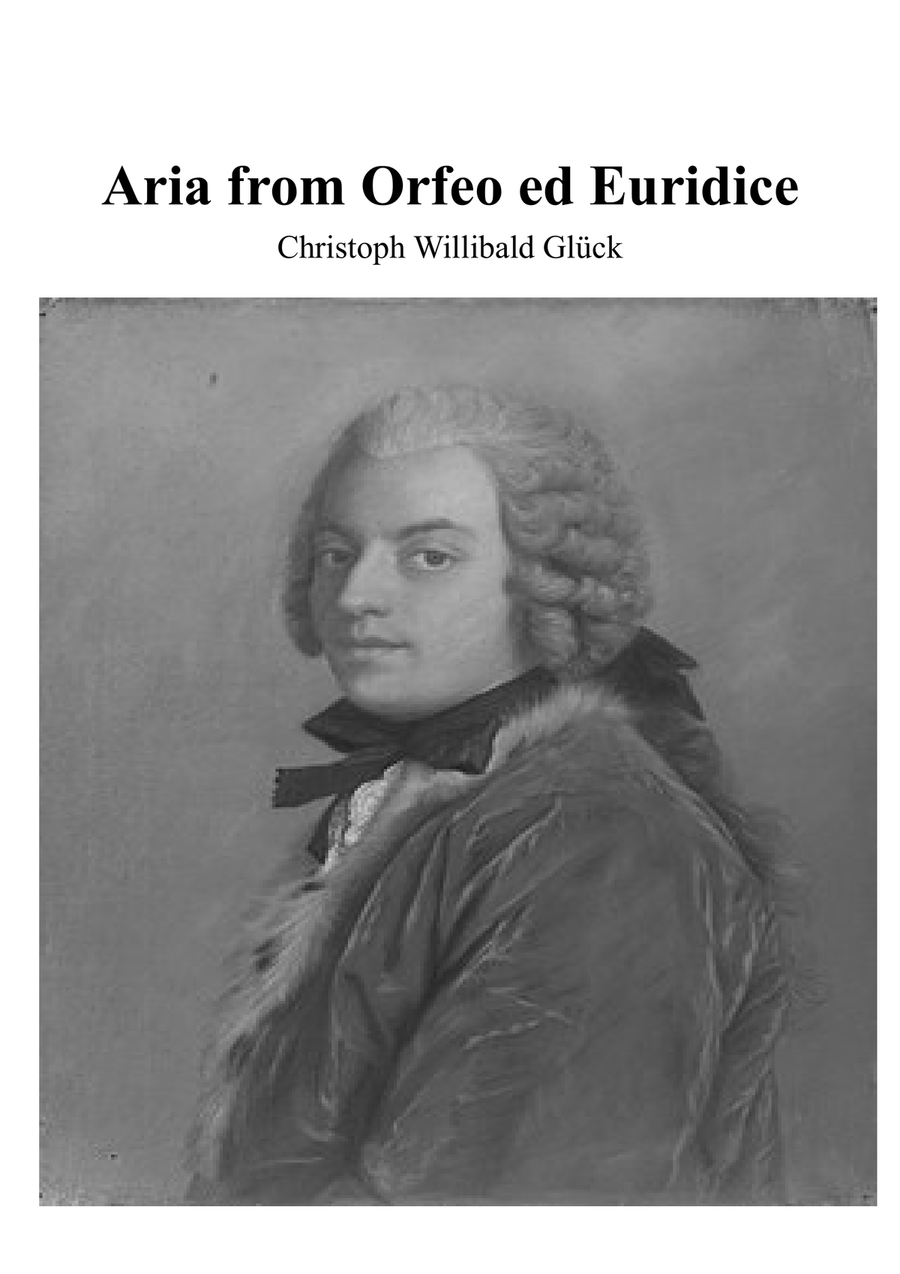
Aria from the Opera Orfeo ed Euridice for Brass Quintet (French Horn solo)
Quintette de Cuivres: 2 trompettes, Cor, trombone, tuba

$8.99 7.62 € Quintette de Cuivres: 2 trompettes, Cor, trombone, tuba PDF SheetMusicPlus


1 16 31 ....331


Partitions Gratuites
Acheter des Partitions Musicales
Acheter des Partitions Digitales à Imprimer
Acheter des Instruments de Musique

© 2000 - 2026

Accueil - Version intégrale





