EUROPE
404 articles
USA
0 articles
DIGITAL
8 articles (à imprimer)
Partitions Digitales
Partitions à imprimer
8 partitions trouvées


Brass Ensemble Horn,Trombone,Trumpet - Level 3 - Digital Download SKU: A0.814531 Composed by Franz Xaver Gruber. Arranged by Regis Bookshar. Christmas,Instructional,Multicultural,World. Score and parts. 11 pages. Regis Bookshar #6636613. Published by Regis Bookshar (A0.814531). Brass Octet - Intermediate - Digital Download. This arrangement of Silent Night, or in German, Stille Nacht, would be a wonderful addition to any music library and could be performed for Christmas concerts, recitals, and, especially, church services. It is equally suitable for junior and senior high school students and even older musicians. Depending on their ability, younger musicians would also enjoy playing this selection. Included are a score and a complete set of parts (11 pages). This selection is one of the many arrangements from The Regis Bookshar Trumpet Ensemble's extensive music library which are being made available for the first time.Silent Night is probably the most popular Christmas carol ever written. It was composed in 1818 by Franz Xaver Gruber to lyrics by Joseph Mohr and was first performed on Christmas Eve at St. Nicholas parish church in Oberndorf, a small village in present-day Austria. A young Catholic priest, Father Joseph Mohr, had written the poem, Stille Nacht, in 1816 and had gone to Oberndorf in 1817. The melody was composed by Franz Xaver Gruber, schoolmaster and organist in the nearby village of Arnsdorf. On Christmas Eve, 1818, Mohr brought the words to Gruber and asked him to compose a melody and guitar accompaniment for that night's mass, after river flooding had possibly damaged the church organ. The church was eventually destroyed by repeated flooding and has since been replaced with the Silent-Night-Chapel.According to Gruber, Karl Mauracher, an organ builder who serviced the instrument at the Oberndorf church, was enamored with the song, and took the composition home with him to the Ziller Valley in Tyrol, Austria. From there, two traveling families of folk singers, the Strassers and the Rainers, included the tune in their shows. The Rainers were already singing it around Christmas, 1819, and once performed it for an audience that included Franz I of Austria and Alexander I of Russia. They also gave the first performance of the song in the United States in New York City in 1839. By the 1840's, the song was well known and was reported to be a favorite of Frederick William IV of Prussia. During this period, the melody changed slightly to become the version that is commonly heard today. The version of the melody that is generally used today is a slow, meditative lullaby, or pastoral, differing slightly from Gruber's original which has a moderate tempo. The song has been translated into about 140 languages and has been recorded by many singers across many music genres. The version sung by Bing Crosby in 1935, has sold over 10 million copies as a single.In this arrangement of Silent Night, Regis Bookshar has kept the basic form of this familiar Christmas carol, but has also included a descant during the third verse. Also, in addition to this version for a Brass Octet, consisting of 3 Trumpets, 2 French Horns and 3 Trombones, there are other arrangements of Silent Night available for a variety of instrumental ensembles. There are Quintets and Octets readily available for purchase. Please take the time to look for other versions of this composition. You may find something else that might also suit your needs.I would also encourage you to search for other arrangements by Regis Bookshar, as well, as there are numerous arrangements in a wide variety of styles, also available for purchase. You may find something else which might interest you. Please continue to check periodically because new arrangements are being added as often as possible. I'm certain that this wonderful arrangement of Silent Night will continue to entertain both performers and audiences alike for years to come.
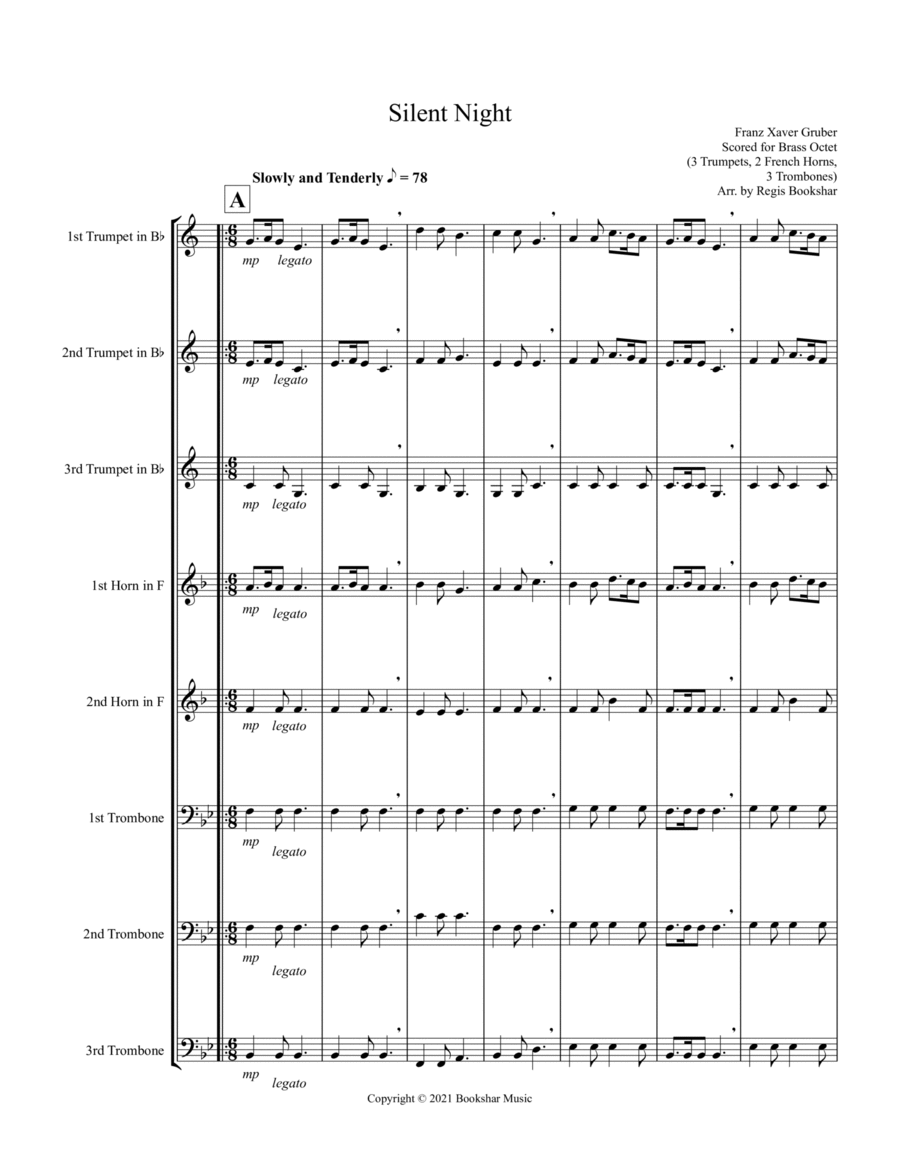
Silent Night (Bb) (Brass Octet - 3 Trp, 2 Hrn, 3 Trb)
Quatuor de Cuivres: 2 trompettes, Cor, trombone
the 1840's, the song was well known and was reported to be a favorite of Frederick William IV of Prussia During this period, the melody changed slightly to become the version that is commonly heard today
$8.00 6.94 € Quatuor de Cuivres: 2 trompettes, Cor, trombone PDF SheetMusicPlus

Brass Ensemble Horn,Trombone,Trumpet - Level 3 - Digital Download SKU: A0.814532 Composed by Franz Xaver Gruber. Arranged by Regis Bookshar. Christmas,Instructional,Multicultural,World. Score and parts. 12 pages. Regis Bookshar #6636621. Published by Regis Bookshar (A0.814532). Brass Octet - Intermediate - Digital Download. This arrangement of Silent Night, or in German, Stille Nacht, would be a wonderful addition to any music library and could be performed for Christmas concerts, recitals, and, especially, church services. It is equally suitable for junior and senior high school students and even older musicians. Depending on their ability, younger musicians would also enjoy playing this selection. Included are a score and a complete set of parts (12 pages). This selection is one of the many arrangements from The Regis Bookshar Trumpet Ensemble's extensive music library which are being made available for the first time.Silent Night is probably the most popular Christmas carol ever written. It was composed in 1818 by Franz Xaver Gruber to lyrics by Joseph Mohr and was first performed on Christmas Eve at St. Nicholas parish church in Oberndorf, a small village in present-day Austria. A young Catholic priest, Father Joseph Mohr, had written the poem, Stille Nacht, in 1816 and had gone to Oberndorf in 1817. The melody was composed by Franz Xaver Gruber, schoolmaster and organist in the nearby village of Arnsdorf. On Christmas Eve, 1818, Mohr brought the words to Gruber and asked him to compose a melody and guitar accompaniment for that night's mass, after river flooding had possibly damaged the church organ. The church was eventually destroyed by repeated flooding and has since been replaced with the Silent-Night-Chapel.According to Gruber, Karl Mauracher, an organ builder who serviced the instrument at the Oberndorf church, was enamored with the song, and took the composition home with him to the Ziller Valley in Tyrol, Austria. From there, two traveling families of folk singers, the Strassers and the Rainers, included the tune in their shows. The Rainers were already singing it around Christmas, 1819, and once performed it for an audience that included Franz I of Austria and Alexander I of Russia. They also gave the first performance of the song in the United States in New York City in 1839. By the 1840's, the song was well known and was reported to be a favorite of Frederick William IV of Prussia. During this period, the melody changed slightly to become the version that is commonly heard today. The version of the melody that is generally used today is a slow, meditative lullaby, or pastoral, differing slightly from Gruber's original which has a moderate tempo. The song has been translated into about 140 languages and has been recorded by many singers across many music genres. The version sung by Bing Crosby in 1935, has sold over 10 million copies as a single.In this arrangement of Silent Night, Regis Bookshar has kept the basic form of this familiar Christmas carol, but has also included a descant during the third verse. Also, in addition to this version for a Brass Octet, consisting of 4 Trumpets, 2 French Horns and 2 Trombones, there are other arrangements of Silent Night available for a variety of instrumental ensembles. There are Quintets and Octets readily available for purchase. Please take the time to look for other versions of this composition. You may find something else that might also suit your needs.I would also encourage you to search for other arrangements by Regis Bookshar, as well, as there are numerous arrangements in a wide variety of styles, also available for purchase. You may find something else which might interest you. Please continue to check periodically because new arrangements are being added as often as possible. I'm certain that this wonderful arrangement of Silent Night will continue to entertain both performers and audiences alike for years to come.
Silent Night (Bb) (Brass Octet - 4 Trp, 2 Hrn, 2 Trb)
Quatuor de Cuivres: 2 trompettes, Cor, trombone
the 1840's, the song was well known and was reported to be a favorite of Frederick William IV of Prussia During this period, the melody changed slightly to become the version that is commonly heard today
$8.00 6.94 € Quatuor de Cuivres: 2 trompettes, Cor, trombone PDF SheetMusicPlus

Brass Ensemble Horn,Trombone,Trumpet - Level 3 - Digital Download SKU: A0.814530 Composed by Franz Xaver Gruber. Arranged by Regis Bookshar. Christmas,Instructional,Multicultural,World. Score and parts. 7 pages. Regis Bookshar #6632969. Published by Regis Bookshar (A0.814530). Brass Quintet Quintet - Intermediate - Digital Download. This arrangement of Silent Night, or in German, Stille Nacht, would be a wonderful addition to any music library and could be performed for Christmas concerts, recitals, and, especially, church services. It is equally suitable for junior and senior high school students and even older musicians. Depending on their ability, younger musicians would also enjoy playing this selection. Included are a score and a complete set of parts (7 pages). This selection is one of the many arrangements from The Regis Bookshar Trumpet Ensemble's extensive music library which are being made available for the first time.Silent Night is probably the most popular Christmas carol ever written. It was composed in 1818 by Franz Xaver Gruber to lyrics by Joseph Mohr and was first performed on Christmas Eve at St. Nicholas parish church in Oberndorf, a small village in present-day Austria. A young Catholic priest, Father Joseph Mohr, had written the poem, Stille Nacht, in 1816 and had gone to Oberndorf in 1817. The melody was composed by Franz Xaver Gruber, schoolmaster and organist in the nearby village of Arnsdorf. On Christmas Eve, 1818, Mohr brought the words to Gruber and asked him to compose a melody and guitar accompaniment for that night's mass, after river flooding had possibly damaged the church organ. The church was eventually destroyed by repeated flooding and has since been replaced with the Silent-Night-Chapel.According to Gruber, Karl Mauracher, an organ builder who serviced the instrument at the Oberndorf church, was enamored with the song, and took the composition home with him to the Ziller Valley in Tyrol, Austria. From there, two traveling families of folk singers, the Strassers and the Rainers, included the tune in their shows. The Rainers were already singing it around Christmas, 1819, and once performed it for an audience that included Franz I of Austria and Alexander I of Russia. They also gave the first performance of the song in the United States in New York City in 1839. By the 1840's, the song was well known and was reported to be a favorite of Frederick William IV of Prussia. During this period, the melody changed slightly to become the version that is commonly heard today. The version of the melody that is generally used today is a slow, meditative lullaby, or pastoral, differing slightly from Gruber's original which has a moderate tempo. The song has been translated into about 140 languages and has been recorded by many singers across many music genres. The version sung by Bing Crosby in 1935, has sold over 10 million copies as a single.In this arrangement of Silent Night, Regis Bookshar has kept the basic form of this familiar Christmas carol, but has also included a descant during the third verse. Also, in addition to this version for a Brass Quinet, consisting of 2 Trumpets, 1 French Horn and 2 Trombones, there are other arrangements of Silent Night available for a variety of instrumental ensembles. There are Quintets and Octets readily available for purchase. Please take the time to look for other versions of this composition. You may find something else that might also suit your needs.I would also encourage you to search for other arrangements by Regis Bookshar, as well, as there are numerous arrangements in a wide variety of styles, also available for purchase. You may find something else which might interest you. Please continue to check periodically because new arrangements are being added as often as possible. I'm certain that this wonderful arrangement of Silent Night will continue to entertain both performers and audiences alike for years to come.

Silent Night (Bb) (Brass Quintet - 2 Trp, 1 Hrn, 2 Trb)
Quatuor de Cuivres: 2 trompettes, Cor, trombone
the 1840's, the song was well known and was reported to be a favorite of Frederick William IV of Prussia During this period, the melody changed slightly to become the version that is commonly heard today
$5.00 4.34 € Quatuor de Cuivres: 2 trompettes, Cor, trombone PDF SheetMusicPlus

Brass Ensemble Horn,Trombone,Trumpet - Level 3 - Digital Download SKU: A0.814537 Composed by James R. Murray. Arranged by Regis Bookshar. Christmas,Instructional,Standards. Score and parts. 12 pages. Regis Bookshar #6658461. Published by Regis Bookshar (A0.814537). Brass Quintet - Intermediate - Digital Download. This arrangement of Away in a Manger, would be a fine addition to any music library and could be performed for Christmas concerts, recitals and church services. It is equally suitable for junior and senior high school students, and, depending on their ability, even younger students, too. Included are a score and a complete set of parts (10 pages). This selection is one of the many arrangements from The Regis Bookshar Trumpet Ensemble's extensive music library which are being made available for the first time.Away in a Manger is one of the most popular Christmas carols and there are a number of musical settings of it. The most popular musical setting of it in the United States is the tune commonly known as Mueller. It was composed by James R. Murray and was first published under the name Luther's Cradle Hymn, in his collection Dainty Songs for Little Lads and Lasses, in 1887. It was intended for use in kindergarten, school and home.In this selection, Regis Bookshar has arranged three verses of this popular Christmas carol for a Brass Quintet, consisting of 2 Trumpets, 1 French Horn and 2 Trombones. The first verse is a traditional setting of the tune while the second verse has a more complex accompaniment. The third verse also includes a descant. Between the second and third verses, he has included a short interlude. In addition to this arrangement for a Brass Quintet, there are also other Quintet arrangements of Away in a Manger for a variety of instrumental ensembles, as well as quite a few other Christmas selections, readily available for purchase. Please take the time to look for other versions of this composition and other selections. You may find something else that may also suit your needs.I would also encourage you to search for other arrangements by Regis Bookshar, as well, as there are numerous arrangements in a wide variety of styles, also available for purchase. You may find something else which might interest you. Please continue to check periodically because new arrangements are being added as often as possible. I'm certain that this wonderful arrangement of Away in a Manger will continue to entertain both performers and audiences alike for years to come.

Away in a Manger (G) (Brass Quintet - 2 Trp, 1 Hrn, 2 Trb)
Quatuor de Cuivres: 2 trompettes, Cor, trombone

$8.00 6.94 € Quatuor de Cuivres: 2 trompettes, Cor, trombone PDF SheetMusicPlus

Brass Ensemble Horn,Trombone,Trumpet - Level 3 - Digital Download SKU: A0.1226488 Composed by Giovanni Gabrieli. Arranged by James M. Guthrie, ASCAP. Chamber,Contest,Early Music,Festival,Historic,Renaissance. Score and Parts. 51 pages. Jmsgu3 #822490. Published by jmsgu3 (A0.1226488). Minimum instrumentation: 4 Trumpets (or Cornets), 4 French Horns, 2 Tenor Trombones, and 2 Bass Trombones.InnovationsGabrieli preferred sacred vocal and certainly instrumental music. Hence, he concentrated on music that consequently took advantage of resonance and likewise reverberation for maximum effect. Seems like Gabrieli may have invented dynamics – or was rather the first to indicate them such as in his Sonata Pian’ e Forte. Consequently, he was also a pioneer in spatial techniques. He therefore developed and used very specific notation to indicate instrumentation. Gabrieli experimented with assembling massive instrumental forces into isolated groups separated by space. In this way, he consequently contributed heavily to the Baroque Concertato style.Polychoral WorksGabrieli probably used the layout of the San Marco church for his experiments. This is because he worked there as a musician and composer. Furthermore, the church had two choir lofts facing each other. He certainly used these to create striking spatial effects between instrumental forces. Certainly, many of his works are composed such that a choir or instrumental group could first be heard on one side, then consequently followed by a response from the group on the other side. Sometimes there was probably a third group positioned near the main altar as well.Spatial MusicAbove all, Gabrieli studied carefully detailed groups of instruments and singers. Furthermore, it seems like he created precise directions for instrumentation rather than two groups. The instruments, because they could be appropriately situated, could consequently be heard with perfect clearness at distant locations. As a result, arrangements that seem bizarre on paper, can in contrast sound perfectly in balance.First WorksFinally, Gabrieli published his first motets along with his uncle Andrea's compositions in Concerti (1587). These compositions furthermore indicate considerable usage of dialogue and echo effects. Consequently, here we see low and high choirs with the variance between their ranges indicated by instrumental accompaniment. Seems like Gabrieli’s later motets Sacrae Symphoniae (1597) move away from close antiphony. In contrast, he moves towards not simply echoing the material but developing it through sequential choral entrances. Even more, he takes this procedure to the extreme in the Motet Omnes Gentes. Unlike earlier works, here the instruments are certainly an essential part of the presentation. Also, only parts marked: Capella are supposed to be sung.HomophonyHence, after 1605, Gabrieli moves to a much more homophonic style. He writes sections purely for instruments – which calls Sinfonia – and smaller sections for vocal soloists, accompanied by a basso continuo.
Gabrieli: Canzona in Echo Ch. 180 for Double Brass Choir
Quatuor de Cuivres: 2 trompettes, Cor, trombone

$47.95 41.58 € Quatuor de Cuivres: 2 trompettes, Cor, trombone PDF SheetMusicPlus

Brass Ensemble Horn,Trombone,Trumpet - Level 3 - Digital Download SKU: A0.1226321 Composed by Giovanni Gabrieli. Arranged by James M. Guthrie, ASCAP. Chamber,Contest,Early Music,Festival,Historic,Renaissance. 48 pages. Jmsgu3 #822323. Published by jmsgu3 (A0.1226321). Minimum instrumentation: 3 Brass Quartets - 6 trumpets in C (or cornets) 3 French Horns in F, and 3 trombones. InnovationsGabrieli preferred sacred vocal and certainly instrumental music. Hence, he concentrated on music that consequently took advantage of resonance and likewise reverberation for maximum effect. Seems like Gabrieli may have invented dynamics – or was rather the first to indicate them such as in his Sonata Pian’ e Forte. Consequently, he was also a pioneer in spatial techniques. He therefore developed and used very specific notation to indicate instrumentation. Gabrieli experimented with assembling massive instrumental forces into isolated groups separated by space. In this way, he consequently contributed heavily to the Baroque Concertato style.Polychoral WorksGabrieli probably used the layout of the San Marco church for his experiments. This is because he worked there as a musician and composer. Furthermore, the church had two choir lofts facing each other. He certainly used these to create striking spatial effects between instrumental forces. Certainly, many of his works are composed such that a choir or instrumental group could first be heard on one side, then consequently followed by a response from the group on the other side. Sometimes there was probably a third group positioned near the main altar as well.Spatial MusicAbove all, Gabrieli studied carefully detailed groups of instruments and singers. Furthermore, it seems like he created precise directions for instrumentation rather than two groups. The instruments, because they could be appropriately situated, could consequently be heard with perfect clearness at distant locations. As a result, arrangements that seem bizarre on paper, can in contrast sound perfectly in balance.First WorksFinally, Gabrieli published his first motets along with his uncle Andrea's compositions in Concerti (1587). These compositions furthermore indicate considerable usage of dialogue and echo effects. Consequently, here we see low and high choirs with the variance between their ranges indicated by instrumental accompaniment. Seems like Gabrieli’s later motets Sacrae Symphoniae (1597) move away from close antiphony. In contrast, he moves towards not simply echoing the material but developing it through sequential choral entrances. Even more, he takes this procedure to the extreme in the Motet Omnes Gentes. Unlike earlier works, here the instruments are certainly an essential part of the presentation. Also, only parts marked: Capella are supposed to be sung.HomophonyHence, after 1605, Gabrieli moves to a much more homophonic style. He writes sections purely for instruments – which calls Sinfonia – and smaller sections for vocal soloists, accompanied by a basso continuo.
Gabrieli: Canzon in Echo a 12 Ch. 192 for Triple Brass Choir
Quatuor de Cuivres: 2 trompettes, Cor, trombone

$47.95 41.58 € Quatuor de Cuivres: 2 trompettes, Cor, trombone PDF SheetMusicPlus

Brass Ensemble Horn,Trombone,Trumpet - Level 3 - Digital Download SKU: A0.1130684 Composed by Johann Sebastian Bach. Arranged by John A. Dempsey. Baroque,Christmas,Classical,Easter,Wedding. Score and parts. 16 pages. John A. Dempsey #730950. Published by John A. Dempsey (A0.1130684). With its bell-like refrain, Bach's exquisite, elegant Sheep May Safely Graze (from Cantata, No. 208) appeals not only to fans of Baroque music but also to admirers of classical, romantic and pop music.  This brass trio for Bb trumpet, French horn and trombone is recommended for concerts, recitals, banquets, weddings, traditional church services and other worship events.  Suggested wedding uses: prelude, unity candle music, bridesmaid processional, bridal march and wedding recessional.  As worship music, Sheep May Safely Graze may serve as a prelude, postlude, an offertory, interlude, silent prayer accompaniment and special music. Key: Bb major. 12 pages of music (that includes separate two-page parts for each instrument).
Sheep May Safely Graze (Bach): Brass Trio for Trumpet, Horn in F and Trombone
Quatuor de Cuivres: 2 trompettes, Cor, trombone

$9.99 8.66 € Quatuor de Cuivres: 2 trompettes, Cor, trombone PDF SheetMusicPlus


Partitions Gratuites
Acheter des Partitions Musicales
Acheter des Partitions Digitales à Imprimer
Acheter des Instruments de Musique

© 2000 - 2026

Accueil - Version intégrale



