EUROPE
11700 articles
USA
0 articles
DIGITAL
42 articles (à imprimer)
Partitions Digitales
Partitions à imprimer
42 partitions trouvées


Brass Ensemble Horn,Trombone,Trumpet,Tuba - Level 4 - Digital Download SKU: A0.528160 Composed by Antonin Dvorak. Arranged by Diego Marani. Classical,Concert,Instructional,Romantic Period,Standards. Score and parts. 19 pages. Diego Marani #4987913. Published by Diego Marani (A0.528160). The Slavonic Dances are a series of 16 orchestral pieces composed by Antonín Dvořák in 1878 and 1886 and published in two sets as Op. 46 and Op. 72 respectively. Originally written for piano four hands, the Slavonic Dances were inspired by Johannes Brahms's own Hungarian Dances and were orchestrated at the request of Dvořák's publisher soon after composition. The pieces, lively and full of national character, were well received at the time and today are considered among the composer's most memorable works, occasionally making appearances in popular culture.In this arrangement for brass quartet (Bb Trumpet 1, Bb Trumpet 2, Trombone or F Horn, Tuba) we have the Slavonic Dance No. 8 (Op. 46): Furiant.
Slavonic Dances No. 8 Op. 46 for Brass Quartet
Quatuor de Cuivres : 2 trompettes, trombone, tuba

$14.99 12.81 € Quatuor de Cuivres : 2 trompettes, trombone, tuba PDF SheetMusicPlus

Brass Ensemble Horn,Trombone,Trumpet,Tuba - Level 4 - Digital Download SKU: A0.528161 Composed by Antonin Dvorak. Arranged by Diego Marani. Classical,Concert,Instructional,Romantic Period,Standards. Score and parts. 23 pages. Diego Marani #4991407. Published by Diego Marani (A0.528161). The Slavonic Dances are a series of 16 orchestral pieces composed by Antonín Dvořák in 1878 and 1886 and published in two sets as Op. 46 and Op. 72 respectively. Originally written for piano four hands, the Slavonic Dances were inspired by Johannes Brahms's own Hungarian Dances and were orchestrated at the request of Dvořák's publisher soon after composition. The pieces, lively and full of national character, were well received at the time and today are considered among the composer's most memorable works, occasionally making appearances in popular culture.In this arrangement for brass quintet (Bb Trumpet 1, Bb Trumpet 2, F Horn, Trombone, Tuba) we have the Slavonic Dance No. 8 (Op. 46): Furiant.
Slavonic Dances No. 8 Op. 46 for Brass Quintet
Quatuor de Cuivres : 2 trompettes, trombone, tuba

$16.99 14.51 € Quatuor de Cuivres : 2 trompettes, trombone, tuba PDF SheetMusicPlus

Brass Ensemble Horn,Trombone,Trumpet,Tuba - Level 4 - Digital Download SKU: A0.827220 Composed by Wilhelm Ramsoe. Arranged by Dennis S. Mowers. Romantic Period. Score and parts. 87 pages. Dennis S. Mowers #3473977. Published by Dennis S. Mowers (A0.827220). Wilhelm Ramsoe's brass quartets are a staple among brass quartet repertoire even today. If you're looking for brass quartet music to play at a recital, wedding, or any other occasion, look no further. This transcription of Ramsoe's second brass quartet is written for modern B flat trumpets, horn in F, and a bass part that can easily be played on bass trombone or tuba if you prefer.Includes:-Score (43 pages)-Trumpet 1 part (8 pages)-Trumpet 2 part (8 pages)-F Horn part (8 pages)-Trombone/Tuba part (8 pages).
Quartet No. 2 for Brass - Wilhelm Ramsoe, Op. 29
Quatuor de Cuivres : 2 trompettes, trombone, tuba

$17.99 15.37 € Quatuor de Cuivres : 2 trompettes, trombone, tuba PDF SheetMusicPlus

Brass Quartet - Level 3 - Digital Download SKU: A0.1261834 Composed by Ludwig van Beethoven. Arranged by Ander. 19th Century,Classical,Film/TV,March,Romantic Period. 13 pages. Woods Only, Arrangements #854917. Published by Woods Only, Arrangements (A0.1261834). This arrangement adapted for brass quartet was written keeping the characteristics of the original work, in order to be performed by young music students who want to enter the symphonic music. Besides, it can also be used by professional musicians, for recitals, repertoire, academic presentations and didactic material. As much as it is a funeral march, it is well suited for any musical performance occasion. The transcription is faithful to the structure, with only one change of key, so that it is comfortable for all the instruments in the formation, as well as for use in ensemble practice between musicians of different traditions. Ludwig van Beethoven began concentrated work on his Symphony No. 7 in A major Op. 92 in 1811, it was completed in 1812, and was dedicated to Count Moritz von Fries, and premiered in Vienna on December 8, 1813. It is considered a remarkable example of the more ebullient side of Beethoven's compositional personality and evidence that even after the onset of deafness, he still found cause for musical optimism. The second movement Allegretto is a funeral march in everything but name. Often several contrasting melodic ideas are made to coexist, as if Beethoven were imagining several processions converging on the cemetery at the same time. As he was working on this symphony during the years of the Napoleonic Wars, this experience was probably within his experience. It was also used as the soundtrack to the film Knowing, by director Alex Proyas and starring Nicolas Cage, where it is used in the final scene of the film. Beethoven called Symphony No. 7 his most excellent symphony, and a music critic of the time reported, this symphony is the most melodically rich and the most pleasing and comprehensible of all Beethoven's symphonies..
Symphony No. 7 by Beethoven for Brass Quartet
Quatuor de Cuivres : 2 trompettes, trombone, tuba

$7.99 6.83 € Quatuor de Cuivres : 2 trompettes, trombone, tuba PDF SheetMusicPlus

Brass Ensemble Horn,Trombone,Trumpet,Tuba - Level 3 - Digital Download SKU: A0.528057 Composed by Georges Bizet. Arranged by Diego Marani. Classical,Concert,Instructional,Romantic Period,Standards. Score and parts. 8 pages. Diego Marani #4631385. Published by Diego Marani (A0.528057). Georges Bizet composed L'Arlésienne as incidental music to Alphonse Daudet's play of the same name, usually translated as The Girl from Arles. Bizet arranged his work into a suite of four movements. Now known as L'Arlésienne Suite No. 1, the suite used a full symphony orchestra but without the chorus.In this arrangement for brass quintet (Bb Trumpet 1, Bb Trumpet 2, F Horn, Trombone, Tuba) we have Adagietto, the third movement of the suite. It is a short but very beautiful melody that takes on chamber tones but with highly dramatic developments.
Adagietto from "L'Arlesienne Suite No. 1" for Brass Quintet
Quatuor de Cuivres : 2 trompettes, trombone, tuba

$12.90 11.02 € Quatuor de Cuivres : 2 trompettes, trombone, tuba PDF SheetMusicPlus

Brass Ensemble Horn,Trombone,Trumpet,Tuba - Level 3 - Digital Download SKU: A0.528056 Composed by Georges Bizet. Arranged by Diego Marani. Classical,Concert,Instructional,Romantic Period,Standards. Score and parts. 8 pages. Diego Marani #4631289. Published by Diego Marani (A0.528056). Georges Bizet composed L'Arlésienne as incidental music to Alphonse Daudet's play of the same name, usually translated as The Girl from Arles. Bizet arranged his work into a suite of four movements. Now known as L'Arlésienne Suite No. 1, the suite used a full symphony orchestra but without the chorus.In this arrangement for brass quartet (Bb Trumpet 1, Bb Trumpet 2, Trombone or F Horn, Tuba) we have Adagietto, the third movement of the suite. It is a short but very beautiful melody that takes on chamber tones but with highly dramatic developments.
Adagietto from "L'Arlesienne Suite No. 1" for Brass Quartet
Quatuor de Cuivres : 2 trompettes, trombone, tuba

$9.90 8.46 € Quatuor de Cuivres : 2 trompettes, trombone, tuba PDF SheetMusicPlus

Brass Ensemble Horn,Trombone,Trumpet,Tuba - Level 3 - Digital Download SKU: A0.1030615 Composed by William Billings. Arranged by Mike Allsen. Classical,Praise & Worship,Renaissance,Sacred,Spiritual. Score and parts. 41 pages. Aaron Hettinga #636010. Published by Aaron Hettinga (A0.1030615). William Billings (1746-1800) was North America’s first great choral composer. He spent most of his life in Boston, working at various times as a tanner or as minor civic official, and occasionally as a church musician. Billings seems to have had little formal music training, but when he was just 22, he also set himself up as an itinerant singing-master, teaching “singing-schools,†where children and adults could learn the rudiments of musical notation and solfege. To feed the market he and other singing-masters had helped to create, Billings published six collections of music, mostly for SATB voices, The first of these, The New England Psalm-Singer (1770) featured a frontispiece engraved by his friend Paul Revere. Billings was fairly prosperous by 1780s, but his good fortune faded in the 1790s. His final collection of music, The Continental Harmony of 1794, was published for his benefit by a group of Boston friends. Billings died destitute in 1800. Billings composed some 340 pieces, mostly collected in his printed editions. This music has a rough-edged and sturdy beauty that is distinctly different from anything in contemporary Europe. The vast majority of Billings’s works were hymns or “psalm tunes.†He was particularly attracted to the great English hymn-writer Isaac Watts (1674-1748), though Billings himself wrote verses for many of his hymns. One of the most famous Billings “psalm tunes,†Chester is not a Christian hymn, but rather a patriotic song of defiance directed against the British. Billings spent nearly all of the Revolutionary War in Boston and made no secret of his patriot sentiments. Chester was first published in 1770, but when he republished it in his The Singing-Master’s Assistant during the height of the war in 1778, Billings added a verse calling out the “infernal league†of the leading British generals Howe, Burgoyne, Clinton, Prescot and Cornwallis. Many brass-players will know Chester from the finale of William Schuman’s 1957 band piece A New England Triptych. Billings also composed over 50 “fuging-tunesâ€â€”a genre that usually included a short introduction and a repeated contrapuntal section. (These fuging sections usually begin with imitation, but they are otherwise not at all like classical fugues written in Europe at the time.) The fuging-tune Creation is one of his later works, published in The Continental Harmony of 1794, and experiments with the form. It sets two verses of the Watts hymn “When I With Pleasing Wonder Stand†though final line of verse 1 is repeated in a striking phrase that suddenly moves twice as fast (m.15). The fuging section begins in m.30, and rather than the usual exact repeat, Billing writes an entirely new and more elaborate second section beginning at m.44. Billings first published the simple but beautiful Africa in 1770, and published a revised version in 1778; the later version appearing with the Isaac Watts hymn “Now Shall My Inward Joys Arise.†I first arranged Africa in 1995, for the Glenwood Moravian Trombone Choir (Madison, WI), and I edited it for this publication. Phrasing and articulations marked here reflect the original vocal texts. Africa has long been a favorite of the Glenwood group. Chester and Creation were arranged in 2022. Mike Allsen February 2022.
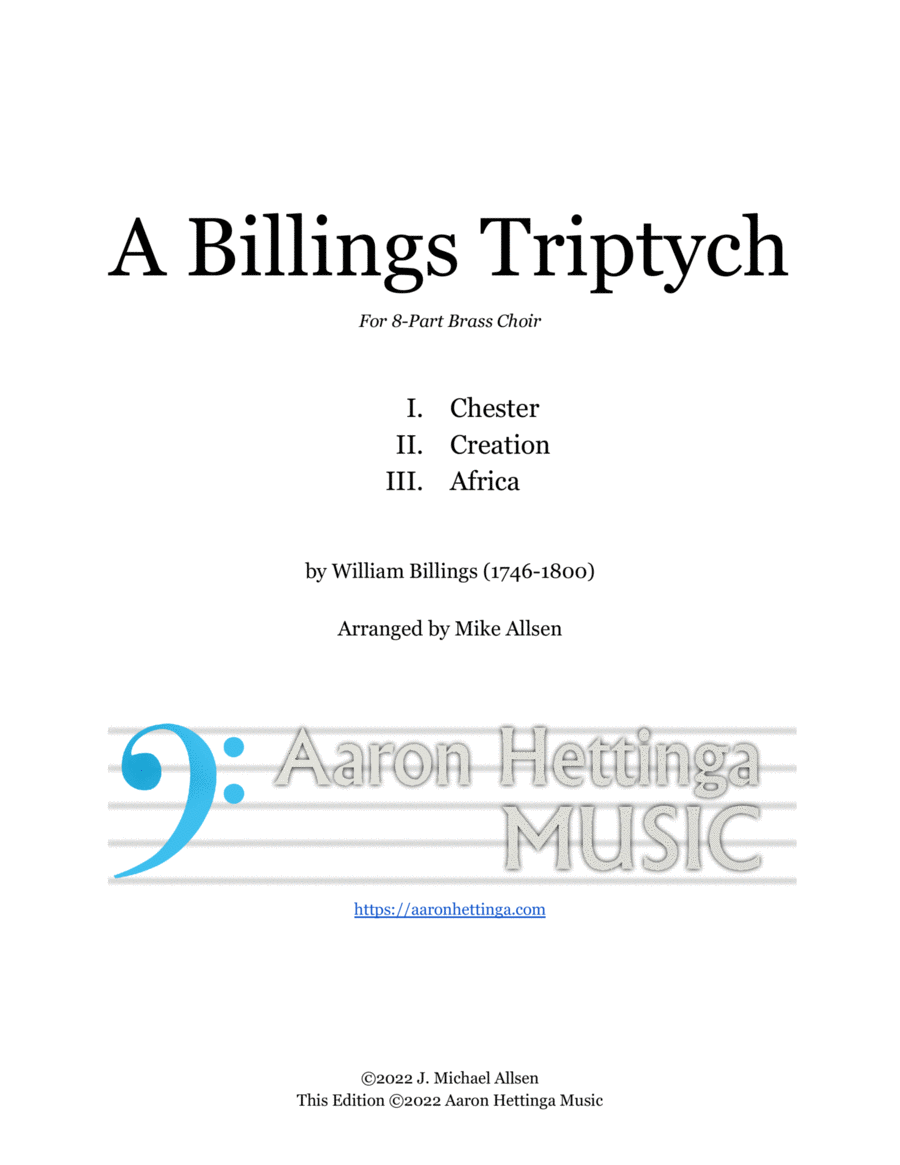
A Billings Triptych - for 8-Part Brass Choir
Quatuor de Cuivres : 2 trompettes, trombone, tuba

$34.99 29.89 € Quatuor de Cuivres : 2 trompettes, trombone, tuba PDF SheetMusicPlus


Partitions Gratuites
Acheter des Partitions Musicales
Acheter des Partitions Digitales à Imprimer
Acheter des Instruments de Musique

© 2000 - 2026

Accueil - Version intégrale





