EUROPE
6378 articles
USA
0 articles
DIGITAL
40 articles (à imprimer)
Partitions Digitales
Partitions à imprimer
40 partitions trouvées


Brass Ensemble Horn,Trombone,Trumpet,Tuba - Level 3 - Digital Download SKU: A0.813843 Composed by Antonin Dvorak. Arranged by Regis Bookshar. Contemporary,Folk,Romantic Period,Standards. Score and parts. 32 pages. Regis Bookshar #6537739. Published by Regis Bookshar (A0.813843). Largo (from Symphony No. 9 in E minor) (From the New World) (Db) (Brass Ensemble) - Intermediate - Digital Download. This marvelous arrangement of the Largo, based on the second movement of Antonin Dvorak's Symphony No. 9 in E minor, would be a fabulous addition to any music library and could be performed for concerts, recitals and church services, especially Funerals, but would be appropriate any time during the church year. This arrangement is suitable for high school and college students but professional musicians would also enjoy playing this selection. Included are a score and a complete set of parts (24 pages). This selection is one of the many arrangements from the The Regis Bookshar Trumpet Ensemble's extensive music library which are being made available for the first time.Symphony No. 9 in E minor, Op. 95 (subtitled From the New World and popularly know as the New World Symphony), was composed by Antonin Dvorak in 1893 while he was the director of the National Conservatory of Music of America from 1892 to 1895. It premiered at Carnegie Hall in New York City on December 16, 1893 and has been described as one of the most popular of all symphonies. The second movement of the symphony, upon which this arrangement is based, is marked Largo, and begins with a harmonic progression of chords which is then followed by a solo instrument playing the famous main theme.Dvorak was interested in Native American music and the African-American spirituals he heard in North America. While director of the National Conservatory he encountered an African-American student, Harry T. Burleigh, who sang traditional spirituals to him. Burleigh, later a composer himself, said that Dvorak had absorbed their spirit before writing his own melodies. Dvorak stated:    I am convinced that the future music of this country must be founded on what are called Negro melodies. These can be the foundation of a serious and original school of composition to be developed in the United States. These beautiful and varied themes are the product of the soil. They are folk songs of America and your composers must turn to them.He further explained how Native American music influenced his symphony:  I have not actually used any of these (Native American) melodies. I have simply written original themes embodying the peculiarities of the Indian music, and, using these themes as subjects, have developed them with all the resources of modern rhythms, counterpoint, and orchestral colour.In 1893, a newspaper interview quoted Dvorak as saying, I found that the music of the negroes and of the Indians was practically identical, and that the music of the two races bore a remarkable similarity to the music of Scotland. Most historians agree that Dvorak is referring to the pentatonic scale, which is typical of each of these musical traditions.Dvorak was influenced not only by music he heard, but also by what he had seen, in America. He wrote that he would not have composed his American pieces as he had if he had not seen America. It has been said that Dvorak was inspired by the wide open spaces of America, such as the prairies he may have seen on his trip to Iowa in the summer of 1893. Notices about several performances of the symphony include the phrase wide open spaces about what inspired the symphony and/or about the feelings it conveys to listeners.The theme from the Largo was adapted into the spiritual Goin' Home (often mistakenly considered a folk song or traditional spiritual) by Dvorak's pupil, William Arms Fisher, who wrote the lyrics in 1922. Regis Bookshar thought it would be wonderful if other instrumentalists could have the opportunity to play this beautiful melody, so, he has created this version for a Brass Ensemble. Parts included with the purchase are a 1st Trumpet in Bb, a 2nd Trumpet in Bb, a 3rd Trumpet in Bb, 1a st French Horn in F, a.
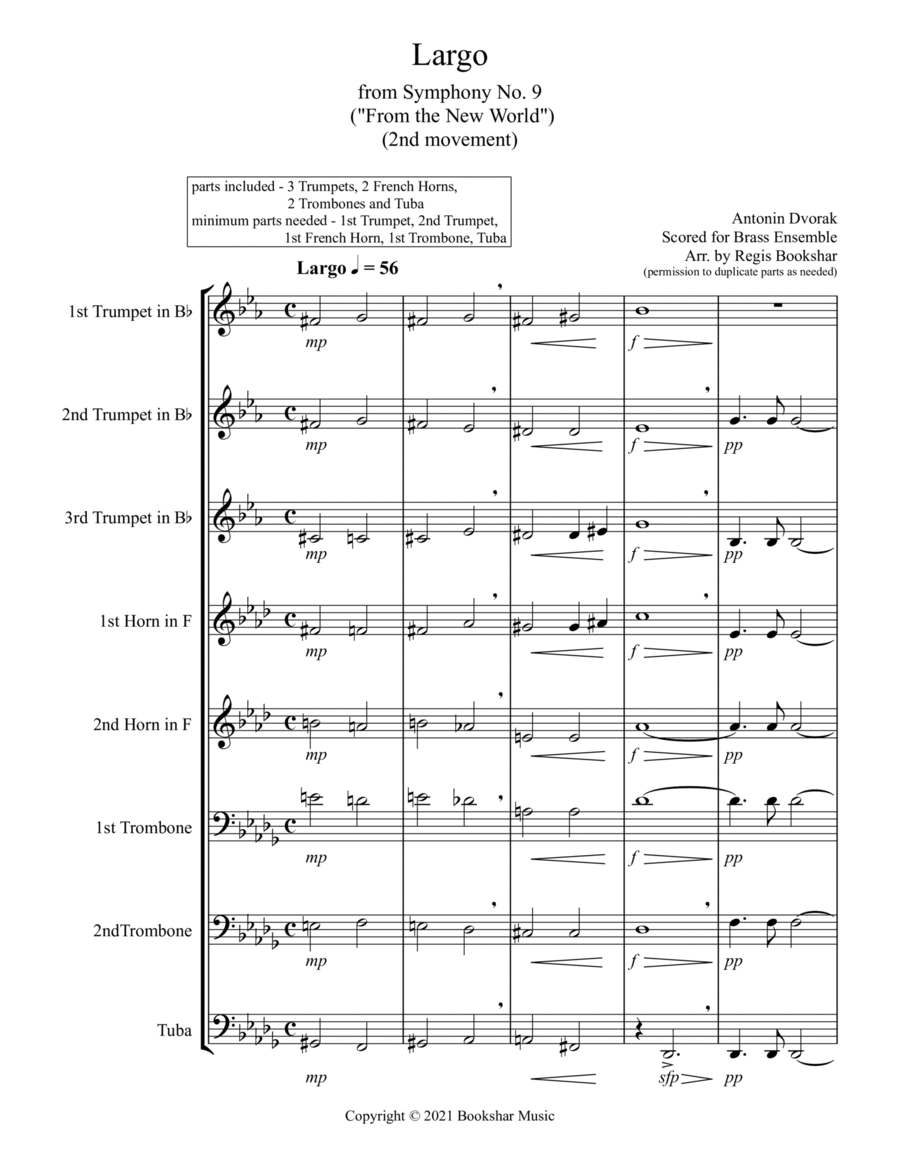
Largo (from "Symphony No. 9") ("From the New World") (Db) (Brass Ensemble - Trps, Hrns, Trbs, Tubas)
Quatuor de Cuivres : 2 trompettes, trombone, tuba

$18.00 15.23 € Quatuor de Cuivres : 2 trompettes, trombone, tuba PDF SheetMusicPlus

Brass Ensemble Trombone,Trumpet,Tuba - Level 3 - Digital Download SKU: A0.813824 Composed by Antonin Dvorak. Arranged by Regis Bookshar. Concert,Contemporary,Folk,Romantic Period,Standards. Score and parts. 18 pages. Regis Bookshar #6533897. Published by Regis Bookshar (A0.813824). Largo (from Symphony No. 9 in E minor) (From the New World) (Db) (Brass Quintet) - Intermediate - Digital Download. This marvelous arrangement of the Largo, based on the second movement of Antonin Dvorak's Symphony No. 9 in E minor, would be a fabulous addition to any music library and could be performed for concerts, recitals and church services, especially Funerals, but would be appropriate any time during the church year. This arrangement is suitable for high school and college students but professional musicians would also enjoy playing this selection. Included are a score and a complete set of parts (18 pages). This selection is one of the many arrangements from the The Regis Bookshar Trumpet Ensemble's extensive music library which are being made available for the first time.Symphony No. 9 in E minor, Op. 95 (subtitled From the New World and popularly know as the New World Symphony), was composed by Antonin Dvorak in 1893 while he was the director of the National Conservatory of Music of America from 1892 to 1895. It premiered at Carnegie Hall in New York City on December 16, 1893 and has been described as one of the most popular of all symphonies. The second movement of the symphony, upon which this arrangement is based, is marked Largo, and begins with a harmonic progression of chords which is then followed by a solo instrument playing the famous main theme.Dvorak was interested in Native American music and the African-American spirituals he heard in North America. While director of the National Conservatory he encountered an African-American student, Harry T. Burleigh, who sang traditional spirituals to him. Burleigh, later a composer himself, said that Dvorak had absorbed their spirit before writing his own melodies. Dvorak stated:    I am convinced that the future music of this country must be founded on what are called Negro melodies. These can be the foundation of a serious and original school of composition to be developed in the United States. These beautiful and varied themes are the product of the soil. They are folk songs of America and your composers must turn to them.He further explained how Native American music influenced his symphony:  I have not actually used any of these (Native American) melodies. I have simply written original themes embodying the peculiarities of the Indian music, and, using these themes as subjects, have developed them with all the resources of modern rhythms, counterpoint, and orchestral colour.In 1893, a newspaper interview quoted Dvorak as saying, I found that the music of the negroes and of the Indians was practically identical, and that the music of the two races bore a remarkable similarity to the music of Scotland. Most historians agree that Dvorak is referring to the pentatonic scale, which is typical of each of these musical traditions.Dvorak was influenced not only by music he heard, but also by what he had seen, in America. He wrote that he would not have composed his American pieces as he had if he had not seen America. It has been said that Dvorak was inspired by the wide open spaces of America, such as the prairies he may have seen on his trip to Iowa in the summer of 1893. Notices about several performances of the symphony include the phrase wide open spaces about what inspired the symphony and/or about the feelings it conveys to listeners.The theme from the Largo was adapted into the spiritual Goin' Home (often mistakenly considered a folk song or traditional spiritual) by Dvorak's pupil, William Arms Fisher, who wrote the lyrics in 1922. Regis Bookshar thought it would be wonderful if other instrumentalists could have the opportunity to play this beautiful melody, so, in addition to this version for a Brass Quintet, but in this case, consisting of 3 Trumpets, 1 Trombone and 1 Tuba, he has made quite a few other arrangements of this selection.
Largo (from "Symphony No. 9") ("From the New World") (Db) (Brass Quintet - 3 Trp, 1 Trb, 1 Tuba)
Quatuor de Cuivres : 2 trompettes, trombone, tuba

$15.00 12.69 € Quatuor de Cuivres : 2 trompettes, trombone, tuba PDF SheetMusicPlus

Brass Ensemble Horn,Trombone,Trumpet,Tuba - Level 3 - Digital Download SKU: A0.813823 Composed by Antonin Dvorak. Arranged by Regis Bookshar. Contemporary,Folk,Romantic Period,Standards. Score and parts. 18 pages. Regis Bookshar #6533895. Published by Regis Bookshar (A0.813823). Largo (from Symphony No. 9 in E minor) (From the New World) (Db) (Brass Quintet) - Intermediate - Digital Download. This marvelous arrangement of the Largo, based on the second movement of Antonin Dvorak's Symphony No. 9 in E minor, would be a fabulous addition to any music library and could be performed for concerts, recitals and church services, especially Funerals, but would be appropriate any time during the church year. This arrangement is suitable for high school and college students but professional musicians would also enjoy playing this selection. Included are a score and a complete set of parts (18 pages). This selection is one of the many arrangements from the The Regis Bookshar Trumpet Ensemble's extensive music library which are being made available for the first time.Symphony No. 9 in E minor, Op. 95 (subtitled From the New World and popularly know as the New World Symphony), was composed by Antonin Dvorak in 1893 while he was the director of the National Conservatory of Music of America from 1892 to 1895. It premiered at Carnegie Hall in New York City on December 16, 1893 and has been described as one of the most popular of all symphonies. The second movement of the symphony, upon which this arrangement is based, is marked Largo, and begins with a harmonic progression of chords which is then followed by a solo instrument playing the famous main theme.Dvorak was interested in Native American music and the African-American spirituals he heard in North America. While director of the National Conservatory he encountered an African-American student, Harry T. Burleigh, who sang traditional spirituals to him. Burleigh, later a composer himself, said that Dvorak had absorbed their spirit before writing his own melodies. Dvorak stated:    I am convinced that the future music of this country must be founded on what are called Negro melodies. These can be the foundation of a serious and original school of composition to be developed in the United States. These beautiful and varied themes are the product of the soil. They are folk songs of America and your composers must turn to them.He further explained how Native American music influenced his symphony:  I have not actually used any of these (Native American) melodies. I have simply written original themes embodying the peculiarities of the Indian music, and, using these themes as subjects, have developed them with all the resources of modern rhythms, counterpoint, and orchestral colour.In 1893, a newspaper interview quoted Dvorak as saying, I found that the music of the negroes and of the Indians was practically identical, and that the music of the two races bore a remarkable similarity to the music of Scotland. Most historians agree that Dvorak is referring to the pentatonic scale, which is typical of each of these musical traditions.Dvorak was influenced not only by music he heard, but also by what he had seen, in America. He wrote that he would not have composed his American pieces as he had if he had not seen America. It has been said that Dvorak was inspired by the wide open spaces of America, such as the prairies he may have seen on his trip to Iowa in the summer of 1893. Notices about several performances of the symphony include the phrase wide open spaces about what inspired the symphony and/or about the feelings it conveys to listeners.The theme from the Largo was adapted into the spiritual Goin' Home (often mistakenly considered a folk song or traditional spiritual) by Dvorak's pupil, William Arms Fisher, who wrote the lyrics in 1922. Regis Bookshar thought it would be wonderful if other instrumentalists could have the opportunity to play this beautiful melody, so, in addition to this version for a Brass Quintet, consisting of 2 Trumpets, 1 French Horn, 1 Trombone and 1 Tuba, he has made quite a few other arrangements of this selectio.
Largo (from "Symphony No. 9") ("From the New World") (Db) (Brass Quintet - 2 Trp, 1 Hrn, 1 Trb, 1 Tu
Quatuor de Cuivres : 2 trompettes, trombone, tuba

$15.00 12.69 € Quatuor de Cuivres : 2 trompettes, trombone, tuba PDF SheetMusicPlus

Brass Ensemble Trombone,Trumpet,Tuba - Level 2 - Digital Download SKU: A0.585565 By Chick Corea. By Chick Corea. Arranged by Jeff Tincher. Contemporary. Score and parts. 8 pages. Jeff Tincher #6318911. Published by Jeff Tincher (A0.585565). Here is the ninth entry in Chick Corea's children songs collection. In the original key from Chick's Children's Songs LP, this is a nice rag that has a mixture of time signatures. The theme is from Chick's Pixieland Rag song from The Leprechaun LP. Duration = 1:16. Visit my websites: https://jefftincher.wixsite.com/sheetmusic, https://jefftincher.wixsite.com/music, https://www.facebook.com/jefftincherpublishing/
Children's Song No. 9
Quatuor de Cuivres : 2 trompettes, trombone, tuba
Chick Corea
$12.99 10.99 € Quatuor de Cuivres : 2 trompettes, trombone, tuba PDF SheetMusicPlus

Brass Ensemble Horn,Trombone,Trumpet,Tuba - Level 3 - Digital Download SKU: A0.527824 Composed by Ludwig van Beethoven. Arranged by Diego Marani. Classical,Concert,Holiday,Instructional,Standards. Score and parts. 14 pages. Diego Marani #3500451. Published by Diego Marani (A0.527824). Ode to Joy (An die Freude) is an ode written in the summer of 1785 by German poet, playwright, and historian Friedrich Schiller. Ode to Joy is best known for its use by Ludwig van Beethoven in the final (fourth) movement of his Ninth Symphony, completed in 1824. Beethoven's text is not based entirely on Schiller's poem, and introduces a few new sections. His tune was adopted as the Anthem of Europe by the Council of Europe in 1972 and subsequently by the European Union.This arrangement for brass quartet includes the following parts: Bb Trumpet 1, Bb Trumpet 2, Trombone or F Horn, Tuba.
Ode To Joy (from Symphony No. 9) for Brass Quartet
Quatuor de Cuivres : 2 trompettes, trombone, tuba

$12.99 10.99 € Quatuor de Cuivres : 2 trompettes, trombone, tuba PDF SheetMusicPlus

Brass Ensemble Horn,Trombone,Trumpet,Tuba - Level 4 - Digital Download SKU: A0.1131722 Composed by George Frideric Handel. Arranged by Vikentios Gionanidis. Baroque. Score and parts. 9 pages. Gordon Cherry #731938. Published by Gordon Cherry (A0.1131722). George Frederic Handel's Sarabande & Variations from Suite No. 4 in D minor for Brass Quintet is a stately dance in a melancholy mood with two variations originally composed for harpsichord. Vikentios Gionanidis has beautifully arranged this famous work for traditional brass quintet of 2 Trumpets in B-flat, Horn, Trombone and Tuba. The work of 4 minutes in length is appropriate for moderately advanced performers and makes a great contrasting work on a program or recital.
Sarabande and Variations from Suite No. 4 in D minor for Brass Quintet
Quatuor de Cuivres : 2 trompettes, trombone, tuba

$20.00 16.92 € Quatuor de Cuivres : 2 trompettes, trombone, tuba PDF SheetMusicPlus

Brass Ensemble Horn,Trombone,Trumpet,Tuba - Level 3 - Digital Download SKU: A0.529280 Composed by Gustav Mahler. Arranged by Diego Marani. Classical,Instructional,Romantic Period,Standards. Score and parts. 9 pages. Diego Marani #6676219. Published by Diego Marani (A0.529280). The Symphony No. 3 in D minor by Gustav Mahler was written in 1896, or maybe only completed in that year, but composed between 1893 and 1896. It is choral, his longest piece and is the longest symphony in the standard repertoire. It was voted one of the ten greatest symphonies of all time in a survey of conductors carried out by the BBC Music Magazine.The last movement (Chorale) in particular had a triumphant critical success. The Swiss critic William Ritter, in his review of the premiere given in 1902, said of the last movement: Perhaps the greatest Adagio written since Beethoven. This arrangement for brass quartet includes the following parts: Bb Trumpet 1, Bb Trumpet 2, Trombone or F Horn, Tuba.
Chorale from Symphony No. 3 for Brass Quartet
Quatuor de Cuivres : 2 trompettes, trombone, tuba

$8.99 7.61 € Quatuor de Cuivres : 2 trompettes, trombone, tuba PDF SheetMusicPlus


Partitions Gratuites
Acheter des Partitions Musicales
Acheter des Partitions Digitales à Imprimer
Acheter des Instruments de Musique

© 2000 - 2026

Accueil - Version intégrale





