EUROPE
3528 articles
USA
0 articles
DIGITAL
72 articles (à imprimer)
Partitions Digitales
Partitions à imprimer
72 partitions trouvées

1 16 31 ....61

Brass Ensemble Horn,Trombone,Trumpet,Tuba - Level 3 - Digital Download SKU: A0.528219 By Glee Cast. By Marc Shaiman. Arranged by Diego Marani. Broadway,Contemporary,Instructional,Musical/Show,Rock,Standards. Score and parts. 18 pages. Diego Marani #5299641. Published by Diego Marani (A0.528219). You Can't Stop The Beat is the finale number in the 2002 musical Hairspray.The New York Times deemed it a contagiously elating finale. The Boston Globe called it the show's splashy closing number, The Boston Herald deemed it joyous, In Newsweekly described it as the fabulous ensemble closing number, and Theatre Mirror noted you won't be able to stop your feet from stomping out the rhythm.This arrangement for brass quartet includes the following parts: Bb Trumpet 1, Bb Trumpet 2, Trombone or F Horn, Tuba.It is suitable for repertoire, classroom and recital.
You Can't Stop The Beat
Quatuor de Cuivres : 2 trompettes, trombone, tuba
Glee Cast
$19.99 17.2 € Quatuor de Cuivres : 2 trompettes, trombone, tuba PDF SheetMusicPlus

Brass Ensemble Horn,Trombone,Trumpet,Tuba - Level 3 - Digital Download SKU: A0.528220 By Glee Cast. By Marc Shaiman. Arranged by Diego Marani. Broadway,Contemporary,Instructional,Musical/Show,Rock,Standards. Score and parts. 21 pages. Diego Marani #5299879. Published by Diego Marani (A0.528220). You Can't Stop The Beat is the finale number in the 2002 musical Hairspray.The New York Times deemed it a contagiously elating finale. The Boston Globe called it the show's splashy closing number, The Boston Herald deemed it joyous, In Newsweekly described it as the fabulous ensemble closing number, and Theatre Mirror noted you won't be able to stop your feet from stomping out the rhythm.This arrangement for brass quintet includes the following parts: Bb Trumpet 1, Bb Trumpet 2, F Horn, Trombone, Tuba.It is suitable for repertoire, classroom and recital.
You Can't Stop The Beat
Quatuor de Cuivres : 2 trompettes, trombone, tuba
Glee Cast
$22.99 19.78 € Quatuor de Cuivres : 2 trompettes, trombone, tuba PDF SheetMusicPlus

Brass Ensemble Horn,Trombone,Trumpet,Tuba - Level 4 - Digital Download SKU: A0.846618 By Lady Antebellum. By Jule Styne. Arranged by Roger Garcia. Christmas,Holiday,Jazz,Standards. Score and parts. 14 pages. Hans Maestro Music #3384831. Published by Hans Maestro Music (A0.846618). This fun, up-beat arrangement of Let It Snow! Let It Snow! Let It Snow! makes a perfect opening tune when caroling with your quintet this winter! Everyone is featured as the melody moves across the ensemble and is sure to have a crowd tapping along. Brass Quintet includes: Trumpet 1, Trumpet 2, Horn, Trombone and Tuba. Suggested performance tempo is 162 bpm yielding a performance time of approximately 1:40. Thank you for choosing Hans Maestro Music. For more information, titles and free resources, please visit our website at www.HansMaestroMusic.com
Let It Snow! Let It Snow! Let It Snow!
Quatuor de Cuivres : 2 trompettes, trombone, tuba
Lady Antebellum
$12.99 11.18 € Quatuor de Cuivres : 2 trompettes, trombone, tuba PDF SheetMusicPlus

Brass Ensemble Trombone,Trumpet,Tuba - Level 2 - Digital Download SKU: A0.584008 By The Beatles. By John Lennon and Paul McCartney. Arranged by Jeff Tincher. Rock. Score and parts. 16 pages. Jeff Tincher #5222635. Published by Jeff Tincher (A0.584008). Here is the song that changed the world and what became Beatlemania. It is the first song on The Beatles first LP released Please Please Me, the first song on the first American release on VeeJay records Introducing The Beatles, the second song on their first American release on Capital Records Meet The Beatles, and the B-side of The Beatles first American single release on Capital Records. In the original key from their Please Please Me UK release. This arrangement includes the guitar nuances and solo. This song will bring back memories to the listener and will rock the venue. Duration = 2:53. Visit my websites: https://jefftincher.wixsite.com/sheetmusic, https://jefftincher.wixsite.com/music, https://www.facebook.com/jefftincherpublishing.
I Saw Her Standing There
Quatuor de Cuivres : 2 trompettes, trombone, tuba
The Beatles
$12.99 11.18 € Quatuor de Cuivres : 2 trompettes, trombone, tuba PDF SheetMusicPlus

Brass Ensemble Horn,Trombone,Trumpet,Tuba - Level 3 - Digital Download SKU: A0.944204 By The Beatles. By John Lennon and Paul McCartney. Arranged by Ryan Putt. Rock. Score and parts. 10 pages. Brasswood Publishing, LLC #5709115. Published by Brasswood Publishing, LLC (A0.944204). This arrangement for Brass Quintet is a great lyrical piece to add to any concert. Capturing the mood of the original song by the Beatles, it is accessible to an intermediate group. The introduction hands the melody off between the trombone, 1st trumpet and horn in an expresive, rubato section. The 1st trumpet part takes the lead for the remainder of the piece until the final two bars. The parts are rhythmically interesting while not being overly difficult. The accompaniment parts fill out the harmonized melody to create a lush texture that will sound equally impressive in the concert hall, in a rehearsal room, or an outdoor stage.
If I Fell
Quatuor de Cuivres : 2 trompettes, trombone, tuba
The Beatles
$14.99 12.9 € Quatuor de Cuivres : 2 trompettes, trombone, tuba PDF SheetMusicPlus

Brass Ensemble Trombone,Trumpet,Tuba - Level 2 - Digital Download SKU: A0.585114 By Smokey Robinson. By Smokey Robinson. Arranged by Jeff Tincher. Contemporary. Score and parts. 14 pages. Jeff Tincher #6169467. Published by Jeff Tincher (A0.585114). Here is one of the cover songs The Beatles did in their early career. They liked Motown music and Paul emulated their bass patterns with a lot of their music. In the original key from their U.K. version of With The Beatles. It appeared in the U.S. on Second Album. Duration = 2:56. Visit my websites: https://jefftincher.wixsite.com/sheetmusic, https://jefftincher.wixsite.com/music, https://www.facebook.com/jefftincherpublishing.
You've Really Got A Hold On Me
Quatuor de Cuivres : 2 trompettes, trombone, tuba
Smokey Robinson
$12.99 11.18 € Quatuor de Cuivres : 2 trompettes, trombone, tuba PDF SheetMusicPlus

Brass Ensemble Trombone,Trumpet,Tuba - Level 3 - Digital Download SKU: A0.584048 By The Beatles. By John Lennon, John Winston Lennon, Paul James Mccartney, and Paul McCartney. Arranged by Jeff Tincher. Rock. Score and parts. 24 pages. Jeff Tincher #5292051. Published by Jeff Tincher (A0.584048). One of The Beatles more popular songs. It was released as a single and appears in two Beatle movies Magical Mystery Tour and Yellow Submarine. In the original key, this was taken from the Magical Mystery Tour soundtrack and includes as much of the montage at the end of the song as possible. The song changes time signatures many times, beginning with 4/4, and then changes between 21/8 (directed as 6/8,6/8,6/8,3/8), 6/8, and 9/8. Duration = 4:04. Visit my websites: http://jefftincher.wixsite.com/sheetmusic, http://jefftincher.wixsite.com/music, https://www.facebook.com/jefftincherpublishing.
All You Need Is Love
Quatuor de Cuivres : 2 trompettes, trombone, tuba
The Beatles
$12.99 11.18 € Quatuor de Cuivres : 2 trompettes, trombone, tuba PDF SheetMusicPlus

Brass Ensemble Horn,Trombone,Trumpet,Tuba - Level 4 - Digital Download SKU: A0.1164066 Composed by Al Stillman and Ernesto Lecuona. Arranged by F. Leslie Smith. Multicultural,Pop,Standards,World. Score and parts. 37 pages. Sweetwater Brass Press #764401. Published by Sweetwater Brass Press (A0.1164066). Ernesto Lecuona was born 1895 in Cuba.  He began piano lessons at 5 years of age and developed into a virtuoso pianist and internationally celebrated composer.  In 1928 he composed Suite Andalucía, a six-movement piano piece portraying the people and places of the Andalusia region of southern Spain.  Two of those pieces eventually achieved tremendous popularity as standalone songs:  #2, “Andalucia†and #6, “Malagueña.† Lecuona had composed both in ¾ time.  Salvador Tutti Camarata reframed “Andalucia†in 4/4, Al Stillman provided English lyrics and the song was given a new title, “The Breeze and I.† Jimmy Dorsey’s big band recorded it in 1940 with the vocal by Bob Eberly.  It was hugely popular, lasting nine weeks on the Billboard magazine chart and peaking at #2.  Fifteen years later, Caterina Valente recorded both “The Breeze and I†and “Malagueña†to great success.     This arrangement opens in A-flat major with Trumpets, Horn and Tuba laying down a Latin beat and the Trombone playing an opening lick.  After the introduction, Trombone and Trumpets take turns with the melody, while Horn and Tuba provide variety and accents.  On the second time through, the key changes to E-flat major and begins with a Trumpets-and-lower-brass fanfare.  The melody repeats, but this time with a different take.  Horn and Trombone take turns with melody and counter melody, then Trumpets take over.  After several cascade effects, the tune reaches its end and Trumpets play an extended version of Trombone’s lick from the introduction.  The group then repeats the final 16 bars of the tune and winds up with an extended ending treatment.  Trombone once again contributes its opening lick, and the arrangement fades away . . . all to a Latin beat.  Enjoy!     Time signature is 2/2 and suggested tempo is 72 BPM, which is maintained all the way through.  There are two instances of a one-bar change to 3/2.  The fanfare at Section C contains a measure and a half of 16th notes.  All notes are well within the normal playing range of the five instruments.     Completed in 2023, performance time runs about 3 minutes, 30 seconds. The arranger, Les Smith, will be happy to provide substitute parts (for example, treble clef baritone for trombone) at no charge.  He would like to receive your suggestions, comments, corrections and criticisms.  For more arrangements by Les, enter Sweetwater Brass Press (without the quotation marks) in the Sheet Music Plus or Sheet Music Direct search box.  (Also, purchase of this piece entitles you to your choice of another of his arrangements at no charge; send a copy of your purchase receipt directly to him at lessmith61@bellsouth.net.).
Breeze And I
Quatuor de Cuivres : 2 trompettes, trombone, tuba

$12.99 11.18 € Quatuor de Cuivres : 2 trompettes, trombone, tuba PDF SheetMusicPlus

Brass Ensemble Horn,Trombone,Trumpet,Tuba - Level 3 - Digital Download SKU: A0.1242178 Composed by Grant Horsley. Classical,Contest,Festival,Film/TV,March. Score and Parts. 32 pages. Grant Horsley #837536. Published by Grant Horsley (A0.1242178). Scored for 2 Trumpets in B flat, Horn in F, 2 Trombones and Tuba, March of the Musketeers is a bright heroic march based upon the characters in the story of The Three Musketeers Quite a simple piece, it is in ternary form starting in the concert key of C major with the middle section in F major, before returning to C major and on to a flourishing ending. The outer sections have strong melodic lines underpinned crisp staccato support providing a solid striding beat. The middle section (which should be played in exactly the same pulse) is more lyrical and legato featuring triplets, but still retains the underpinning crotchet beat, but with a more delicate approach for variation. After a short link passage which features a couple of time signature changes, the main theme returns with a short coda- like few bars to take the piece to a conclusion. The full score is 15 pages and the parts are 3 each. It is 4 mins 15 in length. The whole score is on the youtube link for you to assess suitability.Price is for the full score and all parts.Versions for a Six C Flute Ensemble, Flute Choir (4 C Flutes, Alto and Bass Flute) and Clarinet Choir are also available.
"March of the Musketeers" For Brass Sextet
Quatuor de Cuivres : 2 trompettes, trombone, tuba

$13.50 11.61 € Quatuor de Cuivres : 2 trompettes, trombone, tuba PDF SheetMusicPlus

Brass Ensemble Horn,Trombone,Trumpet,Tuba - Level 4 - Digital Download SKU: A0.1130062 Composed by English Folk Song by way of American Appalachians. Arranged by F. Leslie Smith. Celtic,Children,Folk,Irish,Traditional,Wedding. Score and parts. 28 pages. Sweetwater Brass Press #730439. Published by Sweetwater Brass Press (A0.1130062). The origins of this lullaby can be traced back to 15th-century England. Pioneers from the British Isles brought it with them to the American Appalachians. Written in three verses, its lyrics tell of four seemingly impossible gifts the singer gave my love. The first verse describes each gift: cherry that has no stone, a chicken that has no bone. a story that has no end and a baby with no cryin'. The second verse poses the riddle: how can such items exist? The third provides the answers: A cherry when it's bloomin', it has no stone. A chicken when it's pippin', it has no bone. The story of I love you, it has no end. A baby when it's sleepin', has no cryin'. This Riddle Song has enjoyed somewhat of a revival since mid-20th century, making appearances in various movies, TV shows and recordings. In 1956, Jerry Livingston and Paul Francis adapted The Riddle Song tune, added an original bridge and created new lyrics; Johnny Mathis recorded it as The Twelfth of Never, giving the haunting melody probably its greatest surge in popularity. This arrangement is in G major and opens with an upbeat introduction. For the first statement of the melody, tempo slows and Trumpets alternate the lead. On the second time through, tempo speeds up slightly and tuba takes the lead. For the third, tempo is back to the opening speed and Horn in F plays the melody. On the fourth time through, Trumpets and Trombone frame the tune in a call-and-response form. In the fifth, Trombone takes the lead. In the sixth and final statement, Horn in F and Trombone play melody at half speed while Trumpets play a fairly complicated counterpoint (at what may seem like double speed!). This, until the last phrase (A baby when it's sleepin'), when the melody switches over to Trumpets and Trombone takes the counterpoint. Trumpet 1 plays its A above the staff a number of times. Tuba's lowest note is its F down below the staff. Otherwise, notes for all instruments are well within normal playing range. Because of the recommended tempo, the countermelody at measures 68-83 could be problematic for Trumpets and Trombone and may require a little extra work. Completed in 2022, performance time runs about 3 minutes, 42 seconds. The arranger, Les Smith, will be happy to provide substitute parts (for example, treble clef baritone for trombone) at no charge. He would like to receive your suggestions, comments, corrections and criticisms. For more arrangements by Les, enter Sweetwater Brass Press (without the quotation marks) in the Sheet Music Plus or Sheet Music Direct search box. (Also, purchase of this piece entitles you to your choice of another of his arrangements at no charge; send a copy of your purchase receipt directly to him at lessmith61@bellsouth.net.)
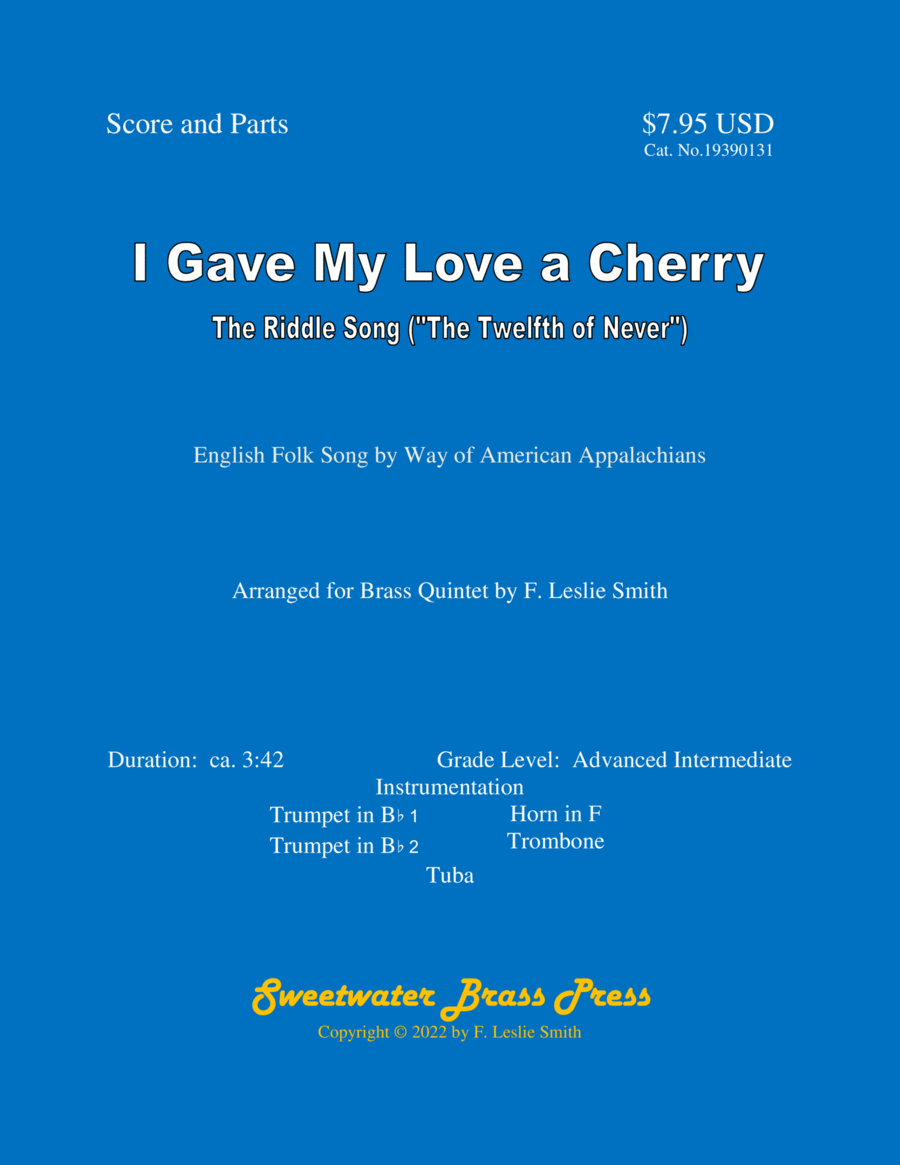
I Gave My Love a Cherry (The Riddle Song ["The Twelfth of Never"])
Quatuor de Cuivres : 2 trompettes, trombone, tuba

$7.95 6.84 € Quatuor de Cuivres : 2 trompettes, trombone, tuba PDF SheetMusicPlus

Brass Ensemble Horn,Trombone,Trumpet,Tuba - Level 2 - Digital Download SKU: A0.802657 Composed by Ray Egan, Roy K Marsh & Paul Whiteman, and Tom Pitts. Arranged by Dudley E Bayford & Peet du Toit. Contemporary. Score and parts. 8 pages. Peet du Toit #6216933. Published by Peet du Toit (A0.802657). This Quick-Step piece was recorded by Judy Garland in 1943 by Decca Records on her Second Souvenir album.The quickstep is a light-hearted dance of the standard ballroom dances. The movement of the dance is fast and powerfully flowing and sprinkled with syncopations. The upbeat melodies that quickstep is danced to make it suitable for both formal and informal events. Quickstep was developed in the 1920s in New York City and was first danced by Caribbean and African dancers. Its origins are in combination of slow foxtrot combined with the Charleston, a dance which was one of the precursors to what today is called swing dancing.This dance gradually evolved into a very dynamic one with much movement on the dance floor, with many advanced patterns including hops, runs, quick steps with much momentum, and rotation. The tempo of quickstep dance is rather brisk, as it was developed to ragtime era jazz music, which is fast-paced when compared to other dance music.The quickstep is elegant like the foxtrot and should be smooth and glamorous. The dancers should appear to be very light on their feet. It is very energetic and form-intensive. The quickstep is danced to 4/4 music of 48-52 measures per minute.
I never knew (I could love anybody, honey, like I'm loving you) - Pitts, Egan, Marsh & Whiteman (Bra
Quatuor de Cuivres : 2 trompettes, trombone, tuba

$14.00 12.04 € Quatuor de Cuivres : 2 trompettes, trombone, tuba PDF SheetMusicPlus

Brass Ensemble Horn,Trombone,Trumpet,Tuba - Level 5 - Digital Download SKU: A0.767578 Composed by Mike Lyons. Contemporary. Score and parts. 81 pages. Lyons Music Services #6422239. Published by Lyons Music Services (A0.767578). These three pieces form a small suite, linked by the idea of ‘pastoral’ or rustic situations and places.   The first piece to be written now forms the middle movement, though at first it was the starting point.   This is not easy music. It travels through several keys with large numbers of sharps and flats and in places the time signature shifts constantly. The first movement is modal, being based on the mixolydian and dorian modes. I took for this movement the idea of ancient Celts celebrating a victory and dancing and getting drunk around a smoky fire. Their chieftain strikes up a song, accompanied by a double drone.   This melody is initially stated on the horn, with just two other instruments providing the accompaniment. At 4 before B, the remaining instruments join in, providing a rhythmic pulse and the melody moves to the Euphonium/Baritone/Trombone. Subtle variations shape the melody anew, leading to letter C. Here the complex overlapping rhythms provide a more dance-like feel to the music. Also, countermelodies start to appear which build the excitement.   At letter E, the music becomes louder and the rhythmic pulse more insistent (perhaps they are dancing on the tables?) The mode changes to the more major sounding mixolydian. But from here on in, the revellers are starting to wend their way home, still singing and dancing and they gradually fade into the distance. At letter G, we’re back to three players, but with the trumpet 1 playing a rhythmic melody over the top of the original tune.   The second movement is called The Aesthetes. The aesthetic movement was formed in the 19th century, but had been around before that in less formal garb. Their ideal was to emulate the Ancient Greeks and Romans – or at least their perception of what the ancients were like as found in statues, paintings and friezes. They adopted studied poses and were very effete in their mannerisms. Gilbert and Sullivan parodied the aesthetic movement in their operettas – particularly Princess Ida (but also in the Mikado and various others).   So, here is a movement with classical lines in the style of a minuet, but in 6/8 rather than ¾ so that it can be more languid. All the melodies are ‘studied’ and ‘formal’ with long, languid notes and rhythms which don’t quite fit to the beat as the aesthetes pose and ponder and languidly look, studied and pale and wan.   Because of the long notes in the melody, there’s an almost dream-like quality to the music as if they are seeing through a haze of Wormwood or Absinthe (a favourite drink of the aesthetes when they weren’t high on themselves or opiates).   The third and final movement is called The Bohemians. This was also a movement at the end of the 19th Century. Where the aesthetes were ruled by rules, the Bohemians lived by none. They were considered wild and unconventional to say the least.   The Bohemians movement owed much to the supposed free life and style of the gypsies and wanderers of Europe. Our piece starts with a gypsy violin style opening, including a cadenza, and then moves into the rapidly time shifting and gyrating gypsy dance.   This section is in alternating bars of 5/8 and 6/8 with occasional 11/8 thrown in to keep you off balance. The frantic and frenetic movement continues up to letter F where things calm down a little – but not for long as the intensity increases again from Letter H to the quite sudden ending.   This is tuneful yet challenging music which will take a lot of effort, but which will give a lot back in return.
Brass Quintet - Three Pastoral Sketches
Quatuor de Cuivres : 2 trompettes, trombone, tuba

$28.00 24.09 € Quatuor de Cuivres : 2 trompettes, trombone, tuba PDF SheetMusicPlus


1 16 31 ....61


Partitions Gratuites
Acheter des Partitions Musicales
Acheter des Partitions Digitales à Imprimer
Acheter des Instruments de Musique

© 2000 - 2026

Accueil - Version intégrale





