EUROPE
1579 articles
USA
0 articles
DIGITAL
29 articles (à imprimer)
Partitions Digitales
Partitions à imprimer
29 partitions trouvées


Brass Ensemble Horn,Trombone,Trumpet,Tuba - Level 4 - Digital Download SKU: A0.1102959 Composed by George Gershwin. Arranged by Kenneth Abeling. 20th Century,Jazz,Standards. Score and parts. 16 pages. LINCOLN MUSIC PUBLICATIONS #706286. Published by LINCOLN MUSIC PUBLICATIONS (A0.1102959). Someone to Watch Over Me by George & Ira Gershwin arranged for Brass Quintet. This is an advanced intermediate ballad arrangement of the centerpiece of the 1926 Broadway Musical “Oh, Kay!’ The song is an enduring jazz standard for which there are over 1800 recordings. The playing time is approximately 4:00. To view and listen to this piece in its entirety as well hundreds of other arrangement and transcriptions by Kenneth Abeling at the lowest prices available please visit: https://lincolnmusicpublications.com/.
Someone to Watch Over Me (for Brass Quintet)
Quatuor de Cuivres : 2 trompettes, trombone, tuba

$13.99 12.19 € Quatuor de Cuivres : 2 trompettes, trombone, tuba PDF SheetMusicPlus

Brass Ensemble Horn,Trombone,Trumpet,Tuba - Level 4 - Digital Download SKU: A0.767367 Composed by Claudio Monteverdi. Arranged by Mike Lyons. Baroque,Renaissance. Score and parts. 58 pages. Lyons Music Services #3548869. Published by Lyons Music Services (A0.767367). At long last I have nearly finished the 7th book. This book has posed some issues as it is such complex music it is almost impossible to cut it down to 5 parts while maintaining its integrity. As a result, some songs will be in 6 or more parts.In Amor che deggio far, the poet is pleading with his love for constancy. he feels she doesn't love him enough to be his lover forever.This is one of the longer poems set in the seventh book and has a variety of musical forms within it. It begins with an opening statment of the 3 ritornelli that will reappear after each solo, duet, trio or quartet from the soloists. In this way, the composer prepares the listener for what will come and it will therefore be familiar and recognisable in the context of the song.This ia also one of the most demanding songs in the book. It requires a set of four solo singers (Trumpet/Horn/Trombone/Tuba) a pair of obbligato violins (Eb trumpet and Bb trumpet) and a string+ keyboard continuo part (Trumpet/Horn/Euphonium/Tuba) making 10 instruments in all. I had to use an Eb trumpet as the range of the obbligato is quite adventurous for the period and covers some of the clarino range that was to become popular in the High Baroque.At 5 minutes in length, this is a great finisher for either hafl of a concert, especially as Monteverdi has reserved use of all the instruments/voices until the very end, creating a rousing finish.The seventh book continues to be a challenge. Monteverdi seems to be concentrating on developing solos and duets, trios and small accompanied ensembles. The accompaniments are often written out with more than just long note chords. The intricate instrumental parts are more than just filling in the harmony (hence the difficulty in paring them down.)Once again, this song is exquisitely crafted and travels well onto brass.
Brass Choir - Monteverdi - The Seventh Book of Madrigals (1619) - 29. Amor che deggio far
Quatuor de Cuivres : 2 trompettes, trombone, tuba

$9.98 8.7 € Quatuor de Cuivres : 2 trompettes, trombone, tuba PDF SheetMusicPlus

Brass Ensemble Horn,Trombone,Trumpet,Tuba - Level 5 - Digital Download SKU: A0.767578 Composed by Mike Lyons. Contemporary. Score and parts. 81 pages. Lyons Music Services #6422239. Published by Lyons Music Services (A0.767578). These three pieces form a small suite, linked by the idea of ‘pastoral’ or rustic situations and places.   The first piece to be written now forms the middle movement, though at first it was the starting point.   This is not easy music. It travels through several keys with large numbers of sharps and flats and in places the time signature shifts constantly. The first movement is modal, being based on the mixolydian and dorian modes. I took for this movement the idea of ancient Celts celebrating a victory and dancing and getting drunk around a smoky fire. Their chieftain strikes up a song, accompanied by a double drone.   This melody is initially stated on the horn, with just two other instruments providing the accompaniment. At 4 before B, the remaining instruments join in, providing a rhythmic pulse and the melody moves to the Euphonium/Baritone/Trombone. Subtle variations shape the melody anew, leading to letter C. Here the complex overlapping rhythms provide a more dance-like feel to the music. Also, countermelodies start to appear which build the excitement.   At letter E, the music becomes louder and the rhythmic pulse more insistent (perhaps they are dancing on the tables?) The mode changes to the more major sounding mixolydian. But from here on in, the revellers are starting to wend their way home, still singing and dancing and they gradually fade into the distance. At letter G, we’re back to three players, but with the trumpet 1 playing a rhythmic melody over the top of the original tune.   The second movement is called The Aesthetes. The aesthetic movement was formed in the 19th century, but had been around before that in less formal garb. Their ideal was to emulate the Ancient Greeks and Romans – or at least their perception of what the ancients were like as found in statues, paintings and friezes. They adopted studied poses and were very effete in their mannerisms. Gilbert and Sullivan parodied the aesthetic movement in their operettas – particularly Princess Ida (but also in the Mikado and various others).   So, here is a movement with classical lines in the style of a minuet, but in 6/8 rather than ¾ so that it can be more languid. All the melodies are ‘studied’ and ‘formal’ with long, languid notes and rhythms which don’t quite fit to the beat as the aesthetes pose and ponder and languidly look, studied and pale and wan.   Because of the long notes in the melody, there’s an almost dream-like quality to the music as if they are seeing through a haze of Wormwood or Absinthe (a favourite drink of the aesthetes when they weren’t high on themselves or opiates).   The third and final movement is called The Bohemians. This was also a movement at the end of the 19th Century. Where the aesthetes were ruled by rules, the Bohemians lived by none. They were considered wild and unconventional to say the least.   The Bohemians movement owed much to the supposed free life and style of the gypsies and wanderers of Europe. Our piece starts with a gypsy violin style opening, including a cadenza, and then moves into the rapidly time shifting and gyrating gypsy dance.   This section is in alternating bars of 5/8 and 6/8 with occasional 11/8 thrown in to keep you off balance. The frantic and frenetic movement continues up to letter F where things calm down a little – but not for long as the intensity increases again from Letter H to the quite sudden ending.   This is tuneful yet challenging music which will take a lot of effort, but which will give a lot back in return.
Brass Quintet - Three Pastoral Sketches
Quatuor de Cuivres : 2 trompettes, trombone, tuba

$28.00 24.4 € Quatuor de Cuivres : 2 trompettes, trombone, tuba PDF SheetMusicPlus

Brass Ensemble Trombone,Trumpet,Tuba - Level 2 - Digital Download SKU: A0.1182989 Composed by Christian Petzold. Arranged by Alex Nunes Rodrigues. Classical. Score and parts. 7 pages. Alex Rodrigues #782735. Published by Alex Rodrigues (A0.1182989). The Minuet in G Major, BWV Anh. 114 is an amazing classical piece that will surprise you with its simplicity and elegance. Although there is some controversy over who composed it, many believe it was created by Johann Sebastian Bach. If you're looking for an easy and beautiful piece of music to play, this minuet is perfect for you. Whether you're new to the world of music or already have some experience, you'll love playing the Minuet in G Major, BWV Anh. 114. Enjoy playing one of the coolest classical pieces of all time with the sheet music for this piece.
Minuet In G Major (with piano)
Quatuor de Cuivres : 2 trompettes, trombone, tuba

$1.99 1.73 € Quatuor de Cuivres : 2 trompettes, trombone, tuba PDF SheetMusicPlus

Brass Ensemble Horn,Trombone,Trumpet,Tuba - Level 2 - Digital Download SKU: A0.1183561 Composed by Christian Petzold. Arranged by Alex Nunes Rodrigues. Classical. Score and parts. 7 pages. Alex Rodrigues #783234. Published by Alex Rodrigues (A0.1183561). The Minuet in G Major, BWV Anh. 114 is an amazing classical piece that will surprise you with its simplicity and elegance. Although there is some controversy over who composed it, many believe it was created by Johann Sebastian Bach. If you're looking for an easy and beautiful piece of music to play, this minuet is perfect for you. Whether you're new to the world of music or already have some experience, you'll love playing the Minuet in G Major, BWV Anh. 114. Enjoy playing one of the coolest classical pieces of all time with the sheet music for this piece.
Minuet In G Major (with chords)
Quatuor de Cuivres : 2 trompettes, trombone, tuba

$1.99 1.73 € Quatuor de Cuivres : 2 trompettes, trombone, tuba PDF SheetMusicPlus

Brass Ensemble Horn,Trombone,Trumpet,Tuba - Level 2 - Digital Download SKU: A0.1183560 Composed by Christian Petzold. Arranged by Alex Nunes Rodrigues. Classical. Score and parts. 8 pages. Alex Rodrigues #783233. Published by Alex Rodrigues (A0.1183560). The Minuet in G Major, BWV Anh. 114 is an amazing classical piece that will surprise you with its simplicity and elegance. Although there is some controversy over who composed it, many believe it was created by Johann Sebastian Bach. If you're looking for an easy and beautiful piece of music to play, this minuet is perfect for you. Whether you're new to the world of music or already have some experience, you'll love playing the Minuet in G Major, BWV Anh. 114. Enjoy playing one of the coolest classical pieces of all time with the sheet music for this piece.
Minuet In G Major (with piano)
Quatuor de Cuivres : 2 trompettes, trombone, tuba

$1.99 1.73 € Quatuor de Cuivres : 2 trompettes, trombone, tuba PDF SheetMusicPlus

Brass Ensemble Trombone,Trumpet,Tuba - Level 2 - Digital Download SKU: A0.1182992 Composed by Christian Petzold. Arranged by Alex Nunes Rodrigues. Classical. Score and parts. 2 pages. Alex Rodrigues #782738. Published by Alex Rodrigues (A0.1182992). The Minuet in G Major, BWV Anh. 114 is an amazing classical piece that will surprise you with its simplicity and elegance. Although there is some controversy over who composed it, many believe it was created by Johann Sebastian Bach. If you're looking for an easy and beautiful piece of music to play, this minuet is perfect for you. Whether you're new to the world of music or already have some experience, you'll love playing the Minuet in G Major, BWV Anh. 114. Enjoy playing one of the coolest classical pieces of all time with the sheet music for this piece.
Minuet In G Major
Quatuor de Cuivres : 2 trompettes, trombone, tuba

$1.99 1.73 € Quatuor de Cuivres : 2 trompettes, trombone, tuba PDF SheetMusicPlus

Brass Ensemble Trombone,Trumpet,Tuba - Level 2 - Digital Download SKU: A0.1182988 Composed by Christian Petzold. Arranged by Alex Nunes Rodrigues. Classical. Score and parts. 7 pages. Alex Rodrigues #782733. Published by Alex Rodrigues (A0.1182988). The Minuet in G Major, BWV Anh. 114 is an amazing classical piece that will surprise you with its simplicity and elegance. Although there is some controversy over who composed it, many believe it was created by Johann Sebastian Bach. If you're looking for an easy and beautiful piece of music to play, this minuet is perfect for you. Whether you're new to the world of music or already have some experience, you'll love playing the Minuet in G Major, BWV Anh. 114. Enjoy playing one of the coolest classical pieces of all time with the sheet music for this piece.
Minuet In G Major (with piano and chords)
Quatuor de Cuivres : 2 trompettes, trombone, tuba

$1.99 1.73 € Quatuor de Cuivres : 2 trompettes, trombone, tuba PDF SheetMusicPlus

Brass Ensemble Trombone,Trumpet,Tuba - Level 2 - Digital Download SKU: A0.1182991 Composed by Christian Petzold. Arranged by Alex Nunes Rodrigues. Classical. Score and parts. 6 pages. Alex Rodrigues #782737. Published by Alex Rodrigues (A0.1182991). The Minuet in G Major, BWV Anh. 114 is an amazing classical piece that will surprise you with its simplicity and elegance. Although there is some controversy over who composed it, many believe it was created by Johann Sebastian Bach. If you're looking for an easy and beautiful piece of music to play, this minuet is perfect for you. Whether you're new to the world of music or already have some experience, you'll love playing the Minuet in G Major, BWV Anh. 114. Enjoy playing one of the coolest classical pieces of all time with the sheet music for this piece.
Minuet In G Major (with chords)
Quatuor de Cuivres : 2 trompettes, trombone, tuba

$1.99 1.73 € Quatuor de Cuivres : 2 trompettes, trombone, tuba PDF SheetMusicPlus

Brass Ensemble Horn,Trombone,Trumpet,Tuba - Level 2 - Digital Download SKU: A0.1183559 Composed by Christian Petzold. Arranged by Alex Nunes Rodrigues. Classical. Score and parts. 8 pages. Alex Rodrigues #783232. Published by Alex Rodrigues (A0.1183559). The Minuet in G Major, BWV Anh. 114 is an amazing classical piece that will surprise you with its simplicity and elegance. Although there is some controversy over who composed it, many believe it was created by Johann Sebastian Bach. If you're looking for an easy and beautiful piece of music to play, this minuet is perfect for you. Whether you're new to the world of music or already have some experience, you'll love playing the Minuet in G Major, BWV Anh. 114. Enjoy playing one of the coolest classical pieces of all time with the sheet music for this piece.
Minuet In G Major (with piano and chords)
Quatuor de Cuivres : 2 trompettes, trombone, tuba

$1.99 1.73 € Quatuor de Cuivres : 2 trompettes, trombone, tuba PDF SheetMusicPlus

Brass Ensemble Horn,Trombone,Trumpet,Tuba - Level 2 - Digital Download SKU: A0.1183562 Composed by Christian Petzold. Arranged by Alex Nunes Rodrigues. Classical. Score and parts. 7 pages. Alex Rodrigues #783235. Published by Alex Rodrigues (A0.1183562). The Minuet in G Major, BWV Anh. 114 is an amazing classical piece that will surprise you with its simplicity and elegance. Although there is some controversy over who composed it, many believe it was created by Johann Sebastian Bach. If you're looking for an easy and beautiful piece of music to play, this minuet is perfect for you. Whether you're new to the world of music or already have some experience, you'll love playing the Minuet in G Major, BWV Anh. 114. Enjoy playing one of the coolest classical pieces of all time with the sheet music for this piece.
Minuet In G Major
Quatuor de Cuivres : 2 trompettes, trombone, tuba

$1.99 1.73 € Quatuor de Cuivres : 2 trompettes, trombone, tuba PDF SheetMusicPlus

Brass Quartet - Level 2 - Digital Download SKU: A0.1258043 Composed by Guillaume de Machaut, 1300-1377. Arranged by James M. Guthrie. Chamber,Contest,Early Music,Festival,Historic,Medieval. 38 pages. Jmsgu3 #851281. Published by jmsgu3 (A0.1258043). 1. Kyrie2. Gloria3. Credo4. Sanctus5. Agnus dei6. Ite missa estGuillaume de Machaut composed the Messe de Nostre Dame, also known as the Mass of Our Lady, in the early 1360s. He wrote the mass for the Cathedral at Reims, where he served as a canon, a permanent clergy member. According to a rubric found at the Cathedral, it would have likely been performed for the Saturday Lady Mass. Guillaume de Machaut's Messe de Nostre Dame is significant in the history of music for several reasons: It is the first complete setting of the Ordinary of the Mass by a single composer that has survived. It is a unified mass, meaning that the composer selected relevant chants for each section as the borrowed tenor. It was composed in four voices, which was unusual at the time. The texts of both Gloria and Credo are quite lengthy, and therefore Machaut set these movements in a style reminiscent of the earlier discant style, having short phrases, similar rhythmic motion in all parts, and a low ratio of notes per syllable of text, both ending with long, rhapsodic sections for the final word, Amen. Machaut's Messe de Nostre Dame is a landmark in musical history, but it is far from being avant-garde merely for the sake of uniqueness. It is considered to be a culmination of the musical style of the Ars Nova period, which was characterized by complex polyphonic textures and rhythmic innovations. The mass is also significant because it was composed during a time of great political and social upheaval in Europe, and it reflects the changing attitudes towards religion and music during this period. Overall, Machaut's Messe de Nostre Dame is a significant work that represents a culmination of the musical style of the Ars Nova period and reflects the changing attitudes towards religion and music during the 14th century. The mass consists of five movements: Kyrie, Gloria, Credo, Sanctus, and Agnus Dei, followed by the dismissal Ite, missa est. The tenor of the Kyrie is based on Vatican Kyrie IV, the Sanctus, and Agnus correspond to Vatican Mass XVII, and the Ite is on Sanctus VIII. The Gloria and Credo have no apparent chant basis, although they are stylistically related to one another. The mass is a unified mass, meaning that the composer selected relevant chants for each section as the borrowed tenor. The Messe de Nostre Dame is significant in the history of music because it is the first complete setting of the Ordinary of the Mass by a single composer that has survived. It is also significant because it was composed during a time of great political and social upheaval in Europe, and it reflects the changing attitudes towards religion and music during this period. Overall, the Messe de Nostre Dame was an important part of the liturgical practices of the time, and it is still regarded as a masterpiece of medieval music and of all religious music.
Machaut: Le Messe de Nostre Dame for 2 Horns & 2 Trombones - Score Only
Quatuor de Cuivres : 2 trompettes, trombone, tuba

$49.95 43.53 € Quatuor de Cuivres : 2 trompettes, trombone, tuba PDF SheetMusicPlus

Brass Quartet - Level 2 - Digital Download SKU: A0.1257202 Composed by Guillaume de Machaut, 1300-1377. Arranged by James M. Guthrie, ASCAP. Chamber,Contest,Early Music,Festival,Historic,Medieval. 38 pages. Jmsgu3 #850533. Published by jmsgu3 (A0.1257202). INSTRUMENTATION: Cornet, French Horn & 2 Trombones 1. Kyrie 2. Gloria 3. Credo 4. Sanctus 5. Agnus dei 6. Ite missa est Guillaume de Machaut composed the Messe de Nostre Dame, also known as the Mass of Our Lady, in the early 1360s. He wrote the mass for the Cathedral at Reims, where he served as a canon, a permanent clergy member. According to a rubric at the Cathedral, it would have likely been performed for the Saturday Lady Mass.   Guillaume de Machaut's Messe de Nostre Dame is significant in the history of music for several reasons: It is the first complete setting of the Ordinary of the Mass by a single composer that has survived. It is a unified mass, meaning the composer selected relevant chants for each section as the borrowed tenor. It was composed in four voices, which was unusual at the time. The texts of both Gloria and Credo are pretty lengthy. Therefore, Machaut set these movements in a style reminiscent of the earlier discant style, having short phrases, similar rhythmic motion in all parts, and a low ratio of notes per syllable of text, ending with long, rhapsodic sections for the final word, Amen. Machaut's Messe de Nostre Dame is a landmark in musical history, but it is far from being avant-garde merely for its uniqueness. It is considered to be a culmination of the musical style of the Ars Nova period, which was characterized by complex polyphonic textures and rhythmic innovations. The mass is also significant because it was composed during a time of great political and social upheaval in Europe, and it reflects the changing attitudes towards religion and music during this period. Overall, Machaut's Messe de Nostre Dame is a significant work that represents a culmination of the musical style of the Ars Nova period and reflects the changing attitudes towards religion and music during the 14th century.   The mass consists of five movements: Kyrie, Gloria, Credo, Sanctus, and Agnus Dei, followed by the dismissal Ite, missa est. The tenor of the Kyrie is based on Vatican Kyrie IV, the Sanctus and Agnus correspond to Vatican Mass XVII, and the Ite is on Sanctus VIII. Although the Gloria and Credo have no apparent chant basis, they are stylistically related. The mass is unified, meaning the composer selected relevant chants as the borrowed tenor for each section. The Messe de Nostre Dame is significant in the history of music because it is the first complete setting of the Ordinary of the Mass by a single composer that has survived. It is also significant because it was composed during a time of great political and social upheaval in Europe, and it reflects the changing attitudes towards religion and music during this period.  Overall, the Messe de Nostre Dame was a vital part of the liturgical practices of the time, and it is still regarded as a masterpiece of medieval and religious music.
Machaut: La Messe de Nostre Dame for Brass Quartet - Score Only
Quatuor de Cuivres : 2 trompettes, trombone, tuba

$49.95 43.53 € Quatuor de Cuivres : 2 trompettes, trombone, tuba PDF SheetMusicPlus

Brass Ensemble Horn,Trombone,Trumpet,Tuba - Level 3 - Digital Download SKU: A0.1092443 Composed by Francesco Durante. Arranged by Regis Bookshar. Baroque,Instructional,Sacred. Score and parts. 8 pages. Regis Bookshar #696535. Published by Regis Bookshar (A0.1092443). Kyrie - by Francesco Durante; Brass Quartet – Intermediate – Digital Download. “Kyrieâ€, originally written for a four-part vocal ensemble by Francesco Durante, has now been transcribed, edited and arranged by Regis Bookshar, for a Brass Quartet, consisting of 1 Bb Trumpet, 1 French Horn, 1 Trombone and 1 Tuba. It would be a welcomed addition to any music library. This short composition, which lasts less than two minutes, will provide many students with the opportunity to practice breath control because of its long phrases, and to help them to continue to develop good intonation because many of the phrases cadence on a unison note. This selection could be performed for concerts, recitals and church services. It is suitable for high school and college students but professional musicians would also enjoy playing this selection. Included are a score and a complete set of parts (8 pages). This selection is one of the many arrangements from the Regis Bookshar Trumpet Ensemble’s extensive music library which are being made available for the first time. We have performed the Trumpet Quartet version of this composition for many church services, especially funerals, when we were asked to supply something more somber and introspective rather than the louder, more festive music which many people come to expect from a Trumpet Ensemble. Francesco Durante was an Italian composer who was born on March 31, 1684 at Frattamaggiore, in the Kingdom of Naples. At an early age he entered the Conservatorio dei poveri di Gesu Cristo, in Naples, where he received lessons from Gaetano Greco. Later he became a pupil of Alessandro Scarlatti at the Conservatorio di Sant’Onofrio. He is said to have succeeded Scarlatti in 1725 at Sant’Onofrio and to have remained there until 1742, when he succeeded Nicola Porpora as head of the Conservatorio di Santa Maria de Loreto, also in Naples. He held this post for thirteen years, until his death on September 30, 1755. His fame as a teacher was considerable, and, unlike his Neapolitan contemporaries, who attracted international notice with their operas, Francesco Durante achieved recognition through his church music, along with some vocal chamber and instrumental works. His concern was not quantity. A complete collection of Durante’s works, consisting almost exclusively of sacred music, was presented by Gaspare Selveggi, a Neapolitan art collector and music theorist, to the Bibliotheque Nationale in Paris. The imperial library of Vienna also preserves a valuable collection of Durante’s manuscripts. The fact that Durante never composed for the stage brought him an exaggerated reputation as a composer of sacred music. He was considered one of the best church composers of his style and period. In his masses, requiems, litanies and Lamentations, he could provide strong expressive moments, as he does in this “Kyrieâ€. In addition to this arrangement for a Brass Quartet, Regis Bookshar has also made other arrangements of this selection. There are Quartets readily available for a wide variety of instrumental ensembles. Please take the time to look for other versions of this composition. You may find something else that may also suit your needs. I would also encourage you to search for other arrangements by Regis Bookshar, as well, as there are numerous arrangements in a variety of styles, also available for purchase. You may find something else which might interest you. Please continue to check periodically because new arrangements are being added as often as possible. I’m certain that this beautiful arrangement of Francesco Durante’s “Kyrie†will continue to entertain both performers and audiences alike for years to come.
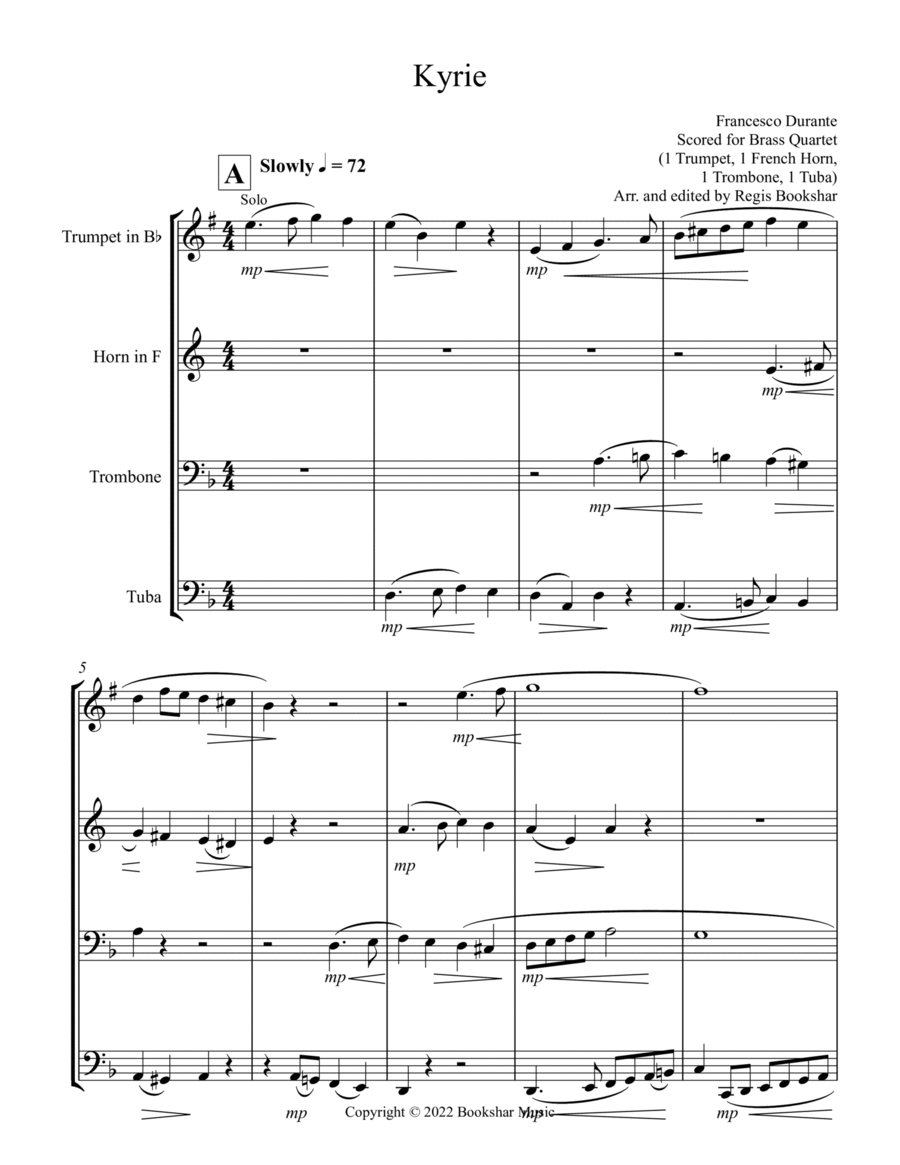
Kyrie (Durante) (Brass Quartet - 1 Trp, 1 Hrn, 1 Trb, 1 Tuba)
Quatuor de Cuivres : 2 trompettes, trombone, tuba

$10.00 8.71 € Quatuor de Cuivres : 2 trompettes, trombone, tuba PDF SheetMusicPlus


Partitions Gratuites
Acheter des Partitions Musicales
Acheter des Partitions Digitales à Imprimer
Acheter des Instruments de Musique

© 2000 - 2026

Accueil - Version intégrale





