EUROPE
969 articles
USA
0 articles
DIGITAL
66 articles (à imprimer)
Partitions Digitales
Partitions à imprimer
66 partitions trouvées

1 16 31 ....61

Brass Ensemble Horn,Trombone,Trumpet,Tuba - Level 4 - Digital Download SKU: A0.813414 Composed by Johann Pachelbel. Arranged by Regis Bookshar. Baroque,Multicultural,Standards,Wedding,World. Score and parts. 30 pages. Regis Bookshar #6259453. Published by Regis Bookshar (A0.813414). Canon (Pachelbel) (Bb) (Brass Quintet - 2 Trp, 1 Hrn, 1 Trb, 1 Tuba) - Advanced/Intermediate - Digital Download. This selection, Johann Pachelbel's celebrated Canon, is perhaps the most famous canon ever written and has been one of my favorite compositions to arrange. A canon is a polyphonic device in which several voices play the same music, entering in sequence. Pachelbel's Canon, was originally written in the key of D Major and was scored for three violins arranged in canon, accompanied by a basso continuo which repeats the same harmonic progression throughout the entire piece. The common musical term for this is ostinato or ground bass. Regis Bookshar has now arranged this music for a Brass Quintet consisting of 2 Trumpets, 1 French Horn, 1 Trombone and 1 Tuba. Two Trumpets and the French Horn play the melody in canon while the ostinato accompaniment is played by the Trombone and Tuba. This arrangement is suitable for high school and college students but could also be performed by professional performers. It is perfect for concerts and church services, especially for Weddings, but could be performed for any occasion. Included are a score and a complete set of parts (30 pages). This version is written in the key of Bb Major, to make it a little easier for some younger performers, but another version is also available in the key of D Major if you would prefer. Other versions of Pachelbel's Canon have also been arranged by Regis Bookshar and are available for a wide variety of instrumental Quintets and Octets, in both the keys of D Major and Bb Major. I think that String players would probably prefer to play the versions in the key of D Major while the Brass and Woodwind musicians might prefer to play the Bb Major versions. I hope you take the time to compare the different versions to find the right version for you. To help you decide which version, or versions, you may want to choose, I have included several musical samples for you to listen to and to hear what these arrangements may sound like and so that you may compare the various arrangements. Also, just to let you know, the Octets written in the key of Bb Major have full-length recordings while the Octets in D Major and all Quintets have only the first 25 measures, or so, available to hear. Please feel free to search for other arrangements by Regis Bookshar which are also available. There are quite a few other arrangements in a variety of styles and I'm certain you will find something else which might interest you as well. Please keep checking because I plan to continue to add new arrangements as often as I can. I'm certain that this exciting arrangement of Pachelbel's Canon will be a challenge to some performers but will continue to entertain both performers and audiences alike for years to come.
Canon (Pachelbel) (Bb) (Brass Quintet - 2 Trp, 1 Hrn, 1 Trb, 1 Tuba)
Quatuor de Cuivres : 2 trompettes, trombone, tuba

$20.00 16.95 € Quatuor de Cuivres : 2 trompettes, trombone, tuba PDF SheetMusicPlus

Brass Quartet - Level 3 - Digital Download SKU: A0.1261834 Composed by Ludwig van Beethoven. Arranged by Ander. 19th Century,Classical,Film/TV,March,Romantic Period. 13 pages. Woods Only, Arrangements #854917. Published by Woods Only, Arrangements (A0.1261834). This arrangement adapted for brass quartet was written keeping the characteristics of the original work, in order to be performed by young music students who want to enter the symphonic music. Besides, it can also be used by professional musicians, for recitals, repertoire, academic presentations and didactic material. As much as it is a funeral march, it is well suited for any musical performance occasion. The transcription is faithful to the structure, with only one change of key, so that it is comfortable for all the instruments in the formation, as well as for use in ensemble practice between musicians of different traditions. Ludwig van Beethoven began concentrated work on his Symphony No. 7 in A major Op. 92 in 1811, it was completed in 1812, and was dedicated to Count Moritz von Fries, and premiered in Vienna on December 8, 1813. It is considered a remarkable example of the more ebullient side of Beethoven's compositional personality and evidence that even after the onset of deafness, he still found cause for musical optimism. The second movement Allegretto is a funeral march in everything but name. Often several contrasting melodic ideas are made to coexist, as if Beethoven were imagining several processions converging on the cemetery at the same time. As he was working on this symphony during the years of the Napoleonic Wars, this experience was probably within his experience. It was also used as the soundtrack to the film Knowing, by director Alex Proyas and starring Nicolas Cage, where it is used in the final scene of the film. Beethoven called Symphony No. 7 his most excellent symphony, and a music critic of the time reported, this symphony is the most melodically rich and the most pleasing and comprehensible of all Beethoven's symphonies..
Symphony No. 7 by Beethoven for Brass Quartet
Quatuor de Cuivres : 2 trompettes, trombone, tuba

$7.99 6.77 € Quatuor de Cuivres : 2 trompettes, trombone, tuba PDF SheetMusicPlus

Brass Ensemble Horn,Trombone,Trumpet,Tuba - Level 4 - Digital Download SKU: A0.813437 Composed by Johann Pachelbel. Arranged by Regis Bookshar. Baroque,Multicultural,Standards,Wedding,World. Score and parts. 36 pages. Regis Bookshar #6260465. Published by Regis Bookshar (A0.813437). Canon (Pachelbel) (Bb) (Brass Octet - 3 Trp, 2 Hrn, 2 Trb, 1 Tuba) (3 Trp lead) - Advanced/Intermediate - Digital Download. This selection, Johann Pachelbel's celebrated Canon, is perhaps the most famous canon ever written and has been one of my favorite compositions to arrange. A canon is a polyphonic device in which several voices play the same music, entering in sequence. Pachelbel's Canon, was originally written in the key of D Major and was scored for three violins arranged in canon, accompanied by a basso continuo which repeats the same harmonic progression throughout the entire piece. The common musical term for this is ostinato or ground bass. Regis Bookshar has now arranged this music for a Brass Octet consisting of 3 Trumpets, 2 French Horns, 2 Trombones and 1 Tuba. Three Trumpets play the melody in canon while the ostinato accompaniment is played by the other five instruments. This arrangement is suitable for high school and college students but could also be performed by professional performers. It is perfect for concerts and church services, especially for Weddings, but could be performed for any occasion. Included are a score and a complete set of parts (36 pages). This version is written in the key of Bb Major, to make it a little easier for some younger performers, but another version is also available in the key of D Major if you would prefer. Other versions of Pachelbel's Canon have also been arranged by Regis Bookshar and are available for a wide variety of instrumental Quintets and Octets, in both the keys of D Major and Bb Major. I think that String players would probably prefer to play the versions in the key of D Major while the Brass and Woodwind musicians might prefer to play the Bb Major versions. I hope you take the time to compare the different versions to find the right version for you. To help you decide which version, or versions, you may want to choose, I have included several musical samples for you to listen to and to hear what these arrangements may sound like and so that you may compare the various arrangements. Also, just to let you know, the Octets written in the key of Bb Major have full-length recordings while the Octets in D Major and all Quintets have only the first 25 measures, or so, available to hear. Please feel free to search for other arrangements by Regis Bookshar which are also available. There are quite a few other arrangements in a variety of styles and I'm certain you will find something else which might interest you as well. Please keep checking because I plan to continue to add new arrangements as often as I can. I'm certain that this exciting arrangement of Pachelbel's Canon will be a challenge to some performers but will continue to entertain both performers and audiences alike for years to come.
Canon (Pachelbel) (Bb) (Brass Octet - 3 Trp, 2 Hrn, 2 Trb, 1 Tuba) (3 Trp lead)
Quatuor de Cuivres : 2 trompettes, trombone, tuba

$28.00 23.73 € Quatuor de Cuivres : 2 trompettes, trombone, tuba PDF SheetMusicPlus

Brass Ensemble Trombone,Trumpet,Tuba - Level 4 - Digital Download SKU: A0.813461 Composed by Johann Pachelbel. Arranged by Regis Bookshar. Baroque,Concert,Standards,Wedding,World. Score and parts. 30 pages. Regis Bookshar #6264773. Published by Regis Bookshar (A0.813461). Canon in D (Pachelbel) (D) (Brass Quintet - 3 Trp, 1 Trb, 1 Tuba) - Advanced/Intermediate - Digital Download. This selection, Johann Pachelbel's celebrated Canon, is perhaps the most famous canon ever written and has been one of my favorite compositions to arrange. A canon is a polyphonic device in which several voices play the same music, entering in sequence. Pachelbel's Canon in D, was originally written in the key of D Major and was scored for three violins arranged in canon, accompanied by a basso continuo which repeats the same harmonic progression throughout the entire piece. The common musical term for this is ostinato or ground bass. Regis Bookshar has now arranged this music for a Brass Quintet consisting of 3 Trumpets, 1 Trombone and 1 Tuba. The three Trumpets play the melody in canon while the ostinato accompaniment is played by the Trombone and the Tuba. This arrangement is suitable for high school and college students but could also be performed by professional performers. It is perfect for concerts and church services, especially for Weddings, but could be performed for any occasion. Included are a score and a complete set of parts (30 pages). This version is written in the key of D Major, as is the original version, but another version is also available, if you prefer, in the key of Bb Major, to make it a little easier for some younger performers. Other versions of Pachelbel's Canon in D have also been arranged by Regis Bookshar and are available for a wide variety of instrumental Quintets and Octets, in both the keys of D Major and Bb Major. I think that String players would probably prefer to play the versions in the key of D Major while the Brass and Woodwind musicians might prefer to play the Bb Major versions. I hope you take the time to compare the different versions to find the right version for you. To help you decide which version, or versions, you may want to choose, I have included several musical samples for you to listen to and to hear what these arrangements may sound like and so that you may compare the various arrangements. Also, just to let you know, the Octets written in the key of Bb Major have full-length recordings while the Octets in D Major and all Quintets have only the first 25 measures, or so, available to hear. Please feel free to search for other arrangements by Regis Bookshar which are also available. There are quite a few other arrangements in a variety of styles and I'm certain you will find something else which might interest you as well. Please keep checking because I plan to continue to add new arrangements as often as I can. I'm certain that this exciting arrangement of Pachelbel's Canon in D will be a challenge to some performers but will continue to entertain both performers and audiences alike for years to come.
Canon in D (Pachelbel) (D) (Brass Quintet - 3 Trp, 1 Trb, 1 Tuba) (3 Trp lead)
Quatuor de Cuivres : 2 trompettes, trombone, tuba

$20.00 16.95 € Quatuor de Cuivres : 2 trompettes, trombone, tuba PDF SheetMusicPlus

Brass Ensemble Horn,Trombone,Trumpet,Tuba - Level 4 - Digital Download SKU: A0.813484 Composed by Johann Pachelbel. Arranged by Regis Bookshar. Baroque,Multicultural,Standards,Wedding,World. Score and parts. 36 pages. Regis Bookshar #6265557. Published by Regis Bookshar (A0.813484). Canon In D (Pachelbel) (D) (Brass Octet - 3 Trp, 2 Hrn, 2 Trb, 1 Tuba) (3 Trp lead) - Advanced/Intermediate - Digital Download. This selection, Johann Pachelbel's celebrated Canon In D, is perhaps the most famous canon ever written and has been one of my favorite compositions to arrange. A canon is a polyphonic device in which several voices play the same music, entering in sequence. Pachelbel's Canon In D, was originally written in the key of D Major and was scored for three violins arranged in canon, accompanied by a basso continuo which repeats the same harmonic progression throughout the entire piece. The common musical term for this is ostinato or ground bass. Regis Bookshar has now arranged this music for a Brass Octet consisting of 3 Trumpets, 2 French Horns, 2 Trombones and 1 Tuba. Three Trumpets play the melody in canon while the ostinato accompaniment is played by the other five instruments. This arrangement is suitable for high school and college students but could also be performed by professional performers. It is perfect for concerts and church services, especially for Weddings, but could be performed for any occasion. Included are a score and a complete set of parts (36 pages). This version is written in the key of D Major, as is the original version, but, if you prefer, another version, written in the key of Bb Major, to make it a little easier for some younger performers, is also available. Other versions of Pachelbel's Canon in D have also been arranged by Regis Bookshar and are available for a wide variety of instrumental Quintets and Octets, in both the keys of D Major and Bb Major. I think that String players would probably prefer to play the versions in the key of D Major while the Brass and Woodwind musicians might prefer to play the Bb Major versions. I hope you take the time to compare the different versions to find the right version for you. To help you decide which version, or versions, you may want to choose, I have included several musical samples for you to listen to and to hear what these arrangements may sound like and so that you may compare the various arrangements. Also, just to let you know, the Octets written in the key of Bb Major have full-length recordings while the Octets in D Major and all Quintets have only the first 25 measures, or so, available to hear. Please feel free to search for other arrangements by Regis Bookshar which are also available. There are quite a few other arrangements in a variety of styles and I'm certain you will find something else which might interest you as well. Please keep checking because I plan to continue to add new arrangements as often as I can. I'm certain that this exciting arrangement of Pachelbel's Canon in D will be a challenge to some performers but will continue to entertain both performers and audiences alike for years to come.
Canon in D (Pachelbel) (D) (Brass Octet - 3 Trp, 2 Hrn, 2 Trb, 1 Tuba) (3 Trp lead)
Quatuor de Cuivres : 2 trompettes, trombone, tuba

$28.00 23.73 € Quatuor de Cuivres : 2 trompettes, trombone, tuba PDF SheetMusicPlus

Brass Ensemble Horn,Trombone,Trumpet,Tuba - Level 4 - Digital Download SKU: A0.813436 Composed by Johann Pachelbel. Arranged by Regis Bookshar. Baroque,Multicultural,Standards,Wedding,World. Score and parts. 36 pages. Regis Bookshar #6260457. Published by Regis Bookshar (A0.813436). Canon (Pachelbel) (Bb) (Brass Octet - 3 Trp, 2 Hrn, 2 Trb, 1 Tuba) (1 Trp, 1 Hrn, 1 Trb lead) - Advanced/Intermediate - Digital Download. This selection, Johann Pachelbel's celebrated Canon, is perhaps the most famous canon ever written and has been one of my favorite compositions to arrange. A canon is a polyphonic device in which several voices play the same music, entering in sequence. Pachelbel's Canon, was originally written in the key of D Major and was scored for three violins arranged in canon, accompanied by a basso continuo which repeats the same harmonic progression throughout the entire piece. The common musical term for this is ostinato or ground bass. Regis Bookshar has now arranged this music for a Brass Octet consisting of 3 Trumpets, 2 French Horns, 2 Trombones and 1 Tuba. One Trumpet, 1 French Horn and 1 Trombone play the melody in canon while the ostinato accompaniment is played by the other five instruments. This arrangement is suitable for high school and college students but could also be performed by professional performers. It is perfect for concerts and church services, especially for Weddings, but could be performed for any occasion. Included are a score and a complete set of parts (36 pages). This version is written in the key of Bb Major, to make it a little easier for some younger performers, but another version is also available in the key of D Major if you would prefer. Other versions of Pachelbel's Canon have also been arranged by Regis Bookshar and are available for a wide variety of instrumental Quintets and Octets, in both the keys of D Major and Bb Major. I think that String players would probably prefer to play the versions in the key of D Major while the Brass and Woodwind musicians might prefer to play the Bb Major versions. I hope you take the time to compare the different versions to find the right version for you. To help you decide which version, or versions, you may want to choose, I have included several musical samples for you to listen to and to hear what these arrangements may sound like and so that you may compare the various arrangements. Also, just to let you know, the Octets written in the key of Bb Major have full-length recordings while the Octets in D Major and all Quintets have only the first 25 measures, or so, available to hear. Please feel free to search for other arrangements by Regis Bookshar which are also available. There are quite a few other arrangements in a variety of styles and I'm certain you will find something else which might interest you as well. Please keep checking because I plan to continue to add new arrangements as often as I can. I'm certain that this exciting arrangement of Pachelbel's Canon will be a challenge to some performers but will continue to entertain both performers and audiences alike for years to come.
Canon (Pachelbel) (Bb) (Brass Octet - 3 Trp, 2 Hrn, 2 Trb, 1 Tuba) (1 Trp, 1 Hrn, 1 Trb lead)
Quatuor de Cuivres : 2 trompettes, trombone, tuba

$28.00 23.73 € Quatuor de Cuivres : 2 trompettes, trombone, tuba PDF SheetMusicPlus

Brass Ensemble Horn,Trombone,Trumpet,Tuba - Level 4 - Digital Download SKU: A0.813481 Composed by Johann Pachelbel. Arranged by Regis Bookshar. Baroque,Multicultural,Standards,Wedding,World. Score and parts. 36 pages. Regis Bookshar #6265545. Published by Regis Bookshar (A0.813481). Canon in D (Pachelbel) (D) (Brass Octet - 3 Trp, 2 Hrn, 2 Trb, 1 Tuba) (1 Trp, 1 Hrn, 1 Trb lead) - Advanced/Intermediate - Digital Download. This selection, Johann Pachelbel's celebrated Canon in D, is perhaps the most famous canon ever written and has been one of my favorite compositions to arrange. A canon is a polyphonic device in which several voices play the same music, entering in sequence. Pachelbel's Canon in D, was originally written in the key of D Major and was scored for three violins arranged in canon, accompanied by a basso continuo which repeats the same harmonic progression throughout the entire piece. The common musical term for this is ostinato or ground bass. Regis Bookshar has now arranged this music for a Brass Octet consisting of 3 Trumpets, 2 French Horns, 2 Trombones and 1 Tuba. One Trumpet, 1 French Horn and 1 Trombone play the melody in canon while the ostinato accompaniment is played by the other five instruments. This arrangement is suitable for high school and college students but could also be performed by professional performers. It is perfect for concerts and church services, especially for Weddings, but could be performed for any occasion. Included are a score and a complete set of parts (36 pages). This version is written in the key of D Major, as is the original version, but, if you prefer, another version, written in the key of Bb Major, to make it a little easier for some younger performers, is also available. Other versions of Pachelbel's Canon in D have also been arranged by Regis Bookshar and are available for a wide variety of instrumental Quintets and Octets, in both the keys of D Major and Bb Major. I think that String players would probably prefer to play the versions in the key of D Major while the Brass and Woodwind musicians might prefer to play the Bb Major versions. I hope you take the time to compare the different versions to find the right version for you. To help you decide which version, or versions, you may want to choose, I have included several musical samples for you to listen to and to hear what these arrangements may sound like and so that you may compare the various arrangements. Also, just to let you know, the Octets written in the key of Bb Major have full-length recordings while the Octets in D Major and all Quintets have only the first 25 measures, or so, available to hear. Please feel free to search for other arrangements by Regis Bookshar which are also available. There are quite a few other arrangements in a variety of styles and I'm certain you will find something else which might interest you as well. Please keep checking because I plan to continue to add new arrangements as often as I can. I'm certain that this exciting arrangement of Pachelbel's Canon in D will be a challenge to some performers but will continue to entertain both performers and audiences alike for years to come.
Canon in D (Pachelbel) (D) (Brass Octet - 3 Trp, 2 Hrn, 2 Trb, 1 Tuba) (1 Trp, 1 Hrn, 1 Trb lead)
Quatuor de Cuivres : 2 trompettes, trombone, tuba

$28.00 23.73 € Quatuor de Cuivres : 2 trompettes, trombone, tuba PDF SheetMusicPlus

Brass Ensemble Trombone,Trumpet,Tuba - Level 4 - Digital Download SKU: A0.813415 Composed by Johann Pachelbel. Arranged by Regis Bookshar. Baroque,Concert,Standards,Wedding,World. Score and parts. 30 pages. Regis Bookshar #6259457. Published by Regis Bookshar (A0.813415). Canon (Pachelbel) (Bb) (Brass Quintet - 3 Trp, 1 Trb, 1 Tuba) - Advanced/Intermediate - Digital Download. This selection, Johann Pachelbel's celebrated Canon, is perhaps the most famous canon ever written and has been one of my favorite compositions to arrange. A canon is a polyphonic device in which several voices play the same music, entering in sequence. Pachelbel's Canon, was originally written in the key of D Major and was scored for three violins arranged in canon, accompanied by a basso continuo which repeats the same harmonic progression throughout the entire piece. The common musical term for this is ostinato or ground bass. Regis Bookshar has now arranged this music for a Brass Quintet consisting of 3 Trumpets, 1 Trombone and 1 Tuba. The three Trumpets play the melody in canon while the ostinato accompaniment is played by the Trombone and the Tuba. This arrangement is suitable for high school and college students but could also be performed by professional performers. It is perfect for concerts and church services, especially for Weddings, but could be performed for any occasion. Included are a score and a complete set of parts (30 pages). This version is written in the key of Bb Major, to make it a little easier for some younger performers, but another version is also available in the key of D Major if you would prefer. Other versions of Pachelbel's Canon have also been arranged by Regis Bookshar and are available for a wide variety of instrumental Quintets and Octets, in both the keys of D Major and Bb Major. I think that String players would probably prefer to play the versions in the key of D Major while the Brass and Woodwind musicians might prefer to play the Bb Major versions. I hope you take the time to compare the different versions to find the right version for you. To help you decide which version, or versions, you may want to choose, I have included several musical samples for you to listen to and to hear what these arrangements may sound like and so that you may compare the various arrangements. Also, just to let you know, the Octets written in the key of Bb Major have full-length recordings while the Octets in D Major and all Quintets have only the first 25 measures, or so, available to hear. Please feel free to search for other arrangements by Regis Bookshar which are also available. There are quite a few other arrangements in a variety of styles and I'm certain you will find something else which might interest you as well. Please keep checking because I plan to continue to add new arrangements as often as I can. I'm certain that this exciting arrangement of Pachelbel's Canon will be a challenge to some performers but will continue to entertain both performers and audiences alike for years to come.
Canon (Pachelbel) (Bb) (Brass Quintet - 3 Trp, 1 Trb, 1 Tuba)
Quatuor de Cuivres : 2 trompettes, trombone, tuba

$20.00 16.95 € Quatuor de Cuivres : 2 trompettes, trombone, tuba PDF SheetMusicPlus

Brass Ensemble Horn,Trombone,Trumpet,Tuba - Level 4 - Digital Download SKU: A0.813458 Composed by Johann Pachelbel. Arranged by Regis Bookshar. Baroque,Multicultural,Standards,Wedding,World. Score and parts. 30 pages. Regis Bookshar #6264769. Published by Regis Bookshar (A0.813458). Canon in D (Pachelbel) (D) (Brass Quintet - 2 Trp, 1 Hrn, 1 Trb, 1 Tuba) - Advanced/Intermediate - Digital Download. This selection, Johann Pachelbel's celebrated Canon in D, is perhaps the most famous canon ever written and has been one of my favorite compositions to arrange. A canon is a polyphonic device in which several voices play the same music, entering in sequence. Pachelbel's Canon in D, was originally written in the key of D Major and was scored for three violins arranged in canon, accompanied by a basso continuo which repeats the same harmonic progression throughout the entire piece. The common musical term for this is ostinato or ground bass. Regis Bookshar has now arranged this music for a Brass Quintet consisting of 2 Trumpets, 1 French Horn, 1 Trombone and 1 Tuba. Two Trumpets and the French Horn play the melody in canon while the ostinato accompaniment is played by the Trombone and Tuba. This arrangement is suitable for high school and college students but could also be performed by professional performers. It is perfect for concerts and church services, especially for Weddings, but could be performed for any occasion. Included are a score and a complete set of parts (30 pages). This version is written in the key of D Major, as is the original version, but another version is also available, if you prefer, in the key of Bb Major, to make it a little easier for some younger performers. Other versions of Pachelbel's Canon in D have also been arranged by Regis Bookshar and are available for a wide variety of instrumental Quintets and Octets, in both the keys of D Major and Bb Major. I think that String players would probably prefer to play the versions in the key of D Major while the Brass and Woodwind musicians might prefer to play the Bb Major versions. I hope you take the time to compare the different versions to find the right version for you. To help you decide which version, or versions, you may want to choose, I have included several musical samples for you to listen to and to hear what these arrangements may sound like and so that you may compare the various arrangements. Also, just to let you know, the Octets written in the key of Bb Major have full-length recordings while the Octets in D Major and all Quintets have only the first 25 measures, or so, available to hear. Please feel free to search for other arrangements by Regis Bookshar which are also available. There are quite a few other arrangements in a variety of styles and I'm certain you will find something else which might interest you as well. Please keep checking because I plan to continue to add new arrangements as often as I can. I'm certain that this exciting arrangement of Pachelbel's Canon in D will be a challenge to some performers but will continue to entertain both performers and audiences alike for years to come.
Canon in D (Pachelbel) (D) (Brass Quintet - 2 Trp, 1 Hrn, 1 Trb, 1 Tuba) (2 Trp, 1 Hrn lead)
Quatuor de Cuivres : 2 trompettes, trombone, tuba

$20.00 16.95 € Quatuor de Cuivres : 2 trompettes, trombone, tuba PDF SheetMusicPlus

Brass Ensemble Horn,Trombone,Trumpet,Tuba - Level 3 - Digital Download SKU: A0.726082 Composed by Philipp Nicolai / J.S. Bach. Arranged by Todd Marchand. Christmas,Sacred. Score and parts. 14 pages. Con Spirito Music #3897165. Published by Con Spirito Music (A0.726082). Wie schön leuchtet der Morgenstern (How Brightly Shines the Morning Star) was written by the German Lutheran pastor, poet, and composer Philipp Nicolai (1556-1608) and published in a collection of his hymns in 1599. Based on Psalm 45, Nicolai's text identifies Jesus Christ as the celestial bridegroom of the psalm and with the bright morning star described in Revelation 22:16.Nicolai also authored and published the hymn, Wachet auf, ruft uns die Stimme (Sleepers, Wake! A Voice Astounds Us) in the same 1599 collection. Together, Wachet Auf and Wie schön leuchtet der Morgenstern have been called The King and Queen of Chorales.Johann Sebastian Bach (1685-1780) used the Morning Star chorale as the basis of his cantata, Wie schön leuchtet der Morgenstern (BWV 1) and individual verses of the text in several other cantatas. Bach also used the tune as the basis for several organ preludes. Other composers to have used the tune in their works include Johann Pachelbel, Dieterich Buxtehude, Max Reger, Hugo Distler, and Howard Hanson.In this arrangement, both Bach's harmonization and original harmonies are employed, as well as original material for the introduction, interlude/modulation, and ending.©Copyright 2018 Todd Marchand / Con Spirito Music (ASCAP). All rights reserved. Visit www.conspiritomusic.com
How Brightly Shines the Morning Star - brass quintet
Quatuor de Cuivres : 2 trompettes, trombone, tuba

$15.00 12.71 € Quatuor de Cuivres : 2 trompettes, trombone, tuba PDF SheetMusicPlus

Brass Ensemble Horn,Trombone,Trumpet,Tuba - Level 5 - Digital Download SKU: A0.767578 Composed by Mike Lyons. Contemporary. Score and parts. 81 pages. Lyons Music Services #6422239. Published by Lyons Music Services (A0.767578). These three pieces form a small suite, linked by the idea of ‘pastoral’ or rustic situations and places.   The first piece to be written now forms the middle movement, though at first it was the starting point.   This is not easy music. It travels through several keys with large numbers of sharps and flats and in places the time signature shifts constantly. The first movement is modal, being based on the mixolydian and dorian modes. I took for this movement the idea of ancient Celts celebrating a victory and dancing and getting drunk around a smoky fire. Their chieftain strikes up a song, accompanied by a double drone.   This melody is initially stated on the horn, with just two other instruments providing the accompaniment. At 4 before B, the remaining instruments join in, providing a rhythmic pulse and the melody moves to the Euphonium/Baritone/Trombone. Subtle variations shape the melody anew, leading to letter C. Here the complex overlapping rhythms provide a more dance-like feel to the music. Also, countermelodies start to appear which build the excitement.   At letter E, the music becomes louder and the rhythmic pulse more insistent (perhaps they are dancing on the tables?) The mode changes to the more major sounding mixolydian. But from here on in, the revellers are starting to wend their way home, still singing and dancing and they gradually fade into the distance. At letter G, we’re back to three players, but with the trumpet 1 playing a rhythmic melody over the top of the original tune.   The second movement is called The Aesthetes. The aesthetic movement was formed in the 19th century, but had been around before that in less formal garb. Their ideal was to emulate the Ancient Greeks and Romans – or at least their perception of what the ancients were like as found in statues, paintings and friezes. They adopted studied poses and were very effete in their mannerisms. Gilbert and Sullivan parodied the aesthetic movement in their operettas – particularly Princess Ida (but also in the Mikado and various others).   So, here is a movement with classical lines in the style of a minuet, but in 6/8 rather than ¾ so that it can be more languid. All the melodies are ‘studied’ and ‘formal’ with long, languid notes and rhythms which don’t quite fit to the beat as the aesthetes pose and ponder and languidly look, studied and pale and wan.   Because of the long notes in the melody, there’s an almost dream-like quality to the music as if they are seeing through a haze of Wormwood or Absinthe (a favourite drink of the aesthetes when they weren’t high on themselves or opiates).   The third and final movement is called The Bohemians. This was also a movement at the end of the 19th Century. Where the aesthetes were ruled by rules, the Bohemians lived by none. They were considered wild and unconventional to say the least.   The Bohemians movement owed much to the supposed free life and style of the gypsies and wanderers of Europe. Our piece starts with a gypsy violin style opening, including a cadenza, and then moves into the rapidly time shifting and gyrating gypsy dance.   This section is in alternating bars of 5/8 and 6/8 with occasional 11/8 thrown in to keep you off balance. The frantic and frenetic movement continues up to letter F where things calm down a little – but not for long as the intensity increases again from Letter H to the quite sudden ending.   This is tuneful yet challenging music which will take a lot of effort, but which will give a lot back in return.
Brass Quintet - Three Pastoral Sketches
Quatuor de Cuivres : 2 trompettes, trombone, tuba

$28.00 23.73 € Quatuor de Cuivres : 2 trompettes, trombone, tuba PDF SheetMusicPlus

Brass Ensemble Horn,Trombone,Trumpet,Tuba - Level 3 - Digital Download SKU: A0.528027 By ABBA. By Benny Andersson, Bjorn Ulvaeus, and Stig Anderson. Arranged by Diego Marani. 20th Century,Contemporary,Instructional,Pop,Standards. Score and parts. 18 pages. Diego Marani #4404406. Published by Diego Marani (A0.528027). Waterloo is the first single from the Swedish pop group ABBA's second album. This was also the first single to be credited to the group performing under the name ABBA. On 6 April 1974 the song was the winning entry for Sweden in the 1974 Eurovision Song Contest. The victory began ABBA's path to worldwide fame. The single became a No. 1 hit in several countries. It reached the U.S. Top 10 and went on to sell nearly six million copies, making it one of the best-selling singles in history. At the 50th anniversary celebration of the Eurovision Song Contest in 2005, it was chosen as the best song in the competition's history.This arrangement for brass quartet includes the following parts: Bb Trumpet 1, Bb Trumpet 2, Trombone or F Horn, Tuba.It is suitable for repertoire, classroom and recital.
Waterloo
Quatuor de Cuivres : 2 trompettes, trombone, tuba
ABBA
$19.99 16.94 € Quatuor de Cuivres : 2 trompettes, trombone, tuba PDF SheetMusicPlus

Brass Ensemble Horn,Trombone,Trumpet,Tuba - Level 3 - Digital Download SKU: A0.813843 Composed by Antonin Dvorak. Arranged by Regis Bookshar. Contemporary,Folk,Romantic Period,Standards. Score and parts. 32 pages. Regis Bookshar #6537739. Published by Regis Bookshar (A0.813843). Largo (from Symphony No. 9 in E minor) (From the New World) (Db) (Brass Ensemble) - Intermediate - Digital Download. This marvelous arrangement of the Largo, based on the second movement of Antonin Dvorak's Symphony No. 9 in E minor, would be a fabulous addition to any music library and could be performed for concerts, recitals and church services, especially Funerals, but would be appropriate any time during the church year. This arrangement is suitable for high school and college students but professional musicians would also enjoy playing this selection. Included are a score and a complete set of parts (24 pages). This selection is one of the many arrangements from the The Regis Bookshar Trumpet Ensemble's extensive music library which are being made available for the first time.Symphony No. 9 in E minor, Op. 95 (subtitled From the New World and popularly know as the New World Symphony), was composed by Antonin Dvorak in 1893 while he was the director of the National Conservatory of Music of America from 1892 to 1895. It premiered at Carnegie Hall in New York City on December 16, 1893 and has been described as one of the most popular of all symphonies. The second movement of the symphony, upon which this arrangement is based, is marked Largo, and begins with a harmonic progression of chords which is then followed by a solo instrument playing the famous main theme.Dvorak was interested in Native American music and the African-American spirituals he heard in North America. While director of the National Conservatory he encountered an African-American student, Harry T. Burleigh, who sang traditional spirituals to him. Burleigh, later a composer himself, said that Dvorak had absorbed their spirit before writing his own melodies. Dvorak stated:    I am convinced that the future music of this country must be founded on what are called Negro melodies. These can be the foundation of a serious and original school of composition to be developed in the United States. These beautiful and varied themes are the product of the soil. They are folk songs of America and your composers must turn to them.He further explained how Native American music influenced his symphony:  I have not actually used any of these (Native American) melodies. I have simply written original themes embodying the peculiarities of the Indian music, and, using these themes as subjects, have developed them with all the resources of modern rhythms, counterpoint, and orchestral colour.In 1893, a newspaper interview quoted Dvorak as saying, I found that the music of the negroes and of the Indians was practically identical, and that the music of the two races bore a remarkable similarity to the music of Scotland. Most historians agree that Dvorak is referring to the pentatonic scale, which is typical of each of these musical traditions.Dvorak was influenced not only by music he heard, but also by what he had seen, in America. He wrote that he would not have composed his American pieces as he had if he had not seen America. It has been said that Dvorak was inspired by the wide open spaces of America, such as the prairies he may have seen on his trip to Iowa in the summer of 1893. Notices about several performances of the symphony include the phrase wide open spaces about what inspired the symphony and/or about the feelings it conveys to listeners.The theme from the Largo was adapted into the spiritual Goin' Home (often mistakenly considered a folk song or traditional spiritual) by Dvorak's pupil, William Arms Fisher, who wrote the lyrics in 1922. Regis Bookshar thought it would be wonderful if other instrumentalists could have the opportunity to play this beautiful melody, so, he has created this version for a Brass Ensemble. Parts included with the purchase are a 1st Trumpet in Bb, a 2nd Trumpet in Bb, a 3rd Trumpet in Bb, 1a st French Horn in F, a.
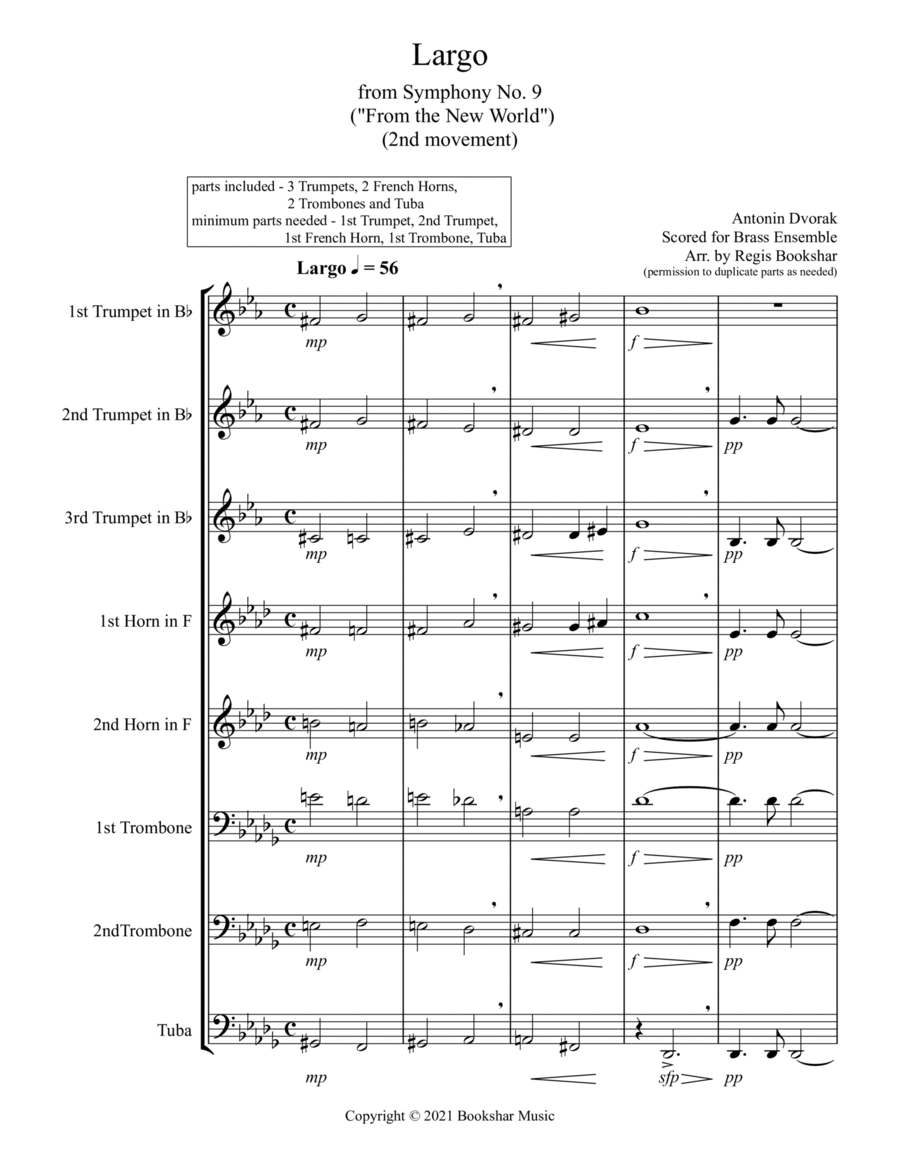
Largo (from "Symphony No. 9") ("From the New World") (Db) (Brass Ensemble - Trps, Hrns, Trbs, Tubas)
Quatuor de Cuivres : 2 trompettes, trombone, tuba

$18.00 15.25 € Quatuor de Cuivres : 2 trompettes, trombone, tuba PDF SheetMusicPlus

Brass Ensemble Horn,Trombone,Trumpet,Tuba - Level 4 - Digital Download SKU: A0.782314 Composed by Various. Arranged by James Haynor. Romantic Period. Score and parts. 31 pages. James Haynor #4996741. Published by James Haynor (A0.782314). The English word opera is an abbreviation of the Italian phrase opera in musica (work in music). It denotes a theatrical work consisting of a dramatic text, or libretto (booklet), that has been set to music and staged with scenery, costumes, and movement. A Night at the Opera, scored here for brass quintet, visits several famous works by the most beloved composers through the years. Included in this medley are: Flower Duet - Delibes ( Lakme ), Toreador - Bizet ( Carmen ), O mio bambino caro - Puccini ( Gianni Schicchi ), Largo el Factotum - Rossini ( The Barber of Saville ), Quando me’n - Puccini ( La Boheme ), Triumphal March - Verdi (Aida ), Un bel di, vedremo - Puccini ( Madam Butterfly ) and Nessun dorma - Puccini ( Turandot ). ( Duration 8:24 )
A Night at the Opera for Brass Quintet
Quatuor de Cuivres : 2 trompettes, trombone, tuba

$10.00 8.47 € Quatuor de Cuivres : 2 trompettes, trombone, tuba PDF SheetMusicPlus

Brass Ensemble Horn,Trombone,Trumpet,Tuba - Level 5 - Digital Download SKU: A0.563399 By The Beach Boys. By Amir Shakir, Brian Wilson, Dan Hartman, Donnie Wahlberg, Mark Wahlberg, and Mike E Love. Arranged by Austin Ralphson. Contemporary. Score and parts. 19 pages. Austin Ralphson #3681205. Published by Austin Ralphson (A0.563399). The making of Good Vibrations was unprecedented for any kind of recording. Over 90 hours of tape was consumed in the sessions, with the total cost of production estimated to be in the tens of thousands. This process was reflected in the song's several dramatic shifts in key, texture, instrumentation and mood. It's arranged here for brass quintet, and works very well in concert or at a wedding. Features the horn quite prominently (which is unusual for my arrangements!).
Good Vibrations
Quatuor de Cuivres : 2 trompettes, trombone, tuba
The Beach Boys
$14.99 12.7 € Quatuor de Cuivres : 2 trompettes, trombone, tuba PDF SheetMusicPlus


1 16 31 ....61


Partitions Gratuites
Acheter des Partitions Musicales
Acheter des Partitions Digitales à Imprimer
Acheter des Instruments de Musique

© 2000 - 2026

Accueil - Version intégrale





