EUROPE
1885 articles
USA
0 articles
DIGITAL
28 articles (à imprimer)
Partitions Digitales
Partitions à imprimer
28 partitions trouvées


Brass Ensemble Horn,Trombone,Trumpet,Tuba - Level 4 - Digital Download SKU: A0.1130062 Composed by English Folk Song by way of American Appalachians. Arranged by F. Leslie Smith. Celtic,Children,Folk,Irish,Traditional,Wedding. Score and parts. 28 pages. Sweetwater Brass Press #730439. Published by Sweetwater Brass Press (A0.1130062). The origins of this lullaby can be traced back to 15th-century England. Pioneers from the British Isles brought it with them to the American Appalachians. Written in three verses, its lyrics tell of four seemingly impossible gifts the singer gave my love. The first verse describes each gift: cherry that has no stone, a chicken that has no bone. a story that has no end and a baby with no cryin'. The second verse poses the riddle: how can such items exist? The third provides the answers: A cherry when it's bloomin', it has no stone. A chicken when it's pippin', it has no bone. The story of I love you, it has no end. A baby when it's sleepin', has no cryin'. This Riddle Song has enjoyed somewhat of a revival since mid-20th century, making appearances in various movies, TV shows and recordings. In 1956, Jerry Livingston and Paul Francis adapted The Riddle Song tune, added an original bridge and created new lyrics; Johnny Mathis recorded it as The Twelfth of Never, giving the haunting melody probably its greatest surge in popularity. This arrangement is in G major and opens with an upbeat introduction. For the first statement of the melody, tempo slows and Trumpets alternate the lead. On the second time through, tempo speeds up slightly and tuba takes the lead. For the third, tempo is back to the opening speed and Horn in F plays the melody. On the fourth time through, Trumpets and Trombone frame the tune in a call-and-response form. In the fifth, Trombone takes the lead. In the sixth and final statement, Horn in F and Trombone play melody at half speed while Trumpets play a fairly complicated counterpoint (at what may seem like double speed!). This, until the last phrase (A baby when it's sleepin'), when the melody switches over to Trumpets and Trombone takes the counterpoint. Trumpet 1 plays its A above the staff a number of times. Tuba's lowest note is its F down below the staff. Otherwise, notes for all instruments are well within normal playing range. Because of the recommended tempo, the countermelody at measures 68-83 could be problematic for Trumpets and Trombone and may require a little extra work. Completed in 2022, performance time runs about 3 minutes, 42 seconds. The arranger, Les Smith, will be happy to provide substitute parts (for example, treble clef baritone for trombone) at no charge. He would like to receive your suggestions, comments, corrections and criticisms. For more arrangements by Les, enter Sweetwater Brass Press (without the quotation marks) in the Sheet Music Plus or Sheet Music Direct search box. (Also, purchase of this piece entitles you to your choice of another of his arrangements at no charge; send a copy of your purchase receipt directly to him at lessmith61@bellsouth.net.)
I Gave My Love a Cherry (The Riddle Song ["The Twelfth of Never"])
Quatuor de Cuivres : 2 trompettes, trombone, tuba

$7.95 6.76 € Quatuor de Cuivres : 2 trompettes, trombone, tuba PDF SheetMusicPlus

Brass Ensemble Horn,Trombone,Trumpet,Tuba - Level 3 - Digital Download SKU: A0.802574 Composed by Antonio Carlos Jobim. Arranged by Peet du Toit. Contemporary. Score and parts. 11 pages. Peet du Toit #5801391. Published by Peet du Toit (A0.802574). Samba do Avião (a.k.a. Song of the Jet, translated literally as Airplane Samba) is a Brazilian song composed in 1962 by Antônio Carlos Jobim, who also wrote the original Portuguese lyrics. The English-language lyrics are by Gene Lees.In the biography Antonio Carlos Jobim: An Illuminated Man, Helena Jobim describes how her brother came up with the idea for the song: Tom's many walks from Ipanema to Santos Dumont Airport yielded that ode of beauty... He would head towards the airport, following the water's edge around Guanabara's Bay. The pretext to go there was to buy foreign magazines and newspapers. From Santos Dumont Airport he could observe his passion, the airplane. Yet he still kept some distance from those machines. He was afraid of flying, but he loved their power, splendor, and aerodynamics-man's conquest over machine.In the song, Jobim writes about landing at Galeão in Rio de Janeiro. The airport was renamed in his honor in 1999 and is now called Rio de Janeiro–Antonio Carlos Jobim International Airport.Jobim wrote Samba do Avião for an Italian film, Copacabana Palace (1962), where it was performed by Jula De Palma and I 4 + 4 di Nora Orlandi. The movie was filmed in Rio and features cameo appearances by Jobim, João Gilberto and Os Cariocas.The first performance of the song was by Jobim and Os Cariocas in August 1962 at the Au Bon Gourmet restaurant in Copacabana, Rio, at what music historian Ruy Castro calls the bossa nova show to end all bossa nova shows, as it featured Jobim, João Gilberto, Vinícius de Moraes and Os Cariocas on stage together for the only time.The first recording of the song was released in October 1962 by Elza Laranjeira. Os Cariocas had a hit with their rendition in 1963.The first English-language version was by Tony Bennett for his 1965 album If I Ruled the World: Songs for the Jet Set.Here is my brass quintet version of the song for your enjoyment.
Song Of The Jet (samba Do Avião)
Quatuor de Cuivres : 2 trompettes, trombone, tuba

$13.00 11.06 € Quatuor de Cuivres : 2 trompettes, trombone, tuba PDF SheetMusicPlus

Brass Ensemble Horn,Trombone,Trumpet,Tuba - Level 5 - Digital Download SKU: A0.1094241 By Joseph Alessi, Christian Lindberg. By Arthur Willard Pryor. Arranged by Aaron Hettinga. 20th Century,Classical,Contest,Festival,Patriotic,Traditional. Score and parts. 24 pages. Aaron Hettinga #698344. Published by Aaron Hettinga (A0.1094241). Arthur Pryor’s famous theme and variations on “The Blue Bells of Scotland†has been a showcase for trombonists with strong technique and agility for well over a century. While this work is most commonly performed as accompanied by a wind band or with piano, in this arrangement the soloist is supported by a standard brass quintet. The solo part is unchanged from Pryor’s original, though there are some minor tweaks to suggested slide positions and other notations throughout. While each of the accompanying quintet parts do feature some small technical requirements, they remain at an intermediate level where even less-experienced players should be able to pull them off. Performance suggestion: as an option, it’s recommended to utilize Cornets and Euphonium in place of the Trumpet and Trombone parts in the accompanying quintet to more faithfully emulate the sounds of the conical-bore instruments of the period and to better separate the tonality of the accompaniment from the soloist. This arrangement is a great vehicle to showcase a talented trombonist on this classic piece of standard trombone literature!
Blue Bells of Scotland - Trombone Solo with Brass Quintet Accompaniment
Quatuor de Cuivres : 2 trompettes, trombone, tuba
Joseph Alessi, Christian Lindberg
$29.99 25.52 € Quatuor de Cuivres : 2 trompettes, trombone, tuba PDF SheetMusicPlus

Brass Ensemble Horn,Trombone,Trumpet,Tuba - Level 3 - Digital Download SKU: A0.1038501 Composed by Frank Loesser. Arranged by Rita Arendz. 20th Century,Broadway,Musical/Show,Pop. Score and parts. 16 pages. Rita Arendz #643464. Published by Rita Arendz (A0.1038501). For Brass Quintet. This popular 1948 Broadway love song, Once in Love With Amy comes from the pen of Frank Loesser and his musical Where's Charley?. It is lighthearted in nature, and being so, it was not only performed by Ray Bolger, Dean Martin, Frank Sinatra, Mel Torme, and Perry Como, just to name a few, but also by Pops and Fozzie in episode 512 of The Muppet Show as well as by Miss Piggy in issue 3 of Muppet Peter Pan with words only Miss Piggy could sing - Once in love with Piggy, always in love with Piggy.... Have fun with this one! Alternate parts for British Brass Band instrumentation included (Eb Horn, Bb Trombone TC, Eb Bass). Trumpet parts can be played on Cornet. Duration ~4:25. 16 pages.
Once In Love With Amy
Quatuor de Cuivres : 2 trompettes, trombone, tuba

$23.99 20.41 € Quatuor de Cuivres : 2 trompettes, trombone, tuba PDF SheetMusicPlus

Brass Ensemble Horn,Trombone,Trumpet,Tuba - Level 3 - Digital Download SKU: A0.527950 By Sergei Prokofiev. By Sergei Prokofiev. Arranged by Diego Marani. 20th Century,Classical,Instructional,Romantic Period,Standards. Score and parts. 18 pages. Diego Marani #3883971. Published by Diego Marani (A0.527950). Romeo and Juliet, Op. 64, is a ballet by Sergei Prokofiev based on William Shakespeare's play Romeo and Juliet.Dance of the Knights is the No. 13 of the complete score. The A section begins with a strong pulsating beat that shows motoric rhythm, one of Prokofiev's signatures. The texture of this opening is almost metronomic, and provides a strong foundation for the dramatic theme that comes out on top of it.This arrangement for brass quartet includes the following parts: Bb Trumpet 1, Bb Trumpet 2, Trombone or F Horn, Tuba.It is suitable for repertoire, classroom and recital.
Dance Of The Knights
Quatuor de Cuivres : 2 trompettes, trombone, tuba
Sergei Prokofiev
$19.99 17.01 € Quatuor de Cuivres : 2 trompettes, trombone, tuba PDF SheetMusicPlus

Brass Ensemble Horn,Trombone,Trumpet,Tuba - Level 3 - Digital Download SKU: A0.527951 By Sergei Prokofiev. By Sergei Prokofiev. Arranged by Diego Marani. 20th Century,Classical,Instructional,Romantic Period,Standards. Score and parts. 22 pages. Diego Marani #3883973. Published by Diego Marani (A0.527951). Romeo and Juliet, Op. 64, is a ballet by Sergei Prokofiev based on William Shakespeare's play Romeo and Juliet.Dance of the Knights is the No. 13 of the complete score. The A section begins with a strong pulsating beat that shows motoric rhythm, one of Prokofiev's signatures. The texture of this opening is almost metronomic, and provides a strong foundation for the dramatic theme that comes out on top of it.This arrangement for brass quintet includes the following parts: Bb Trumpet 1, Bb Trumpet 2, F Horn, Trombone, Tuba.It is suitable for repertoire, classroom and recital.
Dance Of The Knights
Quatuor de Cuivres : 2 trompettes, trombone, tuba
Sergei Prokofiev
$22.99 19.56 € Quatuor de Cuivres : 2 trompettes, trombone, tuba PDF SheetMusicPlus

Brass Ensemble Horn,Trombone,Trumpet,Tuba - Level 5 - Digital Download SKU: A0.809125 By Jack Leonard with Tommy Dorsey Orchestra. By Jerome Kern. Arranged by Tony Benade. Musical/Show. Score and parts. 24 pages. Tony Benade #4855337. Published by Tony Benade (A0.809125). The arrangement opens up with a classic 8 bar riff that was used specially for this tune by various jazz artists.It starts out with a latin feel and moves to standard four on the bridge and then back to the latin feel. It continues to move back and forth from the latin to four throughout with ad lib solos for trumpet and trombone. The riff is brought back in just before the ad lib solos basically as a set up for  those solos. It is a very interesting arrangement for any type of group but especially a brass quintet.
All The Things You Are
Quatuor de Cuivres : 2 trompettes, trombone, tuba
Jack Leonard with Tommy Dorsey Orchestra
$24.99 21.26 € Quatuor de Cuivres : 2 trompettes, trombone, tuba PDF SheetMusicPlus

Brass Ensemble Horn,Trombone,Trumpet,Tuba - Level 3 - Digital Download SKU: A0.855026 Composed by Will L. Thompson (1847-1909). Arranged by Joseph Pugh. Christian,Easter,Sacred,Standards. Score and parts. 8 pages. Joseph Pugh #6056985. Published by Joseph Pugh (A0.855026). Thompson wrote Jesus is All the World to Me in 1904, and it became quite popular. He was as successful with Christian music as he had been earlier with secular music. This offering by Joseph Pugh is a testament to the Christian life. Jesus Is All The World To All Me was first published in the New Century Hymnal. Whilst on a trip to Europe in 1909 he fell ill and died a few weeks after returning to the United States. This song shows total reliance on the Lord Jesus Christ. Through sadness or happiness, Jesus is still all the world to the Christian.
Jesus Is All The World To Me (Brass Quintet)
Quatuor de Cuivres : 2 trompettes, trombone, tuba

$19.99 17.01 € Quatuor de Cuivres : 2 trompettes, trombone, tuba PDF SheetMusicPlus

Brass Ensemble Trombone,Trumpet,Tuba - Level 2 - Digital Download SKU: A0.585940 Composed by Kenny Vaughan and Marty Stuart. Arranged by Jeff Tincher. Contemporary. Score and parts. 22 pages. Jeff Tincher #6510757. Published by Jeff Tincher (A0.585940). I first heard this song while watching The Marty Stuart Show on television. Kenny is Marty's backing band The Fabulous Superlatives lead guitarist. This is a really fun song to perform and so truthful at the same time. A great country swing tune. Duration = 2:51. Visit my websites: https://jefftincher.wixsite.com/sheetmusic, https://jefftincher.wixsite.com/music, https://www.facebook.com/jefftincherpublishing.
Don't Leave Home Without Jesus
Quatuor de Cuivres : 2 trompettes, trombone, tuba

$12.99 11.05 € Quatuor de Cuivres : 2 trompettes, trombone, tuba PDF SheetMusicPlus

Brass Ensemble Horn,Trombone,Trumpet,Tuba - Level 3 - Digital Download SKU: A0.813983 Composed by Franz Xaver Gruber. Arranged by Regis Bookshar. Christmas,Instructional,Multicultural,World. Score and parts. 11 pages. Regis Bookshar #6636615. Published by Regis Bookshar (A0.813983). Brass Octet - Intermediate - Digital Download. This arrangement of Silent Night, or in German, Stille Nacht, would be a wonderful addition to any music library and could be performed for Christmas concerts, recitals, and, especially, church services. It is equally suitable for junior and senior high school students and even older musicians. Depending on their ability, younger musicians would also enjoy playing this selection. Included are a score and a complete set of parts (11 pages). This selection is one of the many arrangements from The Regis Bookshar Trumpet Ensemble's extensive music library which are being made available for the first time.Silent Night is probably the most popular Christmas carol ever written. It was composed in 1818 by Franz Xaver Gruber to lyrics by Joseph Mohr and was first performed on Christmas Eve at St. Nicholas parish church in Oberndorf, a small village in present-day Austria. A young Catholic priest, Father Joseph Mohr, had written the poem, Stille Nacht, in 1816 and had gone to Oberndorf in 1817. The melody was composed by Franz Xaver Gruber, schoolmaster and organist in the nearby village of Arnsdorf. On Christmas Eve, 1818, Mohr brought the words to Gruber and asked him to compose a melody and guitar accompaniment for that night's mass, after river flooding had possibly damaged the church organ. The church was eventually destroyed by repeated flooding and has since been replaced with the Silent-Night-Chapel.According to Gruber, Karl Mauracher, an organ builder who serviced the instrument at the Oberndorf church, was enamored with the song, and took the composition home with him to the Ziller Valley in Tyrol, Austria. From there, two traveling families of folk singers, the Strassers and the Rainers, included the tune in their shows. The Rainers were already singing it around Christmas, 1819, and once performed it for an audience that included Franz I of Austria and Alexander I of Russia. They also gave the first performance of the song in the United States in New York City in 1839. By the 1840's, the song was well known and was reported to be a favorite of Frederick William IV of Prussia. During this period, the melody changed slightly to become the version that is commonly heard today. The version of the melody that is generally used today is a slow, meditative lullaby, or pastoral, differing slightly from Gruber's original which has a moderate tempo. The song has been translated into about 140 languages and has been recorded by many singers across many music genres. The version sung by Bing Crosby in 1935, has sold over 10 million copies as a single.In this arrangement of Silent Night, Regis Bookshar has kept the basic form of this familiar Christmas carol, but has also included a descant during the third verse. Also, in addition to this version for a Brass Octet, consisting of 4 Trumpets, 1 French Horn, 2 Trombones and 1 Tuba, there are other arrangements of Silent Night available for a variety of instrumental ensembles. There are Quintets and Octets readily available for purchase. Please take the time to look for other versions of this composition. You may find something else that might also suit your needs.I would also encourage you to search for other arrangements by Regis Bookshar, as well, as there are numerous arrangements in a wide variety of styles, also available for purchase. You may find something else which might interest you. Please continue to check periodically because new arrangements are being added as often as possible. I'm certain that this wonderful arrangement of Silent Night will continue to entertain both performers and audiences alike for years to come.
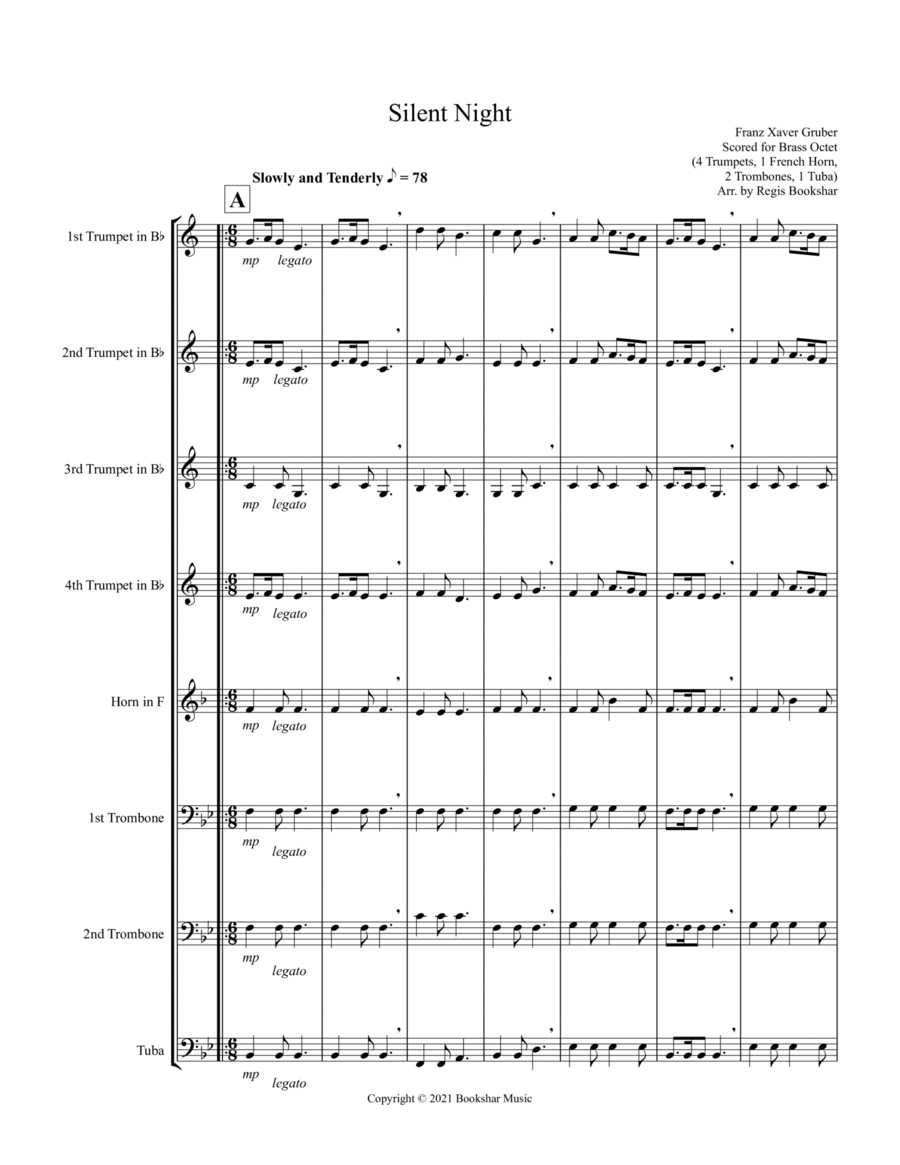
Silent Night (Bb) (Brass Octet - 4 Trp, 1 Hrn, 2 Trb, 1 Tuba)
Quatuor de Cuivres : 2 trompettes, trombone, tuba
the 1840's, the song was well known and was reported to be a favorite of Frederick William IV of Prussia During this period, the melody changed slightly to become the version that is commonly heard today
$8.00 6.81 € Quatuor de Cuivres : 2 trompettes, trombone, tuba PDF SheetMusicPlus

Brass Ensemble Horn,Trombone,Trumpet,Tuba - Level 3 - Digital Download SKU: A0.813980 Composed by Franz Xaver Gruber. Arranged by Regis Bookshar. Christmas,Instructional,Multicultural,World. Score and parts. 12 pages. Regis Bookshar #6636611. Published by Regis Bookshar (A0.813980). Brass Octet - Intermediate - Digital Download. This arrangement of Silent Night, or in German, Stille Nacht, would be a wonderful addition to any music library and could be performed for Christmas concerts, recitals, and, especially, church services. It is equally suitable for junior and senior high school students and even older musicians. Depending on their ability, younger musicians would also enjoy playing this selection. Included are a score and a complete set of parts (11 pages). This selection is one of the many arrangements from The Regis Bookshar Trumpet Ensemble's extensive music library which are being made available for the first time.Silent Night is probably the most popular Christmas carol ever written. It was composed in 1818 by Franz Xaver Gruber to lyrics by Joseph Mohr and was first performed on Christmas Eve at St. Nicholas parish church in Oberndorf, a small village in present-day Austria. A young Catholic priest, Father Joseph Mohr, had written the poem, Stille Nacht, in 1816 and had gone to Oberndorf in 1817. The melody was composed by Franz Xaver Gruber, schoolmaster and organist in the nearby village of Arnsdorf. On Christmas Eve, 1818, Mohr brought the words to Gruber and asked him to compose a melody and guitar accompaniment for that night's mass, after river flooding had possibly damaged the church organ. The church was eventually destroyed by repeated flooding and has since been replaced with the Silent-Night-Chapel.According to Gruber, Karl Mauracher, an organ builder who serviced the instrument at the Oberndorf church, was enamored with the song, and took the composition home with him to the Ziller Valley in Tyrol, Austria. From there, two traveling families of folk singers, the Strassers and the Rainers, included the tune in their shows. The Rainers were already singing it around Christmas, 1819, and once performed it for an audience that included Franz I of Austria and Alexander I of Russia. They also gave the first performance of the song in the United States in New York City in 1839. By the 1840's, the song was well known and was reported to be a favorite of Frederick William IV of Prussia. During this period, the melody changed slightly to become the version that is commonly heard today. The version of the melody that is generally used today is a slow, meditative lullaby, or pastoral, differing slightly from Gruber's original which has a moderate tempo. The song has been translated into about 140 languages and has been recorded by many singers across many music genres. The version sung by Bing Crosby in 1935, has sold over 10 million copies as a single.In this arrangement of Silent Night, Regis Bookshar has kept the basic form of this familiar Christmas carol, but has also included a descant during the third verse. Also, in addition to this version for a Brass Octet, consisting of 3 Trumpets, 2 French Horns, 2 Trombones and 1 Tuba, there are other arrangements of Silent Night available for a variety of instrumental ensembles. There are Quintets and Octets readily available for purchase. Please take the time to look for other versions of this composition. You may find something else that might also suit your needs.I would also encourage you to search for other arrangements by Regis Bookshar, as well, as there are numerous arrangements in a wide variety of styles, also available for purchase. You may find something else which might interest you. Please continue to check periodically because new arrangements are being added as often as possible. I'm certain that this wonderful arrangement of Silent Night will continue to entertain both performers and audiences alike for years to come.
Silent Night (Bb) (Brass Octet - 3 Trp, 2 Hrn, 2 Trb, 1 Tuba)
Quatuor de Cuivres : 2 trompettes, trombone, tuba
the 1840's, the song was well known and was reported to be a favorite of Frederick William IV of Prussia During this period, the melody changed slightly to become the version that is commonly heard today
$8.00 6.81 € Quatuor de Cuivres : 2 trompettes, trombone, tuba PDF SheetMusicPlus

Brass Ensemble Horn,Trombone,Trumpet,Tuba - Level 3 - Digital Download SKU: A0.813961 Composed by Franz Xaver Gruber. Arranged by Regis Bookshar. Christmas,Instructional,Multicultural,World. Score and parts. 7 pages. Regis Bookshar #6632967. Published by Regis Bookshar (A0.813961). Brass Quintet Quintet - Intermediate - Digital Download. This arrangement of Silent Night, or in German, Stille Nacht, would be a wonderful addition to any music library and could be performed for Christmas concerts, recitals, and, especially, church services. It is equally suitable for junior and senior high school students and even older musicians. Depending on their ability, younger musicians would also enjoy playing this selection. Included are a score and a complete set of parts (7 pages). This selection is one of the many arrangements from The Regis Bookshar Trumpet Ensemble's extensive music library which are being made available for the first time.Silent Night is probably the most popular Christmas carol ever written. It was composed in 1818 by Franz Xaver Gruber to lyrics by Joseph Mohr and was first performed on Christmas Eve at St. Nicholas parish church in Oberndorf, a small village in present-day Austria. A young Catholic priest, Father Joseph Mohr, had written the poem, Stille Nacht, in 1816 and had gone to Oberndorf in 1817. The melody was composed by Franz Xaver Gruber, schoolmaster and organist in the nearby village of Arnsdorf. On Christmas Eve, 1818, Mohr brought the words to Gruber and asked him to compose a melody and guitar accompaniment for that night's mass, after river flooding had possibly damaged the church organ. The church was eventually destroyed by repeated flooding and has since been replaced with the Silent-Night-Chapel.According to Gruber, Karl Mauracher, an organ builder who serviced the instrument at the Oberndorf church, was enamored with the song, and took the composition home with him to the Ziller Valley in Tyrol, Austria. From there, two traveling families of folk singers, the Strassers and the Rainers, included the tune in their shows. The Rainers were already singing it around Christmas, 1819, and once performed it for an audience that included Franz I of Austria and Alexander I of Russia. They also gave the first performance of the song in the United States in New York City in 1839. By the 1840's, the song was well known and was reported to be a favorite of Frederick William IV of Prussia. During this period, the melody changed slightly to become the version that is commonly heard today. The version of the melody that is generally used today is a slow, meditative lullaby, or pastoral, differing slightly from Gruber's original which has a moderate tempo. The song has been translated into about 140 languages and has been recorded by many singers across many music genres. The version sung by Bing Crosby in 1935, has sold over 10 million copies as a single.In this arrangement of Silent Night, Regis Bookshar has kept the basic form of this familiar Christmas carol, but has also included a descant during the third verse. Also, in addition to this version for a Brass Quinet, consisting of 2 Trumpets, 1 French Horn, 1 Trombone and 1 Tuba, there are other arrangements of Silent Night available for a variety of instrumental ensembles. There are Quintets and Octets readily available for purchase. Please take the time to look for other versions of this composition. You may find something else that might also suit your needs.I would also encourage you to search for other arrangements by Regis Bookshar, as well, as there are numerous arrangements in a wide variety of styles, also available for purchase. You may find something else which might interest you. Please continue to check periodically because new arrangements are being added as often as possible. I'm certain that this wonderful arrangement of Silent Night will continue to entertain both performers and audiences alike for years to come.

Silent Night (Bb) (Brass Quintet - 2 Trp, 1 Hrn, 1 Trb, 1 Tuba)
Quatuor de Cuivres : 2 trompettes, trombone, tuba
the 1840's, the song was well known and was reported to be a favorite of Frederick William IV of Prussia During this period, the melody changed slightly to become the version that is commonly heard today
$5.00 4.25 € Quatuor de Cuivres : 2 trompettes, trombone, tuba PDF SheetMusicPlus

Brass Ensemble Horn,Trombone,Trumpet,Tuba - Level 4 - Digital Download SKU: A0.1022835 Composed by Leif Jack. Contemporary,Latin. Score and parts. 18 pages. Leif Thomas Marken Jack #5713397. Published by Leif Thomas Marken Jack (A0.1022835). Driving rhythms, catchy melodies, and rich harmonies all feature in this exciting 1-2 minute brass fanfare. This work blends characteristic Spanish harmonies with Latin American rhythms and Swing, mixing the traditions of the Old and New World. Ideal for showcasing the ability of intermediate or advanced brass players, either at the beginning, or in the middle of a concert. This brass quintet can also add a bit of flare to a party, or act as a fanfare to get your audience excited for the show. This fanfare was commissioned by the Chan Centre for the Performing Arts at the University of British Columbia, and was played before a concert there by the famous flamenco band, the Paco de Lucia Project. Contact me at leifjack395@gmail.com for any further questions, concerns or business inquiries or check out my Instagram leif.jack.3 to see what I've been working on. Performing rights managed by SOCAN and BMI.
Danza Hispano
Quatuor de Cuivres : 2 trompettes, trombone, tuba

$4.99 4.25 € Quatuor de Cuivres : 2 trompettes, trombone, tuba PDF SheetMusicPlus


Partitions Gratuites
Acheter des Partitions Musicales
Acheter des Partitions Digitales à Imprimer
Acheter des Instruments de Musique

© 2000 - 2026

Accueil - Version intégrale




