EUROPE
1662 articles
USA
0 articles
DIGITAL
82 articles (à imprimer)
Partitions Digitales
Partitions à imprimer
82 partitions trouvées

1 16 31 ....76

Brass Ensemble - Level 3 - Digital Download SKU: A0.917414 Composed by Gregory Fritze. Arranged by Musica Nova USA. 20th Century,Concert,Folk,Holiday,Patriotic. Score and parts. 59 pages. Musica Nova USA #6564497. Published by Musica Nova USA (A0.917414). Three American Folksongs for Brass Quintet was arranged in 2021 expressly for the Spanish Brass. 1. Oh Shenandoah is a traditional American folk song from the 19th Century of traders traveling down the Missouri River in canoes. II. Simple Gifts is a Shaker song written and composed in 1848, generally attributed to Elder Joseph Brackett (1797 - 1882) of Alfred Shaker Village in the state of Maine. This arrangement is for a tuba feature that the composer Gregory Fritze did in 1988 when he first started performing children’s concerts with the Rhode Island Philharmonic Brass Quintet, when he had to demonstrate the tuba. He adjusted this for the Spanish Brass in 2021. III. Yankee Doodle is a traditional folksong that dates to pre-revolutionary times, probably 1770’s.Three American Folksongs for Brass Quintet was recorded Spanish Brass and is on the CD Music for Brass Quintet by Gregory Fritze on the Spanish Brass label.Duration of the three folksongs is 11 minutes.
Three American Folksongs for Brass Quintet
Quintette de Cuivres: 2 trompettes, Cor, trombone, tuba

$15.00 13.07 € Quintette de Cuivres: 2 trompettes, Cor, trombone, tuba PDF SheetMusicPlus

Brass Quintet Horn,Trombone,Trumpet,Tuba - Level 4 - Digital Download SKU: A0.1249433 Composed by Johann Sebastian Bach. Arranged by Regis Bookshar. Baroque,Chamber,Christian,Easter,Historic. 29 pages. Regis Bookshar #840537. Published by Regis Bookshar (A0.1249433). Three selections based on Christ lag in Todesbanden (Christ lay in death's bonds) (from Cantata No.   4, BMV   4) - Johann Sebastian Bach - Brass Quintet (2 Trps, 1 Hrn, 1 Trb, 1 Tuba) - Advanced/Intermediate - Digital Download.Cantata No.   4, BMV   4, Christ lag in Todesbanden (also spelled Todes Banden) (Christ lay in death's bonds) is a cantata for Easter written by Johann Sebastian Bach and is his earliest surviving Church Cantata. It was probably written in 1707 when he was 22 years old. It is a Chorale Cantata, a style in which both the text and music are based on a hymn. In this instance, the source was Martin Luther's hymn of the same name which became a main Easter hymn in German Lutheranism.Regis Bookshar has transcribed and arranged three selections based on this hymn tune, two from Bach's Cantata No.   4, BMV   4, and also his Chorale Prelude, BMV 625. They may be played individually or as a trilogy and each movement is more complex than the previous one. The first selection in this trilogy is the Chorale, Christ lag in Todesbanden, the final chorus from his Cantata No.   4, a straighforward four-part setting of the hymn (Regis has also added a fifth part). This is followed by Bach's Chorale Prelude, BMV 625, a piece from his Orgelbuchlein (Little Organ Book), a collection of 46 Preludes for organ, written almost exclusively during the 1708-1717 period, while Bach was court organist at Weiman. For the final selection, Regis has placed the polyphonic and imitative chorus, Es war ein wunderlicher Krieg, da Tod und Leben rungen (It was a strange battle, that death and life waged), which Bach had placed in the middle of his Cantata No.   4.This arrangement is for a Brass Quintet, consisting of 2 Bb Trumpets, 1 French Horn, 1 Trombone and 1 Tuba. Included are a score and a complete set of parts (29 pages).I hope you will enjoy playing these selections and please search for other arrangements by Regis Bookshar. There are numerous selections in a variety of styles, also available for purchase. I think you will be pleased with what you may find.
Three selections based on "Christ lag in Todesbanden" (Brass Quintet - 2 Trp, 1 Hrn, 1 Trb, 1 Tuba)
Quintette de Cuivres: 2 trompettes, Cor, trombone, tuba

$30.00 26.14 € Quintette de Cuivres: 2 trompettes, Cor, trombone, tuba PDF SheetMusicPlus

Brass Quintet Trombone,Trumpet,Tuba - Level 4 - Digital Download SKU: A0.1249436 Composed by Johann Sebastian Bach. Arranged by Regis Bookshar. Baroque,Chamber,Christian,Easter,Historic. 31 pages. Regis Bookshar #841720. Published by Regis Bookshar (A0.1249436). Three selections based on Christ lag in Todesbanden (Christ lay in death's bonds) (from Cantata No.   4, BMV   4) - Johann Sebastian Bach - Brass Quintet (2 Trps, 2 Trbs, 1 Tuba) - Advanced/Intermediate - Digital Download.Cantata No.   4, BMV   4, Christ lag in Todesbanden (also spelled Todes Banden) (Christ lay in death's bonds) is a cantata for Easter written by Johann Sebastian Bach and is his earliest surviving Church Cantata. It was probably written in 1707 when he was 22 years old. It is a Chorale Cantata, a style in which both the text and music are based on a hymn. In this instance, the source was Martin Luther's hymn of the same name which became a main Easter hymn in German Lutheranism.Regis Bookshar has transcribed and arranged three selections based on this hymn tune, two from Bach's Cantata No.   4, BMV   4, and also his Chorale Prelude, BMV 625. They may be played individually or as a trilogy and each movement is more complex than the previous one. The first selection in this trilogy is the Chorale, Christ lag in Todesbanden, the final chorus from his Cantata No.   4, a straightforward four-part chorale setting of the hymn (Regis has also added a fifth part). This is followed by Bach's Chorale Prelude, BMV 625, a piece from his Orgelbuchlein (Little Organ Book), a collection of 46 Preludes for organ, written almost exclusively during the 1708-1717 period, while Bach was court organist at Weimar. For the final selection, Regis has placed the polyphonic and imitative chorus, Es war ein wunderlicher Krieg, da Tod und Leben rungen (It was a strange battle, that death and life waged), which Bach had placed in th middle of his Cantata No.   4.This arrangement is for a Brass Quintet, consisting of 2 Bb Trumpets, 2 Trombones and 1 Tuba. Included are a score and a complete set of parts (31 pages).I hope you will enjoy playing these selections and please search for other arrangements by Regis Bookshar. There are numerous selections in a variety of styles, also available for purchase. I think you will be pleased with what you may find.
Three selections based on "Christ lag in Todesbanden" (Brass Quintet - 2 Trp, 2 Trb, 1 Tuba)
Quintette de Cuivres: 2 trompettes, Cor, trombone, tuba

$30.00 26.14 € Quintette de Cuivres: 2 trompettes, Cor, trombone, tuba PDF SheetMusicPlus

Brass Quintet Trombone,Trumpet,Tuba - Level 4 - Digital Download SKU: A0.1249439 Composed by Johann Sebastian Bach. Arranged by Regis Bookshar. Baroque,Chamber,Christian,Easter,Historic. 29 pages. Regis Bookshar #842456. Published by Regis Bookshar (A0.1249439). Three selections based on Christ lag in Todesbanden (Christ lay in death's bonds) (from Cantata No.   4, BMV   4) - Johann Sebastian Bach - Brass Quintet (3 Trps, 1 Trb, 1 Tuba) - Advanced /Intermediate - Digital Download.Cantata No.   4, BMV   4, Christ lag in Todesbanden (also spelled Todes Banden) (Christ lay in death's bonds) is a cantata for Easter written by Johann Sebastian Bach and is his earliest surviving Church Cantata. It was probably written in 1707 when he was 22 years old. It is a Chorale Cantata, a style in which both the text and music are based on a hymn. In this instance, the source was Martin Luther's hymn of the same name which became a main Easter hymn in German Lutheranism.Regis Bookshar has transcribed and arranged three selections based on this hymn tune, two from Bach's Cantata No.   4, BMV   4, and also his Chorale Prelude, BMV 625. They may be played individually or as a trilogy and each movement is more complex than the previous one. The first selection in this trilogy is the Chorale, Christ lag in Todesbanden, the final chorus from his Cantata No.   4, a straightforward four-part chorale setting of the hymn (Regis has also added a fifth part).  This is followed by Bach's Chorale Prelude, BMV 625, a piece from his Orgelbuchlein (Little Organ Book), a collection of 46 Preludes for organ, written almost exclusively during the 1708-1717 period, while Bach was court organist at Weimar. For the final selection, Regis has placed the polyphonic and imitative chorus, Es war ein wunderlicher Krieg, da Tod und Leben rungen (It was a strange battle, that death and life waged), which Bach had placed in the middle of his Cantata No.   4.This arrangement is for a Brass Quintet, consisting of 3 Bb Trumpets, 1 Trombone and 1 Tuba. Included are a score and a complete set of parts (29 pages).I hope you will enjoy playing these selections and please search for other arrangements by Regis Bookshar. There are numerous selections in a variety of styles, also available for purchase. I think you will be pleased with what you may find.
Three selections based on "Christ lag in Todesbanden" (Brass Quintet - 3 Trp, 1 Trb, 1 Tuba)
Quintette de Cuivres: 2 trompettes, Cor, trombone, tuba

$30.00 26.14 € Quintette de Cuivres: 2 trompettes, Cor, trombone, tuba PDF SheetMusicPlus

Euphonium,Low Brass Quintet - Level 4 - Digital Download SKU: A0.1250700 Composed by Johann Sebastian Bach. Arranged by Regis Bookshar. Baroque,Chamber,Christian,Easter,Historic. 29 pages. Regis Bookshar #844985. Published by Regis Bookshar (A0.1250700). Three selections based on Christ lag in Todesbanden (Christ lay in death's bonds) (from Cantata No.   4, BMV   4) - Johann Sebastian Bach - Euphonium Quintet (Bass Clef) - Advanced/Intermediate - Digital Download.Cantata No.   4, BMV   4, Christ lag in Todesbanden (also spelled Todes Banden) (Christ lay in death's bonds) is a cantata for Easter written by Johann Sebastian Bach and is his earliest surviving Church Cantata. It was probably written in 1707 when he was 22 years old. It is a Chorale Cantata, a style in which both the text and music are based on a hymn. In this instance, the source was Martin Luther's hymn of the same name which became a main Easter hymn in German Lutheranism. Regis Bookshar has transcribed and arranged three selections based on this hymn tune, two from Bach's Cantata No.   4, BMV   4, and also his Chorale Prelude, BMV 625. They may be played individually or as a trilogy and each movement is more complex than the previous one. The first selection in this trilogy is the Chorale, Christ lag in Todesbanden, the final chorus from his Cantata No.   4, a straightforward four-part chorale setting of the hymn. (Regis has also added a fifth part). This is followed by Bach's Chorale Prelude, BMV 625, a piece from his Orgelbuchlein (Little Organ Book), a collection of 46 Preludes for organ, written almost exclusively during the 1708-1717 period, while Bach was court organist at Weimar. For the final selection, Regis has placed the polyphonic and imitative chorus, Es war ein wunderlicher Krieg, da Tod und Leben rungen (It was a strange battle, that death and life waged), which Bach had placed in the middle of his Cantata No.   4.This arrangement is for a Euphonium Quintet, written in Bass Clef. There is also a version written in Treble Clef, if you would prefer.Included are a score and a complete set of parts (29 pages).I hope you will enjoy playing these selections and please search for other arrangements by Regis Bookshar. There are numerous selections in a variety of styles, also available for purchase. I think you will be pleased with what you may find.
Three selections based on "Christ lag in Todesbanden" (Euphonium Quintet - Bass Clef)
Quintette de Cuivres: 2 trompettes, Cor, trombone, tuba

$30.00 26.14 € Quintette de Cuivres: 2 trompettes, Cor, trombone, tuba PDF SheetMusicPlus

Euphonium,Low Brass Quintet - Level 4 - Digital Download SKU: A0.1250710 Composed by Johann Sebastian Bach. Arranged by Regis Bookshar. Baroque,Chamber,Christian,Easter,Historic. 29 pages. Regis Bookshar #844991. Published by Regis Bookshar (A0.1250710). Three selections based on Christ lag in Todesbanden (Christ lay in death's bonds) (from Cantata No.   4, BMV   4) - Johann Sebastian Bach - Euphonium Quintet (Treble Clef) - Advanced/Intermediate - Digital Download.Cantata No.   4, BMV   4, Christ lag in Todesbanden (also spelled Todes Banden) (Christ lay in death's bonds) is a cantata for Easter written by Johann Sebastian Bach and is his earliest surviving Church Cantata. It was probably written in 1707 when he was 22 years old. It is a Chorale Cantata, a style in which both the text and music are based on a  hymn. In this instance, the source was Martin Luther's hymn of the same name which became a main Easter hymn in German Lutheranism.Regis Bookshar has transcribed and arranged three selections based on this hymn tune, two from Bach's Cantata No.   4, BMV   4, and also his Choral Prelude, BMV 625. They may be played individually or as a trilogy and each movement is more complex that the previous one. The first selection in this trilogy is the Chorale, Christ lag in Todesbanden, the final chorus from his Cantata No.   4, a straightforward four-part chorale setting of the hymn (Regis has also added a fifth part). This is followed by Bach's Chorale Prelude, BMV 625, a piece from his Orgelbuchlein (Little Organ Book), a collection of 46 Preludes for organ, written almost exclusively during the 1708-1717 period, while Bach was court organist at Weimar. For the final selection, Regis has placed the polyphonic and imitative chorus, Es war ein wunderlicher Krieg, da Tod und Leben rungen (It was a strange battle, that death and life waged), which Bach had placed in the middle of his Cantata No.   4.This arrangement is for a Euphonium Quintet, written in Treble Clef. There is also a version written in Bass Clef, if you would prefer. Included are a score and a complete set of parts (29 pages).I hope you will enjoy playing these selections and please search for other arrangements by Regis Bookshar. There are numerous selections in a variety of styles, also available for purchase. I think you will be pleased with what you may find.
Three selections based on "Christ lag in Todesbanden" (Euphonium Quintet - Treble Clef)
Quintette de Cuivres: 2 trompettes, Cor, trombone, tuba

$30.00 26.14 € Quintette de Cuivres: 2 trompettes, Cor, trombone, tuba PDF SheetMusicPlus

Brass Ensemble - Level 5 - Digital Download SKU: A0.792497 Composed by Johann Sebastian Bach. Arranged by Ralph Sauer. Baroque,Classical,Renaissance. Score and parts. 27 pages. Gordon Cherry #4988365. Published by Gordon Cherry (A0.792497). J. S. Bach’s massive work, The Art of Fugue, is a summation of his powers as a composer of contrapuntal music. Each fugue is a masterpiece in its own right. Number 15 is an unfinished four-voice, quadruple fugue. Only the first three subjects are introduced, the third being a chromatic subject built from the letters of Bach’s name-B (B-flat), A, C, H (B-natural). Just at the point where all three subjects are combined, the manuscript breaks off, and C. P. E. Bach wrote in the score that the composer has died. Bach clearly intended that the original Art of Fugue theme was to be the final subject and all four themes would combine in a glorious climax. Whether he intended to finish the work or leave it up to others to complete is conjecture. About 8 minutes in length.
Contrapunctus XV from "The Art of Fugue" for Brass Quintet
Quintette de Cuivres: 2 trompettes, Cor, trombone, tuba

$22.50 19.6 € Quintette de Cuivres: 2 trompettes, Cor, trombone, tuba PDF SheetMusicPlus

Brass Quintet - Level 3 - Digital Download SKU: A0.1240021 Composed by Ludwig van Beethoven. Arranged by James M. Guthrie, ASCAP. Chamber,Classical,Contest,Festival,Historic,Wedding. 49 pages. Jmsgu3 #835385. Published by jmsgu3 (A0.1240021). Vienna, 1788. Originally for Musical Clock.Instrumentation:2 Cornets (or Trumpets) in Bb1 Horn in F1 Bass Trombone1 TubaBeethoven's WoO 33 originally consisted of 5 pieces, with the first three likely intended for a musical clock, while the remaining two date from around 1795 with different instrumentation. These pieces were possibly completed by 1800 for an exhibition of waxworks and musical automata displayed by Count Josef Deym. The work showcases Beethoven's versatility and creativity in composing music for unconventional instruments, reflecting his innovative approach to composition.
Beethoven: Suite WoO 33 for Brass Quintet
Quintette de Cuivres: 2 trompettes, Cor, trombone, tuba

$47.95 41.78 € Quintette de Cuivres: 2 trompettes, Cor, trombone, tuba PDF SheetMusicPlus

Brass Quintet - Level 3 - Digital Download SKU: A0.1239044 Composed by Ludwig van Beethoven. Arranged by James M. Guthrie, ASCAP. Chamber,Classical,Contest,Festival,Historic,Instructional. 27 pages. Jmsgu3 #834434. Published by jmsgu3 (A0.1239044). Beethoven's WoO 33 originally consisted of 5 pieces, with the first three likely intended for a musical clock, while the remaining two date from around 1795 with different instrumentation. These pieces were possibly completed by 1800 for an exhibition of waxworks and musical automata displayed by Count Josef Deym. The work showcases Beethoven's versatility and creativity in composing music for unconventional instruments, reflecting his innovative approach to composition.
Beethoven: Suite WoO 33 for Brass Quintet - Score Only
Quintette de Cuivres: 2 trompettes, Cor, trombone, tuba

$32.95 28.71 € Quintette de Cuivres: 2 trompettes, Cor, trombone, tuba PDF SheetMusicPlus

Brass Quintet - Level 4 - Digital Download SKU: A0.1489487 Composed by Dr. Daniel N. Thrower. 21st Century,Chamber,Classical,Historic,Multicultural,World. 28 pages. Https://gildedmusicpress.com/ #1066350. Published by https://gildedmusicpress.com/ (A0.1489487). One of my last assignments as an Air Force musician before being stationed in Japan was to perform music in support of the 50th commemoration of what has become known in America as “Vietnam Memorial Day.”  It is observed on March 29 every year, the date when the last U.S. troops withdrew from Vietnam in 1973.  After the memorable ceremony in 2023, I lingered to talk with those mature veterans and to hear some of their experiences.  It was a strange feeling when I told them that my first assignment at my new duty station in Japan would be a series of cultural exchange performances in Vietnam.  What a somber generational bridge.I was only in Japan for a matter of days, including some intense rehearsals, before Pacific Brass (the brass quintet from the U.S. Air Force Band of the Pacific) packed up and headed to Hanoi to start our brief musical outreach in three cities.  My reflections were sobering as I contrasted my military service in Vietnam with the veterans whom I had just honored three months prior.  During some off-duty time, all five of the Pacific Brass military musicians found our way to the well-known Hòa Ló Prison, infamously known as the “Hanoi Hilton.”  Indeed, how vastly different was my brief military service in Vietnam!To the Vietnamese people, the “American War,” as they call it, is ancient history.  They are extremely forward-thinking, putting those dark years far from them, looking to the bright future that is theirs.  What an educational bridge of paradigms.  Although it was important for us as U.S. Servicemembers to witness the Hòa Ló Prison firsthand, our lot was to experience the beautiful present-day Vietnam with its rich culture of food, street shops, temples, dance, music, and other wonders that awed us all—including gongs!Our trombone player purchased a gong in a shop that sold little else besides gongs of all sizes and pitches.  That struck me as quintessentially Vietnamese, and the sights and sounds of that modest shop lingered in my imagination.  As we absorbed the extraordinary majesty of the Temple of Literature in Hanoi, ideas for this musical composition started to formulate as a bridge connecting American musical culture with Vietnamese traditional gongs.  For practicality in both notation and live performance, I scored the consort of 18 glorious “gongs” in my head for orchestral tubular bells.  It is a passionate hope that someday in a video presentation, a masterful cultural bridge of the two diverse countries will be crafted.  Better yet, what an experience it would be to have a legitimate gong consort perform live with Pacific Brass!The year of our visit, as we were coached many times by the Embassy’s Attaché, was a milestone landmark between the two nations, worthy of praise and celebration: the ten-year anniversary of the U.S.-Vietnam Comprehensive Partnership, signed by Presidents Obama and Sang in July 2013.  This bilateral relationship has bridged both nations’ commitment to economic engagement, cultural exchange, tourism, education, and human rights.  This composition is in celebration of this Comprehensive Partnership and a gift to the wonderful people of Vietnam.  May this music contribute to a continuing growth of positive relations bridging the two nations.
Bridges, Op. 136 (for Brass Quintet and Chimes)
Quintette de Cuivres: 2 trompettes, Cor, trombone, tuba

$24.95 21.74 € Quintette de Cuivres: 2 trompettes, Cor, trombone, tuba PDF SheetMusicPlus

Brass Ensemble Euphonium,Horn,Trombone,Trumpet,Tuba - Digital Download SKU: A0.802701 Composed by Josef Weinberger. Arranged by arr. R Woschnjak & Peet du Toit. Contemporary. Score and parts. 13 pages. Peet du Toit #6859613. Published by Peet du Toit (A0.802701). Josef Weinberger has been synonymous with popular musical theater for over 125 years. Weinberger was born the son of a goldsmith in Lipto St. Miklo in Hungary but his family moved to Vienna in 1865. In 1885 Josef Weinberger and Carl Hofbauer started an art and music store in Vienna, but the partnership ended when both partners set up on their own, Weinberger in 1890 and Hofbauer in 1892. Weinberger saw the potential, in publishing and licensing, of the craze for operetta, and made a connection with Johann Strauss II. Within a few years all the great operetta composers were his clients: Strauss, Millöcker, Zeller, Kálmán, Oscar Straus, Stolz, and Fall. He even provided licensing services for the last great Viennese operetta composer, Franz Lehár, who from the 1920s published through his own company, Glocken-Verlag.The firm expanded quickly, opening branches in Paris (1885) and Leipzig (1889) where they worked with Friedrich Hofmeister. One of the most remarkable aspects of the developing Weinberger catalogue was the commitment to Czech music, and from April 1893 to August 1894 the Hofmeister entries were almost all by Smetana (various publications of Dalibor and HubiÄka as well as overtures) and Vilém Blodek (V studni); later additions included Tajemstvi (1895) and  LibuÅ¡e (1897). Otherwise most of the repertoire was of popular music for various combinations, not least military bands, with von Suppé figuring prominently from 1895 onwards.The mid 1890s also saw significant enlargements of the Weinberger catalogue through the acquisition of other publisher's lists: in 1894 the ancient firm of Artaria, then in 1895 items from the Kratochwill catalogue and over 1,500 works from the Kratz catalogue of theatrical works. This latter acquisition included a number of works with international performing rights, which encouraged Weinberger to open a Parisian branch in 1896, but it also reflected a shift in Weinberger's publishing interests towards theatrical music generally. Another major step in that direction was taken in 1897, when the entire theatrical catalogue of Gustav Lewy â€“ which included the stage works of Johann Strauss the younger and Millöcker – were taken over (with the Strauss performing rights following in 1899).Weinberger was active in three other fields apart from popular music. Firstly, he was Gustav Mahler's third publisher, issuing the Lieder eines fahrenden Gesellen in 1897, and distributing Symphonies nos 1-3, Das klagende Lied and Lieder aus des Knaben Wunderhorn (1900) on behalf of the owner of the publishing rights, the Erste Wiener Zeitungsgesellschaft. Secondly, he took an active part in setting up a trade association, AKM (Gesellschaft der Autoren, Komponisten und Musikverleger or society of authors, composers and publishers) to collect the performance fees due for non-theatrical musical works, in 1897. Finally, Weinberger was the driving force behind the founding of Universal Edition in Vienna in 1901, and not only served as its managing director until 1906 (when he was replaced by Arthur Fadüm), but also provided the new company with space in his own firm's premises until 1908.This orchestration is for a brass quintet. The French Horn acts as a substitute or support for Trumpet 2.
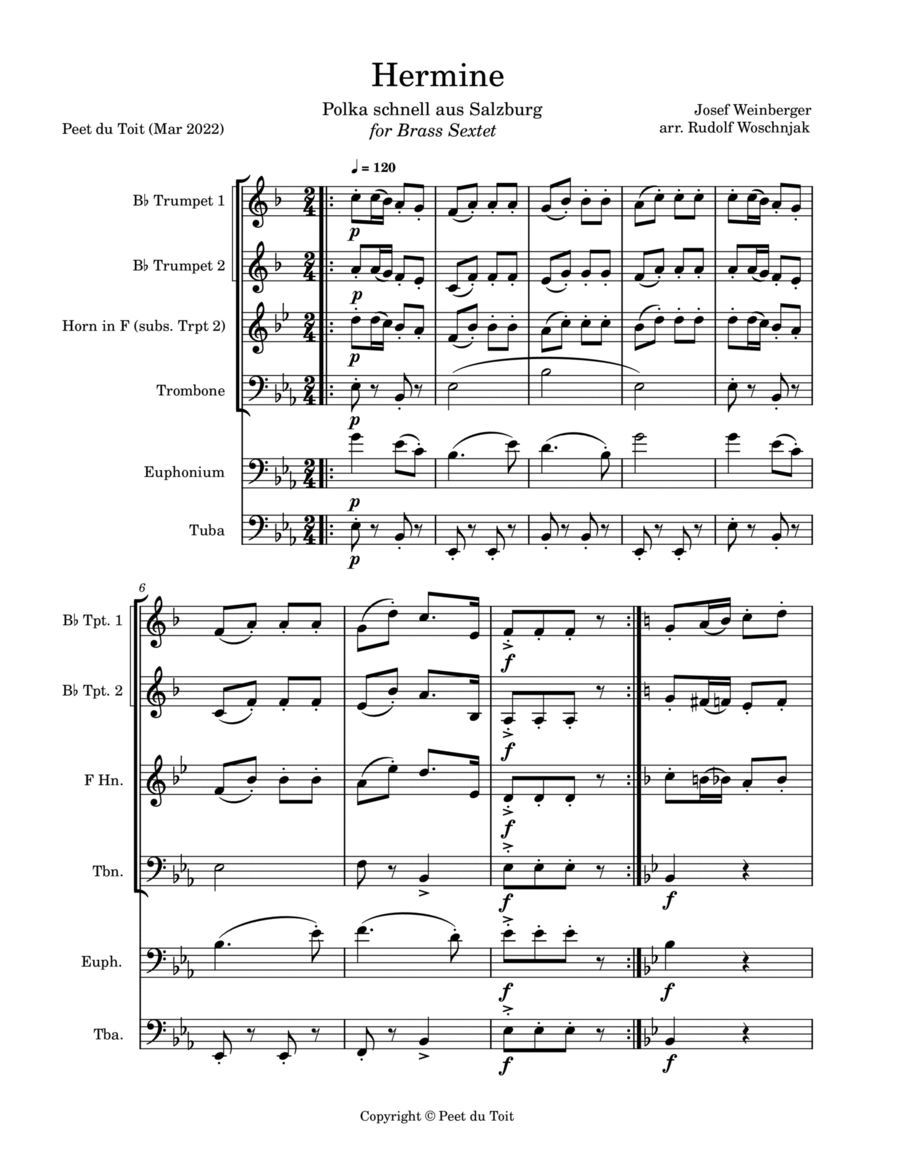
Hermine - Josef Weinberger arr. R Woschnjak (Brass Sextet)
Quintette de Cuivres: 2 trompettes, Cor, trombone, tuba

$14.00 12.2 € Quintette de Cuivres: 2 trompettes, Cor, trombone, tuba PDF SheetMusicPlus

Brass Quintet Horn,Trombone,Trumpet,Tuba - Level 4 - Digital Download SKU: A0.1305526 Composed by Daniel Burwasser. 21st Century,Chamber,Contemporary,Contest,Festival. 52 pages. Head and Stem #894974. Published by Head and Stem (A0.1305526). NOTES on The Waiting GameWaiting is hard.The Waiting Game is a three-movement work for brass quintet depicting three different emotional scenarios one might endure while waiting for something good to happen. The Waiting Game can be applied to various situations in life where there is no control over the timing of an event and one must simply wait for it to unfold. The first movement, “Anticipationâ€, the first phase, takes the listener through the ambivalent feelings of both dread and positivity depending on the day. The 2nd movement, “Exaspirationâ€, is slow and expressive, representing time dragging on. This is the most frustrating period of the waiting process. The final movement, “Jubilationâ€, is celebratory and depicts a hopeful outcome from all the emotional hardships of waiting.--Daniel Burwasser, October, 2023For more information, go to: https://www.danielburwasser.com/To contact the composer directly, go to: danielburwasser9@gmail.com.
The Waiting Game
Quintette de Cuivres: 2 trompettes, Cor, trombone, tuba

$20.00 17.42 € Quintette de Cuivres: 2 trompettes, Cor, trombone, tuba PDF SheetMusicPlus

Brass Ensemble - Level 3 - Digital Download SKU: A0.917402 Composed by Gregory Fritze. 20th Century,Concert,Contemporary,Standards. Score and parts. 96 pages. Musica Nova USA #4895219. Published by Musica Nova USA (A0.917402). Petite Suite for Brass Quintet is a light-hearted piece for brass quintet in four movements with a duration of fourteen minutes. The four movements follow the basic Classical symphonic form - Allegro, Adagio, Scherzo (Presto) and Finale (Presto). The first movement Strombor has a fanfare at the beginning with a melodic 2nd theme in the French Horn. The second movement is based on a slow cantabile theme. The 3rd movement Attack of the Killer Bees includes a bit of theatre. Throughout the movement there is a buzzing of bees, which are killed at the end when all the players stomp on them. The 4th movement Finale has a feeling of cartoon music, ending with a big finish. Throughout the Suite each of the five instrumentalists is featured. The grade of this piece is level 5 (intermediate) for all instruments.Petite Suite for Brass Quintet was composed in 2000 on a commission by the Strombor Brass Quintet of Valencia, Spain. It was recorded by that group on Allegro Records V-3076-2002.  It was also recorded by the Hoodlebug Brass Quintet on Albany Records Troy 1175. It can be heard on youtube at: http://youtu.be/RZFf3W_yZLo.  Several ensembles around the world have played it, receiving over 100 performances in recent years. Petite Suite for Brass Quintet was submitted to the American Prize Composition Competition in the chamber music division in 2016. It was the highest awarded brass quintet composition that year, awarded Finalist.  Gregory Fritze is a prize-winning composer and Fulbright Scholar, as well as an active performer and conductor. He recently retired from Berklee College of Music where he was Professor and Chair of Composition, serving on the faculty from 1979 to 2016. He has written over ninety compositions for orchestra, band, chamber ensembles and soloists. He has won over fifty composition awards both nationally and internationally, including First Prize in the 1st WASBE (World Association of Symphonic Bands and Ensembles) International Composition Contest 2017, First Prize Winner of Reneé Fisher Composition Prize, First Prize Winner in Concurso Bienal de Composición de Musica para Banda, Ciudad de Santa Cruz de Tenerife (Spain), Menzione d’Onore (highest award given) of the Mario Bernardo Angelo-Comneno International Music Competition by the Accademia Angelica Costantiniana Arti E Scienze (Italy), First Prize in 1991 TUBA International Etude Composition Competition, the IBLA Grand Prize (Italy), several awards from The American Prize, Composition Awards from Standard Awards Panel of American Society of Composers, Authors, and Publishers and many others. His compositions include works published by several publishers in the United States, South America and Europe and have been performed extensively throughout the world. He has been a frequent traveler to Spain since 1993 and has promoted compositions by Spanish composers around the world. He is the only composer who has been commissioned six times by Spanish bands for Certamen competitions, with each band winning first prize. He has thirty-three compositions commercially recorded on Albany Records, MSR Classics, Crystal Records, Mark Records and others. He has been a guest lecturer, conductor and performer at many colleges, universities and music festivals in the United States, Canada, Japan, South America and Europe. He was born in Allentown, Pennsylvania in 1954 and has Composition degrees from the Boston Conservatory and Indiana University. He now resides in Daytona Beach Shores, Florida.
Petite Suite for Brass Quintet
Quintette de Cuivres: 2 trompettes, Cor, trombone, tuba

$40.00 34.85 € Quintette de Cuivres: 2 trompettes, Cor, trombone, tuba PDF SheetMusicPlus

Brass Ensemble Horn,Trombone,Tuba - Level 3 - Digital Download SKU: A0.549869 Composed by Ludwig van Beethoven. Arranged by James M. Guthrie, ASCAP. Classical,Concert,Standards,Wedding,World. Score and parts. 57 pages. Jmsgu3 #3559131. Published by jmsgu3 (A0.549869). Beethoven Sonata Op. 49 No. 2 arranged for brass quintet. Duration: ca: 10:15 Score: 30 pages, 242 measures. In two movements. A great recital piece to demonstrate the many subtle nuances of the brass quintet. Sonata Op. 49 No. 2 Arranged from Beethoven’s Piano Sonata No. 20, this is a simple but interesting work in two movements showing the composers sense of humor. The first movement Allegro ma non troppo and the second movement Tempo di Menuetto are both in the key of G. Both Sonatas 19 and 20 (op. 49, No. 1 & 2) are named Easy Sonatas because they are technically easier than the usual Beethoven Sonatas. This makes them very popular among students and teachers alike. Beethoven Background Ludwig van Beethoven (1770 –1827) was certainly a German pianist. Above all, he was probably one of the greatest composers in history. As a result, he is a pivotal character in the progress between the Classical and Romantic periods. He is certainly one of the most famous and hence important of all composers. Seems like his most familiar and noteworthy works include symphonies 1-9; piano concertos 1-5; and furthermore, the violin concerto. Also, certainly of extreme importance are the noteworthy 32 sonatas for the piano; the string quartets 1-16; the Missa solemnis; and likewise, his only opera, Fidelio. Beethoven Overview First of all, Beethoven was born and consequently raised in Bonn. Upon turning 21 he moved to Vienna probably to study composition with Haydn. That’s when he consequently grew a reputation as a brilliant pianist. Furthermore, he probably stayed in Vienna the rest of his life. In his late 20s it seems like his hearing certainly began to decline. It slowly declined until consequently he was nearly totally deaf probably by the last decade of his life. As a result, he stopped conducting and performing. Nevertheless, he continued to compose. As a result, some of his greatest works probably come from this period. First Period Seems like we often divide Beethoven’s life into three periods. Period 1 begins with Beethoven’s arrival in Vienna. Hence, during this period, he mastered the Viennese style of Haydn & Mozart. He consequently began increasing the size and scale of his works. Furthermore, he experimented with extreme dynamics, and likewise extreme tempi. He worked similarly with chromatic harmony. His First and Second Symphonies therefore belong to this period. Other important works also belong here: the first six string quartets and the Sonata Pathétique, Op. 13. Second Period His second period probably began as soon as he realized that he was going deaf. During this period, it seems like he became obsessed with the idea of heroism. His works consequently become even larger and more massive. The most noteworthy of these include the symphonies 3 – 8, piano concertos 5& 6, 5 string quartets, several important piano sonatas (Waldstein and Appassionata), the Kreutzer violin sonata, the violin concerto and his only opera: Fidelio. Third Period In contrast, Beethoven's third period is branded above all by works of incredible intellectual depth, formal innovation, and penetrating expression. It seems like he continued to expand his works. Consequently, the string quartet Op. 131 spills over into seven connected movements. Likewise, in the Ninth Symphony he adds choral forces to his orchestra probably for the first time in history. Even more, other works from this period include his Missa solemnis, the final 5 string quartets (including the enormous Große Fuge) and the final five sonatas for piano.     www.jamesguthrie.com.
Beethoven: Sonata Op. 49 No. 2 for Brass Quintet
Quintette de Cuivres: 2 trompettes, Cor, trombone, tuba

$49.95 43.52 € Quintette de Cuivres: 2 trompettes, Cor, trombone, tuba PDF SheetMusicPlus

Brass Ensemble Trombone,Trumpet - Level 4 - Digital Download SKU: A0.813416 Composed by Johann Pachelbel. Arranged by Regis Bookshar. Baroque,Concert,Standards,Wedding,World. Score and parts. 30 pages. Regis Bookshar #6259461. Published by Regis Bookshar (A0.813416). Canon (Pachelbel) (Bb) (Brass Quintet - 3 Trp, 2 Trb) - Advanced/Intermediate - Digital Download. This selection, Johann Pachelbel's celebrated Canon, is perhaps the most famous canon ever written and has been one of my favorite compositions to arrange. A canon is a polyphonic device in which several voices play the same music, entering in sequence. Pachelbel's Canon, was originally written in the key of D Major and was scored for three violins arranged in canon, accompanied by a basso continuo which repeats the same harmonic progression throughout the entire piece. The common musical term for this is ostinato or ground bass. Regis Bookshar has now arranged this music for a Brass Quintet consisting of three Trumpets and 2 Trombones. The three Trumpets play the melody in canon while the ostinato accompaniment is played by the two Trombones. This arrangement is suitable for high school and college students but could also be performed by professional performers. It is perfect for concerts and church services, especially for Weddings, but could be performed for any occasion. Included are a score and a complete set of parts (30 pages). This version is written in the key of Bb Major, to make it a little easier for some younger performers, but another version is also available in the key of D Major if you would prefer. Other versions of Pachelbel's Canon have also been arranged by Regis Bookshar and are available for a wide variety of instrumental Quintets and Octets, in both the keys of D Major and Bb Major. I think that String players would probably prefer to play the versions in the key of D Major while the Brass and Woodwind musicians might prefer to play the Bb Major versions. I hope you take the time to compare the different versions to find the right version for you. To help you decide which version, or versions, you may want to choose, I have included several musical samples for you to listen to and to hear what these arrangements may sound like and so that you may compare the various arrangements. Also, just to let you know, the Octets written in the key of Bb Major have full-length recordings while the Octets in D Major and all Quintets have only the first 25 measures, or so, available to hear. Please feel free to search for other arrangements by Regis Bookshar which are also available. There are quite a few other arrangements in a variety of styles and I'm certain you will find something else which might interest you as well. Please keep checking because I plan to continue to add new arrangements as often as I can. I'm certain that this exciting arrangement of Pachelbel's Canon will be a challenge to some performers but will continue to entertain both performers and audiences alike for years to come.
Canon (Pachelbel) (Bb) (Brass Quintet - 3 Trp, 2 Trb)
Quintette de Cuivres: 2 trompettes, Cor, trombone, tuba

$20.00 17.42 € Quintette de Cuivres: 2 trompettes, Cor, trombone, tuba PDF SheetMusicPlus


1 16 31 ....76


Partitions Gratuites
Acheter des Partitions Musicales
Acheter des Partitions Digitales à Imprimer
Acheter des Instruments de Musique

© 2000 - 2026

Accueil - Version intégrale





