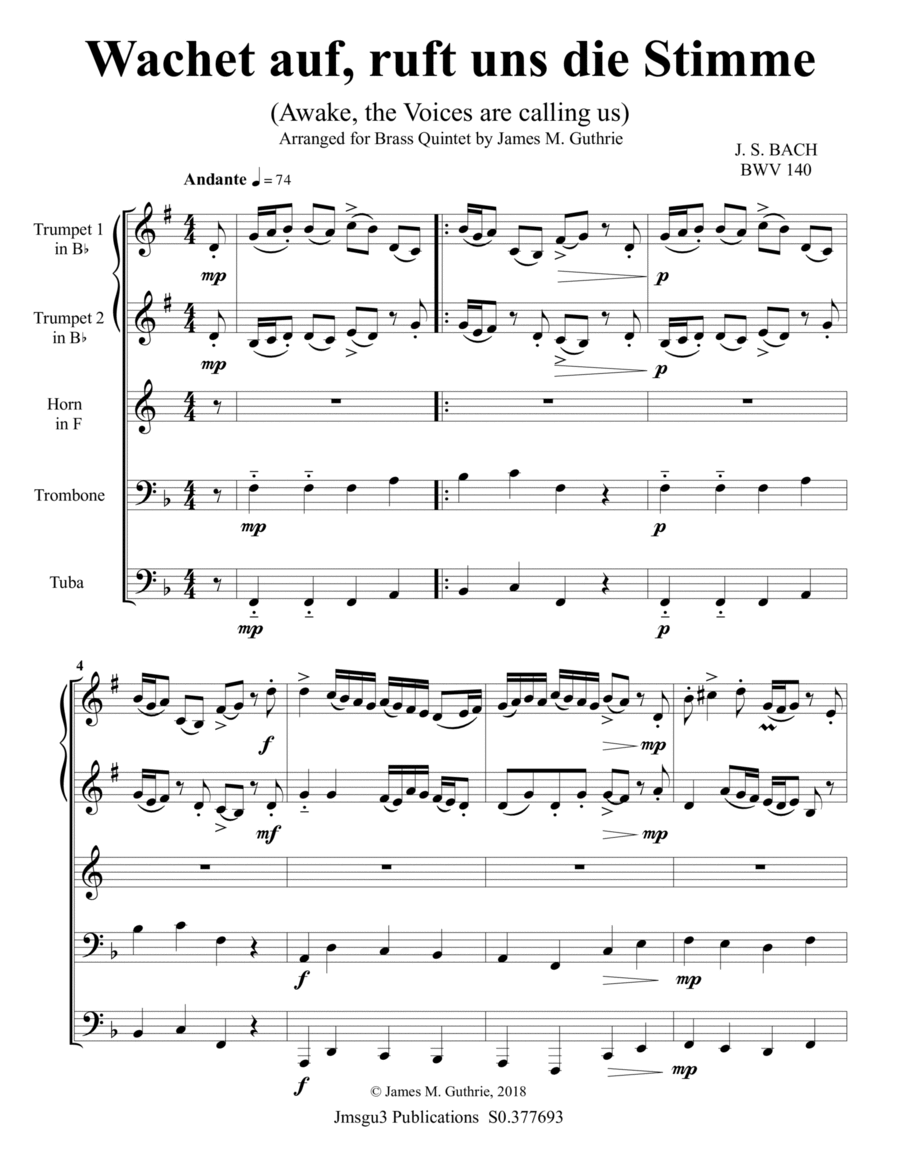
Level 3 - Digital Download SKU: A0.549857 Composed by Johann Sebastian Bach. Arranged by James M. Guthrie, ASCAP. Baroque,Easter,Sacred,Wedding. 17 pages. Jmsgu3 #3556935. Published by jmsgu3 (A0.549857). Wachet auf, ruft uns die Stimme (Awake, the Voice is calling us) from Cantata BWV 140. Program this for church services during Easter or as a recital encore. Also great for Weddings. Wachet auf, ruft uns die Stimme (Awake, the Voice is calling us) also known as Sleepers Awake Bach composed his church cantata Wachet auf (BWV 140) as part of his second annual cantata cycle covering the entire church calendar. It is based on the hymn of the same name by Philipp Nicolai (1599). The hymn text covers the readings for the 27th Sunday after Trinity. Bach designed the cantata in seven movements, setting the stanzas in various forms. Among these forms are the chorale fantasia, the prelude, and a four-part chorale. He casts the new lyrics as recitatives – like the opera. Fourth Movement Bach writes the fourth movement, Zion hört die Wächter singen (Zion hears the guards singing), in the style of a chorale prelude with the chorale phrases performed as a strict cantus firmus. The phrases seem to enter at times erratically against the famous lyrical melody. The violins play this melody in unison as a foil against the cantus phrases. The violin melody is so independent and complete that when the cantus melody appears; it catches the listener off-guard. Bach later transcribed this movement for organ (BWV 645). This transcription became No. 1 of the Six Schübler Chorales. Bach Overview First, Johann Sebastian Bach may be the greatest composer in music history. Indeed, he was prolific. As a result, everyone has heard of his works. Furthermore, these works number well over a thousand. People are probably most familiar with instrumental works such as the Brandenburg Concertos and the Goldberg Variations. But, similarly famous are such noteworthy works as the Well-Tempered Clavier, the Musical Offering, and the Art of Fugue. His most famous vocal works seem to include the most noteworthy Mass in B Minor. Also, most notable are the St. John Passion and, indeed, the Christmas Oratorio.  History Bach came from a long line of musicians and, above all, composers. Consequently, he first of all pursued a career as a church organist. As a result, he gained employment in various Protestant churches in Germany. He worked as a court musician in Weimar and Köthen for a while. Here, he probably developed his organ style and, likewise, his chamber music style. Eventually, he gained an appointment as Cantor of St. Thomas in Leipzig. Here, he worked until difficulties with his employer ultimately drove him away. The King of Poland finally appointed him as court composer.  Style It seems like Bach created a fascinating new international style. He synthesized elements of the most noteworthy European music ideas into his unique style. This new style was probably his synthesis of European musical rhythm and form. Furthermore, he demonstrated a complete mastery of counterpoint and motivic development. His sense of harmonic organization probably propelled him to the top. Revival        Mendelssohn conducted a Bach revival in the nineteenth century. His effort probably helped to re-familiarize the public with the magnitude of Bach's works. During this period, scholars published many noteworthy Bach biographies. Moreover, Wolfgang Schmieder published the BWV (Bach Werke Verzeichnis). As a result, this is now the official catalog of his entire artistic output. The BWV number allows us to locate a work in the catalog. Sometimes scholars will use an S (Schmieder) as an abbreviation for BWV. Â