EUROPE
204 articles
USA
4 articles
DIGITAL
11 articles (à imprimer)
Partitions Digitales
Partitions à imprimer
11 partitions trouvées


Horn,Trombone,Trumpet,Tuba - Level 4 - Digital Download SKU: A0.1108344 Composed by Wolfgang Amadeus Mozart. Arranged by Ray Thompson. Classical,Religious,Sacred. 11 pages. RayThompsonMusic #710984. Published by RayThompsonMusic (A0.1108344). Arranged standard brass quintet. Transposed from A minor down to G minor to suit brass instrumentation The Requiem in D minor, K. 626, is a requiem mass by Wolfgang Amadeus Mozart (1756–1791). Mozart composed part of the Requiem in Vienna in late 1791, but it was unfinished at his death on 5 December the same year. A completed version dated 1792 by Franz Xaver Süssmayr was delivered to Count Franz von Walsegg, who commissioned the piece for a requiem service on 14 February 1792 to commemorate the first anniversary of the death of his wife Anna at the age of 20 on 14 February 1791. This is my arrangement of No.5 Confutatis (From the accursed).It begins with a rhythmic and dynamic sequence of strong contrasts and surprising harmonic turns on tuba and horn the tenors and basses (Trumpets and trombone) burst into a forte vision of the infernal, on a dotted rhythm. The accompaniment then ceases , and trumpet 1 and tbn enter softly and sotto voce, (Voca me cum benedictis ()Call upon me with the blessed) with an arpeggiated accompaniment on horn and trumpet 2. Finally, in the following stanza (Oro supplex et acclinis), there is a striking modulation from G minor to Gb minor. This music suits the brass quintet. Section III of the requiem is titled “Sequenz†(sequentia or sequence). It is made up of the following pieces I have arrangements of all of them, for varying types of ensemble * Dies irae * Tuba mirum * Rex tremendae * Recordare * Confutatis * Lacrymosa. I have also arranged Mozarts Motet “Ave Verum Corpus†K618.
Mozart: Requiem in D minor K626 III.Sequenz No.5 Confutatis Maledictus - brass quintet
Quintette de Cuivres: 2 trompettes, Cor, trombone, tuba

$4.95 4.17 € Quintette de Cuivres: 2 trompettes, Cor, trombone, tuba PDF SheetMusicPlus

Horn,Trombone,Trumpet,Tuba - Level 3 - Digital Download SKU: A0.1126280 Composed by Frederic Chopin(1810-1849). Arranged by Joseph Pugh. Baroque,Chamber,Classical. 6 pages. Joseph Pugh #726983. Published by Joseph Pugh (A0.1126280). Frédéric Chopin wrote a number of preludes for piano solo. His cycle of 24 Preludes, Op. 28, covers all major and minor keys. In addition, Chopin wrote three other preludes: a prelude in C♯ minor, Op. 45; a piece in A♭ major from 1834; and an unfinished piece in E♭ minor. These are sometimes referred to as Nos. 25, 26, and 27, respectively. This No.28, a favorite for many, is here transcribed and arranged by Joseph Pugh for the Brass Quintet. Download today at a reduced price.
Prelude In E Minor For Brass
Quintette de Cuivres: 2 trompettes, Cor, trombone, tuba

$7.99 6.74 € Quintette de Cuivres: 2 trompettes, Cor, trombone, tuba PDF SheetMusicPlus

Brass Ensemble - Level 5 - Digital Download SKU: A0.792498 Composed by Johann Sebastian Bach. Arranged by Ralph Sauer. Baroque,Classical,Renaissance. Score and parts. 8 pages. Gordon Cherry #4988371. Published by Gordon Cherry (A0.792498). This chorale was published with the first edition of The Art of Fugue. Said to have been composed on his deathbed and dictated to a student, it is a fitting conclusion to Bach’s great, unfinished work. The three lower voices weave contrapuntal lines based on the chorale melody, and the trumpets sound the chorale melody in the top voice four times before the harmonically rich conclusion. About 5 minutes in length.
Chorale "Vor deinen Thron tret’ ich hiermit" (Before Thy Throne I Stand) for Brass Quintet
Quintette de Cuivres: 2 trompettes, Cor, trombone, tuba

$17.50 14.75 € Quintette de Cuivres: 2 trompettes, Cor, trombone, tuba PDF SheetMusicPlus

Horn,Trombone,Trumpet,Tuba - Level 4 - Digital Download SKU: A0.1109240 Composed by Wolfgang Amadeus Mozart. Arranged by Ray Thompson. Classical,Religious,Sacred. 10 pages. RayThompsonMusic #711789. Published by RayThompsonMusic (A0.1109240). Arranged standard brass quintet. The Requiem in D minor, K. 626, is a requiem mass by Wolfgang Amadeus Mozart (1756–1791). Mozart composed part of the Requiem in Vienna in late 1791, but it was unfinished at his death on 5 December the same year. A completed version dated 1792 by Franz Xaver Süssmayr was delivered to Count Franz von Walsegg, who commissioned the piece for a requiem service on 14 February 1792 to commemorate the first anniversary of the death of his wife Anna at the age of 20 on 14 February 1791. This is no 1 of the Sequenz Dies irae The Dies irae (Day of Wrath) opens with a show of orchestral and choral might A rising chromatic scurry of sixteenth-notes leads into a chromatically rising harmonic progression with the chorus singing Quantus tremor est futurus (what trembling there will be in reference to the Last Judgment). This material is repeated with harmonic development before the texture suddenly drops to a trembling unison figure evocatively painting the Quantus tremor text. It suits the brass quintet. Interesting parts for every player. . Mozart Section III of the requiem is titled “Sequenz†(sequentia or sequence). It is made up of the following pieces I have arrangements of all of them, for varying types of ensemble * Dies irae * Tuba mirum * Rex tremendae * Recordare * Confutatis * Lacrymosa I have also arranged Mozarts Motet “Ave Verum Corpus†K618.
Mozart: Requiem in D minor K626 III.Sequenz No.1 Dies irae - brass quintet
Quintette de Cuivres: 2 trompettes, Cor, trombone, tuba

$4.95 4.17 € Quintette de Cuivres: 2 trompettes, Cor, trombone, tuba PDF SheetMusicPlus

Brass Ensemble - Level 5 - Digital Download SKU: A0.785279 Composed by Gustav Mahler. Arranged by M. Zavoski. 20th Century,Romantic Period. Score and parts. 80 pages. Dorm40music.com #2094309. Published by dorm40music.com (A0.785279). Mahler's 10th symphony was left unfinished at his death in 1911. All five movements were completed in short-score with memos regarding instrumentation written in the margins. However, Mahler constantly revised his works so no one can be certain what the 10th would have been like if it was completed. The most performed orchestral version was written by Deryck Cooke. This version of the 2nd movement Scherzo is arranged for brass quintet. It is very difficult but makes for an excellent concert piece.
Symphonie No. 10
Quintette de Cuivres: 2 trompettes, Cor, trombone, tuba

$60.00 50.58 € Quintette de Cuivres: 2 trompettes, Cor, trombone, tuba PDF SheetMusicPlus

Brass Quintet - Level 2 - Digital Download SKU: A0.1287967 Composed by Wolfgang Amadeus Mozart. Arranged by Ander. Christian,Classical,Easter,Religious. 8 pages. Woods Only, Arrangements #879009. Published by Woods Only, Arrangements (A0.1287967). Introducing the sheet music for Lacrymosa from the Requiem Mass (Missa pro defunctis), K. 626, by Wolfgang Amadeus Mozart, for Brass Quintet. This sheet music maintains the entire original structure of the work, without reductions in duration and the like, with only the reduction of the ensemble being made. This arrangement is intended for performance groups that already have experience in musical performance, but can also be used as teaching material for music students, and can be used in academic recitals, concerts and ceremonies, catering to various groups of varied tastes. The Requiem in D minor (K. 626) is a requiem mass by Austrian composer Wolfgang Amadeus Mozart from 17911. Mozart composed part of the Requiem in Vienna in late 1791 but it was unfinished at his death on December 5th of the same year. This sheet music is a unique opportunity to experience Mozart’s genius in an arrangement for quintet.
Lacrymosa by Mozart for Brass Quintet
Quintette de Cuivres: 2 trompettes, Cor, trombone, tuba

$9.99 8.42 € Quintette de Cuivres: 2 trompettes, Cor, trombone, tuba PDF SheetMusicPlus

Horn,Trombone,Trumpet,Tuba - Level 4 - Digital Download SKU: A0.1110352 Composed by Wolfgang Amadeus Mozart. Arranged by Ray Thompson. Classical,Religious,Sacred. 21 pages. RayThompsonMusic #712690. Published by RayThompsonMusic (A0.1110352). Arranged standard brass quintet. Alt alto hn in Eb provided for Horn, and Euphonium in Treble Clef for trombone. The music has been spread throughout, to avoid a constant tutti! Using A euphonium instead of a trombone will give a smoother sound! The Requiem in D minor, K. 626, is a requiem mass by Wolfgang Amadeus Mozart (1756–1791). Mozart composed part of the Requiem in Vienna in late 1791, but it was unfinished at his death on 5 December the same year. A completed version dated 1792 by Franz Xaver Süssmayr was delivered to Count Franz von Walsegg, who commissioned the piece for a requiem service on 14 February 1792 to commemorate the first anniversary of the death of his wife Anna at the age of 20 on 14 February 1791. This is no 4 of the Sequenz Recordare At 130 measures, the Recordare (Remember) is the work's longest movement, as well as the first in triple meter the movement is a setting of no fewer than seven stanzas of the Dies irae. The form of this piece is somewhat similar to sonata form, with an exposition around two themes (mm. 1–37), a development of two themes (mm. 38–92) and a recapitulation (mm. 93–98). It suits the brass quintet. Section III of the requiem is titled “Sequenz†(sequentia or sequence). It is made up of the following pieces I have arrangements of all of them, for varying types of ensemble * Dies irae * Tuba mirum * Rex tremendae * Recordare * Confutatis * Lacrymosa. I have also arranged Mozarts Motet “Ave Verum Corpus†K618.
Mozart: Requiem in D Minor K626 III.Sequenz No.4 Recordare - brass quintet
Quintette de Cuivres: 2 trompettes, Cor, trombone, tuba

$4.95 4.17 € Quintette de Cuivres: 2 trompettes, Cor, trombone, tuba PDF SheetMusicPlus

Brass Ensemble - Level 5 - Digital Download SKU: A0.707842 Composed by Johann Sebastian Bach. Arranged by Gordon Cherry. Baroque,Classical,Renaissance. Score and parts. 22 pages. Gordon Cherry #4988139. Published by Gordon Cherry (A0.707842). Bach’s Art of Fugue represents a pinnacle of artistic genius. Each of the 14 fugues and canons is a musical miracle using a variation of a single subject from the initial fugue 1. Written in the last years of his life, the final fugue is unfinished. Contrapunctus VI is in four parts and written in Stylo Francese. This style has little flourishes of scale-like 32nd notes ascending and desending along with dotted rhythms, together called the French style. The work is suitable for advanced performers and is about 5-6 minutes in length.  Parts are for 2 Trumpets in C (B-flat parts are provided), Horn, Trombone and Tuba (or Bass Trombone).
Contrapunctus VI BWV 1080 for Brass Quintet
Quintette de Cuivres: 2 trompettes, Cor, trombone, tuba

$25.00 21.08 € Quintette de Cuivres: 2 trompettes, Cor, trombone, tuba PDF SheetMusicPlus

Brass Quintet - Level 3 - Digital Download SKU: A0.1372446 By Solo Trumpet Player. By Franz Schubert. Arranged by ed. W Beeler & orchestration by Peet du Toit. Classical. 4 pages. Peet du Toit #956746. Published by Peet du Toit (A0.1372446). Franz Peter Schubert (German: [fÊants ˈpeËtÉ ËˆÊƒuËbÉt]; 31 January 1797 – 19 November 1828) was an Austrian composer of the late Classical and early Romantic eras. Despite his short life, Schubert left behind a vast oeuvre, including more than 600 secular vocal works (mainly lieder), seven complete symphonies, sacred music, operas, incidental music, and a large body of piano and chamber music. His major works include the art songs Erlkönig, Gretchen am Spinnrade, Ave Maria; the Trout Quintet, the unfinished Symphony No. 8 in B minor, the Great Symphony No. 9 in C major, the String Quartet No. 14 Death and the Maiden, a String Quintet, the two sets of Impromptus for solo piano, the three last piano sonatas, the Fantasia in F minor for piano four hands, the opera Fierrabras, the incidental music to the play Rosamunde, and the song cycles Die schöne Müllerin, Winterreise and Schwanengesang.Born in the Himmelpfortgrund suburb of Vienna, Schubert showed uncommon gifts for music from an early age. His father gave him his first violin lessons and his elder brother gave him piano lessons, but Schubert soon exceeded their abilities. In 1808, at the age of eleven, he became a pupil at the Stadtkonvikt school, where he became acquainted with the orchestral music of Joseph Haydn, Wolfgang Amadeus Mozart, and Ludwig van Beethoven. He left the Stadtkonvikt at the end of 1813 and returned home to live with his father, where he began studying to become a schoolteacher. Despite this, he continued his studies in composition with Antonio Salieri and still composed prolifically. In 1821, Schubert was admitted to the Gesellschaft der Musikfreunde as a performing member, which helped establish his name among the Viennese citizenry. He gave a concert of his works to critical acclaim in March 1828, the only time he did so in his career. He died eight months later at the age of 31, the cause officially attributed to typhoid fever, but believed by some historians to be syphilis.Appreciation of Schubert's music while he was alive was limited to a relatively small circle of admirers in Vienna, but interest in his work increased greatly in the decades following his death. Felix Mendelssohn, Robert Schumann, Franz Liszt, Johannes Brahms and other 19th-century composers discovered and championed his works. Today, Schubert is ranked among the greatest composers in the history of Western classical music and his work continues to be admired and widely performed.
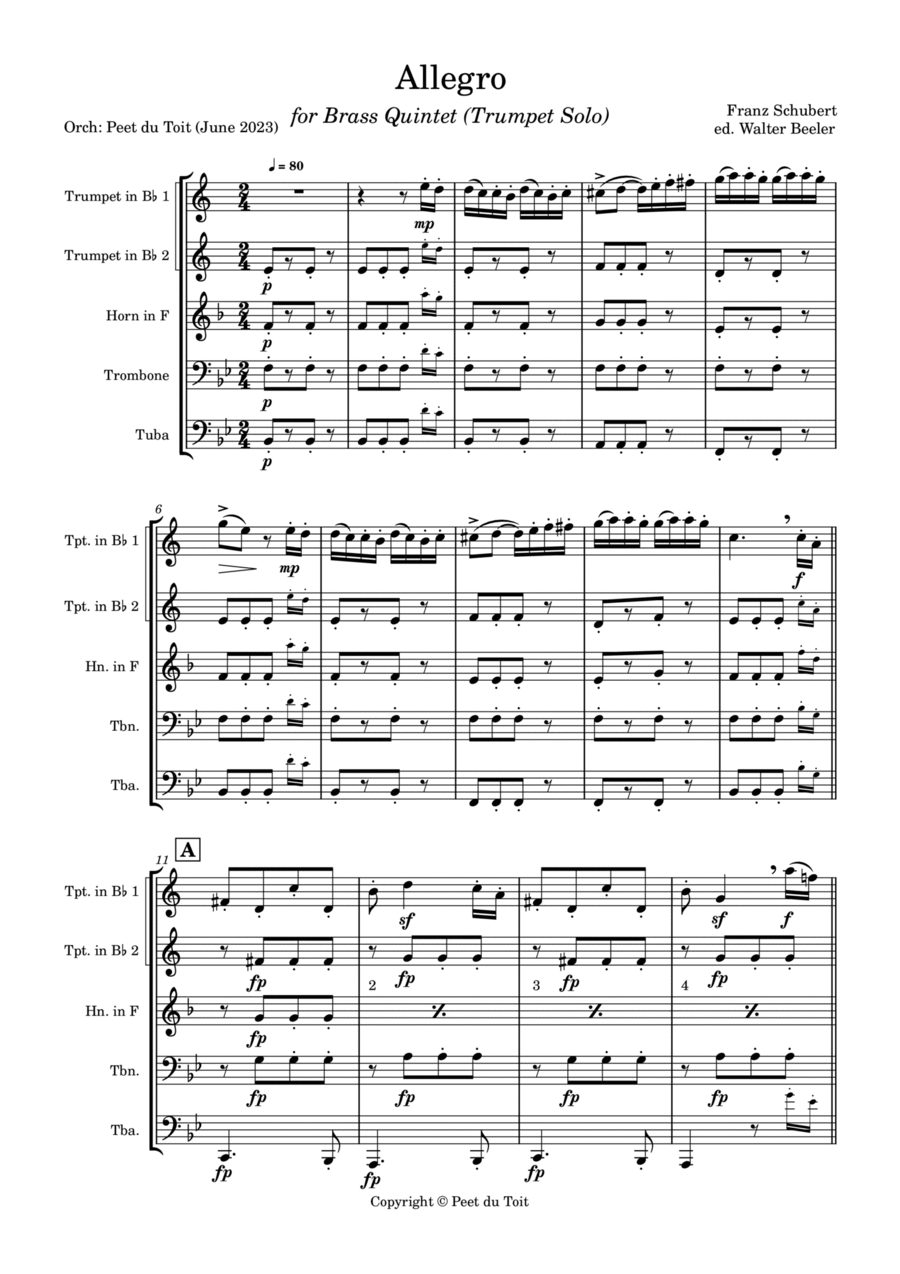
Allegro - Score Only
Quintette de Cuivres: 2 trompettes, Cor, trombone, tuba
Solo Trumpet Player
$17.00 14.33 € Quintette de Cuivres: 2 trompettes, Cor, trombone, tuba PDF SheetMusicPlus

Brass Ensemble - Level 5 - Digital Download SKU: A0.792497 Composed by Johann Sebastian Bach. Arranged by Ralph Sauer. Baroque,Classical,Renaissance. Score and parts. 27 pages. Gordon Cherry #4988365. Published by Gordon Cherry (A0.792497). J. S. Bach’s massive work, The Art of Fugue, is a summation of his powers as a composer of contrapuntal music. Each fugue is a masterpiece in its own right. Number 15 is an unfinished four-voice, quadruple fugue. Only the first three subjects are introduced, the third being a chromatic subject built from the letters of Bach’s name-B (B-flat), A, C, H (B-natural). Just at the point where all three subjects are combined, the manuscript breaks off, and C. P. E. Bach wrote in the score that the composer has died. Bach clearly intended that the original Art of Fugue theme was to be the final subject and all four themes would combine in a glorious climax. Whether he intended to finish the work or leave it up to others to complete is conjecture. About 8 minutes in length.
Contrapunctus XV from "The Art of Fugue" for Brass Quintet
Quintette de Cuivres: 2 trompettes, Cor, trombone, tuba

$22.50 18.97 € Quintette de Cuivres: 2 trompettes, Cor, trombone, tuba PDF SheetMusicPlus


Partitions Gratuites
Acheter des Partitions Musicales
Acheter des Partitions Digitales à Imprimer
Acheter des Instruments de Musique

© 2000 - 2026

Accueil - Version intégrale





