EUROPE
52 articles
USA
3 articles
DIGITAL
10 articles (à imprimer)
Partitions Digitales
Partitions à imprimer
10 partitions trouvées


Easy Guitar (with TAB) - Level 1 - Digital Download SKU: A0.1163675 Composed by Brian Streckfus. Instructional,Singer/Songwriter. Tablature. 1 pages. Brian Streckfus #764016. Published by Brian Streckfus (A0.1163675). This study/etude makes modes a much more fun and practical exploration, rather than feeling like abstract theory. Also, since all seven are used in the key of C major, this study/etude allows someone to quickly memorize how modes work. The modes are diffucult to memorize because of their foreign names. This makes this piece have great replay value since it will take a few run throughs to memorize them. Tips:1. Each mode has one special note. It is a great exercise to figure them out. For example, the B natural in D dorian sections is the special note. This B natural should have been a Bb in the key of regular D minor.2. This piece is a good example of what I like to call half step gravity. For example, in measure 12, the B has more gravity to go to C than A because C is closer. B to C would be a half step. B to A would be a whole step.3. This piece is a good example of bass notes setting the tone and vibe. I invite performers to change the bass notes to see what I mean. For example, a constant C bass note would lead to a problem free sound, whereas a constant B bass note leads to a more uncomfortable metal music sound.4. This piece is a good example of how we hear a chord from the bass note on up. For example, an E minor chord with a B in the bass might actually function more like a B7 with suspended notes.5. This piece is a good example of a perfect authentic cadence (PAC) with a final A minor chord tonic (home) chord with an A in the bass and soprano voices.
Study: 7 Modes
Guitare notes et tablatures

$1.99 1.68 € Guitare notes et tablatures PDF SheetMusicPlus

Guitar - Level 1 - Digital Download SKU: A0.1175289 Composed by Brian Streckfus. Instructional. Guitar Tab. 5 pages. Brian Streckfus #774500. Published by Brian Streckfus (A0.1175289). Pages: 5 (84 chords to name)Objective:Instead of learning chords one by one, you instead learn how to build chords yourself. Also, this mindset helps in composing, because instead of seeing things as wrong chord versus correct chord, you simply see it as every harmony as a name. Like many things in life, theoritcal concepts can allow you to formulate thousands of outcomes in a single day. Tips:1. You start counting from 0 for this exercise if that makes any sense. Avoid the common fence post error by overcounting by 1. Other times you start counting from 1 in music is when talking about scale degrees. What is the distance from C to E? C(0) C#(1) D(2) D#(3) E(4).2. Use the chromatic scale at the top to help in counting.3. E# = F...Fb = E...B# = C...Cb = B...In otherwords, don't let strange enharmonics confuse you. Picture the black key sometimes missing between white keys on a piano in your mind if it helps. 4. Even though enharmonics like E# can seem confusing, they can actually add clarity sometimes because they cause the chord to stack perfectly in the sheet music and letter names. A# C# E#...versus...A# C# F...Sure, F is easier to understand in a part, but it actually makes the harmony harder to understand because not it looks like it isn't 3rds, even though it is.5. I included tab just to make this worksheet a little bit more interesting; however, the guitar chords that result are NOT practical. Voicings of common guitar chords are much more spread out, and often contain more duplicate letter names. Practical guitar chords is sort of a different conversation. I sort of did this intentionally to prove that perfectly stacked voicings do not work well on guitar. C E G Bb perfectly in order in harmony, sounds like it would be easy on guitar, but it is not.6. To make this more practical on guitar, I recommend building the chords yourself by simply knowing letter names well on guitar. The next time something asks for G major, don't just play a common voicing, actually find G B D randomly on the guitar neck. 7. Often the fifth of a chord is removed since it is the least important to invoking the flavor of the chord. This is especially true on guitar because we quickly run out of fingers and strings.8. The nature of the piano lends pianists to constantly seeing these distances on a linear plane. Conversely, guitar is a very murky instrument since the real distances of pitches is counterintuitive to arbitrary (usually) fret numbers! That is why many guitarists would benefit from thinking this way, instead of thinking of chords simply as shapes (which is also important for different reasons). In other words, try to build a chord on one string on guitar. It is impractical, but the half step distances required for chords will make much more sense.To Do:1. Slight differences in how the sheet look need to be made similiar.2. Remove green line.
Triad Chord Worksheet
Guitare notes et tablatures

$1.99 1.68 € Guitare notes et tablatures PDF SheetMusicPlus

Guitar - Level 3 - Digital Download SKU: A0.1356984 Composed by Fernando Sor. Arranged by Brian Streckfus. 19th Century,Classical,Instructional,Romantic Period. Guitar Tab. 3 pages. Brian Streckfus #941611. Published by Brian Streckfus (A0.1356984). Pages: 3Key: B minorFeatures:1. Tablature Added2. Blank version for starting from scratch3. Chord Nomenclature added 4. Dynamics added 5. Fingerings Added 6. Slides/Guide fingers added 7. Modern Fonts Tips: 1. Realizing that you are in position two most of the time helps. In the key of B minor, fret 1s aren't supposed to happen as they would be out of key. This piece does have key changes, so some fret 1s do happen.2. Nearly all measures are arpeggios, so it's best to summarize each measure as a chord shape. If you read the music one note at a time, your playing will most likely sound choppy. It is possible to get the entire measure ready on beat one.3. Similiar to the last point, there are a lot of bars in this piece. Realizing when you are barring and not barring will be helpful.4. I try to strategically leave out fingerings. Too many fingerings and the piece look overly intimidating. Often, if I leave out a fingering, it's because it is a counter-intuitive fingering to use, and therefor the student should pencil it in themselves as a strong reminder of a difficult moment. I also leave out fingerings if I strongly sense there are multiple correct ways of playing a passage.
Etude No 22 Op 35
Guitare notes et tablatures

$1.99 1.68 € Guitare notes et tablatures PDF SheetMusicPlus

Guitar - Level 3 - Digital Download SKU: A0.1177383 By Frederic Chopin. By FreÌdeÌric Chopin. Arranged by Brian Streckfus. 19th Century,Classical,Contemporary,Instructional,Romantic Period. Guitar Tab. 6 pages. Brian Streckfus #776814. Published by Brian Streckfus (A0.1177383). Key: Changed from B minor to A minorCapo: 2 (If you want original key, but I wasn't a fan of capo 2; it felt like there was no bass notes.)1. Arranged for guitar. 2. Piano pedal markings removed 3. Phrase markings removed and opted for commas. 4. Re-harmonized 5. Key changed from B minor to A minor. 6. Slurs 7. Left hand fingers 8. Tablature9. Harmonics added when advantageous, but playing the regular note would work as well.10. Piano pedal markings removed and replaced with commas. It's a flaw of sheet music that slurs, ties, and phrase markings are all the same symbol, and having all three happening can clutter a score.Compromises This may sound obvious, but of course I had to make some alterations to make this flow properly on guitar. Many of the original chord inversions on the piano were not kept. However, many harmonies were kept intact as far as following the chord nomenclature name. Measure 50 was originally an A minor chord, the irony is that the F major suprise is an homage to Chopin anyways, suprised he didn't opt for it. To be honest, I don't like how there is a perfect authentic cadence in measure 50. I think modern audiences would want to clap too badly, so I believe that ending needs to be slightly messed up to propel the music forward, and give a sense that there is still a problem. The other chord that was changed was an E7b9 to a Ddim7 in measure 78. If you know your theory well, you'll realize these chords have the same exact function and nearly the same notes, it's just that Ddim7 flowed a bit better on guitar. I'd rather have guitarists play the rhythms correctly and with musicality, than have guitarist clunkily go though overly large chords in order to mantain historical accuracy.  Measure 15 was hard to keep the original chord intact. A Bb/D with a G in the melody as a suspension sounds more like a g minor chord. That is cliche Chopinesque neopolitan moment so the Bb is crucial to mantain. Having some rough sort of Bbmaj7 or G minor chord while mantaining the melody seemed to sound the best even though the name of the chord might have gotten a little off. I tried chord charts, but they seemed messier than what it was worth. I also could have the denser tablature in the sheet music, but that does make it look 10x more intimidating. So this version is unique in that the tablature is my denser arrangement, whereas the sheet music would allow someone to quickly make a new arrangement. I like this ethos because most guitarists are likely to be much better at playing chord quickly when they don't have to have an exact voicing. This makes this arrangement easier to further perfect since I am naming the harmonies, which often isn't done in classical music.BackstoryThis is one of my favorite pieces, and also my favorite composer. I feel classical guitar repertoire is lacking easily playable music in the romantic style. Often, if it is romantic guitar music, it is extemely difficult and therefore only a select few can enjoy performing it. Also, I sometimes get my hopes up to find a romantic guitar composer, but then after listening, there's nothing quite like Chopin. Obviously, you will have to have some chops to play this since it's one of the most ambitious undertakings a guitarist could take, but it's also not so hard that you have to be train for a decade because I changed the key.
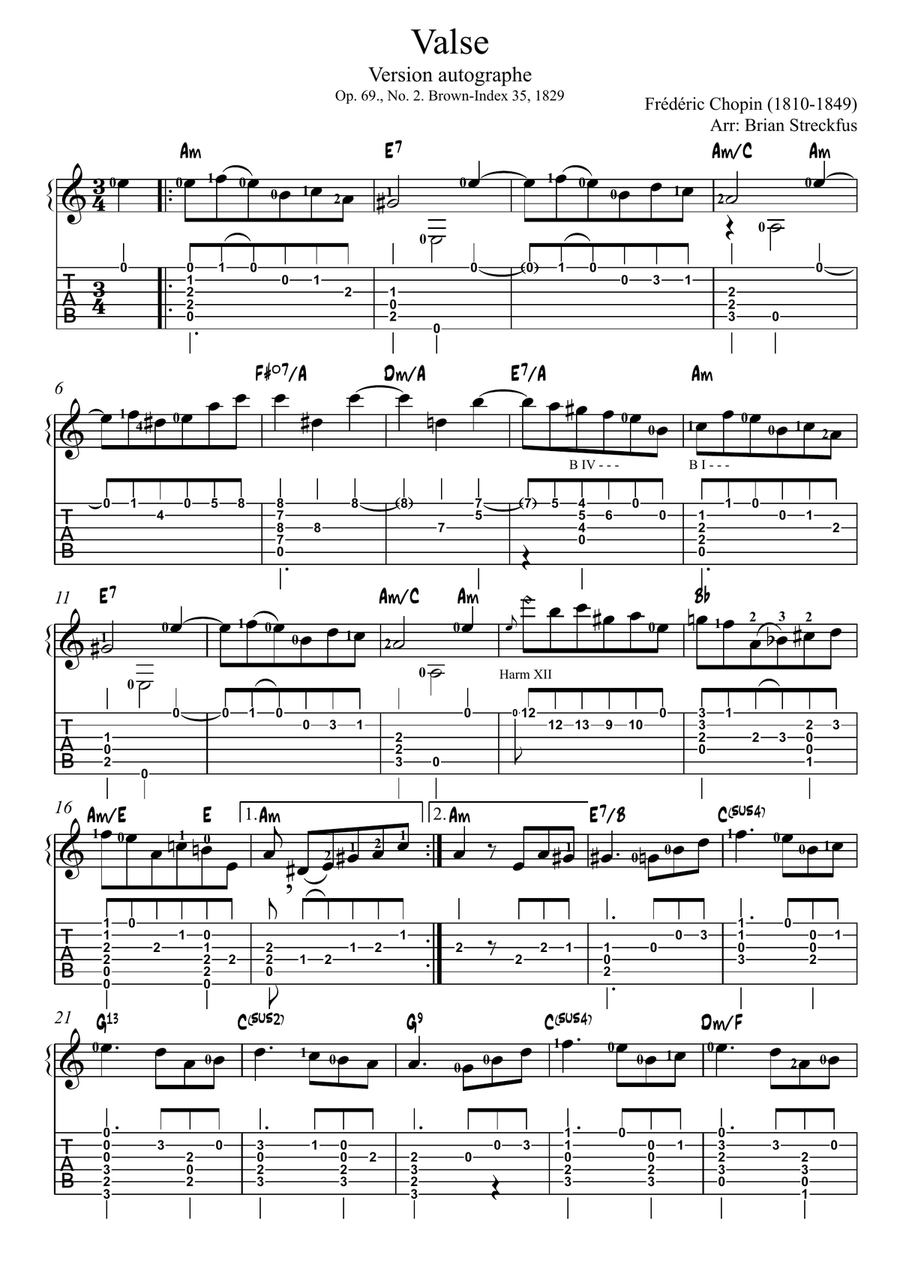
Waltz Op 69 No 2 (Arranged for Guitar)
Guitare notes et tablatures
Frederic Chopin
$1.99 1.68 € Guitare notes et tablatures PDF SheetMusicPlus

Easy Guitar (with TAB) - Level 2 - Digital Download SKU: A0.1175935 Composed by Phil Garrod, Reed Hays, and Scott Schreer. Arranged by Brian Streckfus. Film/TV,Rock. Tablature. 1 pages. Brian Streckfus #776060. Published by Brian Streckfus (A0.1175935). Key: D minorTuning: Drop D TuningPages: 1This arrangement has a heavy metal vibe to it because of the key, tuning, dissonance and making it idiomatic for guitar.Tips:1. Perhaps the constantly occuring D bass notes could be called a pedal. This term originates from organs that have pedals for low pitches. So the A7/D is bizarre, but it isn't so strange that a classical composer wouldn't use it. Bach does this often. 2. Use the chord charts to aid in improvising more repeats. Since this is meant for a commercial, it is breif. 3. Be careful not to accidently bump into the second thinnest string on guitar: a B. The key of d minor has a Bb, so in this case, that string is a hot lava string.4. The final ending would be called a Perfect Authentic Cadence. This is because for the final chord, the soprano and bass are the home note (D), a.k.a. tonic. 5. Guitar position text explains where your index finger should be, NOT what fret is about to come next.6. The A+11 chord can be easier to understand by calling it a Cadential 6/4 chord. This is a classical music cliche and composition trick. The trick is that a home chord (tonic) with the 5th note in the key in the bass, actually sounds more like an away chord (dominant) with a lot of suspended notes on it. To be even vaguer; it's a common strategy to add a lot of dissonance to the last chord in the chord progression.
Nfl On Fox Theme
Guitare notes et tablatures

$4.99 4.21 € Guitare notes et tablatures PDF SheetMusicPlus

Guitar - Level 4 - Digital Download SKU: A0.1278738 Composed by FreÌdeÌric Chopin. Arranged by Brian Streckfus. 19th Century,Classical,Instructional,Romantic Period. Guitar Tab. 7 pages. Brian Streckfus #870305. Published by Brian Streckfus (A0.1278738). Pages: 7Key: Transposed from G minor to A minor (whole step down tuning)I included both the tablature version and just the sheet music version so that this is more inclusive. Just be careful of your printers settings if you don't want to print the whole pdf!Chopin is my favorite composer and this is great piece. It is ambitious to arrange and perform this on guitar. Compromises have to be constantly made, and so of course some bass clef notes or duplicate letter names have been removed. The B section is especially difficult since all notes might be possible if it was played an octave up, but then the mood and tone completely changes. 1. Arranged for guitar. 2. Slurs added 3. Glissandos added. 4. Composer indications added. 5. Guitar tablature added. 6. Chord nomenclature added.7. I transposed the key to make it more idiomatic for guitar.
Nocturne Op 37 No 1 (Transposed from G minor to A minor)
Guitare notes et tablatures

$1.99 1.68 € Guitare notes et tablatures PDF SheetMusicPlus

Guitar - Level 2 - Digital Download SKU: A0.1150935 Composed by Matteo Carcassi. Arranged by Brian Streckfus. Classical. Guitar Tab. 4 pages. Brian Streckfus #751121. Published by Brian Streckfus (A0.1150935). Important: This include two versions, a heavily notated version, and a blank version.1. Added tablature. 2. Fingerings added (Counterintuitive fingerings are left blank for the performer to realize first hand that it will be an awkard passage).3. Chord nomenclature added4. Fonts made larger and more appealing5. Position and Bar markings addedTips:1. Measure 13 is a good example of melodic minor as scale degrees 6 and 7 are rasied by a half step on an upward scale run, and then lowered on the way back down.2. Measures 23-27 is an example of a sequence. I recommend making the catchiness and repetition as obvious as possible as the audience is expecting the sequence to complete. For example, if there is a slur happening on a certain beat, I'll make sure it is mantained for every repetition, which is why measure 20 is more difficult with a fretted B instead of an open string. It's more work, but it sounds better to my ears.3. There is a certain order that the right hand fingers should be following depending on if you are going to thicker or thinner strings. Since this is an etude designed to get a player used to classical guitar technique, it made sense to show the a novice finger-style player which right hand fingers to use and when. Example: 2nd thinnest to thinnest string...Should be i m...not m iTo Do:1. Theoretical explanations in the score? Especially on the heavily notated version?
Etude No. 1
Guitare notes et tablatures

$1.99 1.68 € Guitare notes et tablatures PDF SheetMusicPlus


Partitions Gratuites
Acheter des Partitions Musicales
Acheter des Partitions Digitales à Imprimer
Acheter des Instruments de Musique

© 2000 - 2026

Accueil - Version intégrale





