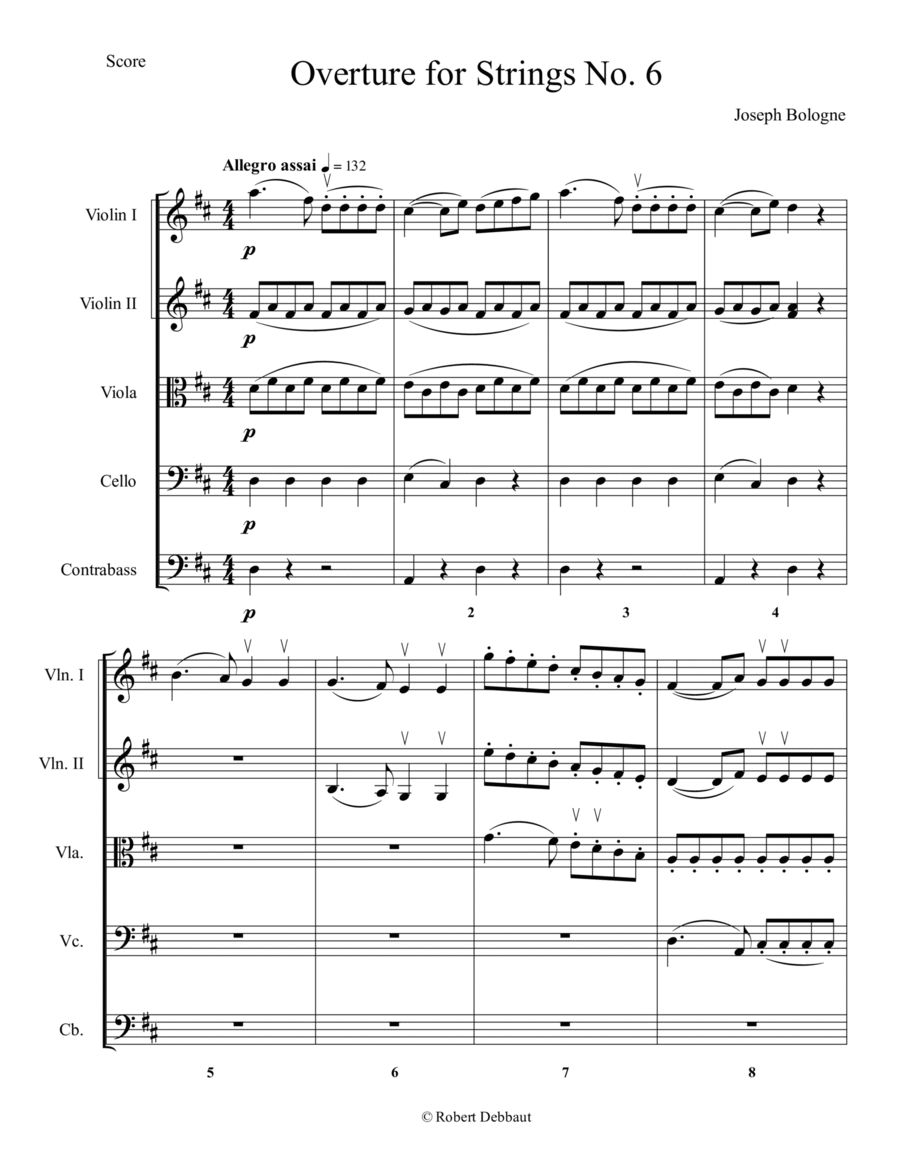
String Orchestra - Level 4 - Digital Download SKU: A0.1183537 Composed by Joseph Bologne, Chevalier de St. Georges. Arranged by Robert Debbaut. Classical,Contest,Festival,Historic,Multicultural,World. 57 pages. ROBERT DEBBAUT #783210. Published by ROBERT DEBBAUT (A0.1183537). How is it that one can be born a slave in French colonial Guadeloupe and rise to be among Paris’ musical giants, to become a colonel in the French Army as well as the frequent dinner guest of princes and potentates? The story of Joseph Bologne, Chevalier de Saint-Georges, is surely an interesting one, even the stuff of which movies are made.Joseph Bologne’s father, Georges Bologne de Saint-Georges was a French planter. Saint-Georges was the name of his plantation. He impregnated Anne, the Senegalese slave of his wife, who bore him a son in 1745. Uncharacteristic of many of these sort of relationships he acknowledged the child was his and gave him his family name. When he was seven Bologne’s father took him to Paris for his education, enrolling him in a boarding school. Two years later he and the child’s mother returned to France and set up housekeeping as a family in Paris’ Saint-Germain-des-Prés district.At age thirteen Joseph’s father enrolled him in the Royal Technical Academy of Fencing and Swordsmanship. He quickly became the finest swordsman in the academy, perhaps in all of Paris. Upon graduation he was made an Officer of the King’s Bodyguard and a chevalier (an honorary knighthood). He went on to serve tours of duty in the French Army during the Seven Years War (1756-1763) and later after the French Revolution, where he was Colonel and commander of an all-Black regiment of the Revolutionary Army. All this in spite of the fact that French law forbade him, a man of African heritage, to become a citizen, to retain his father’s royal title of “Gentleman of the King’s Chamber,� or to marry outside his class.There is limited information about Bologne’s musical training, but he was obviously so well-skilled that Italian violinist-composer Antonio Lolli (1725-1802) wrote two violin concertos for him and French composer François-Joseph Gossec (1734-1829) dedicated his set of String Trios, Op. 9 to Bologne. Lolli may have worked with him on violin technique and Gossec composition, but this may be apocryphal. Bologne played in Gossec’s orchestra, and was later both leader and conductor of the group.As a composer Joseph Bologne was quite prolific, composing six operas, fourteen violin concertos, four symphonies concertantes, and numerous chamber works and songs. His Six String Quartets, Op. 1, Nos. 1-6 date from 1770-1771 and were published by the Paris publishing house of Jean-Georges Sieber (1738-1822) in 1773 (There are a total of 18 quartets: Six Quartets “au goût du jour� [up-to-date] from 1779 and the Opus 14 set of six which date from 1785). The Opus 1 quartets are dedicated to Anne Louis Alexandre de Montmorency (1724-1812), 7th Prince of Robeck (Robecq) and Grand Duke of Spain.The Opus 1 quartets all display a similarity to the Italian opera overtures from earlier in the Eighteenth Century (often called “sinfonia�) in that they have an overall “A-B-A� form with the ‘A’ sections being robust allegros and all ‘B’ sections marked “rondo.� As such, in arranging them for string orchestra it seemed quite natural to rename them “overtures.� Certain liberties were taken by the arranger in order to maintain the integrity of the classic Rondo formula. All six have been arranged in this manner for string orchestra. They vary in length from twelve to almost twenty minutes. If you wish to obtain parts, write to debbaut@gmail.com and pay $42 via venmo or $40 via personal check and they will be sent to you in pdf format.