EUROPE
264 articles
USA
0 articles
DIGITAL
7 articles (à imprimer)
Partitions Digitales
Partitions à imprimer
7 partitions trouvées


String Orchestra - Level 3 - Digital Download SKU: A0.734370 Composed by George Bennard (1913) -Traditional Country Gospel. Arranged by Dennis Ruello. 20th Century,Easter,Praise & Worship,Sacred. Score and parts. 15 pages. Chicory Music #3478479. Published by Chicory Music (A0.734370). 2018 Chamber Music Contest Entry The Old Rugged Cross has been a country gospel favorite ever since it became the title song of Ernest Tubb's 1952 gospel album; it has been performed by some of the twentieth century's most important recording artists, including Andy Griffith, Anne Murray, Brad Paisley, Chet Atkins, John Berry, Floyd Cramer, George Jones, Eddy Arnold, Jim Reeves, Loretta Lynn, Ray Price, Ricky Van Shelton, Tennessee Ernie Ford, Rahsaan Roland Kirk, Roy Rogers and Dale Evans. The Oak Ridge Boys, The Statler Brothers, Vince Gill, Willie Nelson, Alan Jackson, George Beverly Shea and John Prine on the 2007 CD Standard Songs for Average People with Mac Wiseman. British television dramatist Dennis Potter used the gospel song prominently in several of his plays, most notably Pennies from Heaven (1978); and the song also played a major part in Gridlock (2007), an episode of the long-running sci-fi drama series Doctor Who. In early 2009, the song was covered by Johnny Cash and June Carter, Kevin Max, Mahalia Jackson, Merle Haggard, and Patsy Cline. Parts included for this arrangement are: Full Score, 1st and 2nd Violin, Viola, Cello and Contrabass. Performance time: approx. 2 min. 15 sec.
The Old Rugged Cross - String Quartet or Orchestra - Intermediate
Orchestre à Cordes

$14.99 13.02 € Orchestre à Cordes PDF SheetMusicPlus

String Orchestra - Level 3 - Digital Download SKU: A0.1416852 Composed by Oscar Hammerstein and Richard Rodgers. Arranged by Douglas R. Morrison. Broadway,Film/TV,Musical/Show,Pop. 19 pages. Douglas R. Morrison #998446. Published by Douglas R. Morrison (A0.1416852). A Rivendell String Orchestra Arrangement - The Pop Standards SeriesWhile the fourth musical collaboration of Richard Rodgers and Oscar Hammerstein II, The King and I (1951) has many wonderful numbers, one lyrical ballad stands out:  I Have Dreamed.  This beautiful melody was also prominently featured in Aaron Sorkin's 1995 film The American President during the State Dinner scene when widowed President Andrew Shepherd (Michael Douglas) dances with lobbyist Sydney Ellen Wade (Annette Bening).  A truely magical film moment![The audio sample begins at Letter B, measure 21]Like us on Facebook:  www.facebook.com/rivendellarrangements.
I Have Dreamed
Orchestre à Cordes

$49.99 43.41 € Orchestre à Cordes PDF SheetMusicPlus

String Orchestra - Level 4 - Digital Download SKU: A0.922638 Composed by Johann Strauss Jr. Arranged by Aaron Meier. Romantic Period,World. Score and parts. 1 pages. Aaron Meier #5792369. Published by Aaron Meier (A0.922638). Original by Johann Strauss II Reduction to String Orchestra by Aaron Meier Part: Viola True to the original work by Strauss, this reduction for string orchestra features the ornaments and mystical writing that defines Strauss' polkas. There are optional percussion parts to be added at the discretion of the ensemble, however even without percussion the ensemble will sound full (the percussion acts as an ornament). Difficulty: Intermediate-advanced - advanced (best-suited for advanced student ensembles) --- Performance Notes: • Approximate length: 3:30 minutes • 1st Violins: In m. 1, trill a half step from a Dâ™­ to a Dâ™®  • 2nd Violins:  - At m. 42, divide players by 3, with 2 players playing line A and the remaining player playing line B  - At m. 72-75, emphasize the Eâ™­ in the div. • Snare Drum: The buzz roll needs to be quieter than how it is played in the midi recording (*see YouTube link ↓) History: The Olga-Polka itself owed its creation to a Russian royal wedding which took place in St. Petersburg on 28 August 1857. On that day, amid accompanying splendour, the music-loving Grand Duke Michail Nikolaievich (1832-1909), youngest brother of Tsar Alexander II, married Princess Caecilie of Baden (1839-91), daughter of Archduke Leopold of Baden. Johann Strauss, who at that time was giving a summer season of concerts in nearby Pavlovsk, used the opportunity occasioned by the event to enhance his already enviable popularity with the Russian royal family and composed the Caecilien-Polka in honour of the lovely young bride. Indeed, it is clear from a letter which Johann wrote in late July 1857 to Carl Haslinger, his publisher in Vienna, that the new polka had been prepared well in advance of the wedding (the fair copy of the full orchestral score made for the publisher's engraver is dated 9 August) and was enjoying success even before the royal couple's official engagement on 16August 1857. Sometime after performing the Caecilien-Polka in Pavlovsk, Johann despatched the work to the Austrian capital where his brother Josef conducted its Viennese première, together with that of Johann's waltz Telegraphische Depeschen (op. 195, Volume 28), at his own benefit concert in the Volksgartenon Sunday 18 October 1857. The Wiener Allgemeine Theaterzeitung (16.10.1857) remarked that both works have caused a sensation in St. Petersburg and are truly genial Viennese sounds full of verve and melody. Since tradition demanded that the German Princess Caecilie adopt a Russian name - Olga Feodorovna - before her marriage, so Johann's Caecilien-Polka also underwent a change of identity. On 8 December 1857 Carl Haslinger announced the publication of Strauss's Olga-Polka, on the title page of which is the inscription: Dedicated to her Imperial Highness Grand Duchess Olga, née Princess of Baden. It was under this title, too, that Johann himself first conducted the work in Vienna at a concert in the Volksgarten on 1 November 1857, shortly after his return from Russia. Reporting on this event, the Wiener Allgemeine Theaterzeitung (3.11.1857) observed: The 'Olga-Polka' is a most delightful, fragrant musical bouquet, full of fine, gracious rhythms. [excerpted from NAXOS Records] Kemp, Peter. Program Notes - About this Recording. NAXOS, 1993, www.naxos.com/mainsite/blurbs_reviews.asp?item_code=8.223232&catNum=223232&filetype=About%20.......... Accessed 5 June 2020. Resources: • Visit
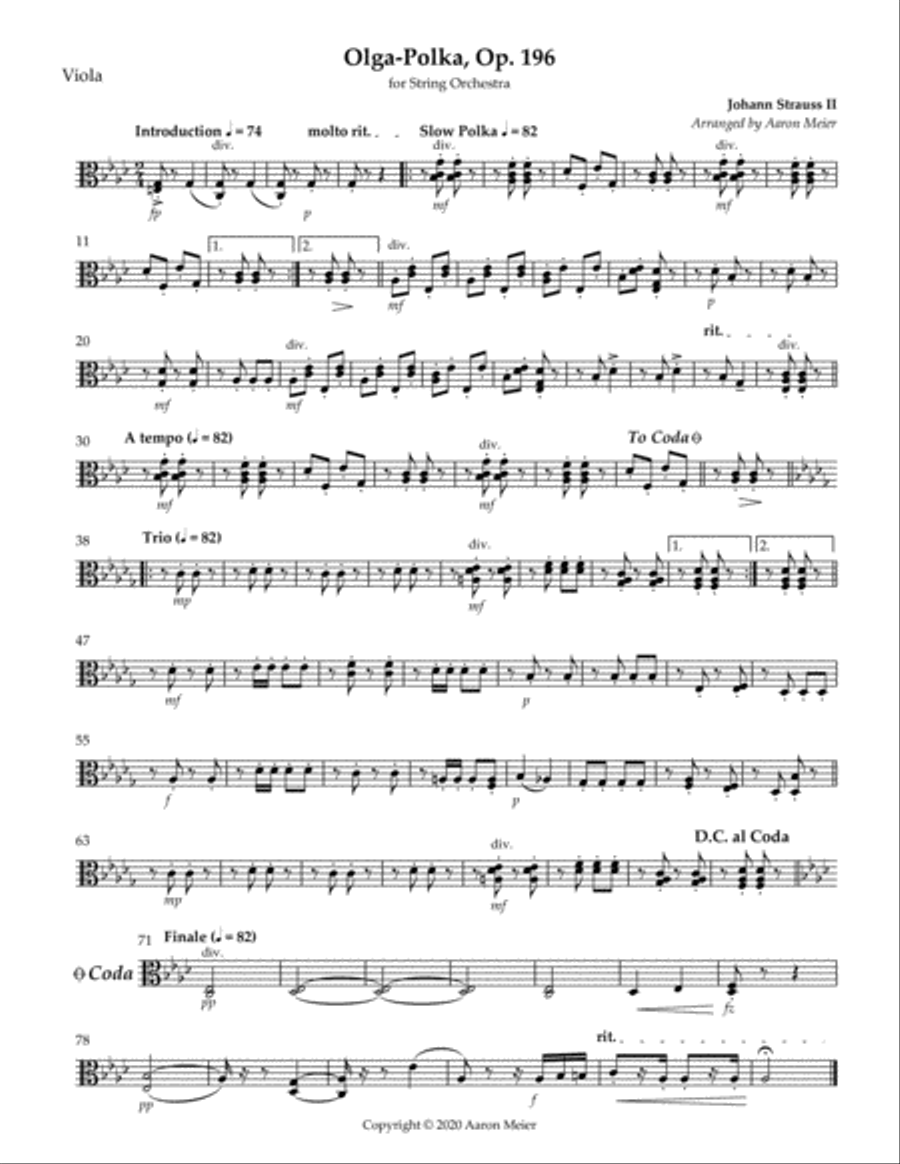
Olga-Polka, Op. 196 (arr. for string orchestra): Viola
Orchestre à Cordes

$3.99 3.46 € Orchestre à Cordes PDF SheetMusicPlus

String Orchestra - Level 4 - Digital Download SKU: A0.922637 Composed by Johann Strauss Jr. Arranged by Aaron Meier. Romantic Period,World. Score and parts. 1 pages. Aaron Meier #5792373. Published by Aaron Meier (A0.922637). Original by Johann Strauss II Reduction to String Orchestra by Aaron Meier Part: Cello True to the original work by Strauss, this reduction for string orchestra features the ornaments and mystical writing that defines Strauss' polkas. There are optional percussion parts to be added at the discretion of the ensemble, however even without percussion the ensemble will sound full (the percussion acts as an ornament). Difficulty: Intermediate-advanced - advanced (best-suited for advanced student ensembles) --- Performance Notes: • Approximate length: 3:30 minutes • 1st Violins: In m. 1, trill a half step from a Dâ™­ to a Dâ™®  • 2nd Violins:  - At m. 42, divide players by 3, with 2 players playing line A and the remaining player playing line B  - At m. 72-75, emphasize the Eâ™­ in the div. • Snare Drum: The buzz roll needs to be quieter than how it is played in the midi recording (*see YouTube link ↓) History: The Olga-Polka itself owed its creation to a Russian royal wedding which took place in St. Petersburg on 28 August 1857. On that day, amid accompanying splendour, the music-loving Grand Duke Michail Nikolaievich (1832-1909), youngest brother of Tsar Alexander II, married Princess Caecilie of Baden (1839-91), daughter of Archduke Leopold of Baden. Johann Strauss, who at that time was giving a summer season of concerts in nearby Pavlovsk, used the opportunity occasioned by the event to enhance his already enviable popularity with the Russian royal family and composed the Caecilien-Polka in honour of the lovely young bride. Indeed, it is clear from a letter which Johann wrote in late July 1857 to Carl Haslinger, his publisher in Vienna, that the new polka had been prepared well in advance of the wedding (the fair copy of the full orchestral score made for the publisher's engraver is dated 9 August) and was enjoying success even before the royal couple's official engagement on 16August 1857. Sometime after performing the Caecilien-Polka in Pavlovsk, Johann despatched the work to the Austrian capital where his brother Josef conducted its Viennese première, together with that of Johann's waltz Telegraphische Depeschen (op. 195, Volume 28), at his own benefit concert in the Volksgartenon Sunday 18 October 1857. The Wiener Allgemeine Theaterzeitung (16.10.1857) remarked that both works have caused a sensation in St. Petersburg and are truly genial Viennese sounds full of verve and melody. Since tradition demanded that the German Princess Caecilie adopt a Russian name - Olga Feodorovna - before her marriage, so Johann's Caecilien-Polka also underwent a change of identity. On 8 December 1857 Carl Haslinger announced the publication of Strauss's Olga-Polka, on the title page of which is the inscription: Dedicated to her Imperial Highness Grand Duchess Olga, née Princess of Baden. It was under this title, too, that Johann himself first conducted the work in Vienna at a concert in the Volksgarten on 1 November 1857, shortly after his return from Russia. Reporting on this event, the Wiener Allgemeine Theaterzeitung (3.11.1857) observed: The 'Olga-Polka' is a most delightful, fragrant musical bouquet, full of fine, gracious rhythms. [excerpted from NAXOS Records] Kemp, Peter. Program Notes - About this Recording. NAXOS, 1993, www.naxos.com/mainsite/blurbs_reviews.asp?item_code=8.223232&catNum=223232&filetype=About%20.......... Accessed 5 June 2020. Resources: • Visit
Olga-Polka, Op. 196 (arr. for string orchestra): Cello
Orchestre à Cordes

$3.99 3.46 € Orchestre à Cordes PDF SheetMusicPlus

String Orchestra - Level 4 - Digital Download SKU: A0.922634 Composed by Johann Strauss Jr. Arranged by Aaron Meier. Romantic Period,World. Score and parts. 1 pages. Aaron Meier #5792359. Published by Aaron Meier (A0.922634). Original by Johann Strauss II Reduction to String Orchestra by Aaron Meier Part: Violin I True to the original work by Strauss, this reduction for string orchestra features the ornaments and mystical writing that defines Strauss' polkas. There are optional percussion parts to be added at the discretion of the ensemble, however even without percussion the ensemble will sound full (the percussion acts as an ornament). Difficulty: Intermediate-advanced - advanced (best-suited for advanced student ensembles) --- Performance Notes: • Approximate length: 3:30 minutes • 1st Violins: In m. 1, trill a half step from a Dâ™­ to a Dâ™®  • 2nd Violins:  - At m. 42, divide players by 3, with 2 players playing line A and the remaining player playing line B  - At m. 72-75, emphasize the Eâ™­ in the div. • Snare Drum: The buzz roll needs to be quieter than how it is played in the midi recording (*see YouTube link ↓) History: The Olga-Polka itself owed its creation to a Russian royal wedding which took place in St. Petersburg on 28 August 1857. On that day, amid accompanying splendour, the music-loving Grand Duke Michail Nikolaievich (1832-1909), youngest brother of Tsar Alexander II, married Princess Caecilie of Baden (1839-91), daughter of Archduke Leopold of Baden. Johann Strauss, who at that time was giving a summer season of concerts in nearby Pavlovsk, used the opportunity occasioned by the event to enhance his already enviable popularity with the Russian royal family and composed the Caecilien-Polka in honour of the lovely young bride. Indeed, it is clear from a letter which Johann wrote in late July 1857 to Carl Haslinger, his publisher in Vienna, that the new polka had been prepared well in advance of the wedding (the fair copy of the full orchestral score made for the publisher's engraver is dated 9 August) and was enjoying success even before the royal couple's official engagement on 16August 1857. Sometime after performing the Caecilien-Polka in Pavlovsk, Johann despatched the work to the Austrian capital where his brother Josef conducted its Viennese première, together with that of Johann's waltz Telegraphische Depeschen (op. 195, Volume 28), at his own benefit concert in the Volksgartenon Sunday 18 October 1857. The Wiener Allgemeine Theaterzeitung (16.10.1857) remarked that both works have caused a sensation in St. Petersburg and are truly genial Viennese sounds full of verve and melody. Since tradition demanded that the German Princess Caecilie adopt a Russian name - Olga Feodorovna - before her marriage, so Johann's Caecilien-Polka also underwent a change of identity. On 8 December 1857 Carl Haslinger announced the publication of Strauss's Olga-Polka, on the title page of which is the inscription: Dedicated to her Imperial Highness Grand Duchess Olga, née Princess of Baden. It was under this title, too, that Johann himself first conducted the work in Vienna at a concert in the Volksgarten on 1 November 1857, shortly after his return from Russia. Reporting on this event, the Wiener Allgemeine Theaterzeitung (3.11.1857) observed: The 'Olga-Polka' is a most delightful, fragrant musical bouquet, full of fine, gracious rhythms. [excerpted from NAXOS Records] Kemp, Peter. Program Notes - About this Recording. NAXOS, 1993, www.naxos.com/mainsite/blurbs_reviews.asp?item_code=8.223232&catNum=223232&filetype=About%20.......... Accessed 5 June 2020. Resources: • Visit

Olga-Polka, Op. 196 (arr. for string orchestra): Violin I
Orchestre à Cordes

$3.99 3.46 € Orchestre à Cordes PDF SheetMusicPlus

String Orchestra - Level 4 - Digital Download SKU: A0.922639 Composed by Johann Strauss Jr. Arranged by Aaron Meier. Romantic Period,World. Score and parts. 1 pages. Aaron Meier #5792379. Published by Aaron Meier (A0.922639). Original by Johann Strauss II Reduction to String Orchestra by Aaron Meier Part: Double Bass True to the original work by Strauss, this reduction for string orchestra features the ornaments and mystical writing that defines Strauss' polkas. There are optional percussion parts to be added at the discretion of the ensemble, however even without percussion the ensemble will sound full (the percussion acts as an ornament). Difficulty: Intermediate-advanced - advanced (best-suited for advanced student ensembles) --- Performance Notes: • Approximate length: 3:30 minutes • 1st Violins: In m. 1, trill a half step from a Dâ™­ to a Dâ™®  • 2nd Violins:  - At m. 42, divide players by 3, with 2 players playing line A and the remaining player playing line B  - At m. 72-75, emphasize the Eâ™­ in the div. • Snare Drum: The buzz roll needs to be quieter than how it is played in the midi recording (*see YouTube link ↓) History: The Olga-Polka itself owed its creation to a Russian royal wedding which took place in St. Petersburg on 28 August 1857. On that day, amid accompanying splendour, the music-loving Grand Duke Michail Nikolaievich (1832-1909), youngest brother of Tsar Alexander II, married Princess Caecilie of Baden (1839-91), daughter of Archduke Leopold of Baden. Johann Strauss, who at that time was giving a summer season of concerts in nearby Pavlovsk, used the opportunity occasioned by the event to enhance his already enviable popularity with the Russian royal family and composed the Caecilien-Polka in honour of the lovely young bride. Indeed, it is clear from a letter which Johann wrote in late July 1857 to Carl Haslinger, his publisher in Vienna, that the new polka had been prepared well in advance of the wedding (the fair copy of the full orchestral score made for the publisher's engraver is dated 9 August) and was enjoying success even before the royal couple's official engagement on 16August 1857. Sometime after performing the Caecilien-Polka in Pavlovsk, Johann despatched the work to the Austrian capital where his brother Josef conducted its Viennese première, together with that of Johann's waltz Telegraphische Depeschen (op. 195, Volume 28), at his own benefit concert in the Volksgartenon Sunday 18 October 1857. The Wiener Allgemeine Theaterzeitung (16.10.1857) remarked that both works have caused a sensation in St. Petersburg and are truly genial Viennese sounds full of verve and melody. Since tradition demanded that the German Princess Caecilie adopt a Russian name - Olga Feodorovna - before her marriage, so Johann's Caecilien-Polka also underwent a change of identity. On 8 December 1857 Carl Haslinger announced the publication of Strauss's Olga-Polka, on the title page of which is the inscription: Dedicated to her Imperial Highness Grand Duchess Olga, née Princess of Baden. It was under this title, too, that Johann himself first conducted the work in Vienna at a concert in the Volksgarten on 1 November 1857, shortly after his return from Russia. Reporting on this event, the Wiener Allgemeine Theaterzeitung (3.11.1857) observed: The 'Olga-Polka' is a most delightful, fragrant musical bouquet, full of fine, gracious rhythms. [excerpted from NAXOS Records] Kemp, Peter. Program Notes - About this Recording. NAXOS, 1993, www.naxos.com/mainsite/blurbs_reviews.asp?item_code=8.223232&catNum=223232&filetype=About%20.......... Accessed 5 June 2020. Resources: • Visit.
Olga-Polka, Op. 196 (arr. for string orchestra): Double Bass
Orchestre à Cordes

$3.99 3.46 € Orchestre à Cordes PDF SheetMusicPlus

String Orchestra - Level 4 - Digital Download SKU: A0.922636 Composed by Johann Strauss Jr. Arranged by Aaron Meier. Romantic Period,World. Score and parts. 1 pages. Aaron Meier #5792367. Published by Aaron Meier (A0.922636). Original by Johann Strauss II Reduction to String Orchestra by Aaron Meier Part: Violin II True to the original work by Strauss, this reduction for string orchestra features the ornaments and mystical writing that defines Strauss' polkas. There are optional percussion parts to be added at the discretion of the ensemble, however even without percussion the ensemble will sound full (the percussion acts as an ornament). Difficulty: Intermediate-advanced - advanced (best-suited for advanced student ensembles) --- Performance Notes: • Approximate length: 3:30 minutes • 1st Violins: In m. 1, trill a half step from a Dâ™­ to a Dâ™®  • 2nd Violins:  - At m. 42, divide players by 3, with 2 players playing line A and the remaining player playing line B  - At m. 72-75, emphasize the Eâ™­ in the div. • Snare Drum: The buzz roll needs to be quieter than how it is played in the midi recording (*see YouTube link ↓) History: The Olga-Polka itself owed its creation to a Russian royal wedding which took place in St. Petersburg on 28 August 1857. On that day, amid accompanying splendour, the music-loving Grand Duke Michail Nikolaievich (1832-1909), youngest brother of Tsar Alexander II, married Princess Caecilie of Baden (1839-91), daughter of Archduke Leopold of Baden. Johann Strauss, who at that time was giving a summer season of concerts in nearby Pavlovsk, used the opportunity occasioned by the event to enhance his already enviable popularity with the Russian royal family and composed the Caecilien-Polka in honour of the lovely young bride. Indeed, it is clear from a letter which Johann wrote in late July 1857 to Carl Haslinger, his publisher in Vienna, that the new polka had been prepared well in advance of the wedding (the fair copy of the full orchestral score made for the publisher's engraver is dated 9 August) and was enjoying success even before the royal couple's official engagement on 16August 1857. Sometime after performing the Caecilien-Polka in Pavlovsk, Johann despatched the work to the Austrian capital where his brother Josef conducted its Viennese première, together with that of Johann's waltz Telegraphische Depeschen (op. 195, Volume 28), at his own benefit concert in the Volksgartenon Sunday 18 October 1857. The Wiener Allgemeine Theaterzeitung (16.10.1857) remarked that both works have caused a sensation in St. Petersburg and are truly genial Viennese sounds full of verve and melody. Since tradition demanded that the German Princess Caecilie adopt a Russian name - Olga Feodorovna - before her marriage, so Johann's Caecilien-Polka also underwent a change of identity. On 8 December 1857 Carl Haslinger announced the publication of Strauss's Olga-Polka, on the title page of which is the inscription: Dedicated to her Imperial Highness Grand Duchess Olga, née Princess of Baden. It was under this title, too, that Johann himself first conducted the work in Vienna at a concert in the Volksgarten on 1 November 1857, shortly after his return from Russia. Reporting on this event, the Wiener Allgemeine Theaterzeitung (3.11.1857) observed: The 'Olga-Polka' is a most delightful, fragrant musical bouquet, full of fine, gracious rhythms. [excerpted from NAXOS Records] Kemp, Peter. Program Notes - About this Recording. NAXOS, 1993, www.naxos.com/mainsite/blurbs_reviews.asp?item_code=8.223232&catNum=223232&filetype=About%20.......... Accessed 5 June 2020. Resources: • Visit

Olga-Polka, Op. 196 (arr. for string orchestra): Violin II
Orchestre à Cordes

$3.99 3.46 € Orchestre à Cordes PDF SheetMusicPlus


Partitions Gratuites
Acheter des Partitions Musicales
Acheter des Partitions Digitales à Imprimer
Acheter des Instruments de Musique

© 2000 - 2026

Accueil - Version intégrale



