EUROPE
3889 articles
USA
2 articles
DIGITAL
13 articles (à imprimer)
Partitions Digitales
Partitions à imprimer
13 partitions trouvées


String Orchestra - Level 4 - Digital Download SKU: A0.1183536 Composed by Joseph Bologne, Chevalier de St. Georges. Arranged by Robert Debbaut. Classical,Contest,Festival,Historic,Multicultural,World. 39 pages. ROBERT DEBBAUT #783209. Published by ROBERT DEBBAUT (A0.1183536). How is it that one can be born a slave in French colonial Guadeloupe and rise to be among Paris’ musical giants, to become a colonel in the French Army as well as the frequent dinner guest of princes and potentates? The story of Joseph Bologne, Chevalier de Saint-Georges, is surely an interesting one, even the stuff of which movies are made.Joseph Bologne’s father, Georges Bologne de Saint-Georges was a French planter. Saint-Georges was the name of his plantation. He impregnated Anne, the Senegalese slave of his wife, who bore him a son in 1745. Uncharacteristic of many of these sort of relationships he acknowledged the child was his and gave him his family name. When he was seven Bologne’s father took him to Paris for his education, enrolling him in a boarding school. Two years later he and the child’s mother returned to France and set up housekeeping as a family in Paris’ Saint-Germain-des-Prés district.At age thirteen Joseph’s father enrolled him in the Royal Technical Academy of Fencing and Swordsmanship. He quickly became the finest swordsman in the academy, perhaps in all of Paris. Upon graduation he was made an Officer of the King’s Bodyguard and a chevalier (an honorary knighthood). He went on to serve tours of duty in the French Army during the Seven Years War (1756-1763) and later after the French Revolution, where he was Colonel and commander of an all-Black regiment of the Revolutionary Army. All this in spite of the fact that French law forbade him, a man of African heritage, to become a citizen, to retain his father’s royal title of “Gentleman of the King’s Chamber,†or to marry outside his class.There is limited information about Bologne’s musical training, but he was obviously so well-skilled that Italian violinist-composer Antonio Lolli (1725-1802) wrote two violin concertos for him and French composer François-Joseph Gossec (1734-1829) dedicated his set of String Trios, Op. 9 to Bologne. Lolli may have worked with him on violin technique and Gossec composition, but this may be apocryphal. Bologne played in Gossec’s orchestra, and was later both leader and conductor of the group.As a composer Joseph Bologne was quite prolific, composing six operas, fourteen violin concertos, four symphonies concertantes, and numerous chamber works and songs. His Six String Quartets, Op. 1, Nos. 1-6 date from 1770-1771 and were published by the Paris publishing house of Jean-Georges Sieber (1738-1822) in 1773 (There are a total of 18 quartets: Six Quartets “au goût du jour†[up-to-date] from 1779 and the Opus 14 set of six which date from 1785). The Opus 1 quartets are dedicated to Anne Louis Alexandre de Montmorency (1724-1812), 7th Prince of Robeck (Robecq) and Grand Duke of Spain.The Opus 1 quartets all display a similarity to the Italian opera overtures from earlier in the Eighteenth Century (often called “sinfoniaâ€) in that they have an overall “A-B-A†form with the ‘A’ sections being robust allegros and all ‘B’ sections marked “rondo.†As such, in arranging them for string orchestra it seemed quite natural to rename them “overtures.†Certain liberties were taken by the arranger in order to maintain the integrity of the classic Rondo formula. All six have been arranged in this manner for string orchestra. They vary in length from twelve to almost twenty minutes. If you wish to obtain parts, write to debbaut@gmail.com and pay $42 via venmo or $40 via personal check and they will be sent to you in pdf format.
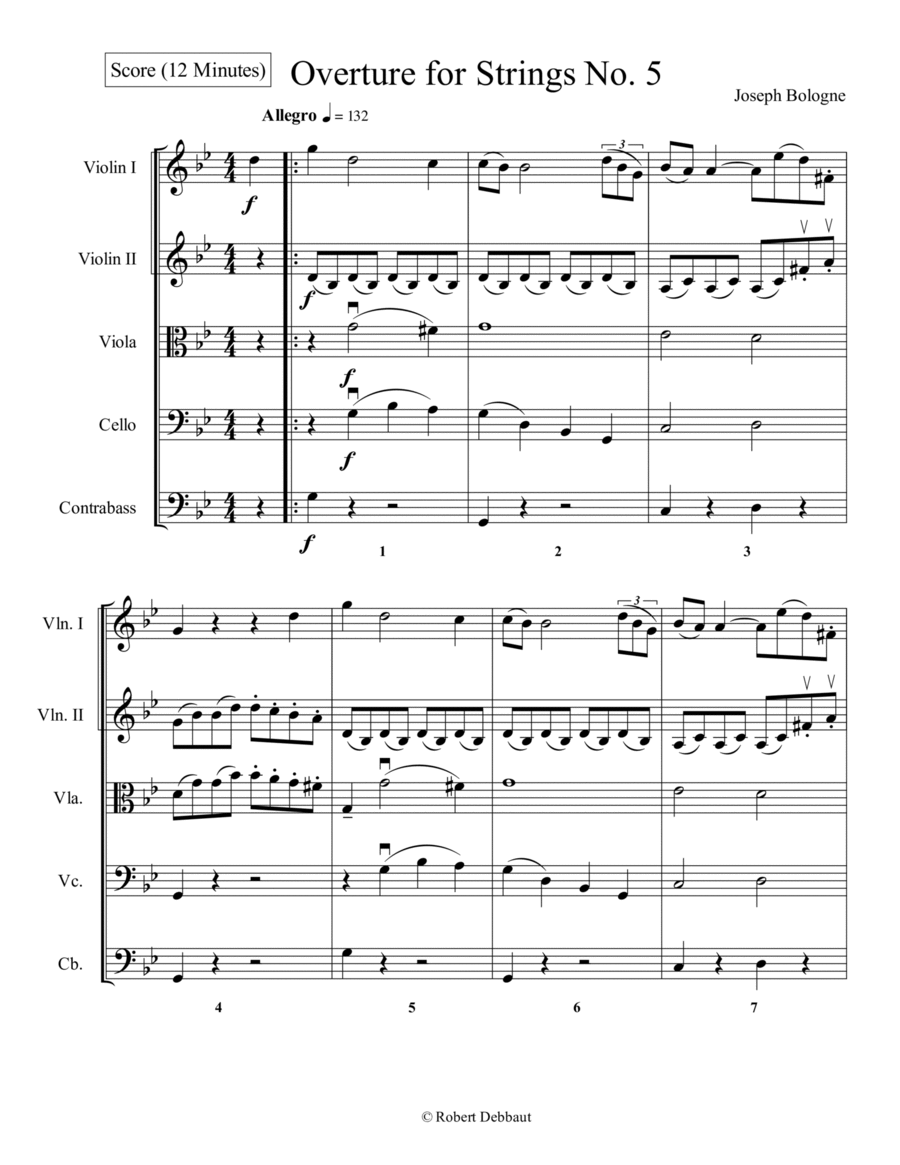
Overture for Strings No. 5 - Score Only
Orchestre à Cordes

$9.99 8.47 € Orchestre à Cordes PDF SheetMusicPlus

String Orchestra - Level 4 - Digital Download SKU: A0.1183535 Composed by Joseph Bologne, Chevalier de St. Georges. Arranged by Robert Debbaut. Classical,Contest,Festival,Historic,Multicultural,World. 34 pages. ROBERT DEBBAUT #783208. Published by ROBERT DEBBAUT (A0.1183535). How is it that one can be born a slave in French colonial Guadeloupe and rise to be among Paris’ musical giants, to become a colonel in the French Army as well as the frequent dinner guest of princes and potentates? The story of Joseph Bologne, Chevalier de Saint-Georges, is surely an interesting one, even the stuff of which movies are made.Joseph Bologne’s father, Georges Bologne de Saint-Georges was a French planter. Saint-Georges was the name of his plantation. He impregnated Anne, the Senegalese slave of his wife, who bore him a son in 1745. Uncharacteristic of many of these sort of relationships he acknowledged the child was his and gave him his family name. When he was seven Bologne’s father took him to Paris for his education, enrolling him in a boarding school. Two years later he and the child’s mother returned to France and set up housekeeping as a family in Paris’ Saint-Germain-des-Prés district.At age thirteen Joseph’s father enrolled him in the Royal Technical Academy of Fencing and Swordsmanship. He quickly became the finest swordsman in the academy, perhaps in all of Paris. Upon graduation he was made an Officer of the King’s Bodyguard and a chevalier (an honorary knighthood). He went on to serve tours of duty in the French Army during the Seven Years War (1756-1763) and later after the French Revolution, where he was Colonel and commander of an all-Black regiment of the Revolutionary Army. All this in spite of the fact that French law forbade him, a man of African heritage, to become a citizen, to retain his father’s royal title of “Gentleman of the King’s Chamber,†or to marry outside his class.There is limited information about Bologne’s musical training, but he was obviously so well-skilled that Italian violinist-composer Antonio Lolli (1725-1802) wrote two violin concertos for him and French composer François-Joseph Gossec (1734-1829) dedicated his set of String Trios, Op. 9 to Bologne. Lolli may have worked with him on violin technique and Gossec composition, but this may be apocryphal. Bologne played in Gossec’s orchestra, and was later both leader and conductor of the group.As a composer Joseph Bologne was quite prolific, composing six operas, fourteen violin concertos, four symphonies concertantes, and numerous chamber works and songs. His Six String Quartets, Op. 1, Nos. 1-6 date from 1770-1771 and were published by the Paris publishing house of Jean-Georges Sieber (1738-1822) in 1773 (There are a total of 18 quartets: Six Quartets “au goût du jour†[up-to-date] from 1779 and the Opus 14 set of six which date from 1785). The Opus 1 quartets are dedicated to Anne Louis Alexandre de Montmorency (1724-1812), 7th Prince of Robeck (Robecq) and Grand Duke of Spain.The Opus 1 quartets all display a similarity to the Italian opera overtures from earlier in the Eighteenth Century (often called “sinfoniaâ€) in that they have an overall “A-B-A†form with the ‘A’ sections being robust allegros and all ‘B’ sections marked “rondo.†As such, in arranging them for string orchestra it seemed quite natural to rename them “overtures.†Certain liberties were taken by the arranger in order to maintain the integrity of the classic Rondo formula. All six have been arranged in this manner for string orchestra. They vary in length from twelve to almost twenty minutes. If you wish to obtain parts, write to debbaut@gmail.com and pay $42 via venmo or $40 via personal check and they will be sent to you in pdf format.
Overture for Strings No. 4 - Score Only
Orchestre à Cordes

$9.99 8.47 € Orchestre à Cordes PDF SheetMusicPlus

String Orchestra - Level 4 - Digital Download SKU: A0.1183533 Composed by Joseph Bologne, Chevalier de St. Georges. Arranged by Robert Debbaut. Classical,Contest,Festival,Historic,Multicultural,World. 43 pages. ROBERT DEBBAUT #783206. Published by ROBERT DEBBAUT (A0.1183533). How is it that one can be born a slave in French colonial Guadeloupe and rise to be among Paris’ musical giants, to become a colonel in the French Army as well as the frequent dinner guest of princes and potentates? The story of Joseph Bologne, Chevalier de Saint-Georges, is surely an interesting one, even the stuff of which movies are made.Joseph Bologne’s father, Georges Bologne de Saint-Georges was a French planter. Saint-Georges was the name of his plantation. He impregnated Anne, the Senegalese slave of his wife, who bore him a son in 1745. Uncharacteristic of many of these sort of relationships he acknowledged the child was his and gave him his family name. When he was seven Bologne’s father took him to Paris for his education, enrolling him in a boarding school. Two years later he and the child’s mother returned to France and set up housekeeping as a family in Paris’ Saint-Germain-des-Prés district.At age thirteen Joseph’s father enrolled him in the Royal Technical Academy of Fencing and Swordsmanship. He quickly became the finest swordsman in the academy, perhaps in all of Paris. Upon graduation he was made an Officer of the King’s Bodyguard and a chevalier (an honorary knighthood). He went on to serve tours of duty in the French Army during the Seven Years War (1756-1763) and later after the French Revolution, where he was Colonel and commander of an all-Black regiment of the Revolutionary Army. All this in spite of the fact that French law forbade him, a man of African heritage, to become a citizen, to retain his father’s royal title of “Gentleman of the King’s Chamber,†or to marry outside his class.There is limited information about Bologne’s musical training, but he was obviously so well-skilled that Italian violinist-composer Antonio Lolli (1725-1802) wrote two violin concertos for him and French composer François-Joseph Gossec (1734-1829) dedicated his set of String Trios, Op. 9 to Bologne. Lolli may have worked with him on violin technique and Gossec composition, but this may be apocryphal. Bologne played in Gossec’s orchestra, and was later both leader and conductor of the group.As a composer Joseph Bologne was quite prolific, composing six operas, fourteen violin concertos, four symphonies concertantes, and numerous chamber works and songs. His Six String Quartets, Op. 1, Nos. 1-6 date from 1770-1771 and were published by the Paris publishing house of Jean-Georges Sieber (1738-1822) in 1773 (There are a total of 18 quartets: Six Quartets “au goût du jour†[up-to-date] from 1779 and the Opus 14 set of six which date from 1785). The Opus 1 quartets are dedicated to Anne Louis Alexandre de Montmorency (1724-1812), 7th Prince of Robeck (Robecq) and Grand Duke of Spain.The Opus 1 quartets all display a similarity to the Italian opera overtures from earlier in the Eighteenth Century (often called “sinfoniaâ€) in that they have an overall “A-B-A†form with the ‘A’ sections being robust allegros and all ‘B’ sections marked “rondo.†As such, in arranging them for string orchestra it seemed quite natural to rename them “overtures.†Certain liberties were taken by the arranger in order to maintain the integrity of the classic Rondo formula. All six have been arranged in this manner for string orchestra. They vary in length from twelve to almost twenty minutes. If you wish to obtain parts, write to debbaut@gmail.com and pay $42 via venmo or $40 via personal check and they will be sent to you in pdf format.

Overture for Strings No. 2 - Score Only
Orchestre à Cordes

$9.99 8.47 € Orchestre à Cordes PDF SheetMusicPlus

String Orchestra - Level 4 - Digital Download SKU: A0.1183534 Composed by Joseph Bologne, Chevalier de St. Georges. Arranged by Robert Debbaut. Classical,Contest,Festival,Historic,Multicultural,World. 28 pages. ROBERT DEBBAUT #783207. Published by ROBERT DEBBAUT (A0.1183534). How is it that one can be born a slave in French colonial Guadeloupe and rise to be among Paris’ musical giants, to become a colonel in the French Army as well as the frequent dinner guest of princes and potentates? The story of Joseph Bologne, Chevalier de Saint-Georges, is surely an interesting one, even the stuff of which movies are made.Joseph Bologne’s father, Georges Bologne de Saint-Georges was a French planter. Saint-Georges was the name of his plantation. He impregnated Anne, the Senegalese slave of his wife, who bore him a son in 1745. Uncharacteristic of many of these sort of relationships he acknowledged the child was his and gave him his family name. When he was seven Bologne’s father took him to Paris for his education, enrolling him in a boarding school. Two years later he and the child’s mother returned to France and set up housekeeping as a family in Paris’ Saint-Germain-des-Prés district.At age thirteen Joseph’s father enrolled him in the Royal Technical Academy of Fencing and Swordsmanship. He quickly became the finest swordsman in the academy, perhaps in all of Paris. Upon graduation he was made an Officer of the King’s Bodyguard and a chevalier (an honorary knighthood). He went on to serve tours of duty in the French Army during the Seven Years War (1756-1763) and later after the French Revolution, where he was Colonel and commander of an all-Black regiment of the Revolutionary Army. All this in spite of the fact that French law forbade him, a man of African heritage, to become a citizen, to retain his father’s royal title of “Gentleman of the King’s Chamber,†or to marry outside his class.There is limited information about Bologne’s musical training, but he was obviously so well-skilled that Italian violinist-composer Antonio Lolli (1725-1802) wrote two violin concertos for him and French composer François-Joseph Gossec (1734-1829) dedicated his set of String Trios, Op. 9 to Bologne. Lolli may have worked with him on violin technique and Gossec composition, but this may be apocryphal. Bologne played in Gossec’s orchestra, and was later both leader and conductor of the group.As a composer Joseph Bologne was quite prolific, composing six operas, fourteen violin concertos, four symphonies concertantes, and numerous chamber works and songs. His Six String Quartets, Op. 1, Nos. 1-6 date from 1770-1771 and were published by the Paris publishing house of Jean-Georges Sieber (1738-1822) in 1773 (There are a total of 18 quartets: Six Quartets “au goût du jour†[up-to-date] from 1779 and the Opus 14 set of six which date from 1785). The Opus 1 quartets are dedicated to Anne Louis Alexandre de Montmorency (1724-1812), 7th Prince of Robeck (Robecq) and Grand Duke of Spain.The Opus 1 quartets all display a similarity to the Italian opera overtures from earlier in the Eighteenth Century (often called “sinfoniaâ€) in that they have an overall “A-B-A†form with the ‘A’ sections being robust allegros and all ‘B’ sections marked “rondo.†As such, in arranging them for string orchestra it seemed quite natural to rename them “overtures.†Certain liberties were taken by the arranger in order to maintain the integrity of the classic Rondo formula. All six have been arranged in this manner for string orchestra. They vary in length from twelve to almost twenty minutes. If you wish to obtain parts, write to debbaut@gmail.com and pay $42 via venmo or $40 via personal check and they will be sent to you in pdf format.

Overture for Strings No. 3 - Score Only
Orchestre à Cordes

$9.99 8.47 € Orchestre à Cordes PDF SheetMusicPlus

String Orchestra - Level 4 - Digital Download SKU: A0.1183537 Composed by Joseph Bologne, Chevalier de St. Georges. Arranged by Robert Debbaut. Classical,Contest,Festival,Historic,Multicultural,World. 57 pages. ROBERT DEBBAUT #783210. Published by ROBERT DEBBAUT (A0.1183537). How is it that one can be born a slave in French colonial Guadeloupe and rise to be among Paris’ musical giants, to become a colonel in the French Army as well as the frequent dinner guest of princes and potentates? The story of Joseph Bologne, Chevalier de Saint-Georges, is surely an interesting one, even the stuff of which movies are made.Joseph Bologne’s father, Georges Bologne de Saint-Georges was a French planter. Saint-Georges was the name of his plantation. He impregnated Anne, the Senegalese slave of his wife, who bore him a son in 1745. Uncharacteristic of many of these sort of relationships he acknowledged the child was his and gave him his family name. When he was seven Bologne’s father took him to Paris for his education, enrolling him in a boarding school. Two years later he and the child’s mother returned to France and set up housekeeping as a family in Paris’ Saint-Germain-des-Prés district.At age thirteen Joseph’s father enrolled him in the Royal Technical Academy of Fencing and Swordsmanship. He quickly became the finest swordsman in the academy, perhaps in all of Paris. Upon graduation he was made an Officer of the King’s Bodyguard and a chevalier (an honorary knighthood). He went on to serve tours of duty in the French Army during the Seven Years War (1756-1763) and later after the French Revolution, where he was Colonel and commander of an all-Black regiment of the Revolutionary Army. All this in spite of the fact that French law forbade him, a man of African heritage, to become a citizen, to retain his father’s royal title of “Gentleman of the King’s Chamber,†or to marry outside his class.There is limited information about Bologne’s musical training, but he was obviously so well-skilled that Italian violinist-composer Antonio Lolli (1725-1802) wrote two violin concertos for him and French composer François-Joseph Gossec (1734-1829) dedicated his set of String Trios, Op. 9 to Bologne. Lolli may have worked with him on violin technique and Gossec composition, but this may be apocryphal. Bologne played in Gossec’s orchestra, and was later both leader and conductor of the group.As a composer Joseph Bologne was quite prolific, composing six operas, fourteen violin concertos, four symphonies concertantes, and numerous chamber works and songs. His Six String Quartets, Op. 1, Nos. 1-6 date from 1770-1771 and were published by the Paris publishing house of Jean-Georges Sieber (1738-1822) in 1773 (There are a total of 18 quartets: Six Quartets “au goût du jour†[up-to-date] from 1779 and the Opus 14 set of six which date from 1785). The Opus 1 quartets are dedicated to Anne Louis Alexandre de Montmorency (1724-1812), 7th Prince of Robeck (Robecq) and Grand Duke of Spain.The Opus 1 quartets all display a similarity to the Italian opera overtures from earlier in the Eighteenth Century (often called “sinfoniaâ€) in that they have an overall “A-B-A†form with the ‘A’ sections being robust allegros and all ‘B’ sections marked “rondo.†As such, in arranging them for string orchestra it seemed quite natural to rename them “overtures.†Certain liberties were taken by the arranger in order to maintain the integrity of the classic Rondo formula. All six have been arranged in this manner for string orchestra. They vary in length from twelve to almost twenty minutes. If you wish to obtain parts, write to debbaut@gmail.com and pay $42 via venmo or $40 via personal check and they will be sent to you in pdf format.

Overture for Strings No. 6 - Score Only
Orchestre à Cordes

$9.99 8.47 € Orchestre à Cordes PDF SheetMusicPlus

String Orchestra - Level 3 - Digital Download SKU: A0.1493207 By Keith Terrett. By Old: B. E. Odiasse New: Frances Benda. Arranged by Keith Terrett. 20th Century,Contest,Festival,Historic,Instructional,Multicultural,World. 16 pages. Keith Terrett #1069860. Published by Keith Terrett (A0.1493207). Nigeria, We Hail Thee was adopted as Nigeria's national anthem on 1 October 1960. The anthem's lyrics were written by Lillian Jean Williams, a British expatriate who lived in Nigeria when it achieved independence. Frances Benda composed the music for Nigeria, We Hail Thee.'' The song was used as the national anthem until it was replaced by Arise, O Compatriots in 1978.On 23 May 2024, the National Assembly passed a bill to relinquish Arise, O Compatriots replacing it with Nigeria, We Hail Thee. The bill was signed into law by President Bola Tinubu on 29 May 2024.
Nigerian National Anthem for String Orchestra (Old & New) - Score Only
Orchestre à Cordes
Keith Terrett
$12.99 11.01 € Orchestre à Cordes PDF SheetMusicPlus

String Orchestra - Level 3 - Digital Download SKU: A0.1500577 By Keith Terrett. By Jean Royer and Joseph Spadilière. Arranged by Keith Terrett. Contest,Festival,Historic,Instructional,Multicultural,Traditional,World. 11 pages. Keith Terrett #1076662. Published by Keith Terrett (A0.1500577). La Congolaise (English: The Congolese, Kongo: Besi Kôngo) is the national anthem of the Republic of the Congo. It was adopted upon independence from France in 1959, replaced in 1969 by Les Trois Glorieuses but reinstated in 1991. The lyrics were written by Jacques Tondra and Georges Kibanghi, and the music was composed by Jean Royer and Joseph Spadilière.
Congolese Republic National Anthem for String Orchestra
Orchestre à Cordes
Keith Terrett
$8.99 7.62 € Orchestre à Cordes PDF SheetMusicPlus

String Orchestra - Level 2 - Digital Download SKU: A0.1107759 Composed by Bach, Beethoven, Bizet, Brahms, Dvorak, Handel, Mozart, Puccini, Rossini, Wagner. Arranged by Laura Jekel. Classical,Instructional,Romantic Period,Standards. Score and parts. 125 pages. Laura Jekel #710385. Published by Laura Jekel (A0.1107759). 20 fun arrangements for beginner and intermediate string orchestra. Written for and played by the MYCincinnati Youth Orchestra over the last decade, and they are greatly enjoyed by the students. These arrangements are available individually, and you can also buy 10 beginner pieces or 10 intermediate pieces. Hope you enjoy! 1. Sarabande and Gavotte by J.S. Bach 2. Symphony No. 5, Movement 3 by Ludwig van Beethoven 3. Symphony No. 7, Movement 2 by Ludwig van Beethoven 4. Carmen Overture by Georges Bizet 5. Piano Quartet No. 1, Gypsy Rondo by Johannes Brahms 6. New World Symphony Finale by Antonin Dvorak 7. Hallelujah Chorus from Messiah by G.F. Handel 8. Rondo alla Turca from Sonata K. 331 by W.A. Mozart 9. Vogelfanger from the Magic Flute by W.A. Mozart 10. ‘O mio babbino caro from Gianni Schicchi by Giaccomo Puccini 11. Nessun Dorma from Turandot by Giaccomo Puccini 12. Overture from William Tell by Gioacchino Rossini 13. Symphony No. 3, Movement 2 by Jean Sibelius 14. Poet and Peasant Overture by Franz von Suppe 15. Symphony No. 4, Movement 3 by P.I. Tchaikovsky 16. Andante from Serenade for Strings by P.I. Tchaikovsky 17. Dance of the Little Swans from Swan Lake by P.I. Tchaikovsky 18. Triumphal March from Aida by Giuseppe Verdi 19. Spring from the Four Seasons by Antonio Vivaldi 20. Tannhauser Overture by Richard Wagner.
20 Arrangements of Classical Favorites for Beginner and Intermediate String Orchestra
Orchestre à Cordes

$49.99 42.39 € Orchestre à Cordes PDF SheetMusicPlus


Partitions Gratuites
Acheter des Partitions Musicales
Acheter des Partitions Digitales à Imprimer
Acheter des Instruments de Musique

© 2000 - 2026

Accueil - Version intégrale


