EUROPE
468 articles
USA
1 articles
DIGITAL
38 articles (à imprimer)
Partitions Digitales
Partitions à imprimer
38 partitions trouvées


String Orchestra - Level 1 - Digital Download SKU: A0.773313 Composed by Yoel Epstein. Arranged by Yoel Epstein. Holiday,Instructional,Patriotic. Score and parts. 53 pages. Yoel Epstein #3686153. Published by Yoel Epstein (A0.773313). This volume contains songs for every national US holiday. The songs are arranged for beginning string orchestra (all first position), with additional parts for violin, viola and cello using open strings only. An accompaniment track is available at https://youtu.be/SlkbjfKBdjc . So you can play this with the accompaniment and any combination of parts. If there are no violists, or if the cello part is too hard for your students, you can play the songs with the accompaniment, and it will sound fine. In fact, I have performed this piece with the violin open string parts only, along with the accompaniment.  Important: This volume contains the scores and one copy of the parts. If you need more parts, please, please, please do not simply photocopy them. You can buy more parts at https://www.sheetmusicplus.com/title/20827196for practically nothing! I know your project is underbudgeted, and money is short, and the photocopier is right down the hall. But this is my livelihood. So I am asking you to please buy your additional parts. Thank you.  This is one of the Open String Symphony series of music for string players of mixed skill levels. You can see all the books of the series at  http://www.sheetmusicplus.com/search?Ntt=Open+String+Symphony  These pieces are part of a more complete program for teaching strings in classes. You can read the entire first-year program in the books Playing Together Student Workbook and Playing Together: Teacher's Guide, both available on Amazon:  Teacher's Guide: https://www.amazon.com/Playing-Together-Teachers-Guide-teaching/dp/1534974598 Student Workbook: https://www.amazon.com/Playing-Together-Student-Workbook-2/dp/1535336617  If you enjoy this, you are welcome to try some of my other arrangements. You can see them at http://www.sheetmusicplus.com/search?Ntt=Yoel+Epstein ), In particular, you might be interested in my music flash cards (here). If you need arrangements of any of these songs for special combinations of instruments, feel free to contact me, and I will try to accommodate. Write me at yoelepst@gmail.com. Hope you enjoy.
Open String Holidays: A song for every US Holiday for violinists of mixed skill levels
Orchestre à Cordes

$19.99 16.88 € Orchestre à Cordes PDF SheetMusicPlus

String Orchestra - Level 1 - Digital Download SKU: A0.773315 Composed by Yoel Epstein. Arranged by Yoel Epstein. Holiday,Patriotic,Standards. Score and parts. 39 pages. Yoel Epstein #3686423. Published by Yoel Epstein (A0.773315). This volume contains parts for songs for every national US holiday. The songs are arranged for beginning string orchestra (all first position), with additional parts for violin, viola and cello using open strings only. You can purchase the score and one set of parts at https://www.sheetmusicplus.com/title/20826942 . An accompaniment track is available at https://youtu.be/SlkbjfKBdjc . So you can play this with the accompaniment and any combination of parts. If there are no violists, or if the cello part is too hard for your students, you can play the songs with the accompaniment, and it will sound fine. In fact, I have performed this piece with the violin open string parts only, along with the accompaniment. Please do not make copies of this. I know your project is underbudgeted and you are underpaid, and the photocopier is right down the hall. But this is my livelihood. So please, please, please, buy as many copies as you need. It's really cheap!This is one of the Open String Symphony series of music for string players of mixed skill levels. You can see all the books of the series at http://www.sheetmusicplus.com/search?Ntt=Open+String+Symphony These pieces are part of a more complete program for teaching strings in classes. You can read the entire first-year program in the books Playing Together Student Workbook and Playing Together: Teacher's Guide, both available on Amazon: Teacher's Guide: https://www.amazon.com/Playing-Together-Teachers-Guide-teaching/dp/1534974598 Student Workbook: https://www.amazon.com/Playing-Together-Student-Workbook-2/dp/1535336617 If you enjoy this, you are welcome to try some of my other arrangements. You can see them at http://www.sheetmusicplus.com/search?Ntt=Yoel+Epstein ), In particular, you might be interested in my music flash cards (here). If you need arrangements of any of these songs for special combinations of instruments, feel free to contact me, and I will try to accommodate. Write me at yoelepst@gmail.com.  Hope you enjoy.  
Open Strings Holidays: A Song for Every US Holiday for Beginning String Orchestra Parts
Orchestre à Cordes

$2.99 2.52 € Orchestre à Cordes PDF SheetMusicPlus

String Orchestra - Level 3 - Digital Download SKU: A0.521757 Composed by Edvard Grieg. Arranged by Sherry Lewis. Holiday,Romantic Period,Wedding. Score and Parts. 35 pages. Sherry Lewis Publishing #6428281. Published by Sherry Lewis Publishing (A0.521757). WEDDING DAY AT TROLDHAUGEN String Orchestra, Intermediate Level for 2 violins, viola, cello and string bass Score: 17 pages Parts: 15 pages  Time: 8'30 MY QUARTET VERSIONS, in short notice work fine for solo, two parts and three parts  however I also offer individual versions for one, two and three parts that are more detailed for these ensembles. Please visit  https://www.sheetmusicplus.com/search?Ntt=sherry+lewis+publishing for all of the titles I offer. If you can’t find a title then contact me through www.baysbest.com/smp-arrangeme/ and I’ll give you the link back to Sheet Music Plus’s listing. VERSATILE Titles that include four parts are written with the idea that they can be performed with 1, 2, 3 or 4 musicians. Most of the contemporary/popular titles include a chord chart for a bass instrument. PRACTICE needs would vary according to the level of the performers but my goal is to be sight-readable for most performers and groups.  AUDIO SAMPLE The 30 second mp3 is frequently shortened and may not start at the introduction to get to the reprise. The actual introduction will be in the sheet music. LISTENABILITY I have performed thousands of weddings and special events. I make it a goal for the music to carry as well as possible through loud and large space situations.  ARRANGEMENTS usually follow the original version. There is an mp3 where you can hear 30 seconds and get a feeling of the originality of the work. EXCELLENT for corporate events, weddings, social gatherings and recitals. APPROPRIATE for students and schools. CHURCH REPERTOIRE I’m always adding more titles. Sherry Lewis is a professional arranger and musician residing in Northern California. Thank you for your purchase!
WEDDING DAY AT TROLDHAUGEN String Orchestra, Intermediate Level for 2 violins, viola, cello and stri
Orchestre à Cordes

$9.50 8.02 € Orchestre à Cordes PDF SheetMusicPlus

String Orchestra - Level 4 - Digital Download SKU: A0.922638 Composed by Johann Strauss Jr. Arranged by Aaron Meier. Romantic Period,World. Score and parts. 1 pages. Aaron Meier #5792369. Published by Aaron Meier (A0.922638). Original by Johann Strauss II Reduction to String Orchestra by Aaron Meier Part: Viola True to the original work by Strauss, this reduction for string orchestra features the ornaments and mystical writing that defines Strauss' polkas. There are optional percussion parts to be added at the discretion of the ensemble, however even without percussion the ensemble will sound full (the percussion acts as an ornament). Difficulty: Intermediate-advanced - advanced (best-suited for advanced student ensembles) --- Performance Notes: • Approximate length: 3:30 minutes • 1st Violins: In m. 1, trill a half step from a Dâ™­ to a Dâ™®  • 2nd Violins:  - At m. 42, divide players by 3, with 2 players playing line A and the remaining player playing line B  - At m. 72-75, emphasize the Eâ™­ in the div. • Snare Drum: The buzz roll needs to be quieter than how it is played in the midi recording (*see YouTube link ↓) History: The Olga-Polka itself owed its creation to a Russian royal wedding which took place in St. Petersburg on 28 August 1857. On that day, amid accompanying splendour, the music-loving Grand Duke Michail Nikolaievich (1832-1909), youngest brother of Tsar Alexander II, married Princess Caecilie of Baden (1839-91), daughter of Archduke Leopold of Baden. Johann Strauss, who at that time was giving a summer season of concerts in nearby Pavlovsk, used the opportunity occasioned by the event to enhance his already enviable popularity with the Russian royal family and composed the Caecilien-Polka in honour of the lovely young bride. Indeed, it is clear from a letter which Johann wrote in late July 1857 to Carl Haslinger, his publisher in Vienna, that the new polka had been prepared well in advance of the wedding (the fair copy of the full orchestral score made for the publisher's engraver is dated 9 August) and was enjoying success even before the royal couple's official engagement on 16August 1857. Sometime after performing the Caecilien-Polka in Pavlovsk, Johann despatched the work to the Austrian capital where his brother Josef conducted its Viennese première, together with that of Johann's waltz Telegraphische Depeschen (op. 195, Volume 28), at his own benefit concert in the Volksgartenon Sunday 18 October 1857. The Wiener Allgemeine Theaterzeitung (16.10.1857) remarked that both works have caused a sensation in St. Petersburg and are truly genial Viennese sounds full of verve and melody. Since tradition demanded that the German Princess Caecilie adopt a Russian name - Olga Feodorovna - before her marriage, so Johann's Caecilien-Polka also underwent a change of identity. On 8 December 1857 Carl Haslinger announced the publication of Strauss's Olga-Polka, on the title page of which is the inscription: Dedicated to her Imperial Highness Grand Duchess Olga, née Princess of Baden. It was under this title, too, that Johann himself first conducted the work in Vienna at a concert in the Volksgarten on 1 November 1857, shortly after his return from Russia. Reporting on this event, the Wiener Allgemeine Theaterzeitung (3.11.1857) observed: The 'Olga-Polka' is a most delightful, fragrant musical bouquet, full of fine, gracious rhythms. [excerpted from NAXOS Records] Kemp, Peter. Program Notes - About this Recording. NAXOS, 1993, www.naxos.com/mainsite/blurbs_reviews.asp?item_code=8.223232&catNum=223232&filetype=About%20.......... Accessed 5 June 2020. Resources: • Visit
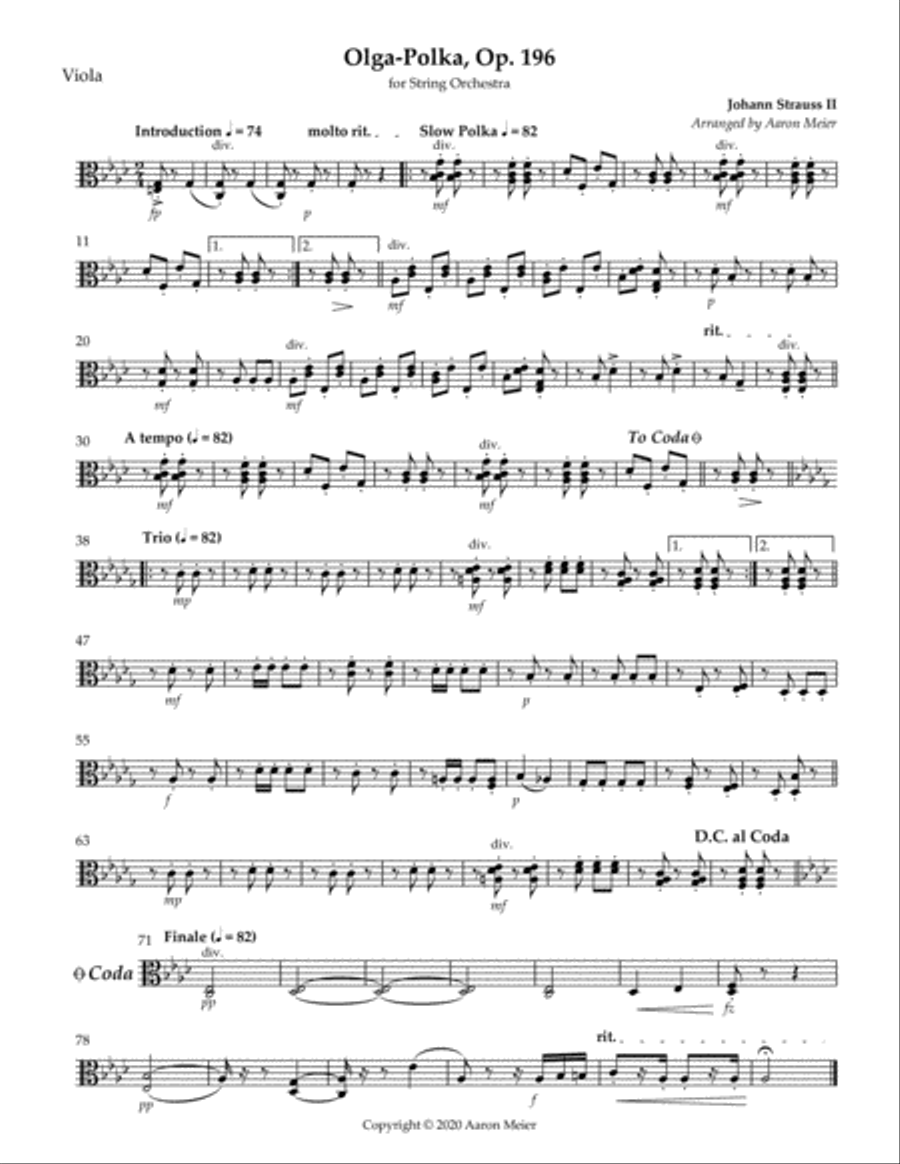
Olga-Polka, Op. 196 (arr. for string orchestra): Viola
Orchestre à Cordes

$3.99 3.37 € Orchestre à Cordes PDF SheetMusicPlus

String Orchestra - Level 4 - Digital Download SKU: A0.922637 Composed by Johann Strauss Jr. Arranged by Aaron Meier. Romantic Period,World. Score and parts. 1 pages. Aaron Meier #5792373. Published by Aaron Meier (A0.922637). Original by Johann Strauss II Reduction to String Orchestra by Aaron Meier Part: Cello True to the original work by Strauss, this reduction for string orchestra features the ornaments and mystical writing that defines Strauss' polkas. There are optional percussion parts to be added at the discretion of the ensemble, however even without percussion the ensemble will sound full (the percussion acts as an ornament). Difficulty: Intermediate-advanced - advanced (best-suited for advanced student ensembles) --- Performance Notes: • Approximate length: 3:30 minutes • 1st Violins: In m. 1, trill a half step from a Dâ™­ to a Dâ™®  • 2nd Violins:  - At m. 42, divide players by 3, with 2 players playing line A and the remaining player playing line B  - At m. 72-75, emphasize the Eâ™­ in the div. • Snare Drum: The buzz roll needs to be quieter than how it is played in the midi recording (*see YouTube link ↓) History: The Olga-Polka itself owed its creation to a Russian royal wedding which took place in St. Petersburg on 28 August 1857. On that day, amid accompanying splendour, the music-loving Grand Duke Michail Nikolaievich (1832-1909), youngest brother of Tsar Alexander II, married Princess Caecilie of Baden (1839-91), daughter of Archduke Leopold of Baden. Johann Strauss, who at that time was giving a summer season of concerts in nearby Pavlovsk, used the opportunity occasioned by the event to enhance his already enviable popularity with the Russian royal family and composed the Caecilien-Polka in honour of the lovely young bride. Indeed, it is clear from a letter which Johann wrote in late July 1857 to Carl Haslinger, his publisher in Vienna, that the new polka had been prepared well in advance of the wedding (the fair copy of the full orchestral score made for the publisher's engraver is dated 9 August) and was enjoying success even before the royal couple's official engagement on 16August 1857. Sometime after performing the Caecilien-Polka in Pavlovsk, Johann despatched the work to the Austrian capital where his brother Josef conducted its Viennese première, together with that of Johann's waltz Telegraphische Depeschen (op. 195, Volume 28), at his own benefit concert in the Volksgartenon Sunday 18 October 1857. The Wiener Allgemeine Theaterzeitung (16.10.1857) remarked that both works have caused a sensation in St. Petersburg and are truly genial Viennese sounds full of verve and melody. Since tradition demanded that the German Princess Caecilie adopt a Russian name - Olga Feodorovna - before her marriage, so Johann's Caecilien-Polka also underwent a change of identity. On 8 December 1857 Carl Haslinger announced the publication of Strauss's Olga-Polka, on the title page of which is the inscription: Dedicated to her Imperial Highness Grand Duchess Olga, née Princess of Baden. It was under this title, too, that Johann himself first conducted the work in Vienna at a concert in the Volksgarten on 1 November 1857, shortly after his return from Russia. Reporting on this event, the Wiener Allgemeine Theaterzeitung (3.11.1857) observed: The 'Olga-Polka' is a most delightful, fragrant musical bouquet, full of fine, gracious rhythms. [excerpted from NAXOS Records] Kemp, Peter. Program Notes - About this Recording. NAXOS, 1993, www.naxos.com/mainsite/blurbs_reviews.asp?item_code=8.223232&catNum=223232&filetype=About%20.......... Accessed 5 June 2020. Resources: • Visit
Olga-Polka, Op. 196 (arr. for string orchestra): Cello
Orchestre à Cordes

$3.99 3.37 € Orchestre à Cordes PDF SheetMusicPlus

String Orchestra - Level 4 - Digital Download SKU: A0.922634 Composed by Johann Strauss Jr. Arranged by Aaron Meier. Romantic Period,World. Score and parts. 1 pages. Aaron Meier #5792359. Published by Aaron Meier (A0.922634). Original by Johann Strauss II Reduction to String Orchestra by Aaron Meier Part: Violin I True to the original work by Strauss, this reduction for string orchestra features the ornaments and mystical writing that defines Strauss' polkas. There are optional percussion parts to be added at the discretion of the ensemble, however even without percussion the ensemble will sound full (the percussion acts as an ornament). Difficulty: Intermediate-advanced - advanced (best-suited for advanced student ensembles) --- Performance Notes: • Approximate length: 3:30 minutes • 1st Violins: In m. 1, trill a half step from a Dâ™­ to a Dâ™®  • 2nd Violins:  - At m. 42, divide players by 3, with 2 players playing line A and the remaining player playing line B  - At m. 72-75, emphasize the Eâ™­ in the div. • Snare Drum: The buzz roll needs to be quieter than how it is played in the midi recording (*see YouTube link ↓) History: The Olga-Polka itself owed its creation to a Russian royal wedding which took place in St. Petersburg on 28 August 1857. On that day, amid accompanying splendour, the music-loving Grand Duke Michail Nikolaievich (1832-1909), youngest brother of Tsar Alexander II, married Princess Caecilie of Baden (1839-91), daughter of Archduke Leopold of Baden. Johann Strauss, who at that time was giving a summer season of concerts in nearby Pavlovsk, used the opportunity occasioned by the event to enhance his already enviable popularity with the Russian royal family and composed the Caecilien-Polka in honour of the lovely young bride. Indeed, it is clear from a letter which Johann wrote in late July 1857 to Carl Haslinger, his publisher in Vienna, that the new polka had been prepared well in advance of the wedding (the fair copy of the full orchestral score made for the publisher's engraver is dated 9 August) and was enjoying success even before the royal couple's official engagement on 16August 1857. Sometime after performing the Caecilien-Polka in Pavlovsk, Johann despatched the work to the Austrian capital where his brother Josef conducted its Viennese première, together with that of Johann's waltz Telegraphische Depeschen (op. 195, Volume 28), at his own benefit concert in the Volksgartenon Sunday 18 October 1857. The Wiener Allgemeine Theaterzeitung (16.10.1857) remarked that both works have caused a sensation in St. Petersburg and are truly genial Viennese sounds full of verve and melody. Since tradition demanded that the German Princess Caecilie adopt a Russian name - Olga Feodorovna - before her marriage, so Johann's Caecilien-Polka also underwent a change of identity. On 8 December 1857 Carl Haslinger announced the publication of Strauss's Olga-Polka, on the title page of which is the inscription: Dedicated to her Imperial Highness Grand Duchess Olga, née Princess of Baden. It was under this title, too, that Johann himself first conducted the work in Vienna at a concert in the Volksgarten on 1 November 1857, shortly after his return from Russia. Reporting on this event, the Wiener Allgemeine Theaterzeitung (3.11.1857) observed: The 'Olga-Polka' is a most delightful, fragrant musical bouquet, full of fine, gracious rhythms. [excerpted from NAXOS Records] Kemp, Peter. Program Notes - About this Recording. NAXOS, 1993, www.naxos.com/mainsite/blurbs_reviews.asp?item_code=8.223232&catNum=223232&filetype=About%20.......... Accessed 5 June 2020. Resources: • Visit

Olga-Polka, Op. 196 (arr. for string orchestra): Violin I
Orchestre à Cordes

$3.99 3.37 € Orchestre à Cordes PDF SheetMusicPlus

String Orchestra - Level 4 - Digital Download SKU: A0.922639 Composed by Johann Strauss Jr. Arranged by Aaron Meier. Romantic Period,World. Score and parts. 1 pages. Aaron Meier #5792379. Published by Aaron Meier (A0.922639). Original by Johann Strauss II Reduction to String Orchestra by Aaron Meier Part: Double Bass True to the original work by Strauss, this reduction for string orchestra features the ornaments and mystical writing that defines Strauss' polkas. There are optional percussion parts to be added at the discretion of the ensemble, however even without percussion the ensemble will sound full (the percussion acts as an ornament). Difficulty: Intermediate-advanced - advanced (best-suited for advanced student ensembles) --- Performance Notes: • Approximate length: 3:30 minutes • 1st Violins: In m. 1, trill a half step from a Dâ™­ to a Dâ™®  • 2nd Violins:  - At m. 42, divide players by 3, with 2 players playing line A and the remaining player playing line B  - At m. 72-75, emphasize the Eâ™­ in the div. • Snare Drum: The buzz roll needs to be quieter than how it is played in the midi recording (*see YouTube link ↓) History: The Olga-Polka itself owed its creation to a Russian royal wedding which took place in St. Petersburg on 28 August 1857. On that day, amid accompanying splendour, the music-loving Grand Duke Michail Nikolaievich (1832-1909), youngest brother of Tsar Alexander II, married Princess Caecilie of Baden (1839-91), daughter of Archduke Leopold of Baden. Johann Strauss, who at that time was giving a summer season of concerts in nearby Pavlovsk, used the opportunity occasioned by the event to enhance his already enviable popularity with the Russian royal family and composed the Caecilien-Polka in honour of the lovely young bride. Indeed, it is clear from a letter which Johann wrote in late July 1857 to Carl Haslinger, his publisher in Vienna, that the new polka had been prepared well in advance of the wedding (the fair copy of the full orchestral score made for the publisher's engraver is dated 9 August) and was enjoying success even before the royal couple's official engagement on 16August 1857. Sometime after performing the Caecilien-Polka in Pavlovsk, Johann despatched the work to the Austrian capital where his brother Josef conducted its Viennese première, together with that of Johann's waltz Telegraphische Depeschen (op. 195, Volume 28), at his own benefit concert in the Volksgartenon Sunday 18 October 1857. The Wiener Allgemeine Theaterzeitung (16.10.1857) remarked that both works have caused a sensation in St. Petersburg and are truly genial Viennese sounds full of verve and melody. Since tradition demanded that the German Princess Caecilie adopt a Russian name - Olga Feodorovna - before her marriage, so Johann's Caecilien-Polka also underwent a change of identity. On 8 December 1857 Carl Haslinger announced the publication of Strauss's Olga-Polka, on the title page of which is the inscription: Dedicated to her Imperial Highness Grand Duchess Olga, née Princess of Baden. It was under this title, too, that Johann himself first conducted the work in Vienna at a concert in the Volksgarten on 1 November 1857, shortly after his return from Russia. Reporting on this event, the Wiener Allgemeine Theaterzeitung (3.11.1857) observed: The 'Olga-Polka' is a most delightful, fragrant musical bouquet, full of fine, gracious rhythms. [excerpted from NAXOS Records] Kemp, Peter. Program Notes - About this Recording. NAXOS, 1993, www.naxos.com/mainsite/blurbs_reviews.asp?item_code=8.223232&catNum=223232&filetype=About%20.......... Accessed 5 June 2020. Resources: • Visit.
Olga-Polka, Op. 196 (arr. for string orchestra): Double Bass
Orchestre à Cordes

$3.99 3.37 € Orchestre à Cordes PDF SheetMusicPlus

String Orchestra - Level 4 - Digital Download SKU: A0.922636 Composed by Johann Strauss Jr. Arranged by Aaron Meier. Romantic Period,World. Score and parts. 1 pages. Aaron Meier #5792367. Published by Aaron Meier (A0.922636). Original by Johann Strauss II Reduction to String Orchestra by Aaron Meier Part: Violin II True to the original work by Strauss, this reduction for string orchestra features the ornaments and mystical writing that defines Strauss' polkas. There are optional percussion parts to be added at the discretion of the ensemble, however even without percussion the ensemble will sound full (the percussion acts as an ornament). Difficulty: Intermediate-advanced - advanced (best-suited for advanced student ensembles) --- Performance Notes: • Approximate length: 3:30 minutes • 1st Violins: In m. 1, trill a half step from a Dâ™­ to a Dâ™®  • 2nd Violins:  - At m. 42, divide players by 3, with 2 players playing line A and the remaining player playing line B  - At m. 72-75, emphasize the Eâ™­ in the div. • Snare Drum: The buzz roll needs to be quieter than how it is played in the midi recording (*see YouTube link ↓) History: The Olga-Polka itself owed its creation to a Russian royal wedding which took place in St. Petersburg on 28 August 1857. On that day, amid accompanying splendour, the music-loving Grand Duke Michail Nikolaievich (1832-1909), youngest brother of Tsar Alexander II, married Princess Caecilie of Baden (1839-91), daughter of Archduke Leopold of Baden. Johann Strauss, who at that time was giving a summer season of concerts in nearby Pavlovsk, used the opportunity occasioned by the event to enhance his already enviable popularity with the Russian royal family and composed the Caecilien-Polka in honour of the lovely young bride. Indeed, it is clear from a letter which Johann wrote in late July 1857 to Carl Haslinger, his publisher in Vienna, that the new polka had been prepared well in advance of the wedding (the fair copy of the full orchestral score made for the publisher's engraver is dated 9 August) and was enjoying success even before the royal couple's official engagement on 16August 1857. Sometime after performing the Caecilien-Polka in Pavlovsk, Johann despatched the work to the Austrian capital where his brother Josef conducted its Viennese première, together with that of Johann's waltz Telegraphische Depeschen (op. 195, Volume 28), at his own benefit concert in the Volksgartenon Sunday 18 October 1857. The Wiener Allgemeine Theaterzeitung (16.10.1857) remarked that both works have caused a sensation in St. Petersburg and are truly genial Viennese sounds full of verve and melody. Since tradition demanded that the German Princess Caecilie adopt a Russian name - Olga Feodorovna - before her marriage, so Johann's Caecilien-Polka also underwent a change of identity. On 8 December 1857 Carl Haslinger announced the publication of Strauss's Olga-Polka, on the title page of which is the inscription: Dedicated to her Imperial Highness Grand Duchess Olga, née Princess of Baden. It was under this title, too, that Johann himself first conducted the work in Vienna at a concert in the Volksgarten on 1 November 1857, shortly after his return from Russia. Reporting on this event, the Wiener Allgemeine Theaterzeitung (3.11.1857) observed: The 'Olga-Polka' is a most delightful, fragrant musical bouquet, full of fine, gracious rhythms. [excerpted from NAXOS Records] Kemp, Peter. Program Notes - About this Recording. NAXOS, 1993, www.naxos.com/mainsite/blurbs_reviews.asp?item_code=8.223232&catNum=223232&filetype=About%20.......... Accessed 5 June 2020. Resources: • Visit

Olga-Polka, Op. 196 (arr. for string orchestra): Violin II
Orchestre à Cordes

$3.99 3.37 € Orchestre à Cordes PDF SheetMusicPlus

String Orchestra - Level 2 - Digital Download SKU: A0.934246 Composed by Antonio Cericola. Concert,Contemporary,Holiday,Love,Standards,Wedding. Score and parts. 35 pages. Antonio Cericola #5017163. Published by Antonio Cericola (A0.934246). La storia di Amore e Psiche è la più bella storia d'amore di sempre, senza tempo. Simbolo dell'eterna lotta tra cuore e razionalità, la leggenda (raccontata da Apuleio nella sua Metamorfosi), non è più la storia di Dio Cupido e della bella Psiche. Le entità dei due amanti si trasformano con una nuova iniziazione in amore maturo e cosciente: rinascono e si completano a vicenda vivendo insieme superando ogni difficoltà tenendosi per mano. Questa è una delle poche storie, tra i miti greci, a lieto fine: i due amanti sono diventati il ​​simbolo dell'amore e della passione, per sempre. Le 12 composizioni per pianoforte (concepite anche nella versione per pianoforte e orchestra) combinando cuore e anima con mente e intelletto in un eterno abbraccio d'amore. Questa è la musica dell'anima per l'anima: per coloro che riescono a elevarsi oltre i sensibili e viventi di emozioni.
Eros and Psyche - The music of the soul 12 compositions for piano
Orchestre à Cordes

$9.90 8.36 € Orchestre à Cordes PDF SheetMusicPlus

String Orchestra - Digital Download SKU: S9.Q49929 Composed by Felix Bartholdy Mendelssohn. This edition: set of parts. Eulenburg Orchestral Series. Downloadable, Set of parts. Ernst Eulenburg & Co. GmbH - Digital #Q49929. Published by Ernst Eulenburg & Co. GmbH - Digital (S9.Q49929). Key: F major.The Allgemeine Musikalische Zeitung, Leipzig 1827, reports that Mendelssohn, between the ages of 12-14, and under the guidance of his teacher Carl Friedrich Zelter, composed 'symphonies for strings alone in the style of C. P. E. Bach, which were then performed in the house of his highly refined and cultivated parents.' These remarkably fresh and precociously accomplished works were presented during Sunday musicales held at the Mendelssohn family residence and performed by members of the Berlin Court Orchestra under the direction of the composer himself. The instrumental parts are based on the recently-published Eulenburg study scores of the 12 Sinfonias for strings, newly-edited by Boris von Haken from the extant autograph MSS in the collection of the Staatsbibliothek zu Berlin - Stiftung Preussischer Kulturbestiz.
Sinfonia XI F major
Orchestre à Cordes

$28.99 24.47 € Orchestre à Cordes PDF SheetMusicPlus

String Orchestra - Level 4 - Digital Download SKU: A0.501749 Composed by Johann Sebastian Bach. Arranged by James M. Guthrie. Baroque,Contest,Festival,Standards,Traditional. Score and parts. 48 pages. Jmsgu3 #114439. Published by jmsgu3 (A0.501749). J. S. Bach: French Suite No. 5 BWV 816 for String Orchestra Duration: 16:10 Score: 20 pages. Contents: Allemande, Courante, Sarabande, Gavotte, Bourrée I, Bourrée II, Gigue.Johann Sebastian Bach is widely considered one of the greatest composers of all time. He was born in Eisenach, Thuringia, Germany in 1685 and is best known for his mastery of the Baroque era of musical composition. One of Bach's most beloved works is the set of French Suites, which he composed in the years between 1722 and 1725. These suites consist of six movements, usually in the forms of allemandes, courantes, sarabandes, gigues, and minuets, which Bach filled with intricate ornamentation.The French Suites were highly influential to later composers, particularly those of the Classical and Romantic periods. Bach's inventiveness in the suites marked a new level of finesse and virtuosity in composition. He also demonstrated his ability to work with preexisting forms and conventions to create a unified and well-crafted whole. The French Suites continue to be performed around the world today, and they remain some of the best-known and most appreciated works.
BACH: French Suite No. 5 BWV 816 for String Orchestra
Orchestre à Cordes

$49.95 42.17 € Orchestre à Cordes PDF SheetMusicPlus


Partitions Gratuites
Acheter des Partitions Musicales
Acheter des Partitions Digitales à Imprimer
Acheter des Instruments de Musique

© 2000 - 2026

Accueil - Version intégrale



