EUROPE
4481 articles
USA
103 articles
DIGITAL
12 articles (à imprimer)
Partitions Digitales
Partitions à imprimer
12 partitions trouvées


String Orchestra - Level 3 - Digital Download SKU: A0.739446 Composed by Johannes Brahms. Arranged by David Catherwood. Multicultural,Romantic Period,World. Score and parts. 4 pages. Opus 3 Music #3692989. Published by Opus 3 Music (A0.739446). St. Anthony Chorale by Brahms (The tune on which Brahms bases his famous set of variations – although the tune itself was possibly written by Haydn)This arrangement is suitable for String Quartet (or String Orchestra with a Double bass playing from the 'cello part.)  As with all music available from Opus 3 Music this arrangement has been well tried and tested in performanceThe download contains parts for the following instruments:1st Violin2nd ViolinViola Cello/BassAlso available as a flexible arrangement for wind and brass at the following link  https://www.sheetmusicplus.com/title/st-anthony-chorale-by-brahms-digital-sheet-music/20476673
St. Anthony Chorale by Brahms arranged for String Quartet by David Catherwood
Orchestre à Cordes

$5.00 4.3 € Orchestre à Cordes PDF SheetMusicPlus

String Orchestra - Level 4 - Digital Download SKU: A0.1183534 Composed by Joseph Bologne, Chevalier de St. Georges. Arranged by Robert Debbaut. Classical,Contest,Festival,Historic,Multicultural,World. 28 pages. ROBERT DEBBAUT #783207. Published by ROBERT DEBBAUT (A0.1183534). How is it that one can be born a slave in French colonial Guadeloupe and rise to be among Paris’ musical giants, to become a colonel in the French Army as well as the frequent dinner guest of princes and potentates? The story of Joseph Bologne, Chevalier de Saint-Georges, is surely an interesting one, even the stuff of which movies are made.Joseph Bologne’s father, Georges Bologne de Saint-Georges was a French planter. Saint-Georges was the name of his plantation. He impregnated Anne, the Senegalese slave of his wife, who bore him a son in 1745. Uncharacteristic of many of these sort of relationships he acknowledged the child was his and gave him his family name. When he was seven Bologne’s father took him to Paris for his education, enrolling him in a boarding school. Two years later he and the child’s mother returned to France and set up housekeeping as a family in Paris’ Saint-Germain-des-PrĂ©s district.At age thirteen Joseph’s father enrolled him in the Royal Technical Academy of Fencing and Swordsmanship. He quickly became the finest swordsman in the academy, perhaps in all of Paris. Upon graduation he was made an Officer of the King’s Bodyguard and a chevalier (an honorary knighthood). He went on to serve tours of duty in the French Army during the Seven Years War (1756-1763) and later after the French Revolution, where he was Colonel and commander of an all-Black regiment of the Revolutionary Army. All this in spite of the fact that French law forbade him, a man of African heritage, to become a citizen, to retain his father’s royal title of “Gentleman of the King’s Chamber,” or to marry outside his class.There is limited information about Bologne’s musical training, but he was obviously so well-skilled that Italian violinist-composer Antonio Lolli (1725-1802) wrote two violin concertos for him and French composer François-Joseph Gossec (1734-1829) dedicated his set of String Trios, Op. 9 to Bologne. Lolli may have worked with him on violin technique and Gossec composition, but this may be apocryphal. Bologne played in Gossec’s orchestra, and was later both leader and conductor of the group.As a composer Joseph Bologne was quite prolific, composing six operas, fourteen violin concertos, four symphonies concertantes, and numerous chamber works and songs. His Six String Quartets, Op. 1, Nos. 1-6 date from 1770-1771 and were published by the Paris publishing house of Jean-Georges Sieber (1738-1822) in 1773 (There are a total of 18 quartets: Six Quartets “au goĂ»t du jour” [up-to-date] from 1779 and the Opus 14 set of six which date from 1785). The Opus 1 quartets are dedicated to Anne Louis Alexandre de Montmorency (1724-1812), 7th Prince of Robeck (Robecq) and Grand Duke of Spain.The Opus 1 quartets all display a similarity to the Italian opera overtures from earlier in the Eighteenth Century (often called “sinfonia”) in that they have an overall “A-B-A” form with the ‘A’ sections being robust allegros and all ‘B’ sections marked “rondo.” As such, in arranging them for string orchestra it seemed quite natural to rename them “overtures.” Certain liberties were taken by the arranger in order to maintain the integrity of the classic Rondo formula. All six have been arranged in this manner for string orchestra. They vary in length from twelve to almost twenty minutes. If you wish to obtain parts, write to debbaut@gmail.com and pay $42 via venmo or $40 via personal check and they will be sent to you in pdf format.
Overture for Strings No. 3 - Score Only
Orchestre à Cordes

$9.99 8.6 € Orchestre à Cordes PDF SheetMusicPlus

String Orchestra - Level 4 - Digital Download SKU: A0.1183535 Composed by Joseph Bologne, Chevalier de St. Georges. Arranged by Robert Debbaut. Classical,Contest,Festival,Historic,Multicultural,World. 34 pages. ROBERT DEBBAUT #783208. Published by ROBERT DEBBAUT (A0.1183535). How is it that one can be born a slave in French colonial Guadeloupe and rise to be among Paris’ musical giants, to become a colonel in the French Army as well as the frequent dinner guest of princes and potentates? The story of Joseph Bologne, Chevalier de Saint-Georges, is surely an interesting one, even the stuff of which movies are made.Joseph Bologne’s father, Georges Bologne de Saint-Georges was a French planter. Saint-Georges was the name of his plantation. He impregnated Anne, the Senegalese slave of his wife, who bore him a son in 1745. Uncharacteristic of many of these sort of relationships he acknowledged the child was his and gave him his family name. When he was seven Bologne’s father took him to Paris for his education, enrolling him in a boarding school. Two years later he and the child’s mother returned to France and set up housekeeping as a family in Paris’ Saint-Germain-des-PrĂ©s district.At age thirteen Joseph’s father enrolled him in the Royal Technical Academy of Fencing and Swordsmanship. He quickly became the finest swordsman in the academy, perhaps in all of Paris. Upon graduation he was made an Officer of the King’s Bodyguard and a chevalier (an honorary knighthood). He went on to serve tours of duty in the French Army during the Seven Years War (1756-1763) and later after the French Revolution, where he was Colonel and commander of an all-Black regiment of the Revolutionary Army. All this in spite of the fact that French law forbade him, a man of African heritage, to become a citizen, to retain his father’s royal title of “Gentleman of the King’s Chamber,” or to marry outside his class.There is limited information about Bologne’s musical training, but he was obviously so well-skilled that Italian violinist-composer Antonio Lolli (1725-1802) wrote two violin concertos for him and French composer François-Joseph Gossec (1734-1829) dedicated his set of String Trios, Op. 9 to Bologne. Lolli may have worked with him on violin technique and Gossec composition, but this may be apocryphal. Bologne played in Gossec’s orchestra, and was later both leader and conductor of the group.As a composer Joseph Bologne was quite prolific, composing six operas, fourteen violin concertos, four symphonies concertantes, and numerous chamber works and songs. His Six String Quartets, Op. 1, Nos. 1-6 date from 1770-1771 and were published by the Paris publishing house of Jean-Georges Sieber (1738-1822) in 1773 (There are a total of 18 quartets: Six Quartets “au goĂ»t du jour” [up-to-date] from 1779 and the Opus 14 set of six which date from 1785). The Opus 1 quartets are dedicated to Anne Louis Alexandre de Montmorency (1724-1812), 7th Prince of Robeck (Robecq) and Grand Duke of Spain.The Opus 1 quartets all display a similarity to the Italian opera overtures from earlier in the Eighteenth Century (often called “sinfonia”) in that they have an overall “A-B-A” form with the ‘A’ sections being robust allegros and all ‘B’ sections marked “rondo.” As such, in arranging them for string orchestra it seemed quite natural to rename them “overtures.” Certain liberties were taken by the arranger in order to maintain the integrity of the classic Rondo formula. All six have been arranged in this manner for string orchestra. They vary in length from twelve to almost twenty minutes. If you wish to obtain parts, write to debbaut@gmail.com and pay $42 via venmo or $40 via personal check and they will be sent to you in pdf format.
Overture for Strings No. 4 - Score Only
Orchestre à Cordes

$9.99 8.6 € Orchestre à Cordes PDF SheetMusicPlus

String Orchestra - Level 4 - Digital Download SKU: A0.1183536 Composed by Joseph Bologne, Chevalier de St. Georges. Arranged by Robert Debbaut. Classical,Contest,Festival,Historic,Multicultural,World. 39 pages. ROBERT DEBBAUT #783209. Published by ROBERT DEBBAUT (A0.1183536). How is it that one can be born a slave in French colonial Guadeloupe and rise to be among Paris’ musical giants, to become a colonel in the French Army as well as the frequent dinner guest of princes and potentates? The story of Joseph Bologne, Chevalier de Saint-Georges, is surely an interesting one, even the stuff of which movies are made.Joseph Bologne’s father, Georges Bologne de Saint-Georges was a French planter. Saint-Georges was the name of his plantation. He impregnated Anne, the Senegalese slave of his wife, who bore him a son in 1745. Uncharacteristic of many of these sort of relationships he acknowledged the child was his and gave him his family name. When he was seven Bologne’s father took him to Paris for his education, enrolling him in a boarding school. Two years later he and the child’s mother returned to France and set up housekeeping as a family in Paris’ Saint-Germain-des-PrĂ©s district.At age thirteen Joseph’s father enrolled him in the Royal Technical Academy of Fencing and Swordsmanship. He quickly became the finest swordsman in the academy, perhaps in all of Paris. Upon graduation he was made an Officer of the King’s Bodyguard and a chevalier (an honorary knighthood). He went on to serve tours of duty in the French Army during the Seven Years War (1756-1763) and later after the French Revolution, where he was Colonel and commander of an all-Black regiment of the Revolutionary Army. All this in spite of the fact that French law forbade him, a man of African heritage, to become a citizen, to retain his father’s royal title of “Gentleman of the King’s Chamber,” or to marry outside his class.There is limited information about Bologne’s musical training, but he was obviously so well-skilled that Italian violinist-composer Antonio Lolli (1725-1802) wrote two violin concertos for him and French composer François-Joseph Gossec (1734-1829) dedicated his set of String Trios, Op. 9 to Bologne. Lolli may have worked with him on violin technique and Gossec composition, but this may be apocryphal. Bologne played in Gossec’s orchestra, and was later both leader and conductor of the group.As a composer Joseph Bologne was quite prolific, composing six operas, fourteen violin concertos, four symphonies concertantes, and numerous chamber works and songs. His Six String Quartets, Op. 1, Nos. 1-6 date from 1770-1771 and were published by the Paris publishing house of Jean-Georges Sieber (1738-1822) in 1773 (There are a total of 18 quartets: Six Quartets “au goĂ»t du jour” [up-to-date] from 1779 and the Opus 14 set of six which date from 1785). The Opus 1 quartets are dedicated to Anne Louis Alexandre de Montmorency (1724-1812), 7th Prince of Robeck (Robecq) and Grand Duke of Spain.The Opus 1 quartets all display a similarity to the Italian opera overtures from earlier in the Eighteenth Century (often called “sinfonia”) in that they have an overall “A-B-A” form with the ‘A’ sections being robust allegros and all ‘B’ sections marked “rondo.” As such, in arranging them for string orchestra it seemed quite natural to rename them “overtures.” Certain liberties were taken by the arranger in order to maintain the integrity of the classic Rondo formula. All six have been arranged in this manner for string orchestra. They vary in length from twelve to almost twenty minutes. If you wish to obtain parts, write to debbaut@gmail.com and pay $42 via venmo or $40 via personal check and they will be sent to you in pdf format.

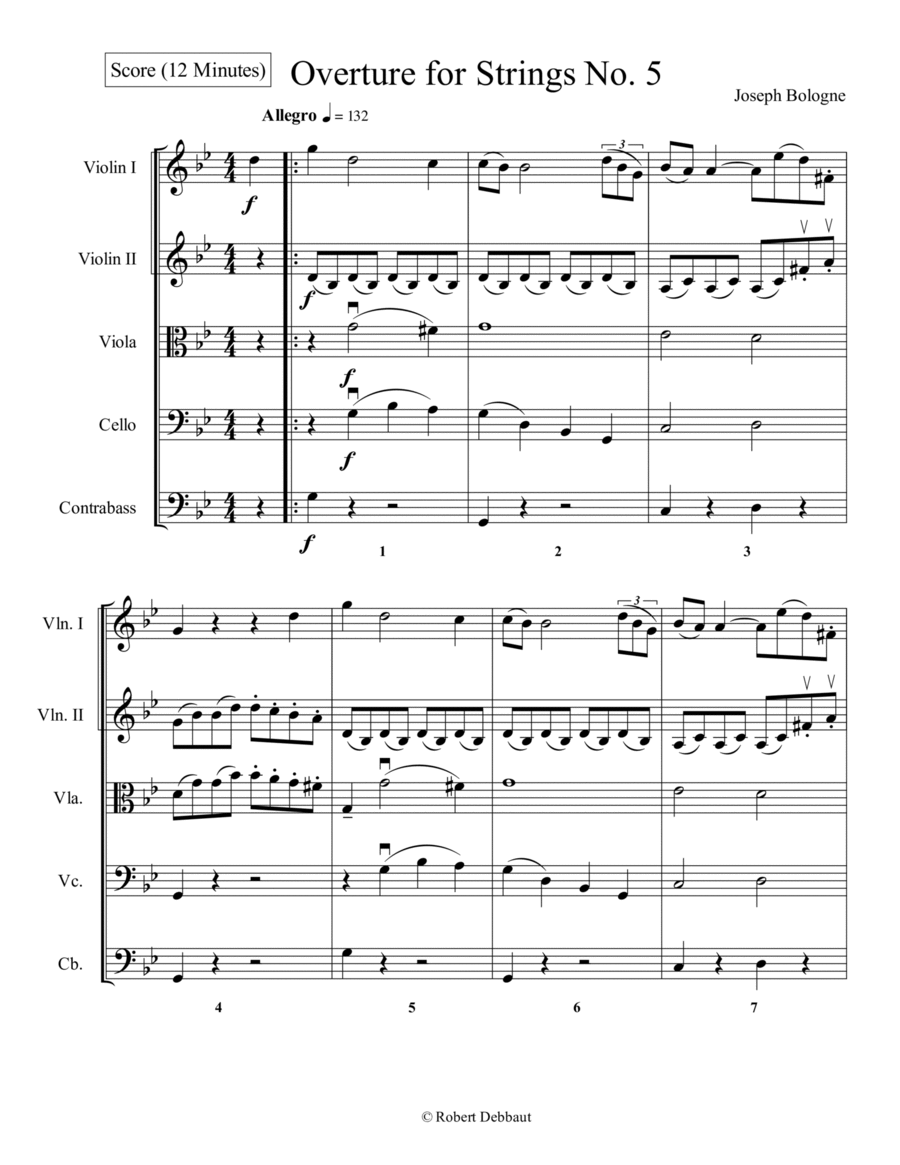
Overture for Strings No. 5 - Score Only
Orchestre à Cordes

$9.99 8.6 € Orchestre à Cordes PDF SheetMusicPlus

String Orchestra - Level 4 - Digital Download SKU: A0.1183537 Composed by Joseph Bologne, Chevalier de St. Georges. Arranged by Robert Debbaut. Classical,Contest,Festival,Historic,Multicultural,World. 57 pages. ROBERT DEBBAUT #783210. Published by ROBERT DEBBAUT (A0.1183537). How is it that one can be born a slave in French colonial Guadeloupe and rise to be among Paris’ musical giants, to become a colonel in the French Army as well as the frequent dinner guest of princes and potentates? The story of Joseph Bologne, Chevalier de Saint-Georges, is surely an interesting one, even the stuff of which movies are made.Joseph Bologne’s father, Georges Bologne de Saint-Georges was a French planter. Saint-Georges was the name of his plantation. He impregnated Anne, the Senegalese slave of his wife, who bore him a son in 1745. Uncharacteristic of many of these sort of relationships he acknowledged the child was his and gave him his family name. When he was seven Bologne’s father took him to Paris for his education, enrolling him in a boarding school. Two years later he and the child’s mother returned to France and set up housekeeping as a family in Paris’ Saint-Germain-des-PrĂ©s district.At age thirteen Joseph’s father enrolled him in the Royal Technical Academy of Fencing and Swordsmanship. He quickly became the finest swordsman in the academy, perhaps in all of Paris. Upon graduation he was made an Officer of the King’s Bodyguard and a chevalier (an honorary knighthood). He went on to serve tours of duty in the French Army during the Seven Years War (1756-1763) and later after the French Revolution, where he was Colonel and commander of an all-Black regiment of the Revolutionary Army. All this in spite of the fact that French law forbade him, a man of African heritage, to become a citizen, to retain his father’s royal title of “Gentleman of the King’s Chamber,” or to marry outside his class.There is limited information about Bologne’s musical training, but he was obviously so well-skilled that Italian violinist-composer Antonio Lolli (1725-1802) wrote two violin concertos for him and French composer François-Joseph Gossec (1734-1829) dedicated his set of String Trios, Op. 9 to Bologne. Lolli may have worked with him on violin technique and Gossec composition, but this may be apocryphal. Bologne played in Gossec’s orchestra, and was later both leader and conductor of the group.As a composer Joseph Bologne was quite prolific, composing six operas, fourteen violin concertos, four symphonies concertantes, and numerous chamber works and songs. His Six String Quartets, Op. 1, Nos. 1-6 date from 1770-1771 and were published by the Paris publishing house of Jean-Georges Sieber (1738-1822) in 1773 (There are a total of 18 quartets: Six Quartets “au goĂ»t du jour” [up-to-date] from 1779 and the Opus 14 set of six which date from 1785). The Opus 1 quartets are dedicated to Anne Louis Alexandre de Montmorency (1724-1812), 7th Prince of Robeck (Robecq) and Grand Duke of Spain.The Opus 1 quartets all display a similarity to the Italian opera overtures from earlier in the Eighteenth Century (often called “sinfonia”) in that they have an overall “A-B-A” form with the ‘A’ sections being robust allegros and all ‘B’ sections marked “rondo.” As such, in arranging them for string orchestra it seemed quite natural to rename them “overtures.” Certain liberties were taken by the arranger in order to maintain the integrity of the classic Rondo formula. All six have been arranged in this manner for string orchestra. They vary in length from twelve to almost twenty minutes. If you wish to obtain parts, write to debbaut@gmail.com and pay $42 via venmo or $40 via personal check and they will be sent to you in pdf format.

Overture for Strings No. 6 - Score Only
Orchestre à Cordes

$9.99 8.6 € Orchestre à Cordes PDF SheetMusicPlus

String Orchestra - Level 4 - Digital Download SKU: A0.1183533 Composed by Joseph Bologne, Chevalier de St. Georges. Arranged by Robert Debbaut. Classical,Contest,Festival,Historic,Multicultural,World. 43 pages. ROBERT DEBBAUT #783206. Published by ROBERT DEBBAUT (A0.1183533). How is it that one can be born a slave in French colonial Guadeloupe and rise to be among Paris’ musical giants, to become a colonel in the French Army as well as the frequent dinner guest of princes and potentates? The story of Joseph Bologne, Chevalier de Saint-Georges, is surely an interesting one, even the stuff of which movies are made.Joseph Bologne’s father, Georges Bologne de Saint-Georges was a French planter. Saint-Georges was the name of his plantation. He impregnated Anne, the Senegalese slave of his wife, who bore him a son in 1745. Uncharacteristic of many of these sort of relationships he acknowledged the child was his and gave him his family name. When he was seven Bologne’s father took him to Paris for his education, enrolling him in a boarding school. Two years later he and the child’s mother returned to France and set up housekeeping as a family in Paris’ Saint-Germain-des-PrĂ©s district.At age thirteen Joseph’s father enrolled him in the Royal Technical Academy of Fencing and Swordsmanship. He quickly became the finest swordsman in the academy, perhaps in all of Paris. Upon graduation he was made an Officer of the King’s Bodyguard and a chevalier (an honorary knighthood). He went on to serve tours of duty in the French Army during the Seven Years War (1756-1763) and later after the French Revolution, where he was Colonel and commander of an all-Black regiment of the Revolutionary Army. All this in spite of the fact that French law forbade him, a man of African heritage, to become a citizen, to retain his father’s royal title of “Gentleman of the King’s Chamber,” or to marry outside his class.There is limited information about Bologne’s musical training, but he was obviously so well-skilled that Italian violinist-composer Antonio Lolli (1725-1802) wrote two violin concertos for him and French composer François-Joseph Gossec (1734-1829) dedicated his set of String Trios, Op. 9 to Bologne. Lolli may have worked with him on violin technique and Gossec composition, but this may be apocryphal. Bologne played in Gossec’s orchestra, and was later both leader and conductor of the group.As a composer Joseph Bologne was quite prolific, composing six operas, fourteen violin concertos, four symphonies concertantes, and numerous chamber works and songs. His Six String Quartets, Op. 1, Nos. 1-6 date from 1770-1771 and were published by the Paris publishing house of Jean-Georges Sieber (1738-1822) in 1773 (There are a total of 18 quartets: Six Quartets “au goĂ»t du jour” [up-to-date] from 1779 and the Opus 14 set of six which date from 1785). The Opus 1 quartets are dedicated to Anne Louis Alexandre de Montmorency (1724-1812), 7th Prince of Robeck (Robecq) and Grand Duke of Spain.The Opus 1 quartets all display a similarity to the Italian opera overtures from earlier in the Eighteenth Century (often called “sinfonia”) in that they have an overall “A-B-A” form with the ‘A’ sections being robust allegros and all ‘B’ sections marked “rondo.” As such, in arranging them for string orchestra it seemed quite natural to rename them “overtures.” Certain liberties were taken by the arranger in order to maintain the integrity of the classic Rondo formula. All six have been arranged in this manner for string orchestra. They vary in length from twelve to almost twenty minutes. If you wish to obtain parts, write to debbaut@gmail.com and pay $42 via venmo or $40 via personal check and they will be sent to you in pdf format.

Overture for Strings No. 2 - Score Only
Orchestre à Cordes

$9.99 8.6 € Orchestre à Cordes PDF SheetMusicPlus

String Orchestra - Level 3 - Digital Download SKU: A0.576182 Composed by David Warin Solomons. Contemporary,Opera,World. Score and parts. 13 pages. David Warin Solomons #4559. Published by David Warin Solomons (A0.576182). ATON is a stage play written by Manfred Strolz and Otmar RĂŒtzler which represents Egypt in the time of the Pharoahs but seen through the eyes of modern theatre directors and actors. The modern scenes are spoken but the Egyptian scenes require music, so Manfred and Otmar asked me to write the music for these. The music is composed for various forces as the play progresses, from the full orchestra (woodwind, strings, harp, piano, timpani) and choir down to more intimate moments with single voice or duets, flute and classical guitar or with single voice and bassoon. For each section the pdf file contains score and parts and the sound sample is an electronic preview. As I write 16 sections have been composed, but more are to come - please just search for Aton in due course for the full picture. The first performance is planned to take place in the Landestheater in Innsbruck during 2015 ================= ATON ist ein BĂŒhnenstĂŒck von Manfred Strolz and Otmar RĂŒtzler geschrieben, das Ägypten von der Pharaonenzeit vorstellt aber auch duch die Augen moderner Direktoren und Schauspieler sieht. Die modernen Szenen sind gesprochen aber die Ă€gyptischen Szenen brauchen Musik, deshalb haben mich Manfred und Otmar gebeten die Musik dafĂŒr zu schreiben. Die Musik ist fĂŒr verschiedene KrĂ€fte wĂ€hrend des StĂŒckes komponiert: vom vollen Orchester (HolzblĂ€ser, Streicher, Harfe, Klavier, Timpani) und Chor bis zu intimeren Augenblicken mit Solostimme (oder Duetten) mit Flöte und klassicher Gitarre oder Solostimme mit Fagott. Im Augenblick gibt es 16 Kompositionen, aber es wird noch mehr geben - bitte suche spĂ€ter nach Aton fĂŒr das vollstĂ€ndige Bild. FĂŒr jede Komposition enhĂ€lt die pdf-Datei Partitur und Stimmen und die mp3-Datei ist eine elektronische Vorschau. Es wird geplant, die erste AuffĂŒhrung im Landestheater Innsbruck im Jahre 2015 stattzuhalten.
ATON part 4-Musikalische Szene - bassoon and strings
Orchestre à Cordes

$5.00 4.3 € Orchestre à Cordes PDF SheetMusicPlus

String Orchestra - Level 3 - Digital Download SKU: A0.1178506 Composed by Johann Sebastian Bach. Arranged by César Madeira. Baroque,Early Music,Film/TV,Multicultural,Wedding,World. Score and Parts. 8 pages. Sheet Music To Play Editions #778468. Published by Sheet Music To Play Editions (A0.1178506). Air on the G String from Orchestral Suite No.3 (BWV1068). Arrangement for String Orchestra - Violin 1, 2, Viola, Violoncello and Contrabass. With Full Score and Individual Parts. Enjoy it!Johann Sebastian Bach (1685 - 1750) was a German composer and musician of the Baroque period. He is known for instrumental compositions such as the Brandenburg Concertos and the Goldberg Variations, and for vocal music such as the St Matthew Passion and the Mass in B minor. Since the 19th-century Bach Revival, he has been generally regarded as one of the greatest composers of all time.For Tutorials, Play Alongs or request New Arrangements, visit the YouTube Channel: Sheet Music To Play
Air on G String - String Orchestra (Full Score and Parts)
Orchestre à Cordes

$13.99 12.04 € Orchestre à Cordes PDF SheetMusicPlus

String Orchestra - Level 3 - Digital Download SKU: A0.1225568 Composed by Johann Sebastian Bach. Arranged by César Madeira. Baroque,Children,Film/TV,Multicultural,Wedding,World. 3 pages. Sheet Music To Play Editions #821640. Published by Sheet Music To Play Editions (A0.1225568). Air on the G String from Orchestral Suite No.3 (BWV1068). Arrangement for String Orchestra - Violin 1, 2, Viola, Violoncello and Contrabass. With Full Score. Enjoy it!This file DOES NOT contain Individual Parts. Full Score only.Johann Sebastian Bach (1685 - 1750) was a German composer and musician of the Baroque period. He is known for instrumental compositions such as the Brandenburg Concertos and the Goldberg Variations, and for vocal music such as the St Matthew Passion and the Mass in B minor. Since the 19th-century Bach Revival, he has been generally regarded as one of the greatest composers of all time.For Tutorials, Play Alongs or request New Arrangements, visit my YouTube Channel: Sheet Music To Play
Air on G String - String Orchestra (Full Score) - Score Only
Orchestre à Cordes

$8.99 7.74 € Orchestre à Cordes PDF SheetMusicPlus

String Orchestra - Level 3 - Digital Download SKU: A0.1225565 Composed by Johann Sebastian Bach. Arranged by César Madeira. Baroque,Chamber,Early Music,Standards,Wedding. Score and Parts. 5 pages. Sheet Music To Play Editions #821637. Published by Sheet Music To Play Editions (A0.1225565). Air on the G String from Orchestral Suite No.3 (BWV1068). Arrangement for String Orchestra - Violin 1, 2, Viola, Violoncello and Contrabass. With Individual Parts. Enjoy it!This file DOES NOT contain Full Score. Individual Parts only.Johann Sebastian Bach (1685 - 1750) was a German composer and musician of the Baroque period. He is known for instrumental compositions such as the Brandenburg Concertos and the Goldberg Variations, and for vocal music such as the St Matthew Passion and the Mass in B minor. Since the 19th-century Bach Revival, he has been generally regarded as one of the greatest composers of all time.For Tutorials, Play Alongs or request New Arrangements, visit my YouTube Channel: Sheet Music To Play
Air on G String - String Orchestra (Individual Parts)
Orchestre à Cordes

$8.99 7.74 € Orchestre à Cordes PDF SheetMusicPlus


Partitions Gratuites
Acheter des Partitions Musicales
Acheter des Partitions Digitales à Imprimer
Acheter des Instruments de Musique

© 2000 - 2026

Accueil - Version intégrale


