EUROPE
954 articles
USA
0 articles
DIGITAL
4 articles (à imprimer)
Partitions Digitales
Partitions à imprimer
4 partitions trouvées


String Orchestra - Level 4 - Digital Download SKU: A0.529930 Composed by Johann Sebastian Bach. Arranged by Matt Riley. Contemporary,Pop,Rock. Score and Parts. 19 pages. Www.mattrileymusic.com #3478241. Published by www.mattrileymusic.com (A0.529930). An epic show opener, this 60 second rock/classical arrangement can be performed with just solo violin, string orchestra and rhythm section (drums, bass guitar, electric guitar). The solo viola and cello parts are optional. The Rhythm Section part has a mix a standard notation and rhythmic notation with chord symbols for a guitarist, bassist and drummer to follow and improvise their parts based on the original recording. https://youtu.be/BLPyFlf81cA
Toccata and Fugue in Dm
Orchestre à Cordes

$75.00 65.35 € Orchestre à Cordes PDF SheetMusicPlus

String Orchestra - Level 5 - Digital Download SKU: A0.533709 Composed by Carson Cooman. 20th Century,Contemporary,Standards. Score and parts. 71 pages. Musik Fabrik Music Publishing #3041103. Published by Musik Fabrik Music Publishing (A0.533709). I. Chaconne: ...a continuum of dreams...II. CadenzaIII. ToccataConcerto for Bass Saxophone and Strings (1999) was commissioned by basssaxophonist Andreas van Zoelen (with generous support from the Broeker Fund forNew Music) and is dedicated with appreciation and admiration to him. Van Zoelen iscommitted to enhancing the very small existing bass saxophone repertoire throughsupporting the creation and performance of new works. The subtitle of the firstmovement (...a continuum of dreams...) could be seen as a sort of subtitle for theentire work that sets the mood and provides unification for the entire piece. The firstmovement is a slow and ethereal chaconne. The strings and the saxophone interact invarious ways throughout this movement in non-traditional form. There are actuallytwo ground bass themes; one is introduced at the beginning with pizzicato stringsbut soon moves to the background (although it is almost always present). The secondis presented near the end of the work and eventually the two are combined. Theinterval of an augmented fourth (tritone) has special use throughout the movementas a variety of themes and motifs are transformed throughout. The second movementis a cadenza for the unaccompanied saxophone. The third movement is a fast andwild toccata. The saxophone plays almost without rest for the entire movement. Amiddle section recalls the theme of augmented fourths from the first movement.Heavy use is made of pizzicato strings. The saxophone part for this movement ishighly virtuosic, exploring the full possibilities and range of the instrument.This is the score and solo part only.  The parts are on rental from the publisher.
Carson Cooman: Concerto for Bass Saxophone and Strings (1999), score and solo part
Orchestre à Cordes

$29.95 26.1 € Orchestre à Cordes PDF SheetMusicPlus

String Orchestra - Level 5 - Digital Download SKU: A0.533701 Composed by Carson Cooman. Baroque,Contemporary,Standards. Score and parts. 77 pages. Musik Fabrik Music Publishing #3038897. Published by Musik Fabrik Music Publishing (A0.533701). Concerto for Portatif Organ and Strings (2006) was commissioned by the Harvard Baroque Chamber Orchestra and its director, Robert Mealy. The work is dedicated to organist Nancy Granert, for whom the solo part was written. The work was commissioned in celebration of the von Clemm Chamber Organ at The Memorial Church, Harvard University, built in 2006 by Klop Organ Builders.As with many of my works, relationships between old and new musical concepts are explored. In this piece, musical aspects of the Baroque organ concerto tradition (and Baroque style string playing) co-exist with more contemporary musical elements. In particular, the directness of expression found in many Baroque concertante works is present throughout. Musical material is shared between the movements in a motivic fashion.The title of the first movement, Bricolage, is defined as “something made or put together using whatever materials happen to be available.†  Thus, the musical material for the movement is of varying characters; these elements are assembled together in ways that allow them to comment on and inform each other. Some of these musical elements include: a traditional “overture†texture, a Basse de Trompette texture (with an organ reed stop in the left hand) common in French Baroque organ music, and the French keyboard toccata style.The second movement, Elegia, is dark and searching in tone. It begins with a rageful roar before quieting down to introduce its basic musical material – a simple “lament†theme in a folk-inflected style. This material is used for further explorations, building to passionate climaxes. Finally, the opening music returns, but this time with a whisper. The movement winds down to a sad conclusion.After the soul-searching of the second movement, the third movement, Rondeau, is sprightly and energetic. The basic material is a set of Baroque and Classical-style figurations (with a few American gospel inflections thrown in), firmly grounded in G major. After minor diversions, the original material continues to return and ends the work with unfettered joy.
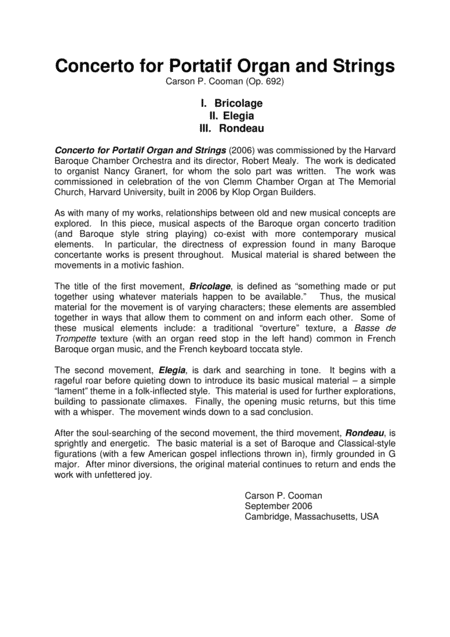
Carson Cooman: Concerto for Portatif Organ and Strings (2006), score and complete parts
Orchestre à Cordes

$64.95 56.6 € Orchestre à Cordes PDF SheetMusicPlus

String Orchestra - Level 5 - Digital Download SKU: A0.533700 Composed by Carson Cooman. Baroque,Contemporary,Standards. Score and parts. 38 pages. Musik Fabrik Music Publishing #3038895. Published by Musik Fabrik Music Publishing (A0.533700). Concerto for Portatif Organ and Strings (2006) was commissioned by the HarvardBaroque Chamber Orchestra and its director, Robert Mealy. The work is dedicatedto organist Nancy Granert, for whom the solo part was written. The work wascommissioned in celebration of the von Clemm Chamber Organ at The MemorialChurch, Harvard University, built in 2006 by Klop Organ Builders.As with many of my works, relationships between old and new musical concepts areexplored. In this piece, musical aspects of the Baroque organ concerto tradition(and Baroque style string playing) co-exist with more contemporary musicalelements. In particular, the directness of expression found in many Baroqueconcertante works is present throughout. Musical material is shared between themovements in a motivic fashion.The title of the first movement, Bricolage, is defined as “something made or puttogether using whatever materials happen to be available.†Thus, the musicalmaterial for the movement is of varying characters; these elements are assembledtogether in ways that allow them to comment on and inform each other. Some ofthese musical elements include: a traditional “overture†texture, a Basse deTrompette texture (with an organ reed stop in the left hand) common in FrenchBaroque organ music, and the French keyboard toccata style.The second movement, Elegia, is dark and searching in tone. It begins with arageful roar before quieting down to introduce its basic musical material – a simple“lament†theme in a folk-inflected style. This material is used for further explorations,building to passionate climaxes. Finally, the opening music returns, but this timewith a whisper. The movement winds down to a sad conclusion.After the soul-searching of the second movement, the third movement, Rondeau, issprightly and energetic. The basic material is a set of Baroque and Classical-stylefigurations (with a few American gospel inflections thrown in), firmly grounded in Gmajor. After minor diversions, the original material continues to return and ends thework with unfettered joy.This item is the score only.  The score and complete parts are available for sale as another item.
Carson Cooman: Concerto for Portatif Organ and Strings, score only
Orchestre à Cordes

$25.95 22.61 € Orchestre à Cordes PDF SheetMusicPlus


Partitions Gratuites
Acheter des Partitions Musicales
Acheter des Partitions Digitales à Imprimer
Acheter des Instruments de Musique

© 2000 - 2026

Accueil - Version intégrale





