EUROPE
1662 articles
USA
0 articles
DIGITAL
42 articles (à imprimer)
Partitions Digitales
Partitions à imprimer
42 partitions trouvées


Cello and piano - advanced - Digital Download SKU: S9.Q52946 For piano and violoncello. Composed by Richard Strauss. This edition: score and part. Complete edition - piano - score - violoncello. Downloadable, Score and part. Duration 26 minutes. Schott Music - Digital #Q52946. Published by Schott Music - Digital (S9.Q52946). Key: F major.The Cello Sonata Op. 6 was composed over an apparently frequently interrupted period of three years, an extraordinarily long time for Strauss’s early creative phase. The compositional process spawned two independent versions of the work, the first of which is published for the first time on the basis of the text in the Critical Edition of the Works of Richard Strauss in the current edition as a practical musical text. The genesis of the two versions and the reasons for revision can only be reconstructed in part: only one of the surviving autographs bears a date and the second version only survives in printed form. What is more, Strauss did not communicate in greater detail on this composition in correspondence with his family and friends. There are enormous differences between the two versions of the Sonata: Strauss deleted the entire second and third movements Larghetto and Allegro vivace, replacing them with a newly composed Andante and Finale. In the first movement, Allegro con brio, Strauss retained the thematic-motivic material and compositionally complex passages such as the three-voice fugue in the development section (from bar 241 in the first version and bar 275 in the second version) almost intact in the new version of the sonata, but also undertook extensive alterations, particularly in the structure of the piano part, the motivic-thematic development of the movement and its harmony which became far more ambitious.12 Particular attention should be drawn to the repetitive accompaniment of the con espressione theme beginning in bar 32 and the significantly shorter development in the first version. The current printed edition of the first version of Richard Strauss’s Cello Sonata now makes it possible to follow Strauss’s compositional development during this period. The significance of the differences between the versions also mean that two sonata compositions for violoncello and piano by Richard Strauss with fundamental disparities in their underlying character are now available for performance. (from the foreword by the editors).
Sonate F-Dur (First edition of 1st version)
Violoncelle, Piano

$34.99 30.48 € Violoncelle, Piano PDF SheetMusicPlus

Cello,Piano - Level 2 - Digital Download SKU: A0.565943 By Sharon Wilson. By John Henry Hopkins Jr. and John Henry Hopkins Jr. Arranged by Sharon Wilson. Children,Christmas,Folk,Sacred,Traditional. Score and part. 6 pages. Sharon Wilson #6601463. Published by Sharon Wilson (A0.565943). Here is an easy instrumental duet arrangement (for CELLO solo with PIANO accompaniment) of the classic Christmas hymn We Three Kings of Orient Are by John H. Hopkins. The CELLO plays the melody throughout. An optional repeat with a second ending is included in case a longer song is desired.All notes for the CELLO are playable in the first position making this arrangement an excellent choice for early-intermediate string players. The PIANO accompaniment is written for an intermediate player. The purchase price includes a 4-page combined score with both CELLO and PIANO parts on each page plus a separate 1-staff score for the CELLO (1 page). This arrangement is one of the 10 songs in the collection Christmas Carols (A Collection of 10 Easy Cello Solos with Piano Accompaniment).Visit Sharon Wilson's website: https://www.sharonwilsonmusic.com/Subscribe to her YouTube Channel: https://youtube.com/@SharonWilsonMusicCover Image Credit: Pixabay.com
We Three Kings (Easy Cello Solo with Piano Accompaniment)
Violoncelle, Piano
Sharon Wilson
$3.99 3.48 € Violoncelle, Piano PDF SheetMusicPlus

Cello,Piano - Level 1 - Digital Download SKU: A0.909028 Composed by Traditional. Arranged by Emma Butterworth. Children,Folk,Instructional,Standards. Score and part. 4 pages. Emma Butterworth #4848239. Published by Emma Butterworth (A0.909028). London's Burning, Bobby Shaftoe and The Caterpillar are three very easy pieces for beginner cellists, using mostly open strings and the first and 4th finger on the D and A. They come with simple piano accompaniments, and are enjoyed by many students at the beginning of their cello journey.Emma Butterworth is a composer for film and TV and also a successful Suzuki cello teacher. She has an intimate knowledge of how to write for strings, and has written and arranged a vast number of pieces for cellos and strings especially. All pieces have been played and performed.
Three Easy Cello Pieces
Violoncelle, Piano

$3.99 3.48 € Violoncelle, Piano PDF SheetMusicPlus

Cello,Piano - Level 4 - Digital Download SKU: A0.1281610 By Ferdinand Ries. By Ferdinand Ries. 19th Century,Classical,Romantic Period. Score and part. 40 pages. Paladino Editions #872952. Published by Paladino Editions (A0.1281610). Trois Airs Russes Variés pour le Piano-forte et Violoncelle ou Violon Concertans, Op. 72, was written in 1812, while Ries was on tour in Russia with virtuoso cellist Bernhard Romberg. A virtuoso display piece for both instruments, it is a potpourri of three Russian tunes. Two cello parts are included in this edition by Cole Tutino and Martin Rummel: one as printed in the first edition, and one with fingerings and bowings by Martin Rummel.
Three Russian Airs With Variations, Op. 72
Violoncelle, Piano
Ferdinand Ries
$15.95 13.9 € Violoncelle, Piano PDF SheetMusicPlus

Cello,Piano - Level 3 - Digital Download SKU: A0.1487802 Composed by Pietro Antonio Locatelli. Arranged by David Starkweather. Classical. Score and part. 28 pages. Artaria Editions #1064740. Published by Artaria Editions (A0.1487802). Three movements from these two sonatas became part of the cello literature due to an arrangement by Alfredo Piatti(1822-1901). Piatti's arrangement, while extending the literature for cello, took considerable liberty with the material. The three movements of the Locatelli-Piatti sonata are originally movements from the two Locatelli violin sonatas arranged in this edition for cello and continuo. Piatti's arrangement used the second and third movements of the Sonata in D Major, Op. 6 No. 6 , and the first movement of the Sonata in D Minor, Op. 6 No. 12 . Pietro Antonio Locatelli (1695-1764) was an Italian composer and violinist who moved to Amsterdam in 1729. He was a virtuoso violinist, and his compositions are all concertos, sonatas and violin caprices. The twelve violin sonatas of Opus 6,1 published in Amsterdam in 1737, are considered to be among Locatelli's best works. The sonatas of Opus 6 generally follow the pattern found in No.6: a three movement scheme with a slow first movement, a fast middle movement, and concluding with a third movement set of variations, often on a minuet theme. No. 12 is a surprise, having five movements the last of which is a Capriccio, a predominantly solo movement subtitled Prova del intonatione. David Starkweather.
Sonata in D major, Op. 6, No. 6 for cello and keyboard (harpsichord)
Violoncelle, Piano

$28.00 24.39 € Violoncelle, Piano PDF SheetMusicPlus

Cello,Piano - Level 3 - Digital Download SKU: A0.1487803 Composed by Pietro Antonio Locatelli. Arranged by David Starkweather. Classical. Score and part. 31 pages. Artaria Editions #1064741. Published by Artaria Editions (A0.1487803). Three movements from these two sonatas became part of the cello literature due to an arrangement by Alfredo Piatti(1822-1901). Piatti's arrangement, while extending the literature for cello, took considerable liberty with the material. The three movements of the Locatelli-Piatti sonata are originally movements from the two Locatelli violin sonatas arranged in this edition for cello and continuo. Piatti's arrangement used the second and third movements of the Sonata in D Major, Op. 6 No. 6 , and the first movement of the Sonata in D Minor, Op. 6 No. 12. Pietro Antonio Locatelli (1695-1764) was an Italian composer and violinist who moved to Amsterdam in 1729. He was a virtuoso violinist, and his compositions are all concertos, sonatas and violin caprices. The twelve violin sonatas of Opus 6,1 published in Amsterdam in 1737, are considered to be among Locatelli's best works. The sonatas of Opus 6 generally follow the pattern found in No.6: a three movement scheme with a slow first movement, a fast middle movement, and concluding with a third movement set of variations, often on a minuet theme. No. 12 is a surprise, having five movements the last of which is a Capriccio, a predominantly solo movement subtitled Prova del intonatione. David Starkweather.
Sonata in D minor, Op.6, No.12 for cello and keyboard (harpsichord)
Violoncelle, Piano

$28.00 24.39 € Violoncelle, Piano PDF SheetMusicPlus

Cello,Instrumental Solo,Piano - Level 4 - Digital Download SKU: A0.987858 Composed by Robert M. Greenberg. 20th Century,Contemporary. Score and individual part. 32 pages. Robert M. Greenberg #115605. Published by Robert M. Greenberg (A0.987858). Preferred Contact Information: RMonteverdi@comcast.net Performing Rights Organization: BMI Website: robertgreenbergmusic.com Facebook Band Page: facebook.com/RobertGreenbergMusic Video: https://mail.google.com/mail/?tab=wm#inbox/14f3cea616cb0a88?projector=1 Duration: ca. 12 minutes Year of composition: 2014 Program Note: I. Overture II. Nigun no. 9 III. Molad’ti IV. Gilu Hagalilim V. Y’mey Hanoar VI. The Gigue Is Up My apologies upfront for all the first person pronouns in this program note! A few years back, Nina Flyer asked me to write for her a piece of music that would contain or make reference to Jewish/Yiddish/Hebrew dance music and/or folk songs. The more I thought about it, the more difficult I realized the challenge would be. As best as I could tell, I had three options. Option one: I could set said dance music/songs for cello and piano, with the result being a series of arrangements: nice, but artlessly unoriginal (meaning dull). Option two: I could weave the tunes into a single narrative and in doing so write another version of Schlomo (a self-proclaimed Hebraic work for cello and orchestra by Ernst Bloch). Option three: I could make up my own ethnic-sounding melodies and either arrange them for cello and piano or weave them into some sort of Hebraic narrative: options one and two all over again. So I came up with option four. I selected four folk tunes (movements II, III, IV, and V) and composed a counter-melody to each. The first half of movements II, III, IV, and V set that counter-melody without any reference to the original folk tune. The second half of those movements then combines the counter-melody with the original tune (and thus the revelation, as the original tune is revealed). The generally two-part shape described above (excepting movement IV, which is A-B-A in structure) suggested Baroque binary dance form, and so I turned the piece into a sort of Baroque dance suite. It begins with a French Overture based on the counter-melodies of movement III and V, and concludes with a gigue based on the counter melodies of movements II and IV. The historical references are supposed to be tongue-in-cheek and I can only hope they will be taken that way. A thousand-and-one thanks to Nina Flyer and Lori Lack for their patience, hard work, and musical brilliance. Suite Revelation is dedicated – with the greatest respect and affection – to Nina Flyer.
Suite Revelation for cello and piano
Violoncelle, Piano

$28.00 24.39 € Violoncelle, Piano PDF SheetMusicPlus

Cello,Piano - Level 2 - Digital Download SKU: A0.1303403 Composed by Gabriel Faure. Arranged by Harry Walker. 19th Century,Romantic Period. Score and part. 8 pages. SCORE EDITIONS #892977. Published by SCORE EDITIONS (A0.1303403). This mélodie is the first in a set of three songs, opus 7, which also comprises Hymne and Barcarolle respectively. All three were composed between 1870 and 1877, then collected and published in 1878 under the title Trois Mélodies. Not originally conceived as a song cycle, these three songs acquired this opus number much later, in the 1890s. The poem for Après un rêve was loosely adapted from an anonymous Italian text by Romain Bussine. It describes, in the form of a dream, the imaginary flight of two lovers who are head over heels in love, although the last verse brings the dreamer inexorably back to harsh reality as dawn is breaking.
Après un rêve (Fauré) for Cello and Piano
Violoncelle, Piano

$5.99 5.22 € Violoncelle, Piano PDF SheetMusicPlus

Cello,Piano - Level 3 - Digital Download SKU: A0.844351 Composed by Lyrics: Charles Wesley, Music: Thomas Campbell, published 1738, and published 1825. Arranged by Dan Cutchen. Christian,Gospel,Sacred,Spiritual. Score and part. 15 pages. Dan Cutchen Music #4281895. Published by Dan Cutchen Music (A0.844351). This arrangement of And Can It Be That I Should Gain? is for cello solo and piano.A theme and variation treatment is used.  For a piano background Mp3 track, search for: Cello - And Can It Be? Piano Accompaniment, Dan CutchenTime: approximately 6:00And Can It Be That I Should Gain? is a Christian hymn written by Charles Wesley. And Can It Be was written in 1738 to celebrate Wesley's conversion, which he regarded as having taken place on May 21 of that year.This beautiful hymn has been popular and enduring.And Can It Be That I Should Gain is perhaps one of the most joyfully poignant hymns penned by Charles Wesley (1707-1788). On Whitsunday (Pentecost), May 21, 1738, three days before his brother John experienced his heart strangely warmed,’ Charles was convalescing in the home of John Bray, a poor mechanic, when he heard a voice saying, In the name of Jesus of Nazareth, arise, and believe, and thou shalt be healed of all thy infirmities. The voice was most likely Mr. Bray’s sister who felt commanded to say these words in a dream.Anglican hymn writer Timothy Dudley-Smith, notes that the following then happened:Charles got out of bed and opening his Bible read from the Psalms: He have put a new song in my mouth, even praise unto our God, followed by the first verse of Isaiah 40, Comfort ye, comfort ye my people, saith your God. He wrote in his journal, I have found myself at peace with God, and rejoiced in the hope of love Christ (Dudley-Smith, 1987, 1).The statement from Mr. Bray’s sister sparked within Charles a conviction like he had never felt before. Moved and convicted in spirit, Charles wrestled with these words until he came to rest in his faith, knowing that it is by faith we are saved (Ephesians 2:8).Soon after this conversion experience, he wrote two hymns in celebration of the amazing love he had come to know: And Can It Be that I Should Gain and Where Shall My Wondering Soul Begin? (United Methodist Hymnal, 342)There has been some debate as to which hymn was written first, but most current scholarship accepts the latter as the first hymn written by Charles after his conversion experience. No matter its place in the chronology of Wesley's output, And Can It Be has been and remains one of his most remarkable hymns, expressing like no other the rapturous joy of receiving salvation.And Can It Be That I Should Gain. Hymnary.org, https://hymnary.org/text/and_can_it_be_that_i_should_gainDudley-Smith, Timothy. A Flame of Love: A Personal Choice of Charles Wesley’s Verse. London: Triangle SPCK, 1987.Timothy Dudley-Smith. And can it be that I should gain. The Canterbury Dictionary of Hymnology. Canterbury Press, accessed May 29, 2018, http://www.hymnology.co.uk/a/and-can-it-be-that-i-should-gain.Young, Carlton R. And Can It Be That I Should Gain. Companion to the United Methodist Hymnal. Abingdon Press, 1993.(Taken from: History of Hymns: And Can It Be That I Should Gain by DeAndre Johnson found at https://www.umcdiscipleship.org/resources)https://youtu.be/xCpG9mpfSFk
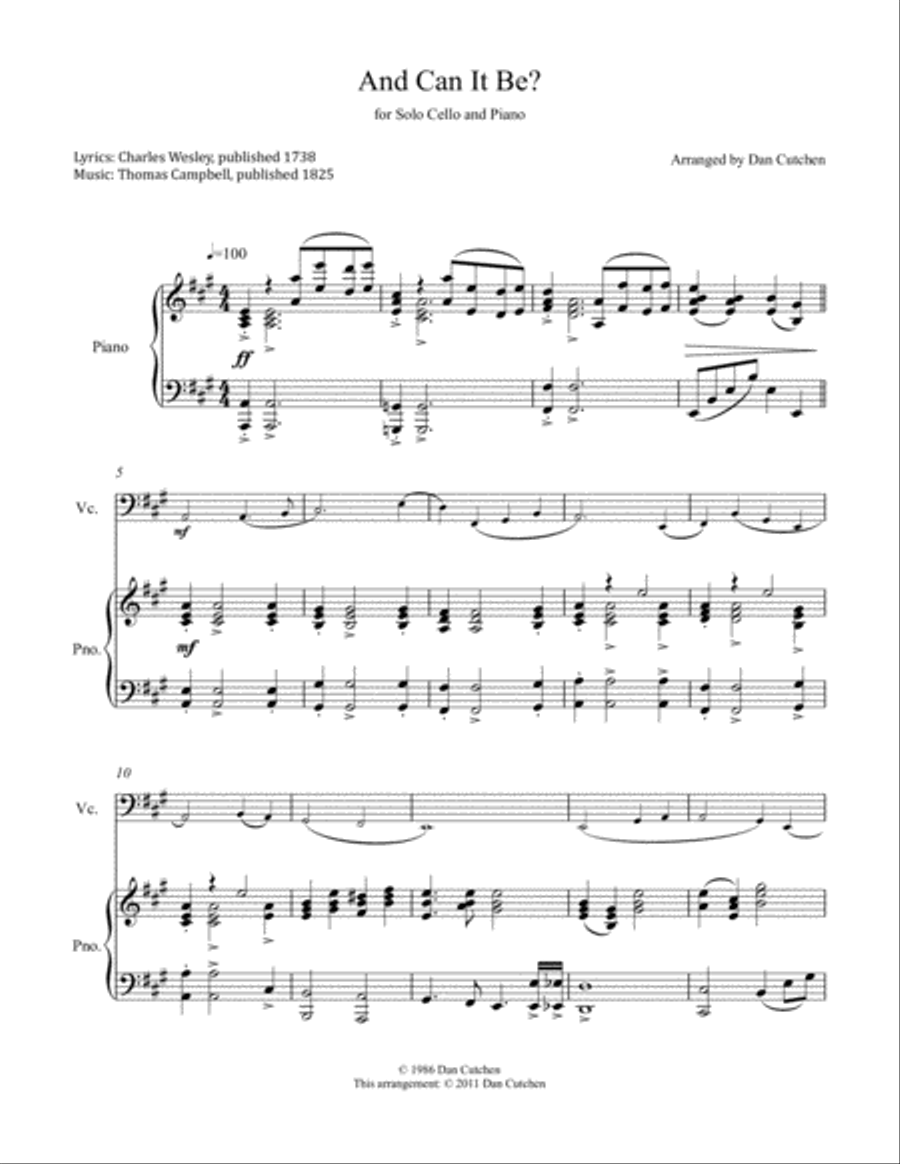
Cello - "And Can It Be?" Theme and Variations
Violoncelle, Piano

$6.00 5.23 € Violoncelle, Piano PDF SheetMusicPlus

Cello,Piano - Level 3 - Digital Download SKU: A0.1349587 By Elvis Presley. By Johnny Christopher, Mark James, and Wayne Thompson. Arranged by Kevin P Holdgate. 20th Century,Country,Pop,Standards,Wedding. Score and part. 6 pages. Kevin P Holdgate #934350. Published by Kevin P Holdgate (A0.1349587). Always on My Mind is a ballad written by Wayne Carson, Johnny Christopher, and Mark James, first recorded by Brenda Lee and first released by Gwen McCrae (as You Were Always on My Mind) in March 1972. Lee's version was released three months later in June 1972. The song has been a crossover hit, charting in both the country and western and pop categories. Elvis Presley's recording was the first commercially successful version of the song.AllMusic lists more than 300 recorded releases of the song in versions by dozens of performers. While Lee's version reached no. 45 on the US country chart in 1972, other performers reached the Top 20 on the country and/or pop charts in the United States and elsewhere with their own versions: Elvis Presley (1972, US country; UK pop Top Ten); John Wesley Ryles (1979, US country) and Willie Nelson's Grammy Award-winning version (1982, US/Canada country number one; US/Canada pop Top Ten); and the Pet Shop Boys' 1987 hi-NRG/synth-pop interpretation (UK number one; US Top Ten).This arrangement of what is a beautiful song is suitable for players of around Grade 4 ABRSM or equivalent.
Always On My Mind
Violoncelle, Piano
Elvis Presley
$5.99 5.22 € Violoncelle, Piano PDF SheetMusicPlus

Flute, cello and piano - difficult - Digital Download SKU: S9.Q16961 For Flute (also Flute in G), Violoncello and Piano. Composed by Thierry Pecou. This edition: score and parts. Downloadable, score and parts. Duration 10 minutes. Schott Music - Digital #Q16961. Published by Schott Music - Digital (S9.Q16961). This diptych consists of two brief contrasting movements which however have a common focus on the amalgamation and fusion of tonal colour in the three instruments.The harmonic foundations of the first movement are provided by ring modulation spectrums although these are also based on equal-tempered tuning in semitones. In the manner of a deep intake of breath, life is breathed into the first movement through numerous clashes, contrasting registers and runs at lightning speed.The second movement has an unmistakable focus on tonal colouring and the concept of echo and reverberation complemented by simple acoustic effects, unfolding a substantially extended tonal spectrum in continuation of the first movement.
Le grain léger
Violoncelle, Piano

$29.99 26.13 € Violoncelle, Piano PDF SheetMusicPlus

Cello,Piano - Level 2 - Digital Download SKU: A0.1453671 By The Newsboys. By Keith Getty and Stuart Townend. Arranged by Sharon Wilson. 21st Century,Christian,Contemporary,Easter,Sacred. Score and part. 15 pages. Sharon Wilson #1032884. Published by Sharon Wilson (A0.1453671). This favorite contemporary hymn by Keith Getty and Stuart Townend is arranged as an instrumental duet (for Cello Solo with Piano Accompaniment). The beautiful, lyrical style of this instrumental piece creates a powerfully uplifting atmosphere and is an ideal selection for any church setting.For the first verse, the CELLO plays the melody. The PIANO plays the melody for the second verse and then concludes with the CELLO on the melody for the third verse. The PIANO has both right-hand and left-hand playing melody during the interludes. Three unique verses are included and if four verses are desired to match the lyrics, an optional repeat is included for the last verse. The first two verses are softer and more lyrical than the third verse.  For the third and optional fourth verse, the PIANO transitions to a bolder, more powerful feel matching the intensity of the lyrics: Then bursting forth in glorious day, Up from the grave He rose again! The audio sample begins in measure 5.The range for the CELLO is C3 to D4. All notes for the CELLO are playable in the first position making this piece an excellent choice for early-intermediate string players.The purchase price includes these printing options: 1. a grand staff (7 pages) with both parts on each page2. separate scores for the CELLO (2 pages) and PIANO (4 pages)This arrangement is also available for the following instrument combinations (all sold separately):Piano SoloFlute or Violin Solo with Piano accompanimentFlute and/or Violin duet with Piano accompanimentViolin and Cello duet with Piano accompanimentVisit Sharon Wilson's website: https://www.SharonWilsonMusic.com/Subscribe to her YouTube Channel: https://youtube.com/@SharonWilsonMusicKeywords: praise music, worship service, meditation, devotion, devotional music, invitation, prelude, offertory, contemporary Gospel songs, communion, altar call, Getty Music, Keith and Kristyn Getty.
In Christ Alone
Violoncelle, Piano
The Newsboys
$5.99 5.22 € Violoncelle, Piano PDF SheetMusicPlus

Cello,Piano - Level 3 - Digital Download SKU: A0.1411066 Composed by P. I. Tchaikovsky. Arranged by Diego Marani. Classical,Film/TV,Instructional,Romantic Period,Standards. Score and part. 15 pages. Diego Marani #993412. Published by Diego Marani (A0.1411066). The Sleeping Beauty is a ballet in a prologue and three acts, first performed in 1890. The music was composed by Pyotr Ilyich Tchaikovsky (his opus 66). The score was completed in 1889, and is the second of his three ballets.This arrangement for cello with piano accompaniment of the marvelous Grande valse villageoise (a.k.a. The Garland Waltz) is maybe one of the most famous composition of Tchaikovsky used also in the Disney's film Sleeping Beauty.It suitable for any occasion: repertoire, recital, classroom or also for an outstanding and beautiful encore.
The Sleeping Beauty Waltz for Cello and Piano
Violoncelle, Piano

$8.99 7.83 € Violoncelle, Piano PDF SheetMusicPlus


Partitions Gratuites
Acheter des Partitions Musicales
Acheter des Partitions Digitales à Imprimer
Acheter des Instruments de Musique

© 2000 - 2026

Accueil - Version intégrale





