EUROPE
0 articles
USA
0 articles
DIGITAL
268 articles (à imprimer)
Partitions Digitales
Partitions à imprimer
268 partitions trouvées

1 16 31 ....256

Cello,Piano - Level 2 - Digital Download SKU: A0.548673 Composed by Adam. Arranged by James M. Guthrie, ASCAP. Christmas. Score and part. 10 pages. Jmsgu3 #3410433. Published by jmsgu3 (A0.548673). Cantique de Noël The French composer Adolphe Adam was already famous as a composer of many successful ballets and operas. Then, in the 1840s, he wrote his most famous work - O Holy Night. The original song title was Minuit Chretiens or Cantique de Noël.  Placide Cappeau provided the original song lyrics. The song was first performed in Roquemaure by the opera singer Emily Laurey at midnight mass in 1847. It became very popular among the French, much like Silent Night was famous elsewhere. In 1850, John S. Dwight, a Unitarian minister and music teacher, translated the song into English.   Adolphe Adam Adam studied organ and composition at the Paris Conservatoire in his younger years. He also played the timpani in the Conservatoire orchestra. Adam used his savings and borrowed money to open a new opera house - the fourth opera house in Paris in 1847. Unfortunately, the Revolution of 1848 forced him to close. He taught composition at the Paris Conservatoire from 1849 until he died in 1856. Placide Cappeau The poet Cappeau was an advocate of the French Enlightenment philosopher Voltaire. Voltaire was renowned for criticizing the Catholic church, religious intolerance, and dogma in general. Consequently, Cappeau made the Redeemer figure in his song a kind of reformer of injustices, particularly the problem of original sin. To begin with, people recognized Cappeau's theology as eccentric, probably even doubtful. Theology In the earlier form of Minuit, the Christ figure descends to intervene with His Father's plan to punish humanity. Traditional doctrine pronounces that Christ came from love, not to intervene. This version also declares that Christ appeared to delete the original sin of Adam. Cappeau removed this part from his poem years later because he didn't believe it. He preferred to portray Christ as the reformer of disparity and unfairness. Before long, the writer/politician Alphonse de Lamartine called the Minuit the Marseillaise of religion. Most French churchmen agreed with this idea but did not consider it a tribute.    
O Holy Night for Cello & Piano
Violoncelle, Piano

$26.95 23.32 € Violoncelle, Piano PDF SheetMusicPlus

Cello,Piano - Level 3 - Digital Download SKU: A0.1037970 Composed by Edward Elgar. Arranged by Diego Marani. Classical,Instructional,Patriotic,Romantic Period,Standards. Score and part. 15 pages. Diego Marani #642890. Published by Diego Marani (A0.1037970). The best known March of the set, it had its premiere in Liverpool on 19 October 1901, with Elgar conducting the Liverpool Orchestral Society. The Trio contains the tune known as Land of Hope and Glory. In 1902 the tune was re-used, in modified form, for the Land of hope and glory section of his Coronation Ode for King Edward VII. The words were further modified to fit the original tune, and the result has since become a fixture at the Last Night of the Proms, and an English sporting anthem. In the United States, the Trio section Land of Hope and Glory of March No. 1 is often known simply as Pomp and Circumstance or as The Graduation March and is played as the processional tune at virtually all high school and some college graduation ceremonies. It was first played at such a ceremony on 28 June 1905, at Yale University, where the Professor of Music Samuel Sanford had invited his friend Elgar to attend commencement and receive an honorary doctorate of music. Elgar accepted, and Sanford made certain he was the star of the proceedings, engaging the New Haven Symphony Orchestra, the College Choir, the Glee Club, the music faculty members, and New York musicians to perform two parts from Elgar's oratorio The Light of Life and, as the graduates and officials marched out, Pomp and Circumstance March No. 1. Elgar repaid the compliment by dedicating his Introduction and Allegro to Sanford later that year. The tune soon became de rigueur at American graduations, used primarily as a processional at the opening of the ceremony. This arrangement for cello with piano is suitable for classroom, repertoire and recital.
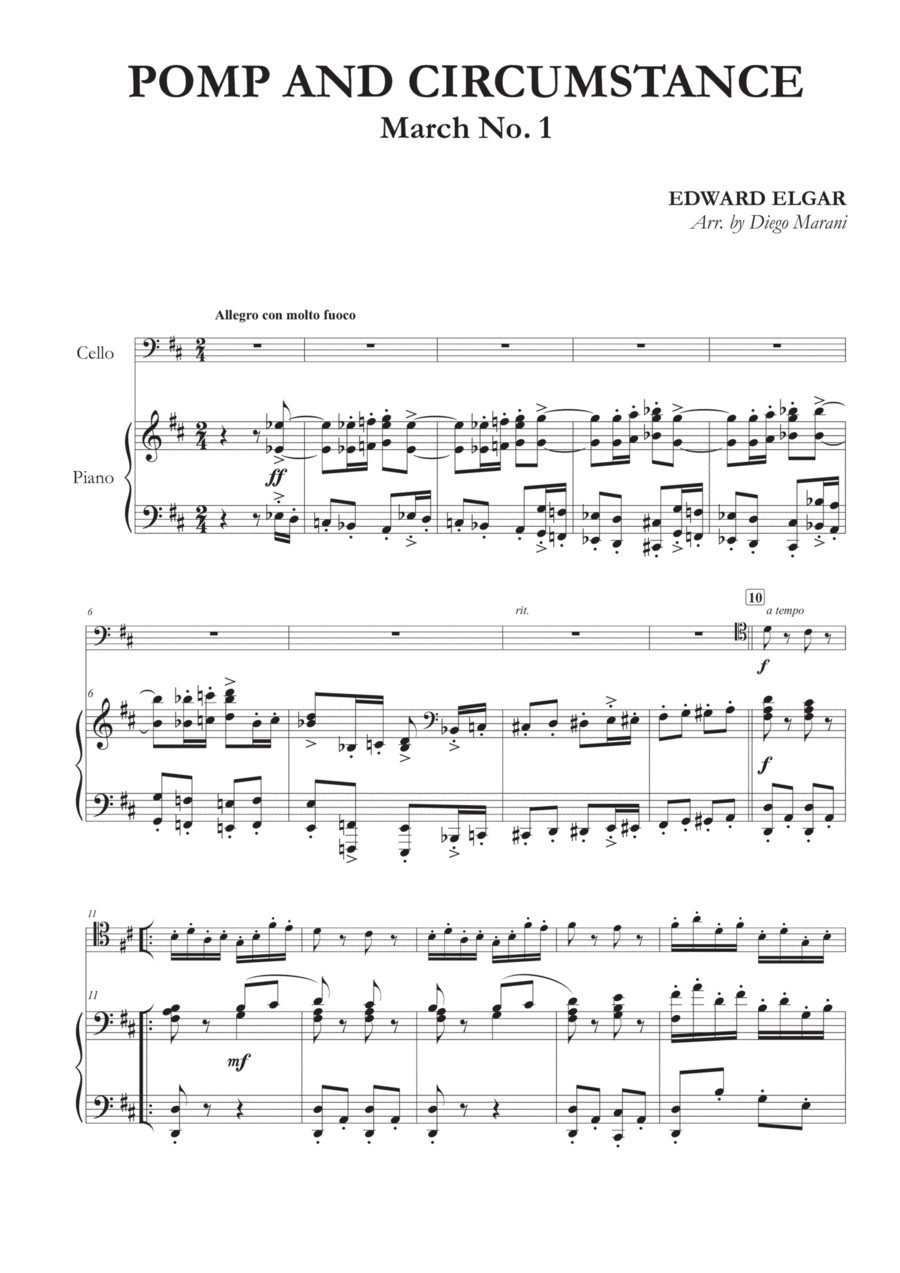
Pomp and Circumstance March No. 1 for Cello and Piano
Violoncelle, Piano

$9.99 8.65 € Violoncelle, Piano PDF SheetMusicPlus


1 16 31 ....256


Partitions Gratuites
Acheter des Partitions Musicales
Acheter des Partitions Digitales à Imprimer
Acheter des Instruments de Musique

© 2000 - 2026

Accueil - Version intégrale





