EUROPE
1008 articles
USA
2 articles
DIGITAL
21 articles (à imprimer)
Partitions Digitales
Partitions à imprimer
21 partitions trouvées


Cello,Piano - Level 3 - Digital Download SKU: A0.791238 By Neil Diamond. By Bob Russell and Bobby Scott. Arranged by Kevin P Holdgate. Pop. Score and part. 8 pages. Kevin P Holdgate #5771819. Published by Kevin P Holdgate (A0.791238). KPHMS 'Solo' CollectionHe Ain't Heavy, He's My Brother is a ballad written by Bobby Scott and Bob Russell. Originally recorded by Kelly Gordon in 1969, the song became a worldwide hit for The Hollies later that year and a minor hit for Neil Diamond in 1970. It has been recorded by many artists in subsequent years.Scott and Russell were introduced to each other by Johnny Mercer, at a California nightclub. Although Russell was dying of lymphoma and the pair met only three times, they managed to collaborate on the song.This is an arrangement as a solo with piano accompaniment that I would judge to be around Grade 5/6 standard for most instruments.
He Ain't Heavy, He's My Brother
Violoncelle, Piano
Neil Diamond
$4.99 4.21 € Violoncelle, Piano PDF SheetMusicPlus

Cello,Piano - Level 3 - Digital Download SKU: A0.1238732 By Various. By Michael Kamen. Arranged by John Fries. 20th Century,Film/TV,Standards. Score and part. 2 pages. John Fries #834174. Published by John Fries (A0.1238732). Please contact me by email at jfries@ptd.net to make a special request or to find out all that I have to offer and to express your comments or concerns. Thanks, John.  Band of Brothers is a 2001 American war drama miniseries based on historian Stephen E. Ambrose's 1993 non-fiction book of the same name. The theme music was composed by the late Michael Kamen, known for his scores for titles such as the Die Hard films, X-Men, Memento as well as several HBO series. He had also collaborated previously with Tom Hanks, who produced the score for Band of Brothers. The bold, evocative soundtrack to the series was very well received, with critics calling it Kamen's best work to date.
Band Of Brothers Suite Two
Violoncelle, Piano
Various
$4.99 4.21 € Violoncelle, Piano PDF SheetMusicPlus

Large Ensemble Cello,Tuba - Level 4 - Digital Download SKU: A0.889878 Composed by Gary Friedman. Contemporary,Jewish,Romantic Period. Score and parts. 66 pages. Gary Friedman #11999. Published by Gary Friedman (A0.889878). The original version for cello and piano was my first formal composition when I started composing in 1998. When my brother, Ralph, heard it, he cried and said that he wished that my parents could have heard it, too. The form and harmonies of this piece are mostly traditional, but there are a few surprises. There is a cantorial cello cadenza. A trumpet and tuba are added to the usual chamber orchestra with piano, just to play an Oh My Darling Clementine counter-melody in one variation but flute and bassoon have cues and can do this nicely. The recording of the beautifully expressive performance by Ken Hoppe and the College of Marin Symphony conducted by Tara Flandreau (who edited the string parts) is of such poor sound quality that I have uploaded the computer playback as the sound clip, which is of course quite mechanical sounding. However, if you would like to hear the live performance the YouTube link is ?v=6RHrLVqTyZg The cello and piano duet version is included in this package but is also sold separately for $5.00. Duration: 8 minutes Year: 1998.
Variations on Eliahu, a Passover Theme (for solo cello and orchestra)
Violoncelle, Piano

$40.00 33.72 € Violoncelle, Piano PDF SheetMusicPlus

Cello,Piano - Level 3 - Digital Download SKU: A0.1252822 By Maria Thompson Corley. By Maria Thompson Corley. Arranged by Maria Thompson Corley. 21st Century,Sacred. Score and part. 9 pages. Maria Thompson Corley #846622. Published by Maria Thompson Corley (A0.1252822). “Pax Aeternam†was written in memory of renowned composer Barbara York, a fellow Canadian whom I was blessed enough to meet in person through my interaction with Matt Brown. Though we connected many years into my collaborative piano career, Matt is the first tubist I ever worked with, and Barbara’s music was my favorite part of getting introduced to the tuba literature. I was thrilled to learn how much she appreciated my playing of her work.“How Beautiful†was written in memory of Matt’s son Eli, who had a congenital condition that took his life a few hours after he was born. This flawless piece of music, poignant yet never maudlin, provided the title for a recording Matt and I did of all of Barbara’s tuba output. It also threw down the gauntlet when Danny Rowland approached me, at Matt’s suggestion, about composing a piece. Danny mentioned loving “How Beautiful,†and intending to commission Barbara, who’d recently passed on. I’d never written for the tuba before, but felt absolutely no pressure. That’s a lie.Like “How Beautiful,†“Pax Aeternam†is in a major key; in my case, I wanted to evoke wistfulness rather than despair. Barbara’s path was full of suffering, and having lost a brother to prolonged illness, I’ve come to embrace the idea that death can be a sweet relief from pain. I tried to capture some of Barbara’s spirit, particularly in the middle section, and chose triple meter to give the outer sections a bit of “swing.†I don’t recall Barbara as a somber person, and I wanted to paint a portrait of someone who moved through life with a smile. I didn’t know her as well as many, but I always found her kind, generous, and unpretentious. I hope that this musical portrait does her justice.I created a cello transcription for a performance with Sara Male, my partner in Duo Chiaroscuro. This seemed appropriate, since “Still Waters Running Deep,†one of our signature pieces, is a transcription of the slow movement of Barbara’s bassoon sonata, created at our request by the composer.
Pax Aeternam for cello and piano
Violoncelle, Piano
Maria Thompson Corley
$15.00 12.65 € Violoncelle, Piano PDF SheetMusicPlus

Cello,Piano - Level 5 - Digital Download SKU: A0.1431347 Composed by Josef B Foerster. Arranged by Zellev. 19th Century,Classical,Contemporary,Historic,Romantic Period. Score and part. 16 pages. Zellev Music #1011815. Published by Zellev Music (A0.1431347). Key Signature: F minorTime Signature: 6/8Tempo: Allegro CommodoDifficulty: AdvancedJosef Bohuslav Foerster (30 December 1859 – 29 May 1951) was a Czech composer and musicologist. He is often referred to as J. B. Foerster, and his surname is sometimes spelled Förster.-Life-Foerster was born in Prague. His ancestors were of Bohemian German ethnicity, but had assimilated into the Czech community. The family normally lived in Prague and was musical. His father, a composer also named Josef Foerster, taught at the Conservatory. (His father's students included Franz Lehár.) His brother was artist Viktor Foerster. Josef was educated accordingly, and duly studied there.-Style-Foerster produced numerous compositions. His music is not nationalistic in the sense of employing the idioms of Czech folk music. His work, words and music, is considered [by whom?] very subjective and personal, mystical and idealistic.Foerster's opera Eva is another example, like Leoš Janá?ek's Jen?fa, of a libretto based on a play by Gabriela Preissová, though his treatment differs.His compositions include five symphonies (No. 1 in D minor; No. 2 in F, Op. 29 (1892–98); No. 3 in D, Op. 36; No. 4 in C minor, Op. 54, Easter Eve (1905); and No. 5 in D minor, Op. 141 (1929)), other orchestral works including a symphonic poem based on Cyrano de Bergerac, much chamber music (including five string quartets (No. 1 in E, Op. 15; No. 2, Op. 39; No. 3 in C, Op. 61; No. 4 in F, Op. 182 (1943); and the last, written 1950–1, completed by Jan Hanuš); three piano trios, two violin and two cello sonatas, and a several-times-recorded wind quintet), at least five operas (notably Eva), concertos for cello (Op. 143) and two for violin (No. 1 in C minor, Op. 88 (1911); No. 2 in D minor, Op. 104), liturgical music, among other works, over 170 published opus numbers in all.Many of his works remember family members: the 2nd Symphony is dedicated to his sister Marie; his brother's death led to the cantata Mortuis fratribus; his son is commemorated in the Piano Trio and the 5th Symphony; and his mother is a theme throughout his oeuvre.
Cello Sonata No.1 Op.45, 1st mvt, Allegro Commodo
Violoncelle, Piano

$8.00 6.74 € Violoncelle, Piano PDF SheetMusicPlus

Cello,Piano - Level 2 - Digital Download SKU: A0.597487 Composed by Franz Schubert. Arranged by Flavio Regis Cunha. Romantic Period,Wedding. Score and part. 8 pages. Flavio Regis Cunha #6208653. Published by Flavio Regis Cunha (A0.597487). Here we offer a beautiful easy arrangement written for cello and piano duet transposed to G Major from the original piece written in G flat Major. You, your student and your audience will love playing and hearing this waltz.Leopold Kupelweiser was the son of Johann Baptist Georg Kilian Kupelwieser (1760–1813), co-owner of a factory that produced tableware.[1] His talents were recognized at an early age by the sculptor Franz Anton von Zauner and by the time he was twelve, he was already attending the Academy of Fine Arts, Vienna.His brother was the theatrical director Joseph Kupelwieser, who wrote the libretto for Schubert's opera Fierrabras. With his brother, Joseph, he was a member of the Schubertianern (friends of Franz Schubert), a group that often got together for summers at the Schloss Atzenbrugg, west of Vienna. In 1826, Leopold married Maria Johanna Evangelista Augustina Stephania Theodora Lutz, an occasion which was marked by Schubert's composition, the Kupelwieser Waltz (never written down, but passed along by the family and later transcribed by Richard Strauss).
Kupelwieser Waltz (for Violoncello and Piano) from Waltz in G-flat major, D.Anh.I/14 - EASY VERSION
Violoncelle, Piano

$7.99 6.74 € Violoncelle, Piano PDF SheetMusicPlus

Cello,Piano - Level 1 - Digital Download SKU: A0.1470328 Composed by Ludwig van Beethoven. Arranged by Benzaiten Editions. 19th Century,Classical,Instructional,Romantic Period. Score and part. 2 pages. Benzaiten Editions #1048051. Published by Benzaiten Editions (A0.1470328). Hey there, music enthusiast! Ready to experience the uplifting melodies of Ludwig van Beethoven's timeless Ode to Joy? Let's make some music! ?Beethoven • Ode to Joy | cello sheet music w/ piano accompanimentIdeal for concerts, family gatherings, or simply enjoying the beauty of classical music, this easy arrangement is perfect for beginners. Bring the inspiring spirit of Ode to Joy to your fingertips, spread joy, and elevate your musical repertoire with this timeless piece! Our 'Ode to Joy' arrangement | Benzaiten Editions By purchasing our edition, you'll be able to download:• Full score with all instruments of the arrangement• Cello solo part About 'Ode to Joy' Ode to Joy, composed by Ludwig van Beethoven, is the final movement of his Ninth Symphony, completed in 1824. This piece has become a universal anthem of joy and brotherhood, known for its powerful and uplifting melody.
Beethoven • Ode to Joy | cello sheet music w/ piano accompaniment
Violoncelle, Piano
purchasing our edition, you'll be able to download:
• Full score with all instruments of the arrangement
• Cello solo part

About 'Ode to Joy'

Ode to Joy, composed by Ludwig van Beethoven, is the final movement of his Ninth Symphony, completed in 1824
This piece has become a universal anthem of joy and brotherhood, known for its powerful and uplifting melody
$4.99 4.21 € Violoncelle, Piano PDF SheetMusicPlus

Cello,Piano - Level 1 - Digital Download SKU: A0.1470329 Composed by Ludwig van Beethoven. Arranged by Benzaiten Editions. 19th Century,Classical,Instructional,Romantic Period. Score and part. 2 pages. Benzaiten Editions #1048052. Published by Benzaiten Editions (A0.1470329). Hey there, music enthusiast! Ready to experience the uplifting melodies of Ludwig van Beethoven's timeless Ode to Joy? Let's make some music! ?Beethoven • Ode to Joy | cello sheet music w/ piano accompaniment [chords]Ideal for concerts, family gatherings, or simply enjoying the beauty of classical music, this easy arrangement is perfect for beginners. Bring the inspiring spirit of Ode to Joy to your fingertips, spread joy, and elevate your musical repertoire with this timeless piece! Our 'Ode to Joy' arrangement | Benzaiten Editions By purchasing our edition, you'll be able to download:• Full score with all instruments of the arrangement• Cello solo part About 'Ode to Joy' Ode to Joy, composed by Ludwig van Beethoven, is the final movement of his Ninth Symphony, completed in 1824. This piece has become a universal anthem of joy and brotherhood, known for its powerful and uplifting melody.
Beethoven • Ode to Joy | cello sheet music w/ piano accompaniment [chords]
Violoncelle, Piano
purchasing our edition, you'll be able to download:
• Full score with all instruments of the arrangement
• Cello solo part

About 'Ode to Joy'

Ode to Joy, composed by Ludwig van Beethoven, is the final movement of his Ninth Symphony, completed in 1824
This piece has become a universal anthem of joy and brotherhood, known for its powerful and uplifting melody
$4.99 4.21 € Violoncelle, Piano PDF SheetMusicPlus

Cello,Piano - Level 3 - Digital Download SKU: A0.844351 Composed by Lyrics: Charles Wesley, Music: Thomas Campbell, published 1738, and published 1825. Arranged by Dan Cutchen. Christian,Gospel,Sacred,Spiritual. Score and part. 15 pages. Dan Cutchen Music #4281895. Published by Dan Cutchen Music (A0.844351). This arrangement of And Can It Be That I Should Gain? is for cello solo and piano.A theme and variation treatment is used.  For a piano background Mp3 track, search for: Cello - And Can It Be? Piano Accompaniment, Dan CutchenTime: approximately 6:00And Can It Be That I Should Gain? is a Christian hymn written by Charles Wesley. And Can It Be was written in 1738 to celebrate Wesley's conversion, which he regarded as having taken place on May 21 of that year.This beautiful hymn has been popular and enduring.And Can It Be That I Should Gain is perhaps one of the most joyfully poignant hymns penned by Charles Wesley (1707-1788). On Whitsunday (Pentecost), May 21, 1738, three days before his brother John experienced his heart strangely warmed,’ Charles was convalescing in the home of John Bray, a poor mechanic, when he heard a voice saying, In the name of Jesus of Nazareth, arise, and believe, and thou shalt be healed of all thy infirmities. The voice was most likely Mr. Bray’s sister who felt commanded to say these words in a dream.Anglican hymn writer Timothy Dudley-Smith, notes that the following then happened:Charles got out of bed and opening his Bible read from the Psalms: He have put a new song in my mouth, even praise unto our God, followed by the first verse of Isaiah 40, Comfort ye, comfort ye my people, saith your God. He wrote in his journal, I have found myself at peace with God, and rejoiced in the hope of love Christ (Dudley-Smith, 1987, 1).The statement from Mr. Bray’s sister sparked within Charles a conviction like he had never felt before. Moved and convicted in spirit, Charles wrestled with these words until he came to rest in his faith, knowing that it is by faith we are saved (Ephesians 2:8).Soon after this conversion experience, he wrote two hymns in celebration of the amazing love he had come to know: And Can It Be that I Should Gain and Where Shall My Wondering Soul Begin? (United Methodist Hymnal, 342)There has been some debate as to which hymn was written first, but most current scholarship accepts the latter as the first hymn written by Charles after his conversion experience. No matter its place in the chronology of Wesley's output, And Can It Be has been and remains one of his most remarkable hymns, expressing like no other the rapturous joy of receiving salvation.And Can It Be That I Should Gain. Hymnary.org, https://hymnary.org/text/and_can_it_be_that_i_should_gainDudley-Smith, Timothy. A Flame of Love: A Personal Choice of Charles Wesley’s Verse. London: Triangle SPCK, 1987.Timothy Dudley-Smith. And can it be that I should gain. The Canterbury Dictionary of Hymnology. Canterbury Press, accessed May 29, 2018, http://www.hymnology.co.uk/a/and-can-it-be-that-i-should-gain.Young, Carlton R. And Can It Be That I Should Gain. Companion to the United Methodist Hymnal. Abingdon Press, 1993.(Taken from: History of Hymns: And Can It Be That I Should Gain by DeAndre Johnson found at https://www.umcdiscipleship.org/resources)https://youtu.be/xCpG9mpfSFk
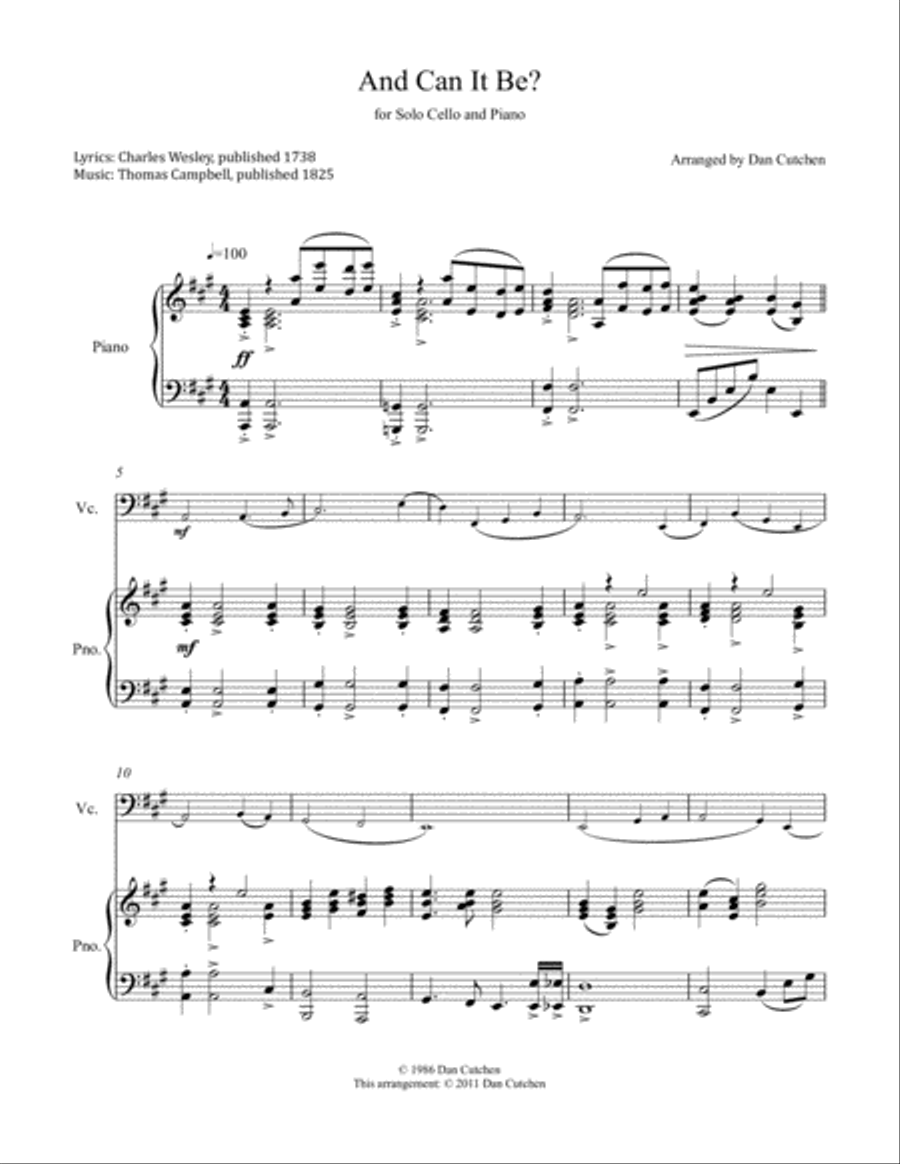
Cello - "And Can It Be?" Theme and Variations
Violoncelle, Piano

$6.00 5.06 € Violoncelle, Piano PDF SheetMusicPlus

Cello and piano - intermediate to advanced - Digital Download SKU: S9.Q53295 Op. 54. Composed by Louis Baerwolf. Edited by Beverley Ellis and Rainer Mohrs. This edition: Sheet music. (c) 2020 Schott Music GmbH & Co. KG, Mainz. Classical. Downloadable. Op. 54. 11 pages. Schott Music - Digital #Q53295. Published by Schott Music - Digital (S9.Q53295). English • German.Belgian composer and cellist Louis Jean Marie Baerwolf (Barwolf) was born in Bruges in 1841 (his exact date of birth is unknown) and died in Brussels on 12.1.1899. He first studied violin, cello and piano at the Conservatoire in Liège – and also played the organ in his native Bruges. From 1862 he studied at the Conservatoire Royal in Brussels. After completing his studies, he was employed for many years at the Théâtre Royal de la Monnaie in Brussels, where his brother Jean worked as a conductor; from 1889-1898 he worked as librarian at that theatre. Baerwolf composed primarily church music, including a Requiem, several masses and motets; he also wrote songs, chamber music and a Cello Concerto op. 48. Two of his compositions for cello and piano were published by Schott: a Mouvement perpétuel op. 66 and our choice, the melodic Morceau de Salon op. 54, which makes a good encore piece. It was published by Schott in 1873 as plate no. 20831.
Morceau de Salon
Violoncelle, Piano

$3.99 3.36 € Violoncelle, Piano PDF SheetMusicPlus

Cello,Piano - Level 2 - Digital Download SKU: A0.1189454 Composed by Allesandro Marcello. Arranged by Diego Marani. Baroque,Classical,Instructional,Standards,Wedding. Score and part. 4 pages. Diego Marani #789092. Published by Diego Marani (A0.1189454). The Oboe Concerto in D minor, S D935, is an early 18th-century concerto for oboe, strings and continuo attributed to the Venetian composer Alessandro Marcello. The earliest extant manuscript containing Johann Sebastian Bach's solo keyboard arrangement of the concerto, BWV 974, dates from around 1715.Bach's keyboard version was published as an arrangement of a concerto by Antonio Vivaldi in the 19th century. In 1923 the C minor version of the oboe concerto was published as a composition by Benedetto Marcello, Alessandro's brother. In the second half of the 20th century several publications indicated Alessandro again as the composer of the piece, as it had been in its early 18th-century print, and the oboe concerto was again published in its D minor version.This easy arrangement for cello with piano accompaniment of the marvelous second movement (adagio) of the concerto is suitable for any occasion.
Marcello's Adagio for Cello and Piano
Violoncelle, Piano

$7.99 6.74 € Violoncelle, Piano PDF SheetMusicPlus


Partitions Gratuites
Acheter des Partitions Musicales
Acheter des Partitions Digitales à Imprimer
Acheter des Instruments de Musique

© 2000 - 2026

Accueil - Version intégrale





