EUROPE
8896 articles
USA
80 articles
DIGITAL
113 articles (à imprimer)
Partitions Digitales
Partitions à imprimer
113 partitions trouvées

1 16 31 ....106

Piano,Viola - Level 2 - Digital Download SKU: A0.1240301 Composed by Ludwig van Beethoven. Arranged by Ander. Classical,Folk,March,Opera,Romantic Period. Score and part. 6 pages. Woods Only, Arrangements #835671. Published by Woods Only, Arrangements (A0.1240301). This arrangement adapted for viola and piano was written keeping the characteristics of the original work, in order to be performed by young music students who want to enter the symphonic music. Besides, it can also be used by professional musicians, for recitals, repertoire, academic presentations and didactic material. As much as it is a funeral march, it is well suited for any musical performance occasion. The transcription is faithful to the structure, with only one change of key, so that it is comfortable for all the instruments in the formation, as well as for use in ensemble practice between musicians of different traditions.Ludwig van Beethoven began concentrated work on his Symphony No. 7 in A major Op. 92 in 1811, it was completed in 1812, and was dedicated to Count Moritz von Fries, and premiered in Vienna on December 8, 1813. It is considered a remarkable example of the more ebullient side of Beethoven's compositional personality and evidence that even after the onset of deafness, he still found cause for musical optimism. The second movement Allegretto is a funeral march in everything but name. Often several contrasting melodic ideas are made to coexist, as if Beethoven were imagining several processions converging on the cemetery at the same time. As he was working on this symphony during the years of the Napoleonic Wars, this experience was probably within his experience. It was also used as the soundtrack to the film Knowing, by director Alex Proyas and starring Nicolas Cage, where it is used in the final scene of the film. Beethoven called Symphony No. 7 his most excellent symphony, and a music critic of the time reported, this symphony is the most melodically rich and the most pleasing and comprehensible of all Beethoven's symphonies..
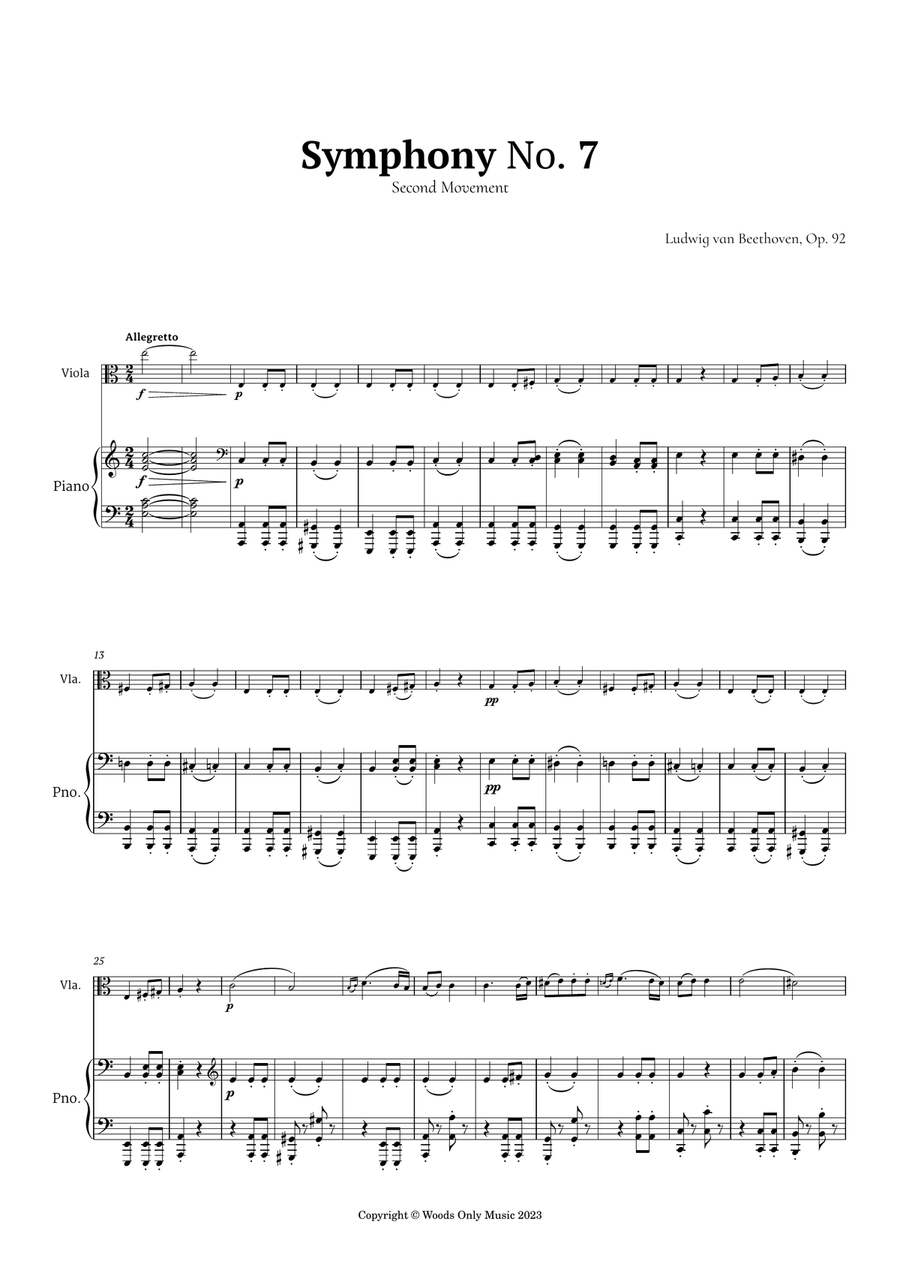
Symphony No. 7 by Beethoven for Viola and Piano
Alto, Piano

$1.99 1.68 € Alto, Piano PDF SheetMusicPlus

Piano,Viola - Level 3 - Digital Download SKU: A0.1309773 Composed by Edvard Grieg. Arranged by André Nusa. 19th Century,Chamber,Romantic Period. Score and part. 4 pages. Andre_Nusa #898939. Published by Andre_Nusa (A0.1309773). Dive into the rich tapestry of Grieg's 'Lyric Piece Op. 12 No. 7' with this meticulously crafted arrangement for viola and piano, designed to captivate both intermediate and advanced players. This rendition showcases the intricate interplay between the two instruments, allowing performers to explore the intricate melodies and expressive nuances inherent in Grieg's evocative composition. With its emotive depth and captivating harmonies, this arrangement brings to life the soul-stirring beauty of the original work, providing an immersive musical experience for both players and audiences.
Lyric Pieces Op.12 No.7
Alto, Piano

$5.99 5.06 € Alto, Piano PDF SheetMusicPlus

Piano,Viola - Digital Download SKU: A0.777967 Composed by Frédéric Chopin (1810-1849) - Alexander Glazunov (1865-1936). Arranged by Mikio Kamada. Romantic Period. Score and part. 6 pages. ACORDO Sheet Music #4609011. Published by ACORDO Sheet Music (A0.777967). Etude Op. 25, No. 7 in C-sharp minor composed by Frédéric Chopin is for a piano technical study.  The melody part is played by the left hand.  It is sometimes called Cello as a term of endearment.  There are several arrangement for Cello solo accompanied by Piano.  The arrangements by Auguste Franchomme (1808-1884), Jules de Swert (1843-1891), and WÅ‚adysÅ‚aw Tarnowski (1836-1878)  are in d minor.  On the other hand, the arrangement by Alexander Konstantinovich Glazunov (1865-1936) is in e minor, which is the most poplar one. This score is a transcription for Viola and Piano.
Etude Op.25 No.7 in e minor for Viola & Piano
Alto, Piano

$6.20 5.23 € Alto, Piano PDF SheetMusicPlus

Piano,Viola - Level 2 - Digital Download SKU: A0.1175639 Composed by Jozsef Bloch. Arranged by Clara Obsidian. 19th Century,Romantic Period. Score and part. 5 pages. Clara Obsidian #775761. Published by Clara Obsidian (A0.1175639). Composed by Hungarian musician and musicologist József Bloch, also known as Josef or Joseph Bloch, is the beautiful tune Valsette originally written for Violin and Piano from the album 12 Morceaux Très Faciles, Op.48.Arranged for Viola and Piano, it is suitable for Beginner to Intermediate Level, featuring the 1st - 3rd position.Full Score and PartOther works of József Bloch also availableAlso arranged for Cello and Piano.
J. Bloch: Valsette from 12 Morceaux Très Faciles, Op.48, no. 7 for Viola and Piano
Alto, Piano

$3.99 3.37 € Alto, Piano PDF SheetMusicPlus

Piano,Viola - Level 3 - Digital Download SKU: A0.1401524 Composed by Alexander Scriabin. Arranged by James M. Guthrie. 20th Century,Chamber,Contemporary,Contest,Festival,Historic. Score and part. 7 pages. Jmsgu3 #984707. Published by jmsgu3 (A0.1401524). The historical context of Scriabin's Prelude, Op. 51 No. 2 is rooted in the broader tradition of preludes as improvisatory pieces that precede performances on keyboard instruments. Scriabin's composition, part of his Quatre Morceaux (Four Pieces) Op. 51, published in 1906, reflects his innovative approach to piano music within the musical landscape of the early 20th century. This piece, along with others by Scriabin, demonstrates a blend of traditional influences and his quest to develop a distinctive and original style in his compositions. The meaning behind Scriabin's Prelude, Op. 51 No. 2 is characterized by its emotional depth and expressive qualities, reflecting the composer's unique musical language and style. This piece, along with others by Scriabin, delves into themes of fatigue, exhaustion, eternity, and millions of years, as described by the composer. In this prelude, Scriabin's use of dissonance, tonal centers, and harmonic language conveys a sense of obsessively seeking out pain or grief. The composition captures a range of emotions, from fatigue to a cry in the night, showcasing Scriabin's ability to evoke intense feelings through his music.
Scriabin: Prelude, Op. 51, No. 2 for Viola & Harp
Alto, Piano

$32.95 27.82 € Alto, Piano PDF SheetMusicPlus

Piano,Viola - Level 3 - Digital Download SKU: A0.1401537 Composed by Alexander Scriabin. Arranged by James M. Guthrie. 20th Century,Chamber,Contemporary,Contest,Festival,Historic. Score and part. 7 pages. Jmsgu3 #984720. Published by jmsgu3 (A0.1401537). The historical context of Scriabin's Prelude, Op. 51 No. 2 is rooted in the broader tradition of preludes as improvisatory pieces that precede performances on keyboard instruments. Scriabin's composition, part of his Quatre Morceaux (Four Pieces) Op. 51, published in 1906, reflects his innovative approach to piano music within the musical landscape of the early 20th century. This piece, along with others by Scriabin, demonstrates a blend of traditional influences and his quest to develop a distinctive and original style in his compositions. The meaning behind Scriabin's Prelude, Op. 51 No. 2 is characterized by its emotional depth and expressive qualities, reflecting the composer's unique musical language and style. This piece, along with others by Scriabin, delves into themes of fatigue, exhaustion, eternity, and millions of years, as described by the composer. In this prelude, Scriabin's use of dissonance, tonal centers, and harmonic language conveys a sense of obsessively seeking out pain or grief. The composition captures a range of emotions, from fatigue to a cry in the night, showcasing Scriabin's ability to evoke intense feelings through his music.
Scriabin: Prelude, Op. 51, No. 2 for Viola & Piano
Alto, Piano

$32.95 27.82 € Alto, Piano PDF SheetMusicPlus


1 16 31 ....106


Partitions Gratuites
Acheter des Partitions Musicales
Acheter des Partitions Digitales à Imprimer
Acheter des Instruments de Musique

© 2000 - 2026

Accueil - Version intégrale





