EUROPE
0 articles
USA
0 articles
DIGITAL
26 articles (à imprimer)
Partitions Digitales
Partitions à imprimer
26 partitions trouvées


Piano,Viola - Level 1 - Digital Download SKU: A0.548726 Composed by Martin Luther. Arranged by James M. Guthrie, ASCAP. Easter,Instructional,Standards. Score and part. 4 pages. Jmsgu3 #3411767. Published by jmsgu3 (A0.548726). Out of the Depths I Cry to You by Martin Luther. The first verses feature modified counterpoint and harmony proceeding at quarter = 82. The final verse is reharmonized for maximum dramatic effect at a more contemplative tempo such as quarter = 64. Very powerful selection for Lent or Easter. Duration (3 verses) 3:05, 36 ms. Score: 3 pg. Solo part: 1 pg. The piano reads from the score. Out of the Depths Aus tiefer Not schrei ich zu dir (From deep affliction I cry out to you), is, of course, a hymn composed by Martin Luther. Moreover, Luther also wrote the lyrics which are essentially a paraphrase of Psalm 130. First published in 1524, it is also one of eight songs in the original Lutheran hymnal. It appears likewise in many hymnals and in different translations. The lyrics furthermore stimulated compositions from the Renaissance to the contemporary. Consequently, composers such as Johann Sebastian Bach built an entire chorale cantata on it. Other composers similarly contributed compositions, such as Felix Mendelssohn and Max Reger. Luther Background Martin Luther, (1483 –1546) was a German professor of theology, composer, priest, and moreover, an influential character in the Protestant Reformation. Luther had a momentous impact on church and society due to his contributions to the musical arts. He wanted to disseminate the gospel among mankind and with this intention thought that the best way to do that was through music. Influence It is important to realize that other musicians, and their descendants, were encouraged by Luther’s songs and wrote their own hymns. Luther, to be sure, had a thorough musical education. For example, he knew secular and sacred songs from an early age. He, in particular, played the lute well and sang in the monastery when he was a monk. That is to say, music was an essential part of his life. He in fact first began writing songs in 1523, sometimes writing the melody as well as the lyrics. Luther was certainly able to evaluate the composers of his time. He thought especially highly of Josquin des and Ludwig Senfl. He was also acquainted, with this in mind, with other composers and their works. Legacy The Lutheran musical ethos soon covered all of Germany and later significantly fashioned Protestant musical culture. Heinrich Schütz and Johann Sebastian Bach are the most compelling evidence of this Protestant musical culture. Additionally, as a point often overlooked, the pedal organ, first refined in northern Germany, became universally prevalent. As a matter of fact, Dieterich Buxtehude established a regular evening organ concert series in Lübeck. Another key point is that this concert series, in turn, spread North German Musical ideas worldwide. Luther was especially convinced that music is a beautiful and exclusive offering of the divine.
Luther: Out of the Depths for Viola & Piano
Alto, Piano

$24.95 21.43 € Alto, Piano PDF SheetMusicPlus

Piano,Viola - Level 4 - Digital Download SKU: A0.635978 By Whitney Houston. By Nickolas Ashford and Valerie Simpson. Arranged by Fishel Pustilnik. Contemporary. Score and part. 10 pages. F & N Enterprise #6108587. Published by F & N Enterprise (A0.635978). An excellent arrangement of the famous Song I'm Every Woman for Viola and Piano-Jazz/Pop Version. The video for Violin and Piano: https://youtu.be/V00RxK2n5J8 The composition is easy to read, fun to play, and sound professional when performed. Arranged by Fishel Pustilnik, a very well known as Composer/Publisher. His books Jazz & Pop Piano Paradise (Volumes 1-5) have become a commercial success and a hit with music teachers and students in Canada. (Thousands of books already sold in Canada). They are also starting to enter the US, Brazil, Norway, Russia, Holland, Israel, Belgium, Sweden, Finland, Greece, Latvia, and the UK markets. This is a wonderful new publication. These pieces offer much appeal for the young pianist and excellent choice for a supplementary book for students from Grade 3 to 8. Lore Ruschiensky, Editor, (from the review in The Canadian Music Teacher) Yesterday I spent at least two pleasure-filled hours playing through your imaginatively inventive compositions. Congratulations! I trust students will decide to program your well crafted and entertaining works on recitals and examinations. Review from Dr. Jack Behrens, B.Sc. (Julliard), Ph.D. (Harvard), Director of Academic Studies, The Glenn Gould School I liked this book the best so far. Great work! You have a gift for melody and your arrangements are very playable. Congratulations on the 3rd Volume. Mark Carlstein, Hal Leonard, Keyboard Publications.
I'm Every Woman
Alto, Piano
Whitney Houston
$4.99 4.29 € Alto, Piano PDF SheetMusicPlus

Piano,Viola - Level 3 - Digital Download SKU: A0.549328 By Barry Manilow. By Bruce Johnston. Arranged by James M. Guthrie, ASCAP. Contemporary,Rock. Score and part. 8 pages. Jmsgu3 #3486067. Published by jmsgu3 (A0.549328). Duration: ca. 3:00, score: 5 pages, solo part: 1 page, piano part: 2 pages.Very famous song suitable for church, recital or nightclub. I Write the Songs is a popular song written by Bruce Johnston in 1975 and made famous by Barry Manilow. Manilow's version reached number one on the Billboard Hot 100 chart in January 1976[2] after spending two weeks atop the Billboard adult contemporary chart in December 1975.[3] It won a Grammy Award for Song of the Year and was nominated for Record of the Year in 1977.[3] Billboard ranked it as the No. 13 song of 1976.[4]The original version was recorded by The Captain & Tennille, who worked with Johnston in the early 1970s with The Beach Boys. It appears on their 1975 album, Love Will Keep Us Together. The first release of I Write the Songs as a single was by then teen-idol David Cassidy from his 1975 solo album The Higher They Climb, which was also produced by Bruce Johnston. Cassidy's version reached #11 on the UK Singles Chart in August of that year.[5]Johnston has stated that, for him, the I in the song is God,[2] and that songs come from the spirit of creativity in all of us. He has said that the song is not about his Beach Boys bandmate Brian Wilson.[6]Manilow was initially reluctant to record the song, stating in his autobiography Sweet Life: The problem with the song was that if you didn't listen carefully to the lyric, you would think that the singer was singing about himself. It could be misinterpreted as a monumental ego trip.[3] After persuasion by Clive Davis, then president of Arista Records, Manilow recorded the song, and his version of I Write the Songs was the first single taken from the album Tryin' to Get the Feeling. It first charted on the Billboard Hot 100 on November 15, 1975, reaching the top of the chart nine weeks later, on January 17, 1976. Wikipedia
I Write The Songs
Alto, Piano
Barry Manilow
$39.95 34.32 € Alto, Piano PDF SheetMusicPlus

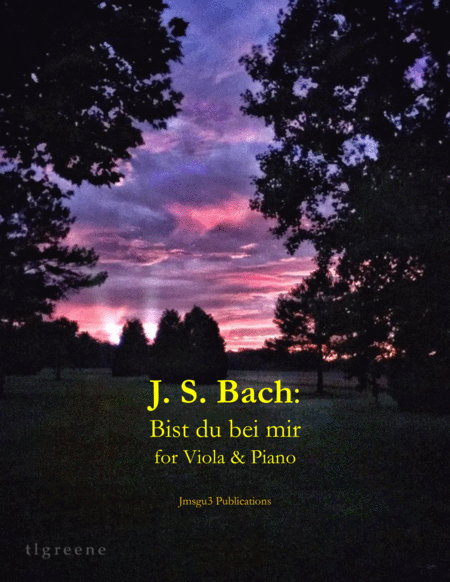
Piano,Viola - Level 2 - Digital Download SKU: A0.549217 Composed by Johann Sebastian Bach. Arranged by James M. Guthrie, ASCAP. Baroque,Holiday,Standards,Wedding. Score and part. 9 pages. Jmsgu3 #3468034. Published by jmsgu3 (A0.549217). J. S. Bach BWV 508. Bist du bei mir Bach adapted this aria from a lost Stölzel opera called Diomedes. He changed the original orchestral instrumentation to soprano, strings, and continuo.  He also modified the voice-leading making it sound more like a Bach composition. The work appears as BWV 508 No. 25 in the Anna Magdalena Notebook No. 2.   Source Only a few remnants of the original opera have survived. Historians speculate that Anna Magdalena got the song from the Leipzig Opera after the bankruptcy of 1720. Chances are good, though, that the tune was a favorite of everyone in Leipzig at the time.   Lyrics When thou art near, I go with joyTo death and to my rest.O how joyous would my end be,If your fair hands            Would close my faithful eyes. - Unknown Bach Overview First of all, Johann Sebastian Bach is maybe the greatest composer in music history. Certainly, he was prolific. As a result, everyone has heard of his works. Furthermore, these works number well over a thousand. It seems like people are probably most familiar with instrumental works such as the Brandenburg Concertos, and the Goldberg Variations. But, similarly famous are such noteworthy works as the Well-Tempered Clavier, the Musical Offering, and certainly the Art of Fugue. Seems like his most famous vocal works include the most noteworthy Mass in B Minor. Also, most noteworthy are the St. John Passion, and indeed the Christmas Oratorio.  History Bach came from a long line of musicians and above all, composers. Consequently, he, first of all, pursued a career as a church organist. So as a result, he gained employment in various Protestant churches in Germany. For a while, he worked as a court musician in Weimar and Köthen. Here he probably developed his organ style and likewise his chamber music style. Eventually, he, therefore, gained an appointment as Cantor of St. Thomas in Leipzig. Here he worked until difficulties with his employer ultimately drove him away. The King of Poland finally appointed him as court composer.  Style It seems like Bach created a fascinating new international style. He synthesized elements of the most noteworthy European music ideas into his new style. Even more, this new style was probably his synthesis of European musical rhythm and form. Furthermore, he demonstrated a complete mastery of counterpoint and motivic development. His sense of harmonic organization probably propelled him to the top. Revival               Mendelssohn conducted a Bach revival in the nineteenth century. His effort probably helped to re-familiarize the public with the magnitude of Bach’s works. During this period, scholars published many noteworthy Bach biographies. Moreover, Wolfgang Schmieder published the BWV (Bach Werke Verzeichnis). As a result, this is now the official catalog of his entire artistic output. The BWV number allows us to locate a work in the catalog. Sometimes scholars will simply use an S (Schmieder) as an abbreviation for BWV.  Voyager NASA launched two Voyager spacecraft in 1977. Onboard are phonograph records with sounds, music, and images of life on Earth. The purpose of the launch was to inform intelligent extraterrestrial life forms about conditions on Earth. The music on the disc is varied. There is Bach, Mozart, Beethoven, and Stravinsky among others. However, because Bach is so important in our music history, it contains three times more Bach than all the others combined.  
Bach: Bist du bei mir BWV 508 for Viola & Piano
Alto, Piano

$32.95 28.31 € Alto, Piano PDF SheetMusicPlus

Piano,Viola - Level 4 - Digital Download SKU: A0.1493034 Composed by Clémence de Grandval. Arranged by Paul Wehage. 19th Century,Chamber,Classical,Romantic Period. Score and part. 33 pages. Musik Fabrik Music Publishing #1069724. Published by Musik Fabrik Music Publishing (A0.1493034). Maria-Félicie-Clémence de Grandval (1828–1907) was born on January 28, 1828 at Saint-Rémy-des-Monts, France and died on January 15, 1907 in Paris.After the death of her mother, Louise Adèle du Temple de Mésières, her father the Baron de Reiset, a military officer remarried with an Englishwoman and moved his family to London. After beginning her musical studies privately, she studied the piano with the German composer Friedrich von Flotow, who was a family friend. Returning to France, she studied the piano briefly with Chopin and composition with Camille Saint-Saëns, who remember their first meeting: “I was 12 when I heard the vicomtesse de Grandval for the first time, who was 18. It was at a musical morning concert at the home of the violinist de Cuvillon. She sang a song of her own composition ‚La Source, in which she accompanied herself. I was struck by the fluidity of her playing, which purely and without useless inflections, was quite close to my way of viewing music. This unified and tranquil style came out of her studies with Chopin.” Camille Saint-Saëns: Quelques mots sur l’exécution des œuvres de Chopin, in: “Le courrier musical de Paris” 13 [1910], S. 386).  At first writing mostly sacred music, most of her public success was due to her comic operas: la Comtesse Eva, la Pénitente, Piccolino and Mazeppa. She also wrote orchestral music, chamber music, and over 60 songs (to poets such as Sully Prudhomme, Michel Carré, Henri Meilhac, Georges Hartmann, Charles Grandmougin and Louis Gallet.) She is chiefly known today for her music for wind instruments, especially for the oboe.
Trois pièces : Andante, Sérénade et Chant Serbe
Alto, Piano

$18.95 16.28 € Alto, Piano PDF SheetMusicPlus

Piano,Viola - Level 2 - Digital Download SKU: A0.550913 Composed by J. S. Bach - Gounod. Arranged by James M. Guthrie, ASCAP. Christmas,Contemporary,Easter,Wedding. Score and part. 12 pages. Jmsgu3 #4888187. Published by jmsgu3 (A0.550913). This arrangement features the controversial Schwencke measure (ms. 27) that was originally introduced in 1783 by Christian Friedrich Gottlieb Schwencke. The convenient 1st & 2nd endings provide an option for extended performance. Duration with repeat - 4:50. Score: 6 pages. Solo part: 2 pages, piano part: 4 pages. Based on Prelude #1 in C Major from the Well-Tempered Clavier, Book 1. Well suited for church meditations or school programs or recital encores.  Ave Maria Ave Maria is a Catholic prayer that consequently asks for the mother of Jesus (Mary) to intercede. Charles Gounod composed a famous version of the Ave Maria. He was a French Romantic composer who overlaid a new melody on an existing Bach chord progression. The progression is from Bach’s Prelude No. 1 from Well-Tempered Clavier I. This version, as well as Schubert’s version, have become essential items at weddings, masses, and funerals. Bach Overview First of all, Johann Sebastian Bach is maybe the greatest composer in music history. Certainly, he was prolific. As a result, everyone has heard of his works. Furthermore, these works number well over a thousand. It seems like people are probably most familiar with instrumental works such as the Brandenburg Concertos, and the Goldberg Variations. But, similarly famous are such noteworthy works as the Well-Tempered Clavier, the Musical Offering, and the Art of Fugue. Seems like his most famous vocal works include the most noteworthy Mass in B Minor. Also, most noteworthy, though, are the St. John Passion, and certainly the Christmas Oratorio.  History Bach came from a long line of musicians and above all, composers. Consequently, he, first of all, pursued a career as a church organist. So as a result, he gained employment in various Protestant churches in Germany. For a while, he worked as a court musician in Weimar and Köthen. Here he probably developed his organ style and likewise his chamber music style. Eventually, he, therefore, gained an appointment as Cantor of St. Thomas in Leipzig. Here he worked until difficulties with his employer ultimately drove him away. The King of Poland finally appointed him as a court composer.  Style It seems like Bach created an engaging new international style. He synthesized elements of the most noteworthy European music ideas into his new style. Even more, this new style was probably his synthesis of European musical rhythm and form. Furthermore, he demonstrated a complete mastery of counterpoint and motivic development. His sense of harmonic organization probably propelled him to the top. Revival               Mendelssohn conducted a Bach revival in the nineteenth century. His effort probably helped to re-familiarize the public with the magnitude of Bach’s works. During this period, scholars published many noteworthy Bach biographies. Moreover, Wolfgang Schmieder published the BWV (Bach Werke Verzeichnis). As a result, this is now the official catalog of his entire artistic output. The BWV number allows us to locate a work in the catalog. Sometimes scholars will simply use an S (Schmieder) as an abbreviation for BWV.  
Bach-Gounod: Ave Maria, Schwencke version for Viola & Piano
Alto, Piano

$32.95 28.31 € Alto, Piano PDF SheetMusicPlus

Piano Trio,String Ensemble Viola,Violin - Level 3 - Digital Download SKU: A0.576789 Composed by Traditional. Arranged by David Warin Solomons. Contemporary,Folk,World. Score and parts. 9 pages. David Warin Solomons #433199. Published by David Warin Solomons (A0.576789). Arrangement for 2 melody instruments and piano of the German folk song Im Märzen der Bauer, which tells of the life of the farmer throughout the various seasons. For each verse I modulate to a different key, swap the tune over to the other melody instrument and change the countermelody. I have also made a version with a rather simpler accompaniment on guitar. The sound sample is an electronic preview. The pdf file contains the score and parts.
Im Märzen der Bauer (In springtime the farmer) for violin, viola and piano
Alto, Piano

$7.00 6.01 € Alto, Piano PDF SheetMusicPlus

Piano,Viola - Level 1 - Digital Download SKU: A0.548507 Composed by Traditional. Arranged by James M. Guthrie, ASCAP. Christian,Christmas. Score and part. 4 pages. Jmsgu3 #3387407. Published by jmsgu3 (A0.548507). The First Noel arranged for Viola & Piano with new harmony for the final verse.Origins The First Noel is an English Christmas carol. Even more, it was probably written in the late Cornish Renaissance period. While other versions spell the title as Nowell, this is just a colloquial variation. Furthermore, Noel is an older word meaning Christmas. Therefore the First Noel translates as the First Christmas. First of all, Gilbert and Sandy published the earliest version. As a result, this version appears in the Carols Ancient and Modern songbook of 1823. William Sandy edited and arranged the book. Similarly, his partner Davies Gilbert edited and added the familiar extra verses. The First Noel: Viola Version comes with new harmony in final verse for more energy and drive. Stainer Organist and composer Sir John Stainer published the most noteworthy customary arrangement in the 1870’s.  Stainer is above all famous for his songbook entitled: Christmas Carols New and Old (1871). This volume served as an important catalyst for reviving the English Christmas carol.  Other famous Stainer arrangements from this book are such titles as What Child Is This, God Rest Ye Merry Gentlemen, Good King Wenceslas, and I Saw Three Ships. Diatonic Function The melodic structure in the First Noel is uncommon among English folk tunes. It simply repeats one phrase twice then follows a variation refrain. All three phrases of the song end on the mediant scale degree. This is unusual because the diatonic function of the mediant is non-final compared to the more usual tonic or even dominant degrees. Consequently, this gives the song as kind of open-ended feeling – like maybe it never really ends. Political Context The Catholic clergy sang carols outside of the church in Latin. After the Protestant Reformation, the reformers thought it would be better for everyone to sing carols. They decided to bring music back to the common folk. So, they translated the lyrics from Latin into common language. Moreover, the Protestants wanted more control over the music in church than what the Vatican allowed. Protestant composers such as William Byrd composed complex polyphonic Christmas music that they called carols. Nonetheless, some famous folk carols were composed in this era. Eminent composers in the nineteenth century began to revise and adapt them. Consequently, they revived the English carol.  Register for free lifetime updates and revisions at www.jamesguthrie.com  
The First Noel for Viola & Piano
Alto, Piano

$24.95 21.43 € Alto, Piano PDF SheetMusicPlus

Piano,Viola - Level 3 - Digital Download SKU: A0.551339 Composed by Antonio Vivaldi. Arranged by James M. Guthrie, ASCAP. Baroque,Instructional,Standards,Wedding. Score and part. 43 pages. Jmsgu3 #5024423. Published by jmsgu3 (A0.551339). Antonio Vivaldi (1676-1741) Spring from the Four Seasons (RV269; Op. 8, No. 1) Score: 23 pages. Duration ca. 10:42Contents:I. Allegro - Spring has returned. Song of the Birds. All is gay, and the birds sing happily.FLOWING FOUNTAINS: Fountains play in the breeze, constantly moving.THUNDER: The skies are dark; lightning flashes and thunder roars.SONG OF THE BIRDS: After the storm, the birds return with their song.II. Largo - THE SLEEPING GOATHERD: On the flowered meadow, the goatherd and his dog roam among the blossoming trees. The Barking DogsIII. Allegro - PASTORAL DANCE: Nymphs and shepherds dance to the bagpipes under the beautiful skies of spring.
Vivaldi: Spring from the Four Seasons for Viola & Piano
Alto, Piano

$32.95 28.31 € Alto, Piano PDF SheetMusicPlus

Piano,Viola - Level 5 - Digital Download SKU: A0.551449 Composed by Antonio Vivaldi. Arranged by James M. Guthrie, ASCAP. Baroque,Instructional,Standards,Wedding. 72 pages. Jmsgu3 #5207327. Published by jmsgu3 (A0.551449). Antonio Vivaldi (1676-1741) Spring from the Four Seasons (RV269; Op. 8, No. 1) Score: 23 pages. Duration ca. 10:42Contents:I. Allegro - Spring has returned. Song of the Birds. All is gay, and the birds sing happily.FLOWING FOUNTAINS: Fountains play in the breeze, constantly moving.THUNDER: The skies are dark; lightning flashes and thunder roars.SONG OF THE BIRDS: After the storm, the birds return with their song.II. Largo - THE SLEEPING GOATHERD: On the flowered meadow, the goatherd and his dog roam among the blossoming trees. The Barking DogsIII. Allegro - PASTORAL DANCE: Nymphs and shepherds dance to the bagpipes under the beautiful skies of spring.
Vivaldi: Spring from the Four Seasons for Viola & Piano Quintet
Alto, Piano

$49.95 42.91 € Alto, Piano PDF SheetMusicPlus


Partitions Gratuites
Acheter des Partitions Musicales
Acheter des Partitions Digitales à Imprimer
Acheter des Instruments de Musique

© 2000 - 2026

Accueil - Version intégrale