EUROPE
54 articles
USA
0 articles
DIGITAL
4 articles (à imprimer)
Partitions Digitales
Partitions à imprimer
4 partitions trouvées


B-Flat Trumpet,Piano - Level 1 - Digital Download SKU: A0.1182594 By Dirk Quinn Band. By Charles Borrelli and Roger Courtland. Arranged by Marcony Carvalho. 20th Century,Classical,March. Score and part. 2 pages. Zedas Couve #782339. Published by Zedas Couve (A0.1182594). The Eagles' Victory Song was the creation of Charles Borrelli and Richard Courtland Harrison, a Washington, D.C. music teacher and arranger for jazz guitarist Charlie Byrd. The song was mistakenly credited to R. Courtland by the Copyright office and in various editions of Eagles programs from the late 1950s through the 1960s.In 1963, Jerry Wolman purchased the Philadelphia Eagles. Wolman was a sports fan growing up and loved hearing the Washington Redskins' fight song Hail to the Redskins at games. Spawning from his admiration for the Redskins' song, Wolman searched for musicians to implement a team song for the Eagles, and founded The Philadelphia Eagles' Sound of Brass band in 1964. The group included 200 musicians and dancers, and was led by Arlen Saylor, who was appointed as the Eagles' entertainment director in 1966 and is credited with penning an arrangement of the fight song that the band played at home games during halftime in the 1960s. Wolman's push to popularize the fight song flew under the radar, however, and in 1969 the Sound of Brass band was discontinued.The song came back into light in 1997, when Bobby Mansure, founder of an unofficial Eagles pep band, asked team management to allow the band to play in the parking lot during home games. Management gave Mansure's pep band an audition, allowing them to play at two preseason games to gauge fan reaction. The song went over so well that Mansure and the band retained a permanent position as the official Philadelphia Eagles Pep Band.In 1998, following Mansure's reintroduction of the song, Eagles management attempted to rebuild its popularity among fans by changing some aspects of the song: they modified the key, changed the opening lyric from Fight, Eagles Fight to Fly, Eagles Fly, and re-marketed the song with that as the title. In addition, they appended the popular E-A-G-L-E-S chant—which had emerged in the 1980s—to the end of the song. While management planned to play the song throughout the 1998 season, the Eagles' poor performance that year caused them to hold off reintroducing the song until the following year. The Eagles fared better during their 1999 season, and subsequently, the fight song was played after every score.
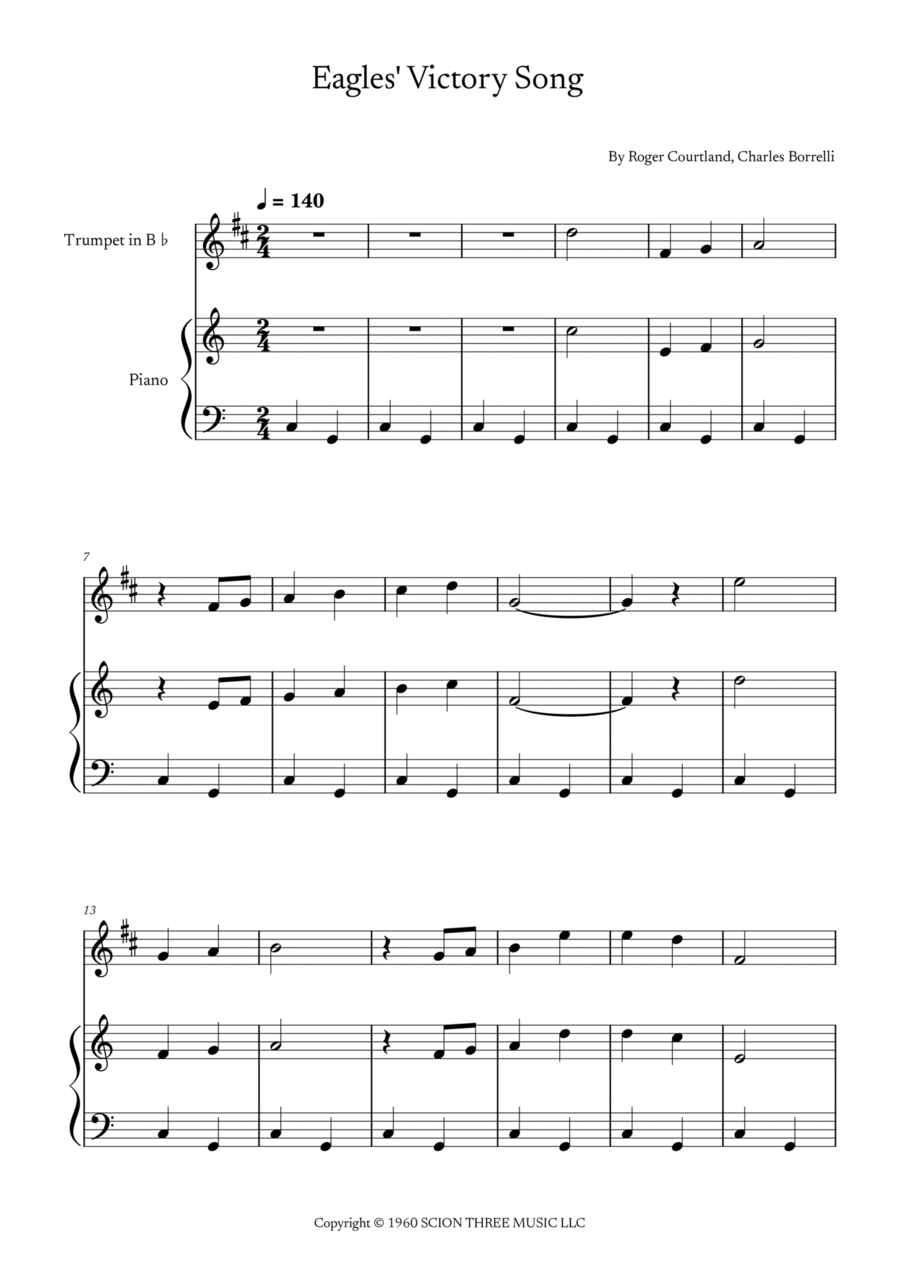
Eagles' Victory Song
Trompette, Piano
Dirk Quinn Band
$4.99 4.32 € Trompette, Piano PDF SheetMusicPlus

B-Flat Trumpet,Piano - Level 1 - Digital Download SKU: A0.1170180 By Dirk Quinn Band. By Charles Borrelli and Roger Courtland. Arranged by Cadenza Editions. Patriotic. Score and part. 3 pages. Cadenza Editions #770549. Published by Cadenza Editions (A0.1170180). Fly Eagles Fly is a classic fight song that has been a staple of Philadelphia Eagles fans for decades. This sheet music  allows musicians to play the iconic tune in their own style. The sheet music features the full score and chord progression, making it suitable for both beginner and advanced players.The history of Fly Eagles Fly dates back to the 1960s, when it was first introduced as the official fight song of the Philadelphia Eagles. The song quickly gained popularity among fans and has since become one of the most recognizable anthems in all of professional sports. Whether it's being played in the stands, at a tailgate, or in your own living room, Fly Eagles Fly is the perfect way to show your support for the Eagles and get in the spirit of game day.So why not bring a bit of Eagles spirit to your own music practice with this sheet music? Whether you're an avid Eagles fan or simply love the classic sound of this timeless tune, this sheet music is sure to bring a smile to your face and get your fingers moving. Get ready to play Fly Eagles Fly and show your support for the Philadelphia Eagles!
Eagles' Victory Song
Trompette, Piano
Dirk Quinn Band
$4.99 4.32 € Trompette, Piano PDF SheetMusicPlus

B-Flat Trumpet,Piano - Level 1 - Digital Download SKU: A0.548747 By Cat Stevens. By Cat Stevens. Arranged by James M. Guthrie, ASCAP. Rock. Score and part. 11 pages. Jmsgu3 #3415221. Published by jmsgu3 (A0.548747). Very strong arrangement for Easter. Duration: 2:48. 84 ms. Score: 7 pg. Solo part 1 pg. piano part 3 pg. Morning Has Broken is a popular and well-known Christian hymn first published in 1931. It has words by English author Eleanor Farjeon and was inspired by the village of Alfriston in East Sussex, then set to a traditional Scottish Gaelic tune known as Bunessan [1] (it shares this tune with the 19th century Christmas Carol Child in the Manger[2]). It is often sung in children's services and in Funeral services.[3] English pop musician and folk singer Cat Stevens included a version on his 1971 album Teaser and the Firecat. The song became identified with Stevens due to the popularity of this recording. It reached number six on the U.S. Billboard Hot 100, number one on the U.S. easy listening chartin 1972,[4] and number four on the Canadian RPM Magazine charts. The hymn originally appeared in the second edition of Songs of Praise (published in 1931), to the tune Bunessan, composed in the Scottish Islands. In Songs of Praise Discussed, the editor, Percy Dearmer, explains that as there was need for a hymn to give thanks for each day, English poet and children's author Eleanor Farjeon had been asked to make a poem to fit the lovely Scottish tune. A slight variation on the original hymn, also written by Eleanor Farjeon, can be found in the form of a poem contributed to the anthology Children's Bells, under Farjeon's new title, A Morning Song (For the First Day of Spring), published by Oxford University Press in 1957. The song is noted in 9/4 time but with a 3/4 feel. Bunessan had been found in L. McBean's Songs and Hymns of the Gael, published in 1900.[5] Before Farjeon's words, the tune was used as a Christmas carol, which began Child in the manger, Infant of Mary, translated from the Scottish Gaelic lyrics written by Mary MacDonald. The English-language Roman Catholic hymnal also uses the tune for the James Quinn hymns, Christ Be Beside Me and This Day God Gives Me, both of which were adapted from the traditional Irish hymn St. Patrick's Breastplate. Another Christian hymn, Baptized In Water, borrows the tune. -Wikipedia  
Morning Has Broken
Trompette, Piano
Cat Stevens
$47.95 41.5 € Trompette, Piano PDF SheetMusicPlus


Partitions Gratuites
Acheter des Partitions Musicales
Acheter des Partitions Digitales à Imprimer
Acheter des Instruments de Musique

© 2000 - 2026

Accueil - Version intégrale





