EUROPE
200 articles
USA
0 articles
DIGITAL
13 articles (à imprimer)
Partitions Digitales
Partitions à imprimer
13 partitions trouvées


French Horn,Piano - Level 3 - Digital Download SKU: A0.1313124 Composed by Camille Saint-Saens. Arranged by James M. Guthrie. 19th Century,Chamber,Contest,Festival,Romantic Period,Wedding. Score and part. 9 pages. Jmsgu3 #901955. Published by jmsgu3 (A0.1313124). Saint-Saëns: The Swan (Le Cygne) movement 13 from the Carnival of the Animals Suite. One of his most popular and widely recognized works, it is the only movement from the Carnival Suite that Saint-Saëns permitted to be performed publicly during his lifetime. This is an excellent recital encore to demonstrate melodic playing and strategic phrasing.The Carnival of the AnimalsThe Carnival of the Animals is an entertaining musical suite of fourteen movements by Camille Saint-Saëns. The work was composed for private performance by an ensemble of two pianos and solo instruments. The Swan (No. 13) is among the fourteen most famous movements. In its entirety, it lasts about 25 minutes.Saint-Saëns BackgroundCharles-Camille Saint-Saëns 1835 – 1921) was, by all means, in particular, a famous French composer, brilliant organist, and significant musical mastermind of the Romantic era. Indeed, his most famous compositions, in the long run, include his Piano Concerto No. 2 (1868), Cello Concerto No. 1 (1872), and the Danse macabre (1874). Notwithstanding, we must also add Violin Concerto No. 3 (1880), Symphony No. 3 (the Organ Symphony, 1886), and, it must be remembered, Carnival of the Animals (1886) to the list.ChildhoodIt is essential to realize that Saint-Saëns was undoubtedly, in fact, a child musical prodigy. Consequently, with this in mind, he made his concert debut, albeit at ten years old. Another critical point to remember is that he expressly studied at the Paris Conservatoire, then, despite reality, conversely followed a traditional career path as a church organist. Nevertheless, twenty years later, on the other hand, he left to become a successful freelance pianist and composer despite, as has been noted, his former employment situation. Furthermore, his performances were, after all, markedly in demand - not only in Europe but, above all, in the Americas all in all as well.YouthA point often overlooked is that in his youth, Saint-Saëns was undoubtedly excited about the modern music of the day. He was, in essence, fond of the music of his contemporaries, particularly Schumann, Liszt, and, for the most part, Wagner. In contrast, however, his compositions seemed, in fact, primarily confined within the conservative classical tradition. Be that as it may, he was, at the same time, nevertheless, a scholar of musical history.CriticismOn the whole, his conservatism, in fact, ultimately brought him into frequent conflict in his later years with composers of the impressionist and, in particular, the dodecaphonic schools of musical thought. A point often overlooked is that he included neoclassical elements in his music, contrary to some critics. Furthermore, in so doing, he provided the most compelling evidence that he predicted the techniques and works by Stravinsky and Les Six. To put it another way, given these points, he was regarded, perhaps for the most part unfairly, as a non-progressive reactionary henceforth around the time of his passing.LegacySaint-Saëns taught briefly in Paris, where his students included Gabriel Fauré. Maurice Ravel later studied with Fauré. In conclusion, both Ravel and Fauré were powerfully influenced by Saint-Saëns, whom they respected as a musical mastermind.
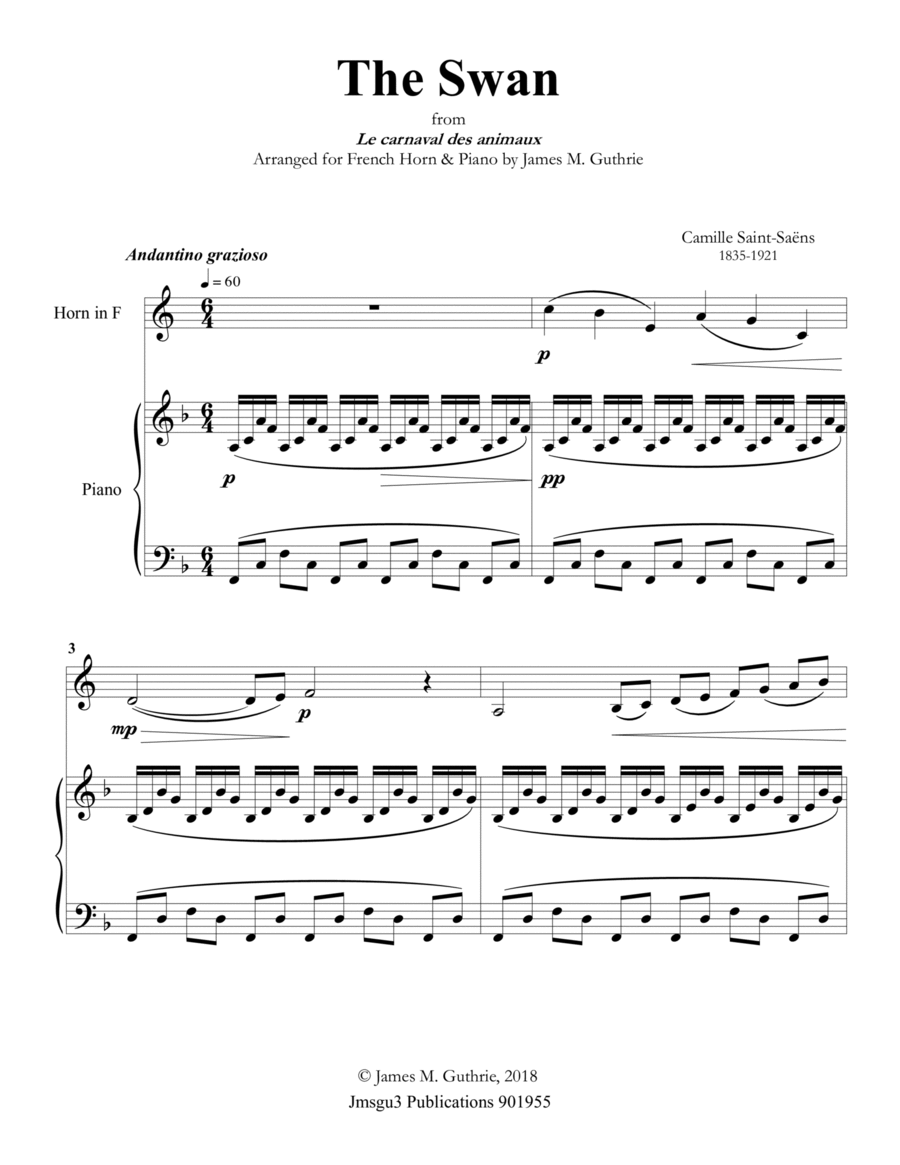
Saint-Saëns: The Swan for French Horn & Piano
Cor et Piano

$32.95 27.75 € Cor et Piano PDF SheetMusicPlus

French Horn,Piano - Level 3 - Digital Download SKU: A0.549834 Composed by Peter Ilyich Tchaikovsky. Arranged by James M. Guthrie, ASCAP. Children,Christmas,Romantic Period,Standards. Score and part. 48 pages. Jmsgu3 #3553495. Published by jmsgu3 (A0.549834). Duration: 6:12, Score: 29 pages, Solo part: 6 pages, Piano part: 12 pages. This is the grand finale of the Nutcracker Suite. Pyotr Ilyich Tchaikovsky Tchaikovsky is probably the most popular of the great composers in America. His music certainly appeals to musicians. Likewise, it appeals even to folks who don’t normally listen to serious music. This is probably because of his most noteworthy melodies. Above all, he writes with great emotion. This certainly makes a most noteworthy if not an unforgettable impact. Education First of all, He attended classes at the Russian Musical Society. Even more, He also attended the St. Petersburg Conservatory. There he studied music theory with Nikolai Zaremba. He also consequently studied composition with Anton Rubenstein. It seems like Rubenstein came under criticism from a group of Russian composers known as the Five. The Five The Five certainly rejected Western musical influences. They rather sought to use elements from Russian music. They furthermore wanted to use more exotic musical materials. Western Techniques More than other Russian composers, Tchaikovsky studied modern Western music. He certainly develops his music like the European masters. So, rather than repeating a motive, he moves to a new key. He then introduces a different theme in the new key. Hence, he maintained his independence from the Five. Even more, he became the first Russian composer of international stature. Influences Tchaikovsky was probably influenced in his ballet scoring by Léo Delibes. Richard Wagner influenced his symphonic writing. Tchaikovsky’s most famous works include the 1812 Overture, The Nutcracker Suite, and Swan Lake. Also famous are the Violin Concerto in D and the six symphonies. The greatest of the six symphonies may be No. 6, the Pathétique. Nutcracker Suite, Op. 71a The Nutcracker Suite is a ballet that was performed for the first time in December 1892 in St. Petersburg. To begin with, the original ballet failed to attract a positive reception. However, the ballet suite became probably one of the most popular of all of Tchaikovsky’s works. The ballet suite became even more famous in the 1960s. It is now performed all over the world, particularly during the Christmas season.  
Tchaikovsky: Waltz of the Flowers from Nutcracker Suite for French Horn & Piano
Cor et Piano

$32.95 27.75 € Cor et Piano PDF SheetMusicPlus

French Horn,Piano - Level 3 - Digital Download SKU: A0.549696 Composed by Peter Ilyich Tchaikovsky. Arranged by James M. Guthrie, ASCAP. Children,Christmas,Romantic Period,Standards. Score and part. 14 pages. Jmsgu3 #3525275. Published by jmsgu3 (A0.549696). Duration: ca. 1:42, 52 measures, Score: 7 pages, solo part: 2 pages, piano part: 4 pages. A popular Christmas favorite from Tchaikovsky's Nutcracker Suite. Pyotr Ilyich Tchaikovsky Tchaikovsky is probably the most popular of the great composers in America. His music certainly appeals to musicians. Likewise, it appeals even to folks who don’t normally listen to serious music. This is probably because of his most noteworthy melodies. Above all, he writes with great emotion. This certainly makes a most noteworthy if not an unforgettable impact. Education First of all, He attended classes at the Russian Musical Society. Even more, He also attended the St. Petersburg Conservatory. There he studied music theory with Nikolai Zaremba. He also consequently studied composition with Anton Rubenstein. It seems like Rubenstein came under criticism from a group of Russian composers known as the Five. The Five The Five certainly rejected Western musical influences. They rather sought to use elements from Russian music. They furthermore wanted to use more exotic musical materials. Western Techniques More than other Russian composers, Tchaikovsky studied modern Western music. He certainly develops his music like the European masters. So, rather than repeating a motive, he moves to a new key. He then introduces a different theme in the new key. Hence, he maintained his independence from the Five. Even more, he became the first Russian composer of international stature. Influences Tchaikovsky was probably influenced in his ballet scoring by Léo Delibes. Richard Wagner influenced his symphonic writing. Tchaikovsky’s most famous works include the 1812 Overture, The Nutcracker Suite, and Swan Lake. Also famous are the Violin Concerto in D and the six symphonies. The greatest of the six symphonies may be No. 6, the Pathétique. Nutcracker Suite, Op. 71a The Nutcracker Suite is a ballet that was performed for the first time in December 1892 in St. Petersburg. To begin with, the original ballet failed to attract a positive reception. However, the ballet suite became probably one of the most popular of all of Tchaikovsky’s works. The ballet suite became even more famous in the 1960s. It is now performed all over the world, particularly during the Christmas season.
Tchaikovsky: Dance of the Sugar-Plum Fairy from Nutcracker Suite for French Horn & Piano
Cor et Piano

$32.95 27.75 € Cor et Piano PDF SheetMusicPlus

French Horn,Piano - Level 2 - Digital Download SKU: A0.549438 Composed by Antonin Dvorak. Arranged by James M. Guthrie, ASCAP. Instructional,Romantic Period,Sacred,Standards. Score and part. 12 pages. Jmsgu3 #3494249. Published by jmsgu3 (A0.549438). Score: 7 pages, solo part: 2 pages, piano part: 3 pages. Duration: 4:25 Not difficult, but requires sensitivity & dynamic control. Suitable for recitals, church meditations, or school programs. Dvořák Background Antonín Dvořák (1841 –1904) was, of course, a composer from Czechoslovakia. As a matter of fact, he was among the first Bohemian composers to attain universal recognition. It is important to realize that the late Romantic Nationalist period featured composers who used traditional and folk elements to portray the character of their nation. In particular, we see this in the music of Grieg (Norway), Finland (Sibelius), and Smetana (Bohemia).  Dvořák relied markedly on rhythms and other characteristics of Moravian and Bohemian folk music. Ascent to Fame Dvořák was truly a child musical prodigy on the violin. The premiere performances of his compositions notably occurred in 1872 and 1873. He submitted his First Symphony in particular to a German competition, but it failed to win. Consequently, in 1874 he presented two more symphonies to the Austrian State Prize for Composition. Johannes Brahms was the principal of the jury and was accordingly very impressed. They forthwith awarded the prize to Dvořák in 1874, 1876, and 1877. At this point, Brahms thereupon endorsed Dvořák to the publisher Simrock. Later, the publisher commissioned Dvořák to compose the Slavonic Dances, Op. 46. These became popular overnight and, as a result, Dvořák's worldwide status was launched. International Status Dvořák visited England upon invitation nine times. On each visit, he frequently conducted performances of his own compositions. He conducted concerts of his music, especially in Moscow and St. Petersburg. Eventually, the Prague Conservatory in fact appointed Dvořák as a professor. There, to be sure, he wrote his famous Dumky Trio. United States Consequently, the National Conservatory of Music of America appointed him as director in 1892. As a result, Dvořák composed his two most famous symphonic works: the Symphony No. 9 (From the New World), which spread his name universally, and his Concerto for Cello and Orchestra, one of the most famous of all cello works. Moreover, he wrote his most celebrated American String Quartet during this time. At the same time, because of his growing recognition in Europe and his homesickness for his own country, he left to return to Bohemia in 1895.
DvoÅ™ák: Largo from the New World Symphony for French Horn & Piano
Cor et Piano

$32.95 27.75 € Cor et Piano PDF SheetMusicPlus

French Horn,Piano - Level 4 - Digital Download SKU: A0.549460 Composed by Sir Arthur Seymour Sullivan. Arranged by James M. Guthrie, ASCAP. Instructional,Romantic Period,Sacred,Standards. Score and part. 15 pages. Jmsgu3 #3497289. Published by jmsgu3 (A0.549460). Score: 10 pages, solo part: 2 pages, piano part: 3 pages. Duration: 4:25. Not difficult, but requires sensitivity & dynamic control. Suitable for recitals, church meditations, or school programs. School Years First of all, Sullivan attended music school at the Royal Academy of Music. Because Sullivan was so talented, the Academy awarded him the Mendelssohn Scholarship for two years in a row. He, therefore, studied with John Goss, who studied with Thomas Atwood, who in turn studied with Mozart. Sullivan similarly studied the piano at the Academy with Arthur O’Leary. Study Abroad During his first year, he also earned money by singing solos in the Chapel Royal. At the end of his second year, the Academy consequently continued his scholarship and sent him to study at the Leipzig Conservatoire. He certainly studied composition, and likewise counterpoint and piano. Hence, during his final year in Leipzig, Sullivan finally completed his graduation composition project: Incidental Music for Shakespeare’s The Tempest. Association with Gilbert It seems like Sullivan built the bulk of his composing career largely in the 1860s. As a result, he became famous for his incidental music for the Tempest and his Irish Symphony. He, therefore, began collaborating with the poet W. S. Gilbert in the 1870s. Rather than focus on serious opera, Gilbert and Sullivan, in contrast, concentrated on comic opera such as H. M. S. Pinafore, the Pirates of Penzance, and the Mikado. Therefore, certainly as a result of his education and experience, Sullivan composed a total of 24 operas, 11 symphonic works, 10 choral pieces. Even more, he wrote a large number of noteworthy hymns such as Onward Christian Soldiers. Lost Chord The general style of his music is maybe similar to Mendelssohn, Schumann, and perhaps Liszt. It seems like Sullivan was fond of writing distinct melodies for each character in his operettas. His melodies combine together as the characters did. Furthermore, he was a master orchestrator, and therefore played the flute, clarinet, trumpet, and trombone fluently. The Lost Chord Sullivan wrote his most noteworthy song the Lost Chord in 1877. As a result, it was a great success and was certainly performed all over the world by a variety of singers such as Enrico Caruso. Because Sullivan was the most famous composer in England, the Lost Chord became the most famous of all British or American songs of the 1870s and 1890s. Consequently, in 1888 Thomas Edison recorded The Lost Chord for the phonograph. It was one of the first songs ever recorded. Furthermore, Queen Victoria knighted Sullivan in 1883.  
Sullivan: The Lost Chord for French Horn & Piano
Cor et Piano

$26.95 22.7 € Cor et Piano PDF SheetMusicPlus

French Horn,Piano - Level 3 - Digital Download SKU: A0.549632 Composed by Peter Ilyich Tchaikovsky. Arranged by James M. Guthrie, ASCAP. Children,Christmas,Romantic Period,Standards. Score and part. 24 pages. Jmsgu3 #3515725. Published by jmsgu3 (A0.549632). Duration: ca. 3:20 Score: 13 pages, solo part: 3 pages, piano part: 7 pages, 182 measures in 2/4. Overture in Miniature to Tchaikovsky's Nutcracker Suite.  Program for a recital, church meditation, school plays, and Christmas presentations of all kinds.  Pyotr Ilyich Tchaikovsky Tchaikovsky is probably the most popular of the great composers in America. His music certainly appeals to musicians. Likewise, it appeals even to folks who don’t normally listen to serious music. This is probably because of his most noteworthy melodies. Above all, he writes with great emotion. This certainly makes a most noteworthy if not an unforgettable impact. Education First of all, He attended classes at the Russian Musical Society. Even more, He also attended the St. Petersburg Conservatory. There he studied music theory with Nikolai Zaremba. He also consequently studied composition with Anton Rubenstein. It seems like Rubenstein came under criticism from a group of Russian composers known as the Five. The Five The Five certainly rejected Western musical influences. They rather sought to use elements from Russian music. They furthermore wanted to use more exotic musical materials. Western Techniques More than other Russian composers, Tchaikovsky studied modern Western music. He certainly develops his music like the European masters. So, rather than repeating a motive, he moves to a new key. He then introduces a different theme in the new key. Hence, he maintained his independence from the Five. Even more, he became the first Russian composer of international stature. Influences Tchaikovsky was probably influenced in his ballet scoring by Léo Delibes. Richard Wagner influenced his symphonic writing. Tchaikovsky’s most famous works include the 1812 Overture, The Nutcracker Suite, and Swan Lake. Also famous are the Violin Concerto in D and the six symphonies. The greatest of the six symphonies may be No. 6, the Pathétique. Nutcracker Suite, Op. 71a The Nutcracker Suite is a ballet that was performed for the first time in December 1892 in St. Petersburg. To begin with, the original ballet failed to attract a positive reception. However, the ballet suite became probably one of the most popular of all of Tchaikovsky’s works. The ballet suite became even more famous in the 1960s. It is now performed all over the world, particularly during the Christmas season.  
Tchaikovsky: Overture from Nutcracker Suite for French Horn & Piano
Cor et Piano

$32.95 27.75 € Cor et Piano PDF SheetMusicPlus

French Horn,Piano - Level 3 - Digital Download SKU: A0.549766 Composed by Peter Ilyich Tchaikovsky. Arranged by James M. Guthrie, ASCAP. Children,Christmas,Romantic Period,Standards. Score and part. 17 pages. Jmsgu3 #3533947. Published by jmsgu3 (A0.549766). Duration: ca. 3:15 Score: 10 pages, solo part: 2 pages, piano part: 4 pages. Tchaikovsky paints a very mysterious mood in this favorite masterpiece from the Nutcracker Suite. It is also a traditional Christmas favorite. Pyotr Ilyich Tchaikovsky Tchaikovsky is probably the most popular of the great composers in America. His music certainly appeals to musicians. Likewise, it appeals even to folks who don’t normally listen to serious music. This is probably because of his most noteworthy melodies. Above all, he writes with great emotion. This certainly makes a most noteworthy if not an unforgettable impact. Education First of all, He attended classes at the Russian Musical Society. Even more, He also attended the St. Petersburg Conservatory. There he studied music theory with Nikolai Zaremba. He also consequently studied composition with Anton Rubenstein. It seems like Rubenstein came under criticism from a group of Russian composers known as the Five. The Five The Five certainly rejected Western musical influences. They rather sought to use elements from Russian music. They furthermore wanted to use more exotic musical materials. Western Techniques More than other Russian composers, Tchaikovsky studied modern Western music. He certainly develops his music like the European masters. So, rather than repeating a motive, he moves to a new key. He then introduces a different theme in the new key. Hence, he maintained his independence from the Five. Even more, he became the first Russian composer of international stature. Influences Tchaikovsky was probably influenced in his ballet scoring by Léo Delibes. Richard Wagner influenced his symphonic writing. Tchaikovsky’s most famous works include the 1812 Overture, The Nutcracker Suite, and Swan Lake. Also famous are the Violin Concerto in D and the six symphonies. The greatest of the six symphonies may be No. 6, the Pathétique. Nutcracker Suite, Op. 71a The Nutcracker Suite is a ballet that was performed for the first time in December 1892 in St. Petersburg. To begin with, the original ballet failed to attract a positive reception. However, the ballet suite became probably one of the most popular of all of Tchaikovsky’s works. The ballet suite became even more famous in the 1960s. It is now performed all over the world, particularly during the Christmas season.
Tchaikovsky: Arabian Dance from Nutcracker Suite for French Horn & Piano
Cor et Piano

$32.95 27.75 € Cor et Piano PDF SheetMusicPlus

French Horn,Piano - Level 3 - Digital Download SKU: A0.549790 Composed by Peter Ilyich Tchaikovsky. Arranged by James M. Guthrie, ASCAP. Children,Christmas,Romantic Period,Standards. Score and part. 11 pages. Jmsgu3 #3537327. Published by jmsgu3 (A0.549790). Duration: ca 1:00 Score: 5 pages, Solo part: 2 pages, piano part: 3 pages. Short but fascinating Chinese Dance from the Nutcracker Suite. Program this for a recital encore or Christmas pageant. Pyotr Ilyich Tchaikovsky Tchaikovsky is probably the most popular of the great composers in America. His music certainly appeals to musicians. Likewise, it appeals even to folks who don’t normally listen to serious music. This is probably because of his most noteworthy melodies. Above all, he writes with great emotion. This certainly makes a most noteworthy if not an unforgettable impact. Education First of all, He attended classes at the Russian Musical Society. Even more, He also attended the St. Petersburg Conservatory. There he studied music theory with Nikolai Zaremba. He also consequently studied composition with Anton Rubenstein. It seems like Rubenstein came under criticism from a group of Russian composers known as the Five. The Five The Five certainly rejected Western musical influences. They rather sought to use elements from Russian music. They furthermore wanted to use more exotic musical materials. Western Techniques More than other Russian composers, Tchaikovsky studied modern Western music. He certainly develops his music like the European masters. So, rather than repeating a motive, he moves to a new key. He then introduces a different theme in the new key. Hence, he maintained his independence from the Five. Even more, he became the first Russian composer of international stature. Influences Tchaikovsky was probably influenced in his ballet scoring by Léo Delibes. Richard Wagner influenced his symphonic writing. Tchaikovsky’s most famous works include the 1812 Overture, The Nutcracker Suite, and Swan Lake. Also famous are the Violin Concerto in D and the six symphonies. The greatest of the six symphonies may be No. 6, the Pathétique. Nutcracker Suite, Op. 71a The Nutcracker Suite is a ballet that was performed for the first time in December 1892 in St. Petersburg. To begin with, the original ballet failed to attract a positive reception. However, the ballet suite became probably one of the most popular of all of Tchaikovsky’s works. The ballet suite became even more famous in the 1960s. It is now performed all over the world, particularly during the Christmas season.
Tchaikovsky: Chinese Dance from Nutcracker Suite for French Horn & Piano
Cor et Piano

$32.95 27.75 € Cor et Piano PDF SheetMusicPlus

French Horn,Piano - Level 3 - Digital Download SKU: A0.549719 Composed by Peter Ilyich Tchaikovsky. Arranged by James M. Guthrie, ASCAP. Children,Christmas,Romantic Period,Standards. Score and part. 15 pages. Jmsgu3 #3530631. Published by jmsgu3 (A0.549719). Duration: ca. 58, score: 9 pages, solo part: 2 pages, piano part: 3 pages.This piece would be a perfect recital encore - short, energetic - leave your audience wanting more. Also, program this for your Christmas pageant. Pyotr Ilyich Tchaikovsky Tchaikovsky is probably the most popular of the great composers in America. His music certainly appeals to musicians. Likewise, it appeals even to folks who don’t normally listen to serious music. This is probably because of his most noteworthy melodies. Above all, he writes with great emotion. This certainly makes a most noteworthy if not an unforgettable impact. Education First of all, He attended classes at the Russian Musical Society. Even more, He also attended the St. Petersburg Conservatory. There he studied music theory with Nikolai Zaremba. He also consequently studied composition with Anton Rubenstein. It seems like Rubenstein came under criticism from a group of Russian composers known as the Five. The Five The Five certainly rejected Western musical influences. They rather sought to use elements from Russian music. They furthermore wanted to use more exotic musical materials. Western Techniques More than other Russian composers, Tchaikovsky studied modern Western music. He certainly develops his music like the European masters. So, rather than repeating a motive, he moves to a new key. He then introduces a different theme in the new key. Hence, he maintained his independence from the Five. Even more, he became the first Russian composer of international stature. Influences Tchaikovsky was probably influenced in his ballet scoring by Léo Delibes. Richard Wagner influenced his symphonic writing. Tchaikovsky’s most famous works include the 1812 Overture, The Nutcracker Suite, and Swan Lake. Also famous are the Violin Concerto in D and the six symphonies. The greatest of the six symphonies may be No. 6, the Pathétique. Nutcracker Suite, Op. 71a The Nutcracker Suite is a ballet that was performed for the first time in December 1892 in St. Petersburg. To begin with, the original ballet failed to attract a positive reception. However, the ballet suite became probably one of the most popular of all of Tchaikovsky’s works. The ballet suite became even more famous in the 1960s. It is now performed all over the world, particularly during the Christmas season.
Tchaikovsky: Russian Dance from Nutcracker Suite for French Horn & Piano
Cor et Piano

$32.95 27.75 € Cor et Piano PDF SheetMusicPlus

French Horn,Piano - Level 3 - Digital Download SKU: A0.549612 Composed by Peter Ilyich Tchaikovsky. Arranged by James M. Guthrie, ASCAP. Instructional,Romantic Period,Standards. Score and part. 15 pages. Jmsgu3 #3513735. Published by jmsgu3 (A0.549612). Tchaikovsky is probably the most popular of the great composers in America. His music certainly appeals to musicians. Likewise, it appeals even to folks who don't usually listen to serious music. This is probably because of his most noteworthy melodies. Above all, he writes with great emotion. This certainly makes a most extraordinary, if not an unforgettable, impact. Education He attended classes at the Russian Musical Society and participated at the St. Petersburg Conservatory. There, he studied music theory with Nikolai Zaremba. Consequently, he also studied composition with Anton Rubenstein.  Rubenstein was criticized by Russian composers known as the Five. The Five The Five indeed rejected Western musical influences. They instead sought to use elements from Russian music. Furthermore, they wanted to use more exotic musical materials. Western Techniques More than other Russian composers, Tchaikovsky studied modern Western music. He develops his music like the European masters. So, rather than repeating a motive, he moves to a new key. He then introduces a different theme in the new key. Hence, he maintained his independence from the Five. Even more, he became the first Russian composer of international stature. Influences Tchaikovsky was probably influenced in his ballet scoring by Léo Delibes. Richard Wagner influenced his symphonic writing. Tchaikovsky's most famous works include the 1812 Overture, The Nutcracker Suite, and Swan Lake. Also notable are the Violin Concerto in D and the six symphonies. The greatest of the six symphonies may be No. 6, the Pathétique. Swan Lake Op. 20 Tchaikovsky composed Swan Lake in 1875-76. The ballet failed to attract a positive reception. Over time, however, it became one of the most popular of all of Tchaikovsky's works. The ballet was first performed by the Bolshoi Ballet in Moscow.
Tchaikovsky: Scene 10 from Swan Lake for French Horn & Piano
Cor et Piano

$32.95 27.75 € Cor et Piano PDF SheetMusicPlus

French Horn,Piano - Level 1 - Digital Download SKU: A0.548477 Composed by Mueller. Arranged by James M. Guthrie, ASCAP. Christian,Christmas. Score and part. 3 pages. Jmsgu3 #3386535. Published by jmsgu3 (A0.548477). Traditional Christmas song arranged for Horn in F and Piano. Third verse features new harmony. Score: 2 pg. Part: 1 pg.Away in a Manger Away in a Manger is a popular Christmas song published originally sometime in the later 19th century and performed throughout the world. In England, it is considered one of the two most popular carols of all time; a 1996 poll ranked it as a tie for second place. To begin with, many thought it was written by Martin Luther, but now the song is considered to be absolutely American. The most common musical arrangements are by William Kirkpatrick (1895) and James R. Murray (1887). The melody was first published, as Luther's Cradle Hymn, by James R. Murray. Then, came a confusing series of explanations about how Martin Luther wrote the song. Murray even went so far as to suggest that Luther wrote it for his children. As a result, the song has become known as simply Mueller. Nobody knows who this Mueller actually is, but the name stuck. Popularity By the 1880’s the cradle song was being performed in church. By the 1990’s the song was becoming the most popular Christmas song of all time. It was sung in school, in church, and at home by nearly everyone. Other musical settings The first musical setting published with the lyrics appeared in the Little Children's Book for Schools and Families (1885). The title was Away in a Manger. This edition is the first one not to attribute the song to Martin Luther.   Charles H. Gabriel was the first arranger to present the third verse. He also composed and published a large number of different arrangements of the song. In one of his settings, he supplies a chorus for each verse with asleep sung in canon. Another prevalent preparation uses the lyrics to the melody Flow Gently, Sweet Afton. Yet another arrangement dating uses the lyrics to an old Normandy Carol.  Register for free lifetime updates and revisions of this product at www.jamesguthrie.com
Away In A Manger: for French Horn & Piano
Cor et Piano
the 1880’s the cradle song was being performed in church
$24.95 21.01 € Cor et Piano PDF SheetMusicPlus

French Horn,Piano - Level 3 - Digital Download SKU: A0.1078459 By Glen Campbell. By Jimmy Webb. Arranged by James M. Guthrie. Country,Jazz,Pop,Standards,Wedding. Score and part. 12 pages. Jmsgu3 #682659. Published by jmsgu3 (A0.1078459). Score: 7 pages. Duration: 2:34Wichita Lineman is a 1968 song by the American singer-songwriter Jimmy Webb. The song has since been praised as one of the most influential and greatest recordings in popular music history. The song has been widely praised by critics and has been called a masterpiece of American music. In 2004, it was ranked number 201 on Rolling Stone's list of The 500 Greatest Songs of All Time. The song has also been praised for its poetic lyrics, as well as its use of electric guitar and strings to create a unique sound. The song has been covered by numerous artists, including Glen Campbell, who recorded a version that reached the top of the US Billboard Hot Country Songs chart in 1968. The song has also been featured in numerous films and television shows and has been referenced in popular culture. Wichita Lineman has been praised for its universal appeal, and its ability to connect with listeners.Wichita Lineman is a timeless classic that has become synonymous with loneliness. The song is about a telephone lineman who is alone in his work and in his life, looking out at the vast landscape in search of something he cannot find. The melancholy and longing of the song evoke the loneliness that many people feel, especially in a society that can often feel disconnected and isolated. Webb's lyrics and Campbell's vocals combine to create a song that is as beautiful as it is heartbreaking. It is a timeless song that captures the loneliness of many, and its enduring popularity over the years is a testament to its power.
Wichita Lineman
Cor et Piano
Glen Campbell
$149.95 126.28 € Cor et Piano PDF SheetMusicPlus

French Horn,Piano - Level 2 - Digital Download SKU: A0.1378343 By Belinda Carlisle. By Ellen Shipley and Rick Nowels. Arranged by Kevin P Holdgate. 20th Century,Broadway,Film/TV,Musical/Show,Pop,Standards. Score and part. 8 pages. Kevin P Holdgate #962967. Published by Kevin P Holdgate (A0.1378343). This is an arrangement for solo instrument and piano pitched at around the level of ABRSM Grade 4/5 for most instruments. The range of notes is very compact with the difficulty steming from the often complicated rhythms and also the opening statement of the main theme is unaccompanied requiring the soloist to play with confidence and accuracy. The use of syncopated rhythms makes this an excellent repertoire piece.Heaven Is a Place on Earth is a single by American singer Belinda Carlisle from her second studio album, Heaven on Earth (1987). Written by Rick Nowels and Ellen Shipley, the song was released as the lead single from the Heaven on Earth album on September 14, 1987, and it reached number one on the US Billboard Hot 100 on December 5, 1987, becoming Carlisle's only US chart-topper to date. A month later it peaked at number one in the United Kingdom, where it held the top spot of the UK Singles Chart for two weeks. In Australia it peaked at number 2. It is considered to be Carlisle's signature song.The song was nominated for the Grammy Award for Best Female Pop Vocal Performance in 1988, but lost out to Whitney Houston's I Wanna Dance with Somebody (Who Loves Me).
Heaven Is A Place On Earth
Cor et Piano
Belinda Carlisle
$5.99 5.04 € Cor et Piano PDF SheetMusicPlus


Partitions Gratuites
Acheter des Partitions Musicales
Acheter des Partitions Digitales à Imprimer
Acheter des Instruments de Musique

© 2000 - 2026

Accueil - Version intégrale





