EUROPE
1099 articles
USA
0 articles
DIGITAL
14 articles (à imprimer)
Partitions Digitales
Partitions à imprimer
14 partitions trouvées


French Horn,Piano - Level 3 - Digital Download SKU: A0.1313124 Composed by Camille Saint-Saens. Arranged by James M. Guthrie. 19th Century,Chamber,Contest,Festival,Romantic Period,Wedding. Score and part. 9 pages. Jmsgu3 #901955. Published by jmsgu3 (A0.1313124). Saint-Saëns: The Swan (Le Cygne) movement 13 from the Carnival of the Animals Suite. One of his most popular and widely recognized works, it is the only movement from the Carnival Suite that Saint-Saëns permitted to be performed publicly during his lifetime. This is an excellent recital encore to demonstrate melodic playing and strategic phrasing.The Carnival of the AnimalsThe Carnival of the Animals is an entertaining musical suite of fourteen movements by Camille Saint-Saëns. The work was composed for private performance by an ensemble of two pianos and solo instruments. The Swan (No. 13) is among the fourteen most famous movements. In its entirety, it lasts about 25 minutes.Saint-Saëns BackgroundCharles-Camille Saint-Saëns 1835 – 1921) was, by all means, in particular, a famous French composer, brilliant organist, and significant musical mastermind of the Romantic era. Indeed, his most famous compositions, in the long run, include his Piano Concerto No. 2 (1868), Cello Concerto No. 1 (1872), and the Danse macabre (1874). Notwithstanding, we must also add Violin Concerto No. 3 (1880), Symphony No. 3 (the Organ Symphony, 1886), and, it must be remembered, Carnival of the Animals (1886) to the list.ChildhoodIt is essential to realize that Saint-Saëns was undoubtedly, in fact, a child musical prodigy. Consequently, with this in mind, he made his concert debut, albeit at ten years old. Another critical point to remember is that he expressly studied at the Paris Conservatoire, then, despite reality, conversely followed a traditional career path as a church organist. Nevertheless, twenty years later, on the other hand, he left to become a successful freelance pianist and composer despite, as has been noted, his former employment situation. Furthermore, his performances were, after all, markedly in demand - not only in Europe but, above all, in the Americas all in all as well.YouthA point often overlooked is that in his youth, Saint-Saëns was undoubtedly excited about the modern music of the day. He was, in essence, fond of the music of his contemporaries, particularly Schumann, Liszt, and, for the most part, Wagner. In contrast, however, his compositions seemed, in fact, primarily confined within the conservative classical tradition. Be that as it may, he was, at the same time, nevertheless, a scholar of musical history.CriticismOn the whole, his conservatism, in fact, ultimately brought him into frequent conflict in his later years with composers of the impressionist and, in particular, the dodecaphonic schools of musical thought. A point often overlooked is that he included neoclassical elements in his music, contrary to some critics. Furthermore, in so doing, he provided the most compelling evidence that he predicted the techniques and works by Stravinsky and Les Six. To put it another way, given these points, he was regarded, perhaps for the most part unfairly, as a non-progressive reactionary henceforth around the time of his passing.LegacySaint-Saëns taught briefly in Paris, where his students included Gabriel Fauré. Maurice Ravel later studied with Fauré. In conclusion, both Ravel and Fauré were powerfully influenced by Saint-Saëns, whom they respected as a musical mastermind.
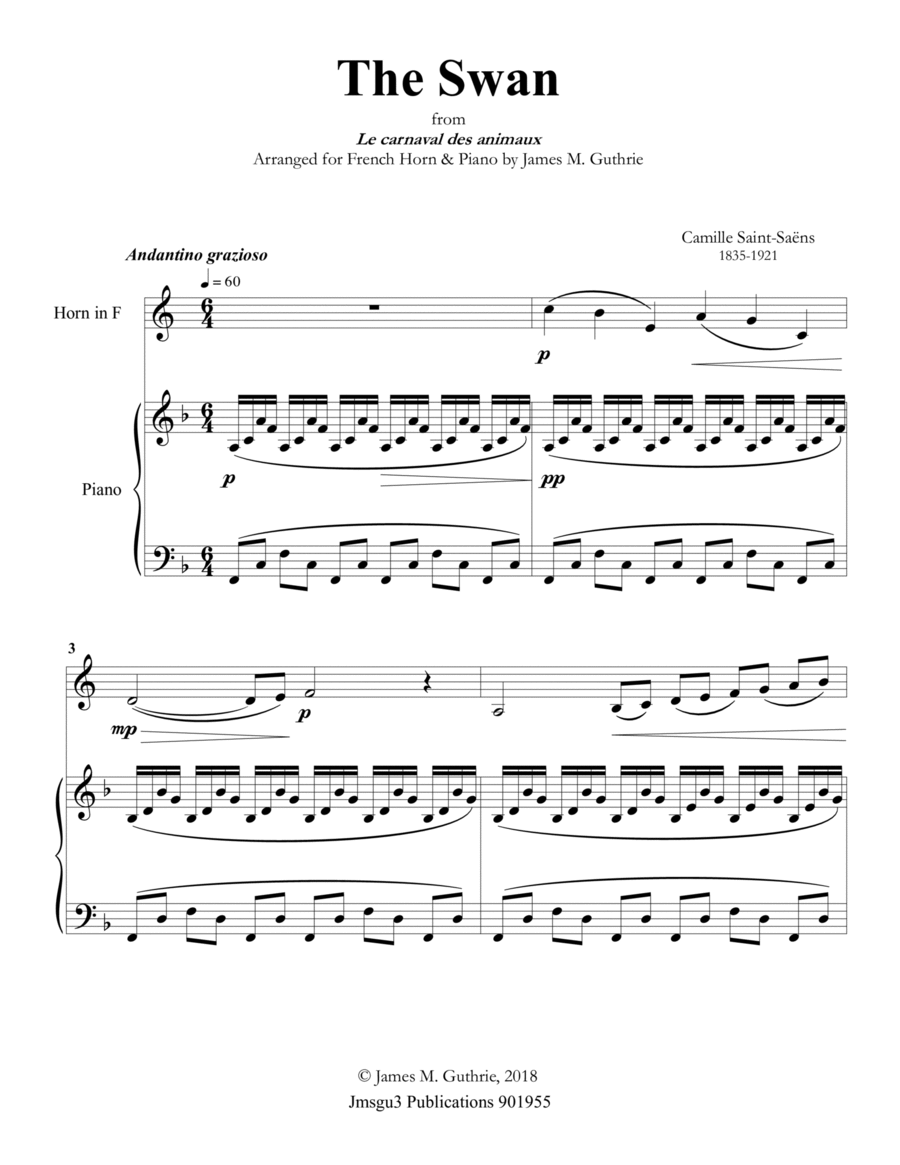
Saint-Saëns: The Swan for French Horn & Piano
Cor et Piano

$32.95 28.65 € Cor et Piano PDF SheetMusicPlus

French Horn,Piano - Level 3 - Digital Download SKU: A0.549653 Composed by Ludwig van Beethoven. Arranged by James M. Guthrie, ASCAP. Concert,Instructional,Romantic Period,Sacred,Standards. Score and part. 16 pages. Jmsgu3 #3516943. Published by jmsgu3 (A0.549653). Duration: ca 5:20, Score: 8 pages, solo part: 3 pages, piano part: 4 pages. One of Beethoven's finest and most famous works. Program for a recital, church meditation or school program. Bring your best espressivo and plan to rehearse the many subtle dynamic changes.Sonata Pathétique Op. 13 First of all, this is an arrangement of the second movement of Beethoven’s Sonata Pathétique. It seems like Beethoven wrote this piece before becoming troubled by deafness. Published in 1799, it consequently remains one of the most celebrated pieces Beethoven ever wrote. As a result of its popularity, the movement was therefore performed by Karl Haas. Hass recorded it for a popular radio show called: Adventures in Good Music. Beethoven Background Ludwig van Beethoven (1770 –1827) was certainly a German pianist. Above all, he was probably one of the greatest composers in history. As a result, he is a pivotal character in the progress between the Classical and Romantic periods. He is certainly one of the most famous and hence important of all composers. Seems like his most familiar and noteworthy works include symphonies 1-9; piano concertos 1-5; and furthermore, the violin concerto. Also, certainly of extreme importance are the noteworthy 32 sonatas for the piano; the string quartets 1-16; the Missa solemnis; and likewise, his only opera, Fidelio. Beethoven Overview First of all, Beethoven was born and consequently raised in Bonn. Upon turning 21 he moved to Vienna probably to study composition with Haydn. That’s when he consequently grew a reputation as a brilliant pianist. Furthermore, he probably stayed in Vienna for the rest of his life. In his late 20s, it seems like his hearing certainly began to decline. It slowly declined until consequently, he was nearly totally deaf probably by the last decade of his life. As a result, he stopped conducting and performing. Nevertheless, he continued to compose. As a result, some of his greatest works probably come from this period. First Period Seems like we often divide Beethoven’s life into three periods. Period 1 begins with Beethoven’s arrival in Vienna. Hence, during this period, he mastered the Viennese style of Haydn & Mozart. He consequently began increasing the size and scale of his works. Furthermore, he experimented with extreme dynamics, and likewise extreme tempi. He worked similarly with chromatic harmony. His First and Second Symphonies, therefore, belong to this period. Other important works also belong here: the first six string quartets and the Sonata Pathétique, Op. 13. Second Period His second period probably began as soon as he realized that he was going deaf. During this period, it seems like he became obsessed with the idea of heroism. His works consequently become even larger and more massive. The most noteworthy of these include the symphonies 3 – 8, piano concertos 5& 6, 5 string quartets, several important piano sonatas (Waldstein and Appassionata), the Kreutzer violin sonata, the violin concerto and his only opera: Fidelio. Third Period In contrast, Beethoven's third period is branded above all by works of incredible intellectual depth, formal innovation, and penetrating expression. It seems like he continued to expand his works. Consequently, the string quartet Op. 131 spills over into seven connected movements. Likewise, in the Ninth Symphony, he adds choral forces to his orchestra probably for the first time in history. Even more, other works from this period include his Missa solemnis, the final 5 string quartets (including the enormous Große Fuge) and the final five sonatas for piano.     www.jamesguthrie.com.
Beethoven: Adagio from Sonata Pathetique for French Horn & Piano
Cor et Piano

$24.95 21.7 € Cor et Piano PDF SheetMusicPlus

French Horn,Piano - Level 1 - Digital Download SKU: A0.1494250 Composed by Thomas Moore. Arranged by Alex Nunes Rodrigues. Folk. Score and part. 3 pages. Alex Rodrigues #1070853. Published by Alex Rodrigues (A0.1494250). The Last Rose of Summer is a work deeply rooted in Irish culture, originally penned as a poem by the renowned poet and composer Thomas Moore in 1805. Moore, regarded as Ireland’s national poet, was inspired by an 'Old Blush' rose while staying at Jenkinstown Castle in County Kilkenny, Ireland. The poem was published as part of his Irish Melodies collection between 1807 and 1834 and later set to music by fellow Irishman John Stevenson. The song gained widespread popularity and was incorporated into the opera Martha by the German composer Friedrich von Flotow, which premiered in 1847 in Vienna.This sheet music has been adapted for solo instrument, preserving the original melody by Moore and Stevenson in its essence. The simplicity of the arrangement allows the musician to highlight the purity of the melody, making it easier to perform while maintaining the piece's emotional character. This version is designed to be accessible for beginner to intermediate musicians, enabling an authentic interpretation that respects the traditional nuances of the work.The Last Rose of Summer captures the essence of melancholy and the passage of time—universal themes reflected in the farewell to the last vestige of a vibrant summer. The melody, paired with Moore’s poetry, evokes a profound sense of loss and longing, with the solitary rose serving as a metaphor for the fleeting nature of life and the seasons. The simplicity and beauty of this piece have made it a classic, perpetuating Irish tradition and touching the hearts of listeners worldwide.
The Last Rose of Summer - Horn with piano and chords
Cor et Piano

$5.99 5.21 € Cor et Piano PDF SheetMusicPlus

French Horn,Piano - Level 1 - Digital Download SKU: A0.1494251 Composed by Thomas Moore. Arranged by Alex Nunes Rodrigues. Folk. Score and part. 3 pages. Alex Rodrigues #1070854. Published by Alex Rodrigues (A0.1494251). The Last Rose of Summer is a work deeply rooted in Irish culture, originally penned as a poem by the renowned poet and composer Thomas Moore in 1805. Moore, regarded as Ireland’s national poet, was inspired by an 'Old Blush' rose while staying at Jenkinstown Castle in County Kilkenny, Ireland. The poem was published as part of his Irish Melodies collection between 1807 and 1834 and later set to music by fellow Irishman John Stevenson. The song gained widespread popularity and was incorporated into the opera Martha by the German composer Friedrich von Flotow, which premiered in 1847 in Vienna.This sheet music has been adapted for solo instrument, preserving the original melody by Moore and Stevenson in its essence. The simplicity of the arrangement allows the musician to highlight the purity of the melody, making it easier to perform while maintaining the piece's emotional character. This version is designed to be accessible for beginner to intermediate musicians, enabling an authentic interpretation that respects the traditional nuances of the work.The Last Rose of Summer captures the essence of melancholy and the passage of time—universal themes reflected in the farewell to the last vestige of a vibrant summer. The melody, paired with Moore’s poetry, evokes a profound sense of loss and longing, with the solitary rose serving as a metaphor for the fleeting nature of life and the seasons. The simplicity and beauty of this piece have made it a classic, perpetuating Irish tradition and touching the hearts of listeners worldwide.
The Last Rose of Summer - Horn with piano
Cor et Piano

$5.99 5.21 € Cor et Piano PDF SheetMusicPlus

French Horn,Piano - Level 5 - Digital Download SKU: A0.1504081 Composed by Arnold Schoenberg. Arranged by Ralph Sauer. 20th Century. Score and part. 8 pages. Gordon Cherry #1079538. Published by Gordon Cherry (A0.1504081). Arnold Schoenberg's Six Little Pieces, Opus 19, originally for Piano, were published in 1913 at a time when the composer was reacting to his feelings of the excesses of the Romantic Period. They were composed concurrently with his gigantic work Gurre-Lieder. The first five pieces were written in one day and the last one shortly after the death of Gustav Mahler as a rumored tombeau or memorial.Mr. Sauer has deftly arranged these six short pieces of around five minutes in length for advanced performers.
Six Little Pieces, Op. 19 for Horn and Piano
Cor et Piano

$25.00 21.74 € Cor et Piano PDF SheetMusicPlus

French Horn,Piano - Level 2 - Digital Download SKU: A0.1170900 By Linda Ronstadt. By Gary B. White. Arranged by Valdir Maia. Film/TV,Pop,Rock,Singer/Songwriter,Standards. Score and part. 4 pages. Valdir Maia #771244. Published by Valdir Maia (A0.1170900). Long Long Time, a beautiful tune sung for Linda Ronstadt and played in an episode of the Netflix series The Last Of Us comes in an easy arrangement for french horn and piano. If you are a really fan of the serie, don't let this Long Long Time french horn and piano sheet music passes by. It is a nice piece to show your musical skills! This sheet music has chords to enhance you play!Wanna see more of my Easy Sheet Music? See my catalogue and my Youtube channel!
Long Long Time
Cor et Piano
Linda Ronstadt
$9.99 8.69 € Cor et Piano PDF SheetMusicPlus

French Horn,Piano - Level 5 - Digital Download SKU: A0.1416186 Composed by Richard Strauss. Arranged by Layne Anspach. Classical. Score and part. 43 pages. Songburd Music #997870. Published by Songburd Music (A0.1416186). RICHARD STRAUSS was a much-celebrated German composer and conductor who is understood by many to have captured the essence of the German Period of Romanticism and his works encompass almost every type of compositional form, noting that many of his compositions became standards of the operatic and orchestral repertoire.  While being personally recognized as one of the leading conductors in Western Europe, and internationally as well, he is also known for his lieder (songs), noting also that Strauss is thought to have composed most of these songs with the voice of his wife in mind, writing them for voice and piano accompaniment.   As the story is sometimes told, it was Ludwig Thuille, also a prominent Austrian operatic composer, who introduced Strauss to the poetry of Hermann von Gilm, Austrian lawyer and poet, whose authored works caught Strauss’ attention.  Strauss’ admiration for Gilm’s work eventually brought him to compose a series of eight art songs found in Gilm’s literary collection Letzte Blätter (Last Leaves or Last Pages). Strauss’ completed musical work, entitled Acht Lieder aus ‘Letzte Blätter,’ op. 10 (Eight Songs from Last Pages), was first published in the year 1887, with the intention that all would be written for the tenor voice, and the collection is thought to contain some of Strauss’ most appreciated and respected art songs of the period.For this arrangement, German lyrics are included to assist the performer in connecting the music to the thoughts, feelings, and specific moments expressed in the words that might otherwise be lost if not aligned with the music.  Noting that changes in mood or tone of the music are better understood when aligned with the words, and by including the lyrics, the performer can phrase a passage while having a guide to see the end of the musical line. Romantic lieder allows for rubato in performance, as playing the piece exactly as written on the page will result in a less inspiring rendition.  To match the horn’s register with the vocal line, the piano part required alterations by moving some notation higher in the register.
Achte Gedichte aus "Letzte Blätter"
Cor et Piano

$39.99 34.77 € Cor et Piano PDF SheetMusicPlus

French Horn,Piano - Level 2 - Digital Download SKU: A0.1487414 Composed by Edward Elgar. Arranged by Benzaiten Editions. 19th Century,Instructional,March,Romantic Period,Wedding. Score and part. 5 pages. Benzaiten Editions #1064359. Published by Benzaiten Editions (A0.1487414). Hey there! Ready to dive into the majestic and stirring melody of Pomp and Circumstance? Let's create some musical magic together!Perfect for graduations and formal events, this song adds a touch of grandeur and tradition to any celebration. Let the powerful music carry you away on a journey of achievement and honor with this unforgettable classic.Elgar • Pomp and Circumstance | french horn sheet music w/ piano accompaniment Our edition | Benzaiten Editions By purchasing our edition, you'll be able to download:• Full score with all instruments of the arrangement (with piano accompaniment)• French horn part About the song | Elgar • Pomp and Circumstance Pomp and Circumstance, composed by Sir Edward Elgar, is an iconic march that has become synonymous with graduation ceremonies worldwide. With its uplifting and ceremonial melody, this piece has inspired countless individuals as they mark significant milestones in their lives.Whether you're playing it solo or as part of a group, its majestic power and timeless appeal are sure to captivate your audience and leave a lasting impression.
Elgar • Pomp and Circumstance | french horn sheet music w/ piano accompaniment
Cor et Piano
purchasing our edition, you'll be able to download:
• Full score with all instruments of the arrangement (with piano accompaniment)
• French horn part

About the song | Elgar • Pomp and Circumstance

Pomp and Circumstance, composed by Sir Edward Elgar, is an iconic march that has become synonymous with graduation ceremonies worldwide
 

With its uplifting and ceremonial melody, this piece has inspired countless individuals as they mark significant milestones in their lives

$5.99 5.21 € Cor et Piano PDF SheetMusicPlus


Partitions Gratuites
Acheter des Partitions Musicales
Acheter des Partitions Digitales à Imprimer
Acheter des Instruments de Musique

© 2000 - 2026

Accueil - Version intégrale





