EUROPE
2832 articles
USA
0 articles
DIGITAL
218 articles (à imprimer)
Partitions Digitales
Partitions à imprimer
218 partitions trouvées

1 16 31 ....211

Piano,Trombone - Level 1 - Digital Download SKU: A0.716977 Composed by Traditional. Arranged by Tim Curd. Latin,Multicultural,World. Score and part. 3 pages. Tim Curd #5041303. Published by Tim Curd (A0.716977). The Banana Boat Song.For Solo Trombone/Euphonium in C (bass clef) and Piano.Also known as Day O this traditional Jamaican work song was covered by Harry Belafonte in 1956.This calypso classic would make a fun upbeat concert item.About ABRSM grade 1 to 2 standard.Score and solo part included.There is a backing track available to purchase so you can practise playing along to the piano.https://www.sheetmusicplus.com/title/the-banana-boat-song-for-solo-trombone-euphonium-in-c-bass-clef...
The Banana Boat Song. For Solo Trombone/Euphonium in C (bass clef) and Piano
Trombone et Piano

$3.99 3.45 € Trombone et Piano PDF SheetMusicPlus

Piano,Trombone - Level 5 - Digital Download SKU: A0.792108 Composed by Nicholas Francis. Contemporary. Score and part. 22 pages. Gordon Cherry #3451987. Published by Gordon Cherry (A0.792108). The Skye Boat Song, among the most popular of all Scottish folk tunes, deals with the flight of Bonnie Prince Charlie (Charles Edward Stewart) from Scotland to the Isle of Skye in 1746, after having been defeated on Culloden Moor by the English Army of King George II. The present setting, for either Tenor or Bass Trombone and Piano, is mostly lyrical and passes through a series of episodes that evoke watery images in various ways.  A stormy episode which superimposes a more martial tune (relying heavily on the familiar scotch snappy rhythm) against a variation of the original folk tune leads to brief quotations from Mendelssohn’s Hebrides overture (the Isle of Skye is part of the group of islands known as the Hebrides) before a short recapitulation of the theme.
Fantasy of the Skye Boat Song for Trombone and Piano
Trombone et Piano

$15.00 12.98 € Trombone et Piano PDF SheetMusicPlus

Instrumental Duet,Piano Harpsichord,Instrumental Duet,Piano,Trombone - Level 4 - Digital Download SKU: A0.811036 Composed by Marcello, Benedetto. Arranged by Hall, Mike. Baroque,Classical. Score and parts. 62 pages. Gordon Cherry #4729063. Published by Gordon Cherry (A0.811036). Marcello's Six Sonatas have become a mainstay of the Trombone literature. This masterful critical edition of Sonatas 4, 5 & 6 by Professor Mike Hall of Old Dominion University, includes a descriptive booklet of his own suggestions for Baroque ornamenation based on his studies of the period.  This usually dry area is brought alive by Professor Hall, with easy to use written out examples of trills, embellishments, etc.  The actual Trombone part includes an extra blank staff for the soloist's own ornamentation markings based on Professor Hall's instructions. This edition is a must for the serious performer.
Sonatas 4-6 for Trombone and Piano Keyboard
Trombone et Piano

$17.50 15.14 € Trombone et Piano PDF SheetMusicPlus

Piano,Trombone - Level 4 - Digital Download SKU: A0.1131518 Composed by Reynaldo Hahn. Arranged by Graham Boag. 20th Century,Chamber,Classical,Latin. Score and part. 22 pages. Graham Boag #731734. Published by Graham Boag (A0.1131518). Reynaldo Hahn (1874 – 1947) was a Venezuelan-born French composer, conductor, music critic, and singer. He is best known for his songs – mélodies – of which he wrote more than 100, mostly composed in a thirty-year period from 1888 to the end of the First World War. Following the War demand for songs with piano accompaniment diminished and he turned to other forms, composing five operas with another unfinished.        We have three examples of Hahn’s melodies spanning his career, ‘Si me vers avaient des alles’ composed in 1888 aged just14. ‘A Chloris’ (1913) and ‘Je me souviens’ (1947) which was part of his final set of ‘9 Mélodies retrouvées’. These are all lyrical and highlight Hahn' musical voice. He had great respect for both Massenet and Faure whom he considered as the master of the mélodie and both are reflected in his writing especially his earlier songs.      In this YouTube link Michael Massong plays 'A Chloris'.
Three Hahn Songs for Trombone & Piano
Trombone et Piano

$15.99 13.84 € Trombone et Piano PDF SheetMusicPlus

Piano,Trombone - Level 3 - Digital Download SKU: A0.549338 By Barry Manilow. By Bruce Johnston. Arranged by James M. Guthrie, ASCAP. Contemporary,Rock. Score and part. 8 pages. Jmsgu3 #3486683. Published by jmsgu3 (A0.549338). Duration: ca. 3:00, score: 5 pages, solo part: 1 page, piano part: 2 pages.Very famous song suitable for church, recital or nightclub. I Write the Songs is a popular song written by Bruce Johnston in 1975 and made famous by Barry Manilow. Manilow's version reached number one on the Billboard Hot 100 chart in January 1976[2] after spending two weeks atop the Billboard adult contemporary chart in December 1975.[3] It won a Grammy Award for Song of the Year and was nominated for Record of the Year in 1977.[3] Billboard ranked it as the No. 13 song of 1976.[4]The original version was recorded by The Captain & Tennille, who worked with Johnston in the early 1970s with The Beach Boys. It appears on their 1975 album, Love Will Keep Us Together. The first release of I Write the Songs as a single was by then teen-idol David Cassidy from his 1975 solo album The Higher They Climb, which was also produced by Bruce Johnston. Cassidy's version reached #11 on the UK Singles Chart in August of that year.[5]Johnston has stated that, for him, the I in the song is God,[2] and that songs come from the spirit of creativity in all of us. He has said that the song is not about his Beach Boys bandmate Brian Wilson.[6]Manilow was initially reluctant to record the song, stating in his autobiography Sweet Life: The problem with the song was that if you didn't listen carefully to the lyric, you would think that the singer was singing about himself. It could be misinterpreted as a monumental ego trip.[3] After persuasion by Clive Davis, then president of Arista Records, Manilow recorded the song, and his version of I Write the Songs was the first single taken from the album Tryin' to Get the Feeling. It first charted on the Billboard Hot 100 on November 15, 1975, reaching the top of the chart nine weeks later, on January 17, 1976. Wikipedia
I Write The Songs
Trombone et Piano
Barry Manilow
$39.95 34.57 € Trombone et Piano PDF SheetMusicPlus

Piano,Trombone - Level 2 - Digital Download SKU: A0.549221 Composed by Johann Sebastian Bach. Arranged by James M. Guthrie, ASCAP. Baroque,Holiday,Standards,Wedding. Score and part. 9 pages. Jmsgu3 #3468176. Published by jmsgu3 (A0.549221). J. S. Bach BWV 508. Bist du bei mir Bach adapted this aria from a lost Stölzel opera called Diomedes. He changed the original orchestral instrumentation to soprano, strings, and continuo.  He also modified the voice-leading making it sound more like a Bach composition. The work appears as BWV 508 No. 25 in the Anna Magdalena Notebook No. 2.   Source Only a few remnants of the original opera have survived. Historians speculate that Anna Magdalena got the song from the Leipzig Opera after the bankruptcy of 1720. Chances are good, though, that the tune was a favorite of everyone in Leipzig at the time.   Lyrics When thou art near, I go with joyTo death and to my rest.O how joyous would my end be,If your fair hands            Would close my faithful eyes. - Unknown Bach Overview First of all, Johann Sebastian Bach is maybe the greatest composer in music history. Certainly, he was prolific. As a result, everyone has heard of his works. Furthermore, these works number well over a thousand. It seems like people are probably most familiar with instrumental works such as the Brandenburg Concertos, and the Goldberg Variations. But, similarly famous are such noteworthy works as the Well-Tempered Clavier, the Musical Offering, and certainly the Art of Fugue. Seems like his most famous vocal works include the most noteworthy Mass in B Minor. Also, most noteworthy are the St. John Passion, and indeed the Christmas Oratorio.  History Bach came from a long line of musicians and above all, composers. Consequently, he, first of all, pursued a career as a church organist. So as a result, he gained employment in various Protestant churches in Germany. For a while, he worked as a court musician in Weimar and Köthen. Here he probably developed his organ style and likewise his chamber music style. Eventually, he, therefore, gained an appointment as Cantor of St. Thomas in Leipzig. Here he worked until difficulties with his employer ultimately drove him away. The King of Poland finally appointed him as court composer.  Style It seems like Bach created a fascinating new international style. He synthesized elements of the most noteworthy European music ideas into his new style. Even more, this new style was probably his synthesis of European musical rhythm and form. Furthermore, he demonstrated a complete mastery of counterpoint and motivic development. His sense of harmonic organization probably propelled him to the top. Revival               Mendelssohn conducted a Bach revival in the nineteenth century. His effort probably helped to re-familiarize the public with the magnitude of Bach’s works. During this period, scholars published many noteworthy Bach biographies. Moreover, Wolfgang Schmieder published the BWV (Bach Werke Verzeichnis). As a result, this is now the official catalog of his entire artistic output. The BWV number allows us to locate a work in the catalog. Sometimes scholars will simply use an S (Schmieder) as an abbreviation for BWV.  Voyager NASA launched two Voyager spacecraft in 1977. Onboard are phonograph records with sounds, music, and images of life on Earth. The purpose of the launch was to inform intelligent extraterrestrial life forms about conditions on Earth. The music on the disc is varied. There is Bach, Mozart, Beethoven, and Stravinsky among others. However, because Bach is so important in our music history, it contains three times more Bach than all the others combined.  
Bach: Bist du bei mir BWV 508 for Trombone & Piano
Trombone et Piano

$32.95 28.52 € Trombone et Piano PDF SheetMusicPlus

Piano,Trombone - Level 2 - Digital Download SKU: A0.550934 Composed by J. S. Bach - Gounod. Arranged by James M. Guthrie, ASCAP. Christmas,Contemporary,Easter,Wedding. Score and part. 12 pages. Jmsgu3 #4888761. Published by jmsgu3 (A0.550934). This arrangement features the controversial Schwencke measure (ms. 27) that was originally introduced in 1783 by Christian Friedrich Gottlieb Schwencke. The convenient 1st & 2nd endings provide an option for extended performance. Duration with repeat - 4:50. Score: 6 pages. Solo part: 1 page, piano part: 4 pages. Based on Prelude #1 in C Major from the Well-Tempered Clavier, Book 1. Well suited for church meditations or school programs or recital encores.  Ave Maria Ave Maria is a Catholic prayer that consequently asks for the mother of Jesus (Mary) to intercede. Charles Gounod composed a famous version of the Ave Maria. He was a French Romantic composer who overlaid a new melody on an existing Bach chord progression. The progression is from Bach’s Prelude No. 1 from Well-Tempered Clavier I. This version, as well as Schubert’s version, have become essential items at weddings, masses, and funerals. Bach Overview First of all, Johann Sebastian Bach is maybe the greatest composer in music history. Certainly, he was prolific. As a result, everyone has heard of his works. Furthermore, these works number well over a thousand. It seems like people are probably most familiar with instrumental works such as the Brandenburg Concertos, and the Goldberg Variations. But, similarly famous are such noteworthy works as the Well-Tempered Clavier, the Musical Offering, and the Art of Fugue. Seems like his most famous vocal works include the most noteworthy Mass in B Minor. Also, most noteworthy, though, are the St. John Passion, and certainly the Christmas Oratorio.  History Bach came from a long line of musicians and above all, composers. Consequently, he, first of all, pursued a career as a church organist. So as a result, he gained employment in various Protestant churches in Germany. For a while, he worked as a court musician in Weimar and Köthen. Here he probably developed his organ style and likewise his chamber music style. Eventually, he, therefore, gained an appointment as Cantor of St. Thomas in Leipzig. Here he worked until difficulties with his employer ultimately drove him away. The King of Poland finally appointed him as a court composer.  Style It seems like Bach created an engaging new international style. He synthesized elements of the most noteworthy European music ideas into his new style. Even more, this new style was probably his synthesis of European musical rhythm and form. Furthermore, he demonstrated a complete mastery of counterpoint and motivic development. His sense of harmonic organization probably propelled him to the top. Revival               Mendelssohn conducted a Bach revival in the nineteenth century. His effort probably helped to re-familiarize the public with the magnitude of Bach’s works. During this period, scholars published many noteworthy Bach biographies. Moreover, Wolfgang Schmieder published the BWV (Bach Werke Verzeichnis). As a result, this is now the official catalog of his entire artistic output. The BWV number allows us to locate a work in the catalog. Sometimes scholars will simply use an S (Schmieder) as an abbreviation for BWV.  Voyager NASA launched two Voyager spacecraft in 1977. Onboard are phonograph records with sounds, music, and images of life on Earth. The purpose of the launch was to inform intelligent extraterrestrial life forms about conditions on Earth. The music on the disc is varied. There is Bach, Mozart, Beethoven, and Stravinsky among others. However, because Bach is so important in our music history, it contains three times more Bach than all the others combined.
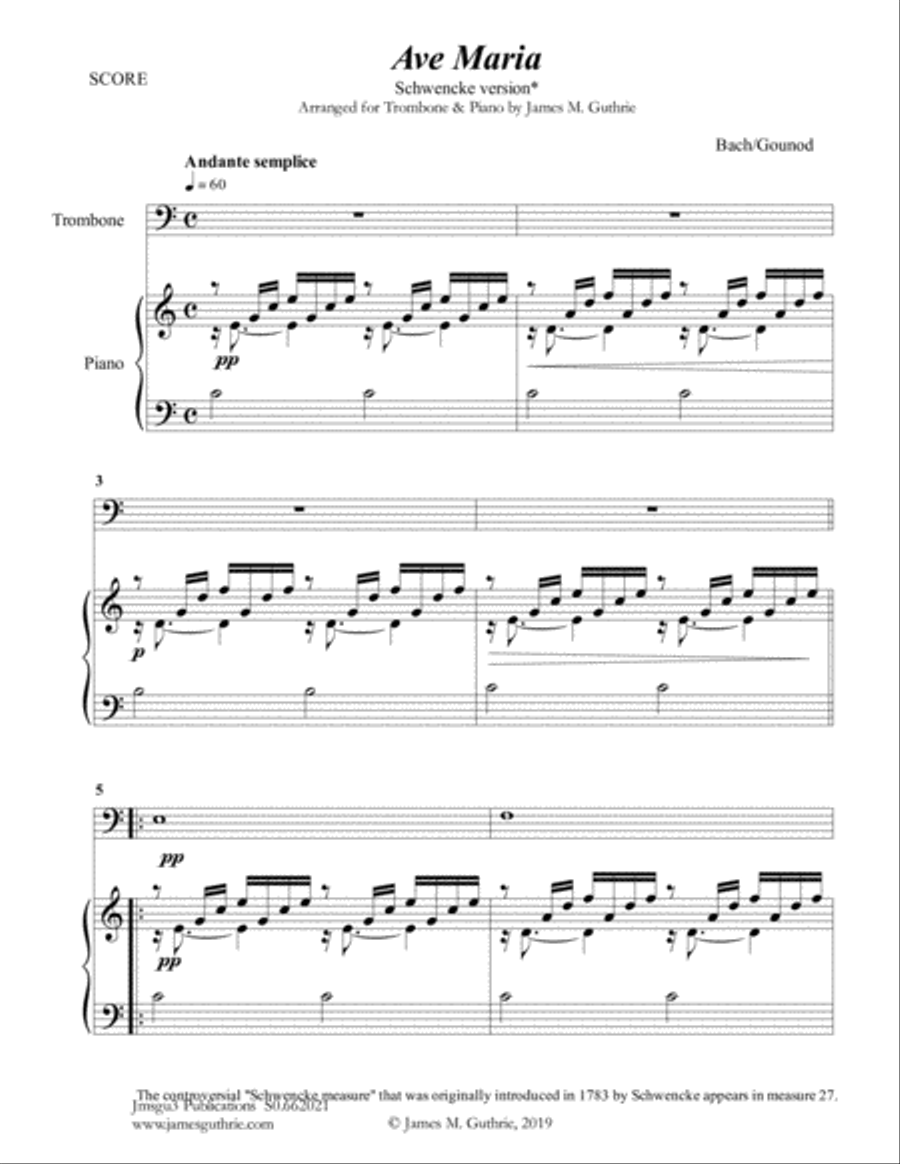
Bach-Gounod: Ave Maria, Schwencke version for Trombone & Piano
Trombone et Piano

$32.95 28.52 € Trombone et Piano PDF SheetMusicPlus

Piano,Trombone - Level 2 - Digital Download SKU: A0.1116442 Composed by Jacques Offenbach. Arranged by Diego Marani. Chamber,Classical,Instructional,Romantic Period,Standards. Score and part. 5 pages. Diego Marani #718085. Published by Diego Marani (A0.1116442). A barcarolle (from French, also barcarole; originally, Italian barcarola or barcaruola, from barca 'boat') is a traditional folk song sung by Venetian gondoliers, or a piece of music composed in that style. It is characterized by a rhythm reminiscent of the gondolier's stroke, almost invariably in 6/8 meter at a moderate tempo. In classical music, the most famous barcarolle is Jacques Offenbach's Belle nuit, ô nuit d'amour from his opera The Tales of Hoffmann. This easy arrangement for trombone (or euphonium) with piano accompaniment is suitable for classroom, repertoire and recital.
Offenbach's Barcarolle for Trombone (or Euphonium) and Piano
Trombone et Piano

$7.99 6.91 € Trombone et Piano PDF SheetMusicPlus

Piano,Trombone - Level 3 - Digital Download SKU: A0.523925 Composed by Traditional Celtic Melody. Arranged by John A. Dempsey. Celtic,Easter,Irish,Spiritual,Traditional,Wedding. Score and part. 11 pages. John A. Dempsey #4332911. Published by John A. Dempsey (A0.523925). Give me a boat that can carry two, and both shall row - my love and I.  From a rich, vibrant Celtic tradition comes the classic tune The Water is Wide, lovingly crafted to evoke misty Scottish landscapes with rolling green hills (you can almost smell the heather).  This unabashedly romantic duet for trombone and piano is perfect for weddings, ceilidhs, other Celtic-themed music events, recitals and concerts.  As wedding music, The Water is Wide stirs the heart as a prelude, unity candle accompaniment, a bridesmaid processional, bridal march and wedding recessional.        Also recommended as a prelude, an offertory, silent prayer accompaniment or special music for traditional church services and other worship events, as this melody has been used in multiple hymn settings, including The Gift of Love, Though I May Speak with Bravest Fire, and as an alternate melody for When I Survey the Wondrous Cross. Key: G major.  7 pages of music (that includes a separate two-page pullout trombone part).
The Water is Wide (Trombone and Piano)
Trombone et Piano

$6.99 6.05 € Trombone et Piano PDF SheetMusicPlus


1 16 31 ....211


Partitions Gratuites
Acheter des Partitions Musicales
Acheter des Partitions Digitales à Imprimer
Acheter des Instruments de Musique

© 2000 - 2026

Accueil - Version intégrale





