EUROPE
2559 articles
USA
0 articles
DIGITAL
17 articles (à imprimer)
Partitions Digitales
Partitions à imprimer
17 partitions trouvées


Piano,Trombone - Level 2 - Digital Download SKU: A0.1379078 Composed by Giacomo Puccini. Arranged by Rodrigo Faleiros. 19th Century,Contest,Festival,Opera,Romantic Period. Score and part. 3 pages. Rodrigo Faleiros #963435. Published by Rodrigo Faleiros (A0.1379078). Enjoy the timeless beauty of Giacomo Puccini's opera Gianni Schicchi with our arrangement of the aria O Mio Babbino Caro for solo trombone. This beloved aria, known for its tender expression of love and longing, is now reimagined for trombone, allowing the melodic lines to shine with the accompaniment of a piano. This arrangement invites players to add their personal touch to the performance, creating a captivating musical experience.Key Features: Trombone Showcase: Tailored for a solo trombone, allowing for a captivating and expressive performance of the iconic aria. Piano Accompaniment: Enhance your performance and explore harmonies with included fully notated piano accompaniment. Instant Digital Download: Begin your musical exploration promptly with our easy-to-access PDF download. Whether you're preparing for a recital, a concert, or simply savoring the beauty of Puccini's operatic masterpiece, this arrangement of O Mio Babbino Caro for trombone and piano offers a poignant and unforgettable musical experience.Check out every other arrangement I've made for this and numerous other arias by clicking here.
O Mio Babbino Caro - for trombone solo (with piano accompaniment)
Trombone et Piano

$2.99 2.6 € Trombone et Piano PDF SheetMusicPlus

Piano,Trombone - Level 2 - Digital Download SKU: A0.1379107 Composed by Giacomo Puccini. Arranged by Rodrigo Faleiros. 19th Century,Contest,Festival,Opera,Romantic Period. Score and part. 3 pages. Rodrigo Faleiros #963405. Published by Rodrigo Faleiros (A0.1379107). Enjoy the timeless beauty of Giacomo Puccini's opera Gianni Schicchi with our arrangement of the aria O Mio Babbino Caro for solo trombone. This beloved aria, known for its tender expression of love and longing, is now reimagined for trombone, allowing the melodic lines to shine with the accompaniment of a piano. With included chord symbols, this arrangement invites players to explore harmonies and add their personal touch to the performance, creating a captivating musical experience.Key Features: Trombone Showcase: Tailored for a solo trombone, allowing for a captivating and expressive performance of the iconic aria. Piano Accompaniment: Enhance your performance and explore harmonies with included fully notated piano accompaniment with chord symbols. Instant Digital Download: Begin your musical exploration promptly with our easy-to-access PDF download. Whether you're preparing for a recital, a concert, or simply savoring the beauty of Puccini's operatic masterpiece, this arrangement of O Mio Babbino Caro for trombone and piano offers a poignant and unforgettable musical experience.Check out every other arrangement I've made for this and numerous other arias by clicking here.
O Mio Babbino Caro - for trombone solo (with piano accompaniment and chords)
Trombone et Piano

$2.99 2.6 € Trombone et Piano PDF SheetMusicPlus

Piano,Trombone - Level 1 - Digital Download SKU: A0.964396 Composed by Johann Sebastian Bach. Arranged by Leyandder Trustworthy. Baroque,Instructional,Sacred,Standards,World. Score and part. 2 pages. Leyandder Trustworthy #6321819. Published by Leyandder Trustworthy (A0.964396). Cantata 156 was written for the third Sunday after Epiphany in 1729, and was first performed on January 23 of that year. The text is by Picander, one of Bach's favorite librettists. of the four cantatas written by Bach for the feast (72, 73, 111 and 156), it was the last, and the only one scored for solo voice. Like Cantatas 73 and 111, it is a choral cantata, employing a choral melody in several movements. Cantata 156, in fact, employs two different melodies and choral texts in the second and sixth (final) movements, respectively; the second uses Machs mit mir, Gott, nach deiner Güt (Schein, 1628), which Herr, wie du willt, so schicks mit mir (Binemann, 1582) is reserved for the finale. This version of the piece was adapted for Contrabass Trombone along with a piano accompaniment that comes with the product.
ARIOSO, by J. S. Bach (sinfonia) - for Contrabass Trombone and accompaniment
Trombone et Piano

$4.99 4.34 € Trombone et Piano PDF SheetMusicPlus

Piano,Trombone - Level 1 - Digital Download SKU: A0.964393 Composed by Johann Sebastian Bach. Arranged by Leyandder Trustworthy. Baroque,Instructional,Sacred,Standards,World. Score and part. 2 pages. Leyandder Trustworthy #6321379. Published by Leyandder Trustworthy (A0.964393). Cantata 156 was written for the third Sunday after Epiphany in 1729, and was first performed on January 23 of that year. The text is by Picander, one of Bach's favorite librettists. of the four cantatas written by Bach for the feast (72, 73, 111 and 156), it was the last, and the only one scored for solo voice. Like Cantatas 73 and 111, it is a choral cantata, employing a choral melody in several movements. Cantata 156, in fact, employs two different melodies and choral texts in the second and sixth (final) movements, respectively; the second uses Machs mit mir, Gott, nach deiner Güt (Schein, 1628), which Herr, wie du willt, so schicks mit mir (Binemann, 1582) is reserved for the finale. This version of the piece was adapted for Trombone along with a piano accompaniment that comes with the product.
ARIOSO, by J. S. Bach (sinfonia) - for Trombone and accompaniment
Trombone et Piano

$4.99 4.34 € Trombone et Piano PDF SheetMusicPlus

Piano,Tenor Trombone - Level 2 - Digital Download SKU: A0.1290810 Composed by Florence Beatrice Price. Arranged by Steven Nunes. 20th Century,Classical. Score and part. 6 pages. Nagamon Publications #881507. Published by Nagamon Publications (A0.1290810). Florence Beatrice Price (April 9, 1887 – June 3, 1953) was an American classical composer, pianist, organist and music teacher. Born in Little Rock, Arkansas, Price was educated at the New England Conservatory of Music, and was active in Chicago from 1927 until her death in 1953. Price is noted as the first African-American woman to be recognized as a symphonic composer, and the first to have a composition played by a major orchestra.This short and tuneful piece is perfect in any performance.
Adoration
Trombone et Piano

$8.00 6.96 € Trombone et Piano PDF SheetMusicPlus

Piano,Trombone - Level 5 - Digital Download SKU: A0.810983 Composed by Cherry Classics Music. Arranged by John, W., and Ware. 20th Century,Contemporary. Score and part. 63 pages. Gordon Cherry #4601711. Published by Gordon Cherry (A0.810983). This fine work has sat dormant for many years and has now come to light thanks to the efforts of Charlie Vernon, Bass Trombonist of the Chicago Symphony, who performed this virtuoso work as a young performer. The concerto is in the standard three movement form: Fast, slow, fast. This publication is a reduction from the original orchestral version (to be released at some point in the future). Here is a description of the Concerto by the composer, John W. Ware. I started on the trombone concerto in my junior year studying composition at Indiana University.  While working on it, I learned of an opportunity to make it sort of a thesis piece (though students didn't write a thesis in composition while an undergrad).  The original version was for trombone with string orchestra, and it was performed by the IU String Orchestra, conducted by Dr. Arthur Corra, with Robert Priez, trombone, as part of my senior composition recital.  I thought the performance was quite good (Priez played extraordinarily well), and the piece received a newspaper review in the Indiana Daily Student, in which the reviewer wrote that the work was almost too exciting.  I thought at the time that he had given me and my music a fine compliment.  I made a piano version of the accompaniment, shortening and tightening the first movement, for performances in 1966; I made a second revision in 1967 for a performance by E. J. Eaton, trombonist at the University of Tennessee at Martin, arriving at the form in which the work exists now. The first movement is in fairly normal sonata-allegro form, in the key of A minor.  It alternates between assertive and more thoughtful moods.   There is no introduction; the soloist enters immediately and dominates much of the movement. The main theme is--by some manipulation--a source for most of the other themes, and all of the themes are used in close proximity to each other, including contrapuntal combinations, especially near the end.  Originally the movement included a lengthy fugato, now much shortened and including a stretto that builds and subsides before a cadenza leading to a coda based on both the principal and secondary themes.  Key relations in this movement, as in the other two, are quite free and often chromatic, with frequent third-relations; but returns to the tonic at the end are emphatic.  The writing is challenging for both soloist and accompanist; the piece is substantial, requiring technique and stamina. The second movement is in F minor and is also built on both contrast and close relationships between the main and secondary themes.  The main theme is heard in the piano part before the soloist enters.  The mood is more lyric than in the first movement, but with dramatic episodes also.  In this movement are some definite derivations from themes in the first movement.  The ending is a sort of lengthened shadow of the opening. The finale returns to A minor, with themes slightly related to polonaise rhythms, but with strong echoes of first-movement themes.  Here, too, dramatic and lyric episodes alternate, with dotted rhythms frequently propelling the music forward.  The introduction is a brief and simple preparation for the solo entry.  Later in the movement, a very brief, slightly slower section is soon overtaken by the original tempo.  Toward the end, there is a second cadenza, again leading to a swift and energetic coda. The work is about 20 minutes in length and is appropriate for advanced performers.
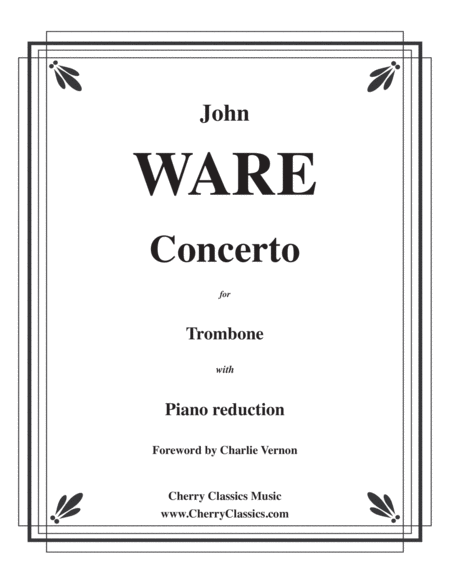
Concerto for Trombone and Piano accompaniment (piano reduction)
Trombone et Piano

$35.00 30.46 € Trombone et Piano PDF SheetMusicPlus


Partitions Gratuites
Acheter des Partitions Musicales
Acheter des Partitions Digitales à Imprimer
Acheter des Instruments de Musique

© 2000 - 2026

Accueil - Version intégrale





