EUROPE
2603 articles
USA
0 articles
DIGITAL
86 articles (à imprimer)
Partitions Digitales
Partitions à imprimer
86 partitions trouvées

1 16 31 ....76

Piano,Trombone - Level 1 - Digital Download SKU: A0.548722 Composed by Martin Luther. Arranged by James M. Guthrie, ASCAP. Easter,Instructional,Standards. Score and part. 4 pages. Jmsgu3 #3411759. Published by jmsgu3 (A0.548722). Out of the Depths I Cry to You by Martin Luther. The first verses feature modified counterpoint and harmony proceeding at quarter = 82. The final verse is reharmonized for maximum dramatic effect at a more contemplative tempo such as quarter = 64. Features the entire range of the instrument. Very powerful selection for Lent or Easter. Duration (3 verses) 3:05, 36 ms. Score: 3 pg. Solo part: 1 pg. The piano reads from the score. Out of the Depths Aus tiefer Not schrei ich zu dir (From deep affliction I cry out to you), is, of course, a hymn composed by Martin Luther. Moreover, Luther also wrote the lyrics, essentially a paraphrase of Psalm 130. First published in 1524, it is also one of eight songs in the original Lutheran hymnal. It appears likewise in many hymnals and in different translations. The lyrics furthermore stimulated compositions from the Renaissance to the contemporary. Consequently, composers such as Johann Sebastian Bach built an entire chorale cantata on it. Other composers similarly contributed pieces, such as Felix Mendelssohn and Max Reger. Luther Background Martin Luther, (1483 –1546) was a German professor of theology, composer, priest, and moreover, an influential character in the Protestant Reformation. Luther had a momentous impact on church and society due to his contributions to the musical arts. He wanted to disseminate the gospel among mankind and with this intention thought that the best way to do that was through music. Influence It is important to realize that other musicians, and their descendants, were encouraged by Luther’s songs and wrote their own hymns. Luther, to be sure, had a thorough musical education. For example, he knew secular and sacred songs from an early age. He, in particular, played the lute well and sang in the monastery when he was a monk. That is to say, music was an essential part of his life. He in fact first began writing songs in 1523, sometimes writing the melody as well as the lyrics. Luther was certainly able to evaluate the composers of his time. He thought especially highly of Josquin des and Ludwig Senfl. He was also acquainted, with this in mind, with other composers and their works. Legacy The Lutheran musical ethos soon covered all of Germany and later significantly fashioned Protestant musical culture. Heinrich Schütz and Johann Sebastian Bach are the most compelling evidence of this Protestant musical culture. Additionally, as a point often overlooked, the pedal organ, first refined in northern Germany, became universally prevalent. As a matter of fact, Dieterich Buxtehude established a regular evening organ concert series in Lübeck. Another key point is that this concert series, in turn, spread North German Musical ideas worldwide. Luther was especially convinced that music is a beautiful and exclusive offering of the divine.
Luther: Out of the Depths for Trombone & Piano
Trombone et Piano

$24.95 21.74 € Trombone et Piano PDF SheetMusicPlus

Piano,Trombone - Level 3 - Digital Download SKU: A0.549588 Composed by Edvard Grieg. Arranged by James M. Guthrie, ASCAP. Instructional,Multicultural,Romantic Period,Standards,World. Score and part. 18 pages. Jmsgu3 #3511293. Published by jmsgu3 (A0.549588). Duration: ca. 2:17 Score: 10 pages, solo part: 2 pages, piano part: 5 pages. A proven audience pleaser - perfect for a recital encore! Grieg Background In the first place, Edvard Grieg (1843 –1907) was a Norwegian composer as well as a concert pianist. As a matter of fact, most music historians consider him one of the foremost Romantic era composers. Consequently, his music is part of the international standard classical repertoire. Grieg moreover used Norwegian folk music in his own compositions.  Consequently, he ushered Norwegian music to transnational consciousness. Furthermore, he forged a national musical identity for Norway. It is important to realize that he did this in a manner similar to Jean Sibelius in Finland, and Bedřich Smetana in Bohemia. Legacy Grieg is especially celebrated in the city of Bergen. For example, the city has erected numerous statues depicting Grieg. Specifically, the city has named a concert hall (Grieg Hall), a music school (Grieg Academy) and a professional choir (Edvard Grieg Kor) after him. As a matter of fact, there is also a museum located at his former home in Troldhaugen. Peer Gynt Suite No. 1 (Op. 46) Grieg wrote incidental music for the purpose of illustrating a play by Ibsen known as Peer Gynt. The play includes, in particular, the famous selection entitled, In the Hall of the Mountain King. In this composition, Grieg indeed depicts the exploits of the scoundrel, Peer Gynt. In one famous episode, for example, Peer steals a bride at her wedding. For this reason, the people chase him, but soon Peer falls, thereupon striking his skull on a boulder. He wakens forthwith in a highland bounded by angry gnomes. Consequently, the music of In the Hall of the Mountain King represents the mad gnomes taunting Peer. Therefore, each time the theme repeats it gets louder and faster. In the end, Peer surprisingly escapes from the mountain. Holberg Suite and Misc. Summary It must be remembered that Grieg originally wrote his Holberg Suite for the piano. In other words, he only later arranged it for strings. Further, Grieg composed by and large many songs with lyrics by famous writers such as Heine, Goethe, Ibsen, Hans Christian Andersen, Rudyard Kipling, and others. On balance, Norwegian pianist Eva Knardahl recorded altogether Grieg’s whole piano catalog on LP in 1980. These recordings were released again on CD in 2006. In any event, Grieg himself performed and recorded the bulk of these pieces toward the end of his life.    
Grieg: Hall of the Mountain King from Peer Gynt Suite for Trombone & Piano
Trombone et Piano

$24.95 21.74 € Trombone et Piano PDF SheetMusicPlus

Piano,Trombone - Level 3 - Digital Download SKU: A0.549831 Composed by Peter Ilyich Tchaikovsky. Arranged by James M. Guthrie, ASCAP. Children,Christmas,Romantic Period,Standards. Score and part. 48 pages. Jmsgu3 #3550639. Published by jmsgu3 (A0.549831). Duration: 6:12, Score: 29 pages, Solo part: 6 pages, Piano part: 12 pages. This is the grand finale of the Nutcracker Suite. Pyotr Ilyich Tchaikovsky Tchaikovsky is probably the most popular of the great composers in America. His music certainly appeals to musicians. Likewise, it appeals even to folks who don’t normally listen to serious music. This is probably because of his most noteworthy melodies. Above all, he writes with great emotion. This certainly makes a most noteworthy if not an unforgettable impact. Education First of all, He attended classes at the Russian Musical Society. Even more, He also attended the St. Petersburg Conservatory. There he studied music theory with Nikolai Zaremba. He also consequently studied composition with Anton Rubenstein. It seems like Rubenstein came under criticism from a group of Russian composers known as the Five. The Five The Five certainly rejected Western musical influences. They rather sought to use elements from Russian music. They furthermore wanted to use more exotic musical materials. Western Techniques More than other Russian composers, Tchaikovsky studied modern Western music. He certainly develops his music like the European masters. So, rather than repeating a motive, he moves to a new key. He then introduces a different theme in the new key. Hence, he maintained his independence from the Five. Even more, he became the first Russian composer of international stature. Influences Tchaikovsky was probably influenced in his ballet scoring by Léo Delibes. Richard Wagner influenced his symphonic writing. Tchaikovsky’s most famous works include the 1812 Overture, The Nutcracker Suite, and Swan Lake. Also famous are the Violin Concerto in D and the six symphonies. The greatest of the six symphonies may be No. 6, the Pathétique. Nutcracker Suite, Op. 71a The Nutcracker Suite is a ballet that was performed for the first time in December 1892 in St. Petersburg. To begin with, the original ballet failed to attract a positive reception. However, the ballet suite became probably one of the most popular of all of Tchaikovsky’s works. The ballet suite became even more famous in the 1960s. It is now performed all over the world, particularly during the Christmas season.  
Tchaikovsky: Waltz of the Flowers from Nutcracker Suite for Trombone & Piano
Trombone et Piano

$32.95 28.71 € Trombone et Piano PDF SheetMusicPlus

Piano,Trombone - Level 3 - Digital Download SKU: A0.549811 Composed by Peter Ilyich Tchaikovsky. Arranged by James M. Guthrie, ASCAP. Children,Christmas,Romantic Period,Standards. Score and part. 16 pages. Jmsgu3 #3542539. Published by jmsgu3 (A0.549811). Duration: ca. 2:10. Score: 9 pages. 77 measures in 2/4. Solo parts: 2 pages, Piano part: 4 pages. A favorite Christmas selection from the Nutcracker Suite. Pyotr Ilyich Tchaikovsky Tchaikovsky is probably the most popular of the great composers in America. His music certainly appeals to musicians. Likewise, it appeals even to folks who don’t normally listen to serious music. This is probably because of his most noteworthy melodies. Above all, he writes with great emotion. This certainly makes a most noteworthy if not an unforgettable impact. Education First of all, He attended classes at the Russian Musical Society. Even more, He also attended the St. Petersburg Conservatory. There he studied music theory with Nikolai Zaremba. He also consequently studied composition with Anton Rubenstein. It seems like Rubenstein came under criticism from a group of Russian composers known as the Five. The Five The Five certainly rejected Western musical influences. They rather sought to use elements from Russian music. They furthermore wanted to use more exotic musical materials. Western Techniques More than other Russian composers, Tchaikovsky studied modern Western music. He certainly develops his music like the European masters. So, rather than repeating a motive, he moves to a new key. He then introduces a different theme in the new key. Hence, he maintained his independence from the Five. Even more, he became the first Russian composer of international stature. Influences Tchaikovsky was probably influenced in his ballet scoring by Léo Delibes. Richard Wagner influenced his symphonic writing. Tchaikovsky’s most famous works include the 1812 Overture, The Nutcracker Suite, and Swan Lake. Also famous are the Violin Concerto in D and the six symphonies. The greatest of the six symphonies may be No. 6, the Pathétique. Nutcracker Suite, Op. 71a The Nutcracker Suite is a ballet that was performed for the first time in December 1892 in St. Petersburg. To begin with, the original ballet failed to attract a positive reception. However, the ballet suite became probably one of the most popular of all of Tchaikovsky’s works. The ballet suite became even more famous in the 1960s. It is now performed all over the world, particularly during the Christmas season.   
Tchaikovsky: Dance of the Flutes from Nutcracker Suite for Trombone & Piano
Trombone et Piano

$32.95 28.71 € Trombone et Piano PDF SheetMusicPlus

Piano,Trombone - Level 3 - Digital Download SKU: A0.549695 Composed by Peter Ilyich Tchaikovsky. Arranged by James M. Guthrie, ASCAP. Children,Christmas,Romantic Period,Standards. Score and part. 14 pages. Jmsgu3 #3525269. Published by jmsgu3 (A0.549695). Duration: ca. 1:42, 52 measures, Score: 7 pages, solo part: 2 pages, piano part: 4 pages. A popular Christmas favorite from Tchaikovsky's Nutcracker Suite. Pyotr Ilyich Tchaikovsky Tchaikovsky is probably the most popular of the great composers in America. His music certainly appeals to musicians. Likewise, it appeals even to folks who don’t normally listen to serious music. This is probably because of his most noteworthy melodies. Above all, he writes with great emotion. This certainly makes a most noteworthy if not an unforgettable impact. Education First of all, He attended classes at the Russian Musical Society. Even more, He also attended the St. Petersburg Conservatory. There he studied music theory with Nikolai Zaremba. He also consequently studied composition with Anton Rubenstein. It seems like Rubenstein came under criticism from a group of Russian composers known as the Five. The Five The Five certainly rejected Western musical influences. They rather sought to use elements from Russian music. They furthermore wanted to use more exotic musical materials. Western Techniques More than other Russian composers, Tchaikovsky studied modern Western music. He certainly develops his music like the European masters. So, rather than repeating a motive, he moves to a new key. He then introduces a different theme in the new key. Hence, he maintained his independence from the Five. Even more, he became the first Russian composer of international stature. Influences Tchaikovsky was probably influenced in his ballet scoring by Léo Delibes. Richard Wagner influenced his symphonic writing. Tchaikovsky’s most famous works include the 1812 Overture, The Nutcracker Suite, and Swan Lake. Also famous are the Violin Concerto in D and the six symphonies. The greatest of the six symphonies may be No. 6, the Pathétique. Nutcracker Suite, Op. 71a The Nutcracker Suite is a ballet that was performed for the first time in December 1892 in St. Petersburg. To begin with, the original ballet failed to attract a positive reception. However, the ballet suite became probably one of the most popular of all of Tchaikovsky’s works. The ballet suite became even more famous in the 1960s. It is now performed all over the world, particularly during the Christmas season.
Tchaikovsky: Dance of the Sugar-Plum Fairy from Nutcracker Suite for Trombone & Piano
Trombone et Piano

$32.95 28.71 € Trombone et Piano PDF SheetMusicPlus

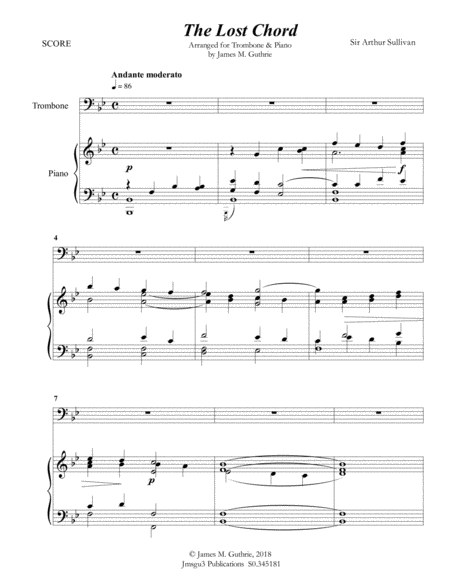
Piano,Trombone - Level 4 - Digital Download SKU: A0.549458 Composed by Sir Arthur Seymour Sullivan. Arranged by James M. Guthrie, ASCAP. Instructional,Romantic Period,Sacred,Standards. Score and part. 15 pages. Jmsgu3 #3497267. Published by jmsgu3 (A0.549458). Score: 10 pages, solo part: 2 pages, piano part: 3 pages. Duration: 4:25. Not difficult, but requires sensitivity & dynamic control. Suitable for recitals, church meditations, or school programs. School Years First of all, Sullivan attended music school at the Royal Academy of Music. Because Sullivan was so talented, the Academy awarded him the Mendelssohn Scholarship for two years in a row. He, therefore, studied with John Goss, who studied with Thomas Atwood, who in turn studied with Mozart. Sullivan similarly studied the piano at the Academy with Arthur O’Leary. Study Abroad During his first year, he also earned money by singing solos in the Chapel Royal. At the end of his second year, the Academy consequently continued his scholarship and sent him to study at the Leipzig Conservatoire. He certainly studied composition, and likewise counterpoint and piano. Hence, during his final year in Leipzig, Sullivan finally completed his graduation composition project: Incidental Music for Shakespeare’s The Tempest. Association with Gilbert It seems like Sullivan built the bulk of his composing career largely in the 1860s. As a result, he became famous for his incidental music for the Tempest and his Irish Symphony. He, therefore, began collaborating with the poet W. S. Gilbert in the 1870s. Rather than focus on serious opera, Gilbert and Sullivan, in contrast, concentrated on comic opera such as H. M. S. Pinafore, the Pirates of Penzance, and the Mikado. Therefore, certainly as a result of his education and experience, Sullivan composed a total of 24 operas, 11 symphonic works, 10 choral pieces. Even more, he wrote a large number of noteworthy hymns such as Onward Christian Soldiers. Lost Chord The general style of his music is maybe similar to Mendelssohn, Schumann, and perhaps Liszt. It seems like Sullivan was fond of writing distinct melodies for each character in his operettas. His melodies combine together as the characters did. Furthermore, he was a master orchestrator, and therefore played the flute, clarinet, trumpet, and trombone fluently. The Lost Chord Sullivan wrote his most noteworthy song the Lost Chord in 1877. As a result, it was a great success and was certainly performed all over the world by a variety of singers such as Enrico Caruso. Because Sullivan was the most famous composer in England, the Lost Chord became the most famous of all British or American songs of the 1870s and 1890s. Consequently, in 1888 Thomas Edison recorded The Lost Chord for the phonograph. It was one of the first songs ever recorded. Furthermore, Queen Victoria knighted Sullivan in 1883.  
Sullivan: The Lost Chord for Trombone & Piano
Trombone et Piano

$26.95 23.48 € Trombone et Piano PDF SheetMusicPlus

B-Flat trombone,Piano - Level 2 - Digital Download SKU: A0.1485708 Composed by Felix Bartholdy Mendelssohn. Arranged by Bruno Monteferrante. Advent,Christmas,Classical,Holiday,Religious. Score and part. 3 pages. Bruno Monteferrante #1062779. Published by Bruno Monteferrante (A0.1485708). Immerse yourself in the festive spirit with our delightful arrangement of Hark the Herald Angels Sing for trombone solo and piano accompaniment. Composed by the legendary Felix Mendelssohn, this piece is meticulously tailored for beginner to intermediate trombone and piano players, blending ease of play with rich musicality.Key Features:Designed for Beginner to Intermediate Musicians: This arrangement caters specifically to the needs of beginner to intermediate trombone and piano players, offering a harmonious balance between accessibility and musical satisfaction.Authentic and Melodic: Retaining the majestic charm of Mendelssohn's original composition, this arrangement brings the heartwarming essence of the classic Christmas carol to life.Clear and Readable Notation: Both the trombone and piano parts are presented with clear, easy-to-read notation, aiding musicians in developing their sight-reading skills and ensuring a smooth performance.Educational and Engaging: This piece not only provides a delightful playing experience but also serves as an educational tool, helping musicians improve their technical abilities and musical expression.Festive Storytelling: Let the uplifting melodies of Hark the Herald Angels Sing tell a festive story, bringing joy and holiday cheer to any setting, whether it's a recital, a family gathering, or personal practice.Unique Selling Points:Perfect Duo Arrangement: This sheet music uniquely combines the expressive tones of the trombone with the harmonic richness of the piano, creating a captivating musical dialogue between the two instruments.Ideal for Various Settings: Whether you're preparing for a holiday concert, looking for a beautiful piece for a church service, or simply want to add a festive touch to your practice repertoire, this arrangement is an excellent choice.Crafted for Enjoyment and Growth: With its focus on beginner to intermediate players, this arrangement ensures that musicians can enjoy the process of learning and performing without feeling overwhelmed, making it a perfect addition to music education programs.Order Your Copy Today!Elevate your holiday music collection with our trombone solo and piano accompaniment arrangement of Hark the Herald Angels Sing. Dive into the magical world of Mendelssohn's music and spread the joy of the season. Order now and let your performance shine with festive brilliance! Enhance your search for the perfect holiday sheet music with this engaging arrangement, designed to make your Christmas celebrations musically memorable. Happy playing!
Hark The Herald Angels Sing
Trombone et Piano

$5.99 5.22 € Trombone et Piano PDF SheetMusicPlus

Piano,Tenor Trombone - Level 2 - Digital Download SKU: A0.1485703 Composed by Felix Bartholdy Mendelssohn. Arranged by Bruno Monteferrante. Advent,Christmas,Classical,Holiday,Religious. Score and part. 3 pages. Bruno Monteferrante #1062774. Published by Bruno Monteferrante (A0.1485703). Immerse yourself in the festive spirit with our delightful arrangement of Hark the Herald Angels Sing for trombone solo and piano accompaniment. Composed by the legendary Felix Mendelssohn, this piece is meticulously tailored for beginner to intermediate trombone and piano players, blending ease of play with rich musicality.Key Features:Designed for Beginner to Intermediate Musicians: This arrangement caters specifically to the needs of beginner to intermediate trombone and piano players, offering a harmonious balance between accessibility and musical satisfaction.Authentic and Melodic: Retaining the majestic charm of Mendelssohn's original composition, this arrangement brings the heartwarming essence of the classic Christmas carol to life.Clear and Readable Notation: Both the trombone and piano parts are presented with clear, easy-to-read notation, aiding musicians in developing their sight-reading skills and ensuring a smooth performance.Educational and Engaging: This piece not only provides a delightful playing experience but also serves as an educational tool, helping musicians improve their technical abilities and musical expression.Festive Storytelling: Let the uplifting melodies of Hark the Herald Angels Sing tell a festive story, bringing joy and holiday cheer to any setting, whether it's a recital, a family gathering, or personal practice.Unique Selling Points:Perfect Duo Arrangement: This sheet music uniquely combines the expressive tones of the trombone with the harmonic richness of the piano, creating a captivating musical dialogue between the two instruments.Ideal for Various Settings: Whether you're preparing for a holiday concert, looking for a beautiful piece for a church service, or simply want to add a festive touch to your practice repertoire, this arrangement is an excellent choice.Crafted for Enjoyment and Growth: With its focus on beginner to intermediate players, this arrangement ensures that musicians can enjoy the process of learning and performing without feeling overwhelmed, making it a perfect addition to music education programs.Order Your Copy Today!Elevate your holiday music collection with our trombone solo and piano accompaniment arrangement of Hark the Herald Angels Sing. Dive into the magical world of Mendelssohn's music and spread the joy of the season. Order now and let your performance shine with festive brilliance! Enhance your search for the perfect holiday sheet music with this engaging arrangement, designed to make your Christmas celebrations musically memorable. Happy playing!
Hark The Herald Angels Sing
Trombone et Piano

$5.99 5.22 € Trombone et Piano PDF SheetMusicPlus

Piano,Trombone - Level 3 - Digital Download SKU: A0.587630 Composed by Various. Arranged by David McKeown. Baroque,Concert,Romantic Period,Standards,Wedding. Score and part. 24 pages. David McKeown #4594699. Published by David McKeown (A0.587630). The Wedding Album is a collection of four beautiful and timeless wedding favourites, arranged for Solo Trombone with Piano accompaniment. Whether for that Special Day, for a recital, or for your own entertainment, these arrangements are ideal for players at an intermediate level or higher. The 24-page file includes the piano accompaniments and the separate solo parts at the end. Ave Maria was written by Franz Schubert in 1825 as the sixth song in his song cycle based on Walter Scott’s poem The Lady of the Lake. It is perhaps the best known of all his melodies, adapted for piano by Franz Liszt, and for orchestra many times since. It is often sung with the Latin lyrics of the Catholic hymn of the same name and has been heard everywhere from the Disney movie Fantasia to the funeral of J.F. Kennedy. The Bridal March was written by Richard Wagner in 1850, scored for orchestra and chorus, and opening the third act of his opera, Lohingren. It is best known in the English-speaking world as Here Comes the Bride. Queen Victoria’s daughter used the music for her marriage in 1858, and its popularity has endured ever since.The Prince of Denmark’s March is better known nowadays as the Trumpet Voluntary and is often used in wedding ceremonies. It was in fact written for organ, with the melody played on thetrumpet stop.  Written around 1700, for many years this piece was mistakenly attributed to Henry Purcell. Only recently has it been established that the composer was Jeremiah Clarke, organist at St Paul’s Cathedral. It is somewhat ironic that this composer of a wedding mainstay was himself a victim of unrequited love. He consequently shot himself in the cathedral graveyard. Felix Mendelssohn’s Wedding March was originally written in 1842 as incidental music to Shakespeare’s famousplay, Midsummer Night’s Dream. When Queen Victoria’s daughter used the music for her marriage in 1858, it became instantly popular and has remained a wedding favourite ever since.These four arrangements are also available as single titles for $3.99 each. You can find these along with many more top quality arrangements and compositions by David McKeown at http://www.sheetmusicplus.com/publishers/david-mckeown/6203 
The Wedding Album, for Solo Trombone and Piano
Trombone et Piano

$9.99 8.71 € Trombone et Piano PDF SheetMusicPlus

Piano,Trombone - Level 3 - Digital Download SKU: A0.587631 Composed by Various. Arranged by David McKeown. Baroque,Concert,Romantic Period,Standards,Wedding. Score and part. 24 pages. David McKeown #4594701. Published by David McKeown (A0.587631). The Wedding Album is a collection of four beautiful and timeless wedding favourites, arranged for Solo Trombone in Bb (Treble Clef) with Piano accompaniment. Whether for that Special Day, for a recital, or for your own entertainment, these arrangements are ideal for players at an intermediate level or higher. The 24-page file includes the piano accompaniments and the separate solo parts at the end. Ave Maria was written by Franz Schubert in 1825 as the sixth song in his song cycle based on Walter Scott’s poem The Lady of the Lake. It is perhaps the best known of all his melodies, adapted for piano by Franz Liszt, and for orchestra many times since. It is often sung with the Latin lyrics of the Catholic hymn of the same name and has been heard everywhere from the Disney movie Fantasia to the funeral of J.F. Kennedy. The Bridal March was written by Richard Wagner in 1850, scored for orchestra and chorus, and opening the third act of his opera, Lohingren. It is best known in the English-speaking world as Here Comes the Bride. Queen Victoria’s daughter used the music for her marriage in 1858, and its popularity has endured ever since.The Prince of Denmark’s March is better known nowadays as the Trumpet Voluntary and is often used in wedding ceremonies. It was in fact written for organ, with the melody played on thetrumpet stop.  Written around 1700, for many years this piece was mistakenly attributed to Henry Purcell. Only recently has it been established that the composer was Jeremiah Clarke, organist at St Paul’s Cathedral. It is somewhat ironic that this composer of a wedding mainstay was himself a victim of unrequited love. He consequently shot himself in the cathedral graveyard. Felix Mendelssohn’s Wedding March was originally written in 1842 as incidental music to Shakespeare’s famousplay, Midsummer Night’s Dream. When Queen Victoria’s daughter used the music for her marriage in 1858, it became instantly popular and has remained a wedding favourite ever since.These four arrangements are also available as single titles for $3.99 each. You can find these along with many more top quality arrangements and compositions by David McKeown at http://www.sheetmusicplus.com/publishers/david-mckeown/6203 
The Wedding Album, for Solo Trombone in Bb (Treble Clef) and Piano
Trombone et Piano

$9.99 8.71 € Trombone et Piano PDF SheetMusicPlus

Piano,Trombone - Level 2 - Digital Download SKU: A0.549436 Composed by Antonín Dvořák. Arranged by James M. Guthrie, ASCAP. Instructional,Romantic Period,Sacred,Standards. Score and part. 12 pages. Jmsgu3 #3494231. Published by jmsgu3 (A0.549436). Score: 7 pages, solo part: 2 pages, piano part: 3 pages. Duration: 4:25 Not difficult, but requires sensitivity & dynamic control. Suitable for recitals, church meditations, or school programs. Dvořák Background Antonín Dvořák (1841 –1904) was, of course, a composer from Czechoslovakia. As a matter of fact, he was among the first Bohemian composers to attain universal recognition. It is important to realize that the late Romantic Nationalist period featured composers who used traditional and folk elements to portray the character of their nation. In particular, we see this in the music of Grieg (Norway), Finland (Sibelius), and Smetana (Bohemia).  Dvořák relied markedly on rhythms and other characteristics of Moravian and Bohemian folk music. Ascent to Fame Dvořák was truly a child musical prodigy on the violin. The premiere performances of his compositions notably occurred in 1872 and 1873. He submitted his First Symphony in particular to a German competition, but it failed to win. Consequently, in 1874 he presented two more symphonies to the Austrian State Prize for Composition. Johannes Brahms was the principal of the jury and was accordingly very impressed. They forthwith awarded the prize to Dvořák in 1874, 1876, and 1877. At this point, Brahms thereupon endorsed Dvořák to the publisher Simrock. Later, the publisher commissioned Dvořák to compose the Slavonic Dances, Op. 46. These became popular overnight and, as a result, Dvořák's worldwide status was launched. International Status Dvořák visited England upon invitation nine times. On each visit, he frequently conducted performances of his own compositions. He conducted concerts of his music, especially in Moscow and St. Petersburg. Eventually, the Prague Conservatory in fact appointed Dvořák as a professor. There, to be sure, he wrote his famous Dumky Trio. United States Consequently, the National Conservatory of Music of America appointed him as director in 1892. As a result, Dvořák composed his two most famous symphonic works: the Symphony No. 9 (From the New World), which spread his name universally, and his Concerto for Cello and Orchestra, one of the most famous of all cello works. Moreover, he wrote his most celebrated American String Quartet during this time. At the same time, because of his growing recognition in Europe and his homesickness for his own country, he left to return to Bohemia in 1895.  
DvoÅ™ák: Largo from the New World Symphony for Trombone & Piano
Trombone et Piano

$32.95 28.71 € Trombone et Piano PDF SheetMusicPlus

Piano,Trombone - Level 3 - Digital Download SKU: A0.749214 By John Lunn. By John Lunn. Arranged by HELEN MARPLE-HORVAT. Film/TV. Score and part. 10 pages. Helen Marple-Horvat #3560439. Published by Helen Marple-Horvat (A0.749214). Downton Abbey was a much loved TV series that ran for six seasons capturing the hearts of many across the world. The composer of the music,  John Lunn, won two Primetime Emmys for the hauntingly beautiful score. I have arranged this wonderful piece for other solo players and piano, as well as for string quartet/string orchestra. The 30 sec clip is done on Sibelius software as I have not yet been able to record this piece live, but if you search my Youtube Channel, Skinny Black Dogs, Capriccio Quartet, Downton Abbey, you can see and hear the live version. The harmony and structure is exactly the same. Though I am a pianist and string player, a trombonist assure me that this is a great key for a trombonist! Make sure that you grow through the phrases with your pianist. It is a piece that requires a great deal of ebb and flow with lots of crescendo and diminuendo throughout for you to feel together! Please do send me a recording of your playing it, even if it is done on a phone. Send me a message on Facebook. I hope you enjoy playing this piece!
Downton Abbey (theme)
Trombone et Piano
John Lunn
$12.99 11.32 € Trombone et Piano PDF SheetMusicPlus

Piano,Tenor Trombone - Level 2 - Digital Download SKU: A0.1242590 Composed by Alan Menken and Howard Ashman. Arranged by Samuel Sequeira. Broadway,Children,Film/TV,Musical/Show,Pop,Singer/Songwriter. Score and part. 13 pages. Samuel Sequeira #837760. Published by Samuel Sequeira (A0.1242590). Part of your World - Howard Ashman & Alan Menken  - Trombone /PianoPlay it at home, with friends, on class, for your teacher or studentPlay it on a public presentation.I present to you the arrangement of Part of Your World from the movie The Little Mermaid released in 2023, specifically designed for piano and trombone with Chords and Piano Playalong Youtube Video.In this arrangement, the piano and trombone come together to create a captivating and expressive performance. The piano provides a melodic and harmonic foundation, while the trombone takes on the main voice, infusing the arrangement with its rich and warm tones.The piano sets the stage with its flowing arpeggios and delicate accompaniment, creating a sense of wonder and enchantment. It creates a lush harmonic backdrop, supporting the trombone and adding depth to the arrangement.The trombone, with its mellow and resonant sound, becomes the voice of the melody. It brings the iconic melodies of Part of Your World to life, conveying the character's longing and curiosity. The trombone's smooth slides and expressive phrasing add a soulful and heartfelt quality to the arrangement.Throughout the piece, the piano and trombone interact, creating a musical dialogue. They blend their voices in harmonious moments and create moments of musical interplay that bring the arrangement to life.Together, the piano and trombone create a captivating rendition of Part of Your World that captures the essence of the story. This arrangement allows the trombone to shine with its expressive capabilities, while the piano provides a supportive and harmonically rich backdrop.You can find me on:Instagram: @SamuelseqYouTube: @SamuelSeqMore arrangements on: Sam'S arrangementsThanks for listening, and happy playing!
Part Of Your World (reprise)
Trombone et Piano

$4.99 4.35 € Trombone et Piano PDF SheetMusicPlus

Piano,Tenor Trombone - Level 2 - Digital Download SKU: A0.1242588 Composed by Alan Menken and Howard Ashman. Arranged by Samuel Sequeira. Broadway,Children,Film/TV,Musical/Show,Pop,Singer/Songwriter. Score and part. 13 pages. Samuel Sequeira #837758. Published by Samuel Sequeira (A0.1242588). Part of your World - Howard Ashman & Alan Menken  - Trombone /PianoPlay it at home, with friends, on class, for your teacher or studentPlay it on a public presentation.I present to you the arrangement of Part of Your World from the movie The Little Mermaid released in 2023, specifically designed for piano and trombone with Piano Playalong Youtube Video.In this arrangement, the piano and trombone come together to create a captivating and expressive performance. The piano provides a melodic and harmonic foundation, while the trombone takes on the main voice, infusing the arrangement with its rich and warm tones.The piano sets the stage with its flowing arpeggios and delicate accompaniment, creating a sense of wonder and enchantment. It creates a lush harmonic backdrop, supporting the trombone and adding depth to the arrangement.The trombone, with its mellow and resonant sound, becomes the voice of the melody. It brings the iconic melodies of Part of Your World to life, conveying the character's longing and curiosity. The trombone's smooth slides and expressive phrasing add a soulful and heartfelt quality to the arrangement.Throughout the piece, the piano and trombone interact, creating a musical dialogue. They blend their voices in harmonious moments and create moments of musical interplay that bring the arrangement to life.Together, the piano and trombone create a captivating rendition of Part of Your World that captures the essence of the story. This arrangement allows the trombone to shine with its expressive capabilities, while the piano provides a supportive and harmonically rich backdrop.You can find me on:Instagram: @SamuelseqYouTube: @SamuelSeqMore arrangements on: Sam'S arrangementsThanks for listening, and happy playing!
Part Of Your World (reprise)
Trombone et Piano

$4.99 4.35 € Trombone et Piano PDF SheetMusicPlus

Piano,Trombone - Level 1 - Digital Download SKU: A0.1353935 By Louis Armstrong. By Bob Thiele and George David Weiss. Arranged by Iury Cardoso. Blues,Chamber,Folk,Multicultural,Pop,World. Score and part. 6 pages. Iury Cardoso #938674. Published by Iury Cardoso (A0.1353935). EASY TROMBONE/PIANO arrangement of the song: What A Wonderful World(Score and violin part: 6 pages)  This is a version of the classic song What A Wonderful World for players of TROMBONE and PIANO. In this arrangement, the simplified chords and melody make it easy to learn. Call a friend to play with you! This arrangement is also a version for teacher/student duet (the students can be accompanied by their teacher playing the piano. The piano parts can be played on piano or electronic keyboard, they are easy to play and are arranged to accompany the TROMBONE).  The CHORDS are not included on this arrangement (there is also a version with the chords on this website). On this site, there is also a version of this arrangement WITHOUT THE PIANO and several other versions for other instruments. See more arrangements by Iury Cardoso, thank you so much!Copyright © 1967 by Range Road Music Inc., Quartet Music and Abilene Music, Inc. Copyright Renewed All Rights for Quartet Music Administered by BUG Music, Inc., a BMG Chrysalis company International Copyright Secured All Rights Reserved Used by Permission  what wonderful world trombone piano sheet musicwhat wonderful world trombone sheet musiceasy beginner trombone pianoeasy tromboneEasy trombone and piano Easy trombone what wonderful worldBeginner trombone dueteasy duet trombonebeginning duettrombone and pianotrombone sheet musicteacher student duetduet for beginnerstrombone for beginnerswith pianotrombone easy sheet musiceasy scoremusic scorebeautiful trombone sheet musictrombone solo.
What A Wonderful World
Trombone et Piano
Louis Armstrong
$4.99 4.35 € Trombone et Piano PDF SheetMusicPlus


1 16 31 ....76


Partitions Gratuites
Acheter des Partitions Musicales
Acheter des Partitions Digitales à Imprimer
Acheter des Instruments de Musique

© 2000 - 2026

Accueil - Version intégrale