EUROPE
48 articles
USA
0 articles
DIGITAL
38 articles (à imprimer)
Partitions Digitales
Partitions à imprimer
38 partitions trouvées


Piano,Trombone - Level 3 - Digital Download SKU: A0.587610 Composed by Felix Bartholdy Mendelssohn. Arranged by David McKeown. Classical,Concert,Romantic Period,Standards,Wedding. Score and part. 9 pages. David McKeown #4403662. Published by David McKeown (A0.587610). Felix Mendelssohn’s Wedding March was originally written in 1842 as incidental music to Shakespeare’s famousplay, Midsummer Night’s Dream. When Queen Victoria’s daughter used the music for her marriage in 1858, it became instantly popular and has remained a wedding favourite ever since.This version is arranged for Solo Trombone and Piano and the performance time is around three and a half minutes. Of course, performers, especially at weddings, may wish to abridge and shorten the arrangement. This is easily done as the different sections are self-contained and interchangeable. Repeats may also be ignored. Both the full length youtube performance and the short audio sample are from the Clarinet version off this arrangement.The solo part is intermediate level, while the piano accompaniment suits an advanced intermediate player.Both will find this ideal for formal and informal performances, with both parts enjoying melodic interest.Teachers will enjoy using this arrangement as a fun way to help with building dynamic range and stamina.There are many more top quality arrangements and compositions by David McKeown for you to browse at http://www.sheetmusicplus.com/publishers/david-mckeown/6203 
Wedding March by Mendelssohn, for Solo Trombone and Piano
Trombone et Piano

$4.60 4 € Trombone et Piano PDF SheetMusicPlus

Piano,Trombone - Level 3 - Digital Download SKU: A0.549502 Composed by Felix Mendelssohn (1809 –1847). Arranged by James M. Guthrie, ASCAP. Instructional,Romantic Period,Sacred,Standards. Score and part. 20 pages. Jmsgu3 #3501861. Published by jmsgu3 (A0.549502). Score: 11 pages, solo part: 3 pages, piano part: 5 pages. Duration: 4:20. This is a popular recital piece that would work well also in church or school programs. Mendelssohn Background Felix Mendelssohn (1809 –1847) was, by all means, a German mastermind composer, musician, and orchestra conductor of the Romantic period. Consequently, Mendelssohn composed in the usual forms of the time - symphonies, concertos, oratorios, piano music, and chamber music. To summarize, his most famous works include his music for A Midsummer Night's Dream, the Italian Symphony, the Scottish Symphony, The Hebrides Overture, his later Concerto for Violin & Orchestra, and his Octet for Strings. His most well-known piano pieces, by and large, are the Songs Without Words.  Artistic Standing  Musical tastes change from time to time. Moreover, just such a change occurred in the late 19th and early 20th centuries. This plus rampant antisemitism brought a corresponding amount of undue criticism. Fortunately, however, his artistic inventiveness has indeed been critically re-evaluated. As a result, Mendelssohn is once again among the most prevalent composers of the Romantic era. Early Family Life Mendelssohn was, in fact, born into a prominent Jewish family. His grandfather was, notably, the philosopher Moses Mendelssohn. Felix was, in fact, raised without religion. At the age of seven, he was suddenly baptized as a Reformed Christian. He was, moreover, a child musical prodigy. Nevertheless, his parents did not attempt to exploit his talent. Early Adulthood Mendelssohn was, in general, successful in Germany. He conducted, in particular, a revival of the music of Johann Sebastian Bach, specifically with his presentation of the St Matthew Passion in 1829. Felix was truly in demand throughout Europe as a composer, conductor, and soloist. For example, he visited Britain ten times. There, he premiered, namely, many of his significant works. His taste in music was. To be sure, inventive and well-crafted yet markedly conservative. This conservatism separated him by all means from more audacious musical colleagues like Liszt, Wagner, and Berlioz. Mendelssohn founded the Leipzig Conservatoire which, to clarify, became a defender of this conservative viewpoint. Mature Adulthood Schumann notably wrote that Mendelssohn was the Mozart of the nineteenth century, the most brilliant musician, the one who most clearly sees through the contradictions of the age and for the first time reconciles them. This observation points to a couple of features in particular that illustrate Mendelssohn's works and his artistic procedure. Musical Features In the first place, his musical style was fixed in his systematic mastery of the style of preceding masters. This being said, he certainly recognized and even developed early romanticism from the music of Beethoven and Weber. Secondly, it indicates that Mendelssohn sought to strengthen his inherited musical legacy rather than to exchange it with new forms and styles or replace it with exotic orchestration. Consequently, he diverged his contemporaries in the romantic period, such as Wagner, Berlioz, and Liszt. Mendelssohn revered Liszt's virtuosity at the keyboard but found his music rather insubstantial.
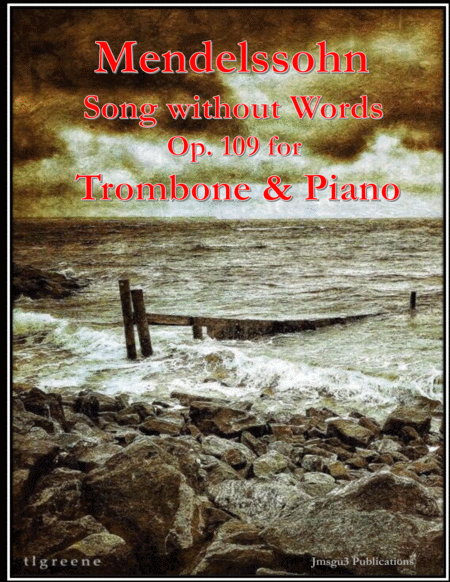
Mendelssohn: Song Without Words Op. 109 for Trombone & Piano
Trombone et Piano

$32.95 28.65 € Trombone et Piano PDF SheetMusicPlus

Piano,Trombone - Level 1 - Digital Download SKU: A0.1494260 Composed by Thomas Moore. Arranged by Alex Nunes Rodrigues. Folk. Score and part. 3 pages. Alex Rodrigues #1070865. Published by Alex Rodrigues (A0.1494260). The Last Rose of Summer is a work deeply rooted in Irish culture, originally penned as a poem by the renowned poet and composer Thomas Moore in 1805. Moore, regarded as Ireland’s national poet, was inspired by an 'Old Blush' rose while staying at Jenkinstown Castle in County Kilkenny, Ireland. The poem was published as part of his Irish Melodies collection between 1807 and 1834 and later set to music by fellow Irishman John Stevenson. The song gained widespread popularity and was incorporated into the opera Martha by the German composer Friedrich von Flotow, which premiered in 1847 in Vienna.This sheet music has been adapted for solo instrument, preserving the original melody by Moore and Stevenson in its essence. The simplicity of the arrangement allows the musician to highlight the purity of the melody, making it easier to perform while maintaining the piece's emotional character. This version is designed to be accessible for beginner to intermediate musicians, enabling an authentic interpretation that respects the traditional nuances of the work.The Last Rose of Summer captures the essence of melancholy and the passage of time—universal themes reflected in the farewell to the last vestige of a vibrant summer. The melody, paired with Moore’s poetry, evokes a profound sense of loss and longing, with the solitary rose serving as a metaphor for the fleeting nature of life and the seasons. The simplicity and beauty of this piece have made it a classic, perpetuating Irish tradition and touching the hearts of listeners worldwide.
The Last Rose of Summer - Trombone with piano
Trombone et Piano

$5.99 5.21 € Trombone et Piano PDF SheetMusicPlus

Piano,Trombone - Level 1 - Digital Download SKU: A0.1494259 Composed by Thomas Moore. Arranged by Alex Nunes Rodrigues. Folk. Score and part. 3 pages. Alex Rodrigues #1070864. Published by Alex Rodrigues (A0.1494259). The Last Rose of Summer is a work deeply rooted in Irish culture, originally penned as a poem by the renowned poet and composer Thomas Moore in 1805. Moore, regarded as Ireland’s national poet, was inspired by an 'Old Blush' rose while staying at Jenkinstown Castle in County Kilkenny, Ireland. The poem was published as part of his Irish Melodies collection between 1807 and 1834 and later set to music by fellow Irishman John Stevenson. The song gained widespread popularity and was incorporated into the opera Martha by the German composer Friedrich von Flotow, which premiered in 1847 in Vienna.This sheet music has been adapted for solo instrument, preserving the original melody by Moore and Stevenson in its essence. The simplicity of the arrangement allows the musician to highlight the purity of the melody, making it easier to perform while maintaining the piece's emotional character. This version is designed to be accessible for beginner to intermediate musicians, enabling an authentic interpretation that respects the traditional nuances of the work.The Last Rose of Summer captures the essence of melancholy and the passage of time—universal themes reflected in the farewell to the last vestige of a vibrant summer. The melody, paired with Moore’s poetry, evokes a profound sense of loss and longing, with the solitary rose serving as a metaphor for the fleeting nature of life and the seasons. The simplicity and beauty of this piece have made it a classic, perpetuating Irish tradition and touching the hearts of listeners worldwide.
The Last Rose of Summer - Trombone with piano and chords
Trombone et Piano

$5.99 5.21 € Trombone et Piano PDF SheetMusicPlus

Piano,Trombone - Level 5 - Digital Download SKU: A0.792223 Composed by Krejci, Miroslav. 20th Century,Contemporary,Romantic Period. Score and part. 21 pages. Gordon Cherry #4728857. Published by Gordon Cherry (A0.792223). The Sonatina for Trombone & Piano was originally published after its composition, but soon became lost. It has recently been brought back into the repertoire.  Cherry Classics Music is proud to be bringing this very fine work back to life. The style of this 3 movement work is similar to the well known Sonatina for Trombone and Piano by Serocki. Miroslav Krejci was born on the 4th of November, 1891 in Rychnov nad Kn??nou (a small town situated in the eastern part of Bohemia of the Czech Republic).  There, he also attended high school. After graduation he travelled to Prague, studying natural science, geography and musicology at Charles University. At the Conservatory he studied composition under Vitezslav Novak. Krejci also became a teacher at a few grammar schools in the Czech republic. He died on the 29th of December 1964 in Prague. Miroslav Krejci created music for many various ensembles and his compositions are among the most prolific of Czech composers. For example, he composed the following:  two Operas: The Summer and The Last Hetman, two Symphonies, string quartets, sonatas for violins, trios for wind instruments, sonatinas for brasswind instruments and piano and five piano cycles. He wrote many vocal compositions, especially for chorus. Krejci also created many arrangements of folk songs for chorus and for solo voice with piano accompaniment. The Sonatina for Trombone and Piano was composed in 1948.  It was first performed on the occasion of the composer's birthday.
Sonatina for Trombone & Piano
Trombone et Piano

$27.50 23.91 € Trombone et Piano PDF SheetMusicPlus

Piano,Trombone - Level 3 - Digital Download SKU: A0.587630 Composed by Various. Arranged by David McKeown. Baroque,Concert,Romantic Period,Standards,Wedding. Score and part. 24 pages. David McKeown #4594699. Published by David McKeown (A0.587630). The Wedding Album is a collection of four beautiful and timeless wedding favourites, arranged for Solo Trombone with Piano accompaniment. Whether for that Special Day, for a recital, or for your own entertainment, these arrangements are ideal for players at an intermediate level or higher. The 24-page file includes the piano accompaniments and the separate solo parts at the end. Ave Maria was written by Franz Schubert in 1825 as the sixth song in his song cycle based on Walter Scott’s poem The Lady of the Lake. It is perhaps the best known of all his melodies, adapted for piano by Franz Liszt, and for orchestra many times since. It is often sung with the Latin lyrics of the Catholic hymn of the same name and has been heard everywhere from the Disney movie Fantasia to the funeral of J.F. Kennedy. The Bridal March was written by Richard Wagner in 1850, scored for orchestra and chorus, and opening the third act of his opera, Lohingren. It is best known in the English-speaking world as Here Comes the Bride. Queen Victoria’s daughter used the music for her marriage in 1858, and its popularity has endured ever since.The Prince of Denmark’s March is better known nowadays as the Trumpet Voluntary and is often used in wedding ceremonies. It was in fact written for organ, with the melody played on thetrumpet stop.  Written around 1700, for many years this piece was mistakenly attributed to Henry Purcell. Only recently has it been established that the composer was Jeremiah Clarke, organist at St Paul’s Cathedral. It is somewhat ironic that this composer of a wedding mainstay was himself a victim of unrequited love. He consequently shot himself in the cathedral graveyard. Felix Mendelssohn’s Wedding March was originally written in 1842 as incidental music to Shakespeare’s famousplay, Midsummer Night’s Dream. When Queen Victoria’s daughter used the music for her marriage in 1858, it became instantly popular and has remained a wedding favourite ever since.These four arrangements are also available as single titles for $3.99 each. You can find these along with many more top quality arrangements and compositions by David McKeown at http://www.sheetmusicplus.com/publishers/david-mckeown/6203 
The Wedding Album, for Solo Trombone and Piano
Trombone et Piano

$9.99 8.69 € Trombone et Piano PDF SheetMusicPlus

Piano,Trombone - Level 3 - Digital Download SKU: A0.587631 Composed by Various. Arranged by David McKeown. Baroque,Concert,Romantic Period,Standards,Wedding. Score and part. 24 pages. David McKeown #4594701. Published by David McKeown (A0.587631). The Wedding Album is a collection of four beautiful and timeless wedding favourites, arranged for Solo Trombone in Bb (Treble Clef) with Piano accompaniment. Whether for that Special Day, for a recital, or for your own entertainment, these arrangements are ideal for players at an intermediate level or higher. The 24-page file includes the piano accompaniments and the separate solo parts at the end. Ave Maria was written by Franz Schubert in 1825 as the sixth song in his song cycle based on Walter Scott’s poem The Lady of the Lake. It is perhaps the best known of all his melodies, adapted for piano by Franz Liszt, and for orchestra many times since. It is often sung with the Latin lyrics of the Catholic hymn of the same name and has been heard everywhere from the Disney movie Fantasia to the funeral of J.F. Kennedy. The Bridal March was written by Richard Wagner in 1850, scored for orchestra and chorus, and opening the third act of his opera, Lohingren. It is best known in the English-speaking world as Here Comes the Bride. Queen Victoria’s daughter used the music for her marriage in 1858, and its popularity has endured ever since.The Prince of Denmark’s March is better known nowadays as the Trumpet Voluntary and is often used in wedding ceremonies. It was in fact written for organ, with the melody played on thetrumpet stop.  Written around 1700, for many years this piece was mistakenly attributed to Henry Purcell. Only recently has it been established that the composer was Jeremiah Clarke, organist at St Paul’s Cathedral. It is somewhat ironic that this composer of a wedding mainstay was himself a victim of unrequited love. He consequently shot himself in the cathedral graveyard. Felix Mendelssohn’s Wedding March was originally written in 1842 as incidental music to Shakespeare’s famousplay, Midsummer Night’s Dream. When Queen Victoria’s daughter used the music for her marriage in 1858, it became instantly popular and has remained a wedding favourite ever since.These four arrangements are also available as single titles for $3.99 each. You can find these along with many more top quality arrangements and compositions by David McKeown at http://www.sheetmusicplus.com/publishers/david-mckeown/6203 
The Wedding Album, for Solo Trombone in Bb (Treble Clef) and Piano
Trombone et Piano

$9.99 8.69 € Trombone et Piano PDF SheetMusicPlus


Partitions Gratuites
Acheter des Partitions Musicales
Acheter des Partitions Digitales à Imprimer
Acheter des Instruments de Musique

© 2000 - 2026

Accueil - Version intégrale





