EUROPE
2678 articles
USA
0 articles
DIGITAL
61 articles (à imprimer)
Partitions Digitales
Partitions à imprimer
61 partitions trouvées

1 16 31 ....61

Trombone and piano - easy - Digital Download SKU: S9.Q7088 5 Easy Pieces. Composed by Hermann Regner. This edition: Sheet music. Downloadable. Schott Music - Digital #Q7088. Published by Schott Music - Digital (S9.Q7088). Apart from numerous publications in the field of music education, the music teacher and composer Hermann Regner (1928-2008) contributed considerably to the brass repertoire, such as material for wind orchestra and wind band. Influenced by his studies with Carl Orff, he paid special attention to the fusion of instrumental education and contemporary music. A matter of particular concern for him was to write practical, easily playable new music for children, young people and amateur musicians - music that takes the technical competence of beginners into account and motivates them to concern themselves with new sounds, rhythms and playing techniques. 'All begins well' is a small collection of easy pieces for trombone with piano accompaniment. The five short pieces are a perfect addition to instrument lessons and 'Jugend musiziert'. The pieces are very melodic, using simple keys (F major, B flat major, E flat major) which are easy to play by the trombone, and they cover a compass from B flat to E flat1.Das fängt ja gut an ist eine kleine Sammlung von leichten Stücken für Posaune mit Klavierbegleitung. Die fünf kurzen Stücke eignen sich hervorragend als Ergänzung zum Unterricht und für Jugend musiziert. Die Stücke sind sehr melodisch und verwenden einfache Tonarten, die für die Posaune gut spielbar sind.
That's a great start
Trombone et Piano

$11.99 10.38 € Trombone et Piano PDF SheetMusicPlus

Piano,Trombone - Level 1 - Digital Download SKU: A0.1182600 By Dirk Quinn Band. By Charles Borrelli and Roger Courtland. Arranged by Marcony Carvalho. 20th Century,March,Patriotic,Traditional. Score and part. 2 pages. Zedas Couve #782346. Published by Zedas Couve (A0.1182600). The Eagles' Victory Song was the creation of Charles Borrelli and Richard Courtland Harrison, a Washington, D.C. music teacher and arranger for jazz guitarist Charlie Byrd. The song was mistakenly credited to R. Courtland by the Copyright office and in various editions of Eagles programs from the late 1950s through the 1960s.In 1963, Jerry Wolman purchased the Philadelphia Eagles. Wolman was a sports fan growing up and loved hearing the Washington Redskins' fight song Hail to the Redskins at games. Spawning from his admiration for the Redskins' song, Wolman searched for musicians to implement a team song for the Eagles, and founded The Philadelphia Eagles' Sound of Brass band in 1964. The group included 200 musicians and dancers, and was led by Arlen Saylor, who was appointed as the Eagles' entertainment director in 1966 and is credited with penning an arrangement of the fight song that the band played at home games during halftime in the 1960s. Wolman's push to popularize the fight song flew under the radar, however, and in 1969 the Sound of Brass band was discontinued.The song came back into light in 1997, when Bobby Mansure, founder of an unofficial Eagles pep band, asked team management to allow the band to play in the parking lot during home games. Management gave Mansure's pep band an audition, allowing them to play at two preseason games to gauge fan reaction. The song went over so well that Mansure and the band retained a permanent position as the official Philadelphia Eagles Pep Band.In 1998, following Mansure's reintroduction of the song, Eagles management attempted to rebuild its popularity among fans by changing some aspects of the song: they modified the key, changed the opening lyric from Fight, Eagles Fight to Fly, Eagles Fly, and re-marketed the song with that as the title. In addition, they appended the popular E-A-G-L-E-S chant—which had emerged in the 1980s—to the end of the song. While management planned to play the song throughout the 1998 season, the Eagles' poor performance that year caused them to hold off reintroducing the song until the following year. The Eagles fared better during their 1999 season, and subsequently, the fight song was played after every score.
Eagles' Victory Song
Trombone et Piano
Dirk Quinn Band
$4.99 4.32 € Trombone et Piano PDF SheetMusicPlus

Piano,Trombone - Level 3 - Digital Download SKU: A0.587630 Composed by Various. Arranged by David McKeown. Baroque,Concert,Romantic Period,Standards,Wedding. Score and part. 24 pages. David McKeown #4594699. Published by David McKeown (A0.587630). The Wedding Album is a collection of four beautiful and timeless wedding favourites, arranged for Solo Trombone with Piano accompaniment. Whether for that Special Day, for a recital, or for your own entertainment, these arrangements are ideal for players at an intermediate level or higher. The 24-page file includes the piano accompaniments and the separate solo parts at the end. Ave Maria was written by Franz Schubert in 1825 as the sixth song in his song cycle based on Walter Scott’s poem The Lady of the Lake. It is perhaps the best known of all his melodies, adapted for piano by Franz Liszt, and for orchestra many times since. It is often sung with the Latin lyrics of the Catholic hymn of the same name and has been heard everywhere from the Disney movie Fantasia to the funeral of J.F. Kennedy. The Bridal March was written by Richard Wagner in 1850, scored for orchestra and chorus, and opening the third act of his opera, Lohingren. It is best known in the English-speaking world as Here Comes the Bride. Queen Victoria’s daughter used the music for her marriage in 1858, and its popularity has endured ever since.The Prince of Denmark’s March is better known nowadays as the Trumpet Voluntary and is often used in wedding ceremonies. It was in fact written for organ, with the melody played on thetrumpet stop.  Written around 1700, for many years this piece was mistakenly attributed to Henry Purcell. Only recently has it been established that the composer was Jeremiah Clarke, organist at St Paul’s Cathedral. It is somewhat ironic that this composer of a wedding mainstay was himself a victim of unrequited love. He consequently shot himself in the cathedral graveyard. Felix Mendelssohn’s Wedding March was originally written in 1842 as incidental music to Shakespeare’s famousplay, Midsummer Night’s Dream. When Queen Victoria’s daughter used the music for her marriage in 1858, it became instantly popular and has remained a wedding favourite ever since.These four arrangements are also available as single titles for $3.99 each. You can find these along with many more top quality arrangements and compositions by David McKeown at http://www.sheetmusicplus.com/publishers/david-mckeown/6203 
The Wedding Album, for Solo Trombone and Piano
Trombone et Piano

$9.99 8.65 € Trombone et Piano PDF SheetMusicPlus

Piano,Trombone - Level 3 - Digital Download SKU: A0.587631 Composed by Various. Arranged by David McKeown. Baroque,Concert,Romantic Period,Standards,Wedding. Score and part. 24 pages. David McKeown #4594701. Published by David McKeown (A0.587631). The Wedding Album is a collection of four beautiful and timeless wedding favourites, arranged for Solo Trombone in Bb (Treble Clef) with Piano accompaniment. Whether for that Special Day, for a recital, or for your own entertainment, these arrangements are ideal for players at an intermediate level or higher. The 24-page file includes the piano accompaniments and the separate solo parts at the end. Ave Maria was written by Franz Schubert in 1825 as the sixth song in his song cycle based on Walter Scott’s poem The Lady of the Lake. It is perhaps the best known of all his melodies, adapted for piano by Franz Liszt, and for orchestra many times since. It is often sung with the Latin lyrics of the Catholic hymn of the same name and has been heard everywhere from the Disney movie Fantasia to the funeral of J.F. Kennedy. The Bridal March was written by Richard Wagner in 1850, scored for orchestra and chorus, and opening the third act of his opera, Lohingren. It is best known in the English-speaking world as Here Comes the Bride. Queen Victoria’s daughter used the music for her marriage in 1858, and its popularity has endured ever since.The Prince of Denmark’s March is better known nowadays as the Trumpet Voluntary and is often used in wedding ceremonies. It was in fact written for organ, with the melody played on thetrumpet stop.  Written around 1700, for many years this piece was mistakenly attributed to Henry Purcell. Only recently has it been established that the composer was Jeremiah Clarke, organist at St Paul’s Cathedral. It is somewhat ironic that this composer of a wedding mainstay was himself a victim of unrequited love. He consequently shot himself in the cathedral graveyard. Felix Mendelssohn’s Wedding March was originally written in 1842 as incidental music to Shakespeare’s famousplay, Midsummer Night’s Dream. When Queen Victoria’s daughter used the music for her marriage in 1858, it became instantly popular and has remained a wedding favourite ever since.These four arrangements are also available as single titles for $3.99 each. You can find these along with many more top quality arrangements and compositions by David McKeown at http://www.sheetmusicplus.com/publishers/david-mckeown/6203 
The Wedding Album, for Solo Trombone in Bb (Treble Clef) and Piano
Trombone et Piano

$9.99 8.65 € Trombone et Piano PDF SheetMusicPlus

Piano,Trombone - Level 3 - Digital Download SKU: A0.587596 Composed by Jeremiah Clarke. Arranged by David McKeown. Baroque,Concert,Instructional,Standards,Wedding. Score and part. 7 pages. David McKeown #4367456. Published by David McKeown (A0.587596). The Prince of Denmark’s March is better known nowadays as the Trumpet Voluntary and is often used in wedding ceremonies. It was in fact written for organ, with the melody played on thetrumpet stop.  Written around 1700, for many years this piece was mistakenly attributed to Henry Purcell. Only recently has it been established that the composer was Jeremiah Clarke, organist at St Paul’s Cathedral. It is somewhat ironic that this composer of a wedding mainstay was himself a victim of unrequited love. He consequently shot himself in the cathedral graveyard. This full version is arranged as a Solo for Trombone and Piano; the performance time is around two and a half minutes. Of course, performers, especially at weddings, may wish to abridge and shorten the arrangement. This is easily done as the different sections are self-contained and the repeat may be ignored. The single pdf file contains both the score and the solo instrumental part. Musicians at an intermediate level and above will find this ideal for formal and informal performances, with both the solo and accompaniment enjoying melodic interest. Teachers will enjoy using this arrangement as a fun way to help with strict time, full tone and dynamics.The short sample here and the full length version on the youtube link are from the Clarinet version of this arrangement.There are many more top quality arrangements and compositions by David McKeown for you to browse at http://www.sheetmusicplus.com/publishers/david-mckeown/6203  ï»¿
Trumpet Voluntary, (Prince of Denmark's March), for Solo Trombone and Piano
Trombone et Piano

$4.60 3.98 € Trombone et Piano PDF SheetMusicPlus

B-Flat trombone,Piano - Level 5 - Digital Download SKU: A0.1431109 Composed by Keiko Takashima. Classical. Score and part. 35 pages. FOSTERMUSIC.JP Digital Publishing #1011578. Published by FOSTERMUSIC.JP Digital Publishing (A0.1431109). INTRODUCTION Breeze in The Hearts, Bloom in The World is a sonata for trombone and piano commissioned by trombonist Takenori Yoshikawa that premiered at Mr. Yoshikawa's recital in July 2010 with Iku Miwa on piano. Mr. Yoshikawa had requested me to compose a bold and spirited piece, which prompted me to write this sonata with four movements after much deliberation.In the original edition, the burden of the performance was a little too focused on the trombone due to the trombonist's heightened interest in the piece, and as a result, the piece became difficult to play. In this revised edition, I have reworked the balance between the trombone and the piano while preserving the length of the piece so that the music can be performed more effectively.<Performance notes>I. The repetitions of the gentle melody in the introduction should be played in a way that allows it to be heard from far away, while the theme that appears after that should sound majestic and brave.II. Nostalgia - Although this movement is in a minor key, the music seeks to depict a sense of nostalgia instead of sorrow. Despite its slow, triple-time rhythm, please ensure that the music progresses quietly without coming to a halt.III. Serenade - In this movement, the trombone's melody should have a smooth and lively rhythm like the cello in a string ensemble. Articulate the melody beautifully with grace and movement and never allow it to become too heavy.IV. The theme in this movement has a similar feel to that in the first movement, but lighter. Maintain a tempo that is not too fast and keep the music moving. In the coda section from F, the opening section of the first theme makes an appearance from time to time as the piece heads toward the end. Please maintain a constant tempo while articulating the notes in a loud and resonant manner.The piano part contains many sections throughout the entire piece that call for a deep, orchestral sound. The pianist should read these parts carefully from the score while supporting the trombone as much as possible.The word fuka in the Japanese title Fuka Sanrei refer to the flowers that bloom when the wind blows between two people and brings about various encounters between them. I hope that this piece will allow colorful flowers to bloom in the hearts of everyone who performs it and listens to it.March 2023, Keiko TakashimaClick here for other Takashima's works
Breeze in The Hearts, Bloom in The World - Sonata for Trombone and Piano
Trombone et Piano

$49.99 43.29 € Trombone et Piano PDF SheetMusicPlus

Piano,Trombone - Level 5 - Digital Download SKU: A0.810983 Composed by Cherry Classics Music. Arranged by John, W., and Ware. 20th Century,Contemporary. Score and part. 63 pages. Gordon Cherry #4601711. Published by Gordon Cherry (A0.810983). This fine work has sat dormant for many years and has now come to light thanks to the efforts of Charlie Vernon, Bass Trombonist of the Chicago Symphony, who performed this virtuoso work as a young performer. The concerto is in the standard three movement form: Fast, slow, fast. This publication is a reduction from the original orchestral version (to be released at some point in the future). Here is a description of the Concerto by the composer, John W. Ware. I started on the trombone concerto in my junior year studying composition at Indiana University.  While working on it, I learned of an opportunity to make it sort of a thesis piece (though students didn't write a thesis in composition while an undergrad).  The original version was for trombone with string orchestra, and it was performed by the IU String Orchestra, conducted by Dr. Arthur Corra, with Robert Priez, trombone, as part of my senior composition recital.  I thought the performance was quite good (Priez played extraordinarily well), and the piece received a newspaper review in the Indiana Daily Student, in which the reviewer wrote that the work was almost too exciting.  I thought at the time that he had given me and my music a fine compliment.  I made a piano version of the accompaniment, shortening and tightening the first movement, for performances in 1966; I made a second revision in 1967 for a performance by E. J. Eaton, trombonist at the University of Tennessee at Martin, arriving at the form in which the work exists now. The first movement is in fairly normal sonata-allegro form, in the key of A minor.  It alternates between assertive and more thoughtful moods.   There is no introduction; the soloist enters immediately and dominates much of the movement. The main theme is--by some manipulation--a source for most of the other themes, and all of the themes are used in close proximity to each other, including contrapuntal combinations, especially near the end.  Originally the movement included a lengthy fugato, now much shortened and including a stretto that builds and subsides before a cadenza leading to a coda based on both the principal and secondary themes.  Key relations in this movement, as in the other two, are quite free and often chromatic, with frequent third-relations; but returns to the tonic at the end are emphatic.  The writing is challenging for both soloist and accompanist; the piece is substantial, requiring technique and stamina. The second movement is in F minor and is also built on both contrast and close relationships between the main and secondary themes.  The main theme is heard in the piano part before the soloist enters.  The mood is more lyric than in the first movement, but with dramatic episodes also.  In this movement are some definite derivations from themes in the first movement.  The ending is a sort of lengthened shadow of the opening. The finale returns to A minor, with themes slightly related to polonaise rhythms, but with strong echoes of first-movement themes.  Here, too, dramatic and lyric episodes alternate, with dotted rhythms frequently propelling the music forward.  The introduction is a brief and simple preparation for the solo entry.  Later in the movement, a very brief, slightly slower section is soon overtaken by the original tempo.  Toward the end, there is a second cadenza, again leading to a swift and energetic coda. The work is about 20 minutes in length and is appropriate for advanced performers.
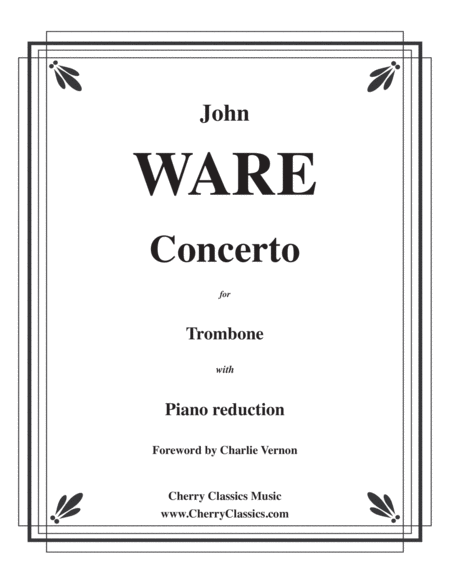
Concerto for Trombone and Piano accompaniment (piano reduction)
Trombone et Piano

$35.00 30.31 € Trombone et Piano PDF SheetMusicPlus

Piano,Trombone - Level 3 - Digital Download SKU: A0.549338 By Barry Manilow. By Bruce Johnston. Arranged by James M. Guthrie, ASCAP. Contemporary,Rock. Score and part. 8 pages. Jmsgu3 #3486683. Published by jmsgu3 (A0.549338). Duration: ca. 3:00, score: 5 pages, solo part: 1 page, piano part: 2 pages.Very famous song suitable for church, recital or nightclub. I Write the Songs is a popular song written by Bruce Johnston in 1975 and made famous by Barry Manilow. Manilow's version reached number one on the Billboard Hot 100 chart in January 1976[2] after spending two weeks atop the Billboard adult contemporary chart in December 1975.[3] It won a Grammy Award for Song of the Year and was nominated for Record of the Year in 1977.[3] Billboard ranked it as the No. 13 song of 1976.[4]The original version was recorded by The Captain & Tennille, who worked with Johnston in the early 1970s with The Beach Boys. It appears on their 1975 album, Love Will Keep Us Together. The first release of I Write the Songs as a single was by then teen-idol David Cassidy from his 1975 solo album The Higher They Climb, which was also produced by Bruce Johnston. Cassidy's version reached #11 on the UK Singles Chart in August of that year.[5]Johnston has stated that, for him, the I in the song is God,[2] and that songs come from the spirit of creativity in all of us. He has said that the song is not about his Beach Boys bandmate Brian Wilson.[6]Manilow was initially reluctant to record the song, stating in his autobiography Sweet Life: The problem with the song was that if you didn't listen carefully to the lyric, you would think that the singer was singing about himself. It could be misinterpreted as a monumental ego trip.[3] After persuasion by Clive Davis, then president of Arista Records, Manilow recorded the song, and his version of I Write the Songs was the first single taken from the album Tryin' to Get the Feeling. It first charted on the Billboard Hot 100 on November 15, 1975, reaching the top of the chart nine weeks later, on January 17, 1976. Wikipedia
I Write The Songs
Trombone et Piano
Barry Manilow
$39.95 34.6 € Trombone et Piano PDF SheetMusicPlus

Instrumental Duet Bass Trombone,Instrumental Duet - Level 4 - Digital Download SKU: A0.755280 Composed by Sy Brandon. 20th Century,Contemporary. Score and parts. 47 pages. Sy Brandon #4886103. Published by Sy Brandon (A0.755280). Adages II is the second in a series of compositions based on familiar sayings. It is composed for Dr. Joseph Murrell and is for bass trombone and piano. There are five movements in this composition. 1. Strike while the iron is hot – This movement is in a fast tempo with a lot of syncopation and irregular meter change. The piano frequently plays two loud chords that indicate the striking. 2. Opposites attract – The opposites in this movement are a swing style and a classical style. Each has its moments to shine and yet one clearly influences the other. 3. Stop and Smell the roses – This movement is lyrical representing the beauty of smelling roses. A motif that contains rests is a reminder to stop and take time for the beautiful things in life. A contrapuntal middle section with steady sixteenth notes builds in intensity as another reminder that one needs to take time from the hectic pace of life to enjoy beauty. 4. Curiosity killed the cat – This movement is mostly soft, staccato, and furtive representing the curiosity of the cat. A loud chord or succession of chords indicates the cat getting into trouble. This happens a total of nine times representing the cat’s nine lives before the cat is finally doomed. 5. Look before you leap – As the adage implies, there are a lot of melodic leaps in this movement. Any scalar material or repeated note figures serve as a warning to look before one leaps.
Adages II for Bass Trombone and Piano
Trombone et Piano

$14.99 12.98 € Trombone et Piano PDF SheetMusicPlus

Piano,Tenor Trombone - Level 3 - Digital Download SKU: A0.1245349 Composed by Erik Satie. Arranged by Samuel Sequeira. 19th Century,Classical. Score and part. 6 pages. Samuel Sequeira #840226. Published by Samuel Sequeira (A0.1245349). Gymnopedie No. 1 - Erik Satie - Trombone/PianoPlay it at home, with friends, on class, for your teacher or studentPlay it on a public presentation.I present to you a captivating arrangement for Trombone and piano of Gymnopédie No. 1 by Erik Satie, with a Youtube PlayAlong VideoIn this arrangement, the trombone takes on the haunting melodies of Satie's iconic composition, while the piano provides a delicate and supportive accompaniment. The combination of these two instruments creates a unique and enchanting musical experience.The arrangement begins with the gentle and sparse opening chords on the piano, creating a serene atmosphere. As the trombone enters, it carries the iconic melody, infusing it with its rich and warm tones. The trombone's expressive qualities add an extra layer of depth and resonance to the music, enhancing its introspective and contemplative nature.Throughout the arrangement, the trombone and piano engage in a musical dialogue, blending their sounds in perfect harmony. The piano provides a nuanced and sensitive backdrop, supporting the trombone's melodic lines and adding depth to the arrangement. The trombone, in turn, showcases its versatility by soaring above the piano, capturing the listener's imagination and conveying the emotional depth of Satie's composition.The arrangement maintains the simplicity and elegance of Satie's original work while allowing for subtle interpretations and expressive phrasing from both the trombone and piano. Together, they create a captivating rendition that invites the listener on a reflective and introspective journey.Gymnopédie No. 1 is a timeless piece that has touched the hearts of many. This arrangement for trombone and piano allows the beauty of Satie's music to shine through in a new and captivating way, showcasing the expressive capabilities of both instruments.You can find me on:Instagram: @SamuelseqYouTube: @SamuelSeqMore arrangements on: Sam'S arrangementsThanks for listening, and happy playing!
Gymnopedie No. 1
Trombone et Piano

$5.99 5.19 € Trombone et Piano PDF SheetMusicPlus

Piano,Tenor Trombone - Level 3 - Digital Download SKU: A0.1373706 Composed by Lawrence H Underwood. 21st Century,Classical,Contemporary,Contest,Festival. Score and part. 8 pages. Lawrence H Underwood #958096. Published by Lawrence H Underwood (A0.1373706). This original composition by veteran performer and music educator, Lawrence Underwood, is the fourth installment in a new 2024 series of pieces for solo instrument with piano accompaniment.  Sunshine After Rain is a musical exploration of the joy that comes after sadness; the new hope that springs when sunshine breaks through the clouds. The piece takes the soloist through different meters, modes, and a cadenza before drawing to its gentle close. Suitable for use as a recital, festival, or contest piece - as well as special music in church - this new piece is a perfect chance to add a little feeling to any program!
Sunshine After Rain
Trombone et Piano

$6.99 6.05 € Trombone et Piano PDF SheetMusicPlus

Piano,Tenor Trombone - Level 2 - Digital Download SKU: A0.1242588 Composed by Alan Menken and Howard Ashman. Arranged by Samuel Sequeira. Broadway,Children,Film/TV,Musical/Show,Pop,Singer/Songwriter. Score and part. 13 pages. Samuel Sequeira #837758. Published by Samuel Sequeira (A0.1242588). Part of your World - Howard Ashman & Alan Menken  - Trombone /PianoPlay it at home, with friends, on class, for your teacher or studentPlay it on a public presentation.I present to you the arrangement of Part of Your World from the movie The Little Mermaid released in 2023, specifically designed for piano and trombone with Piano Playalong Youtube Video.In this arrangement, the piano and trombone come together to create a captivating and expressive performance. The piano provides a melodic and harmonic foundation, while the trombone takes on the main voice, infusing the arrangement with its rich and warm tones.The piano sets the stage with its flowing arpeggios and delicate accompaniment, creating a sense of wonder and enchantment. It creates a lush harmonic backdrop, supporting the trombone and adding depth to the arrangement.The trombone, with its mellow and resonant sound, becomes the voice of the melody. It brings the iconic melodies of Part of Your World to life, conveying the character's longing and curiosity. The trombone's smooth slides and expressive phrasing add a soulful and heartfelt quality to the arrangement.Throughout the piece, the piano and trombone interact, creating a musical dialogue. They blend their voices in harmonious moments and create moments of musical interplay that bring the arrangement to life.Together, the piano and trombone create a captivating rendition of Part of Your World that captures the essence of the story. This arrangement allows the trombone to shine with its expressive capabilities, while the piano provides a supportive and harmonically rich backdrop.You can find me on:Instagram: @SamuelseqYouTube: @SamuelSeqMore arrangements on: Sam'S arrangementsThanks for listening, and happy playing!
Part Of Your World (reprise)
Trombone et Piano

$4.99 4.32 € Trombone et Piano PDF SheetMusicPlus

Piano,Trombone - Level 5 - Digital Download SKU: A0.1455537 By Alex Schwarte. By Alex Schwarte. 21st Century,Classical,Contemporary,New Age. Score and part. 26 pages. Alex Schwarte #1034623. Published by Alex Schwarte (A0.1455537). I have been working on To Rise Again for about a year since the passing of several close family members. As with any long-term struggle, some days are easier than others, and some days it is hard to do much of anything at all. Walking through hard days, this piece is about mental health, the struggles that you face, and on the most difficult days, what it takes to rise again. Despair: This movement opens with what I call the despair motif. This motif consists of seven notes and will return throughout the piece, reminding us of uncertainty and darkness. The middle of the movement includes a build-up leading to a complete panic attack, featuring cluster chords in the piano and extreme volumes and articulation in the trombone. Finally, a quasi-march leads us to the end, where we sink to the lowest and angriest point. Support: This tranquil and shimmering movement evokes the other side of grief and depression: the people around you. In the dark moments, these people can become pillars of aid and light. Even with support, there are moments of darkness and uncertainty, but support will always be there. Musically, this movement features numerous color tones and aims to create an emotionally understanding and steady atmosphere. The opening trombone line (the support motif) represents tender support and is used numerous times in the next movement. Overcome: The final movement opens with a haunting atmosphere created by plucked piano strings. The first normal piano entrance is the Rumbling motif: the feeling of the soul exerting its will to be free but not quite making it. Throughout the rest of the movement, the trombone and piano go back and forth, with the piano emphasizing support and the trombone wallowing in despair. Eventually, the trombone begins to come around and rise. Concluding with a triumphant feeling of release, the mind is lifted from despair, free and open to whatever life brings next. Mental health looks different for everyone, and I want to reflect that in this composition. For all future performances, the performers can make significant musical changes to better reflect their own challenges. This could be as small as a different tempo or as large as a completely different style and articulation. To Rise Again is very personal to me, and I want every performance of it to be just as personal.Playlist: https://www.youtube.com/playlist?list=PLDoVD8lbKulOjUbvdKcc9phxPNOgYLDuh.
To Rise Again
Trombone et Piano
Alex Schwarte
$40.00 34.64 € Trombone et Piano PDF SheetMusicPlus


1 16 31 ....61


Partitions Gratuites
Acheter des Partitions Musicales
Acheter des Partitions Digitales à Imprimer
Acheter des Instruments de Musique

© 2000 - 2026

Accueil - Version intégrale





