EUROPE
971 articles
USA
0 articles
DIGITAL
68 articles (à imprimer)
Partitions Digitales
Partitions à imprimer
68 partitions trouvées

1 16 31 ....61

Piano,Soprano Flute - Level 4 - Digital Download SKU: A0.1437014 By Joe Hisaishi. By Jou Hisaishi. Arranged by Eileen Gilligan. 21st Century,Classical,Film/TV,Instructional,Pop. Score and part. 18 pages. The Flautist #1017082. Published by The Flautist (A0.1437014). The Rain , can be played down the octave ,is an extension exercise to the pitch bend low note chromatic exercise in the Foundation Tools section of The Flautist. The low register of the flute can deliver some beautiful warm deep tone if worked on correctly and controlled. It requires relaxation, flexibility and control. It is an excellent opportunity to find the speaking point of the flute, hold it and carry it through a melody.The melody covers the low to middle register perfectly, demanding an expressive, warm and projective tone.Exercises in order to get the most out of this melody: All of them are in the Foundation Tools section of the website.Whistle tones over the full three registers of the flute, concentrate on the lower fingerings as they are the hardest, if having trouble relax the lips and make sure the airstream is centred.Pitch bend over the full three registers of the flute. Can use arpeggio pattern to do this or chromatic pattern.Pitch bend low note chromatic exercise coming up to the most centred warm tone from the bend and carrying it through down to low C or BHarmonics over the full range and vocalised harmonics. Make sure to test them against the actual note, they must be exactly the same pitch. Aim to get a beautiful tone and singing style when playing harmonics, they can be really beautiful quality wise.If feeling super inspired sing the low register chromatically into the flute whilst fingering it.Do a lot of legato slurred work to warm up before commencing articulation.Air is king and controlling it is the key to everything. If the air speed is not controlled between notes life becomes hard.Keep your tongue low and out of the way of the air stream, never block the air. That is why I use da for tonguing.
Rain After That
Flûte traversière et Piano
Joe Hisaishi
$6.95 5.87 € Flûte traversière et Piano PDF SheetMusicPlus

Flute,Piano - Level 1 - Digital Download SKU: A0.548696 Composed by Franz Schubert. Arranged by James M. Guthrie, ASCAP. Christmas,Easter,Standards. Score and part. 4 pages. Jmsgu3 #3411141. Published by jmsgu3 (A0.548696). A Flute Christmas/Easter classic! Duration: 4:55 Score: 3 pg. Flute part: 1 pg. Piano reads from the score. Schubert seems to have composed this piece as a song-setting. This is because he wanted to portray a poignant emotional event from a poem. The poem was Walter Scott's The Lady of the Lake. Consequently, this song became an integral part of Schubert's Song cycle. Therefore the cycle is called: the Lady of the Lake. In the poem, Ellen Douglas is the Lady of the Lake. The lake is probably Loch Katrine in the Scottish Highlands. First of all, Ellen goes with her father to stay in the Goblin's cave. They go because he earlier refused to join in a rebellion against King James. Roderick Dhu, the chief of the rebellious Alpine Clan, marches up the mountain with his army. But before the battle, he, first of all, hears Ellen singing. She is singing a prayer calling for help from the Virgin Mary. Schubert's piece was first performed at the castle of Countess Sophie Weissenwolff in Steyregg, Austria.  Schubert dedicated the arrangement to her, and as a result, she became famous as the lady of the lake.The incipit of Ellen's song is Ave Maria which is Latin for Hail Mary. It seems like this similarity led Schubert to adapt the melody to accommodate the Roman Catholic prayer Ave Maria. Consequently, the Latin version of Ave Maria finally became more famous than the original so that consequently many believe he wrote the Latin version first. Schubert Franz Schubert (1797–1828) was, in fact, a famous Austrian composer. Moreover, he composed during the late Classical and early Romantic periods. Schubert was comparatively prolific. He wrote more than 600 secular vocal works, seven symphonies, and, correspondingly, a massive amount of piano and chamber music. Critics agree, as a matter of fact, that his most famous works include his Piano Quintet in A major, D. 667 (also known as the Trout Quintet), the Symphony No. 8 in B minor, D. 759 (Unfinished Symphony), the last sonatas for piano (D. 958–960), and the song cycles Die schöne Müllerin (D. 795) and Winterreise (D. 911). Education Schubert was furthermore a musical child prodigy. He studied violin with his father as well as piano with his older brother. In addition, when Schubert was eleven he studied at Stadtkonvikt school, where he became familiar with the orchestral music of Haydn, Mozart, and likewise Beethoven. In due time he left school and returned home where he studied to become an educator; nevertheless, he continued studying composition with Antonio Salieri. Performance Eventually, Schubert was admitted to the Gesellschaft der Musikfreunde as a performer. This appointment straightaway established his name in Vienna as a composer and pianist. Finally, he gave his only composition recital in 1828. He died suddenly a few months later probably due to typhoid fever. Legacy Schubert’s music was by and large underappreciated while he was alive. There were all in all only a few enthusiasts in Vienna. After he died, however, interest in his work in fact increased. Felix Mendelssohn, Robert Schumann, Franz Liszt, Johannes Brahms, and other famous composers in due time discovered his compositions. Nowadays, historians rank Schubert expressly among the greatest composers of the era, and his music remains in general very popular.  
Schubert: Ave Maria for Flute & Piano
Flûte traversière et Piano

$29.95 25.28 € Flûte traversière et Piano PDF SheetMusicPlus

Flute,Piano - Level 1 - Digital Download SKU: A0.548688 Composed by Franz Schubert. Arranged by James M. Guthrie, ASCAP. Christmas,Easter,Standards. Score and part. 4 pages. Jmsgu3 #3411123. Published by jmsgu3 (A0.548688). An Alto Flute Christmas/Easter classic! Duration: 4:55 Score: 3 pg. Alto Flute part: 1 pg. Piano reads from the score. Schubert seems to have composed this piece as a song-setting. This is because he wanted to portray a poignant emotional event from a poem. The poem was Walter Scott's The Lady of the Lake. Consequently, this song became an integral part of Schubert's Song cycle. Therefore the cycle is called: the Lady of the Lake. In the poem, Ellen Douglas is the Lady of the Lake. The lake is probably Loch Katrine in the Scottish Highlands. First of all, Ellen goes with her father to stay in the Goblin's cave. They go because he earlier refused to join in a rebellion against King James. Roderick Dhu, the chief of the rebellious Alpine Clan, marches up the mountain with his army. But before the battle, he, first of all, hears Ellen singing. She is singing a prayer calling for help from the Virgin Mary. Schubert's piece was first performed at the castle of Countess Sophie Weissenwolff in Steyregg, Austria.  Schubert dedicated the arrangement to her, and as a result, she became famous as the lady of the lake.The incipit of Ellen's song is Ave Maria which is Latin for Hail Mary. It seems like this similarity led Schubert to adapt the melody to accommodate the Roman Catholic prayer Ave Maria. Consequently, the Latin version of Ave Maria finally became more famous than the original so that consequently many believe he wrote the Latin version first. Schubert Franz Schubert (1797–1828) was, in fact, a famous Austrian composer. Moreover, he composed during the late Classical and early Romantic periods. Schubert was comparatively prolific. He wrote more than 600 secular vocal works, seven symphonies, and, correspondingly, a massive amount of piano and chamber music. Critics agree, as a matter of fact, that his most famous works include his Piano Quintet in A major, D. 667 (also known as the Trout Quintet), the Symphony No. 8 in B minor, D. 759 (Unfinished Symphony), the last sonatas for piano (D. 958–960), and the song cycles Die schöne Müllerin (D. 795) and Winterreise (D. 911). Education Schubert was furthermore a musical child prodigy. He studied violin with his father as well as piano with his older brother. In addition, when Schubert was eleven he studied at Stadtkonvikt school, where he became familiar with the orchestral music of Haydn, Mozart, and likewise Beethoven. In due time he left school and returned home where he studied to become an educator; nevertheless, he continued studying composition with Antonio Salieri. Performance Eventually, Schubert was admitted to the Gesellschaft der Musikfreunde as a performer. This appointment straightaway established his name in Vienna as a composer and pianist. Finally, he gave his only composition recital in 1828. He died suddenly a few months later probably due to typhoid fever. Legacy Schubert’s music was by and large underappreciated while he was alive. There were all in all only a few enthusiasts in Vienna. After he died, however, interest in his work in fact increased. Felix Mendelssohn, Robert Schumann, Franz Liszt, Johannes Brahms and other famous composers in due time discovered his compositions. Nowadays, historians rank Schubert expressly among the greatest composers of the era, and his music remains in general very popular.
Schubert: Ave Maria for Alto Flute & Piano
Flûte traversière et Piano

$29.95 25.28 € Flûte traversière et Piano PDF SheetMusicPlus

Flute,Piano - Level 3 - Digital Download SKU: A0.549375 Composed by George Frideric Handel. Arranged by James M. Guthrie, ASCAP. Baroque,Sacred,Standards,Wedding. Score and part. 9 pages. Jmsgu3 #3492231. Published by jmsgu3 (A0.549375). Duration: 4:55, Score: 6 pages, Solo part: 1 page, piano part: 2 pages. A very famous aria (Ombra mai fu) from XerxesSuitable for any venue requiring meditative music. Excellent choice for a recital encore. Xerxes Xerxes is, in fact, an opera seria in three acts by Handel. Moreover, Handel conducted the premiere performance in London in 1738. Handel casts the opera in Persia in 470 BC. The part of Xerxes was indeed originally sung by a soprano castrato. Nowadays, the part is generally sung by a mezzo-soprano or conversely a counter-tenor. In the first place, Xerxes sings an opening aria, Ombra mai fu to a plane tree. Handel sets this aria to one of his most truly famous melodies. Although many refer to it traditionally as Handel’s Largo, Handel has, on the contrary, clearly marked Larghetto in the score. Handel Background George Frideric Handel (1685 - 1759) was born in Germany but eventually became a British citizen. Nonetheless, he was a famous Baroque composer. In fact, he became famous for his operas, oratorios, anthems, and organ concertos. Handel studied music and, by and large, worked as a composer in Germany and Italy before moving to London. On the whole, Handel was very familiar with the contemporary music of Italy and Germany. Career in England It is essential to realize that Italian opera was all the rage in England at the time. Moreover, Handel was really good at writing them. Therefore, he started not one but three opera companies in England. Alexander's Feast was a huge success in 1736, but Handel began composing English choral works. After success with the Messiah in 1742) he certainly never again wrote an Italian opera. Consequently, he died in 1759, a treasured genius. Accordingly, the English government gave him full state honors at his funeral. Hence, he is buried in Westminster Abbey in London. Legacy Music historians agree that Handel was in general one of the greatest composers of the Baroque era.  To demonstrate, his works such as the Messiah, Water Music, and Music for the Royal Fireworks remain consistently popular up to the present time. He especially composed the coronation anthem, Zadok the Priest for the coronation of George II. Nevertheless, it has specifically been performed at every succeeding British coronation since. His oratorio Solomon has by all means also continued to be prevalent. As a matter of fact, Sinfonia from act 3 was featured in the 2012 London Olympics opening ceremony. Handel was particularly prolific. To enumerate, he wrote over forty operas.  Since the late 1960s, we have expressly experienced a revival of baroque music. Similarly, we have especially seen a pique of interest in historically informed musical performances. Since his death in 1779, interest in Handel's music has all in all, expanded.  
Handel: Largo from Xerxes for Flute & Piano
Flûte traversière et Piano

$32.95 27.82 € Flûte traversière et Piano PDF SheetMusicPlus

Flute,Piano - Level 1 - Digital Download SKU: A0.522191 Composed by Colin Kirkpatrick. Contemporary,Instructional. Score and part. 28 pages. Colin Kirkpatrick Publications #3130519. Published by Colin Kirkpatrick Publications (A0.522191). My Flute and Me consists of fourteen short and delightful pieces written especially for absolute beginners up to students at elementary level. The pieces are intended as supplementary material to your usual tutor books. The music can be used with any number of players and the pieces remain in the lower register. Several early pieces use only the notes B, A and G and the key of G major predominates. Six of the pieces use only half notes (minims) and quarter notes (crotchets). The low C, a tricky note for many beginners, has been avoided almost completely. On the one occasion it appears, the note C an octave above is given as optional. Although the pieces are arranged in approximate order of difficulty you can play them in any order you want, depending on the musical needs of the student. Your students are sure to enjoy these pieces, which are both easy on the fingers and easy on the ear! The music is identical to that in the companion book My Recorder and Me. Several pieces have a few measures (bars) rest in the middle not only to give the player a break and add musical contrast but also to give the experience of counting empty bars during the music. When space allows, piano cues appear in the solo part. Some of the later pieces in the book have good performing potential and could be strung together in any order to create a small suite. Every piece has a short piano introduction so that the student can sense the tempo and musical style before playing. The keyboard accompaniments have been kept as simple as possible with the minimum number of notes. Dynamic markings (e.g. piano and mezzo-forte) are used from the start, but phrasing has been omitted from the solo part. This is because the teacher is usually in the best position to suggest phrasing within the physical capabilities of each student. Slurs have been employed sparingly and only when necessary.An MP3 file containing all the play-along piano accompaniments is available as a separate item here: https://www.sheetmusicplus.com/title/20679840 The book includes a well-known folk lullaby from Wales and a lively folk song from Thailand which is known by all Thai people because it’s taught in elementary schools throughout the country. The music has been converted into pdf files at 1,200 dpi which will produce professional looking printed copies of high quality. However, the output quality will also depend on your own printer settings and capabilities. The publication consists of a teacher's book (18 pages) and a student's book (8 pages) both contained in the same pdf file. The sample MP3 (click on the “Listen†button above) contains recordings of Starting Tune (No 1); Nice ‘n Easy (No 2); Waltzing Around (No 7) and Donkey Trot (No 12). The composer, Colin Kirkpatrick studied at London’s Royal College of Music. After graduation, he followed a career in music education and composed music as an active sideline. His publishers include Boosey & Hawkes, Novello, Paxton, Schott, Oxford University Press, Belwin Mills and Intrada (Netherlands). His music has been performed and broadcast all over Europe as well as in Japan, Thailand, Australia and the USA. He was a High School Music Director for about fifteen years and then became a Music Education Adviser for local government, with the added responsibility for training teachers and overseeing the instrumental service. He has written articles for magazines in both the UK and the USA and holds MA (Hons) and PhD degrees.
My Flute and Me
Flûte traversière et Piano

$5.95 5.02 € Flûte traversière et Piano PDF SheetMusicPlus

Piano,Soprano Flute - Level 3 - Digital Download SKU: A0.1314255 Composed by Camille Saint-Saens. Arranged by James M. Guthrie. 19th Century,Chamber,Contest,Festival,Historic,Romantic Period. Score and part. 11 pages. Jmsgu3 #902996. Published by jmsgu3 (A0.1314255). Saint-Saëns: The Swan (Le Cygne) movement 13 from the Carnival of the Animals Suite. One of his most popular and widely recognized works, it is the only movement from the Carnival Suite that Saint-Saëns permitted to be performed publicly during his lifetime. This is an excellent recital encore to demonstrate melodic playing and strategic phrasing. The Carnival of the AnimalsThe Carnival of the Animals is an entertaining musical suite of fourteen movements by Camille Saint-Saëns. The work was composed for private performance by an ensemble of two pianos and solo instruments. The Swan (No. 13) is among the fourteen most famous movements. In its entirety, it lasts about 25 minutes. Saint-Saëns BackgroundCharles-Camille Saint-Saëns 1835 – 1921) was, by all means, in particular, a famous French composer, brilliant organist, and significant musical mastermind of the Romantic era. Indeed, his most famous compositions, in the long run, include his Piano Concerto No. 2 (1868), Cello Concerto No. 1 (1872), and the Danse macabre (1874). Notwithstanding, we must also add Violin Concerto No. 3 (1880), Symphony No. 3 (the Organ Symphony, 1886), and, it must be remembered, Carnival of the Animals (1886) to the list. Childhood It is essential to realize that Saint-Saëns was undoubtedly, in fact, a child musical prodigy. Consequently, with this in mind, he made his concert debut, albeit at ten years old. Another critical point to remember is that he expressly studied at the Paris Conservatoire, then, despite reality, conversely followed a traditional career path as a church organist. Nevertheless, twenty years later, on the other hand, he left to become a successful freelance pianist and composer despite, as has been noted, his former employment situation. Furthermore, his performances were, after all, markedly in demand - not only in Europe but, above all, in the Americas all in all as well. YouthA point often overlooked is that in his youth, Saint-Saëns was undoubtedly excited about the modern music of the day. He was, in essence, fond of the music of his contemporaries, particularly Schumann, Liszt, and, for the most part, Wagner. In contrast, however, his compositions seemed, in fact, primarily confined within the conservative classical tradition. Be that as it may, he was, at the same time, nevertheless, a scholar of musical history. Criticism On the whole, his conservatism, in fact, ultimately brought him into frequent conflict in his later years with composers of the impressionist and, in particular, the dodecaphonic schools of musical thought. A point often overlooked is that he included neoclassical elements in his music, contrary to some critics. Furthermore, in so doing, he provided the most compelling evidence that he predicted the techniques and works by Stravinsky and Les Six. To put it another way, given these points, he was regarded, perhaps for the most part unfairly, as a non-progressive reactionary henceforth around the time of his passing.LegacySaint-Saëns taught briefly in Paris, where his students included Gabriel Fauré. Maurice Ravel later studied with Fauré. In conclusion, both Ravel and Fauré were powerfully influenced by Saint-Saëns, whom they respected as a musical mastermind.
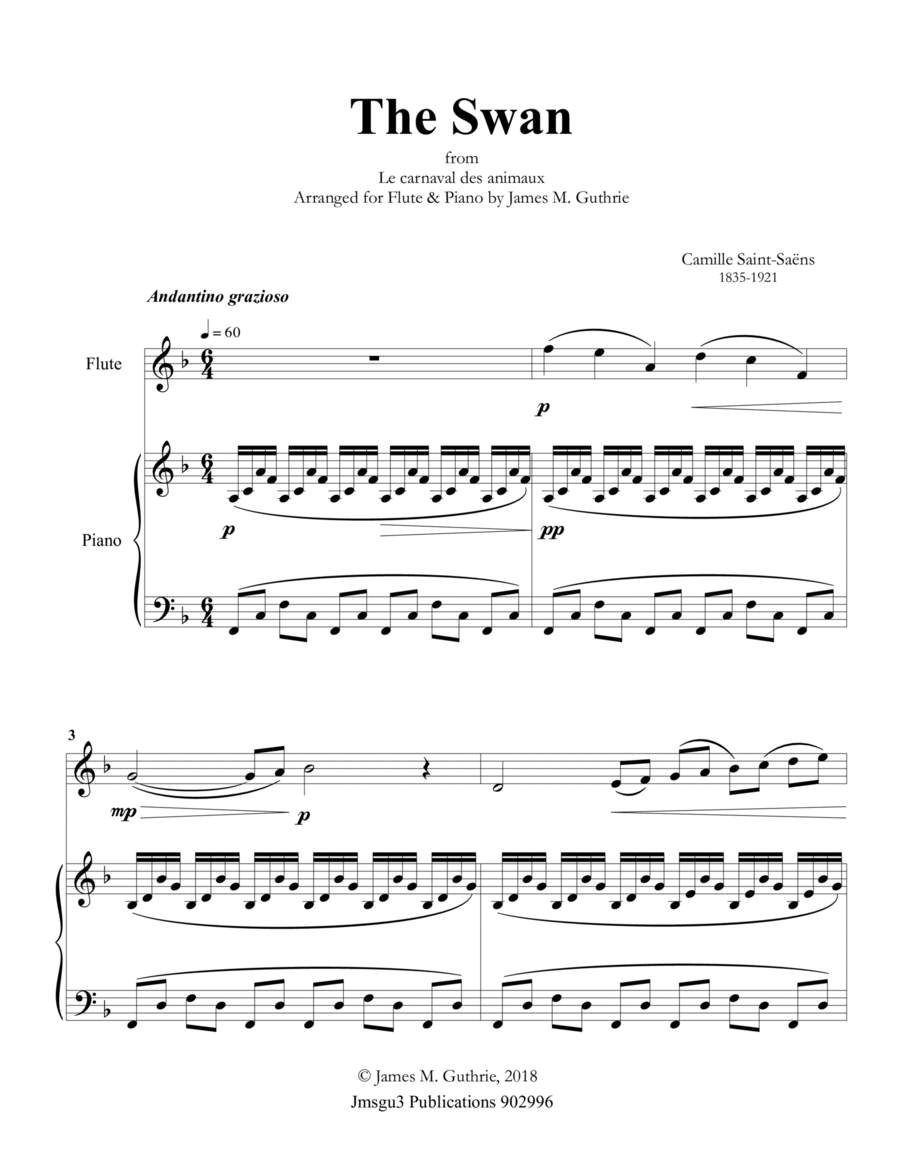
Saint-Saëns: The Swan for Flute & Piano
Flûte traversière et Piano

$32.95 27.82 € Flûte traversière et Piano PDF SheetMusicPlus

Flute,Piano - Level 4 - Digital Download SKU: A0.1236625 Composed by Christian Morris. Contemporary. Score and part. 32 pages. Hoopla Sheet Music #832145. Published by Hoopla Sheet Music (A0.1236625). An exciting concert piece inspired by U.S. WW2 pilot, John Gillespie Magee’s iconic poem ‘High Flight.’ In the opening he describes the the magnificent and exhilarating sensation of flying. In the more contemplative second section he seems to breach the veil between earth and heaven: Oh! I have slipped the surly bonds of EarthAnd danced the skies on laughter-silvered wings;Sunward I've climbed, and joined the tumbling mirthof sun-split clouds,—and done a hundred thingsYou have not dreamed of—wheeled and soared and swungHigh in the sunlit silence. Hov'ring there,I've chased the shouting wind along, and flungMy eager craft through footless halls of air ....Up, up the long, delirious, burning blueI've topped the wind-swept heights with easy graceWhere never lark nor ever eagle flew—And, while with silent lifting mind I've trodThe high untrespassed sanctity of space,Put out my hand, and touched the face of God.High Flight is part of a collection of pieces by Christian Morris entitled ‘A History of Powered Flight’:1. Kitty Hawk2. Dogfight3. Afterburner4. Holding Pattern5. Queen of the Skies6. High Flight.
High Flight
Flûte traversière et Piano

$9.99 8.43 € Flûte traversière et Piano PDF SheetMusicPlus

Piano,Soprano Flute - Level 1 - Digital Download SKU: A0.1468385 By Hoyong Lee. By Hoyong Lee. Arranged by Hoyong Lee. Chamber,Praise & Worship,Religious. Score and part. 2 pages. Hoyong Lee #1046697. Published by Hoyong Lee (A0.1468385). Praise the Lord Praise the Lord is CCM instrumental which was composed by Hoyong Lee. Based on the harmony of the piano, flute and pad, this chill instrumental represents the grace and everlasting love of Jesus with calm and mellow vibe. After having a hard time due to the side effects of the COVID-19 vaccine, everything in composer's life changed and it made him decide to express and share the grace and peace of the Holy Spirit. He truly hopes you're at peace in love of God, with this music.
Praise the Lord
Flûte traversière et Piano
Hoyong Lee
$3.95 3.33 € Flûte traversière et Piano PDF SheetMusicPlus

Flute,Piano - Level 2 - Digital Download SKU: A0.1468445 By Hoyong Lee. By Hoyong Lee. Arranged by Hoyong Lee. Chamber,Praise & Worship,Religious. Full Performance. Duration 111. Hoyong Lee #1046764. Published by Hoyong Lee (A0.1468445). Praise the Lord Praise the Lord is CCM instrumental which was composed by Hoyong Lee. Based on the harmony of the piano, flute and pad, this chill instrumental represents the grace and everlasting love of Jesus with calm and mellow vibe. After having a hard time due to the side effects of the COVID-19 vaccine, everything in composer's life changed and it made him decide to express and share the grace and peace of the Holy Spirit. He truly hopes you're at peace in love of God, with this music.
Praise the Lord
Flûte traversière et Piano
Hoyong Lee
$3.00 2.53 € Flûte traversière et Piano PDF SheetMusicPlus

Flute,Piano - Level 2 - Digital Download SKU: A0.549224 Composed by Johann Sebastian Bach. Arranged by James M. Guthrie, ASCAP. Baroque,Holiday,Standards,Wedding. Score and part. 9 pages. Jmsgu3 #3468208. Published by jmsgu3 (A0.549224). J. S. Bach BWV 508.  Bist du bei mir Bach adapted this aria from a lost Stölzel opera called Diomedes. He changed the original orchestral instrumentation to soprano, strings, and continuo.  He also modified the voice-leading making it sound more like a Bach composition. The work appears as BWV 508 No. 25 in the Anna Magdalena Notebook No. 2.   Source Only a few remnants of the original opera have survived. Historians speculate that Anna Magdalena got the song from the Leipzig Opera after the bankruptcy of 1720. Chances are good, though, that the tune was a favorite of everyone in Leipzig at the time.   Lyrics When thou art near, I go with joyTo death and to my rest.O how joyous would my end be,If your fair hands            Would close my faithful eyes. - Unknown Bach Overview First of all, Johann Sebastian Bach is maybe the greatest composer in music history. Certainly, he was prolific. As a result, everyone has heard of his works. Furthermore, these works number well over a thousand. It seems like people are probably most familiar with instrumental works such as the Brandenburg Concertos, and the Goldberg Variations. But, similarly famous are such noteworthy works as the Well-Tempered Clavier, the Musical Offering, and certainly the Art of Fugue. Seems like his most famous vocal works include the most noteworthy Mass in B Minor. Also, most noteworthy are the St. John Passion, and indeed the Christmas Oratorio.  History Bach came from a long line of musicians and above all, composers. Consequently, he, first of all, pursued a career as a church organist. So as a result, he gained employment in various Protestant churches in Germany. For a while, he worked as a court musician in Weimar and Köthen. Here he probably developed his organ style and likewise his chamber music style. Eventually, he, therefore, gained an appointment as Cantor of St. Thomas in Leipzig. Here he worked until difficulties with his employer ultimately drove him away. The King of Poland finally appointed him as court composer.  Style It seems like Bach created a fascinating new international style. He synthesized elements of the most noteworthy European music ideas into his new style. Even more, this new style was probably his synthesis of European musical rhythm and form. Furthermore, he demonstrated a complete mastery of counterpoint and motivic development. His sense of harmonic organization probably propelled him to the top. Revival                Mendelssohn conducted a Bach revival in the nineteenth century. His effort probably helped to re-familiarize the public with the magnitude of Bach’s works. During this period, scholars published many noteworthy Bach biographies. Moreover, Wolfgang Schmieder published the BWV (Bach Werke Verzeichnis). As a result, this is now the official catalog of his entire artistic output. The BWV number allows us to locate a work in the catalog. Sometimes scholars will simply use an S (Schmieder) as an abbreviation for BWV.  Voyager NASA launched two Voyager spacecraft in 1977. Onboard are phonograph records with sounds, music, and images of life on Earth. The purpose of the launch was to inform intelligent extraterrestrial life forms about conditions on Earth. The music on the disc is varied. There is Bach, Mozart, Beethoven, and Stravinsky among others. However, because Bach is so important in our music history, it contains three times more Bach than all the others combined.
Bach: Bist du bei mir BWV 508 for Flute & Piano
Flûte traversière et Piano

$32.95 27.82 € Flûte traversière et Piano PDF SheetMusicPlus

Flute,Piano - Level 2 - Digital Download SKU: A0.549225 Composed by Johann Sebastian Bach. Arranged by James M. Guthrie, ASCAP. Baroque,Easter,Standards,Wedding. Score and part. 9 pages. Jmsgu3 #3468220. Published by jmsgu3 (A0.549225). J. S. Bach BWV 508. Bist du bei mir Bach adapted this aria from a lost Stölzel opera called Diomedes. He changed the original orchestral instrumentation to soprano, strings, and continuo.  He also modified the voice-leading making it sound more like a Bach composition. The work appears as BWV 508 No. 25 in the Anna Magdalena Notebook No. 2.   Source Only a few remnants of the original opera have survived. Historians speculate that Anna Magdalena got the song from the Leipzig Opera after the bankruptcy of 1720. Chances are good, though, that the tune was a favorite of everyone in Leipzig at the time.   Lyrics When thou art near, I go with joyTo death and to my rest.O how joyous would my end be,If your fair hands            Would close my faithful eyes. - Unknown Bach Overview First of all, Johann Sebastian Bach is maybe the greatest composer in music history. Certainly, he was prolific. As a result, everyone has heard of his works. Furthermore, these works number well over a thousand. It seems like people are probably most familiar with instrumental works such as the Brandenburg Concertos, and the Goldberg Variations. But, similarly famous are such noteworthy works as the Well-Tempered Clavier, the Musical Offering, and certainly the Art of Fugue. Seems like his most famous vocal works include the most noteworthy Mass in B Minor. Also, most noteworthy are the St. John Passion, and indeed the Christmas Oratorio.  History Bach came from a long line of musicians and above all, composers. Consequently, he, first of all, pursued a career as a church organist. So as a result, he gained employment in various Protestant churches in Germany. For a while, he worked as a court musician in Weimar and Köthen. Here he probably developed his organ style and likewise his chamber music style. Eventually, he, therefore, gained an appointment as Cantor of St. Thomas in Leipzig. Here he worked until difficulties with his employer ultimately drove him away. The King of Poland finally appointed him as court composer.  Style It seems like Bach created a fascinating new international style. He synthesized elements of the most noteworthy European music ideas into his new style. Even more, this new style was probably his synthesis of European musical rhythm and form. Furthermore, he demonstrated a complete mastery of counterpoint and motivic development. His sense of harmonic organization probably propelled him to the top. Revival                Mendelssohn conducted a Bach revival in the nineteenth century. His effort probably helped to re-familiarize the public with the magnitude of Bach’s works. During this period, scholars published many noteworthy Bach biographies. Moreover, Wolfgang Schmieder published the BWV (Bach Werke Verzeichnis). As a result, this is now the official catalog of his entire artistic output. The BWV number allows us to locate a work in the catalog. Sometimes scholars will simply use an S (Schmieder) as an abbreviation for BWV.  Voyager NASA launched two Voyager spacecraft in 1977. Onboard are phonograph records with sounds, music, and images of life on Earth. The purpose of the launch was to inform intelligent extraterrestrial life forms about conditions on Earth. The music on the disc is varied. There is Bach, Mozart, Beethoven, and Stravinsky among others. However, because Bach is so important in our music history, it contains three times more Bach than all the others combined.
Bach: Bist du bei mir BWV 508 for Alto Flute & Piano
Flûte traversière et Piano

$32.95 27.82 € Flûte traversière et Piano PDF SheetMusicPlus

Flute,Piano - Level 1 - Digital Download SKU: A0.1158443 Composed by Ludwig van Beethoven. Arranged by Ander. Classical,Film/TV,Instructional,Romantic Period,Traditional. Score and part. 7 pages. Woods Only, Arrangements #758729. Published by Woods Only, Arrangements (A0.1158443). This arrangement adapted for flute e piano was written keeping the characteristics of the original work, in order to be performed by young music students who want to enter the symphonic music. Besides, it can also be used by professional musicians, for recitals, repertoire, academic presentations and didactic material. As much as it is a funeral march, it is well suited for any musical performance occasion. The transcription is faithful to the structure, with only one change of key, so that it is comfortable for all the instruments in the formation, as well as for use in ensemble practice between musicians of different traditions. Ludwig van Beethoven began concentrated work on his Symphony No. 7 in A major Op. 92 in 1811, it was completed in 1812, and was dedicated to Count Moritz von Fries, and premiered in Vienna on December 8, 1813. It is considered a remarkable example of the more ebullient side of Beethoven's compositional personality and evidence that even after the onset of deafness, he still found cause for musical optimism. The second movement Allegretto is a funeral march in everything but name. Often several contrasting melodic ideas are made to coexist, as if Beethoven were imagining several processions converging on the cemetery at the same time. As he was working on this symphony during the years of the Napoleonic Wars, this experience was probably within his experience. It was also used as the soundtrack to the film Knowing, by director Alex Proyas and starring Nicolas Cage, where it is used in the final scene of the film. Beethoven called Symphony No. 7 his most excellent symphony, and a music critic of the time reported, this symphony is the most melodically rich and the most pleasing and comprehensible of all Beethoven's symphonies..
Symphony No. 7 by Beethoven for Flute
Flûte traversière et Piano

$1.99 1.68 € Flûte traversière et Piano PDF SheetMusicPlus

Flute,Piano - Level 1 - Digital Download SKU: A0.1047117 Composed by Johann Sebastian Bach. Arranged by Ander. Baroque,Easter,Sacred,Traditional,Wedding. Score and part. 4 pages. Woods Only, Arrangements #651646. Published by Woods Only, Arrangements (A0.1047117). This easy arrangement for flute and piano was adapted to be simple to perform and understand the structure of the original work for various levels of musical knowledge. It can be played freely by beginning students due to the ease imposed on the piece; however, this does not preclude it from being played by professionals and music teachers. It is also ideal for academic recitals, weddings, student method and ceremonies that are arranged in the same way as the piece contains. The Cantata 156 (BWV 156) was written for the third Sunday after Epiphany in 1729, and was first performed on January 23 of that year. The text is by Picander, one of Bach's favorite librettists. of the four cantatas written by Bach for the feast, it was the last and only one scored for solo voice. This is a choral cantata, employing a choral melody in several movements. Cantata 156, in fact, employs two different choral melodies and texts in the second and sixth movements. A cantata is a sung symphony consisting of several parts, one of which is the Arioso, which is the initial instrumental part.
Arioso by Bach for Flute and Piano
Flûte traversière et Piano

$1.99 1.68 € Flûte traversière et Piano PDF SheetMusicPlus

Flute,Piano - Digital Download SKU: A0.1035219 Composed by Piotr Tchaikovski. Arranged by James Strauss. Halloween,Hanukkah,Romantic Period,World. Score and part. 16 pages. James Strauss #5297983. Published by James Strauss (A0.1035219). Writing to his brother Modest on 18/30 January 1877, Tchaikovsky mentioned that the violinist Iosif Kotek had ordered a piece from him for a forthcoming concert. Four days later Kotek wrote to Tchaikovsky: Thank you in advance for the waltz; it will surely be wonderful, as is everything that you compose... this shall be a piece to impress everybody. In another letter from mid/late February, we read: Incidentally, about the waltz. Why force yourself if you are tired? Of course, I would be delighted and infinitely glad if you were to write the waltz, especially since it is for me. I am still very glad that you have even started to think about this.In the period from March to August, we find no further references to work on the Valse. But, given that in March and April, Tchaikovsky wrote his Fourth Symphony, and that in May he was completely absorbed in composing the opera Yevgeny Onegin, it is likely that by this time the Valse had already been completed.It seems that the waltz was partly or wholly orchestrated by Kotek after Tchaikovsky completed the version for violin with piano. This is suggested by two letters from Kotek to Tchaikovsky: in October 1878, the violinist reported to Tchaikovsky on an unsuccessful performance of the piece: Could my instrumentation be the reason that the waltz did not please?, and early in 1879 he wrote: I think that I badly orchestrated the Waltz ... what extraordinarily empty sounds!. None of Tchaikovsky's letters refer to the orchestration of the piece.Here for the very first time in aversion for flute and piano - I tried to not transcribe the violin part, but re-write the solo part as it was made for flute. 
Valse - Scherzo op.34 for flute and piano
Flûte traversière et Piano

$11.99 10.12 € Flûte traversière et Piano PDF SheetMusicPlus

Flute and orchestra - intermediate - Digital Download SKU: S9.Q49450 Composed by Wolfgang Amadeus Mozart. Arranged by Wolfgang Birtel. This edition: piano reduction with solo part. Flute - Orchestra - teaching repertoire - Wolfgang Amadeus Mozart. Schott Student Edition - Repertoire. Dieser hübsche Einzelsatz wird hier in einer sorgfältig edierten Neuausgabe, mit einer Kadenz des Herausgebers, vorgelegt – ein serenadenhafter Satz, der dem Solisten alle Möglichkeiten für kantables Spiel bietet. Downloadable, Piano reduction with solo part. Duration 5 minutes. Schott Music - Digital #Q49450. Published by Schott Music - Digital (S9.Q49450). Key: C major. German • English • French.Even though Wolfgang Amadeus Mozart (1756-1791), admittedly, was no fan of the flute, he wrote unforgettable music for this instrument 'that I can't stand': two concertos, a double concerto with harp, the original version of the Wind Concertante and the four flute quartets. Commissioned by the Dutch physician and amateur musician Ferdinand Dejean, Mozart wrote his two solo concertos in 1777/78 during a stay in Mannheim. As the middle movement of the Concerto in G major KV 313 supposedly was too difficult for the client – with regard to the playing technique and/or music – the composer wrote an alternative version, 'Andante' KV 315 (285e). This nice individual movement is now presented in a carefully edited new edition, with a cadenza of the editor – a serenade-like setting that offers the soloist many possibilities for cantabile playing. About Schott Student EditionThe Schott Student Edition gathers instrumental works for music lessons providing a unique and varied repertoire resource including standard teaching works, lesser known pieces which are perfectly suited to lessons as well as to student concerts and competitions.The repertoire is divided into levels 1-5, from very easy to difficult, and includes works from the Renaissance up to modern performance pieces. Each title is graded, from very easy works for beginners up to demanding pieces for more advanced students who are preparing for further study or examinations.Every work in the series has been carefully selected and edited by experienced music teachers. The editions also contain a wealth of information on the pieces as well as useful advice on studying, rehearsing and interpreting the works. The first titles to be published in the Schott Student Edition series contain works for violin, violoncello, flute, clarinet and recorder. Further editions are in preparation.
Andante
Flûte traversière et Piano

$9.99 8.43 € Flûte traversière et Piano PDF SheetMusicPlus


1 16 31 ....61


Partitions Gratuites
Acheter des Partitions Musicales
Acheter des Partitions Digitales à Imprimer
Acheter des Instruments de Musique

© 2000 - 2026

Accueil - Version intégrale





