EUROPE
1856 articles
USA
0 articles
DIGITAL
12 articles (à imprimer)
Partitions Digitales
Partitions à imprimer
12 partitions trouvées


Flute,Piano - Level 1 - Digital Download SKU: A0.548707 Composed by Martin Luther. Arranged by James M. Guthrie, ASCAP. Easter,Instructional,Standards. Score and part. 4 pages. Jmsgu3 #3411715. Published by jmsgu3 (A0.548707). Out of the Depths I Cry to You by Martin Luther arranged for alto flute & piano. The first verses feature modified counterpoint and harmony proceeding at quarter = 82. The final verse is reharmonized for maximum dramatic effect at a more contemplative tempo such as quarter = 64. Very powerful selection for Lent or Easter. Duration (3 verses) 3:05, 36 ms.Score: 3 pg. Solo part: 1 pg. The piano reads from the score. Out of the Depths Aus tiefer Not schrei ich zu dir (From deep affliction I cry out to you), is, of course, a hymn composed by Martin Luther. Moreover, Luther also wrote the lyrics, essentially a paraphrase of Psalm 130. First published in 1524, it is also one of eight songs in the original Lutheran hymnal. It appears likewise in many hymnals and in different translations. The lyrics furthermore stimulated compositions from the Renaissance to the contemporary. Consequently, composers such as Johann Sebastian Bach built an entire chorale cantata on it. Other composers similarly contributed pieces, such as Felix Mendelssohn and Max Reger. Luther Background Martin Luther, (1483 –1546) was a German professor of theology, composer, priest, and moreover, an influential character in the Protestant Reformation. Luther had a momentous impact on church and society due to his contributions to the musical arts. He wanted to disseminate the gospel among mankind and with this intention thought that the best way to do that was through music. Influence It is important to realize that other musicians, and their descendants, were encouraged by Luther’s songs and wrote their own hymns. Luther, to be sure, had a thorough musical education. For example, he knew secular and sacred songs from an early age. He, in particular, played the lute well and sang in the monastery when he was a monk. That is to say, music was an essential part of his life. He in fact first began writing songs in 1523, sometimes writing the melody as well as the lyrics. Luther was certainly able to evaluate the composers of his time. He thought especially highly of Josquin des and Ludwig Senfl. He was also acquainted, with this in mind, with other composers and their works. Legacy The Lutheran musical ethos soon covered all of Germany and later significantly fashioned Protestant musical culture. Heinrich Schütz and Johann Sebastian Bach are the most compelling evidence of this Protestant musical culture. Additionally, as a point often overlooked, the pedal organ, first refined in northern Germany, became universally prevalent. As a matter of fact, Dieterich Buxtehude established a regular evening organ concert series in Lübeck. Another key point is that this concert series, in turn, spread North German Musical ideas worldwide. Luther was especially convinced that music is a beautiful and exclusive offering of the divine.
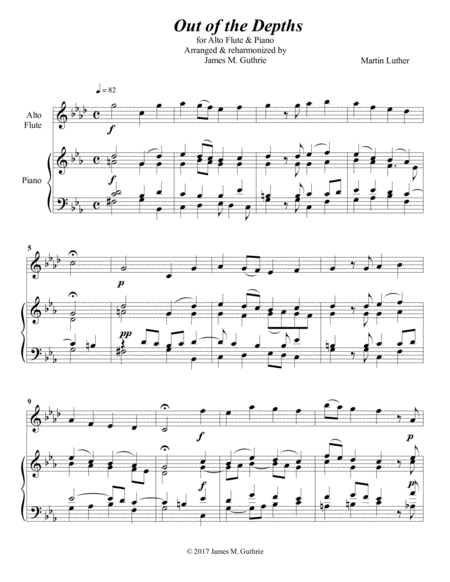
Luther: Out of the Depths for Alto Flute & Piano
Flûte traversière et Piano

$24.95 21.46 € Flûte traversière et Piano PDF SheetMusicPlus

Flute,Piano - Level 3 - Digital Download SKU: A0.587625 Composed by Various. Arranged by David McKeown. Baroque,Concert,Romantic Period,Standards,Wedding. Score and part. 24 pages. David McKeown #4594685. Published by David McKeown (A0.587625). The Wedding Album is a collection of four beautiful and timeless wedding favourites, arranged for Solo Flute with Piano accompaniment. Whether for that Special Day, for a recital, or for your own entertainment, these arrangements are ideal for players at an intermediate level or higher. The 24-page file includes the piano accompaniments and the separate solo parts at the end. Ave Maria was written by Franz Schubert in 1825 as the sixth song in his song cycle based on Walter Scott’s poem The Lady of the Lake. It is perhaps the best known of all his melodies, adapted for piano by Franz Liszt, and for orchestra many times since. It is often sung with the Latin lyrics of the Catholic hymn of the same name and has been heard everywhere from the Disney movie Fantasia to the funeral of J.F. Kennedy. The Bridal March was written by Richard Wagner in 1850, scored for orchestra and chorus, and opening the third act of his opera, Lohingren. It is best known in the English-speaking world as Here Comes the Bride. Queen Victoria’s daughter used the music for her marriage in 1858, and its popularity has endured ever since.The Prince of Denmark’s March is better known nowadays as the Trumpet Voluntary and is often used in wedding ceremonies. It was in fact written for organ, with the melody played on thetrumpet stop.  Written around 1700, for many years this piece was mistakenly attributed to Henry Purcell. Only recently has it been established that the composer was Jeremiah Clarke, organist at St Paul’s Cathedral. It is somewhat ironic that this composer of a wedding mainstay was himself a victim of unrequited love. He consequently shot himself in the cathedral graveyard. Felix Mendelssohn’s Wedding March was originally written in 1842 as incidental music to Shakespeare’s famousplay, Midsummer Night’s Dream. When Queen Victoria’s daughter used the music for her marriage in 1858, it became instantly popular and has remained a wedding favourite ever since.These four arrangements are also available as single titles for $3.99 each. You can find these along with many more top quality arrangements and compositions by David McKeown at http://www.sheetmusicplus.com/publishers/david-mckeown/6203 
The Wedding Album, for Solo Flute and Piano
Flûte traversière et Piano

$9.99 8.59 € Flûte traversière et Piano PDF SheetMusicPlus

Flute,Piano - Level 1 - Digital Download SKU: A0.1230303 Composed by Felix Bartholdy Mendessohn. Arranged by André Nusa. Chamber,Romantic Period. Score and part. 4 pages. Andre_Nusa #826023. Published by Andre_Nusa (A0.1230303). The arrangement of the lieder op.9 no.2 by Mendelssohn features the piano playing the gentle and flowing accompaniment while the flute takes on the sweet melody. The arrangement stays true to the original piece, capturing the romantic and expressive nature of the music. The flute plays the melodic line with a warm and expressive tone, while the piano provides a rich harmonic foundation. The piece is well-suited for intermediate players, with the flute part remaining within the comfortable range of the instrument and the piano part utilizing basic chord progressions. The sheet music includes full score standard notation and individual flute part.
Lieder Op.9 No.2
Flûte traversière et Piano

$5.99 5.15 € Flûte traversière et Piano PDF SheetMusicPlus


Partitions Gratuites
Acheter des Partitions Musicales
Acheter des Partitions Digitales à Imprimer
Acheter des Instruments de Musique

© 2000 - 2026

Accueil - Version intégrale





