EUROPE
3889 articles
USA
0 articles
DIGITAL
16 articles (à imprimer)
Partitions Digitales
Partitions à imprimer
16 partitions trouvées


Flute,Piano - Level 3 - Digital Download SKU: A0.548462 Composed by Johann Pachelbel. Arranged by James M. Guthrie, ASCAP. Wedding. Score and part. 8 pages. Jmsgu3 #3386271. Published by jmsgu3 (A0.548462). Pachelbel's Canon arranged for alto flute & piano. Great for weddings & receptions. Pachelbel's Canon Pachelbel's Canon is, in fact, the traditional title for a composition by the German composer Johann Pachelbel. Other names for the work include namely: Canon and Gigue for 3 violins and basso continuo, Canon and Gigue in D, and of course Canon in D. We do not know when or why in particular it was written. The oldest copy is surprisingly from the 19th century. It is important to realize that it was a common routine for organists to practice improvisation on the chord progression underlying the canon. Pachelbel originally scored the Canon notably for three violins and continuo. He also in fact paired the Canon with a gigue. The movements are homotonal, to clarify, both are in the key of D major. History In due time, Pachelbel's Canon went out of style and remained in virtual oblivion for centuries. The Jean-François Paillard chamber orchestra, however, recorded an arrangement of it in 1968. As a result, it gained approval.  Many ensembles began likewise to record the piece in the 1970s and by the 1980s became ubiquitous as background music. From the 1970s to the early 2000s, pop songs correspondingly used elements of the piece. The chord progression, in particular, was used this way. Also, since the 1980s, it has been not only wildly popular for weddings, but also for funeral ceremonies in the USA and Europe. Pachelbel Background Johann Pachelbel (1653 –1706) was a German composer, as well as an organist. He was furthermore instrumental in bringing the south German organ school to its apex. He wrote a large body of music, both sacred and, equally important, secular. In particular, he uniquely helped develop the chorale prelude and fugue. For this, he has, in fact, earned a rightful place in the company of the most significant composers of the mid-Baroque period. Works Pachelbel's music was certainly popular. With this in mind, he also consequently had many pupils. His music expressly developed into a model for the south German composers. Nowadays, Pachelbel is most famous particularly for the Canon in D, as well as the F minor Chaconne, the Toccata in E minor, and of course the Hexachordum Apollinis, a set of variations for the keyboard. Influences Johann Jakob Froberger and Johann Caspar Kerll were south German composers who significantly influenced Pachelbel. Furthermore, he was especially influenced by Italians such as Frescobaldi and Poglietti. He frequently preferred an articulate, simple contrapuntal style that highlighted clarity. His music is markedly less extravagant and harmonically adventurous than that of Dieterich Buxtehude. However, as a point often overlooked, like Buxtehude, Pachelbel experimented with different instrumental combinations in his chamber music. Legacy All in all, Pachelbel was most famous as a composer for the keyboard. He composed over two hundred pieces specifically for the instrument. Pachelbel was also surprisingly a prolific composer of vocal music. All in all, about a hundred vocal works survive, including 40 or so large-scale works. 
Pachelbel: Canon for Alto Flute & Piano
Flûte traversière et Piano

$26.95 22.84 € Flûte traversière et Piano PDF SheetMusicPlus

Flute and piano - intermediate to advanced - Digital Download SKU: S9.Q53377 Op. 34. Composed by Eugene Walckiers. Edited by Edmund Wachter and Elisabeth Weinzierl. This edition: Sheet music. (c) 2020 Schott Music GmbH & Co. KG, Mainz. Classical. Downloadable. Op. 34. 27 pages. Schott Music - Digital #Q53377. Published by Schott Music - Digital (S9.Q53377). English • German.As a pupil of Antonin Reicha at the Paris Conservatoire Eugène Walckiers, originally from the French part of Flanders, joined the ranks of illustrious French composers such as Hector Berlioz, Charles Gounod and César Franck. He studied the flute with Jean-Louis Tulou and was one of the few celebrated flute virtuosos of the time whose reputation has survived to this day, thanks to their compositions for and including the flute. He himself played regularly in a legendary quartet with the best flautists of his day: Jean Firmin Brossa, Johannes Donjon and Paul Taffanel. This Fantaisie sur des Motifs de l’Opera “Guillaume Tell†was published in the year following the first performance of the opera both by Schott in Mainz and, with insignificant discrepancies, by Troupenas in Paris (Plate number 374), the original publisher of Rossini’s last four operas. Plate no. 3289 / published in 1830.
Fantaisie sur de motifs de l’opéra Guillaume Tell de Rossini
Flûte traversière et Piano

$4.99 4.23 € Flûte traversière et Piano PDF SheetMusicPlus

Flute,Piano - Level 5 - Digital Download SKU: A0.533397 Composed by Therese Brenet. Concert,Contemporary,Standards. Score and part. 30 pages. Musik Fabrik Music Publishing #2894443. Published by Musik Fabrik Music Publishing (A0.533397). A sonata in three movements for flute and piano: I. EphémèreII. La lune s'éteignitIII. Miroirs  The sonata lasts aproximately 13 minutes. Thérèse BRENET, born 22 October 1935 in Paris, France began her musical studies at a very early age, receiving her first prize in Piano from the Conservatoire de Reims.At the Paris Conservatory, her prinicipal teachers were Jean Rivier, Darius Milhaud, Maurice Duruflé, Noël Gallon and Henri Dutilleux and she obtained First Prizes in Harmony, Counterpoint, and Fugue. She finished her studies in 1965, receiving a First Prize in Orchestration, A First Prize with highest honors in Composition and the First Grand Prix de Rome in musical composition.She also won the Halphen Prize for Composition and the Fugue, a grant from the Coplay Foundation of Chigaco and was named honorable member of the National Academy of History of Reims. In 1971, she received the Stéphane Chapelier-Clergue-Gabriel Marie Prize from the SACEM and in 1973, the Silver Medal from the City of Paris.After her stay at the French Academy at the Villa Médicis in Rome, Thérèse Brenet undertook several post-graduate voyages for study, notably to Poland. Upon her return in Paris in 1970, she was immediately named to the Faculty of the Paris Conservatory (CNSMD de Paris) where she also was frequently part of the juries for music theory and composition, as well as electroacoustical music.Thérèse Brenet receiving her definitive SACEM membership from Georges Auric She retired from the Paris Conservatory in 2000 and has since devoted her time to musical composition. She uses both tonal and atonal musical language, which she uses to suit her personal style. Her works are strongly influenced by literature, by painting and by science (especially astronomy). She believes that a composer should use all technical means at his or her disposal and use them rather than be used by them.Her first commission from the French National Radio, Clamavit, for Narrator, Chorus and Orchestra which was premièred by the Orchestre Lyrique de l'O.R.T.F., under the direction of André Girard, with Michel Bouquet as the Narrator, was selected to represent France in the Composer's Forum of 'U.N.E.S.C.O., and was performed in many countries. Many other works have also been performed outside of France in countries such as Switzerland, England, Germany, Belgium, Ireland, the former Yugoslavia, Italy, Portugal, the Netherlands, Libya, Canada, Uruguay, Japan and the United States etc...
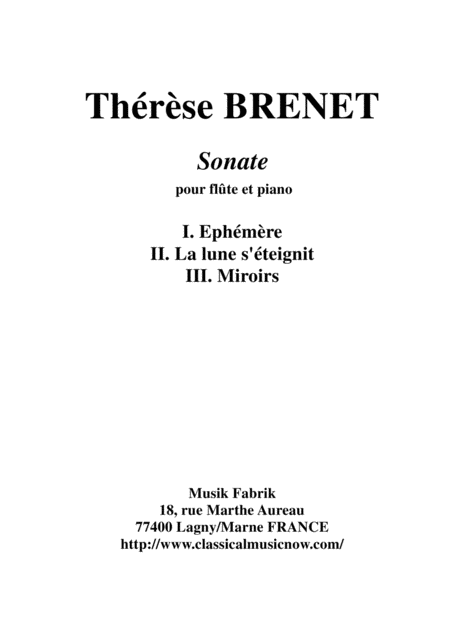
Thérèse Brenet: Sonata for flute and piano
Flûte traversière et Piano

$16.95 14.37 € Flûte traversière et Piano PDF SheetMusicPlus

Flute,Instrumental Solo,Piano - Level 3 - Digital Download SKU: A0.532807 Composed by Jules Demersseman. Arranged by Paul Wehage. Romantic Period. Score and individual part. 21 pages. Musik Fabrik Music Publishing #36919. Published by Musik Fabrik Music Publishing (A0.532807). Jules Demersseman was born on January 9, 1833 in Hondschoote, a small town in the north of France now near the border of Belgium. He entered the Paris Conservatory in 1844 in the class of Jean-Louis Tulou and won a first prize in flute in 1845. Demersseman had a career as a pedogogue and soloist, often performing his own compositions. A close friend of Adolphe Sax, he wrote some of the first works ever written for the saxophone, as well as for the saxhorn and for Sax‘s valved trombone, most of which were published by Sax himself.. Demersseman died in Paris on December 1, 1866 at the age of 33. The work is in the form of a Cavatina and Cabaletta, a vocal aria form used in Bel Canto operas during the life of Demersseman. In this form, a slow, expressive and ornamented melody (the cavatina), usually with solo cadenzas is followed by a faster, usually more dramatic but equally florid section (the cabaletta). Famous examples of this form include the aria Una voce poco fa in Rossini’s Il barbiere di Siviglia and Casta diva ... Ah! bello a me ritorno in Bellini‘s, Norma. It is important to listen to vocal performances in this style, especially in performing the solo cadenzas, which (in spite of the notation) are not necessarily meant to be performed as virtuoso effects., but rather as a means of displaying expression and beautiful tone. The piano part, obviously written to be quickly readable for a conservatory accompanist, has been modified to provide a fuller sound for the concert hall. If the work is used for examinations, these doublings may be changed back to single notes, if desired. Other dynamics, articulations, and expressive marks, absent in the first edition, have been added.
Jules Demersseman : Deuxième Solo : Cavatina et Cabaletta for flute and piano
Flûte traversière et Piano

$11.55 9.79 € Flûte traversière et Piano PDF SheetMusicPlus


Partitions Gratuites
Acheter des Partitions Musicales
Acheter des Partitions Digitales à Imprimer
Acheter des Instruments de Musique

© 2000 - 2026

Accueil - Version intégrale





