EUROPE
0 articles
USA
0 articles
DIGITAL
257 articles (à imprimer)
Partitions Digitales
Partitions à imprimer
257 partitions trouvées

1 16 31 ....256

Flute,Piano - Level 3 - Digital Download SKU: A0.1246834 By Andrew D. Gordon. By Andrew D. Gordon. Arranged by Andrew D. Gordon. Blues,Contemporary,Instructional,Jazz,Pop. Score and part. 3 pages. A.D.G. Productions #841482. Published by A.D.G. Productions (A0.1246834). Midnight Blues Serenade For Flute and Piano is one of a collection of Blues Flute and Piano Pieces for the Intermediate Flautist. This is a medium tempo 12 bar blues with a swing rhythm in the key of F. The audio is recorded 1st. with flute and piano followed by just the piano to practice with. There is a 4 beat click as an intro.About the ComposerAndrew D. Gordon is a well-known author of over 130 music instructional books, particularly in the field of contemporary music and improvisation. His books are highly regarded and are considered to be of excellent quality by musicians and music educators.One notable aspect of Andrew D. Gordon's instructional books is their practicality. He has a knack for presenting complex musical concepts in a clear and accessible manner, making it easier for musicians of different skill levels to understand and apply them. Whether you are a beginner or an advanced player, his books provide valuable insights and techniques that can enhance your musical proficiency.Gordon's instructional books often focus on specific genres such as jazz, blues, funk, and rock, offering targeted guidance to musicians interested in these styles. He explores various aspects of improvisation, including scales, chord progressions, phrasing, and rhythmic patterns, allowing readers to develop their improvisational skills and musical vocabulary.One of the strengths of Andrew D. Gordon's books is the inclusion of practical examples and exercises. He provides musical examples that are relevant to the concepts being discussed, enabling readers to hear and internalize the ideas being presented. Additionally, his books feature exercises that encourage active participation and practice, ensuring that readers can apply what they have learned and reinforce their understanding.Gordon's writing style is concise and engaging, making it easy to follow along and stay engaged throughout the book. He presents the material in a logical and organized manner, building upon foundational concepts and gradually introducing more advanced techniques. This approach helps readers progress in a structured way, ensuring a comprehensive understanding of the topics covered.Moreover, Andrew D. Gordon's instructional books are often accompanied by audio recordings or backing tracks, providing an immersive learning experience. These resources allow readers to hear how the concepts and techniques should sound in a musical context and provide opportunities for practice and improvisation.Overall, Andrew D. Gordon's music instructional books are highly regarded for their practicality, clarity, and comprehensive coverage of contemporary music and improvisation. Whether you are an aspiring musician, a seasoned player, or an educator, his books can serve as valuable resources for enhancing your musical skills and understanding.Andrew D. Gordon's music instructional books are widely available for purchase through various online platforms and music retailers. Here are some common places where you can find his books:Author's Website: http://www.adgproductions.com.  Andrew D. Gordon has a dedicated website where you can directly purchase his books. Online Retailers: Websites like Amazon, Barnes & Noble, and Sheet Music Plus carry Andrew D. Gordon's instructional books. Simply search for his name or the specific book title to find the available options.Music Stores: Check with local music stores or instrument shops in your area. They may stock Andrew D. Gordon's instructional books or be able to order them for you.E-Book Platforms: Look for digital versions of Andrew D. Gordon's books on platforms like Kindle, Apple Books, or Google Play Books. These platforms often offer e-books that can be purchased and downloaded directly to your device.
Midnight Blues Serenade For Flute and Piano
Flûte traversière et Piano
Andrew D Gordon
$2.99 2.61 € Flûte traversière et Piano PDF SheetMusicPlus

Flute,Piano - Level 2 - Digital Download SKU: A0.1155636 Composed by Ludwig van Beethoven. Arranged by Ander. Classical,Folk,March,Opera,Romantic Period. Score and part. 4 pages. Woods Only, Arrangements #755939. Published by Woods Only, Arrangements (A0.1155636). This arrangement adapted for flute and piano was written keeping the characteristics of the original work, in order to be performed by young music students who want to enter the symphonic music. Besides, it can also be used by professional musicians for recitals, repertoire, academic presentations and didactic material. The transcription remains faithful to the structure, with only one change in tone, so that it is comfortable for all the instruments in the formation, as well as being used as an activity in ensemble practice among musicians of different traditions. Beethoven's Turkish March (Op. 113) is the 4th movement of the operatic work: The Ruins of Athens, a set of incidental pieces written in 1812 by Ludwig van Beethoven, where the melody was originally written in 1809 as Theme with Six Variations for Piano, Op. 76. The work was written to accompany the play of the same name by August von Kotzebue, for the dedication of a new theater in Pest. Perhaps the best known part of the composition is the Marcia alla turca, In Latin America, this movement became known in Jean-Jacques Perrey's version (who titled it The Elephant never Forgets) since it was used as the opening theme of the successful Mexican TV comedy El Chavo del Ocho. The opening and the turkish march are often performed separately, and the other pieces in this set are not often heard.
Turkish March by Beethoven for Flute
Flûte traversière et Piano

$1.99 1.73 € Flûte traversière et Piano PDF SheetMusicPlus

Flute,Piano - Level 1 - Digital Download SKU: A0.1158443 Composed by Ludwig van Beethoven. Arranged by Ander. Classical,Film/TV,Instructional,Romantic Period,Traditional. Score and part. 7 pages. Woods Only, Arrangements #758729. Published by Woods Only, Arrangements (A0.1158443). This arrangement adapted for flute e piano was written keeping the characteristics of the original work, in order to be performed by young music students who want to enter the symphonic music. Besides, it can also be used by professional musicians, for recitals, repertoire, academic presentations and didactic material. As much as it is a funeral march, it is well suited for any musical performance occasion. The transcription is faithful to the structure, with only one change of key, so that it is comfortable for all the instruments in the formation, as well as for use in ensemble practice between musicians of different traditions. Ludwig van Beethoven began concentrated work on his Symphony No. 7 in A major Op. 92 in 1811, it was completed in 1812, and was dedicated to Count Moritz von Fries, and premiered in Vienna on December 8, 1813. It is considered a remarkable example of the more ebullient side of Beethoven's compositional personality and evidence that even after the onset of deafness, he still found cause for musical optimism. The second movement Allegretto is a funeral march in everything but name. Often several contrasting melodic ideas are made to coexist, as if Beethoven were imagining several processions converging on the cemetery at the same time. As he was working on this symphony during the years of the Napoleonic Wars, this experience was probably within his experience. It was also used as the soundtrack to the film Knowing, by director Alex Proyas and starring Nicolas Cage, where it is used in the final scene of the film. Beethoven called Symphony No. 7 his most excellent symphony, and a music critic of the time reported, this symphony is the most melodically rich and the most pleasing and comprehensible of all Beethoven's symphonies..
Symphony No. 7 by Beethoven for Flute
Flûte traversière et Piano

$1.99 1.73 € Flûte traversière et Piano PDF SheetMusicPlus

Flute,Piano - Level 1 - Digital Download SKU: A0.548672 Composed by Adam. Arranged by James M. Guthrie, ASCAP. Christmas. Score and part. 10 pages. Jmsgu3 #3410429. Published by jmsgu3 (A0.548672). Duration: 4:56. Score 5 pg. 44 ms. Solo part: 2 pg. Piano part: 3 pg. Cantique de Noël The French composer Adolphe Adam was already famous as a composer of many successful ballets and operas. Then, in the 1840’s he wrote his most famous work - O Holy Night. The original song title was Minuit Chretiens or Cantique de Noël.  Placide Cappeau provided the original song lyrics. The song was first performed in Roquemaure by the opera singer Emily Laurey at midnight mass in 1847. It became very popular among the French, much the way that Silent Night was famous elsewhere. In the 1850’s John S. Dwight, a Unitarian minister and music teacher translated the song into English.   Adolphe Adam In his younger years, Adam studied organ and composition at the Paris Conservatoire. He also played the timpani in the Conservatoire orchestra. Adam used his savings and borrowed money to open a new opera house - the fourth opera house in Paris in 1847. Unfortunately, the Revolution of 1848 forced him to close. He taught composition at the Paris Conservatoire from 1849 until his death in 1856. Placide Cappeau The poet Cappeau was an advocate of the French Enlightenment philosopher Voltaire.  Voltaire was renowned for criticizing the Catholic church, religious intolerance, and dogma in general. Consequently, Cappeau made the Redeemer figure in his song a kind of reformer of injustices, in particular, the problem of original sin. To begin with, people recognized Cappeau’s theology as eccentric, probably even doubtful. Theology In the earlier form of Minuit, the Christ figure descends to intervene with His Father’s plan to punish mankind.  Traditional doctrine pronounces that Christ came from love, not to intervene. This version also declares that Christ appeared to expunge the original sin of Adam. Cappeau removed this part from his poem years later, because he just didn’t believe it.  He preferred to portray Christ as the reformer of disparity and unfairness. Before long, the writer/politician Alphonse de Lamartine referred to the Minuit as the the Marseillaise of religion. Most French churchmen agreed with this idea but certainly did not consider it a tribute.    
Cantique de Noël for Flute & Piano
Flûte traversière et Piano

$24.95 21.74 € Flûte traversière et Piano PDF SheetMusicPlus

Flute,Piano - Level 3 - Digital Download SKU: A0.549464 Composed by Alexander Scriabin. Arranged by James M. Guthrie, ASCAP. Concert,Instructional,Romantic Period,Sacred,Standards. Score and part. 12 pages. Jmsgu3 #3499727. Published by jmsgu3 (A0.549464). Score: 8 pages, solo part: 2 pages, piano part: 2 pages. Duration: 3:10. An introspective and meditative work with a lot of dynamic and phrasing nuance. Works well for church meditations or recital encores. Background Op.11/2 Alto Clarinet version. First of all, Scriabin composed mostly for the solo piano and also the orchestra. This is probably because he was a gifted pianist and therefore certainly appreciated the piano. Scriabin grew up in the late Romantic period, consequently, he was fond of the great piano masters of the time. As a result, he wrote his first noteworthy compositions in the manner of Chopin and Liszt. Forms Likewise, Scriabin used many of the same forms as Chopin. These certainly include the étude, prelude, nocturne, and even the mazurka. In contrast, as he developed his own sense of style his music became more and more unusual. So, the last five of his Piano Sonatas do not have a key signature and therefore lean towards atonality. Philosophy Scriabin also developed a keen interest in philosophy and likewise poetry. He was above all particularly fascinated by Nietzsche, Delville, and Blavatsky. Consequently, he finally established his own ideas about metaphysics and certainly mysticism. Scriabin consequently advanced theories about the relationship between color and musical keys. Synesthesia He also may have experienced a condition called synesthesia where he could probably sense a response created from a different stimulus. Therefore, it was almost as if he could see music and hear colors. Scriabin, therefore, arranged the colors in a circle similar to the circle-of-fifths and assigned each key area a color. Finally, he assigned the key of C to the color red, while the key of G was orange. Similarly, he assigned D to yellow, A to green, and so forth. Strangely, he did not differentiate between major and minor key colors.  Multimedia Hence, his ability to translate colors into music certainly gave Scriabin a most noteworthy interest in creating multimedia events. Furthermore, He designed his biggest work, the Mysterium, to last an entire week. Even more, Scriabin made plans not only for music, but also colored lights, incense, and dancing. He designed the performance to occur in the foothills of the Himalaya mountains. The Mysterium was never performed, and only sketches of the work remain. Modern Performances In modern times, we often experience performances of Scriabin’s most famous completed works accompanied by colored laser lights and incense. These are the Poem of Ecstasy (completed in 1908) and the Poem of Fire (completed in 1910). The lighting effects for these early performances were accomplished by the clavier à lumiéres. It was a keyboard instrument that projected colored light onto a screen.
Scriabin: Prelude Op. 11 No. 2 for Flute & Piano
Flûte traversière et Piano

$19.95 17.38 € Flûte traversière et Piano PDF SheetMusicPlus

Flute,Piano - Level 3 - Digital Download SKU: A0.549473 Composed by Alexander Scriabin. Arranged by James M. Guthrie, ASCAP. Concert,Instructional,Romantic Period,Sacred,Standards. Score and part. 12 pages. Jmsgu3 #3499833. Published by jmsgu3 (A0.549473). Score: 8 pages, solo part: 2 pages, piano part: 2 pages. Duration: 3:10. An introspective and meditative work with a lot of dynamic and phrasing nuance. Works well for church meditations or recital encores.BackgroundOp.11/2 Alto Clarinet version. First of all, Scriabin composed mostly for the solo piano and also the orchestra. This is probably because he was a gifted pianist and therefore certainly appreciated the piano. Scriabin grew up in the late Romantic period, consequently, he was fond of the great piano masters of the time. As a result, he wrote his first noteworthy compositions in the manner of Chopin and Liszt.FormsLikewise, Scriabin used many of the same forms as Chopin. These certainly include the étude, prelude, nocturne, and even the mazurka. In contrast, as he developed his own sense of style his music became more and more unusual. So, the last five of his Piano Sonatas do not have a key signature and therefore lean towards atonality.PhilosophyScriabin also developed a keen interest in philosophy and likewise poetry. He was above all particularly fascinated by Nietzsche, Delville, and Blavatsky. Consequently, he finally established his own ideas about metaphysics and certainly mysticism. Scriabin consequently advanced theories about the relationship between color and musical keys.SynesthesiaHe also may have experienced a condition called synesthesia where he could probably sense a response created from a different stimulus. Therefore, it was almost as if he could see music and hear colors. Scriabin, therefore, arranged the colors in a circle similar to the circle-of-fifths and assigned each key area a color. Finally, he assigned the key of C to the color red, while the key of G was orange. Similarly, he assigned D to yellow, A to green, and so forth. Strangely, he did not differentiate between major and minor key colors. MultimediaHence, his ability to translate colors into music certainly gave Scriabin a most noteworthy interest in creating multimedia events. Furthermore, He designed his biggest work, the Mysterium, to last an entire week. Even more, Scriabin made plans not only for music, but also colored lights, incense, and dancing. He designed the performance to occur in the foothills of the Himalaya mountains. The Mysterium was never performed, and only sketches of the work remain.Modern PerformancesIn modern times, we often experience performances of Scriabin’s most famous completed works accompanied by colored laser lights and incense. These are the Poem of Ecstasy (completed in 1908) and the Poem of Fire (completed in 1910). The lighting effects for these early performances were accomplished by the clavier à lumiéres. It was a keyboard instrument that projected colored light onto a screen.
Scriabin: Prelude Op. 11 No. 2 for Alto Flute & Piano
Flûte traversière et Piano

$19.95 17.38 € Flûte traversière et Piano PDF SheetMusicPlus

Flute,Piano - Level 4 - Digital Download SKU: A0.549725 Composed by Gabriel Faure. Arranged by James M. Guthrie, ASCAP. Contemporary,Multicultural,Romantic Period,Standards,World. Score and part. 22 pages. Jmsgu3 #3531379. Published by jmsgu3 (A0.549725). Duration: ca. 7:00, Score: 12 pages, solo part: 2 pages, piano: 7 pages. An epic choice for a recital or funeral. Fauré Background: In the first place, Gabriel Fauré 1845 –1924) was a famous French composer, musician, and educator. Furthermore, his musical ideas influenced numerous 20th-century composers. Therefore, historians regard him as one of the leading French composers of his time. Famous Works: Among his most famous compositions, by and large, are the Pavane, Elegie (op. 24), Requiem, Sicilienne, Nocturnes for piano and the songs Après un rêve and Clair de lune. Inasmuch as his early works are well-known and relatively easy to perform, Faure’s music seems to have become gradually more difficult during his later life. In other words, his later works are somewhat esoteric and complex. Early Home Life: Fauré was in fact born into a well-cultivated family. His aptitude for music became particularly clear early on - when he was still a boy. Under these circumstances, his parents sent him to a music institution in Paris. Consequently, the training he received there prepared him for a career as a church organist and choirmaster. Middle Life: It is important to realize that Fauré studied music composition with the French musical mastermind Camille Saint-Saëns, who became his lifelong friend. Fauré eventually graduated from college and earned a living as an organist and educator. During this period, he had, on the whole, little time to compose. He consequently became more successful in his middle age, becoming organist of the Église de la Madeleine and director of the Paris Conservatoire. However, he still needed time on balance for composing. Therefore, given these points, he withdrew to the countryside during the summer to focus on composing. Later Life: Fauré was, in the final analysis, recognized in France as the foremost French composer of his time. The French government held a national musical tribute particularly for him in Paris. The French President notably headed the ceremony. Elsewhere, on the contrary, Fauré's music was slow to become accepted, except of course, in England. Legacy: Historians often describe Fauré's music in general as a transition between the end of Romanticism and the beginning of modernism. As an illustration, when Fauré was born, Chopin was still composing. However, by the time of Fauré's death, jazz and atonal music, in particular, had come to fruition. Fauré, by all means, suffered from increasing deafness in his later years. Some musicologists believe this to be indeed the cause of the esoteric nature of Faure’s final works.
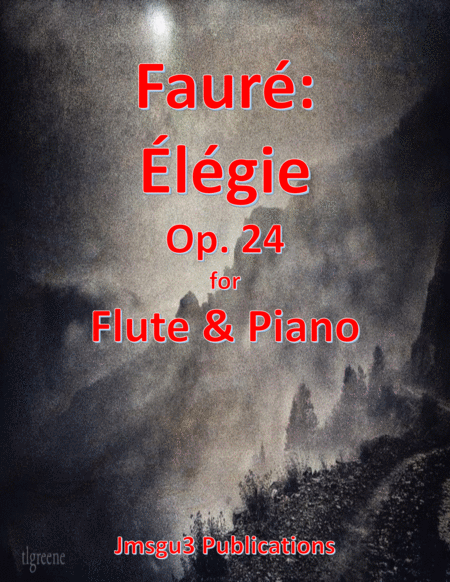
Fauré: Élégie Op. 24 for Flute & Piano
Flûte traversière et Piano

$32.95 28.71 € Flûte traversière et Piano PDF SheetMusicPlus

Flute,Piano - Level 2 - Digital Download SKU: A0.1314046 By Hillsong United. By Joel Houston, Matt Crocker, and Salomon Lighthelm. Arranged by Iury Cardoso. Chamber,Christian,Pop,Praise & Worship,Religious. Score and part. 6 pages. Iury Cardoso #902776. Published by Iury Cardoso (A0.1314046). EASY FLUTE/PIANO arrangement of the song: Oceans (Where Feet May Fail) by Hillsong United. (Score and flute part: 6 pages)  This is a version of the classic song Oceans for players of FLUTE and PIANO. In this arrangement, the simplified chords and melody make it easy to learn. Call a friend to play with you!This arrangement is also a version for teacher/student duet (the students can be accompanied by their teacher playing the piano. The piano parts can be played on piano or electronic keyboard).  The CHORDS are included on this arrangement (there is also a version without the chords on this website). On this site, there is also a version of this arrangement WITHOUT THE PIANO and several other versions for other instruments.See more arrangements by Iury Cardoso, thank you so much! © 2013 HILLSONG MUSIC PUBLISHING (APRA) Admin. in the United States and Canada at CAPITOLCMGPUBLISHING.COM All Rights Reserved Used by Permission Oceans sheet musicOceans where feet may fail sheet musicHillsong United sheet musicOceans easy arrangement easy intermediate flute pianoeasy intermediate celloEasy flute and piano Easy fluteEasy pianoBeginner flute dueteasy duetbeginning duetFlute and pianoPiano flute teacher student duetduet for beginnersFlute for beginnerswith pianosheet musicHillsong United for beginners Flute sheet musiceasy scoremusic score.
Oceans (where Feet May Fail)
Flûte traversière et Piano
Hillsong United
$4.99 4.35 € Flûte traversière et Piano PDF SheetMusicPlus

Flute,Piano - Level 3 - Digital Download SKU: A0.592535 Composed by Jule Styne. Arranged by David McKeown. Contemporary. Score and part. 6 pages. David McKeown #6366339. Published by David McKeown (A0.592535). It’s Been a Long Long Time is arranged as a solo for one Flute with Piano accompaniment. It’s Been a Long Long Time is best known to modern audiences as the song at the end of The Avengers, Endgame, where Steve Rogers, after seventy years, finally gets his dance with Peggy Carter. The song of course, is much older. Two versions of It’s Been a Long Long Time topped the charts in late 1945, and as US servicemen returned from Europe and the Pacific, it perfectly caught the mood of the times. One version was by Bing Crosby, and the other by the Harry James Orchestra featuring Kitty Kallen on vocals. It is the latter version that is heard in Endgame and the one that forms the basis of this arrangement.Musicians at an intermediate standard will find It’s Been a Long Long Time ideal for formal and informal concert performances. with both solo instrument and piano enjoying plenty of melodic interest. The separate solo part is included with the piano score in the same pdf file. The overall performance time is just over two and a half minutes. Click the link above to listen to a full performance of the clarinet version on YouTube.To keep up with new titles, search for Dave McKeown Sheet Music Downloads on Facebook.There are many more top quality arrangements and compositions by David McKeown for you to browse at http://www.sheetmusicplus.com/publishers/david-mckeown/6203
It's Been A Long, Long Time
Flûte traversière et Piano

$5.99 5.22 € Flûte traversière et Piano PDF SheetMusicPlus

Flute,Piano - Level 4 - Digital Download SKU: A0.971652 Composed by Jeffrey Hoover. 20th Century,Contemporary. Score and part. 35 pages. Musicart Publications #4797933. Published by Musicart Publications (A0.971652). In three movements, Romantic Sonata - Poems of Light (flute and piano) communicates how light can be a metaphor for the emotional and spiritual aspects of life.  There are also three paintings - also created by the composer - joining hearing with sight as a poetic way of understanding ideas and emotions.Of Light and Shadow possesses a monothematic sonata design (rather than a two-theme structure), with a primary musical theme that is developed, and a brief closing section.  Colors in the Clouds, the second movement of the work, does not differ greatly in tempo from the first movement, but rather is more relaxed in character.  A slower middle section of this movement explores tone color through expressive use of extended techniques for the flute.  Prism of the Heart is variation of the classical chaconne, with an introduction and a closing section.  The conclusion of the first movement is developed and becomes the closing section of the third movement.  This connects the first and third movements, bringing one back to where one started, yet experiencing change after the musical journey. The score and flute part in this edition are arranged to be printed double-sided, with correct page turns, directly from the PDF. Jeffrey Hoover's compositions- music ranging from soloist to symphony orchestra -have received recognition through the prestigious Trieste prize, the international Luigi Russolo competition, awards from Mu Phi Epsilon, the Lancaster Fine Arts Festival, grants, publications fellowships and more than 20 commissions. He is a member of the ACME roster of Mu Phi Epsilon, recognized for distinguished achievement as a composer. One unique aspect of Hoover’s work is when he combines composition with his paintings, creating synergetic art that intrigues and captivate audiences and performers alike. His paintings are seen in exhibitions and in concerts where his paintings are projected while musicians perform his music. Hoover’s background as a performer includes both classical and jazz music, as saxophonist and conductor. His book The Arts and Society: Making New Worlds is published by Kendall Hunt Publishing. Hoover was born on September 11, 1959, in Anderson, Indiana. He holds a Ph.D. in Fine Arts (Composition and Interdisciplinary Fine Arts) from Texas Tech University, as well as  and .Sc. from Ball State University. His career in higher education has included both faculty and arts administration appointments.
Romantic Sonata - Poems of Light
Flûte traversière et Piano

$21.95 19.13 € Flûte traversière et Piano PDF SheetMusicPlus

Flute,Piano - Level 1 - Digital Download SKU: A0.548696 Composed by Franz Schubert. Arranged by James M. Guthrie, ASCAP. Christmas,Easter,Standards. Score and part. 4 pages. Jmsgu3 #3411141. Published by jmsgu3 (A0.548696). A Flute Christmas/Easter classic! Duration: 4:55 Score: 3 pg. Flute part: 1 pg. Piano reads from the score. Schubert seems to have composed this piece as a song-setting. This is because he wanted to portray a poignant emotional event from a poem. The poem was Walter Scott's The Lady of the Lake. Consequently, this song became an integral part of Schubert's Song cycle. Therefore the cycle is called: the Lady of the Lake. In the poem, Ellen Douglas is the Lady of the Lake. The lake is probably Loch Katrine in the Scottish Highlands. First of all, Ellen goes with her father to stay in the Goblin's cave. They go because he earlier refused to join in a rebellion against King James. Roderick Dhu, the chief of the rebellious Alpine Clan, marches up the mountain with his army. But before the battle, he, first of all, hears Ellen singing. She is singing a prayer calling for help from the Virgin Mary. Schubert's piece was first performed at the castle of Countess Sophie Weissenwolff in Steyregg, Austria.  Schubert dedicated the arrangement to her, and as a result, she became famous as the lady of the lake.The incipit of Ellen's song is Ave Maria which is Latin for Hail Mary. It seems like this similarity led Schubert to adapt the melody to accommodate the Roman Catholic prayer Ave Maria. Consequently, the Latin version of Ave Maria finally became more famous than the original so that consequently many believe he wrote the Latin version first. Schubert Franz Schubert (1797–1828) was, in fact, a famous Austrian composer. Moreover, he composed during the late Classical and early Romantic periods. Schubert was comparatively prolific. He wrote more than 600 secular vocal works, seven symphonies, and, correspondingly, a massive amount of piano and chamber music. Critics agree, as a matter of fact, that his most famous works include his Piano Quintet in A major, D. 667 (also known as the Trout Quintet), the Symphony No. 8 in B minor, D. 759 (Unfinished Symphony), the last sonatas for piano (D. 958–960), and the song cycles Die schöne Müllerin (D. 795) and Winterreise (D. 911). Education Schubert was furthermore a musical child prodigy. He studied violin with his father as well as piano with his older brother. In addition, when Schubert was eleven he studied at Stadtkonvikt school, where he became familiar with the orchestral music of Haydn, Mozart, and likewise Beethoven. In due time he left school and returned home where he studied to become an educator; nevertheless, he continued studying composition with Antonio Salieri. Performance Eventually, Schubert was admitted to the Gesellschaft der Musikfreunde as a performer. This appointment straightaway established his name in Vienna as a composer and pianist. Finally, he gave his only composition recital in 1828. He died suddenly a few months later probably due to typhoid fever. Legacy Schubert’s music was by and large underappreciated while he was alive. There were all in all only a few enthusiasts in Vienna. After he died, however, interest in his work in fact increased. Felix Mendelssohn, Robert Schumann, Franz Liszt, Johannes Brahms, and other famous composers in due time discovered his compositions. Nowadays, historians rank Schubert expressly among the greatest composers of the era, and his music remains in general very popular.  
Schubert: Ave Maria for Flute & Piano
Flûte traversière et Piano

$29.95 26.1 € Flûte traversière et Piano PDF SheetMusicPlus

Flute,Piano - Level 1 - Digital Download SKU: A0.548688 Composed by Franz Schubert. Arranged by James M. Guthrie, ASCAP. Christmas,Easter,Standards. Score and part. 4 pages. Jmsgu3 #3411123. Published by jmsgu3 (A0.548688). An Alto Flute Christmas/Easter classic! Duration: 4:55 Score: 3 pg. Alto Flute part: 1 pg. Piano reads from the score. Schubert seems to have composed this piece as a song-setting. This is because he wanted to portray a poignant emotional event from a poem. The poem was Walter Scott's The Lady of the Lake. Consequently, this song became an integral part of Schubert's Song cycle. Therefore the cycle is called: the Lady of the Lake. In the poem, Ellen Douglas is the Lady of the Lake. The lake is probably Loch Katrine in the Scottish Highlands. First of all, Ellen goes with her father to stay in the Goblin's cave. They go because he earlier refused to join in a rebellion against King James. Roderick Dhu, the chief of the rebellious Alpine Clan, marches up the mountain with his army. But before the battle, he, first of all, hears Ellen singing. She is singing a prayer calling for help from the Virgin Mary. Schubert's piece was first performed at the castle of Countess Sophie Weissenwolff in Steyregg, Austria.  Schubert dedicated the arrangement to her, and as a result, she became famous as the lady of the lake.The incipit of Ellen's song is Ave Maria which is Latin for Hail Mary. It seems like this similarity led Schubert to adapt the melody to accommodate the Roman Catholic prayer Ave Maria. Consequently, the Latin version of Ave Maria finally became more famous than the original so that consequently many believe he wrote the Latin version first. Schubert Franz Schubert (1797–1828) was, in fact, a famous Austrian composer. Moreover, he composed during the late Classical and early Romantic periods. Schubert was comparatively prolific. He wrote more than 600 secular vocal works, seven symphonies, and, correspondingly, a massive amount of piano and chamber music. Critics agree, as a matter of fact, that his most famous works include his Piano Quintet in A major, D. 667 (also known as the Trout Quintet), the Symphony No. 8 in B minor, D. 759 (Unfinished Symphony), the last sonatas for piano (D. 958–960), and the song cycles Die schöne Müllerin (D. 795) and Winterreise (D. 911). Education Schubert was furthermore a musical child prodigy. He studied violin with his father as well as piano with his older brother. In addition, when Schubert was eleven he studied at Stadtkonvikt school, where he became familiar with the orchestral music of Haydn, Mozart, and likewise Beethoven. In due time he left school and returned home where he studied to become an educator; nevertheless, he continued studying composition with Antonio Salieri. Performance Eventually, Schubert was admitted to the Gesellschaft der Musikfreunde as a performer. This appointment straightaway established his name in Vienna as a composer and pianist. Finally, he gave his only composition recital in 1828. He died suddenly a few months later probably due to typhoid fever. Legacy Schubert’s music was by and large underappreciated while he was alive. There were all in all only a few enthusiasts in Vienna. After he died, however, interest in his work in fact increased. Felix Mendelssohn, Robert Schumann, Franz Liszt, Johannes Brahms and other famous composers in due time discovered his compositions. Nowadays, historians rank Schubert expressly among the greatest composers of the era, and his music remains in general very popular.
Schubert: Ave Maria for Alto Flute & Piano
Flûte traversière et Piano

$29.95 26.1 € Flûte traversière et Piano PDF SheetMusicPlus


1 16 31 ....256


Partitions Gratuites
Acheter des Partitions Musicales
Acheter des Partitions Digitales à Imprimer
Acheter des Instruments de Musique

© 2000 - 2026

Accueil - Version intégrale





