EUROPE
12203 articles
USA
0 articles
DIGITAL
395 articles (à imprimer)
Partitions Digitales
Partitions à imprimer
395 partitions trouvées

1 16 31 ....391

Flute,Piano - Level 3 - Digital Download SKU: A0.550397 Composed by Antonio Vivaldi. Arranged by James M. Guthrie. Baroque,Christmas,Easter,Sacred. Score and part. 24 pages. Jmsgu3 #4628299. Published by jmsgu3 (A0.550397). Sonata da Chiesa in Bb for Flute & Piano by Antonio Vivaldi in Four movements.Antonio Vivaldi (1678-1741) was an Italian composer and violinist in the Baroque period who is widely considered one of the greatest composers of all time. He significantly influenced many other composers of the Baroque era, and his impact can still be felt in music today.Vivaldi's most significant contribution to music history was his development of the Sonata da Chiesa or church sonata. This composition was a variation of the Baroque sonata and was used primarily in sacred music. It was characterized by a more lyrical approach to composition, focusing on melody and harmonic structure. Vivaldi was one of the first composers to use this form, and his works set the standard for future composers. His church sonatas were written in various keys and styles, and their influence can be heard in the works of later composers, such as J.S. Bach and Handel.Vivaldi's influence on music history is far-reaching, and his contributions to the development of the Sonata da Chiesa are among his most important. His compositions are still widely performed and appreciated today, and his legacy shapes modern-era music.The mood of Vivaldi's Sonata No. 1 can be described as diverse, as it typically consists of multiple movements with varying emotional qualities. Vivaldi's cello sonatas, including Sonata No. 1, are known for their attractive melodies, stylistic variety, and dance-like movements, which can evoke emotions from lively and joyful to reflective and sad. The sonatas often feature a combination of slow and quick movements, reflecting the typical structure of church sonatas from the Baroque period. Therefore, the mood of Sonata No. 1 is likely to encompass a spectrum of emotional expressions characteristic of Vivaldi's compositional style.
Vivaldi: Sonata No. 1 for Flute & Piano
Flûte traversière et Piano

$32.95 27.86 € Flûte traversière et Piano PDF SheetMusicPlus

Flute,Piano - Level 3 - Digital Download SKU: A0.549643 Composed by Ludwig van Beethoven. Arranged by James M. Guthrie, ASCAP. Concert,Instructional,Romantic Period,Sacred,Standards. Score and part. 16 pages. Jmsgu3 #3516599. Published by jmsgu3 (A0.549643). Duration: ca 5:20, Score: 8 pages, solo part: 3 pages, piano part: 4 pages. One of Beethoven's finest and most famous works. Program for a recital, church meditation or school program. Bring your best espressivo and plan to rehearse the many subtle dynamic changes.Sonata Pathétique Op. 13 First of all, this is an arrangement of the second movement of Beethoven’s Sonata Pathétique. It seems like Beethoven wrote this piece before becoming troubled by deafness. Published in 1799, it consequently remains one of the most celebrated pieces Beethoven ever wrote. As a result of its popularity, the movement was therefore performed by Karl Haas. Hass recorded it for a popular radio show called: Adventures in Good Music. Beethoven Background Ludwig van Beethoven (1770 –1827) was certainly a German pianist. Above all, he was probably one of the greatest composers in history. As a result, he is a pivotal character in the progress between the Classical and Romantic periods. He is certainly one of the most famous and hence important of all composers. Seems like his most familiar and noteworthy works include symphonies 1-9; piano concertos 1-5; and furthermore, the violin concerto. Also, certainly of extreme importance are the noteworthy 32 sonatas for the piano; the string quartets 1-16; the Missa solemnis; and likewise, his only opera, Fidelio. Beethoven Overview First of all, Beethoven was born and consequently raised in Bonn. Upon turning 21 he moved to Vienna probably to study composition with Haydn. That’s when he consequently grew a reputation as a brilliant pianist. Furthermore, he probably stayed in Vienna for the rest of his life. In his late 20s, it seems like his hearing certainly began to decline. It slowly declined until consequently, he was nearly totally deaf probably by the last decade of his life. As a result, he stopped conducting and performing. Nevertheless, he continued to compose. As a result, some of his greatest works probably come from this period. First Period Seems like we often divide Beethoven’s life into three periods. Period 1 begins with Beethoven’s arrival in Vienna. Hence, during this period, he mastered the Viennese style of Haydn & Mozart. He consequently began increasing the size and scale of his works. Furthermore, he experimented with extreme dynamics, and likewise extreme tempi. He worked similarly with chromatic harmony. His First and Second Symphonies, therefore, belong to this period. Other important works also belong here: the first six string quartets and the Sonata Pathétique, Op. 13. Second Period His second period probably began as soon as he realized that he was going deaf. During this period, it seems like he became obsessed with the idea of heroism. His works consequently become even larger and more massive. The most noteworthy of these include the symphonies 3 – 8, piano concertos 5& 6, 5 string quartets, several important piano sonatas (Waldstein and Appassionata), the Kreutzer violin sonata, the violin concerto and his only opera: Fidelio. Third Period In contrast, Beethoven's third period is branded above all by works of incredible intellectual depth, formal innovation, and penetrating expression. It seems like he continued to expand his works. Consequently, the string quartet Op. 131 spills over into seven connected movements. Likewise, in the Ninth Symphony, he adds choral forces to his orchestra probably for the first time in history. Even more, other works from this period include his Missa solemnis, the final 5 string quartets (including the enormous Große Fuge) and the final five sonatas for piano.    Register for free lifetime revisions and updates at www.jamesguthrie.com
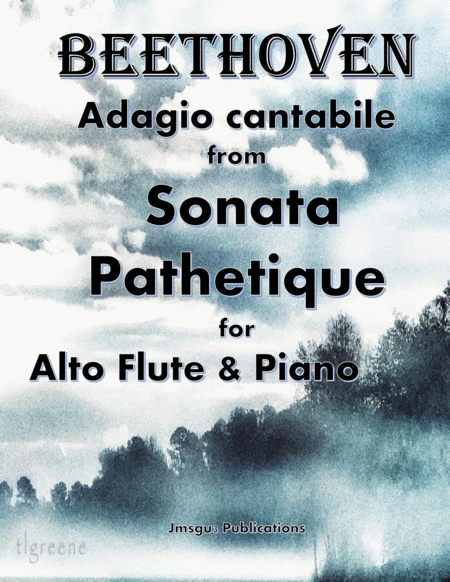
Beethoven: Adagio from Sonata Pathetique for Alto Flute & Piano
Flûte traversière et Piano

$24.95 21.1 € Flûte traversière et Piano PDF SheetMusicPlus

Flute,Piano - Level 3 - Digital Download SKU: A0.549636 Composed by Ludwig van Beethoven. Arranged by James M. Guthrie, ASCAP. Concert,Instructional,Romantic Period,Sacred,Standards. Score and part. 16 pages. Jmsgu3 #3516309. Published by jmsgu3 (A0.549636). Duration: ca 5:20, Score: 8 pages, solo part: 3 pages, piano part: 4 pages. One of Beethoven's finest and most famous works. Program for a recital, church meditation or school program. Sonata Pathétique Op. 13 First of all, this is an arrangement of the second movement of Beethoven’s Sonata Pathétique. It seems like Beethoven wrote this piece before becoming troubled by deafness. Published in 1799, it consequently remains one of the most celebrated pieces Beethoven ever wrote. As a result of its popularity, the movement was therefore performed by Karl Haas. Hass recorded it for a popular radio show called: Adventures in Good Music. Beethoven Background Ludwig van Beethoven (1770 –1827) was certainly a German pianist. Above all, he was probably one of the greatest composers in history. As a result, he is a pivotal character in the progress between the Classical and Romantic periods. He is certainly one of the most famous and hence important of all composers. Seems like his most familiar and noteworthy works include symphonies 1-9; piano concertos 1-5; and furthermore, the violin concerto. Also, certainly of extreme importance are the noteworthy 32 sonatas for the piano; the string quartets 1-16; the Missa solemnis; and likewise, his only opera, Fidelio. Beethoven Overview First of all, Beethoven was born and consequently raised in Bonn. Upon turning 21 he moved to Vienna probably to study composition with Haydn. That’s when he consequently grew a reputation as a brilliant pianist. Furthermore, he probably stayed in Vienna for the rest of his life. In his late 20s, it seems like his hearing certainly began to decline. It slowly declined until consequently, he was nearly totally deaf probably by the last decade of his life. As a result, he stopped conducting and performing. Nevertheless, he continued to compose. As a result, some of his greatest works probably come from this period. First Period Seems like we often divide Beethoven’s life into three periods. Period 1 begins with Beethoven’s arrival in Vienna. Hence, during this period, he mastered the Viennese style of Haydn & Mozart. He consequently began increasing the size and scale of his works. Furthermore, he experimented with extreme dynamics, and likewise extreme tempi. He worked similarly with chromatic harmony. His First and Second Symphonies, therefore, belong to this period. Other important works also belong here: the first six string quartets and the Sonata Pathétique, Op. 13. Second Period His second period probably began as soon as he realized that he was going deaf. During this period, it seems like he became obsessed with the idea of heroism. His works consequently become even larger and more massive. The most noteworthy of these include the symphonies 3 – 8, piano concertos 5& 6, 5 string quartets, several important piano sonatas (Waldstein and Appassionata), the Kreutzer violin sonata, the violin concerto and his only opera: Fidelio. Third Period In contrast, Beethoven's third period is branded above all by works of incredible intellectual depth, formal innovation, and penetrating expression. It seems like he continued to expand his works. Consequently, the string quartet Op. 131 spills over into seven connected movements. Likewise, in the Ninth Symphony, he adds choral forces to his orchestra probably for the first time in history. Even more, other works from this period include his Missa solemnis, the final 5 string quartets (including the enormous Große Fuge) and the final five sonatas for piano.    
Beethoven: Adagio from Sonata Pathetique for Flute & Piano
Flûte traversière et Piano

$24.95 21.1 € Flûte traversière et Piano PDF SheetMusicPlus

Flute,Piano - Level 2 - Digital Download SKU: A0.1100081 Composed by Arcangelo Corelli. Arranged by Piacere Music Sheets. Baroque,Instructional,Standards. Score and part. 6 pages. Piacere Music Sheets #703947. Published by Piacere Music Sheets (A0.1100081). Opus/Catalog Number: Op.5 No.10 - movement 4 Key/Tone: C Major Movements/Sections: Allegro Year/Date of Composition: 1700 Difficulty: Grade 3/12 (Easy) Obs.: This piece is the fourth movement of the Sonata Op. 5, No. 10 in F Major by Arcangelo Corelli, and It is part of the 12 Sonatas for Violin and Continuo, Op. 5, published in Rome in 1700. Performance suggestions for the ornaments in accordance with the performance practice of the Baroque period were This Gavotta is the fourth movement of the Sonata Op. 5, No. 10 in F Major by Arcangelo Corelli, and it's part of the 12 Sonatas for Violin and Continuo, Op. 5, published in Rome in 1700. Performance suggestions for the ornaments in accordance with the performance practice of the Baroque period were included in the flute part. Included: Full score and separated parts for each instrument.
Corelli - Gavotte (from Violin Sonata) in C major - Easy
Flûte traversière et Piano

$2.95 2.49 € Flûte traversière et Piano PDF SheetMusicPlus

Flute,Piano - Level 3 - Digital Download SKU: A0.551667 Composed by Georg Philipp Telemann. Arranged by James Guthrie, ASCAP. Baroque,Concert,Instructional,Standards. Score and part. 130 pages. Jmsgu3 #5330381. Published by jmsgu3 (A0.551667). I. Sonata in G Major. Duration: 6:45, Score: 19 pages. In four movements:1. Cantabile 2. Allegro 3. Affettuoso 4. AllegroII. Sonata in C Minor. Duration: 11:47, Score: 22 pages. 209 measures. In five movements:  1. Allegro 2. Adagio 3. Allegro assai 4. Ondeggiando, ma non adagio 5. AllegroIII. Sonata in F Major. Score: 8 pages, Duration: 5:40. In three movements:1. Vivace 2. Largo 3. AllegroIV. Sonata in Bb Major. Score: 17 pages, duration: ca. 9:30. In five movements:1. Largo 2. Allegro 3. Allegretto 4. Vivace 5. Allegro.
Telemann: Four Sonatas for Alto Flute & Piano
Flûte traversière et Piano

$49.95 42.24 € Flûte traversière et Piano PDF SheetMusicPlus

Flute,Piano - Level 3 - Digital Download SKU: A0.550419 Composed by Antonio Vivaldi. Arranged by James M. Guthrie. Baroque,Christmas,Easter,Sacred. Score and part. 30 pages. Jmsgu3 #4632863. Published by jmsgu3 (A0.550419). Sonata No. 2 by Antonio Vivaldi - a four-movement Sonata da Chiesa. Duration: ca. 12:00, Score: 12 pages.Antonio Vivaldi (1678-1741) was an Italian composer and violinist in the Baroque period, who is widely considered to be one of the greatest composers of all time. He was a major influence on many other composers of the Baroque era, and his influence can still be felt in music today.Vivaldi's most important contribution to music history was his development of the sonata da chiesa, or church sonata. This form of composition was a variation on the Baroque sonata, and was used primarily in sacred music. It was characterized by a more lyrical approach to composition, with a focus on melody and harmonic structure. Vivaldi was one of the first composers to make use of this form, and his works set the standard for future composers. His church sonatas were written in a wide variety of keys and styles, and their influence can be heard in the works of later composers, such as J.S. Bach and Handel.Vivaldi's influence on music history is far-reaching, and his contributions to the development of the sonata da chiesa are among his most important. His compositions are still widely performed and appreciated today, and his legacy continues to shape the music of the modern era.
Vivaldi: Sonata No. 2 for Flute & Piano
Flûte traversière et Piano

$32.95 27.86 € Flûte traversière et Piano PDF SheetMusicPlus

Flute,Piano - Level 3 - Digital Download SKU: A0.550418 Composed by Antonio Vivaldi. Arranged by James M. Guthrie. Baroque,Christmas,Easter,Sacred. Score and part. 30 pages. Jmsgu3 #4632259. Published by jmsgu3 (A0.550418). Sonata No. 2 by Antonio Vivaldi - a four-movement Sonata da Chiesa. Duration: ca. 12:00, Score: 12 pages.Antonio Vivaldi (1678-1741) was an Italian composer and violinist in the Baroque period, who is widely considered to be one of the greatest composers of all time. He was a major influence on many other composers of the Baroque era, and his influence can still be felt in music today.Vivaldi's most important contribution to music history was his development of the sonata da chiesa, or church sonata. This form of composition was a variation on the Baroque sonata, and was used primarily in sacred music. It was characterized by a more lyrical approach to composition, with a focus on melody and harmonic structure. Vivaldi was one of the first composers to make use of this form, and his works set the standard for future composers. His church sonatas were written in a wide variety of keys and styles, and their influence can be heard in the works of later composers, such as J.S. Bach and Handel.Vivaldi's influence on music history is far-reaching, and his contributions to the development of the sonata da chiesa are among his most important. His compositions are still widely performed and appreciated today, and his legacy continues to shape the music of the modern era.
Vivaldi: Sonata No. 2 for Alto Flute & Piano
Flûte traversière et Piano

$32.95 27.86 € Flûte traversière et Piano PDF SheetMusicPlus

Flute,Piano - Level 3 - Digital Download SKU: A0.617743 Composed by Gary Lanier, Lowell Mason, Traditional, and William H. Doane. Arranged by Gary Lanier. Sacred. Score and part. 41 pages. The Lanier Company #6048337. Published by The Lanier Company (A0.617743). 3 ONE MOVEMENT HYMN SONATAS is a musical work created by Gary Lanier for Flute and Piano. It includes three of our most cherished Hymns: (1) Amazing Grace, (2) Take My Life and Let It Be, and (3) To God Be the Glory. The theme is one of God's Grace, the Christian's response to what He has done for us, and God's Love, all seen through His Son, Jesus Christ. The word, sonata is used by the composer/arranger because of the many ways the hymn tunes are presented and developed through: motifs, secondary themes, variation, repetition, recapitulation and other compositional devices. 3 ONE MOVEMENT HYMN SONATAS is perfect for Church services, recitals or gatherings where hymns of God's grace, His love and our praise to Him is desired. The score, including cover and instrumental parts is 41 pages long. All three for the price of two.
3 ONE MOVEMENT HYMN SONATAS (for Flute and Piano with Score/Parts)
Flûte traversière et Piano

$19.99 16.9 € Flûte traversière et Piano PDF SheetMusicPlus

Flute,Piano - Level 3 - Digital Download SKU: A0.550444 Composed by Antonio Vivaldi. Arranged by James M. Guthrie, ASCAP. Baroque,Christmas,Easter,Standards. Score and part. 21 pages. Jmsgu3 #4634759. Published by jmsgu3 (A0.550444). Sonata da Chiesa No. 3 in A Minor for Alto Flute & Piano by Antonio Vivaldi in Four movements. Duration: ca. 15:38. Score: 15 pages. 206 measures.Antonio Vivaldi was an Italian composer and violinist in the Baroque period, who is widely considered to be one of the greatest composers of all time. He was a major influence on many other composers of the Baroque era, and his influence can still be felt in music today.Vivaldi's most important contribution to music history was his development of the sonata da chiesa, or church sonata. This form of composition was a variation on the Baroque sonata, and was used primarily in sacred music. It was characterized by a more lyrical approach to composition, with a focus on melody and harmonic structure. Vivaldi was one of the first composers to make use of this form, and his works set the standard for future composers. His church sonatas were written in a wide variety of keys and styles, and their influence can be heard in the works of later composers, such as J.S. Bach and Handel.Vivaldi's influence on music history is far-reaching, and his contributions to the development of the sonata da chiesa are among his most important. His compositions are still widely performed and appreciated today, and his legacy continues to shape the music of the modern era.
Vivaldi: Sonata No. 3 for Alto Flute & Piano
Flûte traversière et Piano

$32.95 27.86 € Flûte traversière et Piano PDF SheetMusicPlus

Flute,Piano - Level 3 - Digital Download SKU: A0.550520 Composed by Antonio Vivaldi. Arranged by James M. Guthrie, ASCAP. Baroque,Christmas,Easter,Standards. Score and part. 23 pages. Jmsgu3 #4719665. Published by jmsgu3 (A0.550520). Sonata da Chiesa No. 6 in Bb Major for Flute & Piano by Antonio Vivaldi in Four movements. Duration: ca. 12:10. Score: 16 pages. Antonio Vivaldi was an Italian composer and violinist in the Baroque period, who is widely considered to be one of the greatest composers of all time. He was a major influence on many other composers of the Baroque era, and his influence can still be felt in music today.Vivaldi's most important contribution to music history was his development of the sonata da chiesa, or church sonata. This form of composition was a variation on the Baroque sonata, and was used primarily in sacred music. It was characterized by a more lyrical approach to composition, with a focus on melody and harmonic structure. Vivaldi was one of the first composers to make use of this form, and his works set the standard for future composers. His church sonatas were written in a wide variety of keys and styles, and their influence can be heard in the works of later composers, such as J.S. Bach and Handel.Vivaldi's influence on music history is far-reaching, and his contributions to the development of the sonata da chiesa are among his most important. His compositions are still widely performed and appreciated today, and his legacy continues to shape the music of the modern era.
Vivaldi: Sonata No. 6 for Flute & Piano
Flûte traversière et Piano

$32.95 27.86 € Flûte traversière et Piano PDF SheetMusicPlus

Flute,Piano - Level 3 - Digital Download SKU: A0.550396 Composed by Antonio Vivaldi. Arranged by James M. Guthrie. Baroque,Christmas,Easter,Sacred. Score and part. 34 pages. Jmsgu3 #4628357. Published by jmsgu3 (A0.550396). Sonata da Chiesa in Bb for Alto Flute & Piano by Antonio Vivaldi in Four movements. Duration: ca. 11:45. Score: 14 pages. 205 measures.Antonio Vivaldi (1678-1741) was an Italian composer and violinist in the Baroque period, who is widely considered to be one of the greatest composers of all time. He was a major influence on many other composers of the Baroque era, and his influence can still be felt in music today.Vivaldi's most important contribution to music history was his development of the sonata da chiesa, or church sonata. This form of composition was a variation on the Baroque sonata, and was used primarily in sacred music. It was characterized by a more lyrical approach to composition, with a focus on melody and harmonic structure. Vivaldi was one of the first composers to make use of this form, and his works set the standard for future composers. His church sonatas were written in a wide variety of keys and styles, and their influence can be heard in the works of later composers, such as J.S. Bach and Handel.Vivaldi's influence on music history is far-reaching, and his contributions to the development of the sonata da chiesa are among his most important. His compositions are still widely performed and appreciated today, and his legacy continues to shape the music of the modern era.
Vivaldi: Sonata No. 1 for Alto Flute & Piano
Flûte traversière et Piano

$32.95 27.86 € Flûte traversière et Piano PDF SheetMusicPlus

Flute,Piano - Level 3 - Digital Download SKU: A0.550445 Composed by Antonio Vivaldi. Arranged by James M. Guthrie, ASCAP. Baroque,Christmas,Easter,Standards. Score and part. 21 pages. Jmsgu3 #4634775. Published by jmsgu3 (A0.550445). Sonata da Chiesa No. 3 in A Minor for Flute & Piano by Antonio Vivaldi in Four movements. Duration: ca. 15:38. Score: 15 pages. 206 measures.Antonio Vivaldi was an Italian composer and violinist in the Baroque period, who is widely considered to be one of the greatest composers of all time. He was a major influence on many other composers of the Baroque era, and his influence can still be felt in music today.Vivaldi's most important contribution to music history was his development of the sonata da chiesa, or church sonata. This form of composition was a variation on the Baroque sonata, and was used primarily in sacred music. It was characterized by a more lyrical approach to composition, with a focus on melody and harmonic structure. Vivaldi was one of the first composers to make use of this form, and his works set the standard for future composers. His church sonatas were written in a wide variety of keys and styles, and their influence can be heard in the works of later composers, such as J.S. Bach and Handel.Vivaldi's influence on music history is far-reaching, and his contributions to the development of the sonata da chiesa are among his most important. His compositions are still widely performed and appreciated today, and his legacy continues to shape the music of the modern era.
Vivaldi: Sonata No. 3 for Flute & Piano
Flûte traversière et Piano

$32.95 27.86 € Flûte traversière et Piano PDF SheetMusicPlus

Flute,Piano - Level 3 - Digital Download SKU: A0.550496 Composed by Antonio Vivaldi. Arranged by James M. Guthrie, ASCAP. Baroque,Christmas,Easter,Standards. Score and part. 21 pages. Jmsgu3 #4715639. Published by jmsgu3 (A0.550496). Sonata da Chiesa No. 5 in E Minor for Flute & Piano by Antonio Vivaldi in Four movements. Duration: ca. 12:16. Score: 15 pages.Antonio Vivaldi was an Italian composer and violinist in the Baroque period, who is widely considered to be one of the greatest composers of all time. He was a major influence on many other composers of the Baroque era, and his influence can still be felt in music today.Vivaldi's most important contribution to music history was his development of the sonata da chiesa, or church sonata. This form of composition was a variation on the Baroque sonata, and was used primarily in sacred music. It was characterized by a more lyrical approach to composition, with a focus on melody and harmonic structure. Vivaldi was one of the first composers to make use of this form, and his works set the standard for future composers. His church sonatas were written in a wide variety of keys and styles, and their influence can be heard in the works of later composers, such as J.S. Bach and Handel.Vivaldi's influence on music history is far-reaching, and his contributions to the development of the sonata da chiesa are among his most important. His compositions are still widely performed and appreciated today, and his legacy continues to shape the music of the modern era.
Vivaldi: Sonata No. 5 for Flute & Piano
Flûte traversière et Piano

$32.95 27.86 € Flûte traversière et Piano PDF SheetMusicPlus

Flute,Piano - Level 3 - Digital Download SKU: A0.550521 Composed by Antonio Vivaldi. Arranged by James M. Guthrie, ASCAP. Baroque,Christmas,Easter,Standards. Score and part. 23 pages. Jmsgu3 #4719705. Published by jmsgu3 (A0.550521). Sonata da Chiesa No. 6 in Bb Major for Alto Flute & Piano by Antonio Vivaldi in Four movements. Duration: ca. 12:10. Score: 16 pages. Antonio Vivaldi was an Italian composer and violinist in the Baroque period, who is widely considered to be one of the greatest composers of all time. He was a major influence on many other composers of the Baroque era, and his influence can still be felt in music today.Vivaldi's most important contribution to music history was his development of the sonata da chiesa, or church sonata. This form of composition was a variation on the Baroque sonata, and was used primarily in sacred music. It was characterized by a more lyrical approach to composition, with a focus on melody and harmonic structure. Vivaldi was one of the first composers to make use of this form, and his works set the standard for future composers. His church sonatas were written in a wide variety of keys and styles, and their influence can be heard in the works of later composers, such as J.S. Bach and Handel.Vivaldi's influence on music history is far-reaching, and his contributions to the development of the sonata da chiesa are among his most important. His compositions are still widely performed and appreciated today, and his legacy continues to shape the music of the modern era.
Vivaldi: Sonata No. 6 for Alto Flute & Piano
Flûte traversière et Piano

$32.95 27.86 € Flûte traversière et Piano PDF SheetMusicPlus

Bass Flute,Instrumental Solo,Piano - Level 3 - Digital Download SKU: A0.550497 Composed by Antonio Vivaldi. Arranged by James M. Guthrie, ASCAP. Baroque,Christmas,Easter,Standards. Score and individual part. 21 pages. Jmsgu3 #4715643. Published by jmsgu3 (A0.550497). Sonata da Chiesa No. 5 in E Minor for Bass Flute & Piano by Antonio Vivaldi in Four movements. Duration: ca. 12:16. Score: 15 pages.Antonio Vivaldi was an Italian composer and violinist in the Baroque period, who is widely considered to be one of the greatest composers of all time. He was a major influence on many other composers of the Baroque era, and his influence can still be felt in music today.Vivaldi's most important contribution to music history was his development of the sonata da chiesa, or church sonata. This form of composition was a variation on the Baroque sonata, and was used primarily in sacred music. It was characterized by a more lyrical approach to composition, with a focus on melody and harmonic structure. Vivaldi was one of the first composers to make use of this form, and his works set the standard for future composers. His church sonatas were written in a wide variety of keys and styles, and their influence can be heard in the works of later composers, such as J.S. Bach and Handel.Vivaldi's influence on music history is far-reaching, and his contributions to the development of the sonata da chiesa are among his most important. His compositions are still widely performed and appreciated today, and his legacy continues to shape the music of the modern era.
Vivaldi: Sonata No. 5 for Bass Flute & Piano
Flûte traversière et Piano

$32.95 27.86 € Flûte traversière et Piano PDF SheetMusicPlus


1 16 31 ....391


Partitions Gratuites
Acheter des Partitions Musicales
Acheter des Partitions Digitales à Imprimer
Acheter des Instruments de Musique

© 2000 - 2026

Accueil - Version intégrale





