EUROPE
87 articles
USA
0 articles
DIGITAL
6 articles (à imprimer)
Partitions Digitales
Partitions à imprimer
6 partitions trouvées


Flute,Piano - Level 2 - Digital Download SKU: A0.549429 Composed by Antonin Dvorak. Arranged by James M. Guthrie, ASCAP. Instructional,Romantic Period,Sacred,Standards. Score and part. 12 pages. Jmsgu3 #3494181. Published by jmsgu3 (A0.549429). Score: 7 pages, solo part: 2 pages, piano part: 3 pages. Duration: 4:25. Not difficult, but requires sensitivity & dynamic control. Suitable for recitals, church meditations, or school programs. Dvořák Background Antonín Dvořák (1841 –1904) was, of course, a composer from Czechoslovakia. As a matter of fact, he was among the first Bohemian composers to attain universal recognition. It is important to realize that the late Romantic Nationalist period featured composers who used traditional and folk elements to portray the character of their nation. In particular, we see this in the music of Grieg (Norway), Finland (Sibelius), and Smetana (Bohemia).  Dvořák relied markedly on rhythms and other characteristics of Moravian and Bohemian folk music. Ascent to Fame Dvořák was truly a child musical prodigy on the violin. The premiere performances of his compositions notably occurred in 1872 and 1873. He submitted his First Symphony in particular to a German competition, but it failed to win. Consequently, in 1874 he presented two more symphonies to the Austrian State Prize for Composition. Johannes Brahms was the principal of the jury and was accordingly very impressed. They forthwith awarded the prize to Dvořák in 1874, 1876, and 1877. At this point, Brahms thereupon endorsed Dvořák to the publisher Simrock. Later, the publisher commissioned Dvořák to compose the Slavonic Dances, Op. 46. These became popular overnight and, as a result, Dvořák's worldwide status was launched. International Status Dvořák visited England upon invitation nine times. On each visit, he frequently conducted performances of his own compositions. He conducted concerts of his music, especially in Moscow and St. Petersburg. Eventually, the Prague Conservatory in fact appointed Dvořák as a professor. There, to be sure, he wrote his famous Dumky Trio. United States Consequently, the National Conservatory of Music of America appointed him as director in 1892. As a result, Dvořák composed his two most famous symphonic works: the Symphony No. 9 (From the New World), which spread his name universally, and his Concerto for Cello and Orchestra, one of the most famous of all cello works. Moreover, he wrote his most celebrated American String Quartet during this time. At the same time, because of his growing recognition in Europe and his homesickness for his own country, he left to return to Bohemia in 1895.  
DvoÅ™ák: Largo from the New World Symphony for Alto Flute & Piano
Flûte traversière et Piano

$32.95 28.68 € Flûte traversière et Piano PDF SheetMusicPlus

Flute,Piano - Level 2 - Digital Download SKU: A0.549422 Composed by Antonin Dvorak. Arranged by James M. Guthrie, ASCAP. Instructional,Romantic Period,Sacred,Standards. Score and part. 12 pages. Jmsgu3 #3493997. Published by jmsgu3 (A0.549422). Score: 7 pages, solo part: 2 pages, piano part: 3 pages. Duration: 4:25 Not difficult, but requires sensitivity & dynamic control. Suitable for recitals, church meditations, or school programs. Dvořák Background Antonín Dvořák (1841 –1904) was, of course, a composer from Czechoslovakia. As a matter of fact, he was among the first Bohemian composers to attain universal recognition. It is important to realize that the late Romantic Nationalist period featured composers who used traditional and folk elements to portray the character of their nation. In particular, we see this in the music of Grieg (Norway), Finland (Sibelius), and Smetana (Bohemia).  Dvořák relied markedly on rhythms and other characteristics of Moravian and Bohemian folk music. Ascent to Fame Dvořák was truly a child musical prodigy on the violin. The premiere performances of his compositions notably occurred in 1872 and 1873. He submitted his First Symphony in particular to a German competition, but it failed to win. Consequently, in 1874 he presented two more symphonies to the Austrian State Prize for Composition. Johannes Brahms was the principal of the jury and was accordingly very impressed. They forthwith awarded the prize to Dvořák in 1874, 1876, and 1877. At this point, Brahms thereupon endorsed Dvořák to the publisher Simrock. Later, the publisher commissioned Dvořák to compose the Slavonic Dances, Op. 46. These became popular overnight and, as a result, Dvořák's worldwide status was launched. International Status Dvořák visited England upon invitation nine times. On each visit, he frequently conducted performances of his own compositions. He conducted concerts of his music, especially in Moscow and St. Petersburg. Eventually, the Prague Conservatory in fact appointed Dvořák as a professor. There, to be sure, he wrote his famous Dumky Trio. United States Consequently, the National Conservatory of Music of America appointed him as director in 1892. As a result, Dvořák composed his two most famous symphonic works: the Symphony No. 9 (From the New World), which spread his name universally, and his Concerto for Cello and Orchestra, one of the most famous of all cello works. Moreover, he wrote his most celebrated American String Quartet during this time. At the same time, because of his growing recognition in Europe and his homesickness for his own country, he left to return to Bohemia in 1895.
DvoÅ™ák: Largo from the New World Symphony for Flute & Piano
Flûte traversière et Piano

$32.95 28.68 € Flûte traversière et Piano PDF SheetMusicPlus

Flute,Piano - Level 4 - Digital Download SKU: A0.971652 Composed by Jeffrey Hoover. 20th Century,Contemporary. Score and part. 35 pages. Musicart Publications #4797933. Published by Musicart Publications (A0.971652). In three movements, Romantic Sonata - Poems of Light (flute and piano) communicates how light can be a metaphor for the emotional and spiritual aspects of life.  There are also three paintings - also created by the composer - joining hearing with sight as a poetic way of understanding ideas and emotions.Of Light and Shadow possesses a monothematic sonata design (rather than a two-theme structure), with a primary musical theme that is developed, and a brief closing section.  Colors in the Clouds, the second movement of the work, does not differ greatly in tempo from the first movement, but rather is more relaxed in character.  A slower middle section of this movement explores tone color through expressive use of extended techniques for the flute.  Prism of the Heart is variation of the classical chaconne, with an introduction and a closing section.  The conclusion of the first movement is developed and becomes the closing section of the third movement.  This connects the first and third movements, bringing one back to where one started, yet experiencing change after the musical journey. The score and flute part in this edition are arranged to be printed double-sided, with correct page turns, directly from the PDF. Jeffrey Hoover's compositions- music ranging from soloist to symphony orchestra -have received recognition through the prestigious Trieste prize, the international Luigi Russolo competition, awards from Mu Phi Epsilon, the Lancaster Fine Arts Festival, grants, publications fellowships and more than 20 commissions. He is a member of the ACME roster of Mu Phi Epsilon, recognized for distinguished achievement as a composer. One unique aspect of Hoover’s work is when he combines composition with his paintings, creating synergetic art that intrigues and captivate audiences and performers alike. His paintings are seen in exhibitions and in concerts where his paintings are projected while musicians perform his music. Hoover’s background as a performer includes both classical and jazz music, as saxophonist and conductor. His book The Arts and Society: Making New Worlds is published by Kendall Hunt Publishing. Hoover was born on September 11, 1959, in Anderson, Indiana. He holds a Ph.D. in Fine Arts (Composition and Interdisciplinary Fine Arts) from Texas Tech University, as well as  and .Sc. from Ball State University. His career in higher education has included both faculty and arts administration appointments.
Romantic Sonata - Poems of Light
Flûte traversière et Piano

$21.95 19.11 € Flûte traversière et Piano PDF SheetMusicPlus

Flute,Piano - Level 5 - Digital Download SKU: A0.533397 Composed by Therese Brenet. Concert,Contemporary,Standards. Score and part. 30 pages. Musik Fabrik Music Publishing #2894443. Published by Musik Fabrik Music Publishing (A0.533397). A sonata in three movements for flute and piano: I. EphémèreII. La lune s'éteignitIII. Miroirs  The sonata lasts aproximately 13 minutes. Thérèse BRENET, born 22 October 1935 in Paris, France began her musical studies at a very early age, receiving her first prize in Piano from the Conservatoire de Reims.At the Paris Conservatory, her prinicipal teachers were Jean Rivier, Darius Milhaud, Maurice Duruflé, Noël Gallon and Henri Dutilleux and she obtained First Prizes in Harmony, Counterpoint, and Fugue. She finished her studies in 1965, receiving a First Prize in Orchestration, A First Prize with highest honors in Composition and the First Grand Prix de Rome in musical composition.She also won the Halphen Prize for Composition and the Fugue, a grant from the Coplay Foundation of Chigaco and was named honorable member of the National Academy of History of Reims. In 1971, she received the Stéphane Chapelier-Clergue-Gabriel Marie Prize from the SACEM and in 1973, the Silver Medal from the City of Paris.After her stay at the French Academy at the Villa Médicis in Rome, Thérèse Brenet undertook several post-graduate voyages for study, notably to Poland. Upon her return in Paris in 1970, she was immediately named to the Faculty of the Paris Conservatory (CNSMD de Paris) where she also was frequently part of the juries for music theory and composition, as well as electroacoustical music.Thérèse Brenet receiving her definitive SACEM membership from Georges Auric She retired from the Paris Conservatory in 2000 and has since devoted her time to musical composition. She uses both tonal and atonal musical language, which she uses to suit her personal style. Her works are strongly influenced by literature, by painting and by science (especially astronomy). She believes that a composer should use all technical means at his or her disposal and use them rather than be used by them.Her first commission from the French National Radio, Clamavit, for Narrator, Chorus and Orchestra which was premièred by the Orchestre Lyrique de l'O.R.T.F., under the direction of André Girard, with Michel Bouquet as the Narrator, was selected to represent France in the Composer's Forum of 'U.N.E.S.C.O., and was performed in many countries. Many other works have also been performed outside of France in countries such as Switzerland, England, Germany, Belgium, Ireland, the former Yugoslavia, Italy, Portugal, the Netherlands, Libya, Canada, Uruguay, Japan and the United States etc...
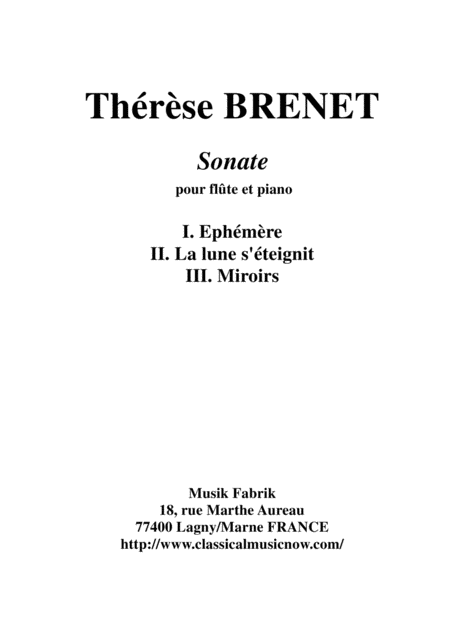
Thérèse Brenet: Sonata for flute and piano
Flûte traversière et Piano

$16.95 14.75 € Flûte traversière et Piano PDF SheetMusicPlus

Flute,Piano - Level 3 - Digital Download SKU: A0.977004 Composed by Keith Moss (b.1982). 20th Century,Concert,Contemporary. Score and part. 9 pages. Keith Moss #3488393. Published by Keith Moss (A0.977004). Commissioned by the SAMRO Endowment for the National Arts, this piece was designed for young flautists looking for new music works for competitions.Tanzanite is a blue/purple gemstone which can only be found in Tanzania, and no where else in the world. When it is found, in its rough state, it is usually a reddish brown colour. It requires an artificial heat of up to 600C to bring out its blue violet colour. It is found mostly in the foothills of Mount Kilimanjaro. Tanzanite was inspired my trips to Tanzania.
Tanzanite - for flute and piano
Flûte traversière et Piano

$9.95 8.66 € Flûte traversière et Piano PDF SheetMusicPlus

Flute,Piano - Level 3 - Digital Download SKU: A0.1507074 Composed by Adolphe-Charles Adam. Arranged by Harry Walker. 19th Century,Chamber,Christmas,Contest,Festival,Holiday. Score and part. 12 pages. SCORE EDITIONS #1082462. Published by SCORE EDITIONS (A0.1507074). Composed by Adolphe Adam in 1847, O Holy Night is one of the most beloved Christmas songs in classical music. The original lyrics, written in French by Placide Cappeau, were commissioned for a Christmas service in a small French town. In 1855, John Sullivan Dwight, an American abolitionist, translated the song into English. Dwight viewed the song’s message as a metaphor for the fight against slavery, which contributed to its popularity in the United States. In this version, the composition was arranged for Flute and Piano by Harry Walker.
O Holy Night (Adolphe Adam) for Flute and Piano
Flûte traversière et Piano

$5.99 5.21 € Flûte traversière et Piano PDF SheetMusicPlus


Partitions Gratuites
Acheter des Partitions Musicales
Acheter des Partitions Digitales à Imprimer
Acheter des Instruments de Musique

© 2000 - 2026

Accueil - Version intégrale





