EUROPE
1184 articles
USA
0 articles
DIGITAL
63 articles (à imprimer)
Partitions Digitales
Partitions à imprimer
63 partitions trouvées

1 16 31 ....61

Flute,Piano - Level 1 - Digital Download SKU: A0.548487 Composed by Gruber. Arranged by James M. Guthrie, ASCAP. Christmas. Score and part. 3 pages. Jmsgu3 #3387051. Published by jmsgu3 (A0.548487). Silent Night arranged for Flute & Piano with new harmony for verse three. Score: 2 pg. Part: 1 pg. Silent Night Origins Father Joseph Mohr wrote the lyrics for a new Christmas Carol. He wanted the new carol for his Christmas Eve Mass. With only a couple of hours until the service, He asked organist and schoolteacher Franz Gruber to write a melody and simple accompaniment to go with the lyrics. The result is probably the most famous of all Christmas carols – Silent Night. First Performance Perhaps because the organ was undergoing repairs, or to make sure the accompaniment was easy enough, Mohr asked Gruber to write it for the guitar. Mohr played the guitar, and both Mohr and Gruber gave the world premiere performance at the Christmas Eve Mass in 1818 at St. Nicholas Church in Oberndorf in Salzburg. Original Score Eventually, the original score became lost, and consequently, Mohr's name was largely forgotten.  Though the public originally recognized Gruber as the composer, many people over time began rumors that a more famous composer was responsible. Thus, they floated the names of Haydn, Mozart, and even Beethoven. Authorities eventually settled the matter when a manuscript in Mohr’s handwriting turned up in 1820. Consequently, we learn that Mohr wrote the lyrics in 1816, and Gruber composed the melody in 1818. Popularity Nonetheless, Silent Night is still very popular. Singers have performed this song in nearly every genre and in multiple languages. Perhaps the most famous version is the one Bing Crosby crafted. This version is the third best-selling physical single recording in the history of recorded music. This particular recording was released in 1935 and sold at least 30 million copies. Only two songs have ever sold more. Elton John released Candle in the Wind in 1997 and sold 33 million copies. The record for most copies ever sold goes to Bing Crosby. He released White Christmas in 1942 and sold 50 million physical copies. Register for free lifetime updates and revisions at www.jamesguthrie.com      
Silent Night for Flute & Piano
Flûte traversière et Piano

$28.95 24.87 € Flûte traversière et Piano PDF SheetMusicPlus

Flute,Piano - Level 3 - Digital Download SKU: A0.547874 By Elton John. By Bernie Taupin and Elton John. Arranged by James M. Guthrie, ASCAP. Pop,Rock. Score and part. 11 pages. Jmsgu3 #3073383. Published by jmsgu3 (A0.547874). ALTO FLUTE & PIANOScore: 6 pages, solo part: 2 pages, piano part: 3 pages. Duration 3' 11 at half note = 60. 51 measures. One of Elton John's greatest songs, this mega-hit is suitable for performance in church, nightclub, or recital hall. This song contains many advanced songwriting techniques and shows a complete mastery of advanced tonal harmony and voice leading. The verses are syllabic and arranged in 8 regular phrases. The last phrase is elided with a contrasting melismatic bridge that suddenly modulates to the lowered mediant, causing a foreign chromatic mediant relation. (F major to Ab major). Further drama is evoked by the voice-leading where an ascending leap of a minor 9th signals the beginning of the bridge. The bridge then modulates back to the original key for the refrain, which, like the verses is arranged in 8 regular phrases and elides once again into a final version of the bridge which functions this time as a coda. 
Goodbye Yellow Brick Road
Flûte traversière et Piano
Elton John
$53.95 46.34 € Flûte traversière et Piano PDF SheetMusicPlus

Piano,Soprano Flute - Digital Download SKU: A0.1433845 By Traditional. By Traditional. Arranged by Joan Bujacich. Celtic,Folk,Irish,Pop,Traditional. Score and part. 10 pages. Joan Bujacich #1014054. Published by Joan Bujacich (A0.1433845). The piano and flute score is 7 pages in length, but Ms. Bujacich extracted the flute alone as well which is only 2 pages. This entire PDF then is 10 pages total with the cover. Clean, professionally notated.This arrangement by Joan Bujacich is in D Dorian mode. The flute plays the melody for the first two verses and then in the third verse it goes up an octave and the piano imitates some of the melodic lines, making for a nice dialogue between the two instruments. This medieval folk song uses  the melody later used by Simon & Garfunkel. It was first sung by Mark Anderson (1874–1953), a retired lead miner from Middleton-in-Teesdale, County Durham, England to Ewan MacColl in 1947.Scarborough Fair, was popularized in the United States by the 1960s singer-songwriting duo Simon & Garfunkel.The  folk song is about a market fair that took place in the town of Scarborough in Yorkshire during medieval times. Like any fair, it attracted traders, entertainers and food vendors, along with other hangers-on. The fair peaked in the late 14th century but continued to operate until the end of the 1700s. Now, several fairs are held in remembrance of the original.Be sure to check out Ms. Bujacich's arrangement page. She has many other great arrangements for Flute and Piano and solo piano.
Scarborough Fair
Flûte traversière et Piano
Traditional
$3.99 3.43 € Flûte traversière et Piano PDF SheetMusicPlus

Flute,Piano - Level 3 - Digital Download SKU: A0.1269847 By Olivia Rodrigo. By Daniel Nigro and Olivia Rodrigo. Arranged by Benzaiten Editions. 21st Century,Contemporary,Pop,Rock,Singer/Songwriter. Score and part. 7 pages. Benzaiten Editions #862323. Published by Benzaiten Editions (A0.1269847). Hey! Are you a flutist who wants to learn how to play Vampire by Olivia Rodrigo? It's your lucky day! 🎵Vampire by Olivia Rodrigo - Intermediate Flute Sheet Music with piano accompaniment The Benzaiten Editions Arrangement Prepare to be entranced by the haunting and emotive ballad, Vampire by Olivia Rodrigo! This poignant song showcases Olivia's incredible songwriting and vocal prowess, making it a powerful and captivating piece for flute. Our flute and piano arrangement of Vampire allows you to embody the raw emotion and vulnerability of Olivia's performance. Through delicate melodies and expressive chords, you'll be able to convey the bittersweet essence of this mesmerizing track. Perfect for intermediate flute players who want to explore Olivia Rodrigo's music or simply appreciate heartfelt compositions, this arrangement strikes a balance between accessibility and musicality. About the song Vampire by Olivia Rodrigo is a soul-stirring ballad that delves into themes of love, heartbreak, and emotional vulnerability. Olivia's evocative lyrics and haunting melody resonate deeply with listeners, capturing the raw essence of human emotions. This flute arrangement allows you to embody the song's bittersweet beauty and express your own feelings through its touching melodies and chords. Whether you're a devoted fan of Olivia Rodrigo or a flute enthusiast seeking emotive compositions, Vampire offers a powerful musical journey that speaks straight to the heart.
Vampire
Flûte traversière et Piano
Olivia Rodrigo
$5.99 5.15 € Flûte traversière et Piano PDF SheetMusicPlus

Flute,Piano - Level 3 - Digital Download SKU: A0.1269851 By Olivia Rodrigo. By Daniel Nigro and Olivia Rodrigo. Arranged by Benzaiten Editions. 21st Century,Contemporary,Pop,Rock,Singer/Songwriter. Score and part. 7 pages. Benzaiten Editions #862327. Published by Benzaiten Editions (A0.1269851). Hey! Are you a flutist who wants to learn how to play Vampire by Olivia Rodrigo? It's your lucky day! 🎵Vampire by Olivia Rodrigo - Intermediate Flute Sheet Music with piano accompaniment and chords The Benzaiten Editions Arrangement Prepare to be entranced by the haunting and emotive ballad, Vampire by Olivia Rodrigo! This poignant song showcases Olivia's incredible songwriting and vocal prowess, making it a powerful and captivating piece for flute. Our flute and piano arrangement of Vampire allows you to embody the raw emotion and vulnerability of Olivia's performance. Through delicate melodies and expressive chords, you'll be able to convey the bittersweet essence of this mesmerizing track. Perfect for intermediate flute players who want to explore Olivia Rodrigo's music or simply appreciate heartfelt compositions, this arrangement strikes a balance between accessibility and musicality. About the song Vampire by Olivia Rodrigo is a soul-stirring ballad that delves into themes of love, heartbreak, and emotional vulnerability. Olivia's evocative lyrics and haunting melody resonate deeply with listeners, capturing the raw essence of human emotions. This flute arrangement allows you to embody the song's bittersweet beauty and express your own feelings through its touching melodies and chords. Whether you're a devoted fan of Olivia Rodrigo or a flute enthusiast seeking emotive compositions, Vampire offers a powerful musical journey that speaks straight to the heart.
Vampire
Flûte traversière et Piano
Olivia Rodrigo
$5.99 5.15 € Flûte traversière et Piano PDF SheetMusicPlus

Flute,Piano - Level 1 - Digital Download SKU: A0.548707 Composed by Martin Luther. Arranged by James M. Guthrie, ASCAP. Easter,Instructional,Standards. Score and part. 4 pages. Jmsgu3 #3411715. Published by jmsgu3 (A0.548707). Out of the Depths I Cry to You by Martin Luther arranged for alto flute & piano. The first verses feature modified counterpoint and harmony proceeding at quarter = 82. The final verse is reharmonized for maximum dramatic effect at a more contemplative tempo such as quarter = 64. Very powerful selection for Lent or Easter. Duration (3 verses) 3:05, 36 ms.Score: 3 pg. Solo part: 1 pg. The piano reads from the score. Out of the Depths Aus tiefer Not schrei ich zu dir (From deep affliction I cry out to you), is, of course, a hymn composed by Martin Luther. Moreover, Luther also wrote the lyrics, essentially a paraphrase of Psalm 130. First published in 1524, it is also one of eight songs in the original Lutheran hymnal. It appears likewise in many hymnals and in different translations. The lyrics furthermore stimulated compositions from the Renaissance to the contemporary. Consequently, composers such as Johann Sebastian Bach built an entire chorale cantata on it. Other composers similarly contributed pieces, such as Felix Mendelssohn and Max Reger. Luther Background Martin Luther, (1483 –1546) was a German professor of theology, composer, priest, and moreover, an influential character in the Protestant Reformation. Luther had a momentous impact on church and society due to his contributions to the musical arts. He wanted to disseminate the gospel among mankind and with this intention thought that the best way to do that was through music. Influence It is important to realize that other musicians, and their descendants, were encouraged by Luther’s songs and wrote their own hymns. Luther, to be sure, had a thorough musical education. For example, he knew secular and sacred songs from an early age. He, in particular, played the lute well and sang in the monastery when he was a monk. That is to say, music was an essential part of his life. He in fact first began writing songs in 1523, sometimes writing the melody as well as the lyrics. Luther was certainly able to evaluate the composers of his time. He thought especially highly of Josquin des and Ludwig Senfl. He was also acquainted, with this in mind, with other composers and their works. Legacy The Lutheran musical ethos soon covered all of Germany and later significantly fashioned Protestant musical culture. Heinrich Schütz and Johann Sebastian Bach are the most compelling evidence of this Protestant musical culture. Additionally, as a point often overlooked, the pedal organ, first refined in northern Germany, became universally prevalent. As a matter of fact, Dieterich Buxtehude established a regular evening organ concert series in Lübeck. Another key point is that this concert series, in turn, spread North German Musical ideas worldwide. Luther was especially convinced that music is a beautiful and exclusive offering of the divine.
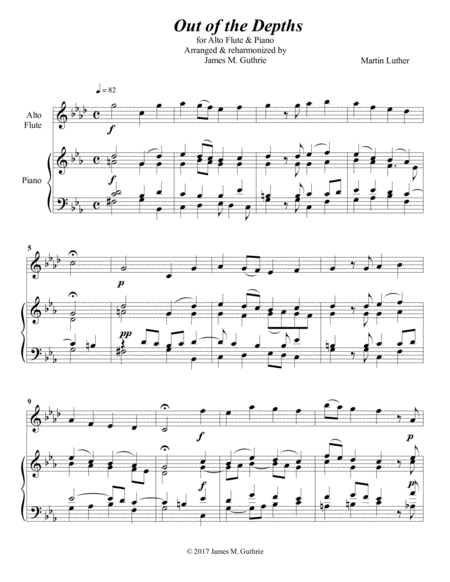
Luther: Out of the Depths for Alto Flute & Piano
Flûte traversière et Piano

$24.95 21.43 € Flûte traversière et Piano PDF SheetMusicPlus

Chamber Orchestra - Level 4 - Digital Download SKU: A0.772375 Composed by Gabriel Faure. Arranged by Amir Awad. Concert,Romantic Period,Standards. Score and parts. 49 pages. Amir Awad #3506351. Published by Amir Awad (A0.772375). This piece is originally composed by Gabriel Fauré for Flute and piano , and it is arranged for Flute and String OrchestraThis elegant solo has some beautiful melodic lines and is Impressionistic in form and harmony. An excellent teaching piece to emphasize phrasing and musicality, or a great programming choice when a lovely lyrical moment is needed!This famous work is dedicated to Paul Taffanel, often called the father of the modern French school of the flute. He was a busy man, active at the Opéra de Paris, in the Conservatoire concerts, as the leader of the Orchestre de la Société des Instruments à Vent, and, from 1893, as a professor at the Conservatoire. Fauré was appointed professor of composition there in 1896, and it was almost inevitable that Taffanel should ask him, in the spring of 1898, to write a sight-reading piece (the Morceau de lecture) and a concours composition for the July examinations. Fauré decided to pass the orchestration of his incidental music for Maeterlinck's play Pelléas et Mélisande, on which he had been feverishly working, to his pupil Charles Koechlin, so he could get to grips with the concours piece. The Fantaisie for flute and piano occupied him from the beginning of June until at least mid-July.The piece opens with an E-minor sicilienne of great charm, but soon gets to a C-major Allegro filled with lightning-fast pyrotechnics. Writing to Koechlin, Fauré complained:I am drowned in the Taffanel and plunged up to my neck in scales, arpeggios, and staccati! I have already perpetrated 104 bars of this irksome torture The first performance of the Fantaisie was given by the concours winner, Gaston Blanquart, on July 28, 1898.
Gabriel Fauré : Fantaisie for Flute and Piano op. 79 , Arranged for Flute and string Orchestra
Flûte traversière et Piano

$5.00 4.29 € Flûte traversière et Piano PDF SheetMusicPlus

Flute,Piano - Digital Download SKU: A0.1071461 Composed by Richard Roderick Jones. Contemporary. Accompaniment. Duration 626. Jacominus Publishing #3603485. Published by Jacominus Publishing (A0.1071461). Alicia Dine (flute) with Richard Roderick Jones (piano)Persephone Dances is a lyrical, free-flowing single movement piece for flute and piano lasting 10 minutes 24 seconds. There are five main sections. Persephone was the ancient Greek goddess of Spring who spent six months with Hades under the earth and the other six upon the earth. The sections describe these periods. The first pits the piano with its explosions against the flutes melodic line - the piano's sustaining pedal held down above which the flute meditates and cascades. The second is more gentle.with the flute and piano intertwined. There are elements of freedom for the players in the third section.The fourth section is like the first with the piano reprise of the gentle flute and piano writing of the second section and the peace ends peacefully.  www.richardroderickjones.com
Persephone Dances for Flute and Piano
Flûte traversière et Piano

$4.00 3.44 € Flûte traversière et Piano PDF SheetMusicPlus

Flute,Piano - Level 3 - Digital Download SKU: A0.549686 Composed by Peter Ilyich Tchaikovsky. Arranged by James M. Guthrie, ASCAP. Children,Christmas,Romantic Period,Standards. Score and part. 14 pages. Jmsgu3 #3520291. Published by jmsgu3 (A0.549686). Duration: ca. 1:42, 52 measures, Score: 7 pages, solo part: 2 pages, piano part: 4 pages. A popular Christmas favorite from Tchaikovsky's Nutcracker Suite. Pyotr Ilyich Tchaikovsky Tchaikovsky is probably the most popular of the great composers in America. His music certainly appeals to musicians. Likewise, it appeals even to folks who don’t normally listen to serious music. This is probably because of his most noteworthy melodies. Above all, he writes with great emotion. This certainly makes a most noteworthy if not an unforgettable impact. Education First of all, He attended classes at the Russian Musical Society. Even more, He also attended the St. Petersburg Conservatory. There he studied music theory with Nikolai Zaremba. He also consequently studied composition with Anton Rubenstein. It seems like Rubenstein came under criticism from a group of Russian composers known as the Five. The Five The Five certainly rejected Western musical influences. They rather sought to use elements from Russian music. They furthermore wanted to use more exotic musical materials. Western Techniques More than other Russian composers, Tchaikovsky studied modern Western music. He certainly develops his music like the European masters. So, rather than repeating a motive, he moves to a new key. He then introduces a different theme in the new key. Hence, he maintained his independence from the Five. Even more, he became the first Russian composer of international stature. Influences Tchaikovsky was probably influenced in his ballet scoring by Léo Delibes. Richard Wagner influenced his symphonic writing. Tchaikovsky’s most famous works include the 1812 Overture, The Nutcracker Suite, and Swan Lake. Also famous are the Violin Concerto in D and the six symphonies. The greatest of the six symphonies may be No. 6, the Pathétique. Nutcracker Suite, Op. 71a The Nutcracker Suite is a ballet that was performed for the first time in December 1892 in St. Petersburg. To begin with, the original ballet failed to attract a positive reception. However, the ballet suite became probably one of the most popular of all of Tchaikovsky’s works. The ballet suite became even more famous in the 1960s. It is now performed all over the world, particularly during the Christmas season.
Tchaikovsky: Dance of the Sugar-Plum Fairy from Nutcracker Suite for Alto Flute & Piano
Flûte traversière et Piano

$32.95 28.3 € Flûte traversière et Piano PDF SheetMusicPlus

Flute,Piano - Level 4 - Digital Download SKU: A0.1366608 Composed by Clémence de Grandval. Arranged by Paul Wehage (édition). Classical,Romantic Period. Score and part. 79 pages. Musik Fabrik Music Publishing #950947. Published by Musik Fabrik Music Publishing (A0.1366608). Maria-Félicie-Clémence de Grandval (1828–1907) was born on January 28, 1828 at Saint-Rémy-des-Monts, France and died on January 15, 1907 in Paris.After the death of her mother,Louise Adèle du Temple de Mésières, her father the Baron de Reiset, a military officer remarriedwith an Englishwoman and moved his family to London. After beginning her musical studiesprivately, she studied the piano with the German composer Friedrich von Flotow, who was a family friend. Returning to France, she studied the piano briefly with Chopin and composition with Camille Saint-Saëns. At first writing mostly sacred music, most of her public success was due to her comic operas: la Comtesse Eva, la Pénitente, Piccolino and Mazeppa. She also wrote orchestral music, chamber music, and over 60 songs (to poets such as Sully Prudhomme, MichelCarré, Henri Meilhac, Georges Hartmann, Charles Grandmougin and Louis Gallet.) She is chieflyknown today for her music for wind instruments, especially for the oboe.1. Prélude2. Scherzo3. Menuet4. Romance5. Finale.
Clémence de Grandval : Suite for flute and piano
Flûte traversière et Piano

$24.95 21.43 € Flûte traversière et Piano PDF SheetMusicPlus

Piano,Soprano Flute - Level 2 - Digital Download SKU: A0.1378739 Composed by George Frideric Handel. Arranged by Glauco Fernandes. Baroque,Chamber,Classical. Score and part. 3 pages. Glauco Fernandes #963447. Published by Glauco Fernandes (A0.1378739). Discover the charm of Handel's Passacaglia, popularized by Johann Halvorsen, in an easy solo arrangement, perfect for musicians at the easy and intermediate levels. This timeless piece comes to life in a professional edition, ensuring accessibility without compromising the depth and beauty of the original composition.With its simplified and idiomatic writing style, this arrangement offers ease of execution while preserving the essence of Handel's masterpiece. Ideal for beginners looking to explore classical repertoire and intermediate musicians seeking new challenges.Don't miss the chance to enrich your repertoire with this beloved classic. Immerse yourself in the emotion and allure of Handel's Passacaglia, immortalized by Johann Halvorsen, and experience the joy of playing one of today's most cherished pieces for solo performance!For more high-quality sheet music options, consider searching for Glauco Fernandes in the website's search bar. Contact: glaucofernandes.arrangements@gmail.com.
Passacaglia by Handel/Halvorsen - Flute & Piano with Chord Notation
Flûte traversière et Piano

$4.99 4.29 € Flûte traversière et Piano PDF SheetMusicPlus

Flute,Piano - Level 4 - Digital Download SKU: A0.549456 Composed by Sir Arthur Seymour Sullivan. Arranged by James M. Guthrie, ASCAP. Instructional,Romantic Period,Sacred,Standards. Score and part. 15 pages. Jmsgu3 #3497233. Published by jmsgu3 (A0.549456). Score: 10 pages, solo part: 2 pages, piano part: 3 pages. Duration: 4:25. Not difficult, but requires sensitivity & dynamic control. Suitable for recitals, church meditations, or school programs.   School Years First of all, Sullivan attended music school at the Royal Academy of Music. Because Sullivan was so talented, the Academy awarded him the Mendelssohn Scholarship for two years in a row. He, therefore, studied with John Goss, who studied with Thomas Atwood, who in turn studied with Mozart. Sullivan similarly studied the piano at the Academy with Arthur O’Leary. Study Abroad During his first year, he also earned money by singing solos in the Chapel Royal. At the end of his second year, the Academy consequently continued his scholarship and sent him to study at the Leipzig Conservatoire. He certainly studied composition, and likewise counterpoint and piano. Hence, during his final year in Leipzig, Sullivan finally completed his graduation composition project: Incidental Music for Shakespeare’s The Tempest. Association with Gilbert It seems like Sullivan built the bulk of his composing career largely in the 1860s. As a result, he became famous for his incidental music for the Tempest and his Irish Symphony. He, therefore, began collaborating with the poet W. S. Gilbert in the 1870s. Rather than focus on serious opera, Gilbert and Sullivan, in contrast, concentrated on comic opera such as H. M. S. Pinafore, the Pirates of Penzance, and the Mikado. Therefore, certainly as a result of his education and experience, Sullivan composed a total of 24 operas, 11 symphonic works, 10 choral pieces. Even more, he wrote a large number of noteworthy hymns such as Onward Christian Soldiers. The general style of his music is maybe similar to Mendelssohn, Schumann, and perhaps Liszt. It seems like Sullivan was fond of writing distinct melodies for each character in his operettas. His melodies combine together as the characters did. Furthermore, he was a master orchestrator, and therefore played the flute, clarinet, trumpet, and trombone fluently. The Lost Chord Sullivan wrote his most noteworthy song the Lost Chord in 1877. As a result, it was a great success and was certainly performed all over the world by a variety of singers such as Enrico Caruso. Because Sullivan was the most famous composer in England, the Lost Chord became the most famous of all British or American songs of the 1870s and 1890s. Consequently, in 1888 Thomas Edison recorded The Lost Chord for the phonograph. It was one of the first songs ever recorded. Furthermore, Queen Victoria knighted Sullivan in 1883.  
Sullivan: The Lost Chord for Alto Flute & Piano
Flûte traversière et Piano

$26.95 23.15 € Flûte traversière et Piano PDF SheetMusicPlus


1 16 31 ....61


Partitions Gratuites
Acheter des Partitions Musicales
Acheter des Partitions Digitales à Imprimer
Acheter des Instruments de Musique

© 2000 - 2026

Accueil - Version intégrale





