EUROPE
1008 articles
USA
0 articles
DIGITAL
25 articles (à imprimer)
Partitions Digitales
Partitions à imprimer
25 partitions trouvées


Flute,Piano - Level 3 - Digital Download SKU: A0.791241 By Neil Diamond. By Bob Russell and Bobby Scott. Arranged by Kevin P Holdgate. Pop. Score and part. 8 pages. Kevin P Holdgate #5771847. Published by Kevin P Holdgate (A0.791241). KPHMS 'Solo' CollectionHe Ain't Heavy, He's My Brother is a ballad written by Bobby Scott and Bob Russell. Originally recorded by Kelly Gordon in 1969, the song became a worldwide hit for The Hollies later that year and a minor hit for Neil Diamond in 1970. It has been recorded by many artists in subsequent years.Scott and Russell were introduced to each other by Johnny Mercer, at a California nightclub. Although Russell was dying of lymphoma and the pair met only three times, they managed to collaborate on the song.This is an arrangement as a solo with piano accompaniment that I would judge to be around Grade 5/6 standard for most instruments.
He Ain't Heavy, He's My Brother
Flûte traversière et Piano
Neil Diamond
$4.99 4.21 € Flûte traversière et Piano PDF SheetMusicPlus

Flute,Piano - Level 3 - Digital Download SKU: A0.1238729 By Various. By Michael Kamen. Arranged by John Fries. 20th Century,Film/TV,Standards. Score and part. 2 pages. John Fries #834171. Published by John Fries (A0.1238729). Please contact me by email at jfries@ptd.net to make a special request or to find out all that I have to offer and to express your comments or concerns. Thanks, John. Band of Brothers is a 2001 American war drama miniseries based on historian Stephen E. Ambrose's 1993 non-fiction book of the same name. The theme music was composed by the late Michael Kamen, known for his scores for titles such as the Die Hard films, X-Men, Memento as well as several HBO series. He had also collaborated previously with Tom Hanks, who produced the score for Band of Brothers. The bold, evocative soundtrack to the series was very well received, with critics calling it Kamen's best work to date.
Band Of Brothers Suite Two
Flûte traversière et Piano
Various
$4.99 4.21 € Flûte traversière et Piano PDF SheetMusicPlus

Flute and piano - intermediate to advanced - Digital Download SKU: S9.Q25990 Composed by Albert Franz Doppler. This edition: Sheet music. Il Flauto traverso. Das abwechslungsreiche Charakterstück für Flöte und Klavier, mit ihren reizvollen, elegischen wie virtuosen Passagen, ist dank seines gemäßigten Schwierigkeitsgrades schon für ambitionierte Liebhaber eine Repertoire-Bereicherung. Downloadable. Op. 16. Schott Music - Digital #Q25990. Published by Schott Music - Digital (S9.Q25990). This Mazurka de Salon for flute and piano with its delightful elegiac and virtuoso passages is a character piece full of contrasts; moderate in difficulty, it represents a valuable addition to the repertoire for ambitious amateur players.Along with his younger brother Carl (1825–1900), Albert Franz Doppler (1821–1883) was one of the most celebrated flautists of the nineteenth Century. Their virtuoso duo playing was greatly admired and they captivated audiences in the musical capitals of Europe with works they had composed themselves.In 1842 the brothers were founder members of the Vienna Philharmonic orchestra. After spending some time as principal flautist at the Bucharest Opera (1835) and in the orchestra of the Hungarian National Theatre (1841), Franz Doppler decided to return to Vienna, where he worked as principal flautist and conductor at the Court opera and was appointed professor at the Conservatoire in 1865. Awarded the Franz-Joseph medal by the Kaiser in 1881, he died in Baden near Vienna in 1883.
Mazurka de Salon
Flûte traversière et Piano

$9.99 8.42 € Flûte traversière et Piano PDF SheetMusicPlus

Flute,Piano - Level 1 - Digital Download SKU: A0.1470308 Composed by Ludwig van Beethoven. Arranged by Benzaiten Editions. 19th Century,Classical,Instructional,Romantic Period. Score and part. 2 pages. Benzaiten Editions #1047519. Published by Benzaiten Editions (A0.1470308). Hey there, music enthusiast! Ready to experience the uplifting melodies of Ludwig van Beethoven's timeless Ode to Joy? Let's make some music! ?Beethoven • Ode to Joy | flute sheet music w/ piano accompaniment [chords]Ideal for concerts, family gatherings, or simply enjoying the beauty of classical music, this easy arrangement is perfect for beginners. Bring the inspiring spirit of Ode to Joy to your fingertips, spread joy, and elevate your musical repertoire with this timeless piece! Our 'Ode to Joy' arrangement | Benzaiten Editions By purchasing our edition, you'll be able to download:• Full score with all instruments of the arrangement• Flute solo part About 'Ode to Joy' Ode to Joy, composed by Ludwig van Beethoven, is the final movement of his Ninth Symphony, completed in 1824. This piece has become a universal anthem of joy and brotherhood, known for its powerful and uplifting melody.
Beethoven • Ode to Joy | flute sheet music w/ piano accompaniment [chords]
Flûte traversière et Piano
purchasing our edition, you'll be able to download:
• Full score with all instruments of the arrangement
• Flute solo part

About 'Ode to Joy'

Ode to Joy, composed by Ludwig van Beethoven, is the final movement of his Ninth Symphony, completed in 1824
This piece has become a universal anthem of joy and brotherhood, known for its powerful and uplifting melody
$4.99 4.21 € Flûte traversière et Piano PDF SheetMusicPlus

Flute,Piano - Level 1 - Digital Download SKU: A0.1470307 Composed by Ludwig van Beethoven. Arranged by Benzaiten Editions. 19th Century,Classical,Instructional,Romantic Period. Score and part. 2 pages. Benzaiten Editions #1047517. Published by Benzaiten Editions (A0.1470307). Hey there, music enthusiast! Ready to experience the uplifting melodies of Ludwig van Beethoven's timeless Ode to Joy? Let's make some music! ?Beethoven • Ode to Joy | flute sheet music w/ piano accompanimentIdeal for concerts, family gatherings, or simply enjoying the beauty of classical music, this easy arrangement is perfect for beginners. Bring the inspiring spirit of Ode to Joy to your fingertips, spread joy, and elevate your musical repertoire with this timeless piece! Our 'Ode to Joy' arrangement | Benzaiten Editions By purchasing our edition, you'll be able to download:• Full score with all instruments of the arrangement• Flute solo part About 'Ode to Joy' Ode to Joy, composed by Ludwig van Beethoven, is the final movement of his Ninth Symphony, completed in 1824. This piece has become a universal anthem of joy and brotherhood, known for its powerful and uplifting melody.
Beethoven • Ode to Joy | flute sheet music w/ piano accompaniment
Flûte traversière et Piano
purchasing our edition, you'll be able to download:
• Full score with all instruments of the arrangement
• Flute solo part

About 'Ode to Joy'

Ode to Joy, composed by Ludwig van Beethoven, is the final movement of his Ninth Symphony, completed in 1824
This piece has become a universal anthem of joy and brotherhood, known for its powerful and uplifting melody
$4.99 4.21 € Flûte traversière et Piano PDF SheetMusicPlus

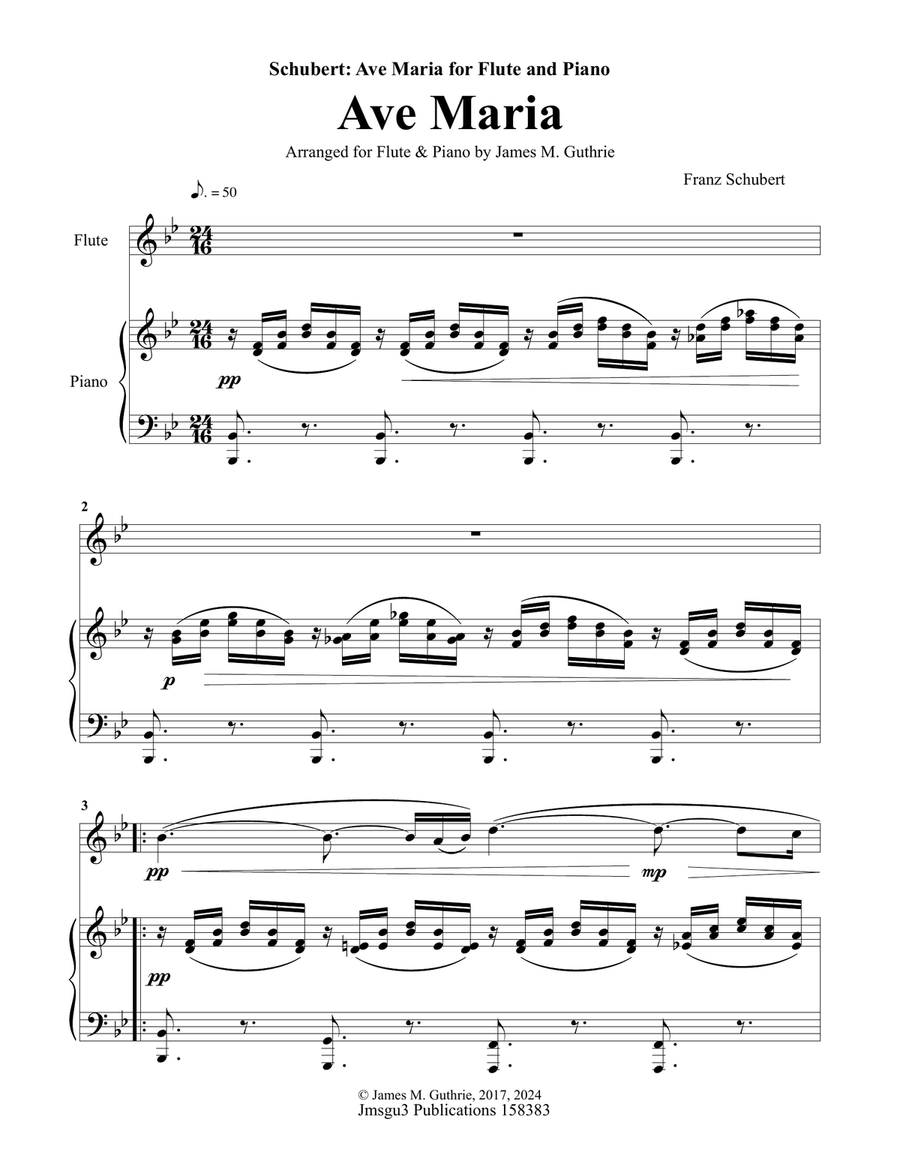
Flute,Piano - Level 1 - Digital Download SKU: A0.548696 Composed by Franz Schubert. Arranged by James M. Guthrie, ASCAP. Christmas,Easter,Standards. Score and part. 4 pages. Jmsgu3 #3411141. Published by jmsgu3 (A0.548696). A Flute Christmas/Easter classic! Duration: 4:55 Score: 3 pg. Flute part: 1 pg. Piano reads from the score. Schubert seems to have composed this piece as a song-setting. This is because he wanted to portray a poignant emotional event from a poem. The poem was Walter Scott's The Lady of the Lake. Consequently, this song became an integral part of Schubert's Song cycle. Therefore the cycle is called: the Lady of the Lake. In the poem, Ellen Douglas is the Lady of the Lake. The lake is probably Loch Katrine in the Scottish Highlands. First of all, Ellen goes with her father to stay in the Goblin's cave. They go because he earlier refused to join in a rebellion against King James. Roderick Dhu, the chief of the rebellious Alpine Clan, marches up the mountain with his army. But before the battle, he, first of all, hears Ellen singing. She is singing a prayer calling for help from the Virgin Mary. Schubert's piece was first performed at the castle of Countess Sophie Weissenwolff in Steyregg, Austria.  Schubert dedicated the arrangement to her, and as a result, she became famous as the lady of the lake.The incipit of Ellen's song is Ave Maria which is Latin for Hail Mary. It seems like this similarity led Schubert to adapt the melody to accommodate the Roman Catholic prayer Ave Maria. Consequently, the Latin version of Ave Maria finally became more famous than the original so that consequently many believe he wrote the Latin version first. Schubert Franz Schubert (1797–1828) was, in fact, a famous Austrian composer. Moreover, he composed during the late Classical and early Romantic periods. Schubert was comparatively prolific. He wrote more than 600 secular vocal works, seven symphonies, and, correspondingly, a massive amount of piano and chamber music. Critics agree, as a matter of fact, that his most famous works include his Piano Quintet in A major, D. 667 (also known as the Trout Quintet), the Symphony No. 8 in B minor, D. 759 (Unfinished Symphony), the last sonatas for piano (D. 958–960), and the song cycles Die schöne Müllerin (D. 795) and Winterreise (D. 911). Education Schubert was furthermore a musical child prodigy. He studied violin with his father as well as piano with his older brother. In addition, when Schubert was eleven he studied at Stadtkonvikt school, where he became familiar with the orchestral music of Haydn, Mozart, and likewise Beethoven. In due time he left school and returned home where he studied to become an educator; nevertheless, he continued studying composition with Antonio Salieri. Performance Eventually, Schubert was admitted to the Gesellschaft der Musikfreunde as a performer. This appointment straightaway established his name in Vienna as a composer and pianist. Finally, he gave his only composition recital in 1828. He died suddenly a few months later probably due to typhoid fever. Legacy Schubert’s music was by and large underappreciated while he was alive. There were all in all only a few enthusiasts in Vienna. After he died, however, interest in his work in fact increased. Felix Mendelssohn, Robert Schumann, Franz Liszt, Johannes Brahms, and other famous composers in due time discovered his compositions. Nowadays, historians rank Schubert expressly among the greatest composers of the era, and his music remains in general very popular.  
Schubert: Ave Maria for Flute & Piano
Flûte traversière et Piano

$29.95 25.25 € Flûte traversière et Piano PDF SheetMusicPlus

Flute,Piano - Level 1 - Digital Download SKU: A0.548688 Composed by Franz Schubert. Arranged by James M. Guthrie, ASCAP. Christmas,Easter,Standards. Score and part. 4 pages. Jmsgu3 #3411123. Published by jmsgu3 (A0.548688). An Alto Flute Christmas/Easter classic! Duration: 4:55 Score: 3 pg. Alto Flute part: 1 pg. Piano reads from the score. Schubert seems to have composed this piece as a song-setting. This is because he wanted to portray a poignant emotional event from a poem. The poem was Walter Scott's The Lady of the Lake. Consequently, this song became an integral part of Schubert's Song cycle. Therefore the cycle is called: the Lady of the Lake. In the poem, Ellen Douglas is the Lady of the Lake. The lake is probably Loch Katrine in the Scottish Highlands. First of all, Ellen goes with her father to stay in the Goblin's cave. They go because he earlier refused to join in a rebellion against King James. Roderick Dhu, the chief of the rebellious Alpine Clan, marches up the mountain with his army. But before the battle, he, first of all, hears Ellen singing. She is singing a prayer calling for help from the Virgin Mary. Schubert's piece was first performed at the castle of Countess Sophie Weissenwolff in Steyregg, Austria.  Schubert dedicated the arrangement to her, and as a result, she became famous as the lady of the lake.The incipit of Ellen's song is Ave Maria which is Latin for Hail Mary. It seems like this similarity led Schubert to adapt the melody to accommodate the Roman Catholic prayer Ave Maria. Consequently, the Latin version of Ave Maria finally became more famous than the original so that consequently many believe he wrote the Latin version first. Schubert Franz Schubert (1797–1828) was, in fact, a famous Austrian composer. Moreover, he composed during the late Classical and early Romantic periods. Schubert was comparatively prolific. He wrote more than 600 secular vocal works, seven symphonies, and, correspondingly, a massive amount of piano and chamber music. Critics agree, as a matter of fact, that his most famous works include his Piano Quintet in A major, D. 667 (also known as the Trout Quintet), the Symphony No. 8 in B minor, D. 759 (Unfinished Symphony), the last sonatas for piano (D. 958–960), and the song cycles Die schöne Müllerin (D. 795) and Winterreise (D. 911). Education Schubert was furthermore a musical child prodigy. He studied violin with his father as well as piano with his older brother. In addition, when Schubert was eleven he studied at Stadtkonvikt school, where he became familiar with the orchestral music of Haydn, Mozart, and likewise Beethoven. In due time he left school and returned home where he studied to become an educator; nevertheless, he continued studying composition with Antonio Salieri. Performance Eventually, Schubert was admitted to the Gesellschaft der Musikfreunde as a performer. This appointment straightaway established his name in Vienna as a composer and pianist. Finally, he gave his only composition recital in 1828. He died suddenly a few months later probably due to typhoid fever. Legacy Schubert’s music was by and large underappreciated while he was alive. There were all in all only a few enthusiasts in Vienna. After he died, however, interest in his work in fact increased. Felix Mendelssohn, Robert Schumann, Franz Liszt, Johannes Brahms and other famous composers in due time discovered his compositions. Nowadays, historians rank Schubert expressly among the greatest composers of the era, and his music remains in general very popular.
Schubert: Ave Maria for Alto Flute & Piano
Flûte traversière et Piano

$29.95 25.25 € Flûte traversière et Piano PDF SheetMusicPlus

Flute,Piano - Level 4 - Digital Download SKU: A0.1426085 Composed by Duncan Druce, Edward Cowie, Michael Ball, Nicholas Marshall, and Peter Racine Fricker. Arranged by John Turner. 20th Century,Classical,Contemporary. Score and part. 44 pages. Forsyth Brothers Ltd #1006899. Published by Forsyth Brothers Ltd (A0.1426085). Forsyth's Modern Wind Music series contains exciting and challenging, but not unduly difficult, works by talented English composers of current or recent vintage for recital, study or recreation. Each volume includes three works with piano, one unaccompanied piece, and one piece for two or more players of the instrument. This volume for flute has a natural history slant. Lacerta Agilis by Duncan Druce is a portrait of a sand lizard, Michael Ball's piece takes as its cue the Greek legend of Philomel who was turned into a nightingale to escape the Wrath of Tereus, whilst Edward Cowie's A Lesson For Reed Warblers (for two flutes) is designed for one bird (or flute) to teach the other to sing. The magical solo work in the album is Two Spells by Peter Recine Fricker, and the remaining piece is Nicholas Marshall's rhythmic and jazz-influenced Jump.Contents:Jump by Nicholas MarshallLacerta Agilis by Duncan DrucePhilomel by Michael BallTwo Spells by Peter Racine FrickerA Lesson For Reed Warblers by Edward Cowie (Flute Duet).
Modern Wind Music - Flute
Flûte traversière et Piano

$13.99 11.79 € Flûte traversière et Piano PDF SheetMusicPlus

Flute,Piano - Level 2 - Digital Download SKU: A0.1434991 Composed by Dorothy Pilling. 20th Century,Classical,Contest,Festival. Score and part. 22 pages. Forsyth Brothers Ltd #1015095. Published by Forsyth Brothers Ltd (A0.1434991). These short but perfectly formed pieces are intended for flautists of about a year's standing. It is hoped that this small album will also help to foster in young players a taste for ensemble playing: the two simple trios also include oboe and clarinet, but if these instruments are not available the parts may be played on a violin. Buffoon The Cuckoo Ländler Jig Bercuse (Trio for Flute, Oboe and Piano) Sarabande (Trio for Flute, Clarinet and Piano) Pilling was a much loved figure in the Mancunian musical world, known to generations of young pianists for her imaginative piano teaching pieces. Most famous for classic 'Harmonization of Melodies at the Keyboard' series, Dorothy Pilling also composed many piano duets and solos, as well as songs and other works. According to the Voxturturis blog:'Her music remains fresh and light; characterised by strong melodies and late romantic harmony which she improvised well and the pieces are, in the main, short.  Instantly appealing to players and audiences alike, most of her work shows a high degree of compositional craft'.
Four Simple Pieces for Flute
Flûte traversière et Piano

$9.99 8.42 € Flûte traversière et Piano PDF SheetMusicPlus

Flute,Piano - Digital Download SKU: A0.1035219 Composed by Piotr Tchaikovski. Arranged by James Strauss. Halloween,Hanukkah,Romantic Period,World. Score and part. 16 pages. James Strauss #5297983. Published by James Strauss (A0.1035219). Writing to his brother Modest on 18/30 January 1877, Tchaikovsky mentioned that the violinist Iosif Kotek had ordered a piece from him for a forthcoming concert. Four days later Kotek wrote to Tchaikovsky: Thank you in advance for the waltz; it will surely be wonderful, as is everything that you compose... this shall be a piece to impress everybody. In another letter from mid/late February, we read: Incidentally, about the waltz. Why force yourself if you are tired? Of course, I would be delighted and infinitely glad if you were to write the waltz, especially since it is for me. I am still very glad that you have even started to think about this.In the period from March to August, we find no further references to work on the Valse. But, given that in March and April, Tchaikovsky wrote his Fourth Symphony, and that in May he was completely absorbed in composing the opera Yevgeny Onegin, it is likely that by this time the Valse had already been completed.It seems that the waltz was partly or wholly orchestrated by Kotek after Tchaikovsky completed the version for violin with piano. This is suggested by two letters from Kotek to Tchaikovsky: in October 1878, the violinist reported to Tchaikovsky on an unsuccessful performance of the piece: Could my instrumentation be the reason that the waltz did not please?, and early in 1879 he wrote: I think that I badly orchestrated the Waltz ... what extraordinarily empty sounds!. None of Tchaikovsky's letters refer to the orchestration of the piece.Here for the very first time in aversion for flute and piano - I tried to not transcribe the violin part, but re-write the solo part as it was made for flute. 
Valse - Scherzo op.34 for flute and piano
Flûte traversière et Piano

$11.99 10.11 € Flûte traversière et Piano PDF SheetMusicPlus

Flute,Piano - Level 2 - Digital Download SKU: A0.1191049 Composed by Allesandro Marcello. Arranged by Diego Marani. Baroque,Classical,Instructional,Standards,Wedding. Score and part. 4 pages. Diego Marani #790567. Published by Diego Marani (A0.1191049). The Oboe Concerto in D minor, S D935, is an early 18th-century concerto for oboe, strings and continuo attributed to the Venetian composer Alessandro Marcello. The earliest extant manuscript containing Johann Sebastian Bach's solo keyboard arrangement of the concerto, BWV 974, dates from around 1715.Bach's keyboard version was published as an arrangement of a concerto by Antonio Vivaldi in the 19th century. In 1923 the C minor version of the oboe concerto was published as a composition by Benedetto Marcello, Alessandro's brother. In the second half of the 20th century several publications indicated Alessandro again as the composer of the piece, as it had been in its early 18th-century print, and the oboe concerto was again published in its D minor version.This arrangement easy for flute with piano accompaniment of the marvelous second movement (adagio) of the concerto is suitable for any occasion.
Marcello's Adagio for Flute and Piano
Flûte traversière et Piano

$7.99 6.74 € Flûte traversière et Piano PDF SheetMusicPlus


Partitions Gratuites
Acheter des Partitions Musicales
Acheter des Partitions Digitales à Imprimer
Acheter des Instruments de Musique

© 2000 - 2026

Accueil - Version intégrale